




Abstract
Introduction
Effective communication and messaging strategies are crucial to raise awareness and support participants' efforts to adhere to lung cancer screening (LCS) guidelines. Health messages that incorporate images are processed more efficiently, and given the stigma surrounding lung cancer and cigarette smoking, emphasis must be placed on selecting imagery that is engaging to LCS-eligible individuals. This exploratory study aimed to identify person-centered themes surrounding LCS imagery.
Materials and Methods
This qualitative study leveraged a modified photovoice approach and interviews to define descriptive themes about LCS imagery. Study participants eligible for annual LCS who had a CT scan within 12 months were asked to select three images and participate in a semi-structured interview about photo selection, likes, and dislikes. Participants were also asked their opinions about images from current LCS communications featuring matches, smoke, and cigarettes. Data were analyzed using an inductive thematic approach.
Results
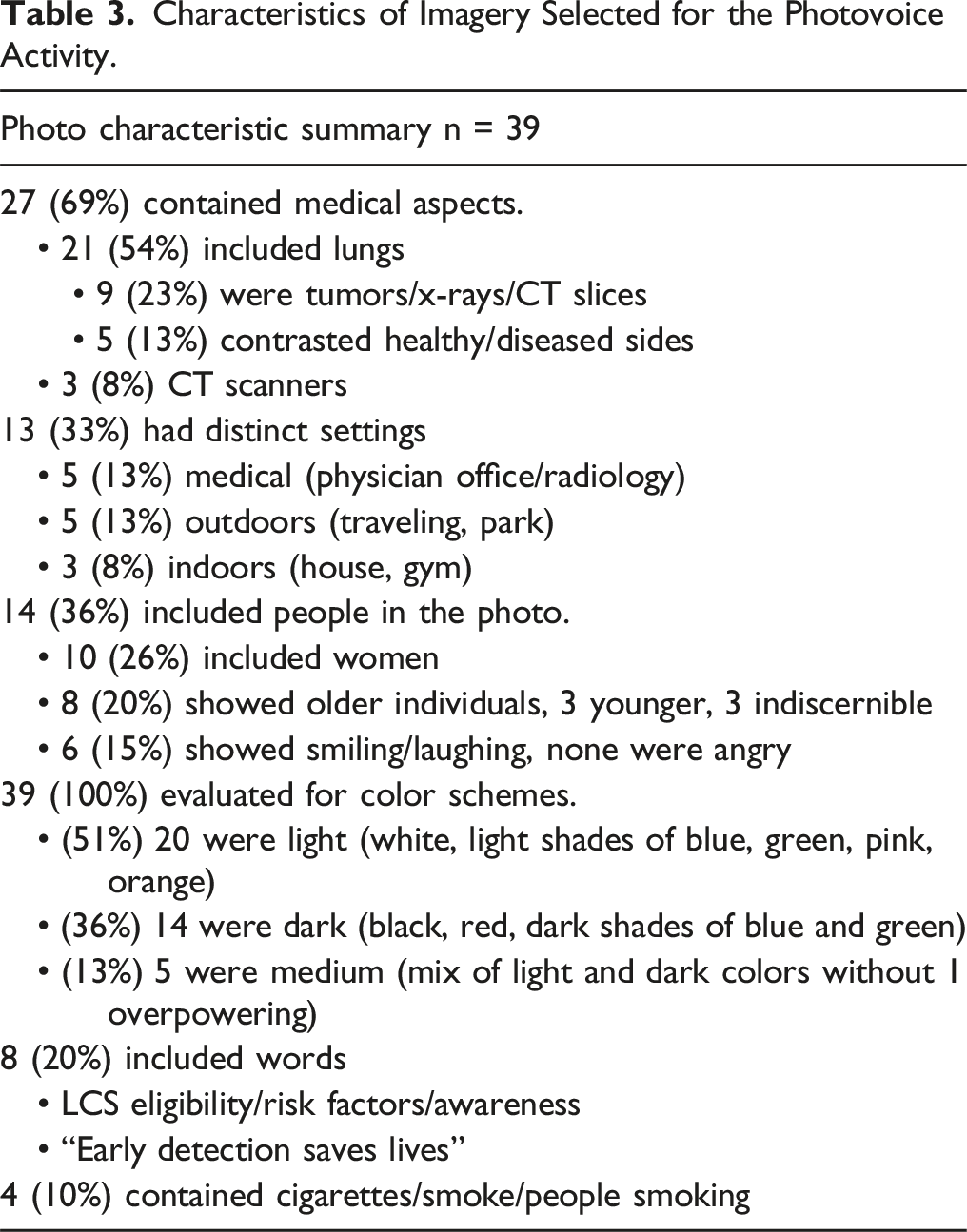
Data saturation was reached after thirteen individuals completed the photovoice activity; each participant selected three pictures resulting in a total of 39 images representing LCS. Over half (54%) of images selected contained lungs and only 4 (10%) contained smoking-related elements. Five main themes emerged: 1) images should focus on good news and early detection; 2) people should be relatable; 3) pictures with lungs can dually support lung health or invoke fear; 4) opportunity for education or awareness; and 5) should not be judgmental and induce stigma.
Conclusions
These findings suggest that LCS imagery should not contain negative or stigmatizing elements but instead be relatable and educational. This information can inform communication and messaging interventions and strategies for future LCS participation, awareness, and educational research.
Introduction
Lung cancer has been the leading cause of cancer death for over 60 years in men and 30 years for women.
1
Historically, lung cancer has been primarily diagnosed in late stages due to lack of symptoms prior to metastatic spread of disease.
2
Lung cancer screening (LCS) with low-dose computed tomography (LDCT) has emerged as an effective method to diagnose early-stage lung cancer when eligible individuals adhere to annual screening.3,4 Two randomized controlled trials provided evidence that LCS reduces lung cancer mortality by approximately 20% when completed annually.3,4 Both trials reported
Unfortunately, participation in LCS outside of clinical trials has been limited in the United States, with only 5.8% of eligible individuals being screened, 6 and adherence to annual screening guidelines reported to be as low as 22%. 7 Despite this limited use and participation, LCS has already contributed to a shift toward early-stage diagnosis. In 2013, the first year the US Preventive Services Task Force (USPSTF) recommended LCS, 8 lung cancer accounted for 27.5% of cancer deaths and had a 5-survival of 16% with only 15% of cases diagnosed as early stage. 9 Ten years later, the percentage of cancer deaths attributable to lung cancer decreased to 20.8%, with an increased 5-year survival of 25.4%, and 21% of cases diagnosed at a localized, early stage. 10
There is a crucial need to increase participation to maximize the unfulfilled individual and population benefits of LCS. Effective communication and messaging strategies are crucial to raise awareness and support participants' efforts to adhere to LCS guidelines. Research has pinpointed several factors related to low participation that can serve as starting points for targeted or tailored messaging content, including logistical barriers (e.g., transportation, taking time off from work, cost); psychosocial factors (e.g., high levels of stigma, fatalism, medical system distrust, low-risk perception); and sociodemographic factors with lower levels of participation among minority populations and individuals that currently smoke.11-14
Health messages that incorporate images are processed more efficiently than messages with text alone and are especially important for individuals with low health literacy and/or numeracy to help explain and retain complicated medical information.15-17 Given the pervasive public stigma surrounding lung cancer and cigarette smoking that is exacerbated by public health communications and ad campaigns, 18 emphasis must be placed on selecting imagery that is engaging to individuals who are eligible for LCS but does not evoke stigma or fear. Recently, the American Cancer Society National Lung Cancer Roundtable published the Lung Cancer Stigma Communications Assessment Tool (LCS-CAT) focused on identifying and providing alternatives for stigmatizing, judgmental, and discriminating language, imagery, and context in lung cancer communications.19,20 Specific to imagery, the LCS-CAT provides guidance that images with dark color schemes, show people as isolated or alone, negative facial expressions, and images with smoking or cigarettes contain stigmatizing qualities.19,20 Similarly, prior qualitative research has reported that individuals at high risk for lung cancer find images of cigarettes ineffective for awareness, 21 indicating a need to pinpoint engaging and non-judgmental imagery for LCS communications. This exploratory study aimed to identify person-centered themes surrounding LCS imagery based on photos selected by LCS-eligible individuals and to inform future LCS communications to facilitate engagement and annual adherence.
Materials and Methods
This qualitative study leveraged a modified photovoice approach where participants’ selected images that represented LCS to them and then participated in semi-structured interviews to define descriptive themes about LCS imagery. This study was approved by the Colorado Multiple Institutional Review Board at the University of Colorado Anschutz Medical Campus (study #21-3881, approved on July 14, 2021) with waivers of HIPAA and informed consent to identify eligible individuals. Additionally, a waiver of informed consent documentation was granted, with study participants agreeing to the contents of an informational sheet before initiating study procedures. Study methodology follows those described by Hirsch and Studts. 22 Due to the ongoing COVID-19 pandemic, all study procedures were completed electronically using REDCap (Vanderbilt University; electronic data capture hosted at University of Colorado Anschutz Medical Campus) and Zoom. The reporting of this study conforms to COREQ guidelines. 23
Study Participants and Recruitment
Study participants included individuals who were English-speaking, eligible for LCS by current US Preventive Services Task Force or Medicare guidelines (50 – 80 years of age, a minimum of a 20 pack year smoking history, and currently smoke or quit within previous 15 years), and had completed an LCS-specific LDCT at University of Colorado Hospital, with results recommending annual follow-up (Lung-RADS 1 or 2) within 12 months prior to study invitation. Individuals that had LDCT results that recommended shorter term follow-up (Lung-RADS 3 or 4) or did not provide consent were excluded. Two methods of participant identification were used to recruit the study sample. First, eligible individuals meeting the inclusion criteria were identified from pulling lists of individuals that had been screened within the previous 12 months with a Lung-RADs 1 or 2 results from the LCS program clinical tracking database. Second, interested individuals were recruited from an interest question that was included in a survey regarding behavioral aspects of annual LCS adherence participation. Since the purpose of the survey was separate from this study about imagery no bias was expected from involving the same participants for both the survey and the imagery work. After determining eligibility the study team sent an introductory letter with details about the study purpose and procedures to eligible individuals by email or postal mail, dependent on contact information available in the electronic health record. Interested individuals were provided a link to a REDCap survey that contained an informational consent sheet; following acknowledgement of the consent, participants completed demographic and smoking history questions and were provided additional information about how to complete the photovoice activity. Investigators used purposive sampling to recruit a variable sampling population by sex, race/ethnicity, age, and smoking status (current or former). Study enrollment was limited to participants with access to a computer with video and audio capability. All individuals that provided informed consent completed all parts of the research.
Modified Photovoice Procedures and Interview Guide
Following informed consent, participants were asked to find three photos representative of LCS and then upload the photos into a REDCap database. Participants were given the choice to find images on the internet or take photos themselves and were provided with the following prompts to help them reflect about images: - Why did you decide to be screened for lung cancer? - What motivated you to be screened for lung cancer? - What aspects in your life helped you decide to be screened for lung cancer? - How did being screened for lung cancer make you feel about your life and health? - What do you think about continuing to participate in lung cancer screening?
This modified photovoice methodology allowed participants to visually share their perceptions of LCS. Traditional photovoice is a participatory research method that gives individuals a ‘voice’ about a community or cultural phenomenon by supplying participants with a camera and then discussing captured photos in a focus group discussion. 24
Photovoice Interview Questions Adapted From the SHOWeD Technique. This Table has Been Previously Published in 20 and can be Reproduced Under the Terms of Creative Commons Attribution 4.0 License.

Interview Procedures
Interviews were conducted 1-on-1 by a female doctoral student with experience conducting qualitative interviews using the Zoom platform. Since interviews were conducted virtually, the research team had little control over the environment and presence of non-participants, however, participants were informed the interviews would be 1-on-1. The interviewer was not known to the participants prior to the interview and information about the LCS background of the interviewer, that the research was part of the interviewer’s doctoral dissertation, and aims of the study were discussed prior to initiating questions. Participants were shown the three images they picked to represent LCS (1 at a time) and asked questions from the interview guide for each photo. At the end of the interview, participants were shown three images from LCS advertisements found on a Google image search in September 2022 that featured images commonly used for LCS communications, including matches, cigarette smoke, and cigarettes. Specifically, each participant was shown the following three images (“a priori LCS images”): 1) Lungs on Fire: A pair of lungs constructed out of matches with several areas caught on fire. The color scheme included red, orange, and black.
26
2) Wondering Smoke: Black background with a light question mark formed from cigarette smoke.
27
3) Lung Ashtray: 2 ashtrays in the shape of lungs filled with burnt-out cigarettes. The background is dark brown, contrasted by white and light gray cigarettes.
28
Participants were asked their thoughts, likes, dislikes, and ratings of each image. In total, each participant was asked about 6 images, the three images they selected to represent LCS and the three a priori images. All interviews took place between October 2022 and February 2023, and lasted an average of 24 minutes (standard deviation = 6 minutes), with a range of 15 to 35 minutes. Interviews were audio-recorded and transcribed. Study participants were compensated with a $60 gift card upon completion of the interview.
Qualitative and Mixed Methods Analysis
An inductive thematic analysis was completed using the 6-step process outlined by Braun and Clark.29,30 Interview transcripts were coded using ATLAS.Ti Version 22 (Scientific Software Development GmbH), with coding completed simultaneously with data collection to track data saturation. Two researchers independently coded the first three interviews to monitor for code intrareader reliability and inform initial codebook development. A second set of three interviews were coded independently by each coder to iteratively refine the codebook, with all codes determined by consensus among the study team. One coder then recoded all transcripts, with the study team meeting weekly to discuss coding, themes, and data saturation. Saturation was determined to be reached when no additional information was being discovered in interviews. 31 The coding tree is included as Supplemental File 1.
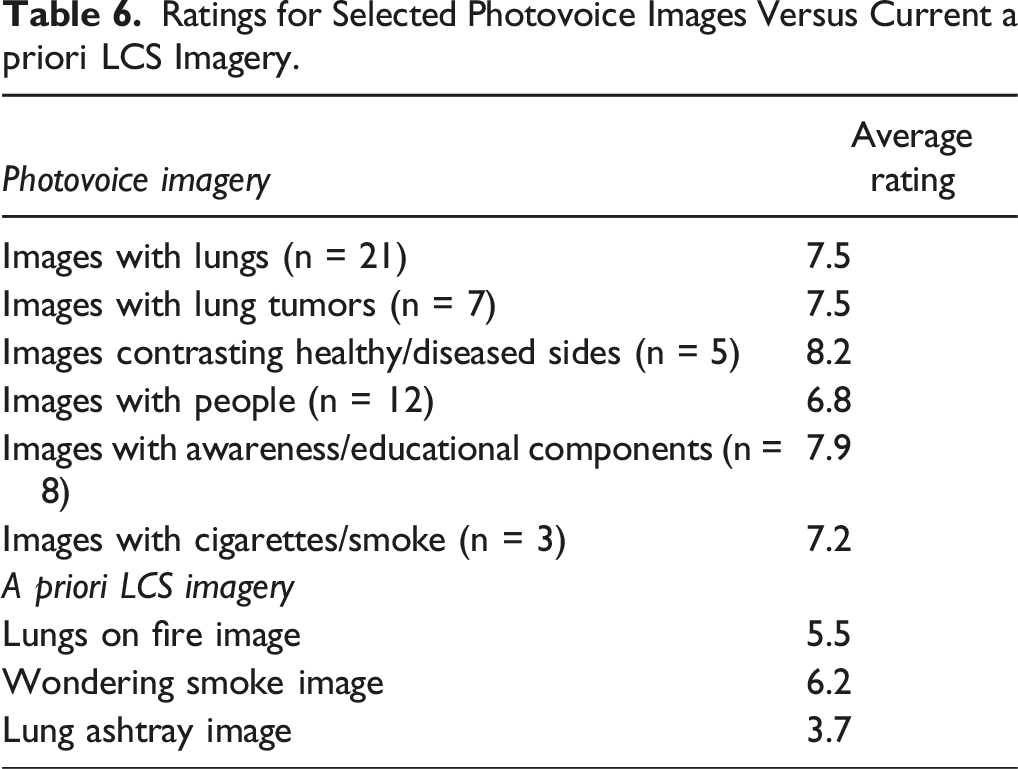
A mixed methods analysis was completed for the three a priori LCS images (Lungs on Fire, Wondering Smoke, and Lung Ashtray) through a matrix analysis 32 to compare the qualitative quotes and quantitative rating data. A matrix analysis had been intended to be completed for all theme and rating data; however, the matrix analysis was not feasible for the photovoice component with the wide variety of images selected by participants. Photo ratings were averaged across comparable components of the photovoice images (i.e., images with lungs, people, cigarettes/smoke) and for the a priori LCS pictures.
Results
Self-Reported Characteristics of Photovoice Participants, n = 13.

*N(%) of Non-missing Data.
Characteristics of Imagery Selected for the Photovoice Activity.
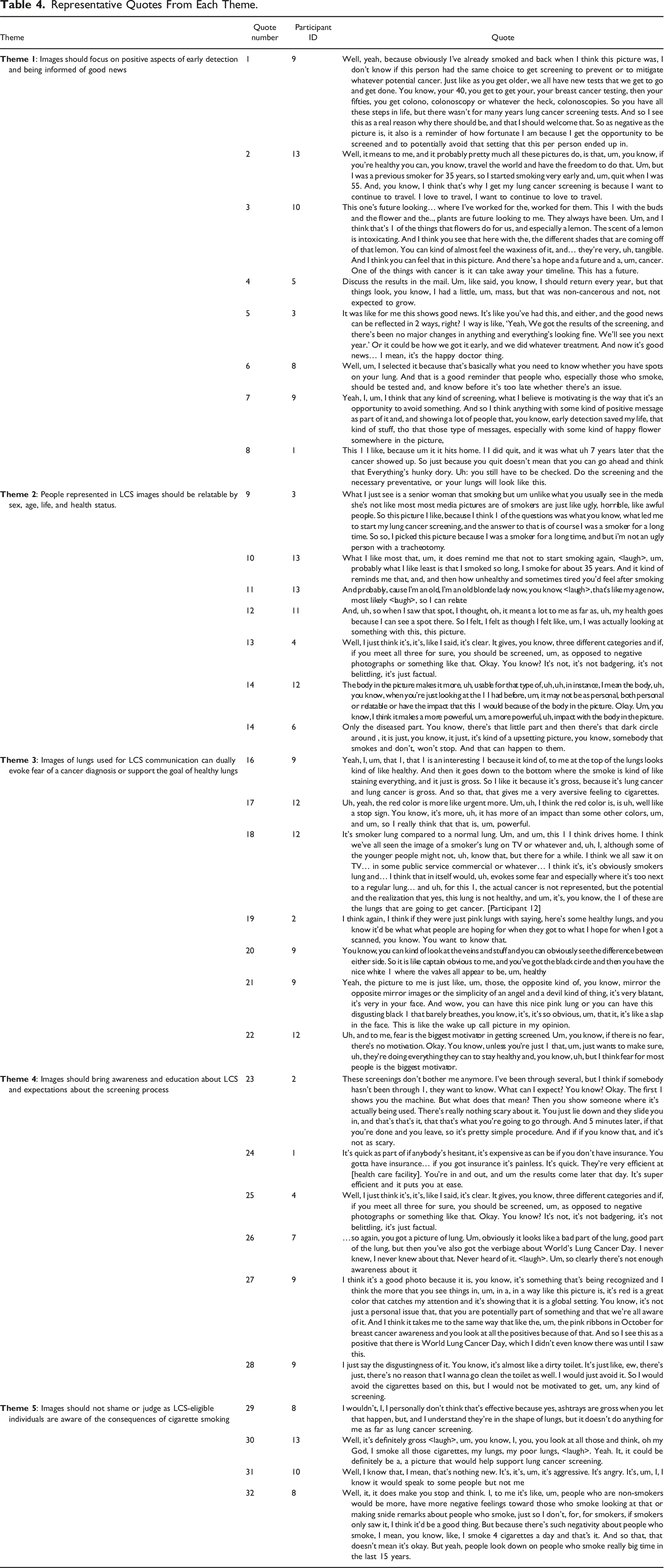
Representative Quotes From Each Theme.
Theme 1: Images Should Focus on Positive Aspects of Early Detection and Being Informed of Good News
Many participants focused on the benefits of LCS and verbalized that participating in LCS was a chance to keep up with their health. One participant commented that “early detection is obviously the goal,” while others discussed the importance of LCS to their health since they had a history of cigarette smoking. Keeping up with health allowed participants to feel that they could continue to enjoy activities in their life, selecting images they enjoyed, such as traveling and exercising (
Although there was widespread knowledge of LCS being able to detect early-stage cancer, participants also commented that good news came in annual phone calls or letters saying that no cancer was found (
Theme 2: People Represented in LCS Images Should be Relatable by Sex, Age, Life, and Health Status
Participants frequently discussed the importance of connecting with the person or situation shown in the image. This notion was raised in several different ways. The most common premise was being like the person in the image by sex and age (
Relatability to the image setting was also raised by several interview participants, with 1 individual commenting that a picture of their house showed “…that our house is not fancy. We’re not a, you know, we’re regular people. And I think that that shows that regular people are affected by this.” Additional discussion surrounding images with a clinician and patient talking represented the shared decision-making conversation.
Theme 3: Images of Lungs Used for LCS Communication can Dually Evoke Fear of a Cancer Diagnosis or Support the Goal of Healthy Lungs
About half of images selected by study participants contained lungs, representing a combination of tumor pictures, healthy lungs, and some photos contrasting diseased and healthy sides. Participants reported 2 ways that lung images can support LCS communications. Pictures showing tumors or a diseased/damaged side usually used black, red, and yellow colors and often accompanied conversation about fear being a motivator for screening participation because it was obvious the picture showed cancer. (
The second common lung image motif was how pink, healthy lungs also motivated the participant to continue yearly screening, with the overarching goal of knowing their lungs were healthy (
Theme 4: Images Should Bring Awareness and Education About LCS and Expectations About the Screening Process
LCS-eligible individuals included in this study reflected that images were an excellent opportunity to educate about the process, especially around knowing what the LDCT procedure encompassed. Participants felt that seeing a CT scanner in pictures made it easy to see that the procedure was not scary and may even help claustrophobic individuals (
Several participants also highlighted how they were unaware there was a Lung Cancer Awareness Day/Month until they were searching for images for the photovoice activity, with 1 participant sharing that advertising of ‘Lung Cancer Day’ may help ‘click off a light bulb in their head’ for other LCS-eligible individuals to participate in screening. Other participants voiced the notion that their friends and family with a cigarette smoking history were unaware of LCS: Well, I have a feeling that really that the public really isn't that knowledgeable about lung cancer screening. I, cause I know, um, like I've asked a few people, like my [family member], and she's still smoking and, and some people if they've ever had lung screen, and they're like, no. And I don't think like all the doctors are bringing it up. [Participant 13]
Theme 5: Images Should Not Shame or Judge as LCS-Eligible Individuals are Aware of the Consequences of Cigarette Smoking
All participants mentioned that they were conscious of the negative effect of smoking on their health, and many viewed the Lungs on Fire, Wondering Smoke, and Lung Ashtray photos as ‘over-the-top.' While the shock value was described as attention-grabbing, some participants felt the images were potentially stigmatizing. Another common observation about images with cigarettes and smoke was that those types of pictures conveyed a message about quitting smoking better than LCS participation. One participant captures these 2 notions: Besides, it's gross. Yeah, I can almost smell that picture I'm telling you because I smoked for so long. Um, and I'm glad I don't now, but, um, uh, yeah, that's <laugh>. Um, you know, it seems like the more things that were absurd the more it, um, gathers people's attention. And so this picture tells me that, um, it's over the top and, and then they did that to grab somebody's attention about quitting smoking. Doesn't say too much about lung screening. But it does say a lot about quitting smoking. [Participant 11]
Some participants voiced that images of cigarettes, fire, and smoke conveyed a sense of self-blame and contributed to societal stigma by portraying the message that cigarettes were the only cause of lung cancer. Another participant shared that they felt the images contributed to society thinking badly about people who smoke (
A Priori LCS Imagery Mixed Methods Analysis
Representative Quotes From Highest and Lowest a priori LCS Imagery Ratings.

Ratings for Selected Photovoice Images Versus Current a priori LCS Imagery.
Discussion
Imagery can be a powerful element of health communication, helping to capture the audience’s attention, communicating important information, and even evoking reactions that can motivate or hinder behavior. 17 LCS communications must emphasize selecting appropriate imagery to connect with the eligible population effectively. This study involved a qualitative inquiry approach and participatory research methodology to have LCS-eligible individuals select imagery representing LCS and thematically illuminate representation of imagery in LCS communications. This is among the first studies to provide rich, qualitative data surrounding preferences for imagery informed through direct engagement with LCS-eligible individuals.
We found that images should be approachable with a preferred focus on screening benefit, such as early detection and lung health. Conversely, there were negative reactions to images of cigarettes and smoke, with many participants describing these images as stigmatizing and judgmental, potentially leading to disengagement. It is possible that using fear-arousing images of fire, matches, and cigarettes are a spillover from anti-smoking campaigns with a similar intended audience. 33 Although fear-arousing campaigns have historically been the most successful anti-smoking messaging, 33 they have also influenced societal stigma associated with smoking and lung cancer and provoked strong reactions from study participants when similar imagery was used for LCS. Moreover, the use of stigmatizing images may be harmful by triggering disgust that makes individuals apprehensive about LCS participation. Combining disgust with fear appeals has been shown to be persuasive for immediate avoidance of a behavior, 34 making this tactic successful for anti-smoking but not screening participation. Importantly, >60% of the images selected for the photovoice activity did not contain dark, stigmatizing colors.
While some participants described fear of a cancer diagnosis as a motivating factor, the photos selected to accompany these quotes were predominantly tumors or other lung anomalies. This suggests it may be possible to use negative emotions to promote healthy behaviors without the added elements of stigma and disgust. Tumor images were concurrently associated with early detection and cancer that has better treatment options among study participants, a finding that is inconsistent with research by Cardarelli, et al. that found images meant to portray early detection in awareness campaigns should show lung cancer survivors and be linked to family and friends. 35 Other lung images selected for the photovoice activity were associated with the goal of healthy lungs, a notion that has been described in earlier qualitative research about motivations to participate in LCS. 36
Another important finding from this study was that images should relate to the intended recipient. Health communications that are targeted with images, especially with regard to racial and cultural sensitivity, are better received and may help facilitate behavior change. 6 The World Health Organization recommends knowing the sociodemographic and cultural characteristics of the target audience in the development of communication campaigns to increase relevance to the audience and effectiveness of the messages. 37 In this study, participants expressed relatability in different dimensions, including demographic characteristics, life status, and significance to the screening process, providing many approaches that can be used to make communications applicable to the LCS-eligible population.
The findings also suggest that images may be an excellent avenue to raise LCS awareness and offer education about the screening process. Reading levels for LCS websites have been reported to have a median reading level of 10th grade, 38 which is concerning because adults that are more likely to smoke cigarettes (i.e., rural residence, racial/ethnic minorities, low socioeconomic status) are also more likely to have low health literacy.39,40 Including educational components in LCS imagery offers an important opportunity to engage and share health information with populations that often have poorer health outcomes and can greatly benefit from LCS participation.
Limitations
This study does have several limitations to note. Although purposive sampling obtained a variable study sample, the final sample was primarily limited to Non-Hispanic White individuals and those with higher attained education, potentially limiting the transferability of our findings to more diverse populations. Second, this research did not focus on some sub-populations that previous research has shown benefit from targeted imagery, including individuals that identify as lesbian, gay, bisexual, transgender, or queer. 41 More research is needed to understand the influence of imagery on LCS communication in diverse populations, such as differences in imagery preferences for individuals that currently and formerly smoke, men and women, high and low literacy levels, and different racial and ethnic backgrounds. Understanding such differences is especially important given the sensitivity to sociodemographic and cultural aspects of pictures and achieving equitable LCS implementation. 42 Last, this research emphasized finding appropriate imagery for future LCS communications, specifically for annual adherence, and the study excluded individuals with LDCT findings that were potentially worrisome for lung cancer (LungRADS 3 or 4). The imagery themes identified in this study may not be generalizable to individuals with shorter and more intensive follow-up, often associated with higher levels of anxiety and distress. 43
Conclusion
Considerations for General Use of Imagery for Lung Cancer Screening Communications. The information provided in this table offer broad elements that can be considered for selecting appropriate imagery for lung cancer screening communications. Choosing imagery as a one size must fit all approach is complicated and often must balance the benefits of the image against the potential harms of the image since population subsets may respond differently to an image. More research is needed on methods and strategies to best target or tailor imagery and messaging to engage and empower the heterogeneous LCS-eligible populations.

Supplemental Material
Supplemental Material - “They Need to Feel Non-Judgmental”: Results of Participatory Photovoice Research to Inform Lung Cancer Screening Imagery
Supplemental Material for “They Need to Feel Non-Judgmental”: Results of Participatory Photovoice Research to Inform Lung Cancer Screening Imagery, Erin A. Hirsch, Kaitlyn Hoover, and Jamie L. Studts in Cancer Control
Supplemental Material
Supplemental Material - “They Need to Feel Non-Judgmental”: Results of Participatory Photovoice Research to Inform Lung Cancer Screening Imagery
Supplemental Material for “They Need to Feel Non-Judgmental”: Results of Participatory Photovoice Research to Inform Lung Cancer Screening Imagery, Erin A. Hirsch, Kaitlyn Hoover, and Jamie L. Studts in Cancer Control
Supplemental Material
Supplemental Material - “They Need to Feel Non-Judgmental”: Results of Participatory Photovoice Research to Inform Lung Cancer Screening Imagery
Supplemental Material for “They Need to Feel Non-Judgmental”: Results of Participatory Photovoice Research to Inform Lung Cancer Screening Imagery, Erin A. Hirsch, Kaitlyn Hoover, and Jamie L. Studts in Cancer Control
Footnotes
Author Contributions
Declaration of Conflicting Interests
The author(s) declared the following potential conflicts of interest with respect to the research, authorship, and/or publication of this article: Dr. Hirsch reports grants from NIH/National Cancer Institute and non-financial support from NIH/National Center for Advancing Translational Sciences, during the conduct of the study. Dr. Studts reports personal fees from Johnson & Johnson and Genentech, outside the submitted work; and Dr. Studts volunteers on the Scientific Leadership Board of GO2 for Lung Cancer and the American Cancer Society National Lung Cancer Roundtable. Dr. Studts receives grant funding from National Cancer Institute, the Bristol Myers Squibb Foundation, the American Cancer Society, the Patient-Centered Outcomes Research Institute, the Colorado Department of Public Health and Environment, and the Centers for Disease Control and Prevention, outside the submitted work. Ms. Hoover has no conflicts of interest to disclose.
Funding
The author(s) disclosed receipt of the following financial support for the research, authorship, and/or publication of this article: This work was supported by National Institutes of Health NCI F99/K00 Predoctoral to Postdoctoral Fellow Transition Award (F99CA264409, PI: Erin Hirsch), the Thoracic Oncology Research Initiative and the Population Health Shared Resource at the University of Colorado Cancer Center (P30CA046934), and NIH/NCATS Colorado CTSA Grant Number UL1 TR002535. Contents are the authors’ sole responsibility and do not necessarily represent official NIH views.
Ethical Statement

Supplemental Material
Supplemental material for this article is available online.
Appendix
References
Supplementary Material
Please find the following supplemental material available below.
For Open Access articles published under a Creative Commons License, all supplemental material carries the same license as the article it is associated with.
For non-Open Access articles published, all supplemental material carries a non-exclusive license, and permission requests for re-use of supplemental material or any part of supplemental material shall be sent directly to the copyright owner as specified in the copyright notice associated with the article.
