




Abstract
Background
Human papillomavirus (HPV) vaccination is one of the key preventative measures for cervical cancer, provided that effective vaccine uptake is employed. However, HPV vaccine uptake is low in settings with limited resources such as low- and middle-income countries.
Objectives
To assesses the uptake of HPV vaccine and associated factors among female students attending secondary schools in South West Shoa Zone, Oromia, Ethiopia, 2022.
Methods
A cross-sectional study was conducted in secondary schools of South West Shoa Zone between November 1st to November 30th 2022. A multi-stage sampling technique was employed among 634 female students attending secondary schools. Data were collected by self-administered structured questionnaires, entered into Epi-info version 7.2.2.6, and exported to SPSS version 25 for statistical analysis. Bivariable analyses were considered for Multivariable analysis. Adjusted odds ratio (AOR) along with 95% confidence levels were estimated to assess the strength of the association, and a P value <0.05 was considered to indicate statistical significance.
Results
The proportion of HPV vaccine uptake was 31.65% (95% CI, 25-38). Having adequate knowledge AOR = 8.51 (95% CI = 4.57-15.84), living in rural area AOR = 0.25 (95% CI = 0.15-0.42), having older sibling AOR = 4.07(95% = 2.50-6.63), mother’s educational level (Diploma and above) AOR = 4.08 (95% CI = 1.75-9.49), and secondary education AOR = 3.98 (95% CI = 1.87-8.48) were significantly associated with HPV vaccine uptake among female students attending secondary schools in South West Shoa Zone, Oromia, Ethiopia.
Conclusions
The study revealed that HPV vaccine uptake was very low among female students attending secondary schools in South West Shoa Zone, Oromia, Ethiopia. Adequate knowledge, having older sibling, living in rural area, and having mothers with higher educational level were significantly associated with HPV vaccine uptake. All concerned bodies should work jointly to enhance the uptake of HPV vaccination among female students.
Plain language summary
The human papilloma virus vaccine is one of the key preventative measures for cervical cancer. However, the vaccine uptake is low in resources limiting settings. The problem is particularly increasing in low and middle-income countries. Aimed at assessing the uptake of human papilloma virus vaccine and associated factors among female students attending secondary schools in South West Shoa Zone, Oromia, Ethiopia, 2022. In current study there was a very low uptake of human papilloma virus vaccine among female students attending secondary schools. Adequate knowledge, having older sibling, living in rural area and having mothers of diploma and above educational level and secondary educational level was significantly associated with the uptake of the HPV vaccine uptake. All concerned bodies should work jointly to enhance the uptake of human papilloma virus vaccination among female students
Introduction
Human papillomavirus (HPV) is the most common sexually transmitted infection and the majority of HPV infections are asymptomatic and resolve spontaneously, but persistent infections can develop into cancers in both women and men. 1 It is estimated that 75% of sexually active females are infected with HPV during their lifetime.2,3 There are more than 100 types HPV, of which at least 14 cause cancer. 4 Of the many genotypes specifically infecting the anogenital area, HPV16 and HPV18 are the commonest responsible for high-risk in cervical cancer, high-grade cervical dysplasia globally.5-8
Global Alliance for Vaccination and Immunization (GAVI) supporting countries has populations of 3082 million people with 1021 million women at risk of cervical cancer. By 2050, this figure is expected to rise to 2468 million. According to current estimates, 282,711 women are diagnosed with cervical cancer in GAVI supporting nations each year and 163,333 women die from the disease. Cervical cancer is the first among eligible GAVI and third cause of female cancer in GAVI-graduating nations respectively and the first and fourth cause of female cancer death according to crude statistics. Cervical cancer cases are estimated to climb to 720,415 new cases and 394,905 deaths in 2025. 9
Cervical cancer is the second most frequent cancer in women, after breast cancer which affects 21 million people. 10 Low- and middle-income nations accounted for 9 out of ten cervical cancer fatalities worldwide. 11 HPV infection is predicted to be prevalent in 21.3% of Africans with considerable regional differences: 33.6% in East Africa, 21.5% in West Africa, and 21% in Southern Africa. 12 The majority of cancers in Sub-Saharan Africa (over 80%) are detected late, owing to a lack of information about cervical cancer, its rarity and prevention services. After surgery or radiotherapy late-stage disease is associated with a low survival rate. Furthermore, many women in low-resource nations, such as Ethiopia, may lack or have limited access to these treatment options or they may be too expensive and inaccessible. 13
In Ethiopia recently the vaccine is given for 9-14 years female in 2 doses by 6-month interval. There are various factors that affect the uptake of vaccinations; including awareness and knowledge about cervical cancer and HPV infection, residence, level of education, parental educational status, and low socioeconomic status, media coverage around the HPV vaccine, allocated resource, the acceptability of a vaccine, or willingness of an individual to be vaccinated, child age, perceived access to the vaccine, societal norms, religious background, perceptions about disease severity and susceptibility were all hypothesized to drive uptake of these vaccines.14-18
WHO set strategy design and coverage improvement plans to reduce the burden of the disease and to reach the 90% goal of the global cervical cancer elimination program. To address such a strategy, different studies need to be conducted pre-and-post the deliverance of the vaccine expecting a high contribution to the success of the program. Therefore, an evidence-based study on the HPV vaccine and associated factors is a cornerstone for tracking the progress of the program to eliminate diseases caused by HPV and achieve the stated goal. However, in Ethiopia, the vaccine is newly introduced and studies conducted to analyze the vaccine uptake level and its associated factors are very limited. Therefore, this study might be used to identify barriers and factors affecting the utilization of the HPV vaccine which might be used as basic information for further interventions. Additionally, this study aimed at providing important information for policymakers and program implementers at national as well as regional levels, and the information derived from the study considered it would benefit the adolescent by providing directions on service provision. Therefore, this study assessed the uptake of HPV vaccination and associated factors among female students attending secondary schools in South West Shoa, Oromia, Ethiopia.
Methods
Study Area, Study Design and Period
School based Cross-sectional study design was conducted in South West Shoa Zone high schools from November 1 to 30, 2022. South West Shoa Zone is one of the 21 administrative zones found in Oromia regional state located at the central Oromia region. There are eleven administrative districts found in South West Shoa Zone. According to data adopted from Zonal Educational Office there are 32 high schools found in South West Shoa Zone and all districts have minimum of 2 high schools. There are total of 31,224 high school students attending secondary school as a zone in this year (2021/2022). From total students 13,871 female students are attending their class. WHO recommended that adolescents principally girls aged between 9 and 14 should get 2 doses of HPV vaccine to prevent infection with HPV, the second dose about 6 to 12 months after the first dose. Ethiopia launched HPV vaccine for the first time in 2018 for all under 14 years old girls through school-based approach and in health center. It is recommended for routine vaccine at the age of 9-14 years old. This study was reviewed and approved by the Ethical Review Board of Ambo University College of Medicine and Health Sciences (Ref. No.: AU/PGC/509/2014).
Populations
Source Populations
The source population of this study were all female students attending secondary schools for 2022-2023 academic year in South West Shoa Zone.
Study Populations
Study population was all female students attending ten secondary schools for 2022-2023 academic year in 5 selected districts.
Study Unit
Study unit was selected female student attending school.
Sample Size Determination and Sampling Technique and Eligibility Criteria
All female students attending ten secondary schools who were attending school during data collection period were included While, Female students who had lived in South West Shoa Zone for less than 6 months were excluded from the study.
The sample size for the study was estimated by using single population proportion formula using the following assumption; 95% confidence level (CI), (Zα/2) = 1.96, an expected uptake of human papilloma virus and associated factors proportion of 50% and, 5% margin of error. Because there was no study previously determined the proportion of uptake regarding human papilloma virus vaccination and associated factors among female high school students as a country and the variation of the study population would be expected to be high which I need optimum sample size to generalize the result. Therefore, the proportion of 50% was considered to determine the minimum sample size required for the study.

Therefore, the final sample size after adding 10% (58) nonresponse rate was 634 female students.
Sampling Technique, Data Collection Tool and Technique, and Data Quality Control
Multi stage sampling technique was used. Stage 1, five districts were selected from eleven districts in South West Shoa Zone by using lottery method. Stages 2, after districts were selected ten high schools were selected again by lottery method since one district has at least 2 high schools. Then the sample size was proportionally allocated for each selected high school based on the number of female students they have. Again, proportional allocation was done for each grade (Grade 9-12). Lastly, simple random sampling method (computer generated random number) was used to select study population. Figure 1 Schematic presentation of the sampling procedure used in the study.
Definition of Terms
Knowledge
The total score was calculated and the average and below average of the ten items used for knowledge assessment can be considered ignorant (inadequate knowledge) while an above average score was displayed as Knowledgeable (adequate knowledge). 19
Attitude
while checking the normality of the score from total of 7 items, the mean was used as the cutoff score to create a composite attitude variable. Participant who was scored above average was classed as having “favorable attitudes,” whereas who was scored average or below average was classified as having “unfavorable attitudes.” 20
Vaccination Uptake
Participants who was vaccinated for cervical cancer at least once and it was assessed by using questions having “Yes” or “No” response. 19
Structured self-administered questionnaires were prepared after reviewing relevant literatures. The tool consists parts that coverssocio-demographic characteristics of the students’ and parents, knowledge, attitude and uptake questions towards human papilloma virus vaccination. Two supervisors and 5 females Bsc Nurse in collaboration with ten female teachers were assigned for data collection. Self-administered structured Afaan Oromo version of the tool was used to collect the data. Moreover, trained data collectors were involved in given orientation to study participants regarding the aim of the study, issue of confidentiality and respondents rights, taking consent form from those above 18 years old and assent form from their family those who are under 18 years old and gathering filled questionnaires.
The questionnaires were translated from English to Afaan Oromoo for data collection and vice-versa for ensuring its consistency and correctness. Data collectors and supervisors were trained for one day on the objectives of the study; how to keep the confidentiality of information; the contents of the questionnaires; how to take informed consent and assent from study participants and families; filling out data collection formats, and data quality management by the investigator.
Before actual data collection time, the questionnaire (tool) was pretested for validity and reliability on 10% (63) of the sample in schools that were not selected for the actual data collection. Two supervisors supervised the data collectors. Finally, data editing and clearance was done for the proper management of data and data entry has been done by the principal investigator to keep the accuracy of the data.
Statistical Analysis of Data
The data was checked for inconsistencies, coding, completeness and clarity before entry. The data entry was done using Epi-info version 7.2.2.6 and then exported to SPSS version 25 for cleaning, editing, and analysis. The data were checked for missed values and outliers. Descriptive statistics such as mean, standard deviation, frequency, and percentage were used to summarize descriptive data. The results were presented in mean, frequency, standard deviation, texts and tables. Both bivariate and multivariable logistic regressions were performed to identify significant factors associated with HPV vaccine uptake. Those variables with P-value <0.25 in bivariate analysis were considered for multivariable logistic regression analysis. Multivariable logistic regression at the 95% confidence level was used to identify the predictors. Variables with a P-value <0.05 were considered significantly associated variables with the outcome variable. The fitness of the final model was tested by Hosmer Lemeshow’s goodness of fit test and the model was a good fit to the data (P = 0.58). Multicollinearity among independently associated variables was checked by variance inflation factor (VIF). However, there were no identified variables with multicollinearity problems (Maximum VIF = 5.09 and Minimum VIF = 1.27). The reporting of the results conforms to the STROBE guidelines. 21
Results
Socio-Demographic Characteristics of Respondents
Socio-demographic Characteristics of Female Students Attending Secondary Schools in South West Shoa Zone, Oromia, Ethiopia, 2022 (n = 585).
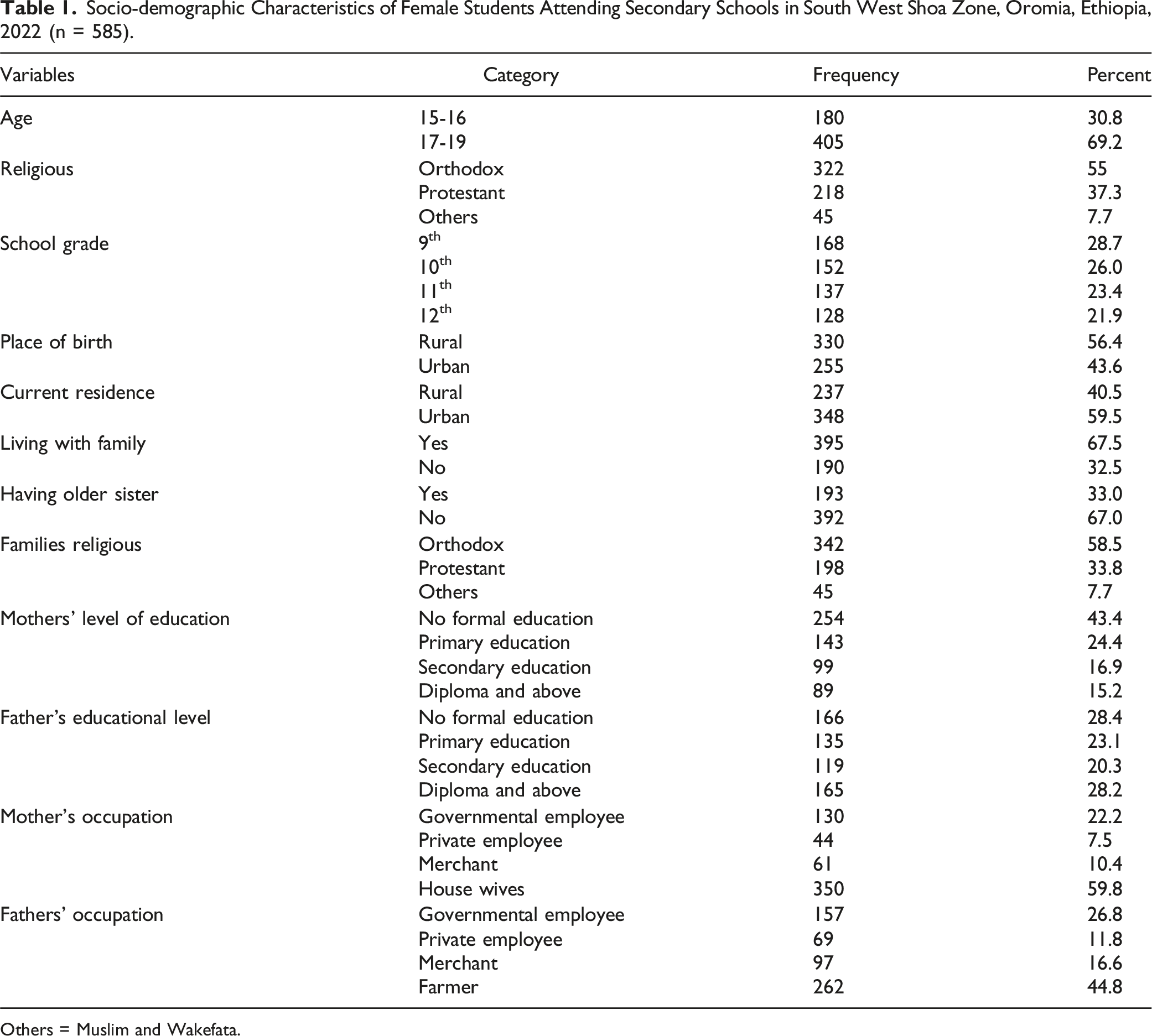
Others = Muslim and Wakefata.
Respondent’s Level of Knowledge About HPV Vaccination
Knowledge About HPV Vaccine Among Female Students Attending Secondary Schools in South West Shoa Zone, Oromia, Ethiopia, 2022 (n = 585).

Respondent’s Attitude Towards Human Papilloma Virus Vaccination
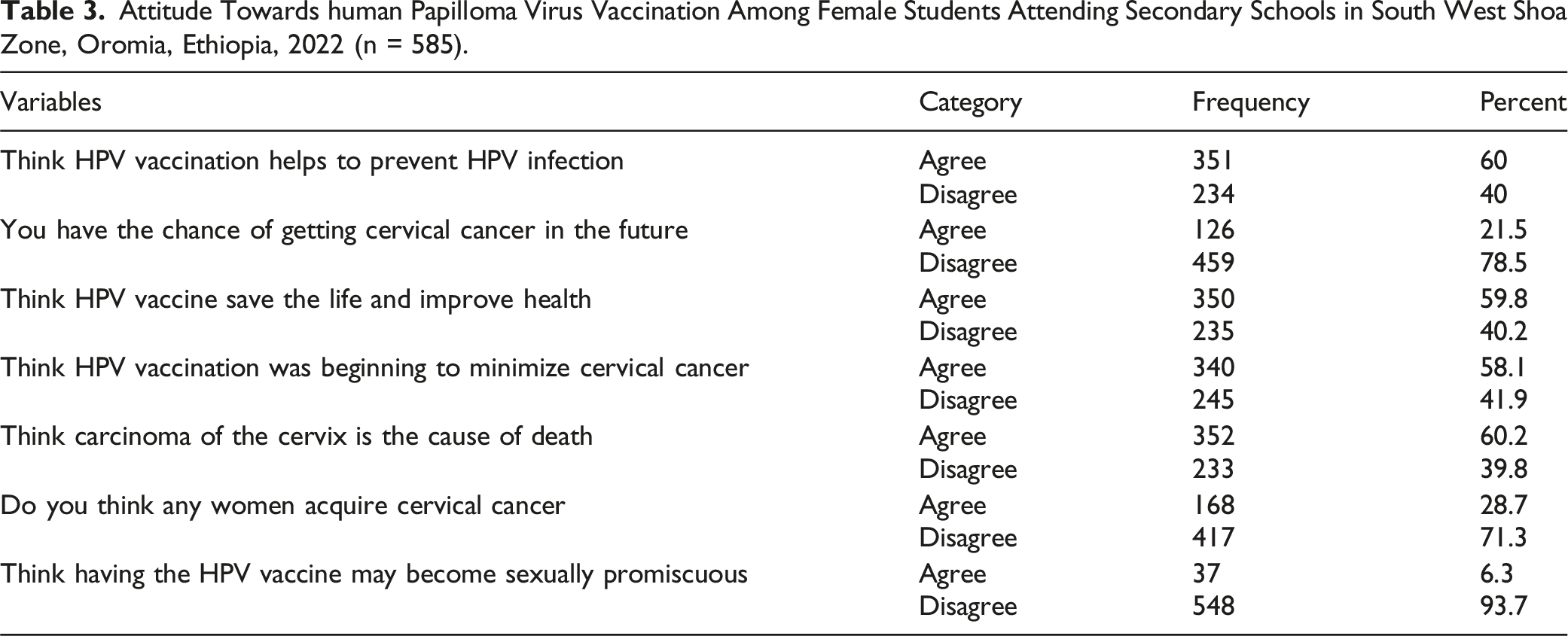
Attitude Towards human Papilloma Virus Vaccination Among Female Students Attending Secondary Schools in South West Shoa Zone, Oromia, Ethiopia, 2022 (n = 585).
Vaccination Status of Study Participants
Regarding to total vaccination only 31.65% (95%CI = 25-38) of female students were vaccinated for human papilloma virus. From those vaccinated 22.4% (95% CI = 7-.37) had taken 2 dose of HPV vaccine and about 9.2% (95% CI = 1-17) students had taken only one dose of HPV vaccine.
Reason for not Vaccinated
Study revealed that the reason of being not vaccinated was, 208 (35.4%) was due to lack of facility, 117 (20.2%) due to fear of vaccine side effects and about 75 (12.8%) didn’t hear when vaccine was given.
Factors Associated with HPV Vaccination Uptake
Residence, living with family, having older sibling, mother’s educational level, father’s educational level, mother’s occupation, following different media, adequate knowledge and favorable attitude had an associated with HPV vaccination uptake in binary logistic regression at P-value <0.25. After multiple logistic regression analysis variables of residence, having older sibling, mothers’ educational level, and adequate knowledge had a significantly associated with HPV vaccination uptake at P-value <0.05.
Factors Associated With Uptake of HPV Vaccination Among Female Students Attending Secondary Schools in South West Shoa Zone, Oromia, Ethiopia, 2022.

*Statistically significant at P-value <0.005.
**statistically significant at P-value ≤0.001.
Discussion
This study was undertaken to describe human papilloma uptake of female student and factors contributing to it. This study is target towards identifying the uptake status and identification of associated factors which will serve as base to design area specific intervention to tackle the problem.
This study investigated that uptake of human papilloma virus vaccination and associated factors among female students attending secondary schools in South West Shoa Zone. In this study, the uptake level among the study group was 31.65%. Additionally, this study also investigated that factors that influence uptake of human papilloma virus vaccination among female students attending secondary schools in South West Shoa Zone. Accordingly, respondent residence, having older sibling, mothers’ educational level and respondent knowledge towards HPV vaccination were significantly associated with uptake of HPV vaccine.
Human papillomavirus (HPV) vaccination is an effective primary prevention method for HPV. 22 It is, developed as the main prevention strategy against HPV infection 23 Therefore, this study is very important indicating the the willingness of this specific target population and to approach the for proper intervention.
The finding was consistent with a finding from a similar study in the New York City in which uptake level was 33%.24,25 The similarity might be due to similarity of study design.
However, this was higher than the study conducted among Female students in German in which uptake level was 17.4%, 26 in Nigeria 22.0% 27 in Uganda, Mbale district 14%, 28 Uganda Gulu Municipality 22%, 29 Uganda Wakiso district 9.2% 30 and Bahir Dar City, Ethiopia 16%. 31 The difference between the finding and the previous study might be due to socio-economic status, study area, study period, socio-demographic factors, cost of vaccine and definition of vaccine. In German definition of vaccination was took 3 complete doses of HPV vaccine but in this study at least took one dose of HPV vaccine considered as vaccinated. In another way when compared to with other study the uptake level of HPV vaccination was found to be lower than similar studies conducted in female adolescents in USA which was 53%, 32 Hong Kong which was 80%, 33 Malaysia which was 89.9%, 34 Malaysia, Melaka district which was 77.9%, 35 The difference between the finding and the previous study might be due to the vaccine accessibility; these countries may have better access coverage. They had also implemented routine HPV vaccination for all eligible girls. Similar study conducted in Ambo town and Minjer-Shankora district on female students on uptake of human papilloma virus vaccination in which uptake level were 44.4% and 66.5% respectively. 36 These studies were higher than current study that may be due to socio-demographic characteristics, health education program of the districts and study setting; the current study had large catchment area than previous study which had an effect on accessibility of vaccination especially on distant rural areas.
Given that rural residents in this study were 75% less likely than urban residents to receive an HPV vaccination, this finding raises the possibility that the responsible body’s message delivery system is ineffective and that students lack awareness, which may also be related to the availability of fewer vaccines in rural areas. The intention of Malaysian secondary school students in rural areas to receive the HPV vaccine was higher, 86.6%, 34 which may be related to Malaysia’s improved national HPV immunization program, which made the vaccine easily accessible to rural areas, as well as their improved message delivery system, similarly in Uganda study higher prevalence of uptake of HPV vaccine among adolescents who reported that HPV vaccine community outreaches were conducted in their residences compared to those who reported that the outreaches were not conducted in their residences. 37 This study was also higher than study conducted in Minjer-Shankora district among female students attending primary schools. Minjer-Shankora rural primary school students not to receive the HPV Vaccine was higher 88%, 36 this difference may be due socio-demographic characteristics.
On the other hand, study indicated that having adequate knowledge about HPV vaccine was associated with uptake of HPV vaccine. According to this finding, female students who had adequate knowledge were 8.51 times more likely vaccinated than who had inadequate knowledge. This is supported by the finding in study conducted in the Chines Hong Kong in which uptake of HPV vaccine among female adolescents having adequate knowledge were 3 times higher than those having inadequate knowledge, 33 study conducted in Malaysia those knowledgeable girls were 69.0% more likely vaccinated than those did not know about HPV vaccine.
Similarly, study conducted in Bahir Dar City, Ethiopia among female students attending preparatory schools those having satisfactory level of knowledge were 2.36 times higher uptake of HPV vaccine than those unsatisfactory level of knowledge 31 and also study done in Minjer-Shankora on female students attending primary schools students those had good knowledge were 8.56 more likely to practice HPV vaccination than those had poor knowledge. 36 This is in fact that, exposure to different sources of information about the cervical cancer, HPV infection and HPV vaccination is makes an individual knowledgeable and this in turn increases the rate of vaccination. Additionally, girls’ mothers with secondary educational level were significantly associated with uptake of HPV vaccination. In this finding, girls’ mothers with secondary educational level were 3.98 times and girls’ mother with diploma and above were 4.08 times more likely have been vaccinated than who had no formal education. This study was consistent with study done in German among female students attending secondary school which was girls’ mothers with high educated were around 2 times more likely vaccinated than those low educated mothers. 38 This revealed that being borne from educated family have great advantages for their children, because flow of information from educated family was an important for their children.
Moreover, having educated older sibling was significantly associated with HPV vaccine. According to this finding girls’ having educated older sibling were 4.07 times more likely uptake HPV vaccine than those have no educated older sibling. This is justified that flow of information from one educated family member increases vaccination rate.
Strength and Limitation of the Study
This is one of the few studies to assess uptake of human papilloma virus vaccination and associated factors among school girls in Ethiopia. It also included more predictor variables than previously conducted studies. In addition, using large sample size and conducted in large geographical area which ensures the transferability to the larger populations. This study’s primary limitation was a mixed study design was not used to obtain in-depth information about knowledge and attitude towards HPV vaccine. Using self-administrated questionnaire may decrease response rate.
Conclusion and Recommendation
Conclusion
In this study very low proportion of the study participants have been vaccinated for human papilloma virus. This study reveals that, residence of students, having older sibling, mother’s educational level and knowledge about HPV vaccine were found to be statistically significant with HPV vaccine uptake. Lack of prior knowledge, worry about side effects, negative perceptions, vaccine inaccessibility and the absence of a regular schedule or program were the biggest obstacles to HPV vaccination.
Recommendations
To Health Care Providers
• To enhance the practice (uptake) of HPV vaccination, particularly in rural areas, health facilities should implement mop-up and routine tactics for vaccine distribution in addition to the campaign-based delivery.
To Schools
• Schools are the main sources of information; they should improve their messaging strategies and raise the students’ level of knowledge about HPV vaccine.
For Government
• For ease of access, the government should make an effort to add the HPV vaccine to the National Program on Immunization (NPI) schedule.
Footnotes
Acknowledgments
We would like to forward our thanks to the South West Shoa education office, and school directors for their direction and assistance during the data collection period. The authors would also like to thank data collectors and study participants.
Declaration of Conflicting Interests
The author(s) declared no potential conflicts of interest with respect to the research, authorship, and/or publication of this article.
Funding
The author(s) received no financial support for the research, authorship, and/or publication of this article.
Ethical Statement

Data Availability Statement
All data utilized for the study are available within the main document and can be accessed without restrictions.