



Abstract
Introduction
The previous reports on clusterin (CLU) levels in various types of cancer have been controversial and heterogeneous. The present meta-analysis has aimed to evaluate the association between soluble CLU levels and the risk of different human cancers based on observational studies.
Methods
A systematic literature review was conducted to determine the relevant eligible studies in English language from health-related electronic databases up to January 2021. Random effects models were used to calculate the summary standard mean difference (SMD) with 95% confidence intervals (CIs) to identify the correlation between CLU levels and cancer risk. The meta-regression, sensitivity, Galbraith, and subgroup analyses were performed to explore the source of between-study heterogeneity. Furthermore, the funnel plot and Egger’s linear regression tests were carried out to evaluate the risk of publication bias.
Results
According to 16 eligible articles, 3331 patients and 839 healthy controls were included in our meta-analysis. Overall, the CLU levels were significantly higher in various cancer cases compared to the healthy groups (SMD = 1.50, 95% CI = 0.47–2.53). Moreover, subgroup analysis based on types of cancer showed a significant correlation between CLU levels and the risk of digestive system cancers (SMD = 1.54, 95% CI = 0.91–2.18, P <0.001), especially in HCC (SMD = 1.89, 95% CI = 0.76–3.03, P = 0.001), and CRC (SMD = 1.63, 95% CI = 0.0–3.23, P = 0.048).
Conclusion
The present meta-analysis indicates a significant association of CLU levels with the risk of digestive system cancers such as hepatocellular carcinoma and colorectal cancer. Therefore, CLU can be monitored as a novel molecular biomarker for the prognosis and diagnosis of various types of cancers particularly in the digestive system.
Introduction
Cancer is a crucial public health problem and the second most frequent factor of worldwide mortality. It leads to the death of over 8 million patients annually all around the world.1-3 Cancer occurrence reflects from differences in medical diagnostic practices and the exposure of cancer risk factors including obesity, unhealthy living, smoking, genetic lesions, and other health behaviors.2,4,5 The increased number of cancer survivors is attributed to improvements in cancer screening tests, early detection and treatment, and access to basic health care, smoking cessation, and healthy lifestyle. These efforts have indicated rapid reductions in some major cancers such as breast, prostate, lung, and colorectal carcinoma.5-8 Accordingly, cancer screening programs including potent molecular biomarkers of prognosis can be applied for early-stage diagnosis of cancers and metastasis prediction to enhance the medical care of cancer cases and their survival.2,3,9,10 Thus, it is essential to identify the efficient protein biomarkers from body fluids to develop theranostic approaches against cancers.11,12
Clusterin (CLU) is a heterodimeric disulfide-linked glycoprotein comprising of 449 amino acids expressed widely in mammalian tissues and human body fluids.12,13 Structural prediction has revealed that CLU possesses a highly conserved flexible structure due to the presence of amphipathic α-helical content as ordered regions and also disordered chains containing the random coil and molten globule conformations.11,13,14 Based on the previous studies, CLU has been associated with various physiological processes critical for tumorigenesis and tumor growth such as cell adhesion, stress response, immunity regulation, complement regulation, lipid transport, cell aggregation, and apoptosis.12,15-17
CLU encodes two subtypes of nuclear clusterin (nCLU) and secreted clusterin (sCLU) in all human fluids and tissues that are distributed in the nucleus and cytoplasm, respectively. The sCLU is present in human plasma at the concentration of 150–540 μg/ml.13,18 Although nCLU is involved in programmed cell death, sCLU plays a significant role in the growth of various carcinomas with chemo- or radio-resistance, angiogenesis, and metastasis of cancers.17,19 Overexpression of CLU has been reported in many human cancers including lung, 20 kidney, 21 breast,20,22 colon,20,23-26 bladder,27,28 prostate,29-32 melanoma,33,34 pancreas, 35 esophageal squamous cells, 18 hepatocellular,17,19,36-39 anaplastic large-cell lymphomas, 40 and ovarian carcinoma.41,42 Nevertheless, the downregulated expression of CLU was found in testicular cancer, 43 prostate carcinoma, 44 hepatocellular cancer, 45 and esophageal squamous cell cancer. 46 Therefore, the level of circulating CLU can be measured as a potential molecular biomarker to identify the early stages of tumorigenesis in humans for reducing the risk of malignancies and mortality.12,15,16,19,24,37,47
The present systematic review and meta-analysis has aimed to determine the association of soluble CLU levels with the risk of different types of cancer. Our study reports data based on published relevant articles to systematically evaluate CLU levels in cases with various cancer, which confirm the potential role of circulating CLU as a molecular biomarker to detect human cancers.
Methods
The Strategy of Literature Search
This report was conducted in adherence to the Preferred Reporting Items for Systematic Reviews and Meta-Analyses (PRISMA) statement. 48 The published systematic studies were evaluated from online databases such as ISI Web of Sciences, PubMed, Scopus, EMBASE, and MEDLINE to assess literature up to January 2021 in English language. The searches were accomplished individually and/or in different combinations using the following terms: “Clusterin,” “apolipoprotein J,” “Apo-J,” “SGP-2,” “CLU,” “CLI,” “Cancer,” ‘‘carcinoma,’’ ‘‘neoplasm,’’ and “tumor” or their equivalents. Furthermore, the reference lists of all retrieved articles were checked by manual searches to identify the additional relevant publications.
Inclusion and Exclusion Criteria
The published studies were included in this meta-analysis according to the following criteria: (i) original case-control and nested case-control articles; (ii) studies describing the relationship between the circulating CLU levels and the risk of various types of cancer in controls and cases; and (iii) investigations reporting the standardized mean difference with 95% confidence intervals (CIs). Additionally, we excluded the following literatures: (i) works on cells, tissues, and animals; (ii) case reports, reviews, letters, comments, editorials, or ecological studies; (iii) investigations with no original data or control group; and (iiii) studies focused exclusively on the mechanism, survival, or prognosis.
Data Extraction and Quality Evaluation
Two independent reviewers (ABN and HMM) checked the eligible articles to extract data by a predetermined database, and disagreements were judged by a third reviewer. Data extraction of the mentioned studies was performed as follows: (i) basic data including the first author’s surname, publication year, and the region of study; (ii) details of investigations such as carcinoma type, study design, CLU detection technique, number of controls and patients, and sample size; and (iii) characterization of cases and controls, for example, age, and CLU mean ± standard deviation (SD). The quality evaluation of the included studies was performed using the Newcastle–Ottawa Scale (NOS) with score rating system (range: 0–9). 49 The investigations with score ≥5 were defined as high quality.
Statistical Analysis
The Comprehensive Meta-Analysis (CMA) software (Biostat, New Jersey, USA) was used, and the P-value less than 0.05 was determined as statistically significant. According to the size of samples, the mean and SD were extracted from the included articles; the standardized mean differences (SMDs) and 95% CIs were computed to evaluate the association strength of the circulating CLU levels with the risk of cancer. The mean and SD were estimated for eligible studies reporting the range and median or interquartile range (IQR), as introduced by Wan et al. 50 The level of heterogeneity among the included studies was calculated using the Cochran Q statistic and inconsistency index (I2). The heterogeneity was significant for I2-value >50% and P-value < 0.05. The random effects model was used based on the presence of significant heterogeneity, whereas the fixed effects model was applied for non-significant heterogeneity. Additionally, the subgroup analysis was accomplished by the study size and quality, carcinoma type, ethnicity, and cancer groups as well as the mean age to reveal the sources of heterogeneity. To explore the considerable heterogeneity contributed by the studies or variables, the Galbraith plot and meta-regression analysis were also applied.51,52 Visual inspection of the funnel plot and Egger’s linear regression test was reported to assess the publication bias.
Results
Search of Literature
A summary of the study selection strategy in the meta-analysis is presented in Figure 1. Briefly, a total number of 1800 relevant studies were determined from the primary search of databases. A total of 1665 irrelevant, duplicates, review articles, animal studies, or mechanism reports were excluded after reviewing the title and abstract of the included investigations. Subsequently, 119 articles were also omitted from 135 potentially relevant studies due to the absence of healthy controls and incomplete data to compute SMD. Consequently, 16 articles reporting the data on the association of CLU levels with cancer risk were selected for further analysis. Flow diagram of the study selection strategy.
Characterization of Study
Characterization of Eligible Included Studies in the Meta‐Analysis.

Abbreviations SD, Standard deviation; NOS, Newcastle-Ottawa Scale; Ref, References; BC, Breast cancer; EOC, Epithelial Ovarian cancer; HCC, Hepatocellular carcinoma; CRC, Colorectal cancer; PC, Prostate cancer; ESCC, Esophageal Squamous Cell carcinoma; OC, Ovarian cancer; LC, Lung cancer; BLC, Bladder cancer; 2-DE, 2-dimensional gel electrophoresis.
Quantitative Analysis of CLU Levels and Cancer Risk
The mean and SD of CLU levels were pooled from 16 eligible articles to compute the summarized SMD for evaluating the relationship between CLU levels and carcinogenesis risk. The quantitative analyses were conducted based on the overall or subgroups using different parameters including the quality of the study, types of cancer, sample size, cancer groups, ethnicity, and mean age. The random effects model was performed according to the significant heterogeneity level (I2 = 99.07%, P <0.001). Overall, our meta-analysis indicated a significantly higher level of CLU in cancer cases compared to healthy controls (SMD = 1.50, 95% CI = 0.47–2.53, P <0.001), resulting in the correlation of CLU levels and cancer risk (Figure 2). As shown in Figure 2, the subgroup analysis based on the cancer groups revealed a significant association between CLU levels and the risk of digestive cancers (SMD = 1.54, 95% CI = 0.91–2.18, P <0.001). However, no significant correlation was found in non-digestive cancers and CLU levels (SMD = 1.20, 95% CI = −1.01-–3.42, P = 0.287). Forest plot of summarized SMD analysis on the relationship between CLU levels and cancer risk in overall and based on subgroup analysis.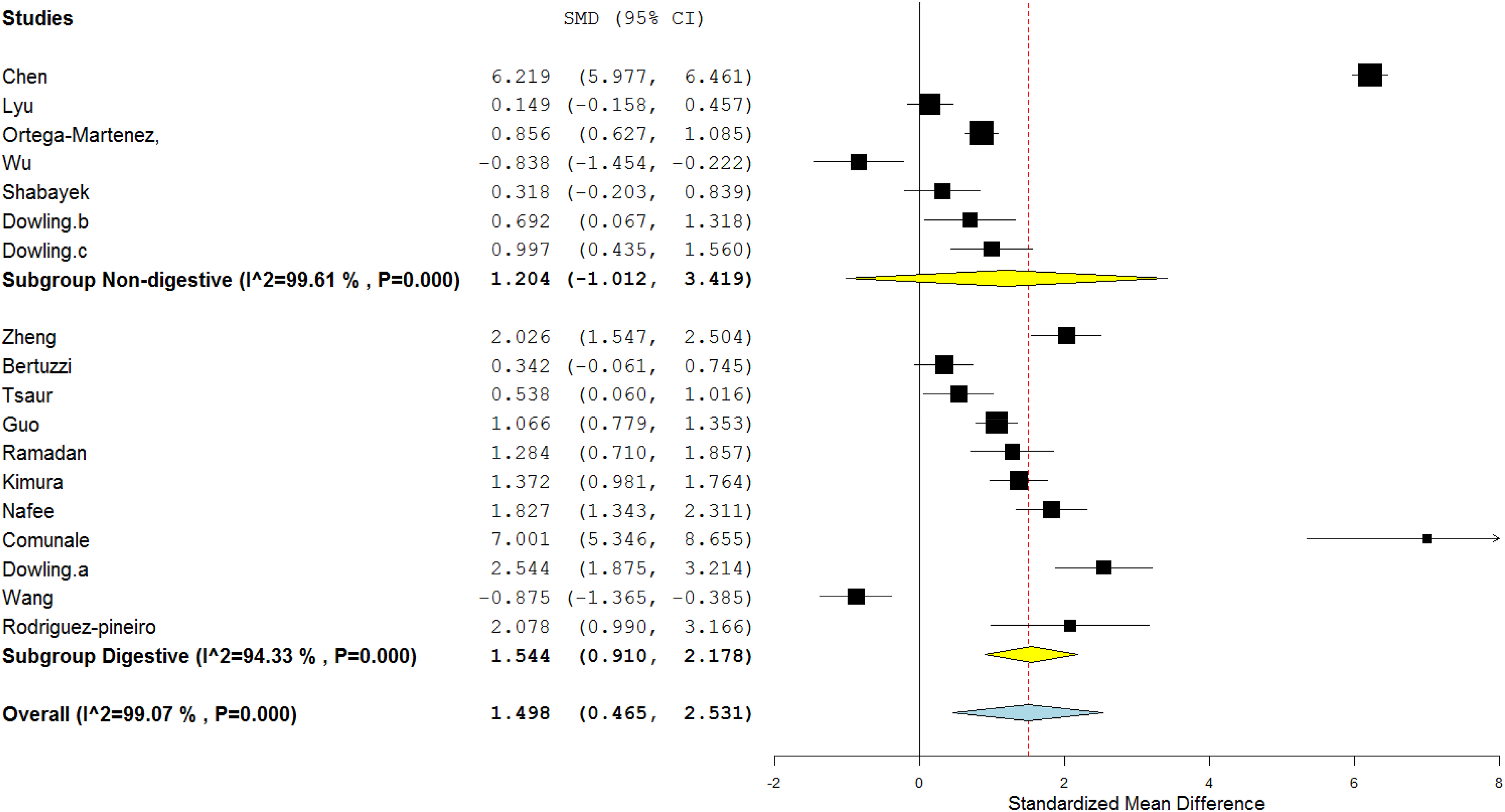
Summarized SMD Analyses on CLU Levels and the Risk of Cancers.

aP-value for heterogeneity within each subgroup.
bP-value for heterogeneity between subgroups with meta-regression analysis.
Abbreviations: SMD, standardized mean difference; CI, confidence interval; HCC, hepatocellular carcinoma; CRC, colorectal cancer; EOC, epithelial ovarian cancer; PC, prostate cancer; ESCC, esophageal squamous cell carcinoma; OC, ovarian cancer; BC, breast cancer; LC, lung cancer; BLC, bladder cancer; NA, not applicable; NOS, Newcastle–Ottawa Scale.
Heterogeneity Analysis
The meta-regression, Galbraith plot, and sensitivity analysis were conducted to detect the potential heterogeneity sources to assess the effect of various studies and covariates on pooled SMD. The univariate analysis of meta-regression for potential factors including cancer groups, sample size, cancer types, ethnicity, quality of life, and the mean age demonstrated that no significant differences were found in between-study variance (Table 2). According to the Galbraith plot analysis, the outlier studies were detected as the potential sources of heterogeneity (Figure 3). As shown in Figure 3, two studies by Comunale et al.39,54 were determined as the outliers and contributed to high heterogeneity based on pooled SMD analysis. Although excluding the mentioned investigations could decrease the level of heterogeneity (I2=92.01), no considerable difference was found on the heterogeneity level. The sensitivity analyses could evaluate the impact of a single study on the overall meta-results by ignoring one study for each meta-analysis (Figure 4). The results of sensitivity analyses showed that no single study significantly changed the overall SMD due to the stability and the strength of the results. Galbraith plot of meta-analysis on the association between CLU levels and cancer risk. Sensitivity analysis on the association of CLU levels and the risk of cancer.

Publication Bias
The funnel plot asymmetry and Egger’s regression test were utilized to assess the publication bias of the meta-analysis (Figure 5). Our results indicated that the publication bias regarding the relationship between CLU levels and the risk of cancer was across the eligible articles (P=0.010). Funnel plot of publication bias on the relationship between CLU levels and cancer risk in summarized SMD analysis.
Discussion
The results of this meta-analysis revealed a direct association between soluble CLU levels and cancer risk. Based on the previous studies, altered levels of CLU are associated with the risk of different types of cancer, which remains controversial in the mentioned investigations.17-19,29-32,36-39,44-46,54,55 Hence, to attain the actual decision-making, our meta-analysis was performed to determine the relationship between CLU levels and cancer risk in the cases through pooling the SMDs of 16 relevant articles. According to our knowledge, the present meta-analysis is the first systematic and quantitative investigation to indicate the association between CLU as a molecular biomarker and the risk of various cancers.
Our meta-results showed a significant increase in CLU levels in cancer cases compared to the healthy controls. Furthermore, the subgroup analysis based on different parameters including the cancer groups, ethnicity, cancer type, sample size, mean age, and study quality confirmed the role of CLU level as a potential molecular biomarker in detecting the risk of cancers. The ethnicity subgroup analysis revealed the significant correlation between CLU levels and cancer risk in Caucasian patients, whereas the CLU levels were not significantly related to the risk of cancer among Asian cases. Concerning the ethnicity, only six studies were conducted on Asian populations and 12 investigations on Caucasians. The non-significant relationship between CLU levels and cancer risk in Asian population could be due to few studies on mentioned patients compared to the Caucasian cases. Hence, it is essential to conduct further investigations on Asian populations to elucidate the prognostic and diagnostic values of CLU levels for various cancers.
Based on the present meta-analysis, the significant elevated CLU levels for patients with gastrointestinal cancers such as CRC and HCC indicated that CLU levels could enhance the risk of digestive cancers. Colorectal cancer and hepatocellular carcinoma are known as the first and second leading causes of cancer mortality, respectively, around the world.19,20,24,36 Identification of potential molecular biomarkers from body fluids is essential for early detection, monitoring the recurrence, and clinical management of cancers. Additionally, the levels of specific circulating proteins might be changed during the years before diagnosing various types of cancers.12,16,19,25
Various investigations have reported the association between CLU levels and the risk of different types of cancer,12,21-24,27,36 particularly colorectal cancer due to the crucial role of CLU in carcinogenesis and overexpression of cancer cells.19,23,26,37,41 According to several studies, the levels of circulating CLU were significantly increased in CRC patients compared to the healthy group.20,24 The high levels of CLU in pre-diagnostic samples indicated that CLU as an oncogenic biomarker could be used to determine the risk of CRC and other gastrointestinal cancers as well as defining appropriate preventive interventions.12,15,16
On the other hand, recent studies have described that the abnormal expression of CLU in sera and tissues of HCC cases could be significantly related to tumor metastasis. The controversial results of the CLU expression level were found in hepatocellular cancer.17,19,36-39,45 Based on different studies, the significant overexpression of CLU was identified in HCC patients compared to liver cirrhosis and healthy groups,17,19,37,38 whereas some investigations have reported decreased CLU levels in the HCC group compared to the control group.39,45 Our meta-results confirmed the positive correlation of CLU levels and the risk of hepatocellular carcinoma by pooling the SMDs of 11 relevant studies. The strength and stability of pooled data were proved according to the results of the Galbraith plot and sensitivity analysis. Therefore, the elevated CLU levels in patients could be applied as a survival indicator for the theranostic of HCC and other digestive human cancers such as the colon,20,24 esophagus, 18 and stomach 56 as reported by clinical analysis. Overall, the prognostic and diagnostic importance of CLU as a potential biomarker has been highlighted to identify various types of human cancers according to the results of the present meta-analysis.
Several strengths were considered in our meta-analysis including the utilization of all relevant eligible investigations, well-designed methodological issues, and the extensive variety of ethnicity. However, some limitations were also found during the interpretation of results as follows: The present meta-analysis is based on observational case-control studies that have intrinsic biases and uncontrolled confounding parameters. Only English published investigations were included in our meta-analysis that might affect the pooled results. The reliability of this meta-analysis could be influenced by the high heterogeneity of the eligible studies. According to the classified subgroup analysis, the included parameters were not confirmed as the contributing factors. The mentioned heterogeneity across the included studies might be related to the inadequate consideration of the main confounding parameters in the majority of the eligible investigations. Additionally, the publication bias could probably be in favor of published studies containing positive results.
Conclusion
The present meta-analysis revealed a significant association between soluble CLU levels and the elevated risk of different cancers including hepatocellular carcinoma and colorectal cancer. Our meta-results indicate that the CLU levels were significantly higher in cancer patients compared to the healthy controls. Hence, the meta-results recommended that the circulating CLU could be applied as a risk assessment biomarker for the prognosis and diagnosis of various types of cancers particularly in the digestive system. Nevertheless, it is essential to evaluate the optimum cut-off value for CLU levels to determine cases with a high risk of various cancers. Further well-designed investigations are needed to confirm the role of CLU levels in the progress of different cancers.
Footnotes
Declaration of Conflicting Interests
The author(s) declared no potential conflicts of interest with respect to the research, authorship, and/or publication of this article.
Funding
The author(s) received no financial support for the research, authorship, and/or publication of this article: This work was financially supported by Mashhad University of Medical Sciences, Mashhad, Iran [grant no. 980999]
Ethics approval
Our study was approved by The Institutional Research Ethics Committee School of Medicine-Mashhad University of Medical Sciences (approval no. IR.MUMS.MEDICAL.REC.1398.694).
