




Abstract
Colorectal cancer (CRC) is the second most common cause of cancer-related deaths worldwide. Survival rates are among the most important factors in quality control and assessment of treatment protocols. This study was aimed to assess the survival rate of colorectal cancer in Eastern Mediterranean Region Countries. In the present study we comprehensively searched 6 international databases including PubMed/Medline, ProQuest, Scopus, Embase, Web of Knowledge and Google Scholar for published articles until November 2018. The Newcastle-Ottawa Quality Assessment Form for Cohort Studies was applied to evaluate the quality of included studies. The heterogeneity of papers was assessed with the Cochran Test and I-Square statistics. Meta-regression test was performed based on publication year, sample size and Human Development Index (HDI) of each study. Among the total of 1023 titles found in the systematic search, 43 studies were eligible to be included in the present meta-analysis. According to the results, the 1-year, 3-year and 5-year survival rate of patients with Colorectal Cancer was 88.07% (95% CI, 83.22-92.92), 70.67% (95% CI, 66.40-74.93) and, 57.26% (95% CI, 50.43-64.10); respectively. Furthermore, Meta-regressions did not show significant correlations between survival rate and year, sample size or Human Development Index. Survival rates, especially the 5-year survival rate in the EMRO were less than European countries and the USA. Documented and comprehensive evidence-based findings of the present meta-analysis can be used to enhance policies and outcomes of different medical areas including prophylaxis, treatment and health related objectives in colorectal cancer.
Background
Nowadays, Non-communicable diseases are the most important cause of death worldwide. It is anticipated that cancer is going to be one of the most critical causes of death and by itself the most extensive cause of decreasing the quality of life in 21 century. 1 Worldwide, Colorectal Cancer is the fourth most common cancer in men and the third among women. 2,3 This cancer is the most common type of gastrointestinal cancers and is the second leading cause of mortality by malignancies. 4 -6 Based on the latest article published by the International Agency for Research on Cancer (2018Globocan IARC), in 2018, Colorectal Cancer consists 10.2% of all cancer cases and 9.2% of cases of cancer mortality. 7 Over 1.8 million new colorectal cancer and 881000 deaths were estimated in 2018. The lowest incidence of Colorectal Cancer is in Africa and southern Asia and the highest rate is in male population of the Republic of Korea and in female population of Macedonia. 4 Colorectal cancer was also responsible for 19·0 million (18·5–19·5) DALYs globally in 2017, with an age-standardized rate of 235·7 (229·7–242·0) DALYs per 100 000 person-years, which decreased between 1990 and 2017 (−14·5% [–20·4 to −10·3]). 8
Incidence and mortality of cancer is increasing globally. These factors are multiplex, but the aging of communities and population growth, as well as changes in the prevalence and distribution of the main risk factors of cancers participate in this matter. All these are a few factors that are associated with the development of socio-economic status (SES). 9 So, it is fair to say that this increase in trend of Colorectal cancer is alarming and the importance of consideration to the recent guidelines of National Comprehensive Cancer Network (NCCN) is crucial for colon and rectal cancers. 10
The increased incidence rate, especially overall changes in the age-period-cohort analysis implies the effects of nutritional patterns, obesity, and lifestyle. Meanwhile decreased mortality rate in developed countries, depicts improvement in survival, which is related to effective treatment methods, appropriate and enhanced management in these countries. 11,12 High consumption of red meat or processed food was associated with increased risk of colon cancer, but it was not associated with rectal cancer. 13 Consumption of processed meat, alcohol, and high body mass index increments the likelihood of colon cancer while physical activity was a protective factor. 14
Diverse factors are involved in the survival of colorectal cancer as potential factors such as stage, grade, tumor location, 15,16 coexisting cancers, 17 provider profile, socio-economic status(SES), 18 and prompt treatment 19 due to earlier diagnosis and advances in chemotherapy, surgery and radiotherapy. These factors improved survival of Colorectal Cancer considerably over the past decade. 20 Although the promotion of therapeutic and diagnostic methods has led to increased survival of these patients, there is clearly a geographical discrepancy in the survival of this cancer globally. 21
The first step to control a disease and its complications in each population, is recognizing its state as well as gathering data about its incidence, survival rates, types and locations. Studies on the survival rates of Colorectal cancer in the Eastern Mediterranean Region have achieved divergent results and the population of the researches is also different in these studies. Familiarity with the multi-year survival rate of Colorectal cancer in this region can provide precious information regarding control, prevention and treatment of patients. A unitary and thorough study regarding survival rate of Colorectal cancer in the eastern Mediterranean region has not yet been done.
Therefore, in this study we aimed to do a systematic review and meta-analysis to calculate the survival rate of Colorectal Cancer in the Eastern Mediterranean region.
Methods
The present study is a systematic review and meta-analysis on the survival rate of Colorectal Cancer in the Eastern Mediterranean region (EMRO) countries. This study was designed and implemented and report based on PRISMA checklist (Preferred Reporting Items for Systematic Reviews and Meta-Analysis) in 2018. 22
Search Strategies
We searched 6 international databases; Medline, PubMed, ProQuest, Scopus, Embase and Web of knowledge to November 2018. We also searched Google Scholar to find gray literature.
Selected keywords for international databases included: (“Neoplasm,” “Cancer,” “Carcinoma,” “Malignancy,” “Colorectal Cancer,” “Colorectal Neoplasms,” “Colorectal carcinoma,” “Colorectal Tumor,” “Cancer of Colorectal,” “Neoplasms of Colorectal,” “Colonic Neoplasm,” “Rectal Neoplasms,” “Survival, “Survival Analysis,” “Survival Rate,” “Afghanistan,” “Bahrain,” “Iran,” “Iraq,” “Jordan,” “Kuwait,” “Lebanon,” “Oman,” “Pakistan,” “Qatar,” “Saudi Arabia,” “Syria,” “United Arab Emirates,” “Djibouti,” “Egypt,” “Morocco,” Palestine,” “Somalia,” “Sudan,” “Tunisia,” “Libya,” and “Yemen”).
Retrieved records were entered in EndNote, X7 software and duplicated records were automatically deleted. Two independent researchers examined all the papers.
Inclusion and Exclusion Criteria
All observational studies (cross-sectional, case-control and cohort) that investigated the survival rate of Colorectal Cancer in the EMRO regions, were included in our project. Studies that involved other cancers and studies that involved metastasis and relative survival rates were excluded as it’s a procedure with systematic reviews and meta-analysis. Studies that did not disclose the sample size or confidence interval of survival rates were not included in the meta-analysis.
Quality Assessment
To assess the quality of articles included in our investigation, the Newcastle-Ottawa Quality Assessment Form for Cohort Studies was applied. This tool consists of 3 separate sections: selection (4 items), comparison (1 item) and, result (3 items Studies scored based on the overall scores and divided into 3 categories: Good (3 or 4 stars in selection domain, 1 or 2 stars in comparability domain, and 2 or 3 stars in outcome/exposure domain), Fair (2 stars in selection domain,1 or 2 stars in comparability domain, and 2 or 3 stars in outcome/exposure domain) and Poor (0 or 1 star in selection domain or 0 stars in comparability domain or 0 or 1 stars in outcome/exposure domain). 23
Screening of Studies
Two independent reviewers screen the records (based on title, abstract and full-text), appraise the quality of included studies and extract the data. A third reviewer resolved potential disagreement.
Data Extraction Form
We used a pre-prepared checklist for data extraction. This checklist included the author’s name, the year of publication, the period of study, the sample size, the country of study, gender and, survival rate in colon, rectum and colorectal cancer.
Statistical Analysis
The heterogeneity of the studies was evaluated by Cochran Test (with a significant level less than 0.1) and evaluated using I2 statistics. Regarding heterogeneity, random effect-model was utilized with the inverse-variance method, and if there was no heterogeneity, fixed effects model was used. In case of heterogeneity among the studies, methods such as meta-regression and sub-groups analysis were performed.
In the first stage, studies were analyzed based on 1, 3 and 5-year survival rates and based on the location of cancer: colon, rectum and colorectal categories. Obtaining the 2-year and 4-year survival rates was only possible for Colorectal cancer. All analyses were fulfilled by STATA statistical software version 13.
Additional Analysis
Because of the high heterogeneity of the studies, the meta-regression analysis was operated. One of the indexes that has been used for this purpose is the Human Development Index. HDI is a relative standard for measuring life expectancy, literacy, learning level, and overall level of life standards in human societies. Human development index is anticipated by measuring the level of well-being, especially well-being among children and individuals with low age. We can use this index to assess the development of countries, the impact of economic policies on life standards. 24 This index is utilized in our study to exhibit the survival rates of colorectal cancer in each of these countries. Other factors that were used in meta-analysis were the year of study and sample size. Additionally, the survival rate of Colorectal cancer in each country was also declaredso that we would have an accurate profile of the survival status of colorectal cancer in each country.
It should be highlighted that for subgroups analysis calculate the survival rates in each gender, within the 43 of the studies that were included in this meta-analysis, only 5 studies were able to demonstrate the results with segregation of gender. Specific year survival rate analysis between subgroups based on gender was not possible with the data we gathered.
Risk of Bias
The random-effects model was used to reduce the risk of bias in the studies. 25,26 The Egger bias test was also used to evaluate the risk of publication bias. 27
Results
Study Selection
In total, 1678 articles were identified for potential inclusion. After reviewing the titles and abstracts, a total of 108 articles were entered to the next phase. Finally, 43 articles fulfilled all criteria and were included in our study (Figure 1).
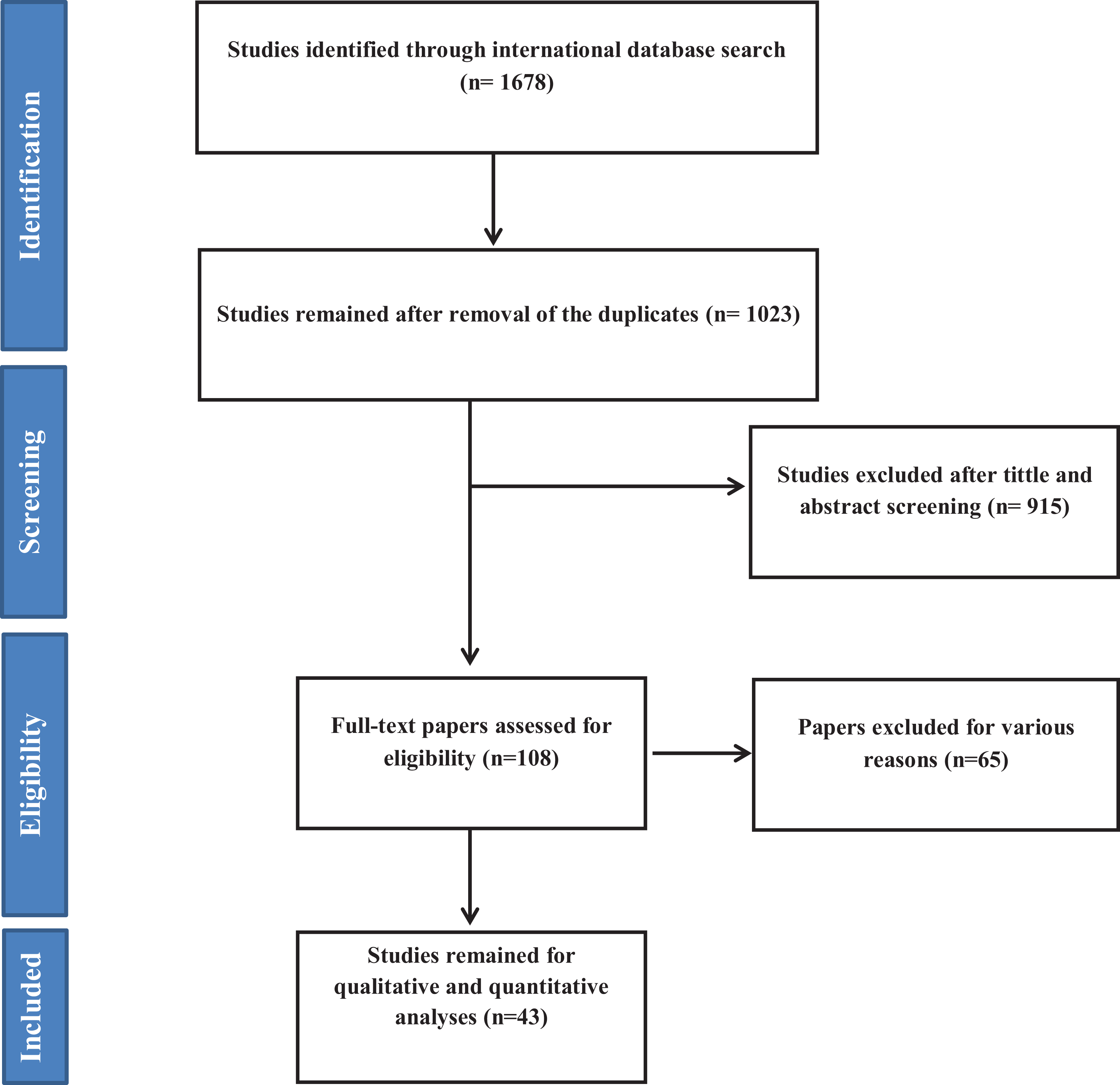
Flowchart of the included eligible studies in systematic review.
Study Characteristics
More specifically, the present review included studies published between 2000 and 2018. Based on geographical location, 29 studies were from Iran, 28 -56 4 study from Saudi Arabia, 57 -60 3 from Oman, 61 -63 2 from Jordan, 64,65 1 from Libya, 66 1 from Kuwait, 67 1 from Lebanon, 68 1 from Pakistan 69 and 1 was from United Arab Emirates. 70 The characteristics of the studies are illustrated in Table 1.
Basic Information of Included Studies.
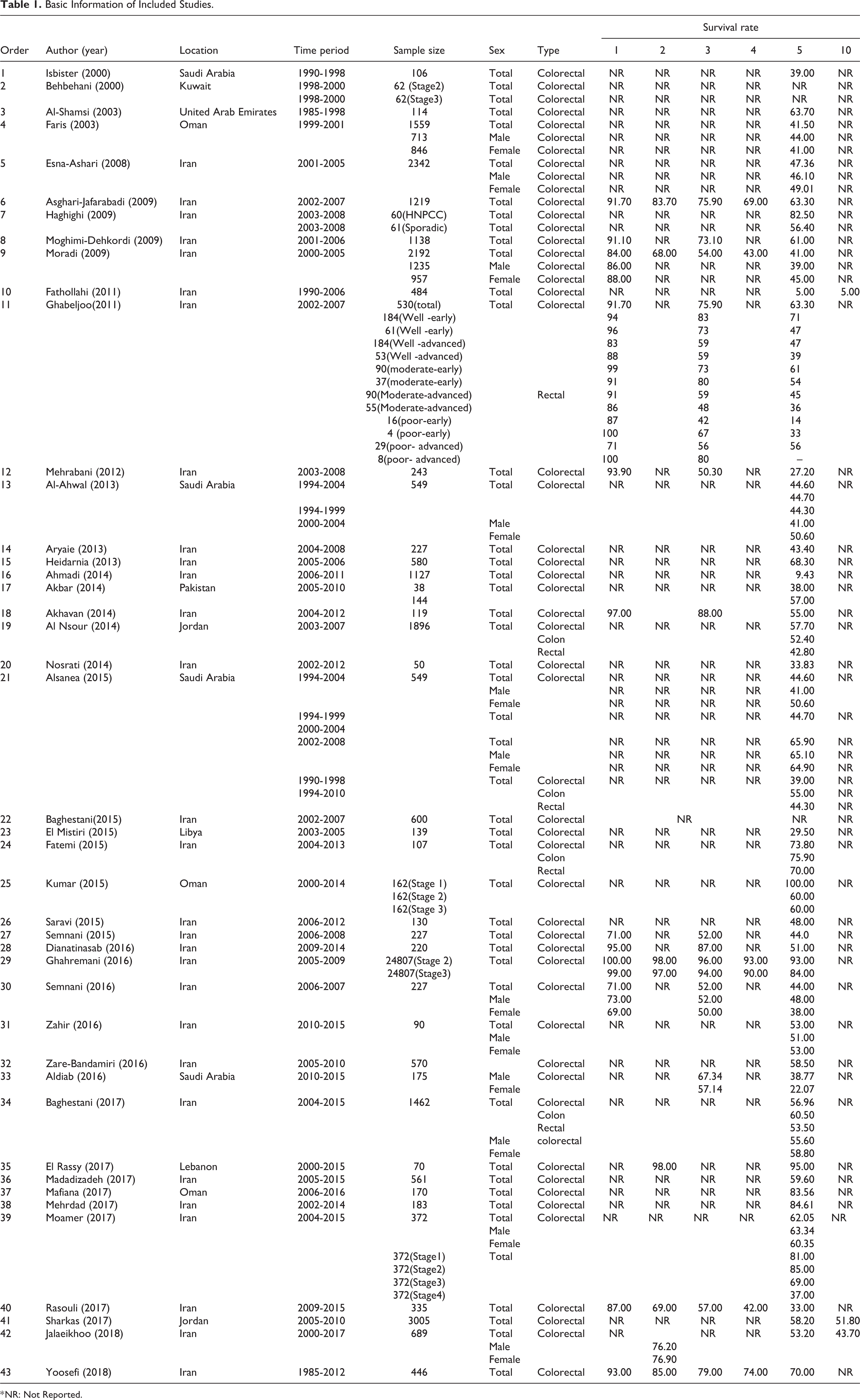
* NR: Not Reported.
Quality Assessment
The quality evaluation results are provided in Online Appendix 1. Based on our review using the relevant checklist, 25 studies had good quality and 18 articles had moderate quality.
Results of Meta-Analysis
First, the articles were arranged based on the publication year. Then the survival rates obtained were stratified by the following: The survival rate of 1, 2, 3, 4 and 5 years and the survival rates of Colon, Rectum and Colorectal cancer individually. Furthermore, Meta-regression was executed based on the year of the study, HDI index and sample size. As specified before subgroup analysis based on gender was not possible due to the lack of reports of the articles.
One-Year Survival Rate
Of the final articles, 10 studies illustrated 1-year survival rate of Colorectal cancer. Based on the random-effect model, the study demonstrated that 1-year survival rates in the Eastern Mediterranean region was 88.07% (95% CI, 83.22-92.92) (Figure 2). Furthermore, studies that disclosed colon and rectal cancer 1-year survival rate stated the rates as following 91.17% (95% CI, 86.73-95.61) and 95.14% (95% CI, 92.84-97.45) respectively (Online Appendix 2 and 3).

Forest plot of 1-year survival rate of Colorectal cancer in EMRO countries.
Two-Year Survival Rate
Of the final articles, 8 studies reported the 2-year survival rate of colorectal cancer. All the reports were based on colorectal cancer exclusively. Based on random-effect model, the results showed that 2-year survival in the Eastern Mediterranean region was 83.19% (95% CI, 80.54-85.84) (Online Appendix 4).
Three-Year Survival Rate
Of the final articles, 11 studies announced the 3-year survival rate of colorectal cancer. Based on the random-effect model, the results of the study portrayed that 3-year survival rate in the Eastern Mediterranean region was 70.67% (95% CI, 66.40-74.93) (Figure 3). In addition, studies that reported colon and rectal cancer illuminated a 3-year survival rate of 65.29% (95% CI, 56.96-73.62) and 71.02% (95% CI, 57.94-84.10) respectively (Online Appendix 5 and 6).

Forest plot of 3-year survival rate of Colorectal cancer in EMRO countries.
Four-Year Survival Rate
Of the final articles, 5 studies reported the 4-year survival rate of Colorectal Cancer. All the reports were based on only Colorectal cancer and there was no data about colon or rectal cancer individually. Based on the random-effect model, the results of the study demonstrated that 4-year survival in the Eastern Mediterranean region was 68.87% (95% CI, 61.46-76.28) (Online Appendix 7).
Five-Year Survival Rate
Of the final articles, 29 studies reported the 5-year survival rates of Colorectal Cancer. Based on random-effect model, 5-year survival rate in the Eastern Mediterranean region was 57.26% (95% CI, 50.43-64.10) (Figure 4). Also, studies that reported colon and rectal cancer had a 5-year survival rate of 51.95% (95% CI, 43.81-60.02) and 47.44% (95% CI, 42.39-52.48) respectively (Online Appendix 8 and 9).

Forest plot of 5-year survival rate of Colorectal cancer in EMRO countries.
Survival Rate of Colorectal Cancer in Each Country
In general, the survival rate outcomes of colorectal cancer in all 6 countries are illustrated in Table 2. The highest 5-year survival rate of colorectal cancer was in Lebanon (68) and Oman (62) and the lowest survival rate was established in Libya (66) and Saudi. 58,59
Result of Meta-Analysis and Heterogeneity of Survival Rate of Colorectal Cancer in EMRO Base on Each Country and Year of Survival.

* NR; Not reported.
Meta-Regression
Meta-regression results did not show a significant relationship based on the variables studied. In survival rate studies based on the year of study, no significant relationship was obtained. (Reg coefficient = 0.004, p = 0.752). Therefore, survival rates do not change based on the year of the study. Also, the results of meta-regression between the HDI index and the 5-year survival rate of Colorectal cancer did not manifest a significant relationship (Reg coefficient =-1.1, p = 0.591). There was no relationship between the sample size and survival rates (Reg coefficient = 0.0002, p = 0.110). The meta-regression results are illustrated in Figure 5.

Result of meta-regression for 5 years survival rate of Colorectal cancer based on HDI, sample size and year of study.
Map-Chart
The map-chart of 5-year survival rate of colorectal cancer in EMRO countries are shown in Figure 6.

The map-chart of 5 year survival rate of colorectal cancer in EMRO countries.
Publication Bias
At last, we draw funnel plots for assessing the publication bias for survival rates of Colorectal cancer. Egger test confirmed our assessment (P < 0.001). (Online Appendix 10). This finding suggested that studies that reported lower survival rate appear to have been more widely published.
Discussion
Colorectal cancer is among the most common types of cancer that leads to more than 500,000 deaths in the world each year. 71 In our investigation, the survival rates of 1, 3 and 5-year of patients with CRC in the Eastern Mediterranean region was analyzed by meta-analysis. The 1-year survival in these countries was 88.07% (with CI 95%: 83.22-92.99). Studies show that 1-year survival rate of CRC patients in European countries including Sweden, Denmark, England, Australia and Norway are less than this comparison and are, 83.8%, 77.7%, 74.7%, 84.9% and 82.4% respectively. 72 This rate is also less in Canada than the estimated rates for countries in the East Mediterranean region and it is 83.5%. 72 The present research showed that 3-year survival rates in the EMRO region was 70.67% (CI 95%: 66.40-74.93). In 2013, Yuan et al corresponded that the 3-year survival rate of CRC patients in China, the most populous country in East Asia is 74%, which is more than the estimated survival rate in our study. 73 The studies demonstrated that in India, 1 and 3-year survival rates of patients with CRC was63.04% and 42.20%, respectively. 74
On the other hand, 5-year survival rate in the Eastern Mediterranean region was 57.26% (CI 95%: 50.43-64.10). However, it is not acceptable to estimate the survival rate level in countries, as this number is related to diversified factors. However, to look at this matter, observationally only the highest 5-year survival rate was in Lebanon (95%) and the lowest was in Iran (9.43%) (Table 2). However, several studies have broadcasted the survival rate of colorectal cancer in Iran and the results of the meta-analysis in subgroups showed a 5-year survival rate in Iran estimated to be59.13% (Table 2). A study executed by Yeole et al 74 in 2001 exhibited that this rate was 33.6% in India, while in some Eastern Asian countries such as China and Japan the rate was more than the estimated rate in the present study and was 68% and 61.4% respectively. 73,75 In another study conducted in Malaysia, the 5-year survival rate of patients with Colorectal Cancer was 34.3%. 76 On the other hand, the 5-year survival rate of these patients in the US was 65%. 77 However, in some European countries, such as France, Germany and Italy this rate was more than the Eastern Mediterranean region; 60.33%, 65% and 59.33% respectively, and in The United Kingdom the rate was casted down and was in the range of 50 to 55%. 78 The 5-year CRC survival rate in the African continent countries including Uganda and Gambia was less than 8%. 79 The survival rate in the Eastern Mediterranean region is less than European countries and the US and more than some Asian and African countries, but it is expected that now with increasing economic growth, higher living standards and the average age of death of gastrointestinal cancers will also increase.
In this study, the survival rate of patients based on the localization of the tumor was also investigated. The results of this research showed that the highest survival rate was dedicated for rectal cancer, which was 95.14% for 1-year and 71.02% for 3-year. While the 5-year survival rate of patients with colon cancer was more than others; 51.91% in comparison with 41.63%. In a meta-analysis study, which was recently done by Maajani et al in Iran, it was suggested that the paramount 1-year survival rate in Iran was colon cancer which was estimated to be near 90%. 77
In meta-regression analysis, which was conducted in this study, there was no significant correlation between the survival rate of CRC with sample size, the year which the studies were conducted in and the Human Development Index of the countries. Several factors can affect the survival rate of colorectal cancer in these measures. One of the most important items that can affect the incidence of patients with Colorectal cancer is gender. A study in the UK depicted that the incidence of Colorectal cancer in women is about 47% less than men. 80 In addition, it has been seen that the 5-year survival rate of women in CRC is superior than men. 81,82 Among other effective factors that can influence the survival rate in patients is smoking and consuming alcohol. 83 Phips and Newcomb in 2011 stated that smoking significantly reduced the survival rate of patients with CRC. 84 To add, the cohort study done by Kangwha cohort study in South Korea stated that the chances of death in CRC patients were about 5 times more than non-alcoholic patients. 85 Among other factors that may affect the survival rate in CRC patients, race, tumor stage, grade should be distinguished as well. 77 In general, it seems that the discrepancies in survival rates can be in relation to various risk factors, the increase in inherent incidence of cancer, or the better report of mortality rates.
Among the limitations of the present study, was that the reported information was not complete in the papers that were included in our survey, and therefore, many risk factors such as ethnicity, sex, smoking and alcohol consumption, stage and grade of the tumor were not entered into sub-group analyses. These elements can also justify the significant heterogeneity that was found between the studies, which even existed in the subgroups. In addition, in this survey, we evaluated the survival rate based on the location of the tumors. Studies that broadcasted the survival rate of metastatic patients were excluded, since the survival rate of these patients are utterly different from patients with non-metastatic tumors. In addition, more than half of the Eastern Mediterranean region had not published any studies on the survival rate of patients with CRC and in 5 counties we found a solo publication. Therefore, in order to make a more accurate estimate, augmented studies are essential to be done in the countries of this region especially in countries who had no data at all. We in this present study, attempted to contact the authors of the publications to gather more data and information, but only few reached out. In order to adjust the heterogeneity of studies, we used a random-effect model which was discussed earlier.
Our meta-analysis had invigorated aspects too, including usage of observational studies with a cohort approach for the study and utilizing meta-analysis to identify heterogeneity of the categorized groups. The results of the present study can be considered as an acceptable estimate of the survival rate of patients in the Eastern Mediterranean region, and it is applicable for planning prevention and treatment programs. Finally, the survival rate was not estimated for some years (such as Survival rate of 2, 4, 7 and 10 year) because a few of the studies had reports on them and this aspect should be carried out in the future in this matter. Also, we suggested that investigation for the survival rate in patients with metastatic cancer should also be considered as it can be critical in clinical decision making and treatment options.
Conclusion
Colorectal cancer is one of the most preventable malignancies and if it is diagnosed in the early stages, it can significantly increase survival rates of patients. The results of this study illustrated the survival rates in the Eastern Mediterranean region and indicated that this rate of survival, especially the 5-year survival rate in this region is less than Europe and the US. The results of this study, based on the results of the published studies, can furnish this documentary and comprehensive evidence, the fundamental basis of many policies and decision makings in many different aspects of medical development, including evaluation of screening programs, treatment and health interventions in the field of colorectal cancer.
Supplemental Material
Supplemental Material, Appendix_1-CRC-Quality_Assessment - Survival Rate of Colorectal Cancer in Eastern Mediterranean Region Countries: A Systematic Review and Meta-Analysis
Supplemental Material, Appendix_1-CRC-Quality_Assessment for Survival Rate of Colorectal Cancer in Eastern Mediterranean Region Countries: A Systematic Review and Meta-Analysis by Hossein-Ali Nikbakht, Soheil Hassanipour, Layla Shojaie, Mohebat Vali, Saber Ghaffari-fam, Mousa Ghelichi-ghojogh, Zahra Maleki, Morteza Arab-Zozani, Elham Abdzadeh, Hamed Delam, Hamid Salehiniya, Maryam Shafiee and Salman Mohammadi in Cancer Control
Supplemental Material
Supplemental Material, Appendix_10 - Survival Rate of Colorectal Cancer in Eastern Mediterranean Region Countries: A Systematic Review and Meta-Analysis
Supplemental Material, Appendix_10 for Survival Rate of Colorectal Cancer in Eastern Mediterranean Region Countries: A Systematic Review and Meta-Analysis by Hossein-Ali Nikbakht, Soheil Hassanipour, Layla Shojaie, Mohebat Vali, Saber Ghaffari-fam, Mousa Ghelichi-ghojogh, Zahra Maleki, Morteza Arab-Zozani, Elham Abdzadeh, Hamed Delam, Hamid Salehiniya, Maryam Shafiee and Salman Mohammadi in Cancer Control
Supplemental Material
Supplemental Material, Appendix_2-Colon_1_000001 - Survival Rate of Colorectal Cancer in Eastern Mediterranean Region Countries: A Systematic Review and Meta-Analysis
Supplemental Material, Appendix_2-Colon_1_000001 for Survival Rate of Colorectal Cancer in Eastern Mediterranean Region Countries: A Systematic Review and Meta-Analysis by Hossein-Ali Nikbakht, Soheil Hassanipour, Layla Shojaie, Mohebat Vali, Saber Ghaffari-fam, Mousa Ghelichi-ghojogh, Zahra Maleki, Morteza Arab-Zozani, Elham Abdzadeh, Hamed Delam, Hamid Salehiniya, Maryam Shafiee and Salman Mohammadi in Cancer Control
Supplemental Material
Supplemental Material, Appendix_3-Rectum_1_000001 - Survival Rate of Colorectal Cancer in Eastern Mediterranean Region Countries: A Systematic Review and Meta-Analysis
Supplemental Material, Appendix_3-Rectum_1_000001 for Survival Rate of Colorectal Cancer in Eastern Mediterranean Region Countries: A Systematic Review and Meta-Analysis by Hossein-Ali Nikbakht, Soheil Hassanipour, Layla Shojaie, Mohebat Vali, Saber Ghaffari-fam, Mousa Ghelichi-ghojogh, Zahra Maleki, Morteza Arab-Zozani, Elham Abdzadeh, Hamed Delam, Hamid Salehiniya, Maryam Shafiee and Salman Mohammadi in Cancer Control
Supplemental Material
Supplemental Material, Appendix_4-CRC_2_000001 - Survival Rate of Colorectal Cancer in Eastern Mediterranean Region Countries: A Systematic Review and Meta-Analysis
Supplemental Material, Appendix_4-CRC_2_000001 for Survival Rate of Colorectal Cancer in Eastern Mediterranean Region Countries: A Systematic Review and Meta-Analysis by Hossein-Ali Nikbakht, Soheil Hassanipour, Layla Shojaie, Mohebat Vali, Saber Ghaffari-fam, Mousa Ghelichi-ghojogh, Zahra Maleki, Morteza Arab-Zozani, Elham Abdzadeh, Hamed Delam, Hamid Salehiniya, Maryam Shafiee and Salman Mohammadi in Cancer Control
Supplemental Material
Supplemental Material, Appendix_5-Colon_3_000001 - Survival Rate of Colorectal Cancer in Eastern Mediterranean Region Countries: A Systematic Review and Meta-Analysis
Supplemental Material, Appendix_5-Colon_3_000001 for Survival Rate of Colorectal Cancer in Eastern Mediterranean Region Countries: A Systematic Review and Meta-Analysis by Hossein-Ali Nikbakht, Soheil Hassanipour, Layla Shojaie, Mohebat Vali, Saber Ghaffari-fam, Mousa Ghelichi-ghojogh, Zahra Maleki, Morteza Arab-Zozani, Elham Abdzadeh, Hamed Delam, Hamid Salehiniya, Maryam Shafiee and Salman Mohammadi in Cancer Control
Supplemental Material
Supplemental Material, Appendix_6-Rectum_3_000001 - Survival Rate of Colorectal Cancer in Eastern Mediterranean Region Countries: A Systematic Review and Meta-Analysis
Supplemental Material, Appendix_6-Rectum_3_000001 for Survival Rate of Colorectal Cancer in Eastern Mediterranean Region Countries: A Systematic Review and Meta-Analysis by Hossein-Ali Nikbakht, Soheil Hassanipour, Layla Shojaie, Mohebat Vali, Saber Ghaffari-fam, Mousa Ghelichi-ghojogh, Zahra Maleki, Morteza Arab-Zozani, Elham Abdzadeh, Hamed Delam, Hamid Salehiniya, Maryam Shafiee and Salman Mohammadi in Cancer Control
Supplemental Material
Supplemental Material, Appendix_7-CRC_4_000001 - Survival Rate of Colorectal Cancer in Eastern Mediterranean Region Countries: A Systematic Review and Meta-Analysis
Supplemental Material, Appendix_7-CRC_4_000001 for Survival Rate of Colorectal Cancer in Eastern Mediterranean Region Countries: A Systematic Review and Meta-Analysis by Hossein-Ali Nikbakht, Soheil Hassanipour, Layla Shojaie, Mohebat Vali, Saber Ghaffari-fam, Mousa Ghelichi-ghojogh, Zahra Maleki, Morteza Arab-Zozani, Elham Abdzadeh, Hamed Delam, Hamid Salehiniya, Maryam Shafiee and Salman Mohammadi in Cancer Control
Supplemental Material
Supplemental Material, Appendix_8-Colon_5_000001 - Survival Rate of Colorectal Cancer in Eastern Mediterranean Region Countries: A Systematic Review and Meta-Analysis
Supplemental Material, Appendix_8-Colon_5_000001 for Survival Rate of Colorectal Cancer in Eastern Mediterranean Region Countries: A Systematic Review and Meta-Analysis by Hossein-Ali Nikbakht, Soheil Hassanipour, Layla Shojaie, Mohebat Vali, Saber Ghaffari-fam, Mousa Ghelichi-ghojogh, Zahra Maleki, Morteza Arab-Zozani, Elham Abdzadeh, Hamed Delam, Hamid Salehiniya, Maryam Shafiee and Salman Mohammadi in Cancer Control
Supplemental Material
Supplemental Material, Appendix_9-Rectum_5_000001 - Survival Rate of Colorectal Cancer in Eastern Mediterranean Region Countries: A Systematic Review and Meta-Analysis
Supplemental Material, Appendix_9-Rectum_5_000001 for Survival Rate of Colorectal Cancer in Eastern Mediterranean Region Countries: A Systematic Review and Meta-Analysis by Hossein-Ali Nikbakht, Soheil Hassanipour, Layla Shojaie, Mohebat Vali, Saber Ghaffari-fam, Mousa Ghelichi-ghojogh, Zahra Maleki, Morteza Arab-Zozani, Elham Abdzadeh, Hamed Delam, Hamid Salehiniya, Maryam Shafiee and Salman Mohammadi in Cancer Control
Footnotes
Authors’ Note
Our study was approved by The Research Ethics Committee of Shiraz University of Medical Sciences, Shiraz, Iran (approval no. 98-01-106-20383). The written informed consent not applicable for this study design (systematic review). Saber Ghaffari-fam is now affiliated with School of Nursing of Miyandoab, Urmia University of Medical Sciences, Urmia, Iran and Morteza Arab-Zozani is now not affiliated with Iranian Center of Excellence in Health Management, School of Management and Medical Informatics, Tabriz University of Medical Sciences, Iran.
Declaration of Conflicting Interests
The author(s) declared no potential conflicts of interest with respect to the research, authorship, and/or publication of this article.
Funding
The author(s) disclosed receipt of the following financial support for the research, authorship, and/or publication of this article: The study was funded by Shiraz University of Medical Sciences, Shiraz, Iran (Grant Number: 98-01-106-20383).

Supplemental Material
Supplemental material for this article is available online.
References
Supplementary Material
Please find the following supplemental material available below.
For Open Access articles published under a Creative Commons License, all supplemental material carries the same license as the article it is associated with.
For non-Open Access articles published, all supplemental material carries a non-exclusive license, and permission requests for re-use of supplemental material or any part of supplemental material shall be sent directly to the copyright owner as specified in the copyright notice associated with the article.


