



Abstract
A study was designed for a reconfigurable, full-scale, full-scope nuclear power plant control room simulator to compare two different thermal power dispatch systems, on separate simulator platforms, demonstrating a TPD concept of operation. A TPD system can provide a desirable alternative revenue source for utilities but requires addressing new and unique operational issues. The selection of representative scenarios and the scenario-based experimental design are presented as key elements to capture evidence for validating the developed TPD concept of operations overcome these operational issues.
Keywords
Introduction
This paper presents a scenario-based nuclear power plant (NPP) main control room simulator study design for comparing the concept of operations across two different implementations of a thermal power dispatch (TPD) system within two separate simulator platforms. The study aims to evaluate the safety and feasibility of a TPD capability for existing U.S. light water reactors to support a high temperature steam electrolysis (HTSE) hydrogen (H2) plant. Researchers at the Idaho National Laboratory, in collaboration with two commercial nuclear vendors and the University of Idaho modified two pressurized water reactor full-scope simulators with a TPD model and human-machine interface. At the time of writing, the study design and simulator development were complete. The preparation phase for this experiment represents a substantial multidisciplinary effort that spans more than can be reasonably shared here. This paper will outline the various activities required to develop the testing infrastructure and experimental protocol to test and compare scenarios across the two full-scope simulators using a single operating crew.
NPP Electric Grid Challenges
U.S. commercial nuclear power plants were built to serve as baseload electric generators during an era in which larger slow-moving generators used large transmission systems to move electricity throughout the electric grid to distance electric loads. In this traditional role, the U.S. fleet of NPPs is a resounding success, as evidenced by a high safety record and maintaining consistently high-capacity factors. However, recent trends toward increasingly distributed electric generation co-located with consumers and less reliance on transmission from large generators. The distributed electric grid stems from increasing adoption of smaller traditional and renewable generators, such as wind and solar. These smaller and renewable generators increase electric grid dynamics and in turn cause fluctuating wholesale electricity markets. Sunny and windy days result in low electricity prices. Curtailing electrical generation to match electrical demand is a potential solution to these rapid fluctuations. Existing U.S. NPPs were designed and engineered to operate at full power steady state and cannot easily adjust to accommodate the resulting fluctuating grid demands. In lieu of any change from steady state operations, NPPs are required to pay other generators to curtail their electricity so that the NPP can maintain steady state operations with full generator output.
Thermal Power Dispatch for Flexible Power Operations and Generation
U.S. Commercial NPPs are critical energy sector infrastructure components and represent a substantial economic investment. As such, the Department of Energy’s (DOE) Light Water Reactor Sustainability Program (LWRS) supports research to safeguard the continued operation of the U.S. commercial reactor fleet. Under the LWRS program, the flexible plant operations and generation pathway (FPOG) aims to evaluate alternative revenue sources and develop capabilities to enhance NPP economics and thus ensure their continued operation (Knighton et al., 2020). At their core, NPPs literally and figuratively, produce large quantities of heat that can be commoditized for use outside of electrical generation. The three-loop pressurized water reactor (PWR) design traditionally uses this thermal energy to generate steam in the secondary system to spin a turbine coupled to an electric generator and produce electricity. The TPD capability allows the reactor to remain at full power during periods of low electricity demand by diverting the overabundance of high-quality steam to an alternative industrial process. Diverting steam away from the turbine reduces the electrical output while maintaining constant steam generation and thus the reactor requires no power manipulation. Conceptually, the TPD system is the conduit for heat exchange and also a physical barrier between the plant’s secondary system and the steam delivery loop for the external industrial process.
Many industrial applications can be supported, but the most lucrative based on the current economic and legislative environment is H2 production. During a given day, the wholesale electricity market can roughly be divided into high-cost and low-cost periods corresponding to the overall generation and consumption. The envisioned TPD operations entail transitioning from a hot standby to online mode at the onset of the low-cost period of the day to favor hydrogen production. Conversely, operators transition the TPD from online to hot standby at the onset of the high-cost portion. As such, the daily routine of operations has two primary transitions to engage or disengage the online configuration of TPD system. The TPD system itself would be warmed up during plant startup and then shutdown when taking the entire NPP offline for a refueling outage. However, the key operational issues arise for the time-sensitive daily operations due to the direct economic impacts to meet transition time targets. Furthermore, these routine operations must be executed every day consistently to adhere to impeccable safety standards of existing NPP operations.
As mentioned previously, this work is part of a larger effort to develop, evaluate, and demonstrate a viable TPD capability. The impetus for this overarching research is to eliminate cost and regulatory risks to accelerate industry adoption. Prior economic analysis, process modelling, system engineering, and human factors engineering developed the foundations for the TPD design implemented to support the study objectives. This prior work identified many of the TPD operational issues and developed solutions carried forward into the concept of operations evaluated in this study. To evaluate this concept of operations, a scenario-based experimental design approach was adopted. A scenario consists of a simulator, a simulator state (initial condition and faults for abnormal scenarios), a procedure, and operators to carryout the procedure and interact with the simulator. In our minds the operators are a central requirement for a scenario-based testing approach allowing us to evaluate human-in-the-loop performance and potential error traps in a high-fidelity environment with expert operators.
TPD Simulator Implementations
Two pre-conceptual TPD models were implemented in two native full-scope main control room training simulator environments. Though the two models were developed from a common pre-conceptual design that comprehensively specified components and their sizing (Westover et al., 2023), the TPD implementations are notably different. First, one design uses a single train to achieve a 20 MWt capability for a 100 MWe H2 plant. The other design used two redundant trains, henceforth referred to as dual or two train, to achieve a 100 MWt for a 500 MWe H2 plant. The scale of the two models differ the amount of steam extracted differed, with the single train supporting a 100 MWe and 20 MWt and the dual train supporting a 500 MWe and 100 MWt H2 production plant. This scaling difference is significant as the 500 MWe HTSE supported by the TPD consumes 50% of the plant’s electrical generation capacity, which is a nominal 956 MWe output.
Many of these differences arise from the maturity of the implementations. The single train simulator implementation represents the first year of development while the dual train TPD model design and simulator integration represents nearly two and a half years of development. The human-machine interfaces for each TPD model differed based on the maturity of the models, but importantly both used identical terminology for component identification tags and unit labels. Both contained a base level of common components within identical naming conventions which afforded the use of common procedures across both implementations with relatively little difference between the two systems basic operation. Small differences in control implementations exist, but these are minor and at this point it is unclear if they will impart a significant impact on performance relative to other differences such as more advanced visualizations contained in the dual train HMI. For example, trend displays and generally more refined visualization resulting from undergoing more extensive usability testing are expected to provide better diagnostic capabilities than in the single train HMI that contains only digital numeric values.
These differences provide a unique opportunity to evaluate differences resulting from the HMI and the dual or single train configuration. The additional train on the dual train simulator implementation provides the opportunity to examine the additional complexity required to manipulate two trains. For example, operators must perform diagnostics to determine to trip both trains for faults that compromise the entire TPD system or determine trip only the faulted train and allow the TPD to continue in a degraded operating configuration.
Despite these differences, the two implementations are operated in a similar manner using similar draft procedures as part of the study preparation. The two simulator platforms represent two different control rooms with two alternative TPD implementations much the same as what would be encountered with different utilities adopting the same technological capability tailored to their specific use case, organizational philosophies, and procedure style guide. Despite the additional complexity of using two different simulator platforms in a single study, the complimentary characteristics of each provide richer comparisons that allows this the unique opportunity to obtain more comprehensive findings that can better characterize the gamut of potential TPD deployments.
Human Factors and Nuclear Operations
Human factors entered the nuclear domain in earnest in response to several high-profile nuclear incidents and accidents in the 1980s, most notably the Three-Mile Island Incident which resulted in a requirement to include a safety parameter display system containing key plant parameters. Formal and rigorous training requirements including abnormal fault scenarios were also established. After a dormant period extending through the 1990s, nuclear human factors emerged to support licensing activities required for control room modernization. Specifically, NUREG-0711 rev 3, Human Factors Engineering Program Review Model, NUREG-0711 prescribes verification and validation activities for new technologies to ensure their safety and compatibility with the existing systems and concept of operations (O’Hara et al., 2012). Control room modernization was required to update obsolete analog components that could no longer be maintained. A fully digital control room upgrade has never been infeasible due to costs, downtime, and potential regulatory risk from such a large modification. Instead, the industry adopted a piecemeal approach with targeted upgrades to individual systems with clear returns on investment, such as a digital turbine control system. A TPD system with an HMI aligns with this piecemeal approach but introduces novel functionality unlike previous modifications. Human factors engineering programs are crucial to the integration of this new capability into existing operations and as outlined in NUREG-0711. The verification and validation of the technology can be achieved with an evaluation of representative scenarios executed to demonstrate safety and operability.
Prior human factors research using the verification and validation approach in control room modernization applications focused on usability issues in digital replacements of analog systems without significant changes to the fundamental operator task. The TPD system introduces new and substantial functionality outside of existing operations. Additional human factors considerations are required to develop and evaluate new operations in response to the new functionality.
TPD Operational Issues
This system thrusts integrated energy systems considerations into the concept of operations which come with unique implications. The TPD physically couples the NPP to the H2 plant by exchanging main steam thermal energy flowing through a heat exchanger to generate demineralized steam in the delivery loop for use at the H2 plant. After traveling approximately 1 km, the H2 plant uses this steam to augment its less efficient electric heaters as they raise the temperature of the steam to the 800°C operating temperature of the solid oxide electrolysis cells. The NPP operator must monitor and control the steam flow balance between the turbine and TPD during the transition to avoid reactivity impacts. This is a crucial operation since reactivity control must remain strictly under the authority of an operator to uphold NPP site licensing requirements as defined in 10 CFR 50.51 and 50.53. Prior research demonstrated a manual control system was both tedious and workload intensive, such that another operator would likely be brought on shift to support the daily TPD operations (Ulrich et al., 2021).
The H2 electrolysis process introduces an additional operational complexity. HTSE requires large amounts of electricity in addition to the thermal energy contained in the steam itself. A prominent uses case includes a direct electrical coupling between the H2 plant and the NPP. Therefore, for every 1 MWt provided as steam, the NPP provides 5 MWe to support the H2 electrolysis process. A 100 MWt TPD design thus requires 500 MWe, which represents over half of the NPP’s full power capacity. The worst-case scenario envisioned for TPD operations involves the H2 plant tripping offline which manifests as large load rejection. In a load rejection scenario, generation outpaces load, which requires the NPP to take swift actions to avoid large reactivity reductions up to a full NPP shutdown. While preparing for and undergoing a restart or less drastically while at a reduced capacity the cost due to the loss of generation and additional fees or fines can rapidly grow into millions of dollars. Therefore, understanding the impacts of thermally and electrically coupling an NPP to the H2 plant must be understood to a high degree of certainty to ensure these costly disruptions to full power operation can be safely mitigated.
The thermal and electrical coupling will almost certainly also change how NPPs coordinate with the grid dispatch as will be required when any change to electrical generation occurs. Operators already coordinate grid dispatch; however, the level of coordination for TPD operations is anticipated to be much greater and is further complicated by the need for concurrent coordination with the H2 plant.
The type of faults typical of existing nuclear systems can also occur in the TPD system. These faults include instrument and controller failures, stuck valves, and line breaks and ruptures. The TPD is an additional system and therefore it is important to ensure operators can detect and respond to failures without overburdening their existing roles and responsibilities. Lastly, the TPD may alter the fault signature of component failures originating from existing nuclear systems. It is therefore important to evaluate representative scenarios to determine the impacts and whether this prevents operators from performing their existing diagnostic activities
In sum, key operational issues were identified across four types of scenarios including normal daily TPD mode transitions, existing NPP faults diagnostics impacted by the TPD, TPD originating fault diagnostics, and mitigation responses for grid-induced and coupled HTSE-induced load rejection scenarios. A representative set of 28 scenarios were selected for the study as can be seen above in Table 1. The scenarios are organized based on the type of operational issue and the single or dual train simulator implementation. Given the more complex nature of the dual train implementation, additional scenarios were selected to account for faults that can impact both trains. A corresponding single train scenario does not exist since it lacks the additional components required to manifest the equivalent failure. Another notable difference is the addition of the manual startup and shutdown scenarios for the single train. The dual train does not have an equivalent manual mode and therefore lacks these scenarios. The final section of this paper presents the protocol developed to test each of these scenarios over a one-week study.
Representative Scenarios Selected to Experimentally Evaluate the Two TPD Implementations and Their Associated Concept of Operations.
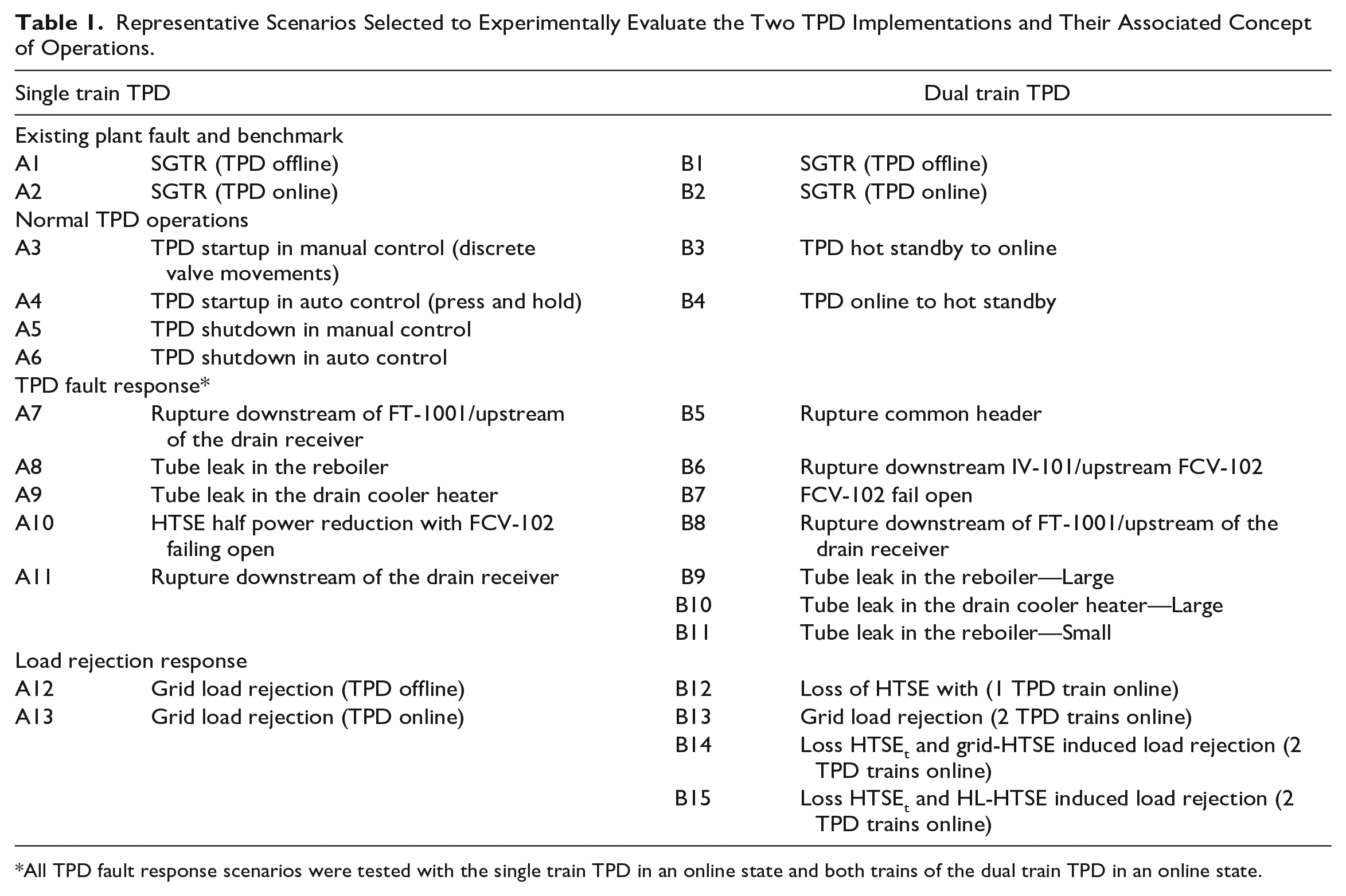
All TPD fault response scenarios were tested with the single train TPD in an online state and both trains of the dual train TPD in an online state.
Scenario-Based Testing Protocol
In each scenario, operators interact with the full-scope simulator and TPD HMI as an exercise to immerse them in the operations of the system integrated into the main control room. An abbreviated operator crew comprised of two licensed operators has been recruited to take part in the study. A typical crew consists of as many as five or six individuals, but this study focuses on one system and therefore the full crew complement is not necessary. In traditional scenario-based testing the bulk of findings come from comments reported by the operators during the debriefs. However, the online measures server to verify operators subject reporting and can provide high-resolution evidence as to how the operator report issue manifested and could manifest in other contexts. Together these form a much more in-depth evaluation of the scenario; however as can be seen below in Figure 1, capturing the online measures during the scenario execution requires a concerted effort across multiple data sources and observers. A key requirement is the time synchronization across the online measures. The time synchronization supports analysis of the plant parameters, automatically logged HMI interaction events, and observer crew behaviors into a cohesive chronological account of the scenario. With this scenario-based approach set of representative data, the study can then form conclusions with supporting evidence to demonstrate a safe and effective TPD concept of operations while identifying any issues in need of further examination and refinement.
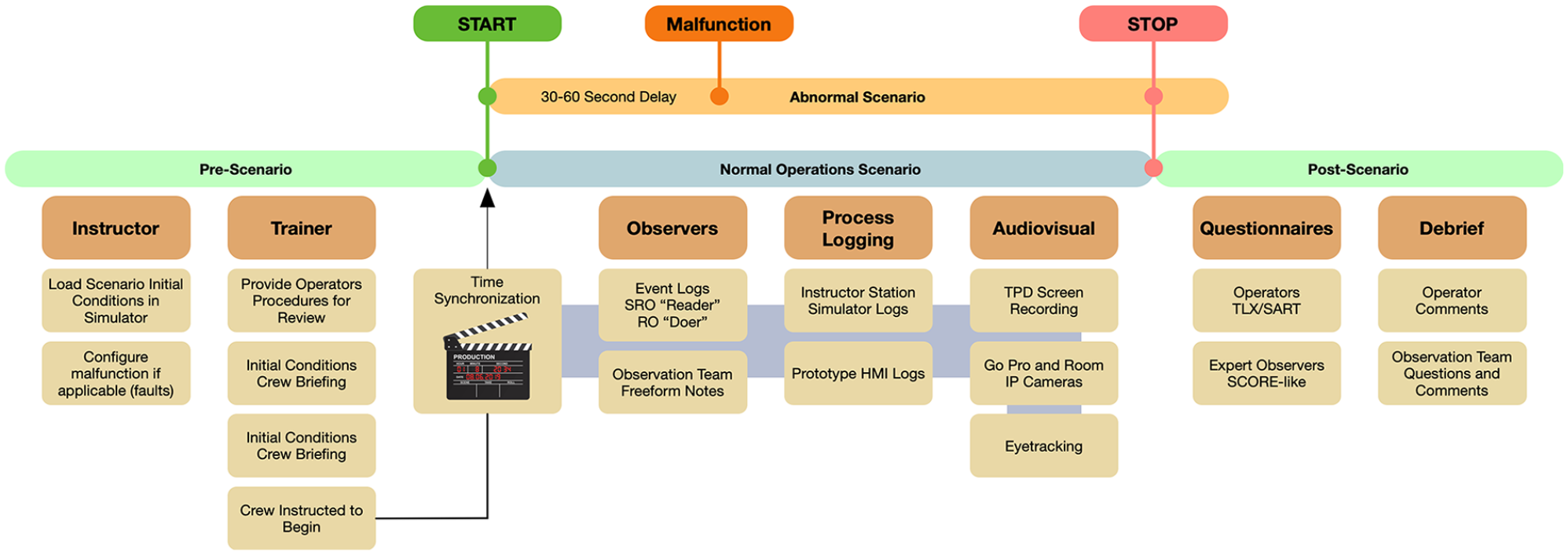
This protocol depicts the roles and activities performed to run scenarios while capturing time-synchronized online operator and system performance measures during the scenario, followed by debriefs. It aims to capture a comprehensive record of overall system performance and operability.
Footnotes
Declaration of Conflicting Interests
The author(s) declared no potential conflicts of interest with respect to the research, authorship, and/or publication of this article.
Funding
The author(s) disclosed receipt of the following financial support for the research, authorship, and/or publication of this article: This work of authorship was prepared as an account of work sponsored by Idaho National Laboratory (under Contract DE-AC07-05ID14517), an agency of the U.S. Government. Neither the U.S. Government, nor any agency thereof, nor any of their employees makes any warranty, express or implied, or assumes any legal liability or responsibility for the accuracy, completeness, or usefulness of any information, apparatus, product, or process disclosed, or represents that its use would not infringe privately owned rights.
