




Abstract
The modern, fast-paced lifestyle intertwined with intricate technological advancements can significantly contribute to stress levels, which can impede decision making and adversely affect action tasks. For Air Traffic Control (ATC) professionals, stress management (SM) skills are increasingly recognized as essential for success. The intent of this study was to evaluate the effectiveness of SM technique training to enhance knowledge about stress and to promote the use of SM techniques. Thirty-one participants from an aeronautical university were assigned to either an experimental group receiving SM training or a control group. A questionnaire assessing SM knowledge and use of SM techniques was administered pre-training, immediately after training, and several weeks after training. Participants in the experimental group showed an increase in SM knowledge and a willingness to use SM techniques, particularly rational self-talk, even weeks after the training. Thus, SM training can improve stress awareness for ATC students, potentially enhancing aviation safety.
Stress can impact individuals of all ages with potentially long-lasting negative effects. The modern, fast-paced lifestyle intertwined with intricate technological advancements significantly contributes to stress levels. When these factors impede decision-making, task completion, and overall comfort, they constitute stress (Lazarus & Folkman, 1984). Both external environmental factors and internal perceptions can trigger psychological stressors (Shahsavarani et al., 2015), often exacerbated by increased work demands exceeding individual capabilities (Hassard & Cox, 2015). Ghorbani et al. (2010) underscore the significance of mindfulness and integrative self-knowledge in enhancing resilience against physical stress symptoms and bolstering overall vitality.
For Air Traffic Control (ATC) professionals, stress management skills are increasingly recognized as essential for success. The Air Traffic Collegiate Training Initiative (ATCTI) highlights a deficiency in stress management skills among ATC college graduates, directly impacting their performance during initial training (called the Academy conducted by the Federal Aviation Administration) once selected as an air traffic controller (Djokic et al., 2010). Technological complexity and heightened traffic demand elevate the complexity of controllers’ roles, making overload stress more prevalent.
Fatigue and stress emerge as common performance detractors for air traffic controllers, posing potential threats to air traffic safety (Zhang et al., 2019). Fatigue slows execution speed and reduces situational awareness, while stress increases the likelihood of control errors or disorders. Elevated stress levels among ATC personnel emphasize the need for effective stress management education to safeguard their well-being and mitigate adverse outcomes (Barrett et al., 2018; Zeier, 1994).
For ATC students, college represents a phase of transition fraught with increased responsibilities and academic demands (Ross et al., 1999). Stressors primarily stem from academic pressures, family expectations, and excessive course workloads (Acharya et al., 2018; Dill & Henley, 1998; Pariat et al., 2014), hindering academic performance and fostering negative behaviors. Unaddressed stress may lead to a cascade of negative consequences, including academic underachievement, strained peer relationships, and diminished social and emotional development (Fallin et al., 2001; Salend, 2012).
The inability to manage stress poses a significant risk to an individual’s well-being during this developmental phase. Academy trainees often share similarities with college students. These individuals, typically of college age, encounter comparable pressures to succeed academically and navigate the uncertainties of impending life changes. Like their peers in traditional college settings, Academy trainees grapple with the stressors associated with coursework and the anticipation of future transitions. Introducing stress management programs in this context can provide these trainees with valuable tools to develop healthy coping mechanisms, enhancing their cognitive, behavioral, and emotional resilience.
This paper presents data of the first part of a study to evaluate the effectiveness of stress management training. The complete study will test 96 participants with ATC class as one of the independent variables (i.e., TRACON, En route, Tower). One of the main intents of this study was to assess the amount of knowledge gained by participants who attended training sessions and whether SMT lectures motivated them to use some of these techniques in their lives, compared to a control group. By analyzing the knowledge difference between these groups, we hope to understand the impact of the training on stress management that can be used for trainees at the Academy and for developmentals at ATC facilities.
Method
Participants
The study was completed by 31 students enrolled in TRACON, Tower, and En route classes at an aeronautical university. The participants were randomly assigned to an experimental group and a control group. Nineteen participants in the experimental group completed the study and 12 participants in the control group completed the study.
Materials and Procedure
The experimental group underwent an interactive Stress Management Training (SMT) training course, originally designed by the National Aeronautics and Space Administration (NASA) for astronauts. The original SMT course was modified for Academy use (Barrett et al., 2018; Torrence et al., 2020), and further adapted for college students. The course was presented over three 1-hr sessions, with a discussion follow-up. Participants received a pre-questionnaire, a post-training questionnaire (immediately following the last session), and a follow-up questionnaire (about 3–4 weeks after the final simulator evaluation). The control group attended lectures and discussions on ATC history over three sessions with a discussion follow-up. They received a pre-questionnaire and a follow-up questionnaire. The questionnaires solicited participants’ responses to knowledge about stress and intent to use techniques for SMT.
Baseline testing was conducted before training began, and testing was conducted during a final graded simulator evaluation for the participants’ enrollment in the air traffic course. The Shimmer 3 GSR + Optical Pulse was used to measure Galvanic Skin Response (GSR). A Garmin Vivosmart smartwatch was used to measure HR and Respiration Rate. The questionnaire assessed SMT knowledge, experience, and opinions. The NASA-TLX was used to measure workload. Data were analyzed by Training Group (SMT) and Control. Pre and Post behaviors were also analyzed.
Results
Because of the unequal participants in each group, one-way ANOVAs were conducted for the control group and the experimental group. No differences were found for any test for the control group. However, a one-way within-subjects ANOVA was conducted to examine the knowledge of the participants in the experimental group by using pre, post, and follow-up knowledge questionnaires. A significant growth in knowledge was found between the pre-training and post-training questionnaires with a slight drop several weeks later F (2, 30) = 8.093, p = .002 (see Figure 1).
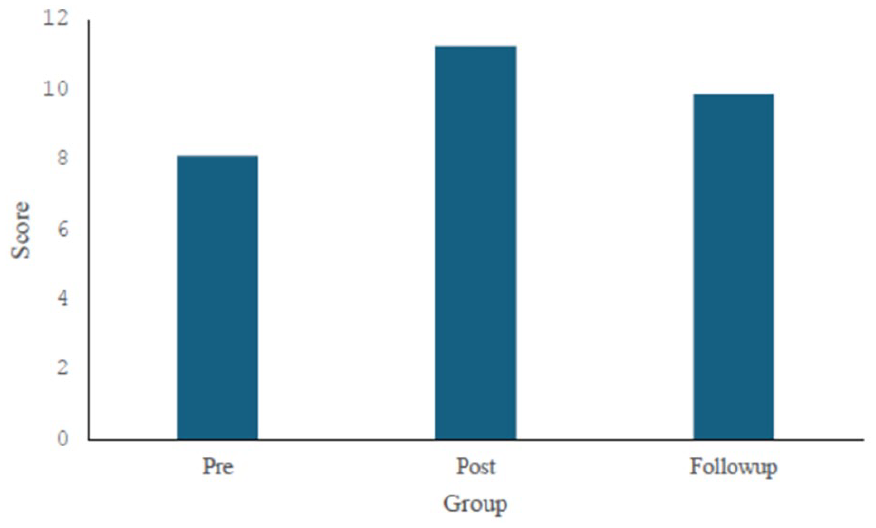
Knowledge questions.
A one-way within-subjects ANOVA for the experimental group showed participants reported greater “knowledge about stress” during the post and follow-up tests compared with the pre-test F (2, 28) = 11.901, p = .001 (see Figure 2).
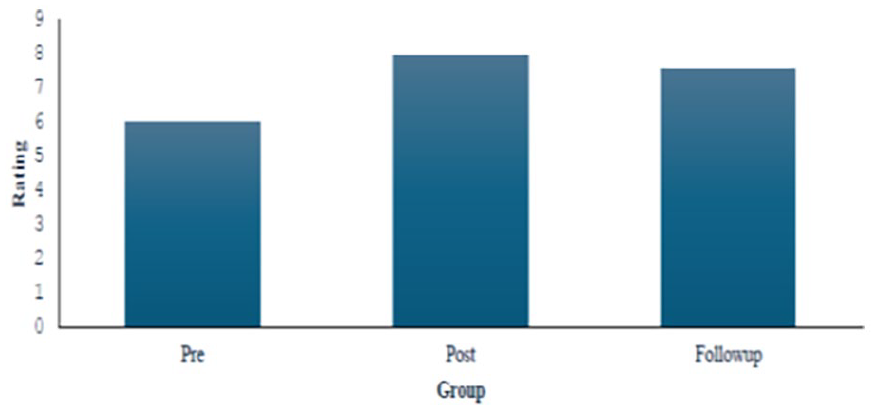
Self-Report “Knowledge about stress”.
A one-way within-subjects ANOVA for the experimental group showed participants reported continued confidence in “knowing what signs to look for when stressed” across the time spectrum from pre-test to follow-up test F (2, 28) = 5.091, p = .013 (see Figure 3).
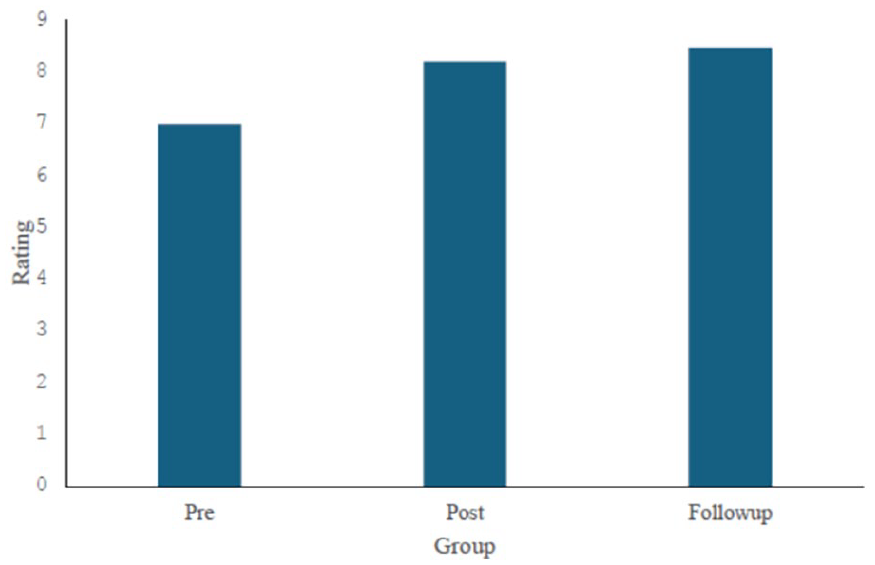
Self-report “Know what signs to look for to know if I am stressed”.
A post-training questionnaire was given to the experimental group about what SMT techniques reviewed in the training sessions were new to the participants (n = 21). Participants reported on average that three of the techniques introduced in the SMT course were new to them with a range of 2 to 6 techniques (see Table 1).
What Stress Management Techniques Were New to You?

Figure 4 shows the SMT techniques the participants plan to try when asked immediately following the course compared to the SMT techniques participants reported that they continued to use several weeks after the semester ended.
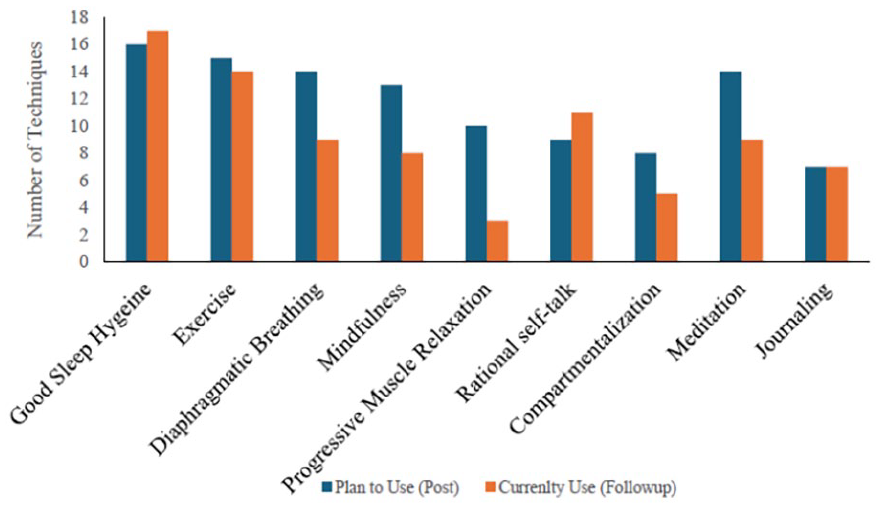
Stress management techniques “tried” and continued.
Discussion
The findings indicate a significant increase in participants’ understanding of stress and its indicators after training. The training was effective in enhancing participants’ theoretical knowledge and their self-awareness regarding personal stress indicators. As expected, the experimental group learned important information about the impact of stress and stress management techniques not only immediately after the course but retained much of that knowledge several weeks later. Even more encouraging is that participants reported confidence to identify the signs to look for when they were stressed, which seemed to improve with time. That is, one becomes more proficient with experience, and in this case, we think the participants became more conscientious when they were experiencing stress. Knowing when to recognize stress will allow one to mitigate the negative impact of it.
The training introduced participants to a variety of stress management techniques. Immediately after the training, participants reported what techniques they planned to use to mitigate stress. Several weeks after the end of the semester, participants reported that progressive muscle relaxation had waned, but more participants reported rational self-talk as a useful tool.
These responses are encouraging that participants are using these techniques in their daily routines, indicating a proactive attitude toward stress management. Thus, training programs such as SMT may be useful in promoting mental health and well-being. Determining the ways to teach knowledge about stress and which techniques participants prefer to use mitigate stress may lead to reducing the negative impact of stress and to greater aviation safety.
Footnotes
Declaration of Conflicting Interests
The author(s) declared no potential conflicts of interest with respect to the research, authorship, and/or publication of this article.
Funding
The author(s) disclosed receipt of the following financial support for the research, authorship, and/or publication of this article: This material is based upon work supported by the Civil Aerospace Medical Institute (AAM-520) and funded by the NextGen Human Factors Division (ANG-C1). Any opinions, findings, conclusions or recommendations expressed in this material are those of the authors and do not necessarily reflect the view of the Civil Aerospace Medical Institute.