




Abstract
Using a Canadian sample of 146 interns surveyed on three occasions (i.e., before, during, and after their internship experiences), we investigated university students’ skills and intentions as critical factors contributing to high-quality intern-supervisor exchanges. Specifically, we sought to better understand how to promote high-quality intern-supervisor relationships by looking at the influences of student-centered factors related to both educational (skills developed while in university) and organizational (intentions to develop relationship with supervisor) domains. To highlight the importance of these factors, we also examined whether their impacts on the quality of intern-supervisor exchanges ultimately translate into better internship outcomes, which we assessed by incorporating perceptions from both interns (i.e., internship satisfaction and general learning) and their supervisors (i.e., interns’ in-role performance and preparedness for work). Consistent with expectations, we found that both students’ skills developed while in university and students’ intentions to develop the relationships with their supervisors were positively related to the quality of intern-supervisor exchanges and, through that pathway, had positive indirect effects on internship satisfaction, general learning, in-role performance, and preparedness for work. Our findings indicate that students, universities, and employers all play a role in the development of high-quality intern-supervisor relationships, which are critical to student learning and performance.
Keywords
Introduction
Student internship programs are university-sponsored employment opportunities designed to prepare students for their future careers (Inceoglu et al., 2019; Margaryan et al., 2022). Also called traineeships, these programs involve a limited period of work experience with an employer – typically under one year – which is neither part of a regular employment relationship nor a formal apprenticeship (O’Higgins & Pinedo, 2018). It is estimated that about half of university students in Canada, the US, and the European Union benefit from completing an internship or a practical experience program each year (Canadian University Survey Consortium, 2021; European Commission, 2013; Stewart et al., 2021). Internships serve as an educational tool for universities by helping students develop career skills and resources (D’Abate et al., 2009), but they are also thought to benefit participating organizations by offering them a recruiting and selection tool to fulfill their future human resources needs (Zhao & Liden, 2011). In light of the many potential advantages of internship programs for students, universities, and organizations alike – and the increased frequency of their use – scholars have sought to better understand how internships can have their intended effects for their multiple stakeholders (Inceoglu et al., 2019; Narayanan et al., 2010). A key takeaway from this emerging body of work is that internship supervisors play a crucial role in the experience and outcomes of internship programs (Inceoglu et al., 2019; Lin & Chen, 2022).
Research evidence illustrates that interns’ attitudes and behaviors are greatly influenced by their supervisors, such that interns who receive more support from their supervisors in the form of mentoring, challenging tasks, autonomy, and performance feedback tend to experience higher levels of learning, performance, and satisfaction, as well as higher chances of being hired by their internship organizations (D’Abate et al., 2009; Liu et al., 2011; Rose et al., 2014). These findings are in line with research on the quality of supervisor-subordinate relationships, or leader-member exchanges (LMX) (Graen & Uhl-Bien, 1995; Liden et al., 1997), which is one of the most well-established bodies of work in the organizational behavior literature. The main idea behind this research is that when supervisors form high-quality relationships with their subordinates, they are more likely to provide those employees with the support and resources necessary for successful job performance (Martin et al., 2016). Because the study of LMX has great potential for furthering our understanding of the internship experience and its outcomes, scholars have recently begun to explore the generalizability of LMX to the internship context (e.g., Masterson et al., 2021; Rose et al., 2014). This promising new research indicates that the quality of the intern-supervisor exchange is a key predictor of critical internship outcomes and, as such, should be nurtured and encouraged. However, there is less clarity around how to do so.
The existing gap in the literature leaves us with questions around how a high-quality relationship can best be formed between interns and their supervisors. Considering the positive implications of such a relationship in the internship context, this is an oversight that needs to be addressed for the benefit of interns, their supervisors, and universities alike. With this view in mind, the main goal of our research was to study antecedents of LMX in an internship context to enhance scholarly understanding of how to promote a high-quality intern-supervisor relationship during university students’ internship experiences. Drawing upon insights from the broader LMX literature (Dulebohn et al., 2012) – and extending these insights to the internship context – we looked at student-centered factors related to both educational (i.e., skills developed while in university) and organizational (i.e., intentions to develop relationship with supervisor) domains. Our interest in these predictors was further motivated by the fact that student skills and intentions can be developed before the beginning of an internship, thus having the potential to give rise to meaningful practical implications. To highlight the importance of our chosen predictors, we also explored whether their impacts on LMX translate into better internship outcomes, which we assessed by incorporating perceptions from both interns and their supervisors (see call for more such research in Inceoglu et al., 2019). Specifically, we focused on interns’ perceptions of their internship satisfaction and general learning, as well as on supervisors’ perceptions of their interns’ in-role performance and preparedness for work in the field. Overall, our research contributes to the internship literature by shedding light on factors contributing to high-quality exchanges between interns and their supervisors (sometimes referred to as the “forgotten educators”; Sosland & Lowenthal, 2017), including an examination of indirect effects of these factors on internship outcomes.
Theoretical Framework
Internship Context
Internships represent a short-term, university-sponsored employment opportunity for students to gain job skills and resources meant to help them better transition into their future careers (Inceoglu et al., 2019; Margaryan et al., 2022). Although internship experiences resemble new relationship development experiences in organizations, such as those of newcomers going through socialization processes, internships are unique relative to traditional employment arrangements due to their short duration and strong developmental focus (Liu et al., 2011). Indeed, internships have been described as “a unique hybrid experience of education and work as students take time out from their education to work full-time in an organization” (Inceoglu et al., 2019, p. 318), allowing them to practice making the transition into the world of work before actually doing so. In addition, there are unique pressures inherent in the internship experience that set it apart from most other types of employment arrangements, including its high levels of uncertainty and power dynamics as a result of students’ younger age and lack of work experience (e.g., it is often students’ first work experience, and thus they lack knowledge about work norms and practices; Masterson et al., 2021; Sobral & Islam, 2015). In spite of these differences, though, the role of supervisors is important in both internship and traditional employment contexts. In particular, a small but growing body of work suggests that the relationship between interns and their supervisors is critical for interns’ attitudes and learning behaviors (e.g., D’Abate et al., 2009; Rose et al., 2014), similar to research on LMX in the organizational behavior literature (e.g., Sparrowe & Liden, 1997), which has long established that a high-quality relationship with one’s leader promotes overall positive outcomes for employees and organizations (Dulebohn et al., 2012; Eisenberger et al., 2019; Martin et al., 2016).
Building on this work, we argue that the unique context of internships makes the role of LMX particularly salient for interns. There are multiple reasons why students are likely to pay special attention to the cues sent by their supervisors and to appreciate, and capitalize on, a developmental relationship with them. First, as alluded to above, students are likely to see their internships as learning opportunities, and thus may perceive their supervisors as “educators” from whom they can learn new competencies. Second, because they typically have limited work experience, students may be particularly attuned to their supervisors to ensure that they understand what is expected of them. Third, power dynamics may also be at play due to age and experience differences, often prompting students to be particularly dependent on, and responsive to, their supervisors’ cues. Last but not least, scholars have contended that “because of the short duration of internships, the most effective way for interns to impress their future employers is to impress their immediate supervisors and establish good relationships with them” (Liu et al., 2011, p. 99). Based on all this, LMX appears to be highly relevant to the internship context.
Despite its potential for helping us better understand internship experiences, LMX has been surprisingly overlooked by internship scholars (Rose et al., 2014). However, two recent studies have established that LMX does matter in the internship context in that its previously observed positive effects also apply to interns and their organizations. Rose et al. (2014) adapted the LMX concept to the intern-supervisor relationship, and showed the relevance of LMX for interns, especially in terms of learning and performance outcomes. More recently, Masterson et al. (2021) found that interns’ happiness-eliciting interactions with their supervisors influenced their perceptions of LMX, which, in turn, increased their intentions to seek full-time employment with their internship-providing organizations. Taken together, these findings suggest that LMX plays a crucial role in internship success, and highlight the need for further LMX research in the internship context, especially in terms of antecedents. Indeed, because the internship context offers a unique hybrid experience of education and work, it provides a distinct opportunity to investigate LMX antecedents that are malleable and context specific.
LMX Theory and Research
Over the past decades, LMX has become a dominant approach in leadership research, and has been recognized as a prominent topic in the field of organizational behavior. LMX proposes a relational view of leadership that emphasizes the dyadic leader-follower relationship and the fact that leaders – that is, individuals with formal authority to influence and support others to meet organizational objectives – do not develop the same types of relationships with all of their followers – that is, their subordinates – (Barling et al., 2011). Based on role theory (Kahn et al., 1964), LMX scholars have proposed that LMX develops through a role-making process (Graen & Scandura, 1987; Wang et al., 2023): the role-taking phase, during which the leader sends role cues and evaluates the member’s potential and motivations; the role-making phase, during which the leader and the member begin to define the nature of their relationship; and the role-routinization phase, during which the relationship stabilizes and both the leader and the member have mutual expectations of behaviors. LMX scholars have also used social exchange theory (Blau, 1964) to explain leader-follower relationship formation: after the initial interaction between the leader and the member, a sequence of exchanges follows “in which individuals ‘test’ one another to determine whether they can build the relational components of trust, respect, and obligation necessary for high-quality exchanges to develop” (Maslyn & Uhl-Bien, 2001, p. 698).
Whereas an abundance of research has demonstrated the role of LMX in predicting important follower and organizational outcomes (see meta-analyses by Dulebohn et al., 2012, Eisenberger et al., 2019, and Martin et al., 2016), much less is known about the antecedents of LMX, despite the fact that scholars have long called for more research on them (e.g., Gerstner & Day, 1997). In the organizational context, LMX antecedents have been categorized into follower characteristics (e.g., competence, personality), leader characteristics (e.g., contingent reward behaviors, perceptions of followers), and interpersonal relationship factors (e.g., upward influence behaviors, perceived similarity) (see Dulebohn et al.’s 2012 meta-analysis). Most research on LMX antecedents in the organizational context has focused on the role of leader characteristics, as leaders have been seen as dominant figures in determining the quality of leader-follower relationships (Dulebohn et al., 2012). However, scholars have increasingly recognized the importance of followership (e.g., Carsten et al., 2010; Uhl-Bien et al., 2014), and recent research has started to emphasize the role of followers in influencing LMX (e.g., Xu et al., 2019). Therefore, examining how follower characteristics shape LMX is a worthwhile endeavor.
Predictors of LMX in the Internship Context
Although there is a need for more research on follower-focused antecedents of LMX in the organizational context, this is even more the case when it comes to the internship context. Indeed, we currently know very little about student-centered factors contributing to the development of high-quality intern-supervisor relationships. Based on prior LMX research in organizational settings, we thus propose that LMX in the internship context is influenced by interns’ soft skills before the beginning of their internship experiences (i.e., a follower characteristic related to competence that includes skills like critical thinking, adaptability, and collaboration; Franco-Ángel et al., 2023), as well as interns’ intent to put effort into developing the relationships with their future supervisors (i.e., an interpersonal relationship factor related to upward influence). We develop our rationale for examining these two antecedents below.
Soft Skills
In their meta-analysis, Dulebohn et al. (2012) showed that the follower characteristic that displays the strongest relation with LMX is competence (ρ = .38). Indeed, competence is one of the qualities that managers look for and value the most in their subordinates (Uhl-Bien et al., 2022). However, despite its prominence in early LMX theory and research, competence has received relatively less attention to date, and its most common measures have been general ability and experience (Dulebohn et al., 2012) – two follower characteristics that offer limited practical implications for LMX development in today’s organizations, especially in internship settings. Drawing from these insights and adapting them to the internship context, we contend that in the initial phase of relationship formation, supervisors will be particularly attentive to interns’ soft skills (also known as generic skills) in order to determine their future roles. Soft skills include transferable competencies such as critical thinking, adaptability, problem-solving, communication, and collaboration, and stand in contrast with hard skills, which refer to technical competencies that are tied to specific tasks (Franco-Ángel et al., 2023; Kember et al., 2007). To succeed in today’s knowledge-based economy that is facing rapid technological advancements, a hyper-competitive global labor market, and flatter management structures, employees are increasingly required to possess soft skills (e.g., Greiff et al., 2015; Succi & Canovi, 2020). Correspondingly, soft skills have been shown to be a critical predictor of students’ career preparedness, making them more successful in the transition from school to work (Marciniak et al., 2021). As such, it is arguably the role of higher-education institutions to develop these skills in students to better prepare them for their future careers (Kember et al., 2007). Based on this perspective and in line with role theory (Kahn et al., 1964), we propose that students who have acquired these skills before their internships will signal higher levels of competence to their supervisors during the role-taking phase, thereby encouraging them to make further investments into relationship development during the role-making and role-routinization phases, leading to higher-quality exchanges.
Soft skills are positively related to LMX.
Intended Effort to Develop Relationship With Supervisor
In addition to students’ skills, we examine students’ intentions to exert effort toward relationship development with their supervisors as an interpersonal relationship factor contributing to high-quality intern-supervisor exchanges. In the LMX literature, effort put into relationship development is a relationship-relevant subordinate behavior (Maslyn et al., 2017). In fact, research has shown that for both managers and subordinates, exerting effort toward relationship development has a positive impact on LMX (Maslyn & Uhl-Bien, 2001). Turning to the internship context, research has revealed that students’ internship expectations influence their internship experiences, specifically their attitudes toward various facets of the internship (e.g., Feldman & Weitz, 1990). In line with the theory of planned behavior (Ajzen, 1991), we anticipate that interns who intend – before their internship begins – to invest time and energy in developing good relationships with their supervisors will likely engage in such behaviors. As a result, based on social exchange principles (Blau, 1964), we propose that these interns’ intentions to exert effort toward relationship development with their supervisors will spark a cycle of positive exchanges, making it more likely that high-quality relationships will be formed. This is consistent with recent research emphasizing the role of followers in influencing LMX, for instance through helpful behaviors that invite positive leader responses (Xu et al., 2019).
Intended effort to develop relationship with supervisor is positively related to LMX.
Predictors of LMX and Internship Outcomes
According to LMX theory, a high-quality relationship is characterized by respect, trust, loyalty, appreciation, and support, whereas a low-quality relationship is characterized by more contractual exchanges (Martin et al., 2010). The leadership literature has recognized the influence of LMX on several behavioral, attitudinal, and perceptual variables at the employee level (Dulebohn et al., 2012). In this study, we focus on four student-related outcomes (i.e., internship satisfaction, general learning, in-role performance, and preparedness for work) to examine indirect effects of our predictors (i.e., soft skills and intended effort to develop relationship with supervisor) via LMX. Examining such indirect effects is critical to demonstrating the relevance of students’ skills and intentions as predictors of LMX in an internship context.
First, we propose that through their influence on LMX, students’ skills and intentions will have positive indirect effects on students’ internship satisfaction. This is because LMX is positively related to internship satisfaction. Drawing from a resource perspective (e.g., conservation of resources theory; Hobfoll et al., 2018) and building on discrepancy theories of satisfaction (see Diener et al., 1999, for a review), the literature suggests that high-quality supervisor-subordinate relationships lead to resource-enriching work experiences that positively shape employees’ appraisals of their jobs (Liang et al., 2022). In the organizational context, prior research has demonstrated a robust relation between LMX and job satisfaction (see Dulebohn et al., 2012), a finding that has also been replicated in the internship context (Rose et al., 2014).
Soft skills (H3a) and intended effort to develop relationship with supervisor (H3b) have positive indirect effects on internship satisfaction via LMX.
Second, we propose that through their influence on LMX, students’ skills and intentions will have positive indirect effects on students’ general learning. This is because LMX is positively related to general learning. Because internships are integrated into academic programs, one of their aims is to complement in-class learning with on-the-job learning. In line with Rose et al. (2014), we argue that LMX will contribute to interns’ general learning during their internships because high-quality relationships come with greater provision of support, feedback, and goal setting from supervisors (e.g., Martin et al., 2010). This argument is corroborated by social learning theory (Bandura, 1977), which suggests that individuals can learn not only from their own direct experiences, but also from observing and replicating others’ behaviors, especially those whom they hold in high regard. Consistent with expectations, Rose et al. (2014) found a positive relation between LMX and general learning in the internship context.
Soft skills (H4a) and intended effort to develop relationship with supervisor (H4b) have positive indirect effects on general learning via LMX.
Third, we propose that through their influence on LMX, students’ skills and intentions will have positive indirect effects on students’ in-role performance. This is because LMX is positively related to in-role performance. In the organizational context, meta-analytic results have shown that LMX contributes to in-role performance (Dulebohn et al., 2012). This effect can be explained by social exchange theory (Blau, 1964) and the norm of reciprocity (Gouldner, 1960) because employees who experience high-quality LMX receive more resources from their supervisors, and, as a result, tend to feel compelled to reciprocate via behaviors that are beneficial to their organizations. Despite the shorter durations and arguably lower commitment levels associated with intern-supervisor relationships compared to regular employee-supervisor relationships (D’Abate et al., 2009), the positive relation between LMX and in-role performance has also been observed in the internship context (Rose et al., 2014).
Soft skills (H5a) and intended effort to develop relationship with supervisor (H5b) have positive indirect effects on in-role performance via LMX.
Fourth, we propose that through their influence on LMX, students’ skills and intentions will have positive indirect effects on students’ preparedness for work. This is because LMX is positively related to preparedness for work. As mentioned above, high-quality LMX comes with better resources from supervisors. One such resource is career mentoring. According to the supervisory career mentoring literature, employees who receive mentoring from their supervisors experience higher levels of career development (Scandura & Schriesheim, 1994; Scandura & Williams, 2004), and such mentoring is more likely to take place in high-quality supervisor-subordinate relationships (McManus & Russell, 1997). Indeed, research has found that employees who develop high-quality relationships with their supervisors receive more career advantages both inside their current organizations (e.g., higher supervisory assessments of promotability; Wayne et al., 1999) and outside those organizations (e.g., better career outcomes after a change in employer; Raghuram et al., 2017). These effects can be theoretically justified using sponsorship theory (Wayne et al., 1999), which suggests that leaders in high-quality relationships with their followers provide high levels of sponsorship resources (e.g., mentoring, developmental opportunities) that improve their followers’ work capabilities. We expect this mechanism to also hold in an internship context.
Soft skills (H6a) and intended effort to develop relationship with supervisor (H6b) have positive indirect effects on preparedness for work via LMX.
Method
Participants and Procedure
Participants were full-time undergraduate students enrolled in business programs at a large, francophone, public, comprehensive university in a Canadian metropolitan area. These programs include internship opportunities lasting one academic term (i.e., 3-4 months) that are typically completed in the penultimate year of studies. An internship coordination center helps students find internships and supports them throughout their internship experiences. Internships placements are available in various sectors of work, the most common being accounting, fashion management, human resources management, and marketing. Although not all programs require the completion of a work term, for the vast majority of the participants in our final sample (76.71%), the internship component was mandatory. Students were recruited through internship program directors over the course of five academic terms and received course credits for their participation in the study.
Data were collected using online self-report questionnaires administered at three time points: before the beginning of the internship (T1), around the mid-point of the internship (T2), and shortly before the end of the internship (T3). We sent invitations to 324 students and received T1 surveys from 180 of them (55.56%). Of the 180 students who provided T1 surveys, 167 (92.78%) also provided T2 surveys, and of the 167 students who provided both T1 and T2 surveys, 151 (90.42%) also provided T3 surveys. Therefore, our final response rate was 46.60%. Because of missing data on relevant variables, five participants were excluded from the sample. The average age of the interns in our final sample (N = 146) was 23.44 years (SD = 3.70), and approximately 88% of them identified as female. We assessed soft skills and intended effort to develop relationship with supervisor at T1, LMX at T2, and internship satisfaction and general learning at T3. Our decision to measure LMX around the mid-point of the internship was guided by prior research on early LMX development (see, e.g., Liden et al., 1993), as well as by best-practice recommendations for testing indirect effects (Cain et al., 2018).
Mean Comparisons Between Subsamples.
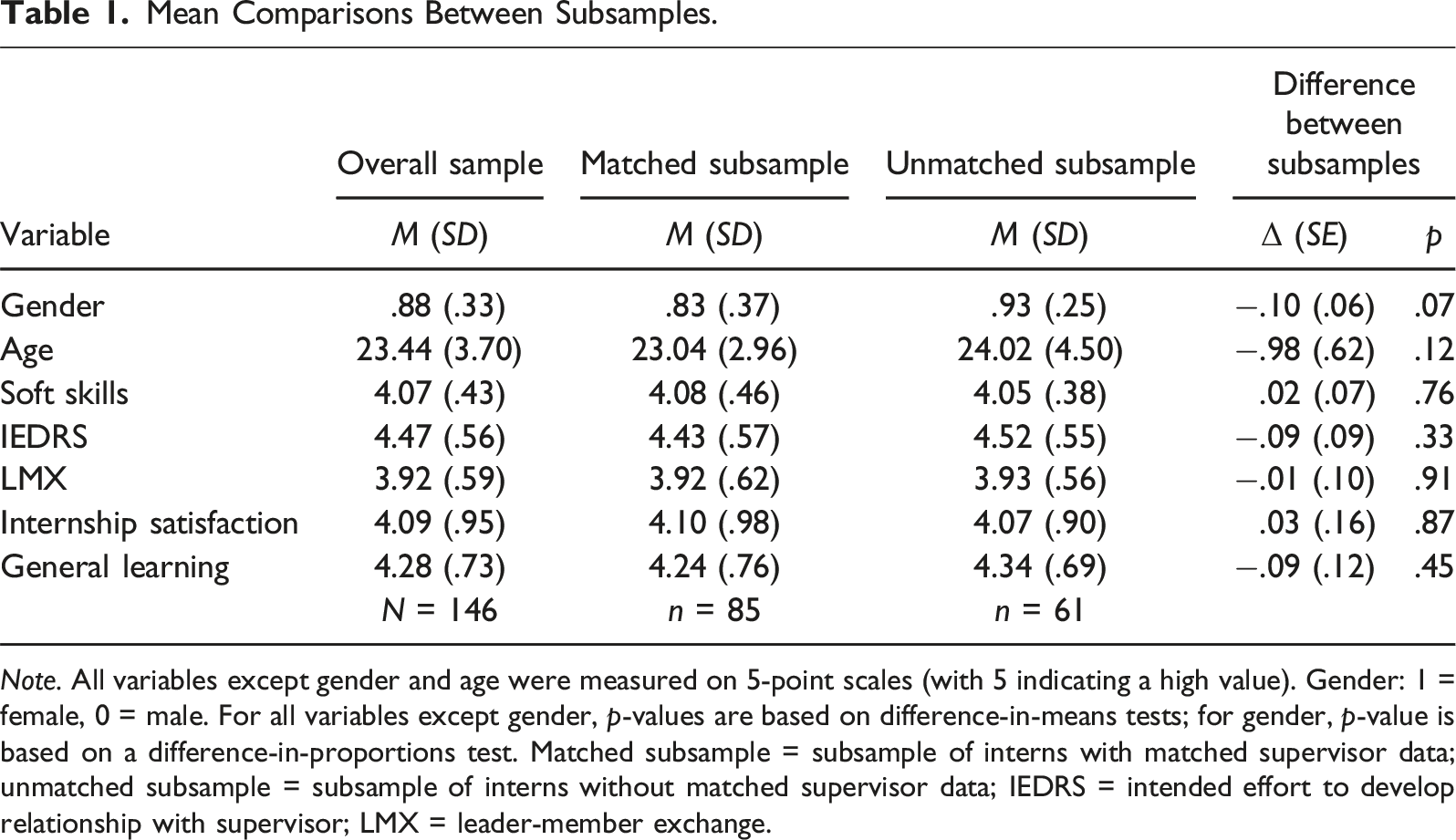
Note. All variables except gender and age were measured on 5-point scales (with 5 indicating a high value). Gender: 1 = female, 0 = male. For all variables except gender, p-values are based on difference-in-means tests; for gender, p-value is based on a difference-in-proportions test. Matched subsample = subsample of interns with matched supervisor data; unmatched subsample = subsample of interns without matched supervisor data; IEDRS = intended effort to develop relationship with supervisor; LMX = leader-member exchange.
Measures
As the study was conducted in a French-speaking context, measures were translated into French using a standard translation back-translation procedure (Brislin, 1990). All variables were assessed using 5-point Likert-type scales (with 5 indicating a high value).
Soft Skills
We assessed soft skills with the 12-item scale used by Kember et al. (2007) to measure critical thinking, self-managed learning, adaptability, problem solving, communication skills, as well as interpersonal skills and groupwork. The original coefficient alphas for the six two-item subscales ranged from .72 for adaptability to .78 for critical thinking (based on a sample of full-time students; Kember & Leung, 2005). Because the scale was specifically designed to measure the development of soft skills while in university, we used all its items in their original version. Sample items include “During my time at university, I have learned how to be more adaptable” and “I have learned how to become an effective team or group member.” The coefficient alpha for the overall measure of soft skills in our study was .86 for the matched subsample and .84 for the overall sample.
Intended Effort to Develop Relationship With Supervisor
We assessed intended effort to develop relationship with supervisor with three items adapted from the future effort scale developed by Maslyn and Uhl-Bien (2001). The original coefficient alpha for this scale was .79 (Maslyn & Uhl-Bien, 2001). Because our assessment took place before the beginning of internships, adaptations to the original items were necessary to reflect the absence of prior relationships between students and their future internship supervisors, as well as the uncertainty about students’ behavioral responses to the demands of their future internships. The final three items are “I will strive to develop a good relationship with my internship supervisor,” “Establishing an effective relationship with my internship supervisor is a priority for me,” and “I don’t think I will invest time and energy in building a good relationship with my internship supervisor.” The coefficient alpha for our three-item measure was .69 for the matched subsample and .70 for the overall sample.
LMX
We assessed LMX with the 12-item multidimensional scale developed by Liden and Maslyn (1998), which captures LMX’s four dimensions: affect, loyalty, contribution, and professional respect. The original coefficient alphas for the four three-item subscales were .90 for affect, .78 for loyalty, .74 for contribution, and .92 for professional respect (based on a sample of working students; Liden & Maslyn, 1998). Because the scale was designed for any type of supervisor-subordinate relationship, we used all its items in their original version. Sample items include “I like my supervisor very much as a person” and “I respect my supervisor’s knowledge of and competence on the job.” The coefficient alpha for the overall measure of LMX in our study was .88 for both the matched subsample and the overall sample.
Internship Satisfaction
We assessed internship satisfaction with three items adapted from the work facet of the job descriptive index developed by Roznowski (1989), and one discrepancy-based item (i.e., “The internship corresponds to what I am looking for”) developed for the purpose of this study. The decision to focus on a cognitive (rather than affective) measure of facet job satisfaction was motivated by the desire to avoid conceptual overlap with the affect dimension of LMX. The original coefficient alpha for the work facet of the job descriptive index was .87 for the full version of the subscale (Roznowski, 1989) and .84 for the abridged version of the subscale (Stanton et al., 2002). Adaptations to one of the original items were made to capture the strong developmental focus of internships. The final three items are “My internship is interesting,” “My internship is challenging,” and “This internship is a good learning experience.” The extra item specifically developed for this study was included in light of previous research findings on the benefits (including incremental validity) of single-item, discrepancy-based measures of facet job satisfaction (Nagy, 2002). The coefficient alpha for our four-item measure was .93 for both the matched subsample and the overall sample.
General Learning
We assessed general learning with the three-item learning opportunity scale developed by D’Abate et al. (2009), supplemented by two items (i.e., “My internship has improved my technical skills in my specialty area” and “So far in my internship, I have learned new skills or knowledge that is important for my career development”) from the learning scale developed by Beenen and Rousseau (2010). The original coefficient alpha for the learning opportunity scale was .76 (D’Abate et al., 2009). Because the scale was specifically designed for the internship context, we used all its items in their original version. A sample item is “My internship has taught me a lot of things that I would never have been able to learn in the classroom.” The two additional items from Beenen and Rousseau’s (2010) scale – which was also designed to assess learning in internship contexts – were used to increase content validity. The coefficient alpha for our five-item measure was .88 for the matched subsample and .87 for the overall sample.
In-role Performance
We assessed in-role performance using six items from the in-role behaviors scale developed by Williams and Anderson (1991), and one additional item (i.e., “This intern regularly performs quality work”) developed for the purpose of this study. The original coefficient alpha for the seven-item in-role behaviors scale was .91 (Williams & Anderson, 1991). One of the original seven items (i.e., “Engages in activities that will directly affect his/her performance evaluation”) – which also happened to be the item with the lowest factor loading – was omitted because it seemed less compatible with the unique characteristics of internships (i.e., short duration and strong developmental focus). The remaining six items were used in their original version. A sample item is “This intern adequately completes assigned duties.” The new item specifically developed for this study was included to increase content validity. The coefficient alpha for our seven-item measure was .86 (only available for the matched subsample).
Preparedness for Work
We assessed preparedness for work with four items adapted from the confidence in preparation for work scale developed by Taylor (1988). The original coefficient alpha for this scale was .60 (Taylor, 1988). Adaptations to the original scale were necessary to reflect the shift from self-reports to supervisor reports. The final four items are “This intern is prepared to perform a full-time job in his/her major field of study,” “This intern will perform well on his/her first permanent job,” “This intern can successfully carry out job duties in his/her field of study,” and “I doubt that this intern has the abilities to do this work” (reverse scored). The coefficient alpha for our four-item measure was .85 (only available for the matched subsample).
Results
Descriptive Statistics, Reliabilities, and Bivariate Correlations.
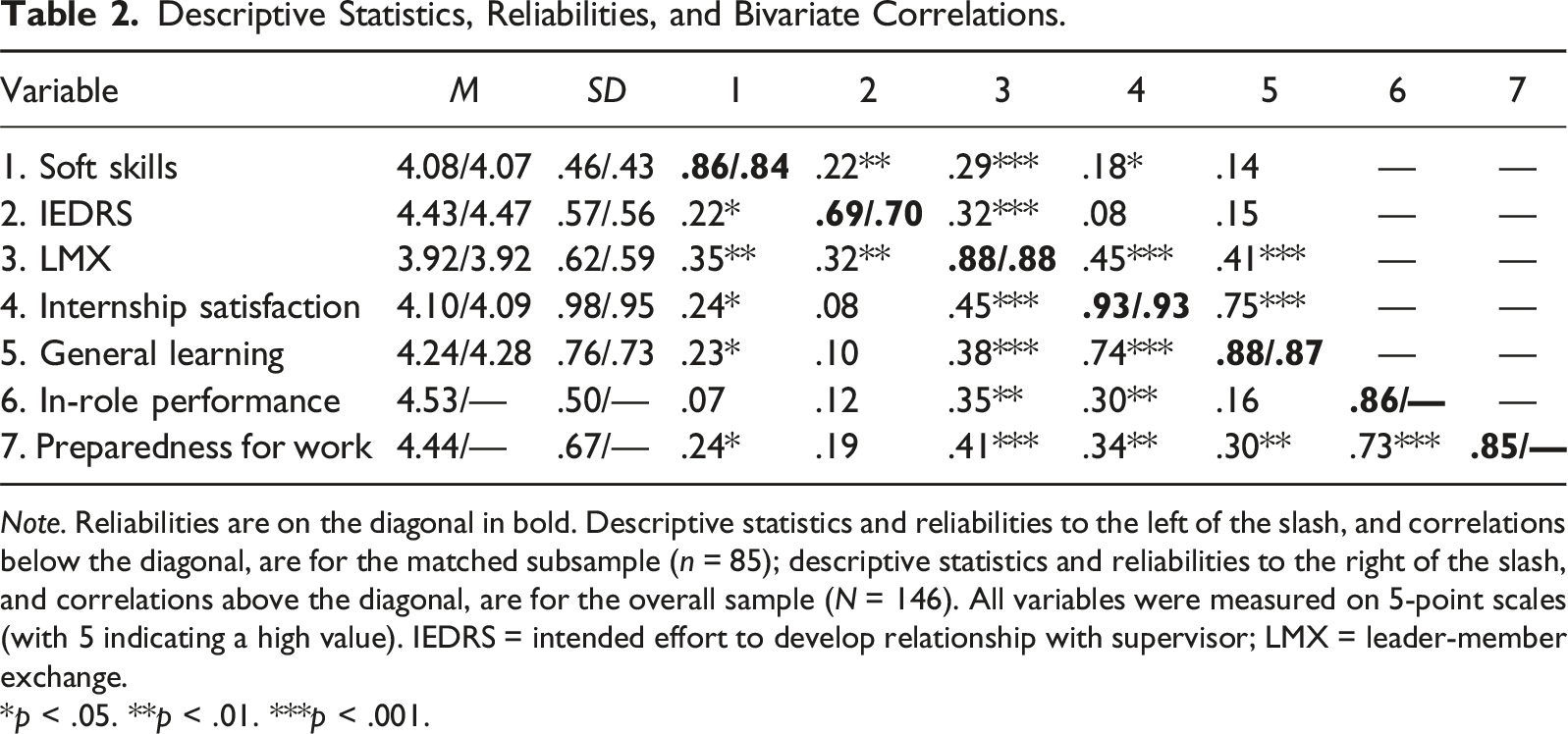
Note. Reliabilities are on the diagonal in bold. Descriptive statistics and reliabilities to the left of the slash, and correlations below the diagonal, are for the matched subsample (n = 85); descriptive statistics and reliabilities to the right of the slash, and correlations above the diagonal, are for the overall sample (N = 146). All variables were measured on 5-point scales (with 5 indicating a high value). IEDRS = intended effort to develop relationship with supervisor; LMX = leader-member exchange.
*p < .05. **p < .01. ***p < .001.
CFA results for the matched subsample revealed that the default seven-factor model in which soft skills, intended effort to develop relationship with supervisor, LMX, internship satisfaction, general learning, in-role performance, and preparedness for work were assumed to load onto their intended factors provided a good fit to the data (Satorra-Bentler chi-square (
Path-Analytic Regression Results for the Matched Subsample.
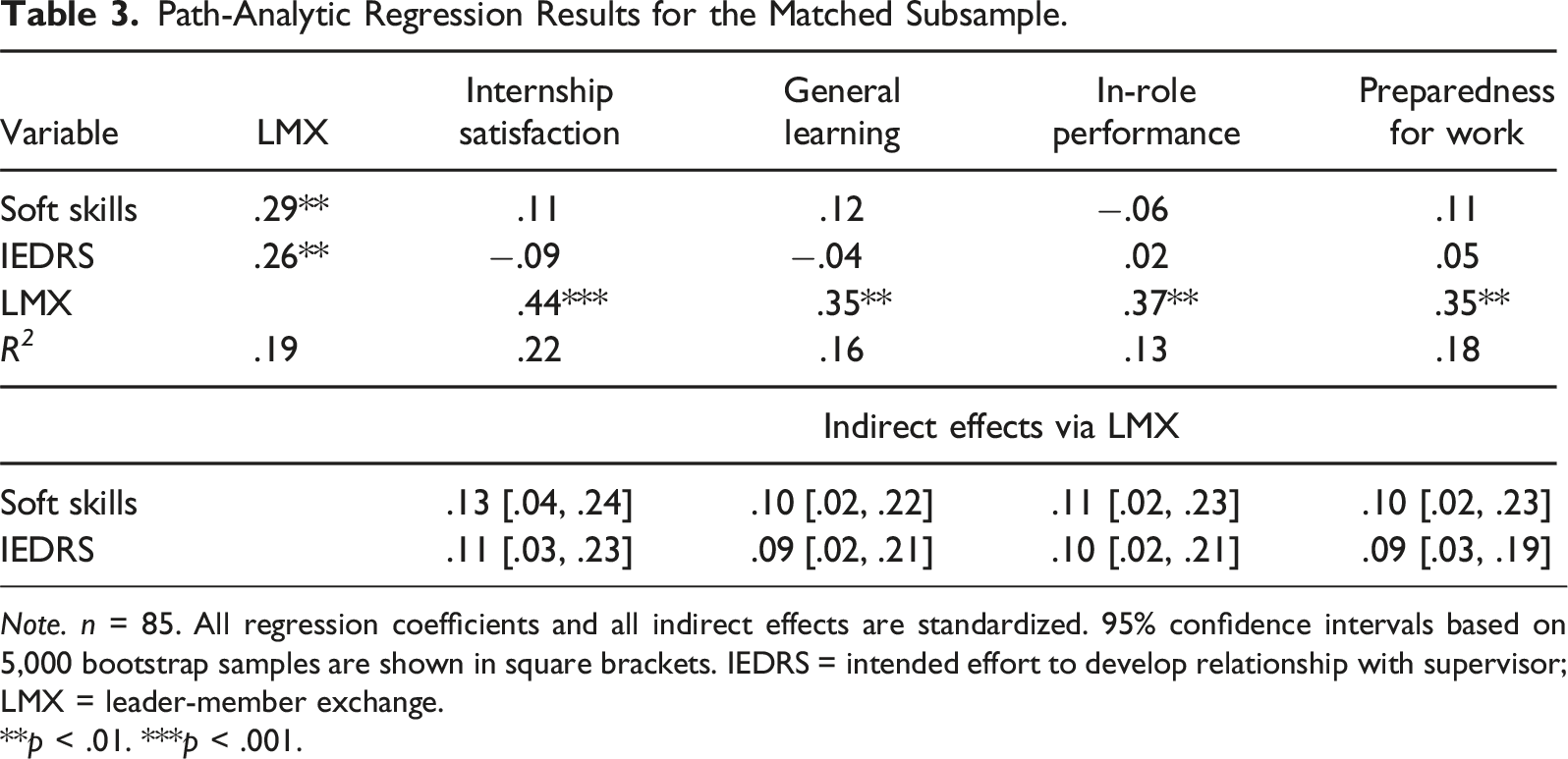
Note. n = 85. All regression coefficients and all indirect effects are standardized. 95% confidence intervals based on 5,000 bootstrap samples are shown in square brackets. IEDRS = intended effort to develop relationship with supervisor; LMX = leader-member exchange.
**p < .01. ***p < .001.
Path-Analytic Regression Results for the Overall Sample.
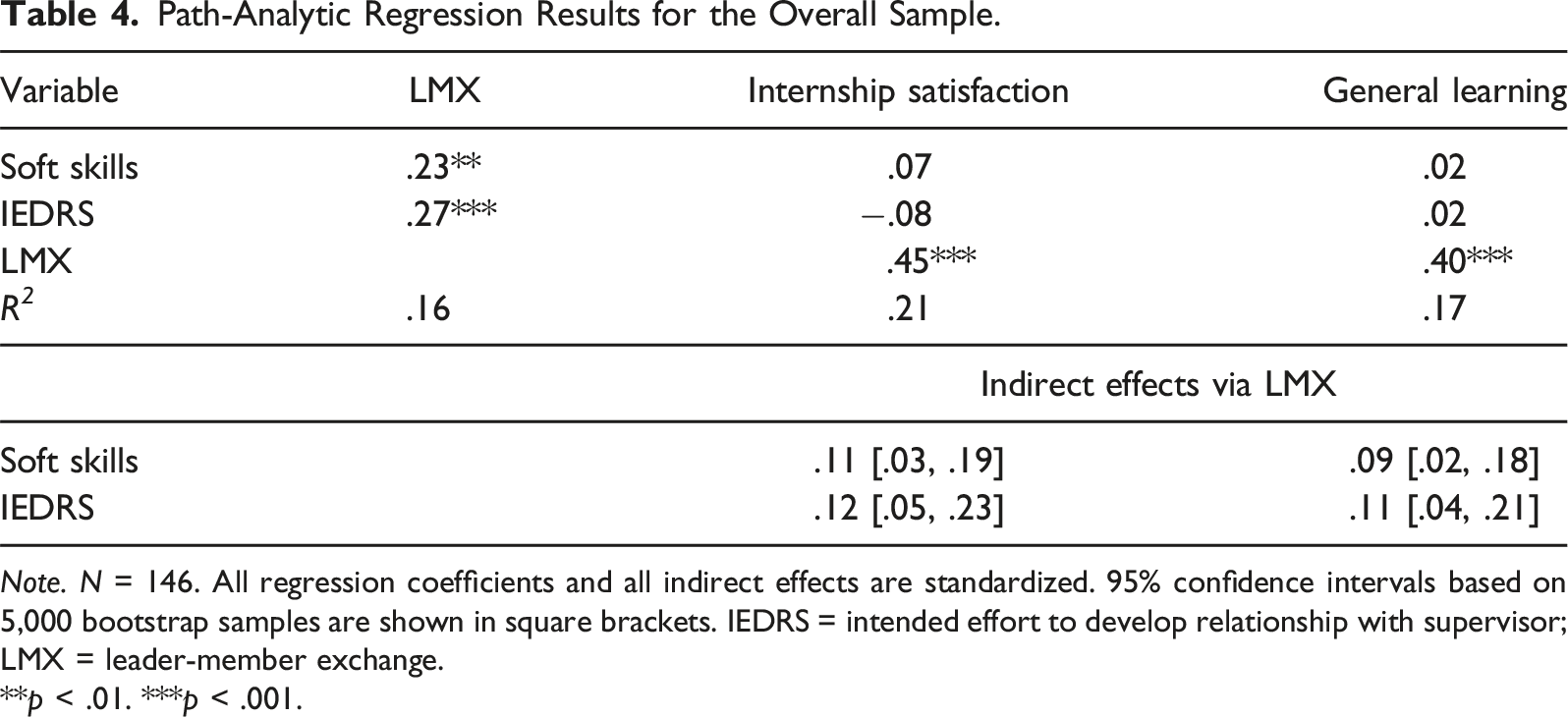
Note. N = 146. All regression coefficients and all indirect effects are standardized. 95% confidence intervals based on 5,000 bootstrap samples are shown in square brackets. IEDRS = intended effort to develop relationship with supervisor; LMX = leader-member exchange.
**p < .01. ***p < .001.
In H2, we proposed that intended effort to develop relationship with supervisor is positively related to LMX. As shown in Table 2, the bivariate correlation between intended effort to develop relationship with supervisor and LMX was positive and significant (r = .32, p = .003 for the matched subsample, and r = .32, p < .001 for the overall sample). Moreover, regression results revealed a positive and significant effect of intended effort to develop relationship with supervisor on LMX (b = .26, p = .009 for the matched subsample, and b = .27, p < .001 for the overall sample) even after accounting for the effect of soft skills on LMX (see Tables 3 and 4). These results supported H2.
In H3, we proposed that soft skills (H3a) and intended effort to develop relationship with supervisor (H3b) have positive indirect effects on internship satisfaction via LMX. As shown in Tables 3 and 4, both the indirect effect of soft skills on internship satisfaction via LMX (estimate = .13, 95% CI = [.04, .24] for the matched subsample, and estimate = .11, 95% CI = [.03, .19] for the overall sample) and the indirect effect of intended effort to develop relationship with supervisor on internship satisfaction via LMX (estimate = .11, 95% CI = [.03, .23] for the matched subsample, and estimate = .12, 95% CI = [.05, .23] for the overall sample) were positive and significant. These results supported both H3a and H3b.
In H4, we proposed that soft skills (H4a) and intended effort to develop relationship with supervisor (H4b) have positive indirect effects on general learning via LMX. As shown in Tables 3 and 4, both the indirect effect of soft skills on general learning via LMX (estimate = .10, 95% CI = [.02, .22] for the matched subsample, and estimate = .09, 95% CI = [.02, .18] for the overall sample) and the indirect effect of intended effort to develop relationship with supervisor on general learning via LMX (estimate = .09, 95% CI = [.02, .21] for the matched subsample, and estimate = .11, 95% CI = [.04, .21] for the overall sample) were positive and significant. These results supported both H4a and H4b.
In H5, we proposed that soft skills (H5a) and intended effort to develop relationship with supervisor (H5b) have positive indirect effects on in-role performance via LMX. As shown in Table 3, both the indirect effect of soft skills on in-role performance via LMX (estimate = .11, 95% CI = [.02, .23]) and the indirect effect of intended effort to develop relationship with supervisor on in-role performance via LMX (estimate = .10, 95% CI = [.02, .21]) were positive and significant. These results supported both H5a and H5b.
Finally, in H6, we proposed that soft skills (H6a) and intended effort to develop relationship with supervisor (H6b) have positive indirect effects on preparedness for work via LMX. As shown in Table 3, both the indirect effect of soft skills on preparedness for work via LMX (estimate = .10, 95% CI = [.02, .23]) and the indirect effect of intended effort to develop relationship with supervisor on preparedness for work via LMX (estimate = .09, 95% CI = [.03, .19]) were positive and significant. These results supported both H6a and H6b.
Discussion
The goal of our research was to contribute to the intersection of the literatures on internships and LMX (see Masterson et al., 2021, and Rose et al., 2014, for prior contributions) by investigating antecedents of the quality of intern-supervisor exchanges. Our investigation sheds light on two proximal factors that can facilitate high-quality exchanges between interns and their supervisors: students’ soft skills developed while in university and students’ pre-internship intentions to exert effort toward relationship development with their supervisors. Our work further indicates that through their influence on LMX, these skills and intentions also act as distal factors contributing to better internship outcomes, such as internship satisfaction, general learning, in-role performance, and preparedness for work. Taken together, these findings suggest that students, universities, and employers all play a role in the development of high-quality intern-supervisor relationships, which are critical to student learning and performance.
Theoretical Contribution
Although the study of LMX has only recently been brought to the attention of internship scholars, emerging evidence has supported the generalizability of LMX to the internship context by showing that the quality of intern-supervisor exchanges has positive effects on interns’ learning and performance (Masterson et al., 2021; Rose et al., 2014). In light of these important effects, there is a clear need to expand the surprisingly limited body of research on antecedents of LMX in an internship context. To contribute to the internship literature and help us learn from the rich body of work on LMX in the organizational context – and vice versa – we developed and empirically assessed a model in which interns’ skills and intentions serve as proximal predictors of LMX and, via LMX, as distal predictors of several key internship outcomes (i.e., internship satisfaction, general learning, in-role performance, and preparedness for work). Put differently, we added to emerging research on LMX in the internship context by investigating student-centered factors that can help promote high-quality relationships between interns and their supervisors, thereby leading to better internship outcomes.
Research by Masterson et al. (2021) suggests that LMX is influenced by interns’ happiness, albeit in nuanced ways (i.e., happiness variability enhances perceptions of high-quality LMX for interns who are low in optimism and core self-evaluation). To provide insights into other ways to promote LMX in an internship context, we established that interns are more likely to build positive relationships with their supervisors when they have relevant skills (i.e., soft skills) and intentions (i.e., intentions to exert effort toward relationship development with their supervisors). To our knowledge, these predictors have not received scholarly attention before. The literature on LMX development is considered quite limited so far (Masterson et al., 2021), and thus we shine a spotlight on ways in which educational institutions and organizations can help foster high-quality intern-supervisor relationships.
As a foundation for our research, we argued that the unique pressures inherent in the internship experience, including its strong developmental focus (Liu et al., 2011) and its high levels of uncertainty and power dynamics (Masterson et al., 2021; Sobral & Islam, 2015), make the intern-supervisor exchanges particularly salient and impactful for interns. This foundation was important not only in our theorizing about the direct effects of interns’ skills and intentions on LMX, but also in our theorizing about their indirect effects on internship outcomes via LMX. To assess internship outcomes, we built on prior research on the multifaceted nature of internship effectiveness (Narayanan et al., 2010), and used different types of indicators as reported by multiple raters, including interns’ perceptions of their internship satisfaction and general learning, and supervisors’ perceptions of their interns’ in-role performance and preparedness for work in the field. Our results revealed that both antecedents had positive indirect effects via LMX on all these indicators of internship success, further attesting to the relevance of students’ skills and intentions as predictors of LMX in an internship context.
All in all, our research extends prior work on LMX in an intership context to indicate that (a) high-quality intern-supervisor relationships can be promoted through the development of the right skills and intentions in students prior to their internship experiences, and (b) developing the right skills and intentions in students prior to their internship experiences will ultimately ensure students’ success at the end of their internship experiences. These findings fit within the larger body of work on LMX in traditional employment contexts, where employee competence has been positively linked to LMX (Dulebohn et al., 2012), and LMX has been positively linked to employee success (e.g., performance; Eisenberger et al., 2019; Martin et al., 2016). As such, our work emphasizes the promotability of high-quality exchanges between supervisors and subordinates in early-stage, short-term employment contexts such as internships. It also encourages more investigations of antecedents of LMX in the internship context so that the benefits of internships for students, universities, and employers alike can be further enhanced.
Practical Implications
Considering the various potential advantages of internship programs for students, universities, and organizations alike, our research offers insights into how some of these benefits can be brought to fruition. From an educational perspective, universities should ensure that students develop soft skills prior to their internship experiences because such skills will facilitate their ability to build high-quality relationships with their internship supervisors. This, in turn, will increase their chances of learning during their internship experiences, which is one of the main reasons why universities use internships as an educational tool (D’Abate et al., 2009). For example, according to research by Kember and colleagues (2007), universities can facilitate the development of soft skills in their students by providing an environment that is characterized by opportunities for active and collaborative learning as well as the development of teacher-student and peer-student relationships. Overall, these university efforts can help ensure that internship experiences become more impactful for students in terms of their relationships with their supervisors and, ultimately, their internship satisfaction, general learning, in-role performance, and preparedness for future work.
From an organizational perspective, in light of our findings that interns’ intentions to exert effort toward relationship development with their supervisors are positively related to the quality of intern-supervisor exchanges, organizations should work to establish pre-internship connections and positive expectations with their interns to capitalize on the benefits of such intentions. For example, organizations should involve supervisors in the recruitment and selection of interns so that they can begin to provide guidance before the actual internship begins. Such socialization efforts have been linked to the development of positive supervisor-subordinate relationships in regular employment settings (Sluss & Thompson, 2012).
Finally, employers should ensure that supervisors have the ability to form high-quality relationships with their interns; this has been shown to positively influence follower perceptions of LMX in the organizational context (Dulebohn et al., 2012), and our research indicates that such perceptions are critical to many internship outcomes. Promoting the development of this type of supportive relationships has the potential to greatly benefit organizations because high-quality intern-supervisor exchanges are likely to increase interns’ performance and their satisfaction with their internship experiences, ultimately making them more likely to want to return as full-time employees to their internship-providing organizations (i.e., internship as future recruitment tool; Zhao & Liden, 2011). One way to improve supervisors’ ability to form high-quality relationships with their interns is to ensure that they adequately recognize and reward interns’ performance (e.g., through provision of feedback, clarification of expectations, and acknowledgement of accomplishments) because these types of supervisor contingent reward behaviors have been shown to positively affect LMX (see Dulebohn et al., 2012, for meta-analytic evidence). Another way is to offer training to supervisors on how to inspire and motivate their interns to meet internship goals (i.e., transformational leadership training; see Dulebohn et al., 2012, for meta-analytic evidence on the positive relation between transformational leadership and LMX), as well as on how to be fair and supportive throughout this process (i.e., procedural and distributive justice training; see Eisenberger et al., 2019, for meta-analytic evidence on the positive relations between procedural and distributive justice and LMX).
Limitations and Future Research
While our study has many strengths, including temporal separation in the measurement of variables and the use of multiple sources, it also has limitations that warrant further research. In particular, the matched subsample used for some of our analyses consists of 85 observations, which is a relatively small sample size. However, as with all longitudinal data collection efforts, it is a challenge to retain most original participants, especially when matched data from different individuals are required (as in our case). We were nonetheless able to detect significant effects for all our hypothesis tests, and we found no significant differences between this subsample and the overall sample of 146 interns. Related to this, our research was based on predominantly female students enrolled in business programs at a francophone Canadian university, and, as such, it is possible that our findings may not generalize to other types of students or national contexts. Overall, we encourage future scholars to conduct research on this topic across more diverse settings and with larger samples to help increase the external validity of our claims.
Given the goals and outcomes of our research, the antecedents of LMX included in our model are focused on intern characteristics. We assessed soft skills developed while in university through self-reports because students had not yet started their internships at the time, and therefore their supervisors would have been unable provide such data. To improve the internal validity of our research, we encourage future scholars to assess soft skills through other sources, such as university professors, class project teammates, or internship program directors. Moving forward, future research should also broaden the range of antecedents by examining supervisor characteristics (e.g., skills and motivation) that may be relevant to LMX in an internship context. Related to this, we focused on LMX from the interns’ perspective, and, in so doing, we did not consider the supervisors’ perspective, which may be different. Hence, we encourage scholars to include supervisor perceptions of LMX in future research, including an investigation of effects on supervisor-focused outcomes (e.g., supervisor satisfaction and learning).
Finally, even though we took steps to reduce common method bias in our research (e.g., data collection from multiple sources and at different times), we recognize that we cannot rule out threats to causality. It is therefore plausible that students who learn and perform better during internships develop better relationships with their supervisors, rather than the other way around. Although our findings are aligned with well-established LMX theorizing, future research should adopt a true longitudinal research design to help shed more light on the proposed relations in our model. Related to this, there may be unmeasured variables that might have played a role or even caused spuriousness in our results, and, as such, future research should investigate the potential contributions of other theory-based antecedents of LMX in an internship context.
Conclusion
Our research contributes to the internship literature by offering critical insights into how to promote high-quality relationships between interns and their supervisors. Building on the LMX literature, we found that interns’ soft skills developed while in university and interns’ intentions to exert effort toward relationship development with their future supervisors are key contributors to high-quality intern-supervisor relationships. Moreover, we found that through their influence on LMX, these skills and intentions lead to higher levels of internship satisfaction, general learning, in-role performance, and preparedness for future work at the end of the internship experiences. These outcomes have far-reaching implications not only for individual students’ career potential, but also for the future of the workforce in general. We encourage further investigations of LMX in internship settings, especially in terms of ways in which high-quality intern-supervisor exchanges can be promoted.
Footnotes
Declaration of Conflicting Interests
The author(s) declared no potential conflicts of interest with respect to the research, authorship, and/or publication of this article.
Funding
The author(s) disclosed receipt of the following financial support for the research, authorship, and/or publication of this article: This work was funded by Grant 430-2017-01125 from the Social Sciences and Humanities Research Council of Canada.
