




Abstract
This paper explores how politicians respond to the public salience of policy issues when determining which topics to publicly address. Using new data and state-of-the-art methodology, our study provides a fresh perspective on this fundamental question. We focus on a multi-party parliamentary system, specifically the Canadian House of Commons, with a specific emphasis on the issue of climate change. To assess the attention given by political parties to various policy issues, we analyze transcripts from the Question Period spanning from April 2006 to June 2021. To gauge the public’s level of concern for these issues, we incorporate data obtained from Google Trends. Employing an instrumental variable estimation strategy, our study causally estimates the extent to which the public salience of climate change influences elite attention. Our findings reveal that the public salience of climate change significantly influences the attention given to this issue by parties, albeit with noticeable partisan variations. Moreover, our research highlights the effectiveness of the Question Period in compelling the government to address challenging or potentially embarrassing issues. Lastly, we uncover evidence suggesting that the Liberal Party of Canada successfully increased the public salience of climate change during its tenure in government.
Keywords
Are politicians responsive to public opinion? This question undeniably stands as one of the most prominent subjects of interest in political science. Consequently, it lies at the core of a substantial body of research. The answer to this question carries significant normative implications for the effective functioning of representative democracy, as it is widely acknowledged that it requires political elites to be somewhat responsive to public opinion.
Prior research on political representation has established that political elites are generally responsive to public opinion. However, many questions remain unanswered. Firstly, although a considerable amount of research has been dedicated to assessing the congruence between the policy positions of political representatives and the preferences of the public, commonly referred to as “policy responsiveness,” our comprehension of “issue responsiveness” remains limited. Issue responsiveness is characterized by the extent to which the issues that politicians focus on is proportional to the public salience attached to those issues, irrespective of the specific positions politicians adopt on those matters (Spoon and Klüver 2014; Wagner and Meyer 2014; Klüver and Spoon 2016; Barberá et al. 2019). Secondly, a considerable portion of the research on political representation has focused on the United States and its unique political institutions, potentially limiting its generalizability to countries with different systems, such as multi-party and parliamentary systems (Shapiro 2011). Thirdly, most of the previous studies have been correlational in nature, lacking the ability to make causal claims. Finally, very few studies have addressed political elites’ responsiveness concerning one of the most pressing issues of our time: climate change.
This paper aims to provide answers to these lingering questions. Our study focuses on the issue responsiveness of political parties within the context of a multi-party parliamentary system, specifically the Canadian House of Commons, spanning a 15-year period from April 2006 to June 2021. We examine the extent to which parties’ emphasis on climate change corresponds to its public salience. Additionally, we explore potential variations in issue responsiveness across different parties. Our analysis combines machine learning techniques with conventional causal inference methods to generate causal estimates of issue responsiveness.
We have chosen to focus our analysis on Canada for several reasons. Similar to many developed nations, climate change has gained significant attention in Canada over the past decade as citizens have witnessed the tangible effects of a changing climate, including notable variations in temperature, precipitation, snow, ice, permafrost, and sea levels. Additionally, the production of fossil fuels remains a crucial aspect of the Canadian economy, positioning it as the world’s fourth largest oil producer and sixth largest natural gas producer. Canada, like most Western democracies except for the United States, operates within a multi-party system (Johnston 2017). The current party system revolves around three national political parties: the right-wing Conservative Party (CPC), the center-leaning Liberal Party (LPC), and the left-wing New Democratic Party (NDP). Climate change remains a contentious issue, with noticeable partisan differences in attitudes towards it. We expect this partisan heterogeneity to manifest in varying levels of issue responsiveness among parties, influenced by their respective issue ownership and institutional roles.
We employ cutting-edge approaches to measuring issue attention and salience. Specifically, we quantify the public salience of policy issues through their relative popularity on Google’s search engine. Additionally, we evaluate the attention political parties allocate to these issues by analyzing the topic composition of interventions made by their members during the Question Period. These metrics provide representative indicators of the attention that politicians and the public give to policy issues. Additionally, the use of web search data helps mitigate certain biases that have affected previous survey studies on issue salience.
The Question Period holds significant importance in the political landscape of Canada. Taking place whenever the House of Commons convenes, it garners extensive media coverage. Its primary objective is to provide Members of Parliament, particularly those from opposition parties, a platform to inquire about current issues and hold government ministers responsible for their actions. The dynamics of political parties’ behavior during the Question Period, especially regarding their choice of topics to address, remain poorly understood. This paper aims to fill this knowledge gap. As various parliamentary institutions adopt similar procedures, the insights derived from this study are relevant and applicable to other countries as well (Green-Pedersen and Mortensen 2010; Vliegenthart and Walgrave 2011; Bevan and John 2016; Borghetto and Russo 2018).
From a methodological perspective, this paper showcases the utilization of machine learning in conjunction with traditional causal identification techniques to address substantive questions in political science. Our paper is part of the expanding body of research that leverages natural language processing methods to analyze parliamentary speeches (Rheault et al. 2016; Abercrombie and Batista-Navarro 2020; Guber, Bohr, and Dunlap 2021; Cochrane et al. 2022). While the majority of this literature has centered around the United States and the United Kingdom, our study extends its scope beyond these two countries. We use the resulting measures to carry out standard causal analysis.
Estimating issue responsiveness presents a considerable challenge due to simultaneous causality. Indeed, the public salience of policy issues can be influenced by, as well as influence, their prevalence in Question Period interventions. To neutralize this potential source of endogeneity, we adopt an instrumental variables estimation strategy. Specifically, we use the public salience of climate change in the United States as an instrument for the public salience of climate change in Canada. By employing this identification strategy, we can establish causal relationships and draw reliable conclusions regarding issue responsiveness.
Our findings indicate that Canada’s three major national political parties adapt the topics they address during the Question Period to align with the public salience of climate change. There is considerable partisan heterogeneity in this behavior. Furthermore, our analysis reveals that the Question Period, by granting agenda-setting authority to opposition parties, effectively prompts the government to address challenging or potentially embarrassing issues. Lastly, we provide evidence suggesting that the Liberal Party of Canada, while in power, successfully increased the public salience of climate change.
A study closely aligned with ours was conducted by Penner, Blidook, and Soroka (2006). Similarly to us, they explore the relationship between the attention parties give to policy issues during the Question Period and the public salience of those issues. Their findings align with our conclusions, indicating that the attention dedicated to policy issues is consistent with their public salience, although there is variation across partisan groups. However, our study builds and improves upon their work in several significant ways. Firstly, while their analysis relies on correlation, we employ an identification strategy that allows us to establish causal relationships regarding issue responsiveness. Additionally, while they employ manual coding to estimate the topic composition of Question Period interventions, we utilize unsupervised machine learning techniques. Lastly, our study extends their work by specifically focusing on the topic of climate change, which was not included in their analysis. Overall, this paper provides a valuable contribution by introducing and implementing a methodology that not only replicates but also confirms the causal nature of the existing substantive findings in the literature.
Research has also been devoted to studying the influence of the media on politicians’ agenda, particularly regarding the topics discussed during the Question Period (Soroka 2000; 2002). This literature also finds a strong relationship between the public salience of climate change and the attention political parties pay to that issue. However, it emphasizes the mediating role of the media in this relationship. The influence of the media on the Question Period is evident, as Members of Parliament systematically review news headlines to determine the questions they will pose to the government. More generally, the media plays a crucial role in two aspects: first, by conveying the concerns of the public to politicians, and second, by relaying politicians’ actions and speeches to the public. Acting as a conduit between politicians and the public, the media possesses the power to shape and distort the public’s and politicians’ sense of priorities. Hence, it is crucial to recognize and take into account, whenever possible, the influential role exerted by the media.
The remainder of this article is structured as follows. In the next section, we establish the theoretical framework for studying issue responsiveness and formulate hypotheses regarding its determinants. Subsequently, we provide an overview of the data sources and methodology employed in our analysis. Finally, we present our findings and discuss their implications for the broader understanding of political representation and issue responsiveness.
The Relevance of Issue Responsiveness
Considerable attention has been devoted to investigating policy responsiveness, which examines the congruence between the policy positions of politicians and the preferences of their constituents (Page and Shapiro 1983; Stimson, Mackuen, and Erikson 1995; Erikson, Mackuen, and Stimson 2001; Manza and Lomax Cook 2002; Burstein 2003; Canes-Wrone and Shotts 2004; Canes-Wrone 2005; Shapiro 2011; Achen and Bartels 2017; Caughey and Warshaw 2018). However, political competition involves more than just divergent policy positions. Politicians also assign varying levels of attention and importance to policy issues. We argue that issue responsiveness, which measures how politicians adjust the attention they give to policy issues in response to shifts in their public salience, deserves as much attention from political scientists as policy responsiveness. This assertion is particularly valid for two reasons.
Firstly, given the scarcity of time and attention, the choices made by officeholders regarding which issues to address from the universe of policy matters are just as crucial in determining the degree to which policy outcomes align with the preferences of their constituents as the specific actions they take on those issues. As stated by Barberá et al. (2019, 885), “[f]or politicians to be truly responsive to the public, they first need to pay attention to the issues [their] constituents deem relevant, and then their actions must reflect people’s preferences on those issues.”
Secondly, political competition largely revolves around the relative importance of issues on the public agenda, particularly in the short term. In fact, it is easier for political actors to modify the attention they assign to policy issues rather than completely change their positions on each individual issue. Over time, politicians develop a reputation for competence in handling specific issues, and parties and candidates eventually become associated with certain policy domains (Petrocik 1996; Bélanger and Meguid 2008; Egan 2013; Stubager 2018). This reputation is shaped, among other factors, by politicians’ track record in office and their previous investments in expertise. Its influence is amplified by the fact that many voters do not actively engage in staying updated on the latest political developments, often relying on long-held beliefs and preconceived notions when making choices. While it is challenging for political actors to rapidly alter their reputation, they can strategically emphasize specific aspects of it. For instance, consider a party that has gained a reputation for competence in handling education and healthcare. In the short term, this party can choose to highlight one of these policy issues over the other and emphasize both of them more than other issues.
Partisan Heterogeneity in Issue Responsiveness
Attitudes towards climate change vary significantly among the three primary national political parties in Canada (Mildenberger et al., 2016). Notably, the Conservative Party is widely perceived to hold a weaker position and possess a weaker reputation along this policy dimension compared to the Liberal Party and the New Democratic Party. Figure 1 presents data from the 2019 Canadian Election Study, indicating that respondents who reported voting for the Conservative Party in October 2019 were less likely to acknowledge the existence of climate change compared to those who voted for the Liberal Party or the New Democratic Party (Stephenson et al. 2021). Furthermore, among those who acknowledged climate change, Conservative supporters were less inclined to believe that human activities are its primary cause, which represents the scientific consensus, and more inclined to attribute it to natural changes. Finally, in March 2021, despite advocacy from the party’s leader, 54% of delegates at the Conservative Party’s policy convention voted against a resolution recognizing the threat posed by climate change. Distribution of voters’ views on climate change and its main cause by party preference in the 2019 federal election.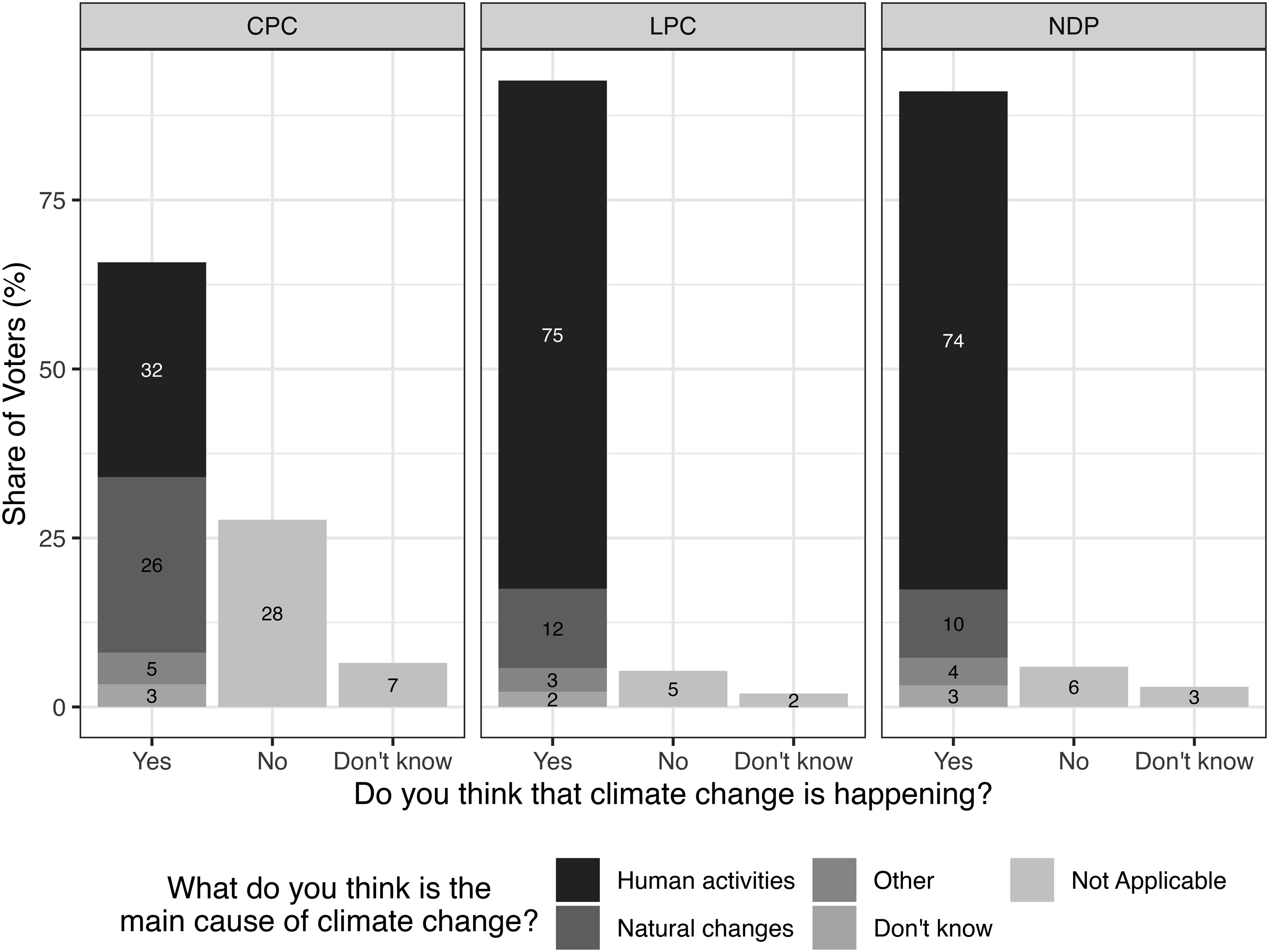
While all political parties share an incentive to align their policy priorities with salient issues, the presence of partisan heterogeneity in attitudes towards climate change is likely to result in varying degrees of issue responsiveness among these parties. Specifically, we expect that issue responsiveness will differ based on issue ownership and the institutional roles of political parties.
Firstly, previous research suggests that the attention parties give to policy issues is contingent upon their reputation regarding those issues. In particular, parties are unlikely to draw attention to problems for which they have a weak reputation, as doing so would highlight their opponents’ strengths and undermine their own position. All else being equal, parties tend to selectively emphasize issues about which they have a stronger reputation and neglect those about which their reputation is weaker. This principle is commonly referred to as the “Dominance Principle” (Petrocik 1996; Damore 2004; Sides 2006). Analogously, we posit that the incentives for a party to discuss an issue that gains sudden salience are stronger when that party “owns” the issue. Conversely, we expect parties for which climate change is a vulnerability to be less responsive to shifts in its public salience. In our specific institutional context, this means that we anticipate the Conservative Party to address climate change to a lesser extent and be less responsive to fluctuations in its public salience compared to the Liberal and New Democratic parties.
The issue responsiveness of parties should also be influenced by their institutional role. During the Question Period, the opposition determines the topics of questions and can compel the government to address issues that it might otherwise disregard due to their disadvantageous or embarrassing nature (Bevan and John 2016). From a strategic standpoint, it is advantageous for a party seeking to improve its electoral prospects to raise policy issues about which its opponents have a weak reputation or that could potentially demean them. However, the government has the ability to counter these tactics and shape the debate in a more favorable manner. Indeed, as “[t]here [are] no explicit rules governing the form or content of replies to oral questions” beyond very general “standards of order, decorum and parliamentary language,” government ministers have significant freedom in choosing how to respond (Bosc and Gagnon 2017 Chapter 11). In theory, an answer in the Question Period is simply an opportunity for a minister to make a 45-second statement, and its relevance to the question posed is incidental. For instance, it is not uncommon for a minister to dismiss the issue raised by their opponent as irrelevant and shift the discussion towards a more favorable topic. Although the government may be reluctant to provide candid responses to inquiries regarding issues about which it has a weak reputation, outright refusal to address pertinent questions could have detrimental consequences in the long term. Consequently, we posit that the government will yield to some of the pressures from the opposition and address certain embarrassing topics. Specifically, we expect that the Conservative Party, during its tenure in government, will exhibit a higher level of responsiveness to the public salience of climate change compared to its time in opposition.
Data and Measurement
Our analysis relies on two dynamic data sets: one that quantifies the temporal evolution of the public salience of climate change, and another that tracks the attention devoted by political parties to this issue in their interventions during the Question Period.
Public Salience
To monitor the evolution of the public salience of policy issues, we rely on Google Trends data. This data set is derived from a sample of all queries conducted on Google’s search engine and is extensively used across various disciplines, including epidemiology, finance, and marketing. The data is presented in the form of an index, which tracks the relative changes in the interest of users in predefined topics or specific keywords over time. To enable meaningful comparisons across various topics, time periods, and geographic regions, the data points are normalized using the total search volume for a specific topic within a particular region at a given time.
The operationalization and measurement of issue salience have been long-standing challenges (Wlezien 2005; Moniz and Wlezien 2020). In our study, we utilize Google Trends as a measurement tool for assessing issue salience, which we believe offers several advantages over alternative methods. Firstly, Google Trends provides data at frequent intervals, including daily, weekly, and monthly, allowing us to capture the dynamics of issue salience. Furthermore, it enables us to analyze issue salience across different geographic entities, ranging from metropolitan areas to provinces, states, territories, and even countries. Obtaining this level of granularity through survey studies would be prohibitively costly. In our analysis, we specifically employ weekly data. 1
Secondly, Google Trends data is derived directly from users’ behavior, which helps mitigate some of the biases that typically affect survey responses (e.g., social desirability bias, subject-expectancy bias). It captures variations in public salience as manifested in web search behavior. In this regard, we believe that the act of searching for information on a policy issue reflects a genuine level of concern and interest. Given the scarcity of time and attention, individuals are unlikely to invest effort in researching problems they deem irrelevant. Therefore, we anticipate that users will actively seek more information on the issues they are most invested in and care about deeply.
Thirdly, the conventional approach of asking survey respondents “What is the most important issue facing the country?” has limitations as it only elicits a single response at a time. In contrast, Google Trends data considers all possible topics simultaneously and aims to gauge the relative interest of the public in each topic. Therefore, our measurement approach offers a more comprehensive portrayal of issue salience.
Undoubtedly, Google Trends data also come with certain limitations (Mellon 2013). One primary concern is the representativeness of Google’s user base, which may not accurately reflect the broader electorate or general public due to variations in Internet usage across socio-demographic groups. Additionally, there could have been changes in the composition of Google Search’s user base, making it challenging to generalize findings beyond the observed sample. However, previous studies have demonstrated that Google Trends can provide reliable measures of public salience, alleviating some of these concerns (Ripberger 2011; Reilly, Richey, and Taylor 2012; Mellon 2014; Swearingen and Ripberger 2014).
In our analysis, we utilize the predefined “climate change” topic provided by Google Trends. We consider the resulting variable as an indicator of the public salience of climate change. The evolution of this variable in Canada and the United States is depicted in Figure 2. Weekly evolution of the public salience of climate change in Canada and the United States.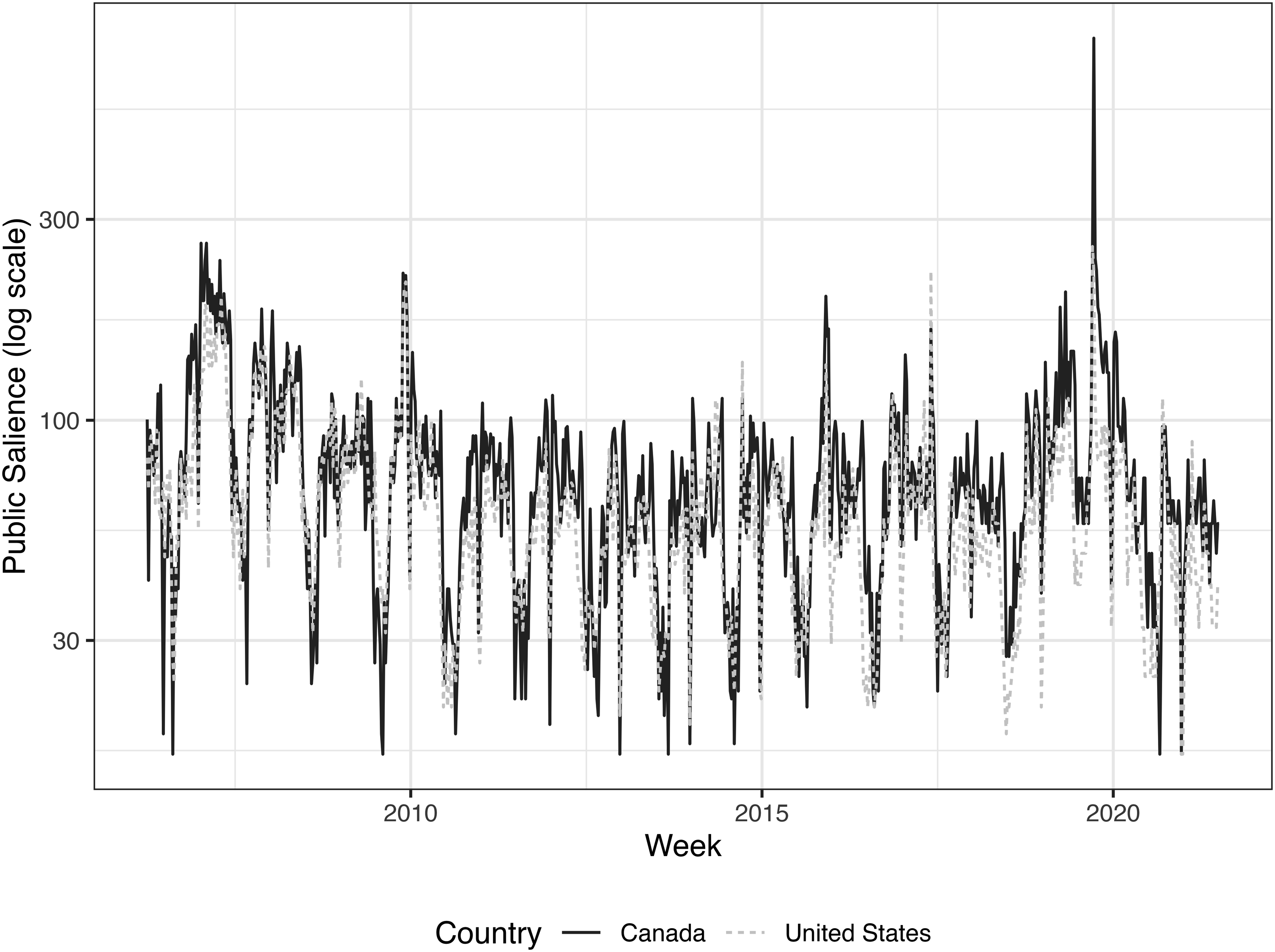
Attention from Political Parties
To measure the attention that political parties pay to policy issues, we collected and analyzed the transcripts of every Question Period conducted in the Canadian House of Commons from the 39th to the 43rd legislature. This period spans from the election held on January 23, 2006, to the election held on September 20, 2021. Our data set is derived from the official English transcripts published by the Clerk of the House of Commons, which include professionally translated versions of the interventions originally delivered in French.
The House of Commons serves as the lower chamber of the Parliament of Canada and is where the Prime Minister and other federal Cabinet ministers hold their seats. A significant event in Canadian political life is the Question Period, which takes place for 45 minutes each day the House is in session and garners close attention from the media and public. This segment serves as a crucial opportunity for Members of Parliament to seek information on current issues and hold the government accountable for its actions. Notably, it is one of the rare instances in Parliament where the opposition, rather than the government, exerts control over the topics that are discussed.
The Question Period typically begins with the Speaker granting the Leader of the Opposition the opportunity to ask questions, often directed at the Prime Minister. Subsequent questions are then posed in a predetermined rotation based on the parties’ representation in the House. While backbench members of the governing party and independent members also have the chance to ask questions, their participation is generally less frequent compared to officially-recognized opposition parties. 2 The party caucuses and their whips manage participation in the Question Period. They determine which members from their respective parties will take part and provide the Speaker’s Office with a list of names and a suggested order of recognition. The government possesses the discretion to determine which of its members will provide a response to a question, and in line with the principle of collective responsibility, any minister may answer a question directed at one of them.
Our analysis focuses exclusively on the interventions emanating from Canada’s three main national political parties. These parties are the only ones that maintained official party status throughout our entire period of study. The Conservative Party held the position of the governing party from January 2006 until October 2015 and has since served as the official opposition. 3 The Liberal Party held the position of the official opposition from January 2006 to May 2011, transitioned to third-party status from May 2011 to October 2015, and has been in government since then. Lastly, the New Democratic Party maintained third-party status for the majority of our period of study, except from May 2011 to October 2015 when it held the status of the official opposition.
From January 2006 to May 2011 and again from October 2019 onwards, the Bloc Québécois, a regionalist party, held third-party status. However, since the Bloc Québécois did not maintain official party status throughout our period of study, our data on their attention to issues is limited between May 2011 and October 2019. Moreover, since the Bloc Québécois represents only one of Canada’s ten provinces, the issues they raise are likely influenced by factors specific to that province, which may not be adequately captured by our national measure of public salience. Considering the complexities and nuances associated with the case of the Bloc Québécois, we will defer its analysis to future research.
An alternative source of data for measuring the attention parties give to issues would be their party platforms. Question Period interventions offer several advantages over this alternative approach. Firstly, the Question Period occurs more frequently compared to the publication of party platforms, which typically happens only once during a general election. By analyzing Question Period interventions, we can assess the attention parties give to various policy issues on a weekly basis for most of the year. This is because the House of Commons sits quasi-continuously from late January to June and from late September to mid-December. Secondly, during the Question Period, parties face limited opportunities to address issues, necessitating careful selection of topics. In contrast, parties face no limitations on the length of their party platforms, which can result in a noisy distribution of topics that may not accurately reflect the parties’ actual priorities.
We posit that the topics addressed by parties in their Question Period interventions reflect the level of attention they allocate to policy issues. To analyze the latent topic composition of the inherently high-dimensional text data, we employ the Latent Dirichlet allocation (LDA) model (Blei, Ng, and Jordan 2003; Grimmer and Stewart 2013; Grimmer, Roberts, and Stewart 2021). This unsupervised machine learning algorithm is widely used by social scientists to identify the latent topics present in a collection of documents and assign each document to the relevant topics. We estimate the LDA model using the implementation provided by the
The LDA model is a mixed-membership model, which operates on the assumption that (i) each document is a combination of multiple topics, and (ii) each topic is a probability distribution over words, allowing a particular term to be associated with multiple topics. In this model, documents are treated as “bags of words,” where the syntax and word order are disregarded, and only the frequency of words is considered.
We consider every intervention, whether it takes the form of a question or an answer, as a separate document. In order to obtain meaningful and coherent results, it is essential to preprocess these documents appropriately before conducting the estimation (Denny and Spirling 2018). First, we remove all numbers, punctuation marks, and unnecessary white spaces from the documents. Next, we convert all remaining terms to lowercase and apply Porter’s stemming algorithm to reduce words to their root form. Lastly, to identify the terms that provide the most distinguishing information for the various topics, we eliminate “stop words” that are unlikely to convey significant meaning. We only retain tokens that occur in a range of one to 25% of the documents, ensuring that we focus on terms that are both informative and sufficiently prevalent in the data set.
The LDA model requires the analyst to determine the number of topics to be used. After evaluating diagnostic values for different numbers of topics, we opted for a model consisting of 15 topics. This choice was based on the model’s optimal combination of held-out likelihood and semantic coherence. For reference, the diagnostic values are presented in Figures S1 and S2 (cf., Supplementary Material). Table S1 (cf., Supplementary Material) showcases words representative of the estimated topics. It is worth mentioning that the resulting topics are well-defined, easily comprehensible, and possess substantial meaning. Of particular interest to our analysis is the topic related to climate change. 4 To provide a glimpse of the discussions pertaining to climate change, we have randomly chosen ten documents from those where the prevalence of climate change exceeds the 99th percentile. These documents can be found in Table S2 (cf., Supplementary Material).
Statistical Methodology
Model Specification
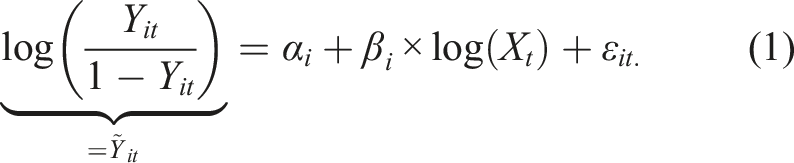
Our objective is to estimate the causal parameter β
i
in the following equation:
Identification Strategy
The existing literature consistently demonstrates a strong correlation between the priorities of the public and the policy agenda pursued by their political representatives. On average, politicians tend to discuss policy issues that are more salient to their constituents and align with public concerns (Wagner and Meyer 2014; Klüver and Spoon 2016). Scholars have proposed two mechanisms to explain this relationship.
On the one hand, politicians have a strong motivation to adjust their rhetoric to address issues that are highly relevant to their constituents. Voters actively seek politicians whose priorities align with their own, and as a result, electorally-driven politicians are inclined to shape the content of their public statements accordingly. Moreover, addressing issues that voters perceive as important allows parties and candidates to capture more attention from the electorate compared to discussing topics that are deemed less significant.
On the other hand, politicians have the ability to engage in “public agenda-setting” and influence the weight that voters assign to policy dimensions (Jones and Baumgartner 2005; Baumgartner and Jones 2009; Boydstun, Glazier, and Pietryka 2013; Rossiter 2021). Voters, as relatively unsophisticated actors who pay limited attention to politics, are often uncertain about what issues are truly significant and are susceptible to believing that any policy matter is important (Chong and Druckman 2007). This susceptibility opens the door to framing and priming effects in determining the relative importance of different issues. Signals from news reports and public statements made by politicians are interpreted by voters as cues of relevance (Iyengar and Kinder 2010; McCombs and Valenzuela 2021). Political parties can exploit this susceptibility to influence and shape the political agenda to their liking. In fact, prior research suggests that parties dedicate significant effort to these agenda-setting efforts (Jacobs and Shapiro 1997; 2000; Druckman and Jacobs 2015).
The reality lies somewhere between these two conflicting theories. While voters’ sense of priorities can be influenced by politicians, it is important to recognize that politicians do not have complete control over all relevant factors. External events, such as natural disasters or international incidents, can also impact the public salience of policy issues. In other words, the topic composition of Question Period interventions can be influenced by and, in turn, influence the public salience of climate change. This implies that the relationship between the attention politicians devote to policy issues and their public salience is afflicted by reverse or simultaneous causality, as both variables are jointly determined (Page 1994). Observing the correlation between the topic composition of politicians’ public interventions and the public salience of policy issues can create the illusion that politicians are responsive to the public, when in reality, citizens’ sense of priorities may be distorted by political rhetoric.
The presence of simultaneous causality introduces endogeneity, which can result in inconsistent estimates when employing ordinary least squares (OLS) regression. To achieve causal identification of the parameter β
i
, we employ a two-stage least squares (2SLS) estimation strategy. Specifically, we instrument the public salience of climate change in Canada with the analogous variable for the United States

Our estimation strategy seeks to neutralize the influence of Question Period interventions on the public salience of climate change in Canada. This is accomplished by isolating variations in the public salience of climate change that occur concurrently in Canada and the United States. To ensure the validity of this approach, we must assume that Question Period interventions do not influence the public salience of climate change in the United States. Under this assumption, shared variations of the public salience of climate change between Canada and the United States can be treated as exogenous. By leveraging these shared variations, we can achieve causal identification of issue responsiveness.
Formally, the validity of this identification strategy relies on two key assumptions: • Relevance. The public salience of climate change in Canada and the United States are not independent; • Exclusion Restriction. The public salience of climate change in the United States is exogenous conditional on the public salience of climate change in Canada.
The validity of the exclusion restriction assumption, also known as the “only through” assumption, relies on the notion that any influence exerted by the public salience of climate change in the United States on the topic composition of Question Period interventions is solely mediated by the public salience of climate change in Canada.
While these assumptions are unfalsifiable, we find them highly plausible. Given the close proximity and strong relationship between Canada and the United States, with both countries sharing the longest undefended border in the world, it is reasonable to expect that factors influencing the public salience of climate change would be similar in both countries. Figure 2 illustrates the relationship of the public salience of climate change in Canada and the United States, with a correlation coefficient slightly above 0.75. However, it is crucial to recognize that the United States is a significantly larger country, and its media coverage primarily revolves around domestic politics. Hence, it is reasonable to assume that discussions in the Canadian House of Commons have a minimal impact on the public salience of climate change in the United States.
The question remains whether there are additional variables that could jointly influence Question Period interventions and the public salience of climate change in the United States, potentially leading to omitted variable bias. One possibility is that Members of Parliament might feel compelled to express sympathy for a natural disaster that occurred in the United States. We do not expect this to introduce systematic biases. In general, we find it unlikely that the public salience of climate change in the United States would directly impact Question Period interventions without this effect being mediated by the public salience of climate change in Canada. Nevertheless, we acknowledge that the flow of information between political representatives and their constituents can be influenced by other institutions, such as the media. While these institutions may filter or potentially distort information, we maintain our belief that they do not introduce confounding factors that would undermine the validity of our identification strategy.
Using a Latent Variable as the Dependent Variable
Our identification strategy involves conducting causal analysis on the latent topic composition of Question Period interventions, which is estimated through an unsupervised machine learning algorithm. As argued by Egami et al. (2022), analyzing this variable can lead to a violation of the Stable Unit Treatment Value Assumption (SUTVA), a fundamental assumption in causal inference. SUTVA requires that there be no interference between the treatment assigned to one unit and the outcomes of other units (Imbens and Rubin 2015, 10). Unfortunately, the estimation of the LDA model introduces interference across observations, since the estimated topic composition of a document typically depends on the corpus used to train the model. To address this issue, we implement the solution proposed by Egami et al. (2022). Specifically, we train the LDA model on a corpus of documents separate from the one used for the causal analysis. We randomly set aside ten percent of our entire corpus as training data. Using the trained model, we estimate the topic composition of the remaining 90% of documents and perform our analysis on the resulting time series.
Adjusting our Dynamic Regression Model for Serial Correlation
Equation (1) describes an inherently dynamic process. However, the absence of the lagged value of the dependent variable in our model makes it vulnerable to serial correlation. Serial correlation can render the standard 2SLS estimates inconsistent and invalidate the associated inference.
To address this issue, we employ the Cochrane–Orcutt estimation procedure (Box-Steffensmeier et al. 2014, 77). This estimation procedure can be summarized as follows: 1. Estimate the model using the 2SLS method and save the residuals, denoted 2. Regress the residuals on their lagged values without an intercept: 3. Using the estimated serial correlation coefficient 4. Regress 5. Repeat steps 2 to 4 until satisfactory convergence in the estimate of

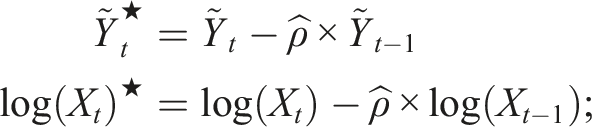
In practice, this process can be automated using the
Results
Relationship between the Prevalence of Climate Change in Question Period Interventions and its Public Salience
Figure 3 illustrates the weekly evolution of the share of Question Period interventions focused on climate change by party, represented by colored curves, along with the public salience of this issue in Canada, represented by a thick black curve. To emphasize the underlying trends, we present smoothed values obtained through local polynomial regression. The four curves display remarkably similar patterns, indicating a strong correlation between the topic composition of Question Period interventions and the public salience of climate change. Weekly evolution of the prevalence of climate change in question period interventions and its public salience over time.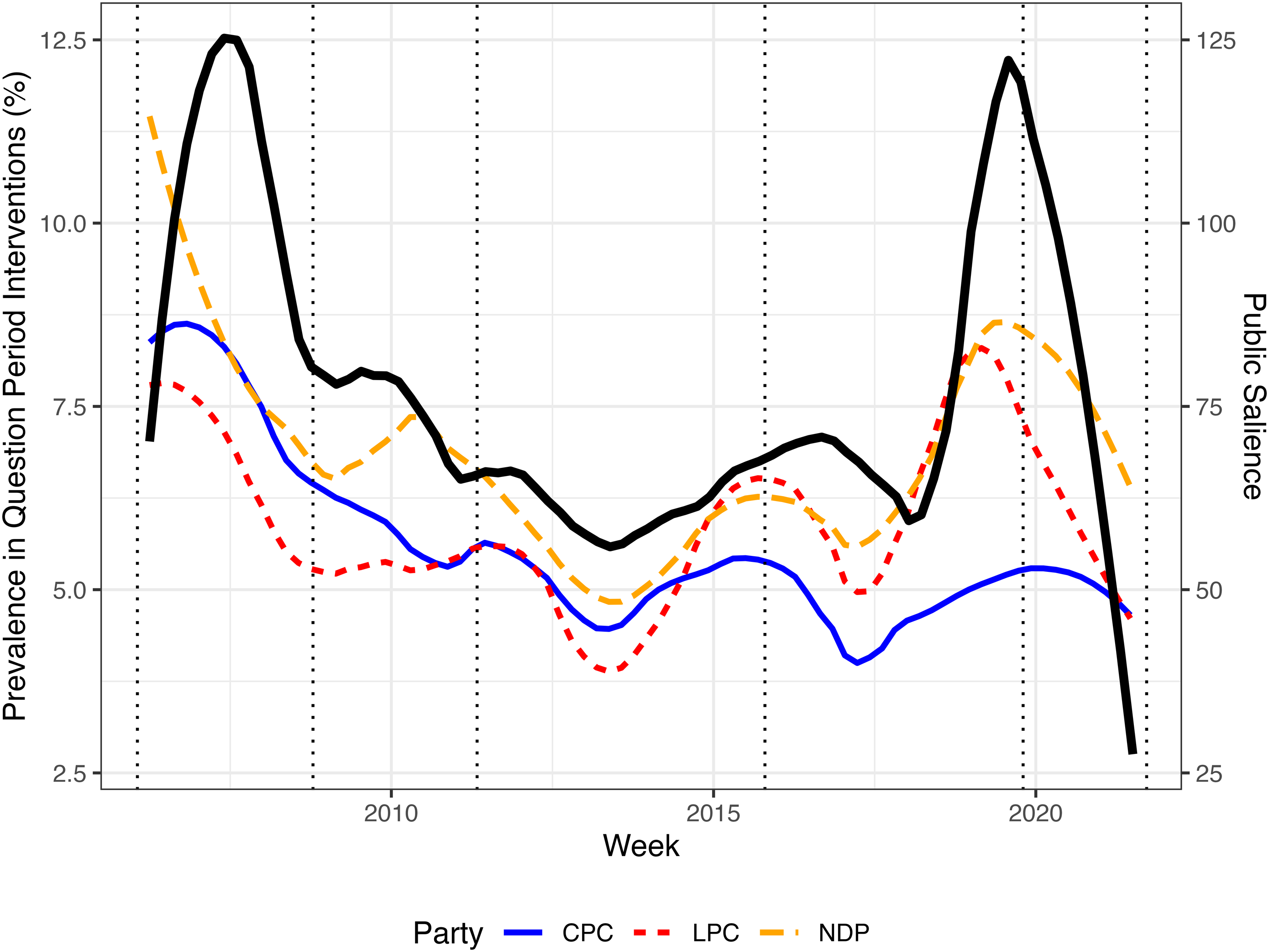
This finding is further supported by Figure 4. The figure illustrates the log-ratio of parties’ interventions on climate change in a given week on the y-axis, while the log-measure of the public’s perception of the salience of climate change in Canada during the same period is represented on the x-axis. These variables correspond to the independent and dependent variables, respectively, in equation (1). For each of the three parties, the scatter plot includes a loess curve that demonstrates the local relationship between these variables. Relationship between the prevalence of climate change in question period interventions and its public salience.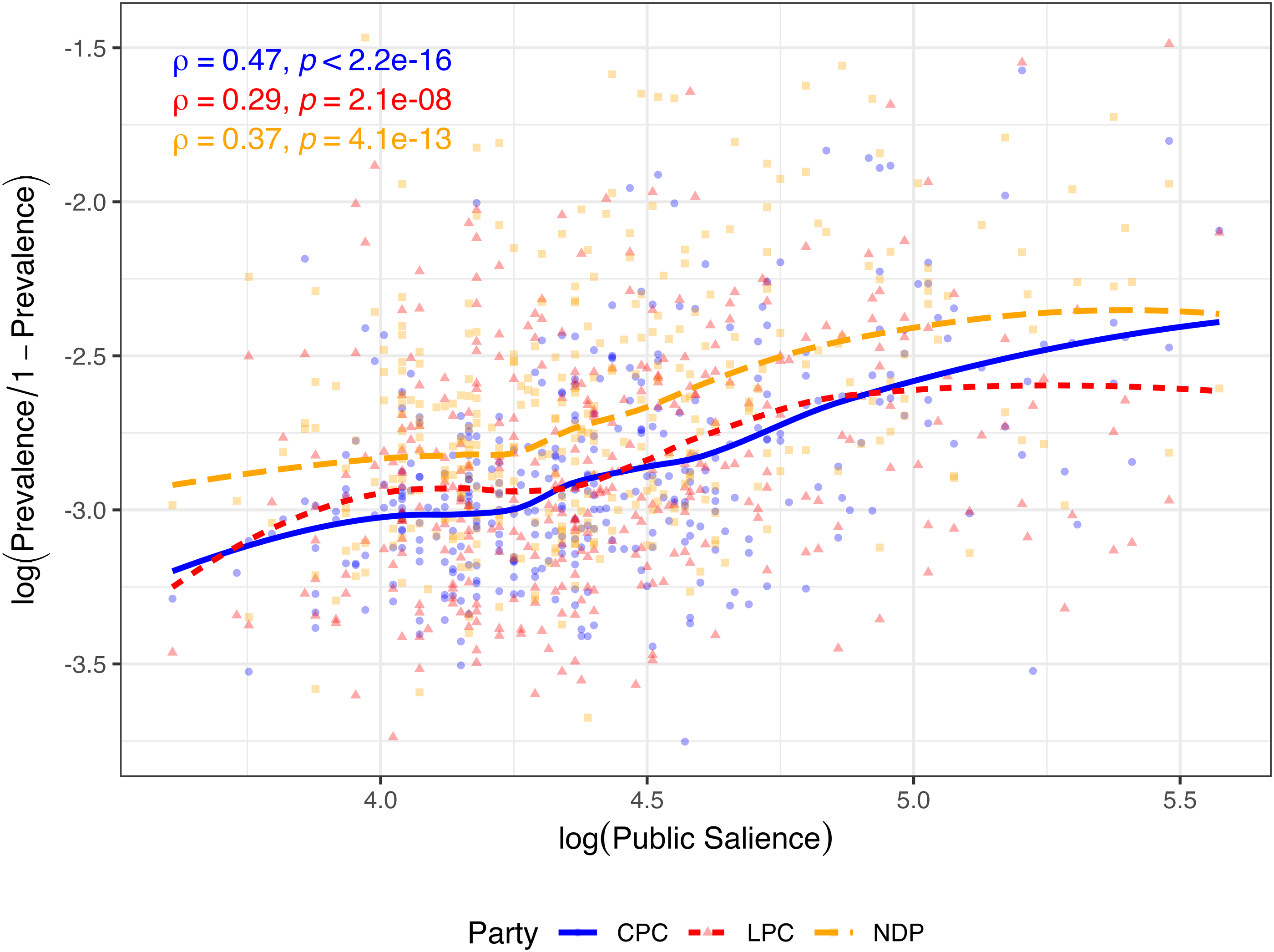
Consistent with expectations, the three political parties allocate a greater proportion of their Question Period interventions to climate change when the issue is more prominent. This relationship exhibits a predominantly linear pattern, supporting the functional form of equation (1), with the slope being nearly identical for all parties. Furthermore, all three parties display a positive and statistically significant correlation between the two variables at a 99% confidence level. The magnitude of the correlation coefficient is greatest for the Conservative Party, followed by the New Democratic Party, and finally the Liberal Party. This indicates that variations in the topic composition of Question Period interventions are most accurately predicted by the public salience of climate change for the Conservatives, while other factors play a relatively larger role in predicting the topic composition of Question Period interventions made by the Liberals and New Democrats.
While the previous findings indicate a positive correlation between the public salience of climate change and the share of Question Period interventions related to climate change, it is crucial to note that, at this stage, we cannot assert that parties are responsive to the public’s policy priorities, nor can we provide a causal estimate of this responsiveness. As mentioned earlier, the topic composition of interventions may explain as much as it is explained by the public salience of climate change. This can be observed in Figure 3, where the four curves closely align with each other. However, at this point, we are unable to ascertain the extent to which each party’s curve specifically responds to public salience. The identification strategy we outlined will allow us to address this issue.
In Figure 3, we have indicated the occurrences of elections during our period of study with dotted vertical lines. Notably, the relationship between the proportion of Question Period interventions dedicated to climate change by the Conservative Party and the public salience of climate change seems to diminish following the 2015 election when the party transitioned from government to opposition. As a result, a clear divergence arises between the curve representing the topic composition of the Conservative Party’s Question Period interventions and those of the other parties. This divergence suggests that, during their tenure in government, the Liberal Party discussed climate change significantly more than the official opposition. This finding supports the notion that government ministers possess considerable flexibility in shaping their answers to the opposition’s questions.
Causal Estimates of Issue Responsiveness
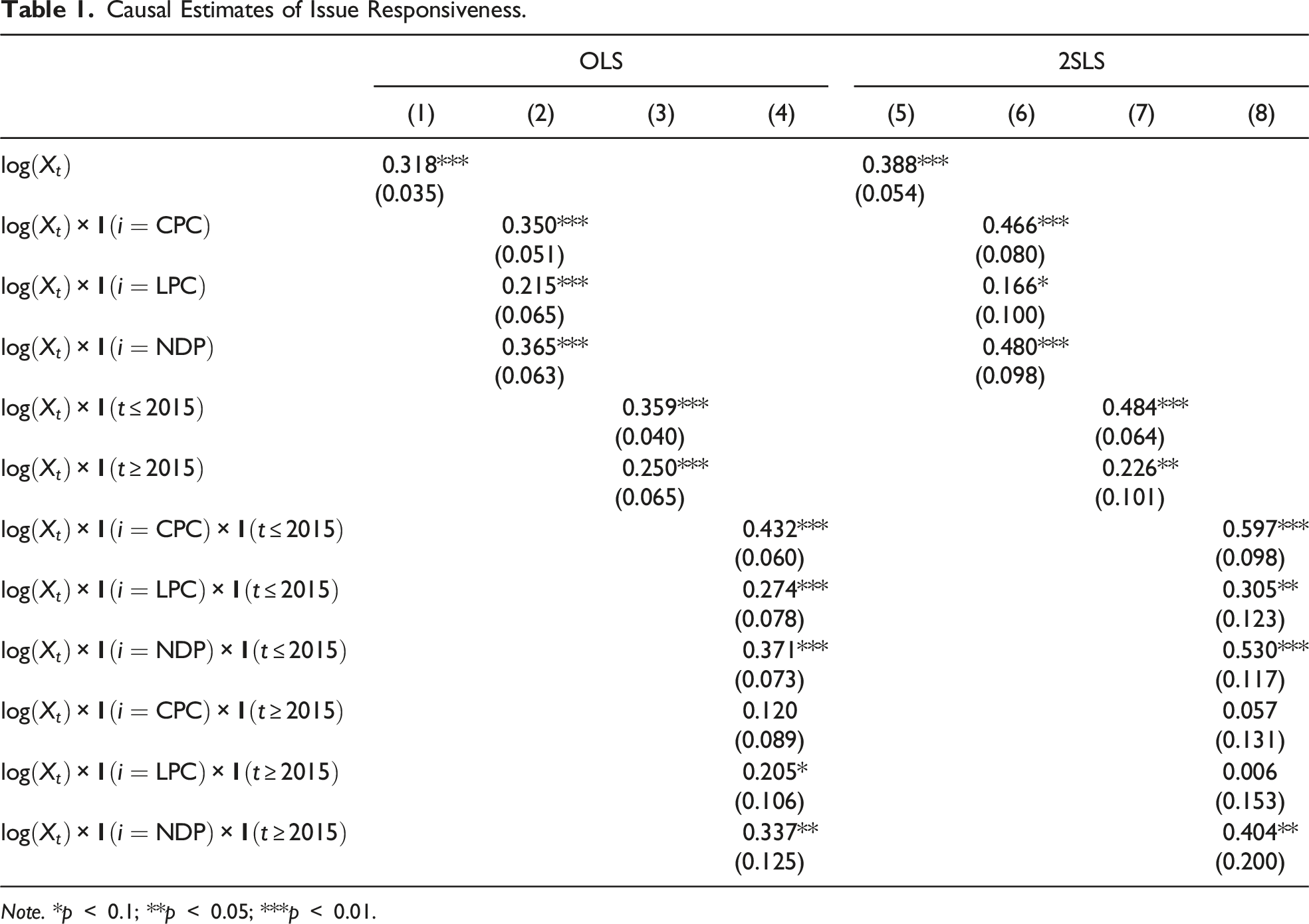
Causal Estimates of Issue Responsiveness.
Note. *p
We would like to emphasize three findings. Firstly, all parties exhibit issue responsiveness by adjusting the topic composition of their Question Period interventions in response to exogenous variations in the public salience of climate change. As shown in column (5), on average, the ratio of a party’s Question Period interventions related to climate change increases by 0.4% following a one percent increase in the public salience of this issue. This estimate is statistically significant at the 99% confidence level.
Secondly, 2SLS estimation noticeably alters the coefficient values and reveals significant heterogeneity in issue responsiveness among the three parties. Surprisingly, the Liberal Party exhibits a lower responsiveness to changes in the public salience of climate change compared to the Conservative Party and the New Democratic Party. However, this does not imply that the Liberals engage in fewer discussions about climate change overall. In fact, it appears that they address the issue on their own terms and successfully increase its public salience. This can be observed by comparing columns (2) and (6): instrumental variables estimation reduces the estimate of the Liberals’ issue responsiveness by approximately 25%. This finding aligns with the notion that the Liberals have effectively bolstered the public salience of climate change during the period of study. Initially, this may create the illusion of issue responsiveness, which our identification strategy disentangles by separating the effect of public salience on Question Period interventions from the effect of interventions on public salience. This “reverse effect” primarily occurs during the tenure of the Liberal Party in government. Specifically, 2SLS estimation reduces the estimate of the Liberals’ issue responsiveness during this period by around 99%, while increasing it by approximately 29% for the period prior to 2015.
Thirdly, both the Conservative Party and the New Democratic Party exhibit a similar level of issue responsiveness. This finding is notable considering that climate change has historically been a weaker policy issue for the Conservatives. The fact that the Conservatives’ response to changes in the public’s perception of the salience of climate change is not significantly different from that of the New Democrats adds credibility to the notion that the Question Period compels the governing party to address challenging or unfavorable policy issues. This interpretation is further supported by the observation, as hinted in Figure 3, that the estimated level of issue responsiveness for the Conservative Party is approximately 77% lower after 2015 compared to when they held government. After 2015, the issue responsiveness of the Conservatives is statistically indistinguishable from zero. This difference is statistically significant at a confidence level of 95%. In contrast, there is no statistically significant difference in the issue responsiveness of the New Democrats before and after the 2015 election.
Causal Estimates of the Government’s Issue Responsiveness
One could argue that assessing the issue responsiveness of the government in the context of Question Period is futile. After all, the primary role of the government during the Question Period is to provide responses to the questions raised by the opposition. It is reasonable to expect that the government will address at least some of the inquiries from the opposition parties. By transitivity, if the opposition parties are responsive to the public salience of climate change when formulating their questions, and the government offers forthcoming answers, the government should also be responsive to the public salience of climate change. In this sense, a portion of the government’s issue responsiveness is expected to be mediated by the opposition’s inquiries. However, it is crucial to acknowledge that the government has considerable flexibility in how it chooses to respond to questions. A minister may downplay the relevance of the issue raised by their opposition counterpart and instead choose to focus on a more favorable topic. Hence, it is unlikely that the entirety of the government’s issue responsiveness will be solely dictated by the opposition’s inquiries.
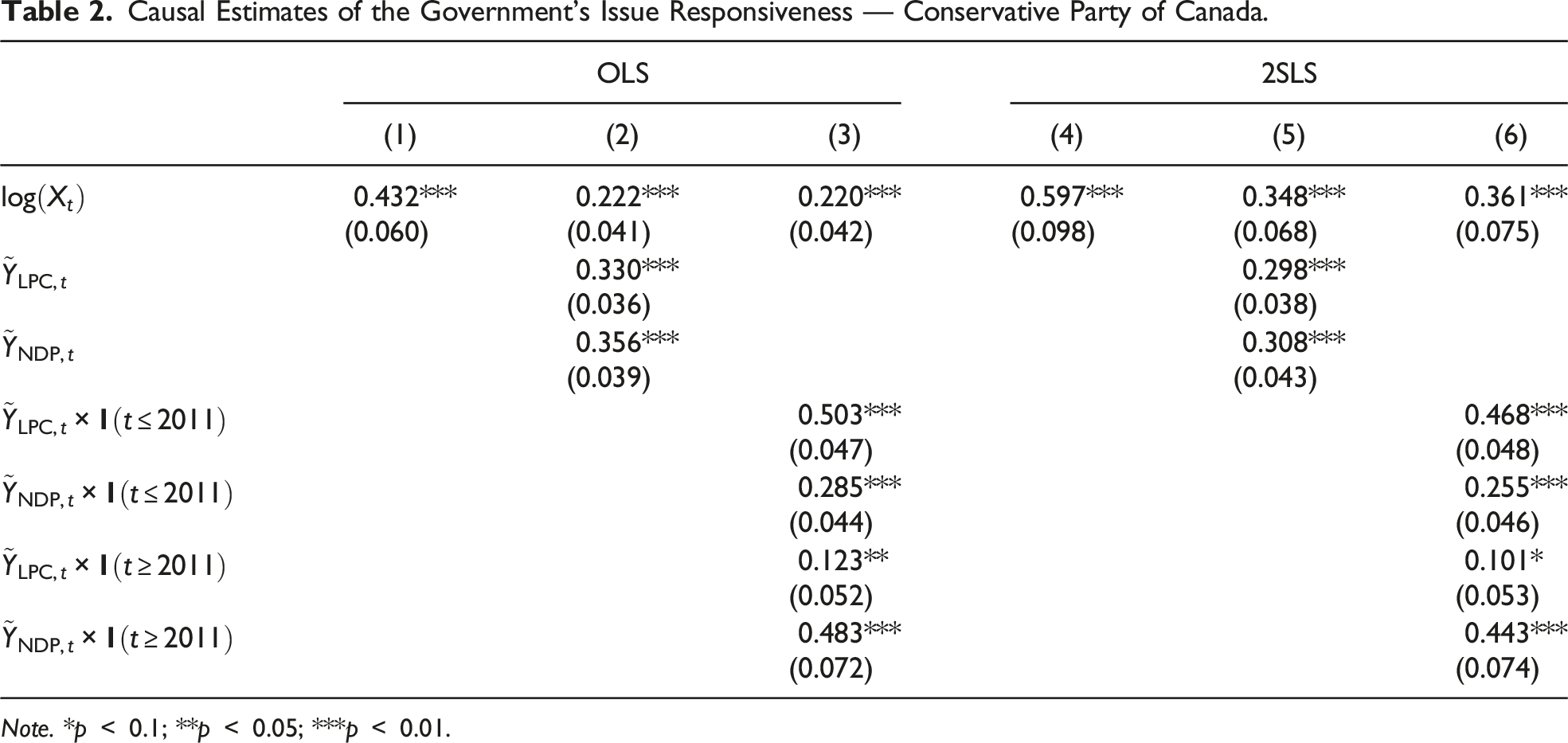
We examine the extent to which the government’s issue responsiveness is mediated by the questions posed by the opposition. To accomplish this, we employ a regression model akin to equation (1), incorporating the proportion of climate change-related interventions made by each opposition party during the Question Period as covariates. This regression model is defined as follows
Causal Estimates of the Government’s Issue Responsiveness — Conservative Party of Canada.
Note. *p
Causal Estimates of the Government’s Issue Responsiveness — Liberal Party of Canada.
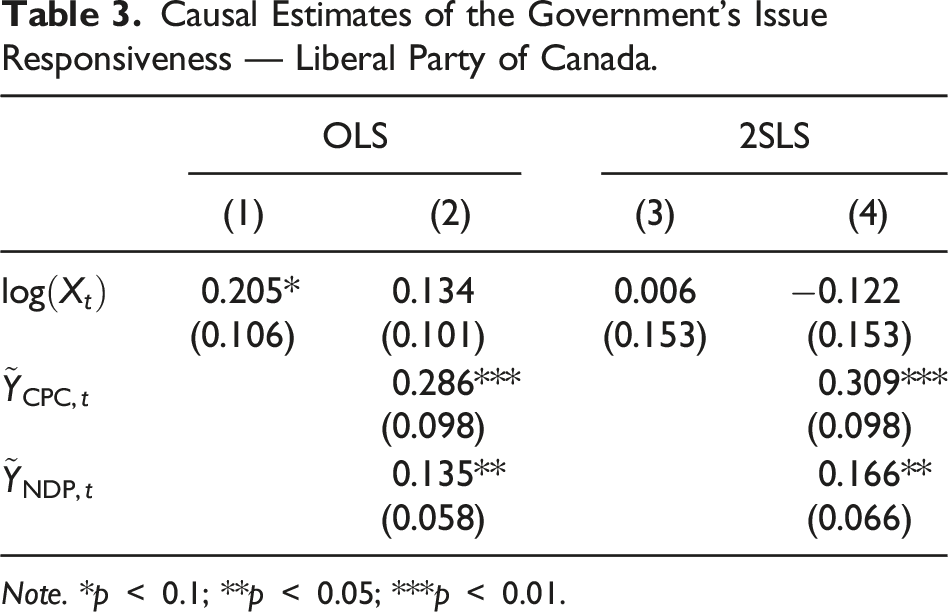
Note. *p
The findings presented in Tables 2 and 3 indicate that, when in government, parties generally respond to inquiries from opposition parties. Specifically, the proportion of Question Period interventions dedicated to climate change by the government increases significantly when the opposition parties focus a larger share of their questions on this policy issue. Furthermore, it appears that the government is more responsive to inquiries from the official opposition compared to those from third parties. This observation is supported by examining Column (6) in Table 2 and Column (4) in Table 3. From 2006 to 2011, the Conservative government demonstrated significantly greater responsiveness to the Liberal Party compared to the New Democratic Party. From 2011 to 2015, the government displayed significantly greater responsiveness to the New Democratic Party than the Liberal Party. Lastly, from 2015 onwards, the government exhibited more responsiveness to the Conservative Party than the New Democratic Party. Overall, these results suggest that the Question Period serves as an effective mechanism for opposition parties, particularly the official opposition, to elicit responses from the government on current affairs.
Not all of the government’s issue responsiveness can be attributed solely to the inquiries made by the opposition parties. Accounting for the topic composition of the Question Period interventions from the opposition parties does not alter the finding that the party in government demonstrates a significant level of responsiveness to the public salience of climate change. Although the magnitude of this responsiveness decreases by approximately 40%, there remains a statistically significant relationship between the share of Question Period interventions from the Conservative Party addressing climate change and the public salience of this issue, even after considering the content of the questions posed by the opposition parties. This suggests that, apart from the influence of the inquiries from opposition parties, the Conservative Party had direct incentives to be responsive to the public salience of climate change while in government. However, these incentives did not persist beyond the 2015 election. Regardless of whether we account for the topic composition of the inquiries from the opposition parties, there is no statistically significant relationship between the share of Question Period interventions from the Liberal Party devoted to climate change and this issue’s public salience.
Discussion and Conclusion
This article makes valuable contributions to the study of political representation and issue responsiveness in Canadian politics.
All three parties studied show some level of responsiveness to the public salience of climate change during the Question Period. However, the New Democratic Party consistently exhibits the highest degree of responsiveness to fluctuations in the public’s interest in climate change. This observation aligns with the party’s status as the smallest of Canada’s three major national political parties and its limited experience in federal government, except for a period in the official opposition from May 2011 to October 2015. It is possible that smaller parties face greater difficulties in influencing or diverting the public agenda, which makes them more directly responsive to the public’s concern about climate change. Nonetheless, it is important to recognize that the New Democratic Party’s level of responsiveness depends on its favorable reputation on the issue of climate change, as it benefits the party to actively engage in discussions on this topic.
During their tenure in government, the Conservative Party displayed a level of issue responsiveness similar to that of the New Democratic Party, despite the Conservatives generally being perceived as having a weaker stance on climate change. However, after the Conservatives transitioned to the opposition, they did not exhibit notable responsiveness to the public salience of climate change. This finding highlights the significant role played by the Question Period in ensuring democratic accountability. By granting opposition parties the opportunity to shape the agenda, the Question Period empowers them to pressure the government into addressing issues that hold importance to the public but might otherwise be ignored or neglected. Our findings suggest that the government is more responsive to inquiries from the official opposition compared to those from smaller parties. Nonetheless, it is important to acknowledge that the government’s issue responsiveness is not solely influenced by inquiries from the opposition. Taking into account inquiries from opposition parties does not alter the assessment of whether the government demonstrates significant responsiveness to the public salience of climate change.
Our findings reveal that, during its tenure in government, the Liberal Party successfully elevated the public salience of climate change. Following the 2015 election, it appears that the Liberals have not been responsive to the public salience of climate change but have instead addressed this policy issue on their own terms. This has had a noticeable impact on the public salience of climate change. While this may initially create the illusion of issue responsiveness, our research design allows us to disentangle genuine issue responsiveness from the effect of Question Period interventions on the public salience of climate change. Consequently, we observe that the Liberals’ responsiveness to public salience was effectively null during their time in government. This outcome underscores the significant role played by political parties in shaping the political agenda and drawing attention to emerging policy concerns, such as the climate crisis. In this regard, we speculate that the government has greater influence over the public agenda compared to opposition parties.
The Supplementary Material presents the results of two robustness checks conducted in this study. Firstly, a placebo test was performed to estimate the effect of the public salience of climate change on the topic composition of Question Period interventions across all other topics. The analysis does not indicate any consistent effect of the public salience of climate change on the topic composition of Question Period interventions related to other topics. However, the findings do suggest that both the Conservatives and the Liberals engaged in some limited obfuscation and manipulation. Secondly, we examined the potential geographical variations in issue responsiveness. We acknowledge that our national measure of public concern may mask regional differences in the importance of climate change. Some scholars have suggested that political representation in the Question Period is “particularized,” meaning that parties may represent the interests of certain constituencies and provinces more effectively than others (Penner, Blidook, and Soroka 2006). However, our analysis reveals little to no evidence indicating that parties respond differently to the public salience of climate change across individual provinces.
We acknowledge potential concerns regarding the external validity of our analysis, particularly in extending our findings to other policy issues and institutional contexts. Climate change in Canada possesses unique characteristics that may limit the generalizability of our insights. Its high salience leads to a significant number of Question Period interventions, and the issue’s political contentiousness contributes to partisan variations in issue responsiveness. While these characteristics make climate change an intriguing subject to study in the Canadian context, it is plausible that other salient and politically contentious issues exhibit similar patterns of issue responsiveness. Several other institutions, such as the ten Canadian provincial legislatures, the British House of Commons, and the French National Assembly, have procedures similar to the Question Period. Therefore, the insights gained from our analysis might potentially be applicable to these institutional contexts as well. However, it is important to consider whether there are specific idiosyncrasies associated with climate change in the Canadian context. For example, Canada’s significant role as a producer of fossil fuels may influence the perception of climate change among political elites and the public. In summary, although it may be tempting to make generalizations to other policy issues and institutional contexts, it is vital to approach each situation with caution, taking into account its unique characteristics and potential peculiarities.
In conclusion, we believe that further research is crucial to gain a comprehensive understanding of how the exchanges between political parties during the Question Period are effectively communicated to the public and how this process may affect parties’ issue responsiveness. The role of the media in disseminating political news is undeniably significant. In addition, it is important to recognize that the media also wields its own influence over the “public agenda.” Previous studies, including those by Soroka (2000, 2002), have already explored the intricate interactions between the media, the public, and politicians in shaping the public agenda. Nevertheless, to fully grasp issue responsiveness, it is imperative that we delve deeper into the mechanisms through which information flows from politicians to the public. Therefore, a more thorough investigation of this topic is warranted.
Supplemental Material
Supplemental Material - Issue Responsiveness in Canadian Politics: Are Parties Responsive to the Public Salience of Climate Change in the Question Period?
Supplemental Material for Issue Responsiveness in Canadian Politics: Are Parties Responsive to the Public Salience of Climate Change in the Question Period? by R. Michael Alvarez and Jacob Morrier in Political Research Quarterly
Footnotes
Acknowledgments
The authors thank Arnaud Dellis, Danny Ebanks, Claudia Kann, seminar participants, and anonymous referees for their thoughtful comments.
Declaration of Conflicting Interests
The author(s) declared no potential conflicts of interest with respect to the research, authorship, and/or publication of this article.
Funding
The author(s) received no financial support for the research, authorship, and/or publication of this article.

Supplemental Material
Supplemental material for this article is available online.
Notes
References
Supplementary Material
Please find the following supplemental material available below.
For Open Access articles published under a Creative Commons License, all supplemental material carries the same license as the article it is associated with.
For non-Open Access articles published, all supplemental material carries a non-exclusive license, and permission requests for re-use of supplemental material or any part of supplemental material shall be sent directly to the copyright owner as specified in the copyright notice associated with the article.
