



Abstract
Issue accountability – the extent to which elected representatives are rewarded or punished by voters for their legislative actions in office – is fundamental to many conceptions of healthy democratic accountability. It is not clear, however, if this form of accountability is possible in non-partisan contexts, when constituents may have considerably more difficulty acquiring information about what their elected representatives have done. In this research note, we use data from council roll calls and a large public opinion survey to provide a case study of issue accountability in a large non-partisan city in Canada, assessing how citizens’ agreement with their elected representatives’ actions on seven high-profile policy issues is related to their satisfaction with their representatives’ performance. We find that most local residents are unaware of or incorrect about their councillors’ actions in office, even on issues that they consider important. However, we also find that issue alignment is very strongly related to performance satisfaction among citizens who do know how their councillors have acted in office. Our findings thus illustrate both the possibility of issue accountability in non-partisan municipal politics as well as its constraints.
Introduction
A foundational principle of democratic accountability is that constituents will hold their elected representatives accountable for representatives’ legislative decisions (Ansolabehere and Kuriwaki 2022; Mansbridge 2003). This accountability relationship requires that constituents are aware of their representatives’ actions in office, at least on policy issues that constituents consider important. It is largely for this reason that democratic theorists (Mill 1862) view an informed electorate as vital to the health of a democracy. If voters are uninformed about politicians’ performance in office, they cannot properly reward or punish those representatives for their actions (Achen and Bartels 2016), nor can they make reasonable inferences about their representatives’ likely future performance on the basis of those actions (Ashworth 2012).
We have good reason to worry that voters in non-partisan local elections do not meet the information requirements necessary for this form of issue accountability. In a partisan context, it has long been recognized that levels of voter knowledge about politics are regrettably limited (Berelson 1952; Campbell et al. 1960). Even at the best of times, municipal voters generally have less information than is available in national and provincial elections, in large part due to the absence of a partisan cue. In non-partisan municipal elections, the informational challenges are even more severe, because voters cannot make inferences about their elected representative's behavior from the politician's membership in a majority or minority party caucus (Kenneth 1998). This relative absence of information may be one source of the extraordinary dominance that municipal incumbents often enjoy in municipal elections (Lucas 2021; Warshaw 2019).
Assessing voters’ ability to hold their elected representatives to account for their actions requires data on elected representatives’ legislative actions, voters’ knowledge of those actions, and voters’ own policy preferences. These data are uncommon even in national elections (Ansolabehere and Kuriwaki 2022) and are even rarer at the municipal level. As a result, we currently know very little about the presence or character of issue accountability in municipal politics. In this research note, we provide a case study of municipal issue accountability in a major Canadian city election using data from a multi-wave survey of municipal residents alongside council roll-call records. The results are not entirely reassuring: across seven of the most high-profile policy decisions in council's most recent term, we find that well over half of local residents are either incorrect or unaware of their councillor's support or opposition votes. However, among local residents who do have knowledge of their councillor's action, issue alignment is strongly related to performance satisfaction; in other words, we find strong descriptive evidence that issue alignment is a feature of political accountability in non-partisan municipal politics among the subset of local residents who know how their councillor behaved in office. Thus, our findings suggest that issue accountability does occur in the absence of standard partisan cues, perhaps to a degree that could generate issue accountability at the macro level, but also that a majority of constituents in such settings may lack the information necessary to incorporate issue alignment into their performance assessments.
Political Accountability in Non-Partisan Municipalities
In traditional representation theory, constituents exert control over representatives’ policy actions by selecting a representative who reflects their views or by making a representative's prospect of re-election contingent on following constituency preferences (Miller and Stokes 1963). In their seminal article on constituency influence, Miller and Stokes (1963) conclude that the conditions for the second type of constituent control are often not fully met, because constituents often lack knowledge of their representative's policy actions—hampering democratic accountability (Miller and Stokes 1963). While issue accountability relies on constituents’ knowledge of their representatives’ policy actions (Cho 2009; Hansford and Gomez 2015; Key 1966; Powell 2000; Stiers 2021), research on information availability, psychological cues, and political groups has highlighted widespread political ignorance and a reliance on heuristics in the voting decisions of democratic electorates (Converse 2006; Kuklinski and Quirk 2000; Zaller 1992).
In the years since Miller and Stokes's article, scholars have debated the ability of voters to hold their representatives accountable. Canes-Wrone, Brady and Cogan (2002) provide evidence of electoral accountability for policy actions of U.S. House members, and Ansolabehere and Jones (2010) demonstrate that constituents use perceptions of Congressional roll-call votes to hold legislators accountable. In contrast, Vivyan, Wagner and Tarlov (2012), in their study of democratic accountability after the 2009–10 U.K. expenses scandal, find that despite publicly available information, electoral accountability can still fail when perceptions do not strongly translate into vote choices.
Here, we follow the work of Ansolabehere and Kuriwaki (2022), who examine the effects of respondents’ perceived issue agreement with their representative on key U.S. Congressional votes on approval. On average, Ansolabehere and Kuriwaki (2022) find that 42 percent of their sample are unsure, and 19 percent incorrectly perceive how their representatives voted. Despite the large number of respondents who are uncertain of their representative's voting decision, a large number (43 percent) correctly perceive how their representative voted (Ansolabehere and Kuriwaki 2022). Overall, these authors argue that the public's perceptions of representative voting behavior are “fairly accurate” (Ansolabehere and Kuriwaki 2022). Further, Ansolabehere and Kuriwaki (2022) provide evidence that constituents can hold representatives accountable for votes on key legislative decisions as constituents perceiving vote alignment with their representative show higher support for their representative.
Outside of the American context, Hanretty, Mellon and English (2021) examine the effect of constituent-representative congruence in the United Kingdom on the issue of Brexit. They find that congruence between voters and incumbents resulted in voters being, on average, 2.5 percentage points more likely to vote for that incumbent (Henretty, Mellon and English 2021). This effect was compounded when the principal challenger in the 2017 election held a different position on Brexit, resulting in an average 4 point effect (Henretty, Mellon and English, 2021). These authors also find that MPs in Britain are generally accurate in estimating the small benefits of congruence (Hanretty, Mellon and English 2021). We add to this literature on accountability by examining the relationship between perceived issue alignment and councillor satisfaction in a non-partisan municipal context.
We focus – once again following Ansolabehere and Kuriwaki – on two research questions: first, we ask how accurate constituents are when asked about their legislators’ actions in office. Ansolabehere and Kuriwaki (2022) find that most constituents express a belief on how their representative voted. Further, they find that these beliefs are largely accurate. Ansolabehere and Kuriwaki (2022) state that lack of beliefs or inaccurate beliefs is due to uncertainty and misperceptions. In the municipal context, we expect that among those who express a belief about their councillor's actions, a majority will be accurate. However, we expect fewer constituents to be willing to express a belief compared to the American national politics studied by Ansolabehere and Kuriwaki due to the low-information context of municipal elections. Municipal elections are often regarded as low-information and low-salience contests where voters face high costs of attaining political information (Boudreau, Elmendorf and Mackenzie 2015; Crowder-Meyer, Gadarian and Trounstine 2020; Holman and Lay 2021). For instance, Brockington (2003) states that city council elections, in particular, “are notoriously low in salience and information” – problems exacerbated by a lack of partisan cues for voters (p. 3). While Calgary is a major city with multiple media outlets, its non-partisan municipal elections represent a low-information electoral environment relative to elections at the provincial and federal levels, which receive extended, in-depth coverage from well-resourced national and regional media outlets along with substantial social media attention. Attention to municipal politics is especially low between elections. We thus expect that most respondents will be unable or unwilling to express a belief about their councillor's votes on key issues.
Second, we explore how strongly related citizens’ performance satisfaction scores are to the alignment between their policy preferences and legislators’ actions. Here Ansolabehere and Kuriwaki (2022) find that perceived congruence between constituents and representatives on congressional votes leads to higher support from constituents for their congressional representatives. Further, a body of literature has examined the relationship between ideological and policy congruence between citizens and representatives and ideological and policy congruence has been linked to governmental satisfaction (Curini, Jou and Memoli 2012; Mayne and Broderstad 2022). We thus expect that perceived policy alignment between Calgarians and their councillors will positively affect reported councillor satisfaction scores. We expect to find the same relationship at the municipal level (Lucas, McGregor and Bridgman 2023); however, given the low information environment of Calgary's elections, we expect this relationship between policy alignment and councillor satisfaction to be mediated by political knowledge. We expect that the relationship between policy alignment and satisfaction depends on whether citizens know their councillor's policy positions.
Data: Knowledge and Accountability in a Non-Partisan City
To answer these research questions, we report results from an in-depth case study of Calgary, Canada, undertaken prior to the city's 2021 municipal election. A city of approximately 1.4 million, Calgary is Canada's third-largest municipality and the seventh-largest non-partisan municipality in North America. The city is divided into fourteen single-member wards and holds off-cycle elections every four years (due to the Westminster system, all municipal elections in Canada are “off-cycle” from provincial or federal elections). Importantly, Calgary's municipal elections and politics are non-partisan not only in the de jure sense that municipal ballots do not include party affiliation, but also in the de facto sense that, in most cases, municipal voters have no knowledge of the party affiliation (if any) of the municipal candidates in their ward or mayoral races (Lucas 2022; Lucas and Santos 2021).
To understand issue alignment and performance satisfaction in this non-partisan context, we carried out a large-scale public opinion survey in Calgary prior to the October, 2021 municipal election. The survey was conducted as part of the Canadian Municipal Election Study (McGregor et al. 2021); respondents were recruited by Forum Research using Random Digit Dial, and those who agreed to participate were provided with a link to complete the survey online. A total of 2,334 individuals completed the survey, representing one of the largest ever representative single-city municipal politics surveys. We provide additional detail on survey recruitment and field dates, along with complete question wording for all variables, in the Supplementary Material.
Outcome Variable: Councillor Satisfaction
Our outcome variable of interest is councillor satisfaction, measured as the survey respondent's level of satisfaction with their city councillor on a four-point scale ranging from “very satisfied” to “very unsatisfied.” This question also provided a “don’t know” response option, which we employ in some of our analysis below. We also asked each respondent for their satisfaction with the current mayor, the council as a whole, and the provincial government in Alberta, allowing us to assess the relationship between policy alignment and performance satisfaction while accounting for respondents’ more general satisfaction with their municipal and provincial governments.
Because this is an election survey, we also have information about some respondents’ self-reported voting decisions in the 2021 municipal election. However, we rely on councillor satisfaction as our main variable of interest because many incumbent councillors chose not to seek re-election in 2021. As a result, most of our respondents did not have the opportunity to choose between incumbent and challenger candidates in their ward. Importantly, however, this relative absence of council incumbents does not appear to have been related to factors that might contaminate our assessment of the relationship between issue alignment and performance satisfaction, such as a scandal or major policy failure on council. Instead, the absence of incumbents was due to more idiosyncratic factors including an open mayoral race (three council incumbents opted to run for mayor), retirements of several long-time councillors, and, in some cases, what appears to have been burnout and exhaustion in the aftermath of a difficult pandemic-era term in office. We note, however, that satisfaction scores and incumbent support are strongly and significantly related in the few wards for which we do have available data. 1
Independent Variables: Policy Alignment and Knowledge
Because our goal is to assess the role of policy alignment on performance satisfaction in a non-partisan, low-information context, we needed data on survey respondents’ positions on important municipal policy issues, as well as their knowledge of how their municipal councillor had voted on those issues. To make this comparison as direct as possible, we began by selecting seven high-profile municipal policy decisions that Calgary's municipal council had made in recent years. To select these issues, we identified every news article written by the city's major media outlets (CBC Calgary, Calgary Herald, Calgary Sun) about council meetings over the previous term; we read these articles to identify a shortlist of issues which received sustained attention in the Calgary media. We then narrowed our list to seven especially important issues based on conversations with local experts and community leaders, local journalists at both the Calgary Herald and CBC Calgary, and our own close observation of Calgary's municipal politics. 2 We provide a brief description of each of these issues, along with the date and outcome of the relevant council vote on each issue, in Table 1. We provide additional detail on each policy debate, along with relevant media coverage, in the Supplementary Material (SM2).
Municipal Policy Issues: Overview. Caption: Summary of Issue Questions Selected for Analysis, Including Date of Council Vote, Outcome of Council Vote, and Description. See Supplementary Material (SM2) for More Information.
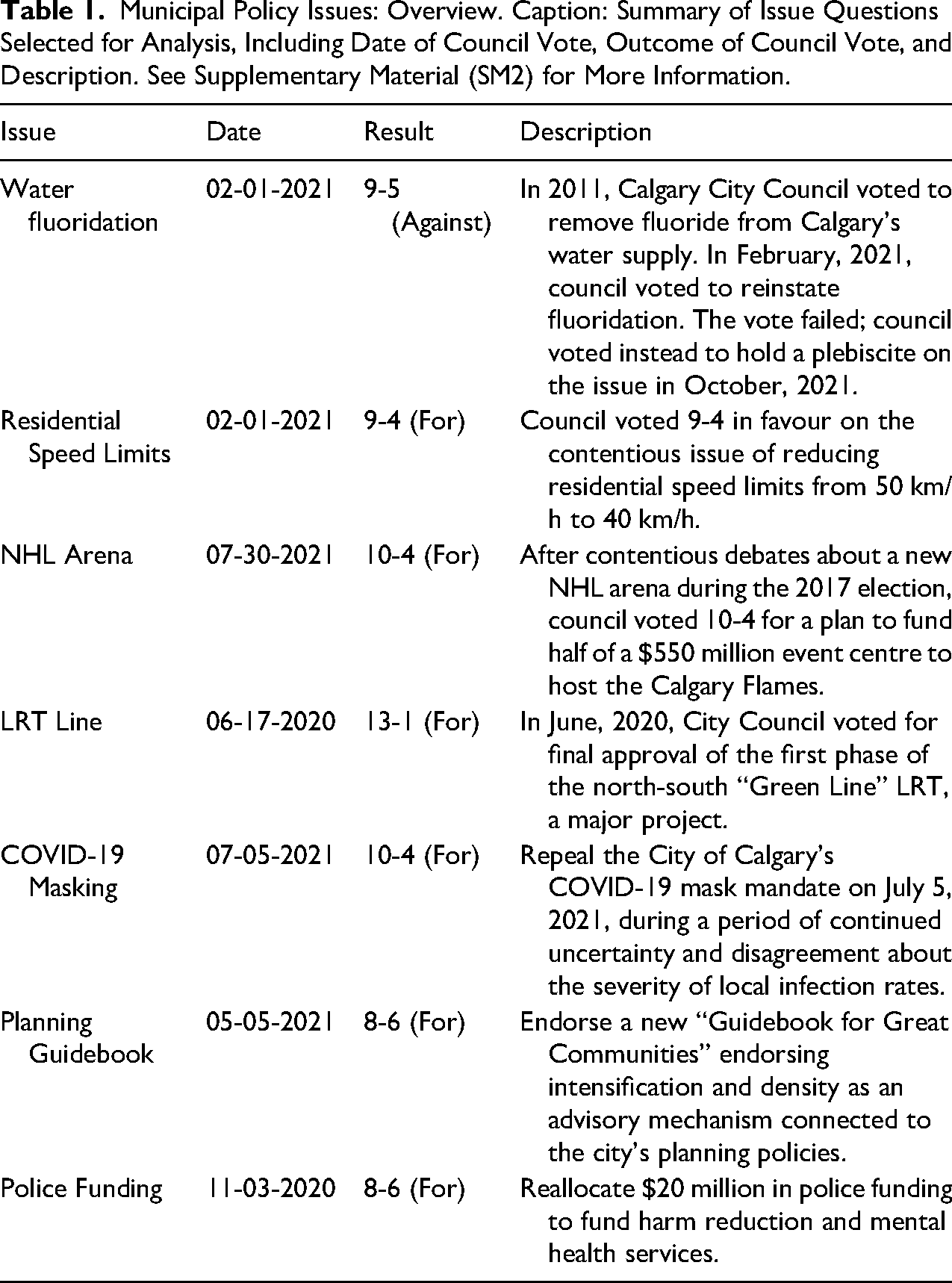
To assess policy alignment and knowledge, we asked each survey respondent two simple questions. First, we asked each respondent how they would have voted on each issue if they had been a member of Calgary city council. This question structure allows us to assess policy alignment in the most direct possible sense, comparing each respondent's “vote” on council to their councillor's vote. To avoid adding noise to these responses, we also provided a “don’t know” response for each policy item. To calculate policy alignment, we compare respondent's position on each issue to their councillor's position (these positions are drawn from official records of city council). We then created an overall agreement score by coding each instance of disagreement as (−1), each instance of agreement as (1), each instance in which the respondent had no opinion as (0), and then summed across the seven issues to produce an overall agreement score ranging from −7 (complete disagreement with the councillor on every issue) to 7 (complete agreement with the councillor). We also created a second measure in which each issue was weighted by the self-reported importance of the issue for the respondent; in this measure, issues considered important by respondents count more strongly toward the agreement score than issues considered less important. We replicate our analysis in the Supplementary Material using this second importance-weighted measure as a robustness test for our results (SM4).
To assess respondent's knowledge of their councillor's activity on council, we simply asked respondents how their councillor had voted on the same seven policy issues. Here, too, respondents were provided with a “don’t know” response option. We created an overall knowledge score by adding the respondent's correctness across the seven issues. We rescale this variable to range between 0 and 1; readers can therefore interpret the knowledge coefficient as the expected difference when comparing respondents at the minimum and the maximum of the knowledge scale.
Additional Controls
To clarify the relationship between policy alignment and councillor satisfaction, we include models that adjust our estimates for several factors known to be associated with performance assessment. These include the respondent's overall satisfaction with council's performance, their general economic retrospection, a suite of political and demographic variables (duration in municipality, gender, education, home ownership, ideological extremity), and ward fixed effects. We provide more detail on each of these control variables, and full survey question wording, in the Supplementary Material (SM1).
Results
We begin with Figure 1, which provides a descriptive overview of Calgarians’ knowledge of their councillors’ decisions on city council. For each issue, we report the proportion of respondents who were correct (in orange), incorrect (in green), and did not know (in blue). We then provide further breakdowns for each issue among respondents who considered the issue very important, moderately important, and low in importance.
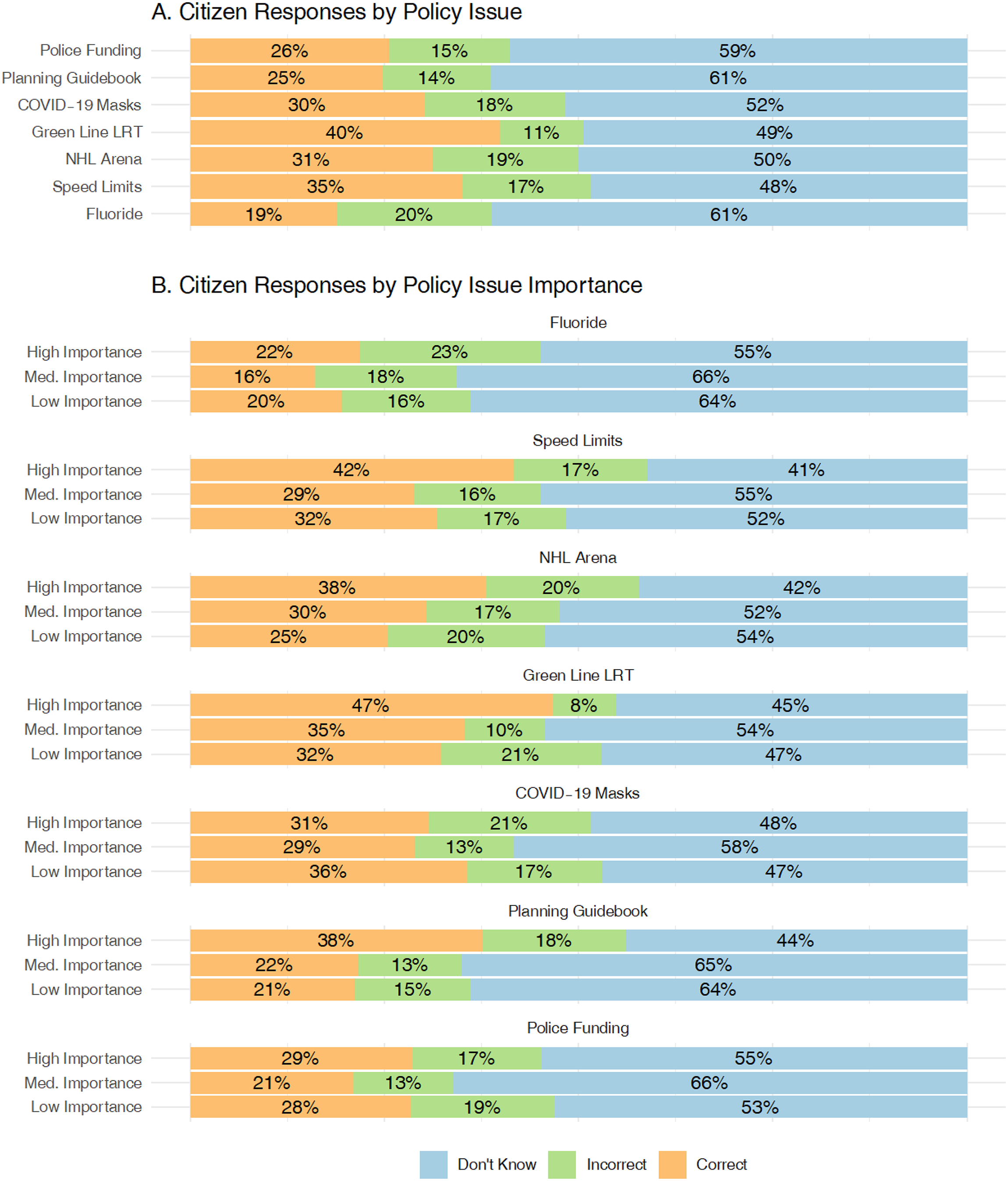
Knowledge of Council Votes. Caption: This figure summarizes correct (orange/left), incorrect (green/centre), and “don't know” (blue/right) responses for each council vote. Panel (A) summarizes overall results, and Panel (B) summarizes results organized by self-reported issue importance among citizens.
When it comes to citizens’ awareness of their councillors’ activity on council, the results in Figure 1 are not encouraging. A majority or near-majority of Calgarians do not know how their councillor voted on all seven issues – a particularly striking finding considering that the issues we selected were the most high-profile and well-covered policy issues in the council's term. Some 39 percent of respondents have zero correct scores (answering either “don’t know” or incorrectly on all questions). Just 1.4 percent of respondents answered correctly on all seven issues. Moreover, a substantial fraction of respondents who did provide an answer were incorrect; for most issues, less than a third of Calgarians have an accurate understanding of how their councillor voted on the city's highest-profile policy issues.
When we break down respondents’ accuracy by their self-reported issue importance, we find that citizens do generally perform better on issues they consider important (defined as a score of 7–10 on the 0–10 importance scale). In most cases, correctness scores improve among high-importance respondents and are near or above 40 percent in four cases. 3 On two highly polarizing issues, COVID-19 mask mandates and police funding, performance was highest among those who indicated very high or very low importance, suggesting that some respondents may have interpreted low importance to indicate disagreement with the issue. 4 Overall, however, citizens’ performance remains poor even when restricted to those who consider issues important.
Performance Satisfaction and Issue Alignment
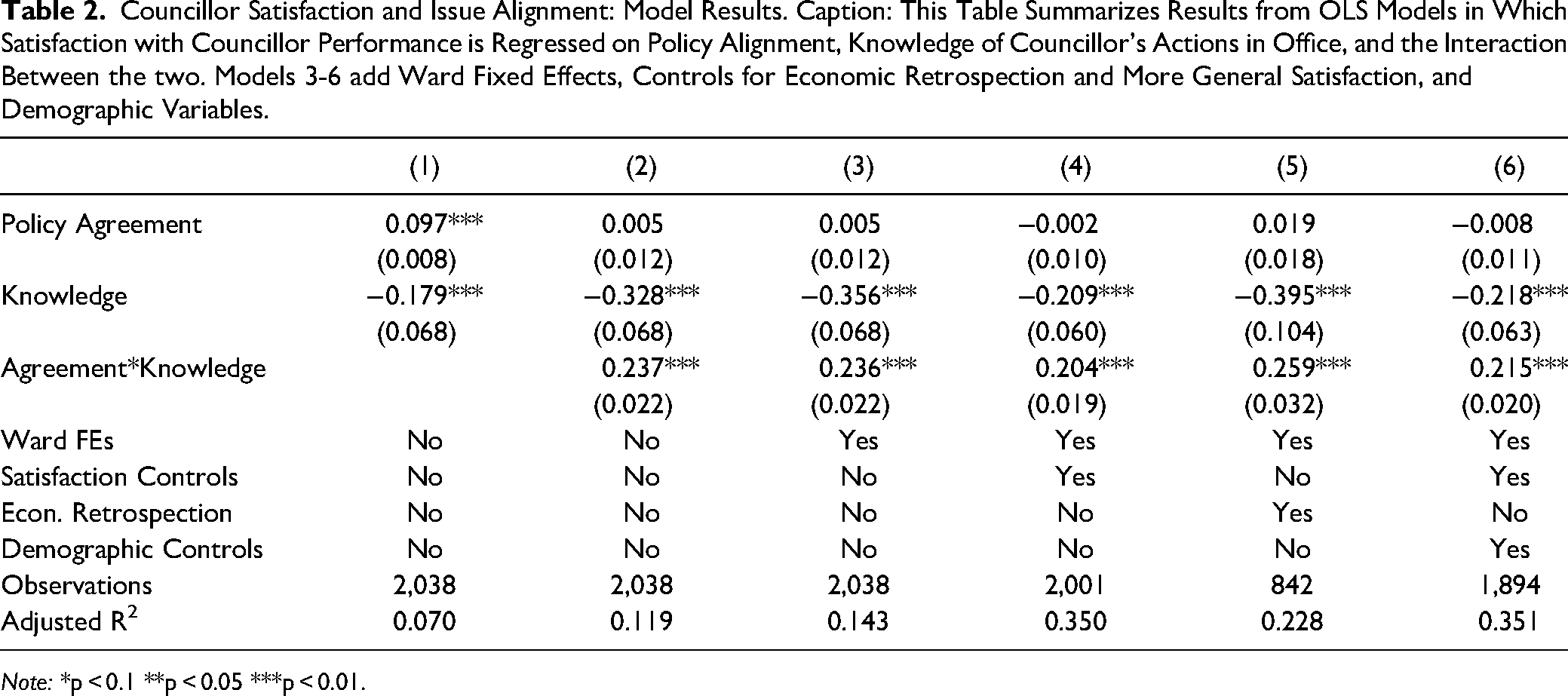
In Table 2, we summarize our findings for our main research questions: the relationship between issue alignment, knowledge, and performance satisfaction. Recall that we expected issue alignment to be positively related with councillor satisfaction, but also that this relationship would be strongest among high-knowledge residents. These expectations necessitate a model containing variables for issue alignment, knowledge, and the interaction between the two.
Councillor Satisfaction and Issue Alignment: Model Results. Caption: This Table Summarizes Results from OLS Models in Which Satisfaction with Councillor Performance is Regressed on Policy Alignment, Knowledge of Councillor's Actions in Office, and the Interaction Between the two. Models 3-6 add Ward Fixed Effects, Controls for Economic Retrospection and More General Satisfaction, and Demographic Variables.
Note: *p < 0.1 **p < 0.05 ***p < 0.01.
Table 2 provides these model results in six distinct specifications. Model 1 reports the simple relationships with no interaction or controls. This model provides us with a general picture of the “accountability relationship” in Calgary: adjusting for respondents’ knowledge of their councillors’ actions, we find that higher policy alignment is associated with higher levels of satisfaction with councillors’ performance. For our purposes, however, the more relevant models add the interaction between knowledge and policy alignment. Model 2 reports the simple relationships with no additional controls. Model 3 adds ward fixed effects. Model 4 retains ward fixed effects and adds controls for respondents’ overall satisfaction with their municipal and provincial governments, isolating councillor-specific satisfaction. Model 5 replaces the satisfaction controls with the respondents’ assessment of the state of the local economy over the past year (sociotropic retrospection). 5 Finally, model 6 contains the general satisfaction controls and ward fixed effects along with controls for respondents’ ideological self-placement, home ownership status, duration in Calgary, educational attainment, and gender. Because of the interaction term in the model, the first coefficient in Models 2–6 can be interpreted as the relationship between policy agreement and satisfaction when knowledge is set to zero, and the second variable can be interpreted as the relationship between knowledge and councillor satisfaction when policy agreement is set to zero. The interaction term tells us if the relationship between policy agreement and satisfaction is conditional on a citizens’ knowledge of their councillor's performance.
Across all of the interaction models, the first variable (Policy Agreement) is substantively small and not statistically significant, the second variable (Knowledge) is large, negative, and statistically significant, and the third variable (Agreement * Knowledge) is large, positive, and statistically significant. These consistent findings illustrate that the relationships we have uncovered are robust to a variety of alternative specifications and assumptions about the relationships among agreement, knowledge, and satisfaction. The findings correspond to our theoretical expectations, suggesting that the relationship between issue agreement and performance satisfaction is null when respondents do not know what their councillor has done in office (the first row of coefficients) but also that the relationship becomes stronger as knowledge grows (the final row of coefficients).
As with many interaction models, these results are easier to interpret when visualised as expected values. In Figure 2, we plot respondents’ expected satisfaction score (vertical axis) and policy agreement with their councillor (horizontal axis) among low-knowledge respondents, medium-knowledge respondents, and high-knowledge respondents (the three panels). 6 The figure clearly reveals that the relationship between policy agreement and performance satisfaction is strongly conditional on knowledge: among respondents who have no knowledge of their councillors’ actions, the relationship is completely flat, but among respondents with high knowledge, the relationship is steeply upward-sloping.
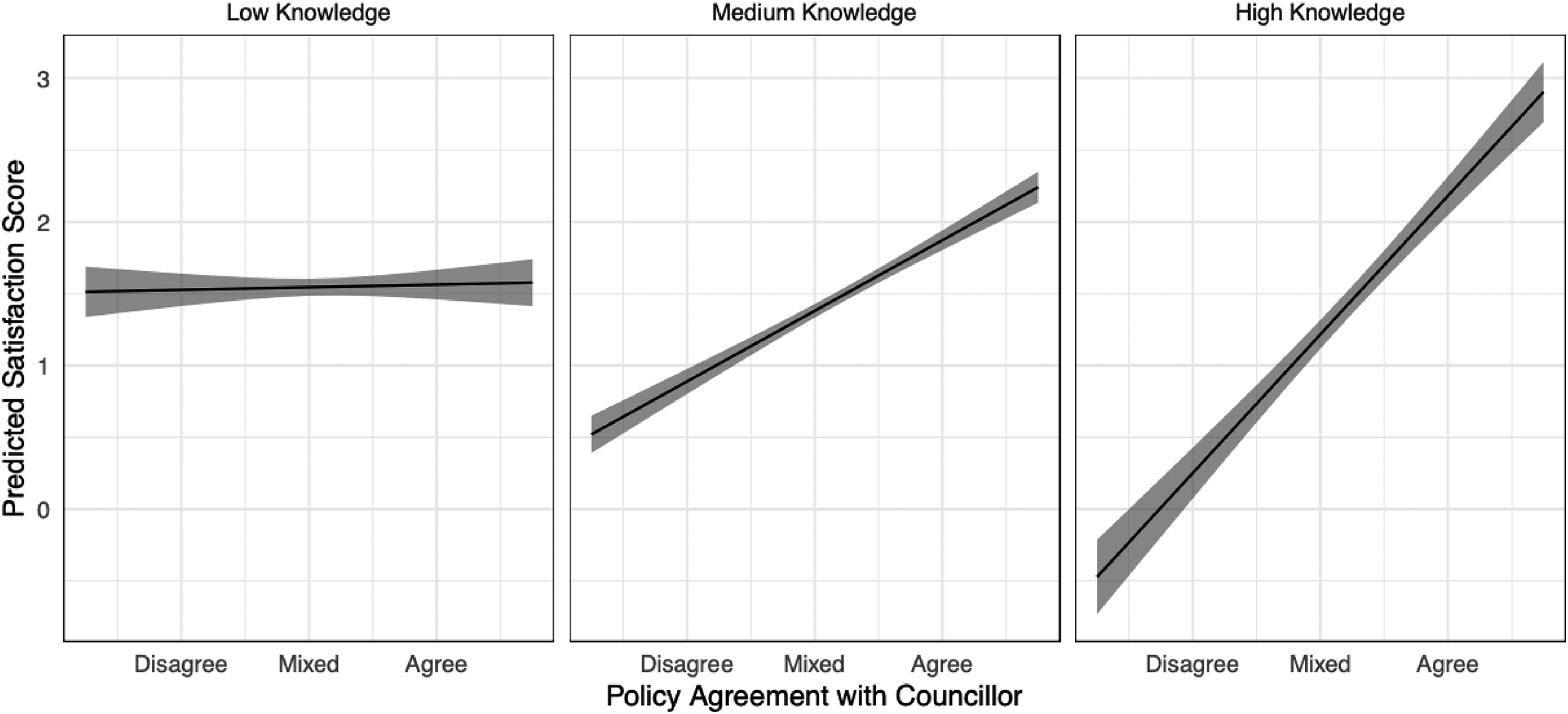
Issue Accountability, by Citizen Knowledge. Caption: This figure summarizes the relationship between performance satisfaction (vertical axis) and issue alignment (horizontal axis), among citizens with low knowledge of their councillor's votes (left panel), moderate knowledge (middle panel), and high knowledge (right panel).
To provide a final assessment of this relationship, Figure 3 summarizes a model of the correlates of performance satisfaction among low-information respondents (the blue coefficients) and high-information respondents (the red coefficients). The gap between the blue coefficient and the red coefficient at the top of the figure – illustrating the large and positive relationship between alignment and satisfaction for high-knowledge citizens versus the null relationship for low-knowledge citizens – reveals the dramatic difference in the predictive power of issue alignment for high-knowledge and low-knowledge citizens. The second set of coefficients, capturing general satisfaction with council, lends additional context; while the relationship is positive among both low-knowledge and high-knowledge respondents, the significantly larger blue coefficient for this second variable indicates that low-knowledge respondents are more likely to “read off” satisfaction scores for their individual councillor from their more general satisfaction with city council, suggesting that these individuals differentiate less than between their councillor and council as a whole than do high knowledge respondents. In non-partisan contexts, citizens with little information are unable to distinguish between their own councillor's performance and their assessment of council's overall performance.
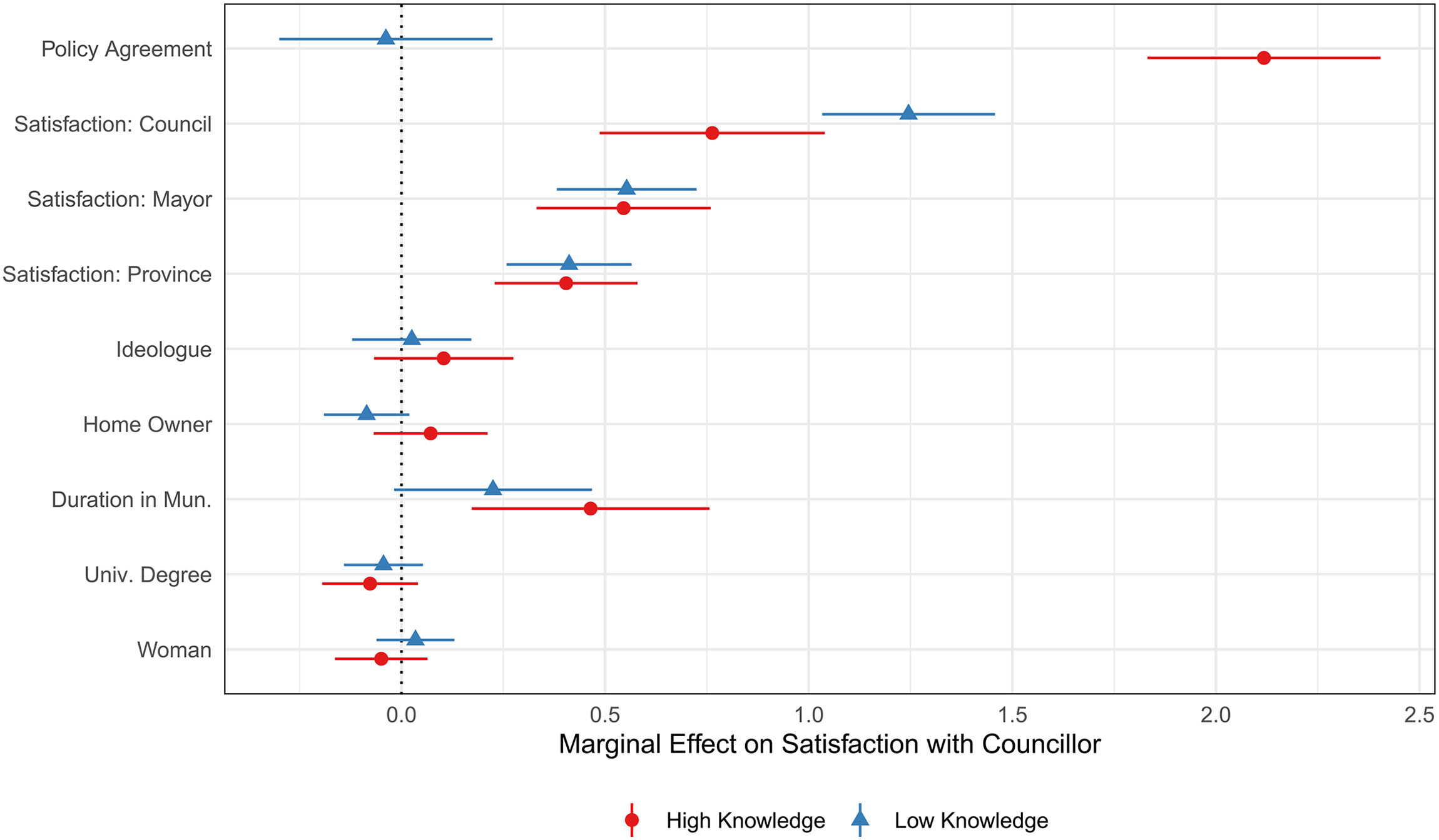
Correlates of Performance Satisfaction. Caption: This figure summarizes the correlates of respondents' satisfaction with their councillor's performance, among citizens with low knowledge of their councillor's actions (blue triangle coefficients) and high knowledge of their councillor's actions (red circle coefficients).
Discussion and Conclusion
Non-partisan municipal electoral systems create challenges for voters who are accustomed to relying on partisan heuristics to assess their representatives’ performance. In this paper, we have provided what is, to our knowledge, the first ever individual-level assessment of issue accountability in a non-partisan municipal context. Our results confirm the basic challenge: most municipal electors simply do not know, or are incorrect in their knowledge of, their councillor's actions as part of the municipal legislature. Even when citizens consider an issue very important, fewer than half are able to correctly report how their elected representative voted on the issue. Across the seven issues we examined – deliberately selected to represent the highest-profile recent issues addressed by city council – an average of 29 percent of respondents were able to correctly report how their councillor voted.
Among respondents who do know how their councillor voted, however, our findings reinforce evidence on the presence of electoral accountability in contemporary politics: when citizens know how their councillors have voted and agree with those votes, issue agreement and performance satisfaction are strongly and robustly related to one another. While these voters are a minority in our case study, they strongly illustrate the possibility of issue accountability even in a deeply non-partisan electoral context.
It is possible, however, that a small number of knowledgeable citizens – in our case, 29 percent of respondents knowing how their councillor voted – is sufficient to incentivize politicians to attend to their constituents’ interests. While incumbent candidates continue to dominate non-partisan municipal elections in Canada, incumbent races in Calgary have become somewhat more competitive in recent years, and many are decided by a margin of victory of less than 10 percent. In 2021, ten elections were decided by 5,000 votes or fewer, and fewer than 1,000 votes decided six. As long as municipal elections are sufficiently competitive, with well-resourced challengers, it is possible that a small number of engaged citizens can motivate politicians to be attentive to how voters will respond to their actions on council.
Comparing our findings to those of Ansolabehere and Kuriwaki (2022) and Hanretty, Mellon and English (2021), the non-partisan municipal context most clearly reflects that of American congressional elections. Much like Ansolabehere and Kuriwaki's (2022) findings, we see that, on average, twice as many respondents report correct perceptions of their councillor's issue votes compared to those reporting incorrect perceptions. However, our average of 29 percent of correct respondents is much lower than Ansolabehere and Kuriwaki's (2022) 43 percent finding. Additionally, our finding that, on average, 54 percent of respondents reported that they did not know their councillor's issue position is considerably higher than Ansolabehere and Kuriwaki's (2022) finding of 42 percent of unsure respondents. This discrepancy may be due to the informational environment surrounding municipal issues, which is likely lower than that of congressional issues. The discrepancy could also be due to the relative political importance of congressional and municipal elections. Importantly, however, we find a relationship between perceived issue congruence and councillor satisfaction, providing additional evidence of the accountability findings of Ansolabehere and Kuriwaki (2022).
Examining the contrast between Ansolabehere and Kuriwaki (2022) and Hanretty, Mellon and English (2021) in light of our findings, the nonfindings of accountability in Hanretty, Mellon and English (2021) may reflect the nature of parliamentary, strong-party systems. The presence of party discipline in the UK and the possible conflation between MP votes and votes for a prime minister could result in less clear accountability lines. Further, the separate presidential election may make US congressional elections more conducive to individual issue accountability.
Non-partisan municipal contexts reflect the US congressional context in several ways. A separate mayoral election, like the American presidential election, presents a clear separation between votes for a legislative representative and votes for an executive, unlike parliamentary systems. Further, a lack of parties likely emphasizes individual issue positions in city councils for accountability much like the US congressional context's lack of strong party discipline. Thus, the municipal context likely is more conducive to accountability, like the US congressional context, when compared to parliamentary contexts. Future research in Canada should compare accountability between non-partisan municipalities and parliamentary levels of government to investigate the above possibilities.
Our findings also illustrate the critical role of information in making the connection between issue alignment and performance judgments. In non-partisan municipalities, citizens lack standard partisan tools with which to make reasonable inferences about their councillor's actions on council – inferences like, “if my councillor is a member of the partisan majority, they probably voted in favor of council's major policies.” While some citizens do know how their councillor voted on specific policies (or perhaps have sufficient background knowledge about their councillor and the issue to be able to make a reasonable guess), most do not. As a matter of political accountability and democratic engagement, then, our findings suggest that any policy interventions that have the possibility of increasing local residents’ awareness of what their specific councillors have done in office – “vote tracker” applications, recurring reports in local media outlets on “how they voted” on council, extensive public education on the role of municipal government in relation to other levels of government, and data visualization applications created by local public sector organizations, such as universities, or other similar initiatives – would help move more voters out of the left-hand panel in Figure 2 and into the more democratically satisfying right hand panel.
Following our findings, there are several potential directions for future research. Above all, our conclusions are limited to a single election in a single municipality in a single region and country. Extending our findings to a broader suite of municipalities is, therefore, an important priority. However, this will require extensive survey data along with considerable expertise across many municipalities about (a) the important local issues in those municipalities and (b) individual councillors’ votes on those issues. Collaborative research employing “local experts” in several municipalities or collaboration with local newspapers and journalists in many municipalities may offer a potential path forward for this research. This research could also enable comparison not only across municipalities but also across municipal elected positions, such as mayors, councillors, and elected special-purpose bodies.
Future research should also explore knowledge acquisition and municipal accountability, with a particular focus on the mechanisms that allow local residents to gain knowledge of (or make reasonably accurate guesses about) how their councillor has performed in office. We have assumed in this research note that citizens’ weak knowledge of councillors’ actions is due in part to the absence of political parties, but this assumption can and should be investigated in comparative analyses of partisan and non-partisan municipalities. We have also assumed that municipal residents would be receptive to information about council performance if they did have it; field experiments supplying information of various types to local residents would be especially valuable to probe this assumption, and would help both academic researchers and local practitioners to clarify the types of information that are most effective for knowledge acquisition in non-partisan settings.
Footnotes
Declaration of Conflicting Interests
The authors declared no potential conflicts of interest with respect to the research, authorship, and/or publication of this article.
Funding
The authors disclosed receipt of the following financial support for the research, authorship, and/or publication of this article: This work was supported by the Social Sciences and Humanities Research Council of Canada (grant number 892-2020-2003).

Supplemental Material
Supplemental material for this article is available online.
Notes
Author Biographies
References
Supplementary Material
Please find the following supplemental material available below.
For Open Access articles published under a Creative Commons License, all supplemental material carries the same license as the article it is associated with.
For non-Open Access articles published, all supplemental material carries a non-exclusive license, and permission requests for re-use of supplemental material or any part of supplemental material shall be sent directly to the copyright owner as specified in the copyright notice associated with the article.
