



Abstract
Since 1999, the farmer–herder conflict in Nigeria has intensified and spread, driven by a complex set of social, political and environmental factors, including climate change. This study uses topic modelling and Qualitative Content Analysis (QCA) to analyse newspaper coverage of the conflict between 2017 and 2021 across four national newspapers, encompassing a geographically, ethnically and religiously diverse corpus. Whilst the topic models provide a macro-level overview of the farmer–herder conflict’s coverage across outlets, the qualitative analysis examines the representation of the conflict’s causes, consequences and solutions in greater depth, revealing a lack of clear-cut patterns between newspapers. Findings demonstrate that representations of the conflict’s consequences and solutions were diverse, with newspapers from the South generally focusing more upon an ethnic framing of the conflict’s causes, whereas newspapers in the North emphasized climate change as a key driver. Overall, the authors’ findings complicate previous understandings of media coverage of the conflict, revealing a diverse set of media frames.
Introduction
Climate change is one of the most pressing environmental issues of the 21st century, having an especially strong impact on vulnerable societies in the Global South (Odoh and Chilaka, 2012; Ozor et al., 2015; Wakdok and Bleischwitz, 2021). In Nigeria, climate change has adversely influenced the normal functioning of the ecosystem, which in turn affects how humans access certain vital resources for their survival (Odoh et al., 2012; Onuoha and Ezirim, 2010). A climatic demarcation between the north and south is evident in Nigeria; the northern region, characterized by a savannah forest area, is conducive to cattle rearing, while the thick forest of the south is suitable for crop farming (Olaniyan and Okeke-Uzodike, 2015). The profound impact of climate change, especially in the north, has led to an increased southward (east–west) movement of herdsmen, intensifying interactions with communities in southern Nigeria and sparking conflicts (Chukwuma, 2019; Ononye and Osoba, 2020). The ever-growing farmer–herder conflict, especially in the face of climate change, is unique in the extent to which it has weakened the social structure and threatened Nigeria’s unity (Nwankwo, 2022).
Some argue that ‘one basic feature of Fulani herdsmen is migration and at the heart of migration is climate change’ (Odoh and Chilaka, 2012: 114). In fact, migration linked to climate change is increasingly observed within many African countries, significantly influencing the risk of intergroup conflict (Trisos et al., 2022). However, the link between climate change and social conflict is highly controversial (Akinyemi and Olaniyan, 2017) and climate change should rather be seen as one of the many interacting conflict risk factors (Trisos et al., 2022). Especially during periods of conflict, the media play a crucial role in keeping audiences informed, often selectively, with potentially escalatory or de-escalatory consequences (Iyorza and Ackar, 2022; Kolawole, 2021). Media ownership and ethnic affiliation can influence how social issues are reported (Iyorza and Ackar, 2022), subsequently influencing audience perception of issues and groups (Ojebuyi and Ogunkunle, 2019). As such, this study asks: How does the news media frame the farmer–herder conflict in Nigeria, and how does this vary between newspapers and by media ownership?
Whilst extant studies have shed light on dynamics of, and discourses surrounding the conflict (see Chiluwa and Chiluwa, 2020; Iyorza and Ackar, 2022; Kolawole, 2021; Nwankwo, 2024; Yusuf et al., 2022), to our knowledge no study includes such a large and comprehensive corpus, spanning diverse outlets from the north and south, and focusing on actors cited in the news. Most strikingly, no extant research has used topic modelling to study news coverage of the farmer–herder conflict in Nigeria. In this article, we combine the advantages of the macro-level, computational approach of topic modelling with qualitative analysis to explore news articles published in four Nigerian newspapers between 2017 and 2021. Drawing upon this approach allows for a broad overview of the conflict to be analysed through mapping the key topics and themes in coverage on a large scale, alongside more fine-grained analysis.
Social Identity Theory and news media framing
This study focuses on the news media’s coverage of the Nigerian farmer–herder conflict that runs along ethno-religious lines. To this end, it is helpful to understand why people draw boundaries between in- and out-groups; Social Identity Theory suggests that belonging to social groups is crucial in shaping identities, and the process of creating distinctions between groups lies at the core of this phenomenon (Tajfel et al., 1971). The pursuit of positive distinctiveness for the in-group serves as an explanation for harbouring negative beliefs and attitudes towards outgroups, ultimately giving rise to prejudice and discrimination against others (Harwood, 2020; Nwachukwu et al., 2021). Media coverage plays an important role in shaping these positive in-group and negative out-group distinctions, through providing clues about which characteristics define in- and out-groups (Harwood and Giles, 2005; Mastro, 2009), and/or creating or strengthen stereotypes towards outgroups (Ortiz and Behm-Morawitz, 2015). That said, besides the potential escalatory role of the media during conflicts, in pluralist societies, the news media can also act as brokers between citizens from different groups, with the potential to promote peace and resolve conflicts (Joseph, 2014; Kolawole, 2021). Whilst the media do not determine the political outcome of crises, both the amount and nature of media coverage can affect policy outcomes and political decisions (Dekker and Scholten, 2017).
News media framing plays a definitive role in conflict situations, because ‘media are strong forces in constructing social reality of conflicts’ (Iyorza and Ackar, 2022: 91). Notably, framing refers to the process through which certain elements of reality are selected, then highlighted or distorted to become more prominent in news media coverage (Entman, 1993). Conflict frames ‘emphasise conflict between individuals, groups, or institutions as a means of capturing audience interest’ (Semetko and Valkenburg, 2000: 95). They also refer to the way that participants define the situation; what is focused on, what is ignored, what is considered important and what action is encouraged (Putnam and Shoemaker, 2007). Further, conflict framing calls attention to oppositional tensions, disagreements and incompatibilities.
In excluding or emphasizing some aspects of conflicts, media frames might also lead to an oversimplification of the issue at hand through decontextualizing violence, ignoring context, or reducing the number of parties in a conflict to two, and demonizing one side. Also, conflict framing typically implies that violence is inevitable, and overlooks structural causes like poverty, government neglect and military or police repression (Lynch and Galtung, 2010). In conflict framing, focusing on violence alone means that the forces and factors that influence the violence are overlooked, the objectives of outside interventionists are not identified, and there is often a failure to explore peace proposals and to offer images of peaceful outcomes.
Previous studies have highlighted conflict framing’s limited opportunities for promoting reconciliation; instead, conflict framing is often polarizing, in order to capture audience interest (Semetko and Valkenburg, 2000: 95). According to Demarest and Langer (2018), the ability of the media either to fuel or mitigate intergroup divisions depends on the level of media independence from political interference, or level of professionalism and training. Media coverage of conflict is also influenced by media ownership (private, state, trust or political ownership) (Hoff et al., 2020; Joseph, 2014). Indeed, news organizations’ function, structure and ownership are fundamental in the democratic process (Simiyu, 2014). McQuail (2003) states that three matters in particular stand out regarding the potential impact of media ownership. Firstly, the degree to which a media outlet chooses a politically influential role in society, or is perceived by political actors as doing so. Secondly, the degree to which the pursuit of purely commercial objectives interferes with the (chosen or not) political or social role of the media. Thirdly and finally, the use of actual powers of ownership in relation to publication decisions. Connecting media ownership and media content, the latter may be defined as the product of the complex set of ideological forces held by those who fund the mass media (Shoemaker and Mayfield, 1987). Political beliefs and/or interests of the owners of media organizations may not only be reflected in editorials and columns, but also in coverage of news and features. Overall, it is clear that links between media ownership and content may impact group portrayals and conflicts in dominant group-owned media, group-based selective consumption of specific media messages and the effects of exposure to that content for dominant and subordinate group members (Harwood, 2020).
Nigeria’s national diversity is mirrored in its media landscape. Interestingly, media ownership in Nigeria is largely defined by ethnic, political and regional orientations and along the north/south dichotomy of newspaper ownership (Oso, 1991). Most Nigerian newspapers are based in the southern part of Nigeria, especially, the Lagos–Ibadan route, although there are other newspapers in the northern part of Nigeria. The newspapers represent the ethnic and religious interests of their region respectively. Yusha’u (2018) further classified Nigerian newspapers into four categories: clientelist–political, commercial, diaspora and online newspapers, and local or indigenous language newspapers. Clientelist–political newspapers are those established by former or existing politicians or government executives; their owners have business, family and political interest. Next, commercial newspapers are privately-owned newspapers managed by professional journalists, driven primarily by a profit-making motive. Online and diasporic newspapers are advocacy-type newspapers established online by the diaspora community or journalists within Nigeria. Finally, local language newspapers include many smaller news outlets published in Hausa, Yoruba, Igbo or any other Nigerian language, which cover different interests from culture, religion and news and current affairs.
It has been argued that in some situations the news media contributed to dividing Nigerians along ethnic and regional lines, heightening ethnic or religious crises (Oso, 1991). According to Yusha’u (2018), the way newspapers report some crises results in retaliatory attacks on innocent individuals. Overall, this makes Nigerian news coverage not only an interesting but also a vital case for studying the news media framing of intergroup conflicts and the role of news media ownership.
The Nigerian farmer–herder conflict and the news media’s role
Nigeria is a multi-ethnic nation with ethno-religious fault lines that are further accentuated by cultural identities. Since independence, Nigeria has witnessed varying degrees of crises (civil war, inter-tribal conflict, insurgency and the trending farmer–herder conflict) which have caused a monumental loss of lives and resources (Kolawole, 2021). In all these crises, the Nigerian media actively participated and reported different perspectives to these conflicts. Indeed, the media’s role in the recurring farmer–herder conflict is understood as pivotal. This is because newspapers in Nigeria continue to be affiliated to political parties and strongmen, which commonly rely on ethno-regional voter support, especially along North–South and Muslim–Christian fault lines. Moreover, as Demarest and Langer (2018) show, whilst there is a willingness among Nigerian journalists to avoid potentially escalatory language, a dearth of resources and capacities impedes independent and in-depth analysis concerning the underlying drivers of conflicts.
Historically, a peaceful relationship used to exist between the herders and farmers in Nigeria, but it is now shaped by violent clashes with the attendant loss of lives and property in great magnitude (International Crisis Group [ICG], 2018; Iyorza and Ackar, 2022). The perennial and ever-increasing farmer–herder conflict phenomenon has greatly weakened the social structure and threatened Nigeria’s unity (Nwankwo, 2022). The situation worsened and became more deadly under the previous Buhari-led administration, with some arguing that this is because the former president was a cattle-breeder and Fulani by ethnic affiliation (Ogu, 2020). Uwazuruike (2020) explains that this can also be attributed to the insensitivity of Muhammadu Buhari’s administration, leading to the construction of the conflict in terms of ethnicity and religion, having a political undertone. It has created a wide social chasm between the northern and southern hemispheres of the country. The effects of the farmer–herder conflict have been revealed in terms of physical assaults and psychological trauma of the victims, especially women, children and the aged (Atim and Gbamwuan, 2022; Obasanmi and Enoma, 2022).
Regarding extant studies examining news coverage of the farmer–herder conflict so far, in a study of the identity construction of the farmer–herder conflict in Nigerian newspapers, Kolawole (2021) found that the Nigerian media’s use of war-oriented narratives reinforces ethnic group differences. Othering, especially the stereotype of the Fulani ethnic group in newspaper reports of the farmer–herder conflict in Nigeria also features in the news coverage (Nwachukwu et al., 2021). A study by Onoja et al. (2020) on audiences’ discourse on selected top five farmer–herder violent conflicts related news stories found that the commenters aligned with and amplified existing stances like Fulanization/Islamization, political conspiracy, leadership failure, and the need to disintegrate the country into smaller governable sizes in their comments. Meanwhile, Igwebuike (2021) focused on metaphorical expressions in the coverage of farmers and herders, relating to invasion as ’hunting’, and other authors such as Abonyi and Ohaja (2021) have focused more broadly on framing, finding that security, economic and consequence frames were the dominant frames used by the newspapers, and that responsibility and solution-oriented framing were privileged over war-orientated narratives.
In the study of the farmer–herder conflict in Benue state, Uwazuruike (2020) found that Idoma Voice did not adopt an ethno-religious frame in the coverage of the conflict but reported on and emphasized the violent aspects of and effects of the conflict. The article focused on episodic framing of the conflict by emphasizing the immediate violence. In their study of the media discourse of the farmer–herdsmen conflict in the Punch, Sun and Daily Trust newspapers during a short time frame (January to May 2018), Nwankwo et al. (2020) found that the selected newspapers framed the conflict as a security threat and advocated for a more temporal analysis (analysis over time) of the discourse of the conflict. Whilst Nwankwo et al.’s study successfully revealed how the construction of the conflict draws on the political and ideological dispositions of the papers, knowledge gaps remain relating to the framing of the conflict from the lens of religion and ethnicity. Moreover, there is a need to expand the focus from understanding frames, to also capture the voices of actors amplified in media discourse about the conflict.
Pate and Dauda (2015) posit that the Nigerian media promote prejudicial stereotypes about groups and individuals through selective reporting, while inter-group conflicts are mostly reported out of fundamental sociological, economic, political and other contexts. The media also promote conflict by attributing statements by individuals to collectives as well as using shallow and episodic coverage, which ignores context. In addition, inflammatory, misleading and sensational headlines relating to certain ethnic, religious, or political groups are used frequently (Chiluwa and Chiluwa, 2020).
Overall, whilst a growing number of studies have examined the farmer–herder conflicts in Nigeria, many are limited to smaller corpuses, examine shorter periods or moments (Nwachukwu et al., 2021), include a smaller range of outlets (Gever and Essien, 2019), or focus on one dimension of the conflict, such as audience responses (Onoja et al., 2022). As such, extant studies have not yet explained variation in the representation of the conflict across media outlets; we do not know how or why media ownership might explain variation in the framing of the conflict, and how this might have changed over time. Given that most Nigerians learn about these conflicts in and outside their immediate settings through newspapers, it is important we gain a comprehensive overview of coverage and understand these dynamics (Pate and Dauda, 2015).
Building upon extant research, this mixed-method study seeks to study the representation of the farmer–herder conflict on both the macro and micro scale, through combining both computational and qualitative approaches. In addition, this study seeks to understand some major but understudied dimensions of the conflict that include a consideration of the actors cited in the news on this topic and an exploration of the conflict framed as related to climate change. In doing so, this study highlights unique articulations of climate change framing in news media coverage in the Global South, which are understudied by researchers in a field dominated by Western countries.
Methodology
We collected articles from four different Nigerian newspapers between 2017 and 2021 using the Factiva Developers API. It is worth noting that we included the time frame of 2017–2021 because there was a surge in the conflict’s intensity during this period (Nwankwo et al., 2020). From this larger corpus, we then selected news articles mentioning the following keywords: ‘farmer’, ‘farmers’, ‘herder’, ‘herders’ or ‘herdsmen’ (N = 2076). Our purposeful sample included newspapers from the South whose owners’ religious affiliation is Christian (Daily Independent, Nigerian Tribune, Vanguard), and the North whose owner’s religious affiliation is Muslim (Daily Trust). This geographic and religious diversity might affect news coverage as it runs along the conflict lines to the extent that herders generally belong to the Islamic North and farmers mostly to the Christian South. Notably, differences between North and South Nigeria are a historical, political and religious reality, offering an interesting comparison to explore (Campbell, 2011). However, whilst our choice of newspapers cuts across the broader classification of the country into the north and the south, as well as including media owners of different religious backgrounds, it is important to note that we did not aim to conduct a systematic comparison. Rather than making representative claims about differences between coverage based upon the geographical region or media ownership, our focus was on gaining an explorative overview of the conflict in the nation using a mixed methodological approach. Further information on the sampled newspapers’ geographic base and the religious affiliation of the owner is offered in Table 1.
Sampled newspapers and their regional and (their owners’) religious affiliations.
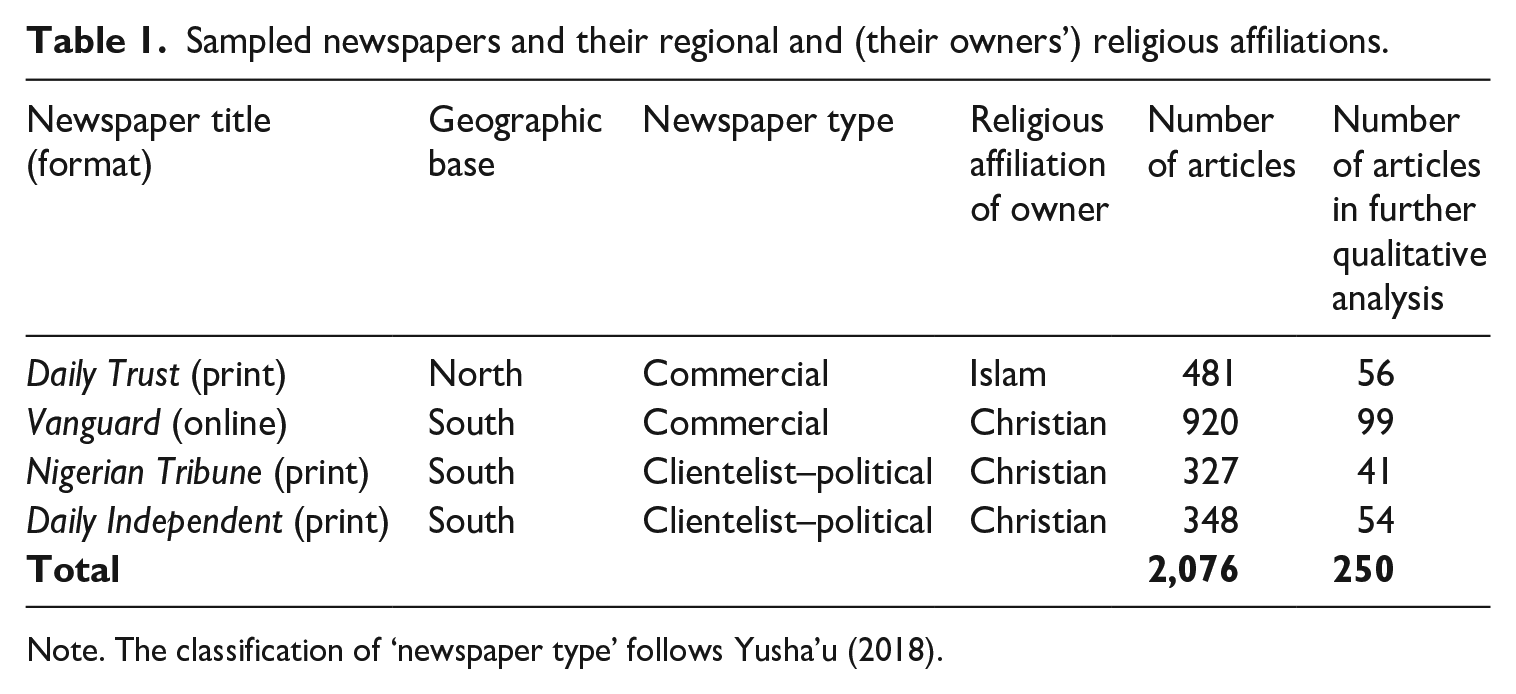
Note. The classification of ‘newspaper type’ follows Yusha’u (2018).
Recently, scholars started exploring the benefits of combining computational methods with qualitative approaches (Nelson, 2020). In this study, we combine topic models and Qualitative Content Analysis (QCA) in order to study both the broader media framing of the farmer–herder conflict at the macro level, as well as the details of coverage at the micro level, both of which are elaborated on below.
Topic models
Given our interest in the broader framing of the farmer–herder conflict across a large corpus, unsupervised methods are useful as they allow us to extract patterns and classify this previously unstructured data (Roberts et al., 2016). Topic modelling is a widely used unsupervised technique for exploring and classifying topics from a corpus of documents (Benoit, 2020). We use the Latent Dirichlet Allocation (LDA) topic model that is able to detect latent thematic structures in texts (Blei et al., 2003). We identified 40 as the optimal number of topics (see Appendix I for details).
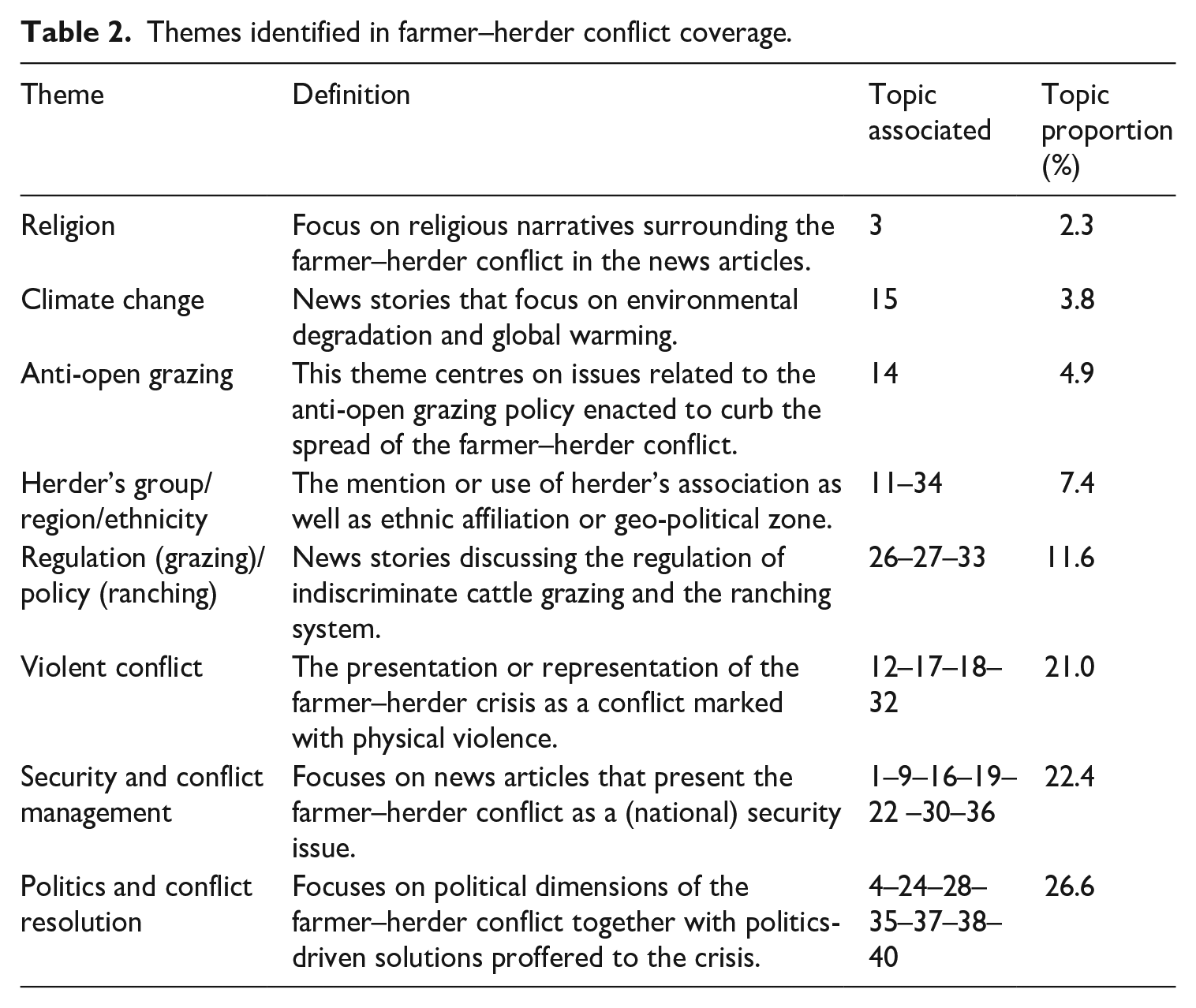
To label each topic, two researchers with contextual knowledge reviewed the top 15 most prevalent words for each, and read the article that was most likely to be associated with the respective topic (Rabitz et al., 2021). After excluding incoherent topics and those which were not directly related to the farmer–herder conflict, we identified eight broader themes (see Table 2), of which the themes ‘climate change’, ‘security and conflict management’, ‘politics and conflict resolution’ and ‘herder’s group/region/ethnicity’, were selected for further qualitative analysis. These topics were chosen for further qualitative analysis because they are all relevant to the key focus of this study: the causes, consequences and potential solutions of the conflict.
Themes identified in farmer–herder conflict coverage.
Qualitative Content Analysis
Following the topic models, QCA was used to gain a richer understanding of the framing of the conflict (Mayring, 2004). Initially, 100 articles were sampled from across the four topics relevant to the study; these articles were sampled randomly, but assessed for relevance by the authors before analysis. Including QCA allowed us to study the precise nature and articulation of frames. Specifically, we followed a semi-inductive and deductive approach, meaning that our analysis was informed by some previously defined frames, including ‘causes’, ‘consequences’ and ‘solutions’. This initial, partially theoretically deduced coding scheme drew upon elements of Putnam and Shoemaker’s (2007) conflict framing theory and Entman’s (1993) broader framing approach. Our QCA was structured by the following steps: researchers read an initial sample of articles from four themes supplied in the topic modelling results (‘politics and conflict resolution’, ‘security and conflict management’, ‘climate change’, ‘herder’s group/region/ethnicity’), to refine the coding frames further and conduct a preliminary analysis. Next, the full sample of articles from each cluster was qualitatively coded based on the framing elements outlined in Table 3, as well as additional framing elements identified by researchers (inductive coding). This follows Mayring’s (2004) approach to QCA which involves moving continuously between the data and the previously defined coding framework, and making comparisons between articles within the same topic cluster and across topic clusters.
Initial coding schema.
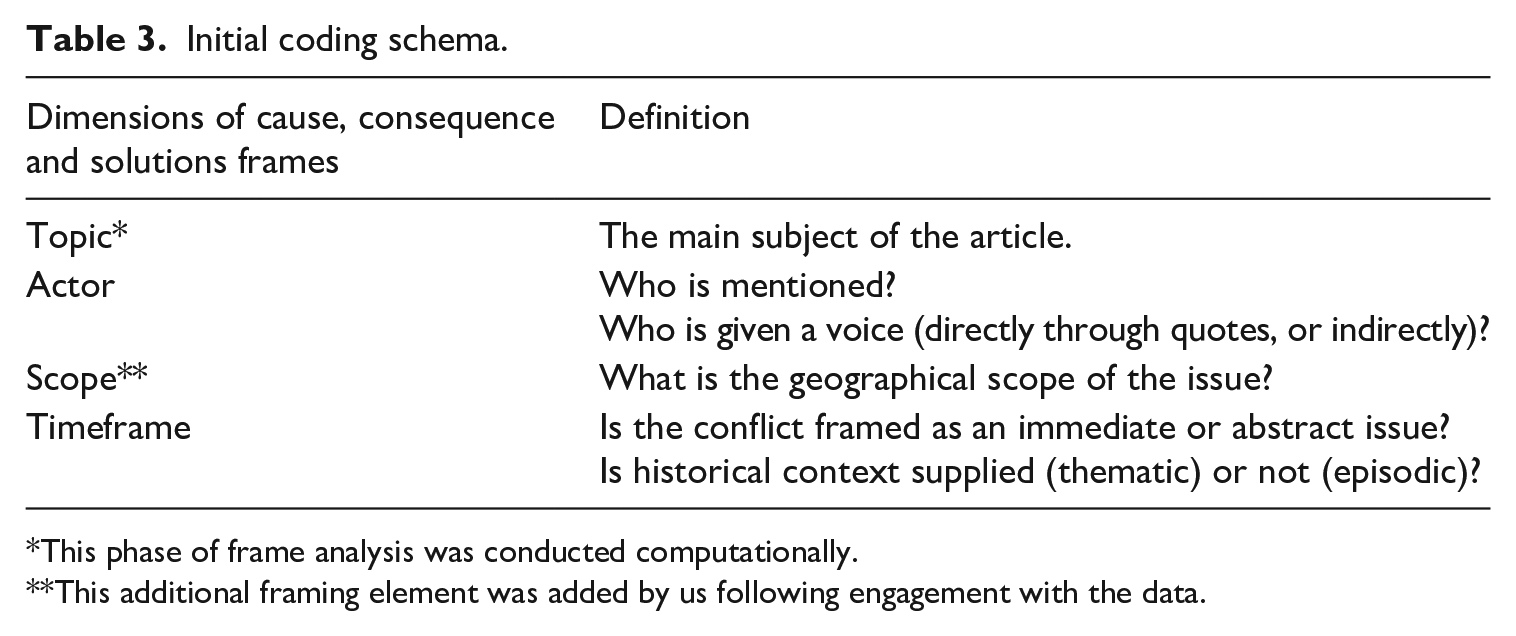
This phase of frame analysis was conducted computationally.
This additional framing element was added by us following engagement with the data.
By comparing the themes identified within and across each topic cluster, we were able to identify the unique discursive dimensions and articulations of each theme, across different news outlets.
Notably, the QCA approach allows different frame elements to be focused on more than others. Our analysis paid special attention to the actors quoted on the conflict because a consideration of who is cited, and how, provides a robust context for a better understanding of the nuances of the crisis. In addition to considering different actors, we paid special attention to rhetorical devices including keywords. Whilst QCA as an approach to frame analysis has been criticized for only dealing with smaller samples, we argue that, by combining topic modelling with qualitative analysis, these weaknesses are largely overcome.
Results
Before exploring the framing of the farmer–herder conflict in Nigerian newspapers in more depth, we first examined the issue salience across time. Due to issues with missing data, we excluded 2017 from this analysis and instead analysed salience of the farmer–herder conflict between 2018 and 2020. We see that the conflict received the most attention in 2018 followed by a decline and another peak in summer 2019 (see Figure 1).
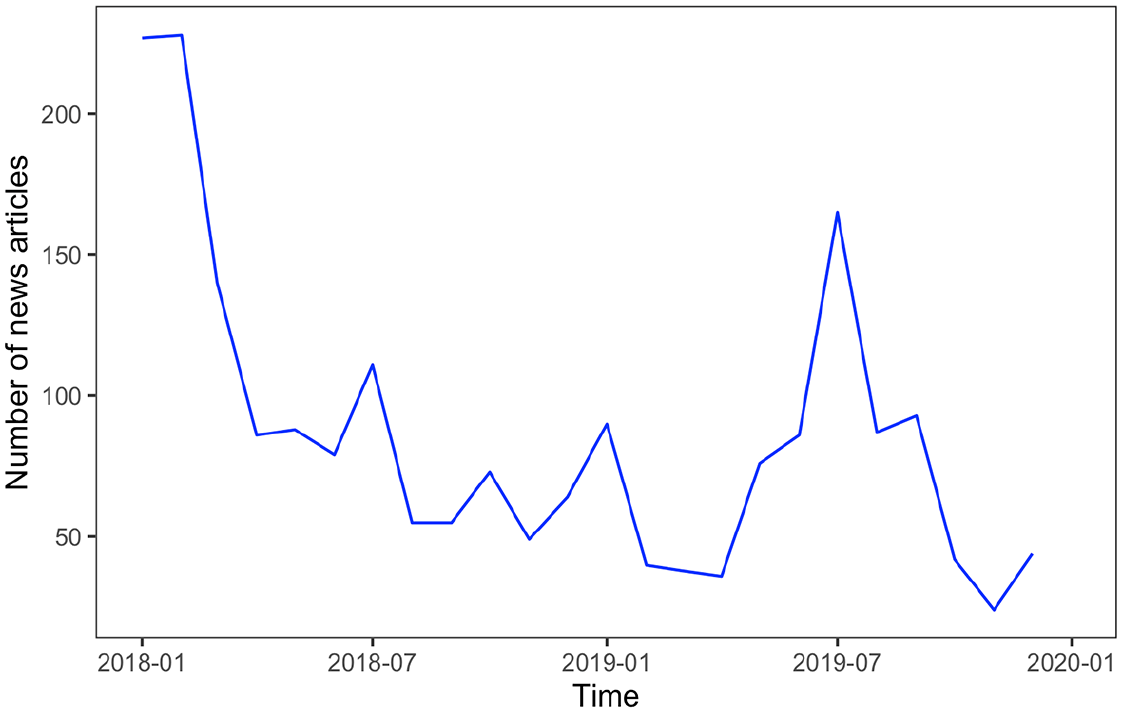
Number of articles about farmer–herder conflict across time.
We used topic models to identify broader themes in the news coverage of the farmer–herder conflict. These computational results provide key insights regarding the dominance of different substantive framings of the conflict across our geographically diverse corpus. We see that topics related to ‘politics and conflict resolution’ received the most attention (topic proportion = 26.6%), followed by ‘security and conflict management’ (22.4%). Though less salient, ‘herder’s group/region/ethnicity’ (7.4 %) and ‘climate change’ (3.8%) offer alternative viewpoints on the conflict.
Following the broader themes identified in the topic modelling analysis, we selected articles from the themes ‘politics and conflict resolution’, ‘security and conflict management’, ‘herder’s group/region/ethnicity’ and ‘climate change’ for further qualitative analysis in order to encompass a combination of dominant, but also diverse perspectives on the conflict. The findings of our fine-grained qualitative analysis are presented under three broader frames of causes, consequences and solutions in order to provide an overview of how the situation is framed across outlets.
Qualitative results
Causes frame
The framing of the farmer–herder conflict’s causes varied across outlets in the sample; whilst the Nigerian Tribune newspaper concentrated on the Fulani nationality movement, the Daily Independent newspaper highlighted the politics of ethnic sentiments, the Vanguard newspaper coverage centred on economic hardship and the Daily Trust newspaper emphasized climate change-related issues.
In the Nigerian Tribune, the conflict was mainly framed in relation to land grabbing and national movements. The conflict and ‘attack on Benue communities’ described ‘not as a result of quest for grazing but an agitation to take over the state’ (Nigerian Tribune, 1 June 2017). In the same article, territorial claims are described: ‘According to the House, the group also . . . laid claim to being the real inhabitants of the Benue Valley’ (Nigerian Tribune, 1 June 2017). This article uses episodic framing, highlighting land grabbing and its attendant effects as a major immediate cause of the conflict. Comparably, in a later article in the Nigerian Tribune, the following extract displays the historical roots of this conflict: ‘the Fulani Nationality Movement, FUNAM, has stated that what was happening in Benue State was a continuation of the 1804 Jihad when they were opposed by Benue indigenes to dip the Qur’an in the sea’ (Nigerian Tribune, 13 January 2013). This quote underlines that the farmer–herder conflict is an extension of the historical pattern of dispute over the territory of the Fulani people (Oke and Olawale, 2019). As such, this article frames the event thematically, as opposed to episodically, by showing that it is an historically rooted and repeated crisis.
The ethnic diversity of Nigeria has posed several societal challenges, across different scales (Salihu et al., 2021). The role of ethnicity is frequently employed as a causal frame of the farmer–herder conflict; notably, challenges arising from ethnic diversity as a potential cause of the conflict are often implicitly, rather than explicitly presented in articles. For example, in The Daily Independent (14 March 2021), Senator Ahmed Tinubu, the national leader of the ruling party, is cited as describing the conflict as ‘not ethnic in factual origin or actual causation, although . . . it has become ethnic in recrimination and impulsive action’. In this quotation from this senior politician, ethnicity is constructed not as an inherent cause, but a social one. In Nigeria today, every occurrence of farmland invasion/destruction is readily attributed to the Fulani herdsmen, even if it was perpetrated by members of other ethnic groups (Kolawole, 2021). In another article from The Daily Independent (15 July 2019), the former President of Nigeria, Olusegun Obasanjo is quoted as saying: ‘The main issue . . . is poor management or mismanagement of diversity which, on the other hand, is one of our greatest and most important assets.’ Here, it is not ethnic diversity being blamed as the cause of the issue, but rather the mismanagement of Nigeria’s diversity has been a major catalyst of the farmer–herder crisis. In other words, blame is not assigned to any particular group, and there is a hopeful tone; it is implied that ethnic diversity is also an ‘important asset’, which could unlock potential. Interestingly, both quotes tend to subtly extricate ethnicity as a causative factor while still acknowledging its relevance as a frame of the conflict. This might be explained by the two statesmen diplomatically wanting to protect their national image by expressing their belief in the unity of Nigeria.
The role of ethnicity as a cause of the conflict is more explicitly acknowledged by non-political actors. For example, in the Vanguard, a US-based Nigerian musician Prince Ayo Manuel Ajisebutu is cited as follows: . . . the unity of Nigeria continues to be threatened by perceived political imbalance and domination of the country’s top government positions by the Hausa/Fulani ethnic group since independence . . . such sense of entitlements is responsible for the incessant farmers/herdsmen clash . . . (Vanguard, 10 August 2023)
In this statement, Ajisebutu identifies political imbalance and skewed representation of the diverse ethnic groups in government as another cause of the farmer–herder’s clash; a claim supported by research findings (Eme-Uche and Eme, 2023), and this has always portended a threat to Nigeria’s unity beyond the farmers and herders’ conflict.
Moving beyond ethnicity, Nigerian news media also frame the conflict through the political causal lens. In the Vanguard (25 June 2018), for example, President Muhammadu Buhari is cited as largely attributing the farmer–herder conflict to economic and political factors: ‘We know that a number of geographical and economic factors are contributing to the longstanding herdsmen/farmers clashes. But we also know that politicians are taking advantage of the situation.’
This statement suggests that the conflict is impacted by political interference and corruption. The fact that the President’s voice is included by Vanguard shows that political interest has significantly perpetuated the crisis. Similarly, in the Daily Independent (23 July 2018) which is credited to an advocacy group in Nigeria (Save Humanity Advocacy Centre [SHAC]), the political dimension is highlighted, without referring to any particular politician or affiliation: . . . the endless clashes between herders and farmers have led to loss of lives and properties worth millions of naira . . . are politically sponsored. (Save Humanity Advocacy Centre [SHAC], Daily Independent, 23 July 2018) . . . the spate of killings under the guise of herdsmen’s/farmers conflict, are indeed politically motivated. (SHAC, Daily Independent, 23 July 2018)
Further, more complex discussions on the causes of the conflict are presented in a way that reveals interconnectedness. For example, the former President of the Academic Staff Union of Universities, Professor Biodun Ogunyemi, noted that the farmer–herder’s conflict is grounded in ecological and socio-historical problems: The farmers–pastoralist conflict is an outcome of a combination of environmental ecological crisis, and socio-historically derived problems which the ruling class of Nigeria, in its different wings, has been manipulating to suit its economic and political goals. (Daily Trust, 5 July 2018)
Here is an example of thematic framing of the conflict’s causes because extensive historical context is provided. Comparably, the topic of climate change is mentioned as a cause of the conflict by the researcher Chris Kwaja in the Daily Trust (22 May 2018). Another emerging cause covered by different Nigerian news outlets is ‘neo-pastoralism’, whereby herdsmen use sophisticated weapons to herd their cattle instead of traditional methods. In the Daily Trust on 22 May 2022, Dr Chris Kwaja, Research Fellow with Search for Common Ground, was quoted saying that ‘the proliferation of arms and light weapons must be addressed.’ Similarly, Ahmed Tinubu noted that the proliferation of weapons is a factor responsible for the escalation of the conflict (Nigerian Tribune, 14 March 2021).
Consequences frames
The consequences of the farmer–herder conflict on the Nigerian state were also captured within the sample. One key consequence highlighted across many outlets was the economic impact: ‘. . . the crisis has crippled many private and public investments across the nation. Several businesses and investors in affected areas are currently counting their losses (Daily Independent, 6 June 2021). This quote foregrounds the adverse effect of the conflict on the Nigerian economy broadly. Other economic consequences highlighted in the news coverage concern the livelihood of farmers specifically. A woman farmer, Mrs Elizabeth Eyinade in the South, reports on the ordeals of farmers in the hands of the herders. In an article by Nigerian Tribune published on 9 February 2021, she is directly quoted: . . . if we cultivate farmlands, they will say the place is meant for cow grazing. They will destroy the crops on the farm and if we report them to their leader, he [Alhaji Saliu Abdulkadir] will tell us that there is nothing he could do and that there was no money to compensate us.
Critically, the concept of otherness is evident in the quote as ‘we’ represents the farmers while ‘they’ refers to the herders. By this, there is already an entrenched social divide that wields a great influence on the psychology of the conflict between the two groups.
On a broader scale, the clashes between farmers and Fulani herdsmen have also negatively affected the agricultural value chain in volatile areas and, in turn, lead to food scarcity in the country: . . . many farmlands across the country (although more pronounced in the North and Middle Belt) have been destroyed in the process, and this has continued to disrupt agricultural activities in these areas. (Daily Independent, 6 June 2021) . . . the insurgency that bars farmers from accessing their farms and farmers/herders’ clashes have caused a shortage of farm yields and food blockades; Nigeria faces a crisis in terms of access to food and general food availability. (Daily Independent, 20 March 2021)
From the above excerpts, it is clear that the news media generally framed the effects of the conflict as having immediate and negative impacts on the economy and agriculture. Specifically, words like ‘crisis’ and ‘disrupt’ are markers of the degree of toll the conflict has taken on farmland cultivation and agribusiness in general.
Solutions frames
We now turn to potential solutions presented in the Nigerian news coverage. These solutions cut across engagement of relevant stakeholders, enactment of anti-grazing law, creation of ranching system, decisive leadership, synergy of efforts, avoidance of religious bigotry and meting out of punitive measures.
The first sub-frame identified as a solution for the long-standing farmer–herder conflict is ‘public deliberation’. Specifically, stakeholders’ engagement is highlighted as an effective strategy by several outlets. For example, the Attorney General of the Federation is quoted as saying: ‘the better approach towards resolving the crisis over the short, medium and long terms is to directly involve the stakeholders at the conception, implementation and monitoring phases’ (Daily Independent, 23 February 2020). This is underscored by Prince Bola Ajibola, the Chairman of Ogun Elders’ Consultative Forum, quoted in the Vanguard (27 February 2021) as follows: ‘It is imperative for the good people of Ogun State to continue to engage in dialogue where there are issues and tolerate one another . . .’ Thus, across many outlets, there is an emphasis on the need for dialogue and understanding.
In framing political solutions to the conflict, ‘policies’ was another sub-frame emerging across many outlets. In the Nigerian Tribune (18 March 2018), the Benue state governor is cited as saying: ‘the law we enacted was meant to proffer solution to the incessant herders/farmers clashes.’ Likewise, Vanguard (10 January 2018) posits that ‘the Federal Government should commence the process of establishing ranches across the country as a panacea to farmers/herders’ clashes.’ This is in tandem with the submission of the PDP Governors that ‘ranching is the most viable solution to the herders/farmers clashes in Nigeria’ (Daily Independent, 17 May 2021). More specifically, the enactment of an anti-open grazing law and the creation of a ranching system are proposed as policy measures in resolving the farmer–herder conflict (Vanguard; Nigerian Tribune & Daily Independent).
Closely related to policies is the proposed solution of ‘decisive leadership’. In the sampled news articles, some state actors were platformed stressing the need for a more decisive leadership from the president. For example, the Benue State government is quoted as saying: ‘. . . the President needs to offer leadership and be decisive so that these killings will end just like what he did with Indigenous Peoples of Biafra, IPOB’ (Vanguard, 12 March 2018).
The above excerpt underlines a top-down approach, in contrast to the earlier suggested stakeholder engagement solution (bottom-up). Also, the Ondo State Governor, Rotimi Akeredolu, advocated for a ‘greater pro-activeness and dedication on the political class and security operatives in the country’ (Daily Independent, 10 August 2019).
That political solutions are necessary, but perhaps not sufficient, is highlighted in a Daily Trust article citing Laurentia Malam, former Minister of Environment: All those responsible for one form of evil or the other must be exposed and dealt with in accordance with the provisions of the laws of the land. There must be no sacred cows. Also, religious leaders must not use religion to divide us. (Daily Trust, 30 May 2018)
Here, she stresses the need to avoid further conflict promoted along religious lines, encouraged by religious leaders; the farmer–herder conflict has a religious dimension with the herders being predominantly Muslims from Northern Nigeria and the farmers being largely Christians from the Middle Belt and Southern part. The choice of the word ‘us’ reveals the need for unity in Nigeria despite the ethnic and religious divides.
Discussion
Finally, in addressing the question ‘How does the news media frame the farmer–herder conflict in Nigeria, and how does this vary between newspapers and by media ownership?’, findings of this mixed methods study build upon previous research to reveal patterns in the coverage of the conflict’s causes, consequences and solutions. Through combining topic modelling and QCA, our macro- and micro-level analysis reveals how, among many other factors, climate change and politics were used to frame the primary causes of the conflict, highlighting the complexity and protraction of the crisis. Using a significantly larger corpus than previous studies and drawing special attention to actors cited in texts, we not only highlight the frames employed in news coverage but also reflect on which actors propagate such framings. A more detailed description of the main findings and the other frames employed in the conflict coverage are discussed below.
The analysis reveals a diverse range of frames through which the conflict’s causes, consequences and solutions are covered; interestingly, we find that, especially, a wide range of causes are covered, with sub-frames highlighting the mismanagement of the country’s diversity, ecological problems and politicians’ role in amplifying the conflict. This variation in the framing of the farmer–herder conflict in terms of causes by the select news media, suggests some level of ownership influence. Specifically, within the sample, the Nigerian Tribune included predominantly episodic ethnic frames, blaming the Fulani nationality movement as the cause of the conflict. In contrast, the Daily Independent used thematic frames that focused more on the mismanagement of the nation’s diversity and politicization of the conflict through ethnic labelling as the cause of the crises. The Vanguard presented the conflict through a geographical and economic lens, whilst emphasizing the marginalization of groups, and accentuated by politicians, as the cause of the conflict using thematic frames. The Daily Trust framed the causes of the conflict thematically, as an ecological issue, accentuated by political manipulations and governments’ indecisiveness. Generally, the variation in framing the causes of the crisis by the studied news outlets does not imply a clear-cut stance of the select newspapers on the phenomenon. Rather the highlighted causal framing for each news outlet only provides an approximate lens for viewing the crisis in terms of the causative factors, as well as revealing the profound complexity of the conflict. Our findings align with several other studies in which the agro-pastoralist conflict in Nigeria is presented as being convoluted with a series of intricate eco-political causes (see Ani and Uwizeyimana, 2020; McGuirk and Nunn, 2024; Nwankwo, 2021).
Regarding media coverage of the potential solutions to the conflict, the Daily Trust presents engaging stakeholders, setting up reconciliation tribunals and serving justice to perpetrators as solutions to the conflict. The Daily Independent frames community engagement, proactiveness and political will on the part of government as a panacea to the conflict. Meanwhile, the Nigerian Tribune emphasizes the enactment of grazing laws as the solution to the conflict and the Vanguard offers ranching and decisive decisions by the government as the solution to the crises. These results also confirm previous research that advanced climate change adaptation measures and efficient conflict management strategies as a key panacea to mitigating the farmer–herder crisis in Nigeria (Olagunju et al., 2021). However, McGuirk and Nunn (2024) argue that a more equal political representation of the different ethnic groups in Nigeria could potentially address the socio-political dimensions of the crisis.
In terms of potential differences in coverage based upon media ownership, whilst one news outlet in our sample with an owner from Southern Nigeria focused more on ethnic sentiments and the Fulani nationality movement, in contrast, another news outlet owned by a Northern Nigerian emphasized climate change-related issues, accentuated by political manipulation. However, this trend was not consistent across the North- and South-owned newspapers; instead, the coverage was more mixed and complex. Rather than clear-cut geographic and religious lines, each outlet places its own emphasis on the framing of the conflict, whilst all highlighted the role of politicians. Interestingly, these findings stand in contrast to previous work on the influence of ownership on reportage of conflict, which assumes differences in the nature of coverage of the same conflict by various media based on the location of the conflict (Joseph, 2014). However, it is worth noting that this study did not aim to systematically compare newspapers from each region; only one newspaper in our sample was selected from the north (Daily Trust). Therefore, further research is needed to build upon our tentative, explorative findings in order to make systematic comparisons across regions.
Conclusion
Overall, across the corpus, we see that Nigeria’s diversity is consistently identified as both a cause of and a solution to the conflict. Given the fact that the farmer–herder conflict presents a serious threat to the subsistence of Nigeria, it is essential that we understand the media coverage, which has the power to both fuel or abate social tensions. Indeed, beyond the nature of the framing of the conflict, the media have to play a constructive role in resolving the conflict by ensuring a more diverse representation of voices on the matter. Promisingly, our sample reveals a diverse range of societal actors in the media coverage – varying across outlets – including governors, politicians/political party leaders, experts in cognate fields, farmers and advocacy organizations.
Whilst this study has covered a large and diverse set of content, future studies could explore the impact of news media framing of the farmer–herder crisis on the perception and attitude of the heterogeneous Nigerian audience. More specifically, extending our analysis of the diverse range of voices included in media coverage, future research could explore how the diversity of voices included in the media impacts audience opinions and perspectives. Finally, alongside textual content analysis, there is a need to explore the dimensions of visual representation of the conflict, and to understand the perspectives of journalists covering the conflict.
Footnotes
Appendix I
Funding
The authors received no financial support for the research, authorship and publication of this article.

Author biographies
Address: University of Ibadan, Room 608, Faculty of Arts Annex, University of Ibadan, Nigeria 07089778396. [email:
Address: Department of Communication, Wayne State University, Room 508 Manoogian Hall, Detroit, MI, USA. [Email:
Address: Technical University of Munich, Richard-Wagner-Str. 1, Munich 80333, Germany. [email:
Address: as Stefanie Walter. [email:
Address: as Stefanie Walter. [email:
Address: as Stefanie Walter. [email: