



Abstract
Emerging literature shows that citizens in established democracies do not unconditionally support central democratic principles when asked to weigh them against co-partisanship or favored policy positions. However, these studies are conducted in highly polarized contexts, and it remains unclear whether the underlying mechanisms also operate in more consensual contexts. Furthermore, it is unclear whether “critical citizens” or satisfied democrats are more eager to support democratic principles. We study these questions with evidence from a conjoint experiment conducted in Finland (n = 1030), an established democracy with high levels of democratic satisfaction and a consensual political culture. We examine how transgressions of two central democratic norms, the legitimacy of political opposition and the independence of the judiciary, affect leader favorability. We also explore how these differ across ideological and policy congruence and across levels of political disaffection. Our results show that some segments of the Finnish population are willing to condone authoritarian behavior if this brings them political benefits. Furthermore, we find that satisfied rather than “critical” citizens are more likely to sanction such behavior. These findings suggest that dangers of democratic deconsolidation may appear even in consensus democracies with relatively low levels of political polarization.
Keywords
Introduction
Public support for democracy is essential for democratic stability (Dahl 1956, Lipset 1959, Easton 1965). Recent scholarship has debated whether voters in established democracies are increasingly willing to support more authoritarian political alternatives to democracy, but the findings are very mixed (Foa and Mounk 2016, 2017 vs. Alexander and Welzel 2017, Norris 2017, Voeten 2017). Most recent studies have concluded that even though voters in established democracies are very critical on how democracy functions in their countries, they are still supportive of core democratic principles and continue to endorse democracy as a political system (Norris 1999, 2017, Wuttke et al. 2020).
Yet, democratic stability also requires that people are willing to translate their pro-democratic attitudes into practice, by being willing to defend democracy against the transgressions of political leaders (Weingast 1997, 2005, Fearon 2011, for a discussion, see also Luo and Przeworski 2019). Indeed, classical liberal democratic theory stresses the need for citizen vigilance against “the potential abuse of power by the state” (Norris 2011, 245). Alarmed by the rise of populist and authoritarian politicians in the world an emerging line of scholarship has begun to examine whether citizens in established democracies are willing to condemn democratic transgressions by politicians, especially when this means prioritizing democratic principles against favored policy goals or co-partisanship (Carey et al. 2020, Graham and Svolik 2020). Most prominently, Graham and Svolik (2020) found that when voters are asked to weigh their support for democratic principles against partisan interests or policy concerns, they care more about them than democratic norms (for more nuanced findings, see Carey et al. 2020). These findings are in line with earlier studies that have shown that citizens take into consideration multiple issue areas when evaluating the conduct of politicians, and do not always punish “malfeasant” politicians if supporting these politicians brings adjacent benefits (Klašnja and Tucker 2013, Franchino and Zucchini 2015, Breitenstein 2019, see also Singer 2018).
We contribute to both literatures with the help of data from a conjoint survey experiment embedded in a nationally representative survey carried out in Finland in May and June 2020. First, building on Carey et al. (2020) and Graham and Svolik (2020), we examine whether Finnish citizens support core democratic principles, especially when they are asked to weigh them against other important dimensions, such as ideological or policy congruence. Conjoint experiments are particularly suited for exploring these questions as they enable us to probe respondents’ attitudes toward democracy while avoiding problems with social desirability bias that may affect answers to direct survey questions (Hainmueller et al. 2014, Svolik 2019 and 2020). Moreover, the experimental design allows us to explore the multidimensional choices that citizens make when assessing the behavior of (un)democratic politicians and allows us to probe citizens’ “actual” commitment to democratic values as opposed to their “stated” preferences measured in comparative surveys (see Svolik 2019 and 2020, Graham and Svolik 2020).
Our results show that most Finnish citizens continue to support core principles of democracy. However, worryingly, we also find that even in Finland, with high levels of democratic satisfaction (Rapeli and Koskimaa 2020) and a consensual political culture (Karvonen 2014), some people are willing to ignore blatant transgressions of democratic principles when there is ideological and policy goal alignment. The extant literature on voters’ reactions to democratic transgressions has examined these “trade-off effects” mostly in highly politically polarized contexts, such as the US and Venezuela (Carey et al. 2020, Graham and Svolik 2020, Svolik 2020). These studies have suggested that individual-level political polarization is partially driving the unwillingness of voters to condemn democratic norm violations by politicians (McCoy and Somer 2019, Svolik 2019 and 2020, Graham and Svolik 2020). Our empirical setting allows us to examine voter reactions to democratic norm violations by politicians in a polity characterized by high degrees of social trust (Söderlund 2019) and relatively low ideological and affective polarization (Isotalo et al. 2020, Reiljan 2020, Wagner 2021). Yet we find that segments of the Finnish population are willing to make significant trade-offs between democratic principles and policy concerns. This suggests that these concerns may not be purely driven by political polarization but may be more general to political behavior in established democracies.
We also examine differences across levels of political disaffection and thus contribute to the debate on the linkage between democratic disaffection and support for democracy. To our knowledge, this has not been examined with experimental evidence previously. We find that citizens with higher levels of political trust and democratic satisfaction are more likely to defend core democratic principles. This suggests that citizens with high political satisfaction rather than the “critical citizens” (see Norris 1999) are the true guardians of democracy.
Theoretical Expectations: Citizens and Democratic Transgressions
Democracy is a multidimensional concept. Mettler and Lieberman (2020) argue that the functioning of modern representative democracy is based on four essential dimensions: free and fair elections, respecting the civil and political rights of the population, respecting the legitimacy of the political opposition, and respecting the system of separation of powers and the rule of law. The latter two dimensions, respecting the legitimacy of political opposition and respecting the independence of the judiciary, have been especially under attack in many European established democracies, and we therefore focus on measuring citizen responses to the trampling of these two key democratic norms.
First, we examine citizens’ reactions to politicians breaking the democratic norm of respecting the legitimacy of the political opposition. Modern representative democracy is based on free competition between politicians for the support of the voters (Schumpeter 1942). The functioning of representative democracy thus entails that politicians respect the legitimacy of their political opponents and do not prevent each other from governing or campaigning (Levitsky and Ziblatt 2018, Mettler and Lieberman 2020). Building on the work of Juan Linz (1978) Levitsky and Ziblatt (2018) argued that toleration for or encouragement of violence against political opposition are warning signs that can help to identify politicians with authoritarian tendencies. We first examine how Finnish citizens react to politicians seeking to restrict political competition by exhorting the use of political violence against their opponents. The literature on social norms and informal institutions suggests that citizens should punish transgressions of “socially shared norms” such as basic democratic principles (Helmke and Levitsky 2004). Finnish voters report one of the highest levels of democratic satisfaction in Europe, and the level of satisfaction has remained rather stable over time (Karvonen, 2014; Kestilä-Kekkonen 2015, Rapeli and Koskimaa 2020). Overall, we expect Finnish citizens to condemn the exhortation of the use of political violence against their opponents.
However, we go beyond previous efforts by examining how leader favorability is affected when leaders transgress this basic democratic norm by either inciting violence or failing to condemn this sort of violence when it does occur. Unlike previous studies that have studied voter reactions to politicians either supporting or opposing democratic violations, our experiment includes cases where politicians tacitly approve serious democratic violations. This resembles real-world behavior where politicians with authoritarian tendencies rarely advocate illicit actions directly. Instead, they often signal their support for these actions by refraining from explicitly condemning these practices. While violence in any form clearly violates basic democratic norms, there is a subtle, albeit important, difference between a leader manifestly inciting violence and quietly failing to clearly denounce it when it does occur. From a democratic perspective, citizens should be able to recognize that both tacitly approving violence and inciting violence constitute violations of the basic democratic credo. However, there may nonetheless be important differences in how they affect leader favorability, which it is important to examine.
The other basic democratic principle that we examine concerns the rule of law and the respect for the separation of powers. Democracy entails the basic legal and political equality of all the citizens (Dahl 1991), and therefore, the rule of law is one of the “essential pillars” of democratic regimes (O’Donnell 2004, 32). However, questioning the legitimacy of judicial decisions and judicial independence has become worryingly common even in many established European democracies. Breaking the norm of judicial deference also “frequently signal[s] the early stages of democratic erosion” (Helmke and Rosenbluth 2009, Mounk 2018, cited in Carey et al. 2020, 4). The second norm that we test therefore is politician’s judicial deference to court decisions, and whether politicians argue that judicial decisions should be respected even though this may be politically disadvantageous for their party. Previous research has found that voters punish politicians breaking the norm of judicial deference when there is a strong pre-existing norm of compliance with the courts (Krehbiel 2020), as there is in Finland (Kestilä-Kekkonen 2015). We should therefore expect Finnish respondents to condemn this democratic transgression.
In our conjoint experiment, we examine how breaking these two basic democratic norms, not condemning or inciting violence against political opponents and not respecting judicial independence, affects the favorability of hypothetical political leaders. We expect that, overall, Finnish citizens will condemn these democratic transgressions. Accordingly, we propose the following two hypotheses for the direct effects of leader transgressions of basic democratic norms:
However, these effects may not be homogenous in the population. Particularly relevant issues for the current purposes are the extent to which ideological or policy congruence moderates these effects (see Graham and Svolik 2020). Citizens evaluate politicians based on a multiple, sometimes conflicting issues areas, such as their policy positions and their reputation for competence (valence) (Franchino and Zucchini 2015). Moreover, citizens are found to make trade-offs between these various dimensions when they evaluate the favorability of different politicians (Franchino and Zucchini 2015, Breitenstein 2019, Graham and Svolik 2020). For example, voters may care sincerely about combating corruption but are willing to overlook corrupt behavior by politicians if they represent qualities that are otherwise desirable for voters (Breitenstein 2019, see also Klašnja and Tucker 2013). For the present purposes, previous literature has found that voters’ willingness to punish politicians who violate democratic standards is moderated by their policy preferences. Voters with intense policy preferences have been found to put more weight on strongly held policies than on democratic norms (Graham and Svolik 2020). We therefore expect that Finnish respondents are less willing to condemn democratic violations by leaders who represent the “same side” in a policy position that is important to the respondents.
Based on these considerations, we propose the following hypotheses for how the effects of norm transgressions may differ depending on policy congruence
1
:
Voters have also been found to make trade-offs between partisanship and other attributes of politicians (Breitenstein 2019) and this may even crowd out other relevant information (Kirkland and Coppock 2018). The extant literature has found that partisanship moderates voters’ willingness to punish democratic violations by politicians. Voters employ a partisan “double standard” when reacting to politicians’ democratic violations, thus punishing politicians with different partisanship more strongly than co-partisan politicians (Graham and Svolik 2020). While ideology and partisanship remain intertwined, partisanship may be less imperative in multiparty systems, especially in Finland where the electoral system is strongly candidate-centered (Borg et al. 2020) and affective polarization has traditionally been low, even if it has increased slightly in recent years (Isotalo et al. 2020). However, some studies have found that ideological congruence may play a similar role in moderating voters’ willingness to condemn politicians who transgress against basic democratic norms (Singer 2018, Chiopris et al. 2021). This is especially the case for egocentric ideological congruence, where there is a close ideological match between the individual and the executive (Mayne and Hakhverdian 2016). Singer (2018) suggests that citizens who see the sitting executive as a representative of their ideological interests are more willing to accept authoritarian behavior from political leaders. This suggests that citizens may be willing to trade off ideological congruence for democratic principles, that is, overlook democratic transgressions committed by a leader who is ideologically close to them. Based on these considerations, we propose the following hypotheses for ideological congruence:
A major factor for explaining the increased tolerance for transgression of basic democratic norms is related to the increase in political disaffection. Political disaffection is a multifaceted phenomenon witnessed in most democratic countries, which entails that populations experience low levels of trust in political actors and institutions, decreasing satisfaction with the functioning of the democratic system, and a dwindling belief in the responsiveness of the political system (Norris 2011, Stoker 2006). The increase in political disaffection seems to be connected to the increasing political incivility that shapes the nature of contemporary politics and is particularly prevalent among populist leaders who challenge the status quo (Mutz 2015, Sydnor 2019). Populist leaders frequently exploit feelings of discontent by questioning the legitimacy of liberal democracy and the elected officials (Norris and Inglehart 2019, 4–6). It is therefore important to examine whether the effects of transgressions differ across levels of political disaffection to understand why some citizens may be willing to accept that leaders transgress basic democratic norms.
Political attitudes of ordinary citizens have to some extent been neglected in the literature on democratic backsliding. For example, Levitsky and Ziblatt (2018) discuss various informal norms that act as guardrails to protect democracy, but focus exclusively on political elites and institutional factors. Nevertheless, citizens may also act like guardians of democracy by punishing democratic transgressions of elites (see, e.g., Weingast 1997). Classical literature on democratic support argued that the satisfaction of citizens was paramount for democratic stability (Almond and Verba 1963, Easton 1965). According to this line of reasoning, it is the satisfied citizens who are likely to punish leaders who violate democratic norms. However, more recent contributions argue that critical political attitudes may be beneficial for democracy. Indeed, disaffection does not necessarily entail a rejection of democracy per se, but a negative evaluation of the actual performance of democracy (Norris and Inglehart 2017, 427). According to Inglehart (1997), generations born after WW2 exhibit more critical attitudes toward authorities, including political elites. However, this does not entail that they reject democracy as an ideal. On the contrary, people embrace democratic ideals but reject traditional forms of participation and dislike the functioning of the traditional representative structures since they feel that these do not constitute a genuine democracy. According to this perspective, people may be dissatisfied with the performance of the traditional democracy, but these sentiments are beneficial for democracy since their critical attitudes keep citizens alert and decision makers accountable (Norris 1999). It may therefore be the case that critical citizens are more disapproving of democratic transgressions. Nevertheless, our hypotheses here follow the traditional view that disaffection enhances toleration for transgressions. We test the following hypotheses for the effects across levels of political disaffection:
Since political disaffection is a multifaceted phenomenon with different important aspects, we examine these differences by focusing on three different attitudes: Political trust, satisfaction with democracy, and external political efficacy. These attitudes provide an extensive overview of different types of disaffection, even if the selection is not exhaustive.
A Conjoint Analysis of Elite Transgressions
Conjoint analysis has become a popular tool within political science since it offers a way to test multidimensional causal relations for a variety of purposes including candidate choice, policy evaluations and participatory mechanisms (Hainmueller et al. 2014, Franchino and Zucchini 2015, Christensen 2020, Kirkland and Coppock 2018, Breitenstein 2019). In a conjoint analysis, respondents evaluate sets of alternatives with randomly varied attributes (Hainmueller et al. 2014). The attributes are the characteristics assumed to affect evaluations and the levels are discrete categories describing theoretically relevant values of the attribute in question. Although such experimental approaches potentially suffer from a lack of external validity, a study comparing effects from survey experiments with a natural experiment showed that the hypothetical scenarios did remarkably well in predicting real-life effects (Hainmueller, Hangartner and Yamamoto 2015).
The use of conjoint analysis is warranted for the present purpose (Hainmueller et al. 2014). It is possible to examine the effects of multiple traits on evaluations, meaning we can assess differences between the impacts of democratic transgressions and compare effects to other potential attributes. The conjoint design mimics the situation that voters face in elections where they are choosing between several candidates (Mares and Young 2019, Graham and Svolik 2020). This increases the face validity of the conjoint experiment, especially in Finland where the electoral system entails that voters are accustomed to choosing between candidates rather than parties (Christensen et al. 2020). Conjoint analysis also makes it possible to limit problems with social desirability bias, which often present a challenge when examining sensitive questions in surveys, including biases against female candidates (Ono and Yamada 2018), or voting for corrupt candidates (Breitenstein 2019). Since it is not necessary to ask respondents directly for their preferences on the given attributes, it is more likely that they will answer truthfully. Finally, conjoint analysis also makes it possible to assess differences across subgroups in the population (Hainmueller et al., 2014), which is a central part of the current endeavors.
In the choice-based conjoint design used here, respondents were presented with comparisons of two profiles presented as prospective prime ministers and were asked to pick the profile they would prefer as prime minister of Finland. 2 Since we are here interested in the factors shaping citizens’ general evaluations of Finnish political elites and their actions, we did not construe the comparison as a voting decision, as is often the case in the literature (Breitenstein 2019, Christensen et al. 2020, Kirkland and Coppock 2018). We did, however, ask a follow-up question whether people would also vote for the leader selected, which we use as a robustness check.
Conjoint attributes and attribute levels.
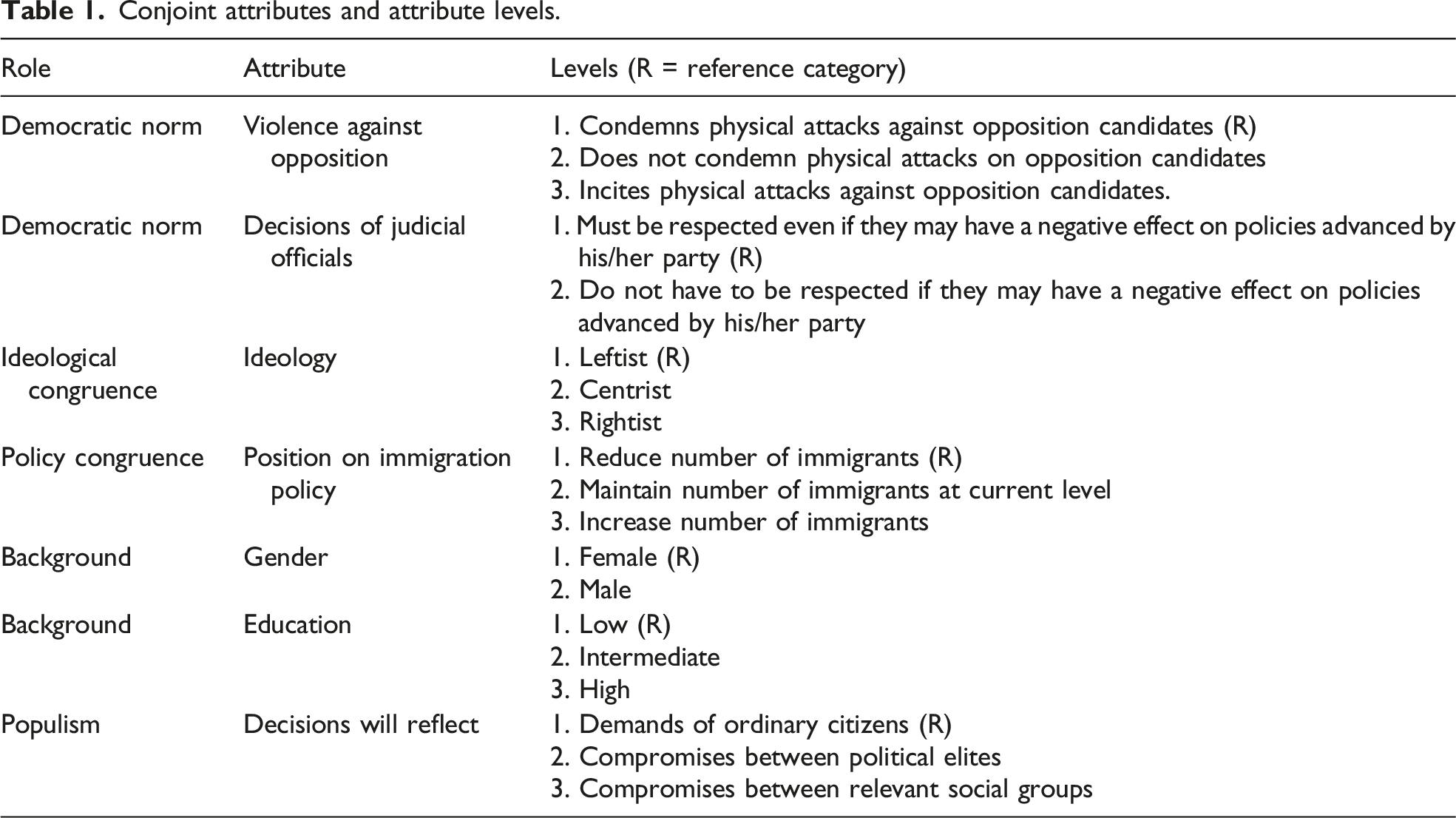
We include two forms of democratic transgressions. The first concerns violence against opposition politicians since it is a basic democratic norm that political violence has no place in democratic societies. Here, the first level involves a clear condemnation of violence against opposition candidates; the second level describes the absence of such condemnations, while the third involves the profile inciting violence against opposition candidates to grasp the extent of the commitment to democratic norms.
The other democratic transgression concerns the rule of law and the basic democratic principle that politicians should respect the insulation of judicial officials from political pressure (Levitsky and Ziblatt 2018, Mettler and Lieberman 2020). This attribute includes two levels: one where the profile clearly states that decisions from judicial officials must be respected even when they may have a negative effect on policies advanced by his/her party, while the other level is the abstention of such promises in the case where the decision could have adverse effects for policies advanced by the party that the politicians represents.
These attributes include clear transgression of key democratic norms. For the inferences from conjoint experiments to be valid, the treatments should be realistic to the respondents (Mares and Young 2019). Even though our examples are rather extreme, violence against politicians has become increasingly common in established European democracies and in Finland. In the run up to the 2019 parliamentary elections in Finland, electoral candidates were physically attacked during campaign events even though political violence had until then been rare (Wass et al. 2020). However, based on the considerations above, it remains unclear how the general population reacts when confronted with such democratic transgressions.
To gauge the importance of policy congruence, we include a policy position that has been prominent in recent years, namely, policy position on immigration (Norris and Inglehart 2019: 175–206). Here, there are also three levels, as the leaders can promise to decrease number of immigrants, maintain the status quo, or increase the number of immigrants. We also include ideological placement on a left/right scale (leftist, centrist, and rightist) to gauge the importance of ideological congruence. To examine the importance of congruence, these two attributes are aligned with respondents’ answers to similar questions, as described below.
While these attributes are central for the current purposes, we include other attributes to present a complete leader profile to make the assessments more realistic for the respondents.
We also include basic background characteristics that are common to include in conjoint experiments of candidate evaluations (Kirkland and Coppock 2018, Breitenstein 2019, Christensen et al. 2020): gender (male vs female), education (low, intermediate, high educational attainment). While these attributes are important for creating realistic profiles, the substantial impact is of less interest in this case, and we do not here offer specific hypotheses for their effects on favorability.
Finally, we include an attribute gauging the extent of populism of the prospective leaders since this has been a major component in explaining the lure of anti-democratic politicians. 3 Based on the definition of Mudde (2004: 543), we divide this attribute into three levels, where the profile promises that decisions will reflect either the demands of ordinary people, compromises between political elites or compromises between different interests in society. While this simple distinction does not capture all possible connotations of populism, it adds extra conceptual validity that the two latter levels include a “compromise” since this is frequently seen as contrary to populism (Mudde 2004: 544, Rostbøll 2020).
Some combinations of attribute levels may be impossible or highly implausible, which can make it necessary to exclude certain combinations from occurring (Hainmueller et al. 2014). While some of the combinations here may seem unlikely to occur in contemporary politics (e.g., a leader being both leftist and in favor of restricting immigration), none of them are logically impossible, and therefore, no restrictions were added to the randomization, as is also recommended by Hainmueller et al. (2014).
Data, Variables, and Methods
Presentation of Survey
The data for testing our hypotheses come from a conjoint experiment embedded in a survey distributed to a representative sample of the Finnish population when it comes to age, gender, and region of living, as shown in the appendix (n = 1030). 4 Since the sample matches the general population well, we do not employ weighting when analyzing the results. The design with 1030 respondents performing six tasks and a maximum of three attribute levels entails that for H1a and H1b, we can estimate relatively small effects sizes of AMCE = 0.03, or changes in favorability of 3 percentage points, with an estimated statistical power of 81%, and effects sizes of AMCE = 0.04 with a statistical power of 95%, as shown in the appendix (Lukac and Stefanelli 2020). Hence, the study is well-powered to correctly detect causal effects of a magnitude where the effects have concrete implications. We were unable to perform similar power analysis for our subgroup analyses since group sizes were unknown beforehand, which means some groups have a relatively low number of respondents. There is therefore still a need to examine whether these results can be replicated in studies with more powerful research designs. The data was collected between 27 May and 1 June 2020 via an online panel recruited through Qualtrics. In the survey, the respondents first completed basic socio-demographic information, before being asked a series of questions about their general political attitudes and preferences. Following this, the respondents completed the conjoint experiment.
Finland constitutes a fitting case for examining how transgressions of democratic norms affect evaluations of political leaders for two reasons. First, Finland is a multiparty parliamentary democracy where large coalitions and consensual politics are deeply ingrained political norms (Karvonen 2014) and is thereby provides an example of “consensual” political system (Lijphart 2012). This consensus system is likely to affect how citizens perceive violations of established democratic norms. Ideological polarization has been rather low in Finland in comparative context (Isotalo et al. 2020, Reiljan 2020, Fornaro 2021). Even though affective polarization has increased in Finland recently, it “still remains on a moderate level when looked at from an international perspective” (Kekkonen and Ylä-Anttila 2021, 5, see also Reiljan 2020 and Wagner 2021). This makes for an important contrast to the previous literature that has studied citizens’ propensity to support democratic norms mostly in highly polarized contexts such as the United States and Venezuela and has argued that individual-level political polarization drives citizens’ willingness to overlook democratic violations (Svolik 2019, 2020, Graham and Svolik 2020, on polarization see also Levitsky and Ziblatt 2018, Mettler and Lieberman 2020). Second, if we expect voters to defend democratic principles and judicial independence, this should be especially salient in a context where trust in democracy and democratic institutions is high. Finnish voters report one of the highest levels of democratic satisfaction in Europe, and the level of satisfaction has remained rather stable over time (Bäck et al. 2016; Karvonen 2014, Kestilä-Kekkonen 2015, Rapeli and Koskimaa 2020). The level of political trust among the Finnish voters is also particularly high in the European context (Kestilä-Kekkonen 2015, Söderlund 2019). Both aspects entail that we consider Finland to be a “least-likely case” for tolerance for violations of democratic norms.
Variables
The dependent variable is whether a given profile was chosen or not in a comparison. All attribute levels are coded as dummy variables indicating whether the attribute in question was shown or not. The randomization of the attribute levels across respondents entail that it is unnecessary to include control variables to ascertain the causal effects (Hainmueller et al. 2014). However, it is often valuable to examine differences in effect sizes across subgroups since there may be important differences in effects for certain groups (Abramson et al. 2019, Hainmueller et al., 2014, Leeper et al. 2020). Since these variables are observed rather than randomized, we can only observe whether differences in effects exist depending on the characteristics, not ascertain that the moderator variables cause the observed differences in effects (Kam and Trussler, 2017: 793).
In line with our hypotheses, we examine differences in effects across two types of congruence: Ideological congruence and immigration policy congruence, and three types of political disaffection: Political trust, satisfaction with democracy and external political efficacy. 5
Ideological congruence is constructed based on the attribute ideology and a survey question where respondents indicated their ideological left-right placement on a scale coded 0–10 (10 furthest to the right). The variable ideological congruence has four categories: 1) Mismatch (respondent and profile had different ideological positions, 6 66.7%); 2) Both leftist (profile was leftist and respondent indicated 0–4 on the scale, 11.0%); 3) Both centrist (profile was centrist and respondent chose 5 on the scale, 10.4%); and 4) Both rightist (profile was rightist and respondent chose 6–10 on the scale, 11.9%).
The immigration policy congruence variable is constructed based on the attribute immigration policy and an index ranging from 0 to 8 based on two questions where respondents indicated their attitudes to immigrant workers and asylum seekers on five-point Likert scales (higher scores indicates more positive attitudes to immigration). The immigration congruence variable also has four categories: 1) Mismatch (respondent and profile had different attitudes to immigration, 66.7%); 2) Both pro-immigration (profile promised to increase number of immigrants and respondent scored 5–8 on the index, 12.4%); 3) Both intermediate (profile promised to maintain the status quo and respondent scored 4 on the index, 8.9%); and 4) Both anti-immigration (Profile promised to lower the number of immigrants and respondent scored 0–3 on the index, 12.1%).
Political trust is measured with an index based on respondents’ trust in parliament, politicians, political parties, and government (each item scored 0–10, index 0–40, Cronbach’s alpha = 0.94). The respondents were classified into three categories based on their scores: Disaffected (0–14, 19.6%), Intermediate (15–25, 38.4%), Satisfied (26–40, 42.0%). Satisfaction with democracy is measured with a single item where respondents indicate their level of satisfaction with the way democracy works in Finland on a scale 0–10. Respondents who indicate 0–4 are classified as Disaffected (18.4%), those who pick 5 are classified as intermediate (10.8%), while those scoring 6–10 are classified as Satisfied (70.9%). For external efficacy, we form an index based on answers to three questions scored on a five-point Likert scale (1. Elected representatives quickly forget the worries of ordinary citizens, 2. Citizens’ opinions are considered in political decision-making, 3. Politicians do not care about the opinions of ordinary people, Cronbach’s alpha = 0.75). The index ranging 0–12 was constructed so that higher scores indicate a higher level of external efficacy. Here, respondents scoring 0–3 were classified as Disaffected (37.4%), 4–6 as Intermediate (44.4%) and those scoring 7–12 were regarded as Satisfied (18.3%).
Methods of Analysis
All analyses are linear regression analyses with standard errors clustered at the respondent level to consider that each of the 1030 respondents provides six evaluations of two profiles (Hainmueller et al. 2014). Due to the randomization of attributes, the coefficients can be interpreted as Average Marginal Component Effect (AMCE), which describes how much the probability of choosing a leader profile would change on average if one of the leader’s attributes were switched from the reference category to the particular attribute level (Hainmueller et al. 2014).
These are population averages, but there may be important differences in effects across subgroups (Leeper et al. 2020). As outlined above, we are interested in differences across ideological congruence, policy congruence, and political disaffection. To determine whether there are differences in effects, interaction terms between the attributes and the relevant groups are included (Hainmueller et al. 2014). This conditional AMCE shows effect sizes for the different groups. To assess the implications of the interaction effects, we rely on formal tests of significance and assess practical implications by seeing whether the effects have similar magnitudes and directions for different values of the moderator (Kam and Franzese, 2007).
A final measure of interest is the marginal mean, which describes the level of favorability toward leaders with a particular feature level when ignoring all other features (Leeper et al. 2020). While the AMCE depend on the reference category used, the marginal mean allows us to verify the popularity of a given attribute level in descriptive terms without using a reference category, which may be somewhat arbitrary and can lead to misleading interpretations when assessing differences across subgroups (Leeper et al. 2020).
As recommended by Hainmueller et al. (2014), we report the results in coefficient plots. The estimates are indicated by dots with lines indicating the 95% confidence intervals to show the uncertainty surrounding this estimate. For the AMCEs, there is a vertical line at 0, and when the confidence intervals cross this line, it entails that the effect is not statistically significant at p < 0.05. For the marginal means, the line is at 0.5 since this indicates the point where less than half of the respondents prefer this option when presented with it. The full regression results are included in the appendix.
Analysis
As a prelude to the conjoint analysis, we in Figure 1 present descriptive evidence to respondents’ opinions on basic democratic norms. This is based on the extent of agreement with some statements on basic democratic norms. Approval of democratic norms.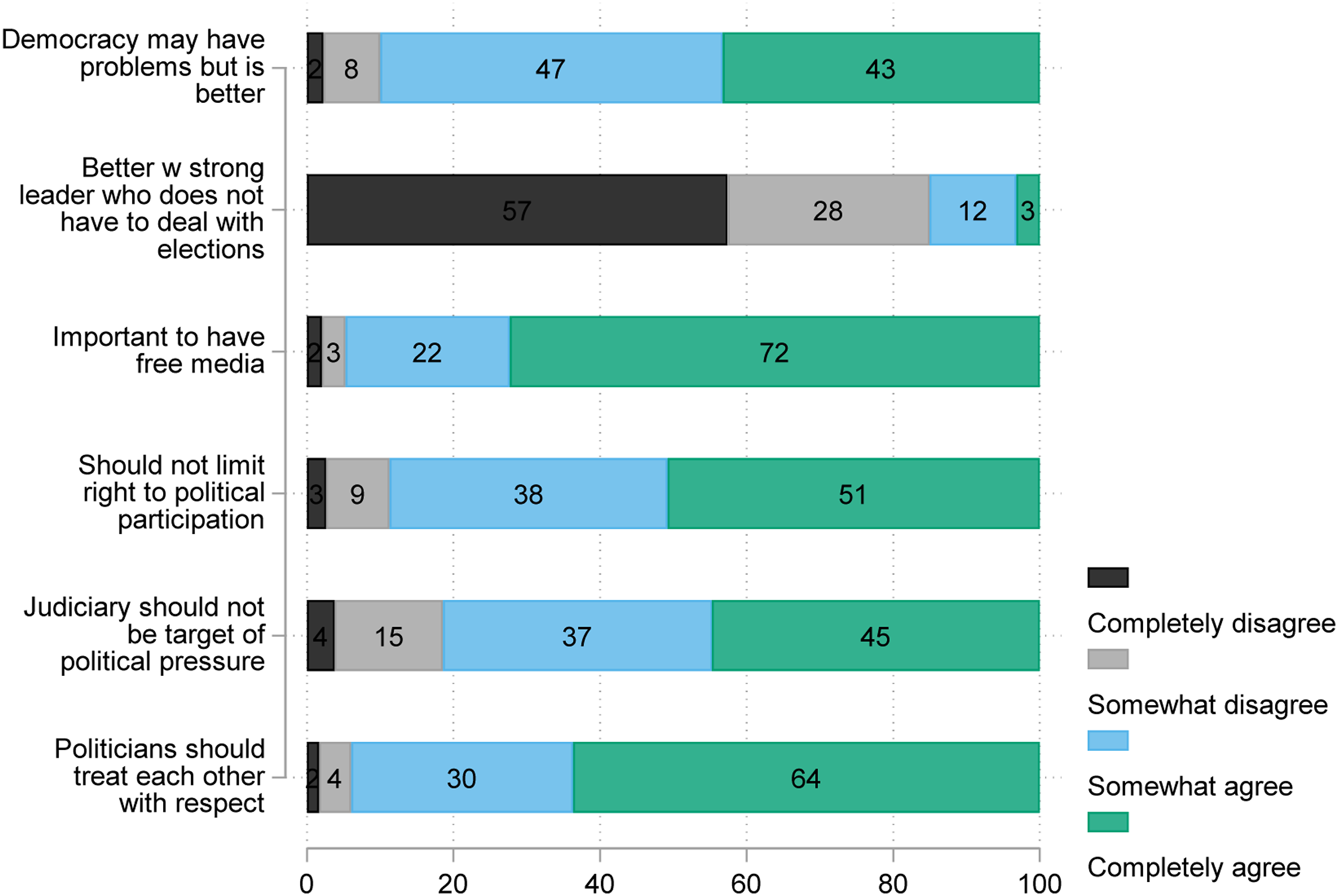
An overwhelming majority of Finns express support for basic democratic norms when asked directly. It is at most 19% who do not agree that the judiciary should not be the target of political pressure, 94% agree that politicians should treat each other with respect. If we combine all questions to an index with higher scores indicating higher support for democratic principles and norms ranging from 0 to 18, the mean is 14.5 and only 5% of respondents score 9 or less on the index. This clearly demonstrates that Finns support democratic norms when they are asked directly. The question is whether this support is also evident when asking them for implicit preferences in a conjoint experiment. The results for the first pair of hypotheses are shown in Figure 2. Direct effects of norm transgressions (AMCEs and marginal means).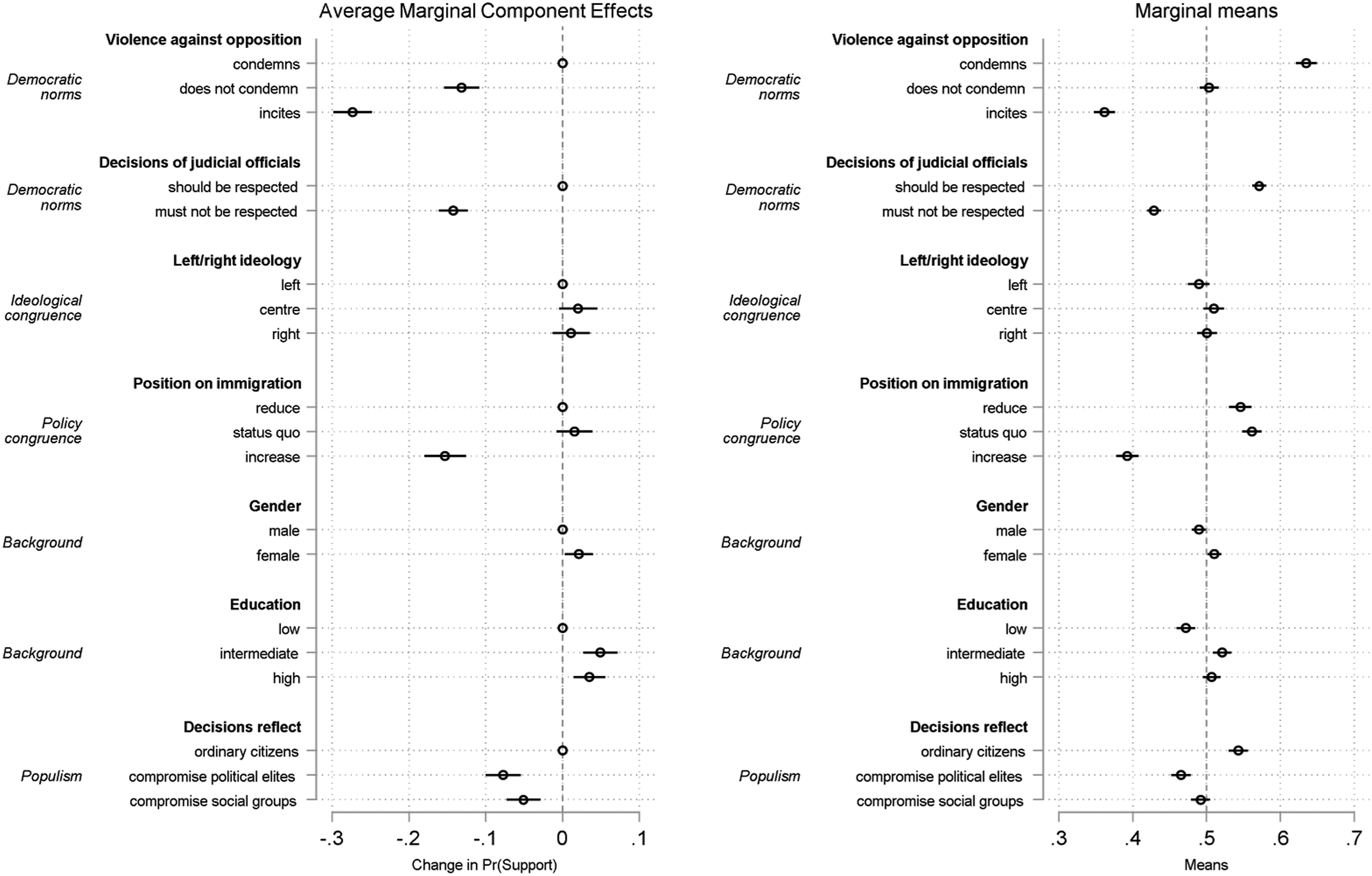
The results as expected show that violating democratic norms has negative effects on favorability. For violence against opposition politicians, a leader who does not condemn the use of violence is 13 percentage points worse of (AMCE = −0.13, p = 0.000) while a leader who incites violence loses 27 percentage points (AMCE = −0.27, p = 0.000), comparing each to a leader who condemns the use of violence. However, the marginal means reveal that while a leader who incites violence is picked about 36% of the time, a leader who does not condemn violence is picked about 50% of time, showing that the consequences of such less explicit democratic transgression are less severe. Even if people prefer a leader who clearly condemns violence, many are willing to ignore not condemning physical attacks when selecting a leader. When prospective leaders indicate that court decisions do not have to be respected under all circumstances, they drop 14 percentage points compared to leaders who respect court decisions (AMCE = −0.14, p = 0.000). The marginal means entail that a leader who respects court decisions is picked 57% of the time regardless of other attributes while a leader who makes no such promise is selected 43% of the time. These effect sizes are large, entailing that, on average, Finns strongly punish politicians for explicit democratic violations.
However, we have hypothesized that ideological and policy congruence may moderate reactions to democratic violations by politicians. We therefore move on to exploring H2a and b concerning differences across policy position congruence and H3a and b on ideological congruence on the left-right dimension in Figure 3. Differences in effects of norm transgressions depending on policy congruence and ideological congruence (conditional AMCEs and marginal means).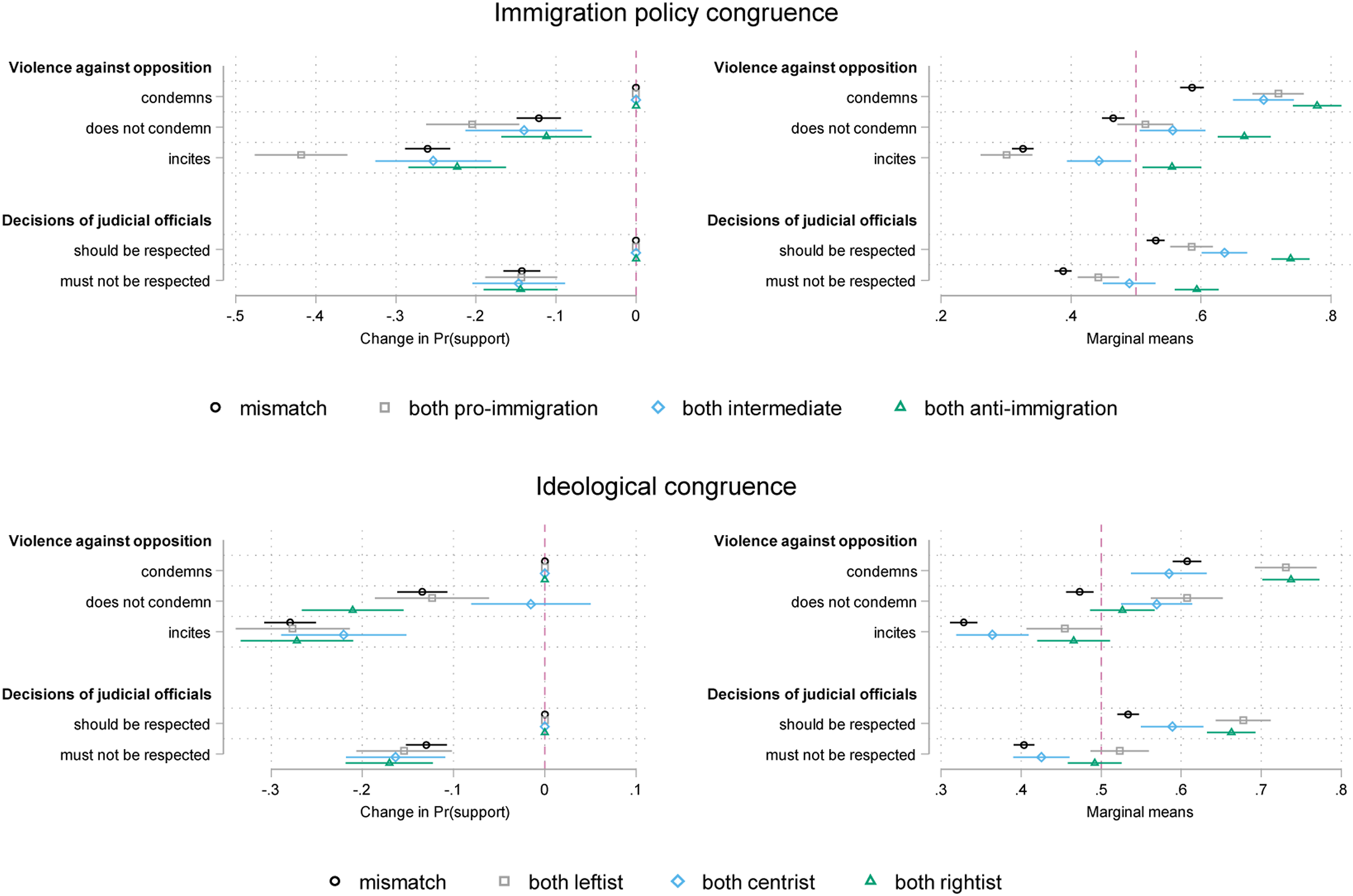
The two upper panes show conditional AMCEs and marginal means for policy congruence. There are no significant interaction terms for respecting judicial independence. For violence against opposition, the negative impact is stronger for pro-immigration congruence and both not condemning violence (B = −0.08, p = 0.009) and inciting violence (B = −0.16, p = 0.000). The marginal means show that policy congruence entails that respondents will often pick leaders even when they transgress basic democratic norms. This is clearest when both leader and respondent are anti-immigration, where leaders who incite violence against opposition politicians are picked 56% of the time they are shown, while the corresponding figure for not respecting judicial officials is 59% and for not condemning violence it is 67%. Hence, people are willing to ignore even major democratic transgressions when there is agreement on reducing the number of immigrants. Intermediate and pro-immigration policy congruence also means that people are willing to ignore some transgressions. When there is pro-immigration congruence, people pick leaders who fail to condemn violence 51% of the time and status quo congruence entails that people select such leaders 56% of the time. However, these groups are less willing to selected leaders inciting violence, indicating that policy congruence does not override this type of transgression. This shows that it is important to be aware of the different types of transgression and their severity.
A similar pattern can be observed in the two lower panes, which show the corresponding results for ideological congruence. There are no significant interaction terms for respecting the decisions of judicial officials, but for violence against the opposition, there are significant interaction terms for profiles not condemning attacks and centrist congruence (B = 0.12, p = 0.001) and rightist congruence (B = −0.08, p = 0.015). While the differences for the conditional AMCEs appear small, the marginal means show that people are more likely to pick leaders even when they commit democratic transgressions when there is ideological congruence. People generally prefer leaders who condemn violence, but when there is ideological congruence, people select leaders who do not condemn violence more than 50% of the times such a profile is shown. For leftist congruence, it is even 61% of the time that such a profile is selected. Leaders who do not promise to respect judicial officials are also selected about 52% of the time when there is leftist ideological congruence and 49% of the time when there is rightist ideological congruence with the leader profile. Hence, while people prefer leaders who abide by democratic norms, ideological congruence appears to be more important than democratic principles when they evaluate potential political leaders.
We now turn to H4a and b and differences in effects across political disaffection. Figure 4 shows the results. Differences in effects of norm transgressions across political disaffection (conditional AMCEs and marginal means).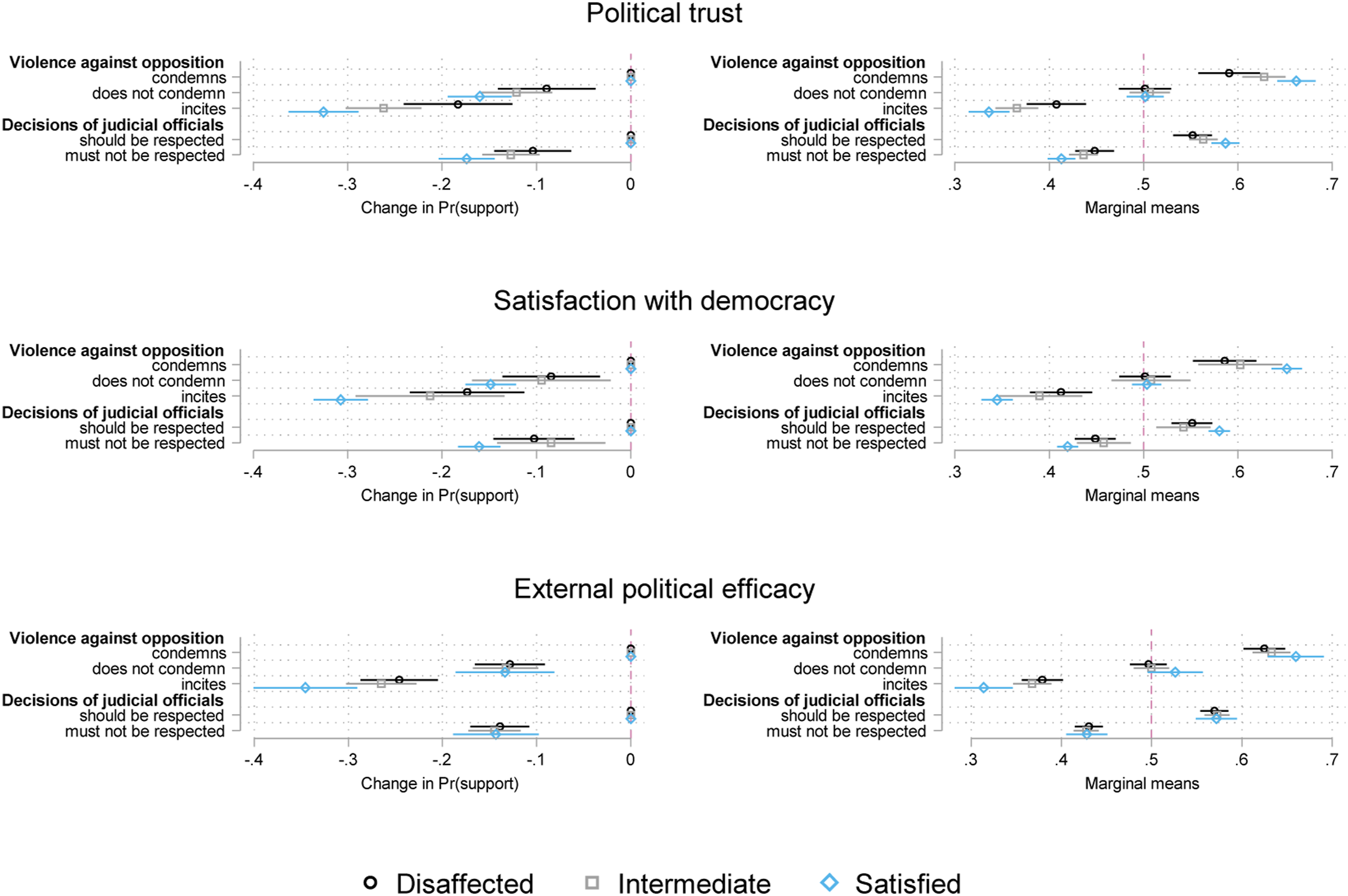
The results for political trust and satisfaction with democracy are generally in line with the expectations. For violence against opposition politicians, there are significant interaction terms for satisfaction when it comes to political trust and both not condemning (B = −0.07, p = 0.024) and inciting violence (B = −0.14, p = 0.000). The same is true for satisfaction with democracy, where the effects differ for not condemning violence (B = −0.06, p = 0.030) and inciting violence (B = −0.13, p = 0.000). For disrespecting judicial officials, we find significant interaction terms for the satisfied when it comes to political trust (B = −0.07, p = 0.006) and satisfaction with democracy (B = −0.06, p = 0.018). These differences in effects entail that satisfied citizens (i.e., those with high trust and/or satisfaction with democracy) are more likely to condemn democratic transgressions. These effects are more muted, albeit still negative, among those who are disaffected.
The situation is slightly different for external political efficacy where there are no significant interaction terms. While there is thus no clear-cut evidence for differences depending on the level of efficacy, the pattern largely resembles the one found for the other items since the satisfied are less likely to pick leader who commit democratic transgressions.
Robustness Checks
We performed various robustness checks to ascertain the robustness of these results. The results are shown in the online appendix, and we only outline the most relevant findings here.
First, the choice-based conjoint format used here means that respondents may be forced to select a leader profile that they do not really like. We therefore also asked a follow-up question after each round, where we asked respondents whether they would also vote for the leader they had just selected. This is a more demanding test of the impact of democratic transgressions since respondents get two chances to rebuff unjustifiable elite behavior. We reran the analyses for the follow-up question only for the candidates picked in the choice-based conjoint, meaning the number of units of analysis is halved from 12,360 to 6180. The results are shown in Figures A2–A4 in the online appendix. As might be expected, the effects are generally weaker when concerned with voting since some indicate they would not vote for the selected profile. Nevertheless, the marginal means show that almost 30% of the respondents would also vote for a selected leader profile who violates central democratic principles, which may still be a cause for concern.
The patterns are generally similar for voting propensity when examining the corresponding results for ideological and policy congruence. Anti-immigration and right-wing congruence in particular entail that people are willing to overlook democratic transgressions and vote for a leader regardless. A leader who does not condemn violence is picked more than 40% when there is policy congruence, and slightly less than 40% of the time when he/she incites violence. While we should not interpret such percentages as vote shares (Abramson et al. 2019), it nonetheless indicates that many are willing to ignore democratic incivilities to achieve their desired policy goals. The results for political disaffection are also similar since those with high satisfaction are generally much less likely to accept democratic transgressions, although the differences are not as pronounced as in the forced choice conjoint.
Overall, we take these results to mean that the findings are not solely an artifact of the forced choice conjoint design.
Another important aspect is to examine whether effects are similar across rounds and independent of placement of the profile (left–right) since it could affect the findings when there are systematic differences (Hainmueller et al. 2014). The results reported in Figure A5 show that there is no uniform trend for differences, meaning we are confident such differences do not bias the results.
Concluding Discussion
Our results contribute to the emerging line of scholarship on citizens reactions to democratic violations by politicians (Carey et al. 2020, Svolik 2020, Graham and Svolik 2020), as well as the earlier literature on the link between democratic disaffection and democratic system support (see, e.g., Norris 1999, 2011).
First, we examined the support of Finnish citizens of several key aspects of democracy when these were measured by answers to standard direct survey questions. We found that an overwhelming majority supported core democratic principles when asked directly. However, the results were much more nuanced when the support for democratic principles was measured indirectly via a conjoint experiment. The results for our conjoint experiment generally support the notion that clear democratic transgressions are punished by the public. However, the results also reveal that less explicit violations, where leaders fail to condemn violence against opposition politicians, can go unpunished by people as these are still picked about 50% of the time. These results support the contention that direct survey questions may not capture the extent of “true” democratic support in established democracies (Svolik 2020, Graham and Svolik 2020). While people generally agree with basic democratic norms when asked directly, many will fail to act in accordance with these beliefs when put in a position where it is necessary to make a trade-off between democratic ideals and specific policy goals. This “trade-off” mechanism, which has also been found in previous literature (see, e.g., Breitenstein 2019, Graham and Svolik 2020), suggests that people are willing to support undemocratic or corrupt politicians when these politicians are co-partisans or deliver other benefits to the voters.
In line with this notion, we find that people are more willing to ignore even serious and explicit violations when they agree with a potential leader either ideologically or on the policy issue of immigration. While people generally prefer leaders who do not transgress democratic norms, many are willing to overlook not condemning violence or disrespecting judicial officials when there is ideological congruence or a respondent and the potential leader both agree that immigration should be restricted. Our results show that the respondents who are opposed to immigration are willing to overlook even blatantly authoritarian behavior by a prospective political leader, that is, inciting violence against the opposition, when this leader is also in favor of curtailing immigration. The issue of immigration appears to be such an important policy issue (a kind of “lexicographic preference”) for some citizens that it overrides all other political dimensions. These results thereby may help explain the apparent success of political leaders who violate basic democratic norms in several established democracies.
We have here extended previous findings to Finland, a stable democracy with a consensual political culture, which may be considered a least likely case for this sort of mechanism to operate. However, even here we find that some people are willing to ignore serious violations of basic democratic norms when leaders represent policies or ideological positions that these people concur with. This does not bode well for democracy in less stable political regimes plagued by intense social conflicts. Under such circumstances, large parts of the electorate may become open for ignoring, or even openly supporting, violations of democratic principles if leaders otherwise appear able to deliver political outcomes that correspond to popular demand (see McCoy and Somer 2019, Svolik 2019 and 2020).
Finally, we examine the extent to which political disaffection moderates the impact of democratic transgressions. The results here show that the effects of democratic transgressions are more severe when people have high political trust and/or satisfaction with democracy, while the disaffected do not as strongly condemn transgressions. While low trust and/or satisfaction with democracy does not necessarily entail low commitment to democracy per se, these results show that citizens who are satisfied with democratic performance will act as guardians of democracy, whereas the disaffected are more likely to be passive bystanders. It would seem there is little protection to be had from the critical citizens some suggest should be more eager to protest basic democratic norms (Inglehart 1997, Norris 1999). This thereby indicates that even if disaffection does not necessarily constitute a direct threat to democracy, it can erode the mechanisms that ensure that leaders respect basic democratic norms.
These findings come with some caveats. While conjoint experiments are well suited for examining multidimensional political choices, they are limited in the number of attributes that can be included in the experimental setting. We were only able to examine the policy issue of migration, which may be said to occupy a particular role in contemporary political discourse in most democracies. There is therefore a need to examine in greater detail whether other policy areas can play a similar role, and if so, under what circumstances. There is also a need to examine further what citizen characteristics explain the propensity to forgive transgressions of democratic norms. Here, a focus on diffuse support for democracy (Easton 1965) versus preferences for more authoritarian regimes may constitute a promising avenue of future research. Furthermore, while both ideological and affective polarization have been low in Finland by comparative standards (Isotalo et al. 2020, Reiljan 2020, Wagner 2021), recent studies have shown that affective polarization has been increasing in Finland, although it is still at a comparatively moderate level (Kekkonen and Ylä-Anttila 2021). Further research is therefore needed to probe the potential links between affective polarization and the support for democracy in established democracies.
Despite these limitations, our results contribute to the growing number of studies examining the mechanisms of democratic backsliding in contemporary democracies.
Supplemental Material
sj-pdf-1-prq-10.1177_10659129211073592 – Supplemental Material for Guardians of Democracy or Passive Bystanders? A Conjoint Experiment on Elite Transgressions of Democratic Norms
Supplemental Material, sj-pdf-1-prq-10.1177_10659129211073592 for Guardians of Democracy or Passive Bystanders? A Conjoint Experiment on Elite Transgressions of Democratic Norms by Inga A-L Saikkonen and Henrik Serup Christensen in Political Research Quarterly
Footnotes
Acknowledgments
We would like to thank the editors and the anonymous reviewers as well as the participants in the General Research Seminar at the Department of Political Science, Åbo Akademi University, for helpful comments on the paper, as well as friends and colleagues for helpful feedback during the experimental design process.
Declaration of Conflicting Interests
The author(s) declared no potential conflicts of interest with respect to the research, authorship, and/or publication of this article.
Funding
The author disclosed receipt of the following financial support for the research, authorship, and/or publication of this article: This work was supported by the Academy of Finland (Grant 285167 and Grant 316897).

Supplementary Material
Supplemental material for this article is available online.
Notes
Author Biographies
References
Supplementary Material
Please find the following supplemental material available below.
For Open Access articles published under a Creative Commons License, all supplemental material carries the same license as the article it is associated with.
For non-Open Access articles published, all supplemental material carries a non-exclusive license, and permission requests for re-use of supplemental material or any part of supplemental material shall be sent directly to the copyright owner as specified in the copyright notice associated with the article.
