




Abstract
We investigate how to design sanction regimes that enhance public support for sanctions in the sending countries. To this end, we conduct a conjoint experiment on quota samples in Poland and Germany, using the context of sanctions on Russia. We find that support for sanctions decreases as domestic costs increase. However, support can be bolstered through aid programs that mitigate these costs and through beneficial policy alternatives. Furthermore, we show that support for sanctions rises when the costs imposed on the target state increase and when the sanctioning coalition expands.
Introduction
Economic sanctions are a frequently used tool of foreign policy. In the past, the literature on economic sanctions has focused on the questions whether, and later why, sanctions (do not) work. Initial research has indicated that sanctions were ineffective in their instrumental goal to achieve concessions from the target states. The claim was that the costs of sanctions to the target states often did not outweigh the benefits stemming from maintaining chosen policies and holding on to power (Galtung, 1967; Lindsay, 1986; Nossal, 1989; Morgan and Schwebach, 1997), additionally owing to the regime type of target states the political costs imposed by the domestic audiences were low (Allen, 2008). Therefore, great attention has been devoted to the question of why, despite this scholarly conviction, economic sanctions are still so prevalent (Lindsay, 1986; Nossal, 1989).
One reason which has received extensive consideration is that in democratic societies policymakers respond to their publics (Page and Shapiro, 1983). With salient international conflicts in particular, public pressure to take action may be strong (McLean and Whang, 2014). Hence, governments may decide to impose sanctions as a signal of taking action (Galtung, 1967; Lindsay, 1986; Whang, 2011). This is especially important when military intervention is not a desirable option, but the complete lack of action is perceived almost as complicity (Galtung, 1967). Others argued that sanctions are imposed even when they are not expected to be effective to signal to the target and future targets that the threat of sanctions is credible (Lacy and Niou, 2004; Drezner, 2003; Peterson, 2013, 2014). Hence, the ineffective sanctions may be pursued to preserve their deterrence function in the future. Lastly, sanctions may also serve as a retributive punishment for aggressive behavior rather than just having a deterrence goal (Doxey, 1987: 92; Nossal, 1989).
Over the years the research on economic sanctions became more nuanced. Rather than investigating why sanctions do not work, and why despite their general ineffectiveness, they are still imposed, researchers began investigating the question “when do sanctions work”. Different factors such as the number of the sanctioning states (Weber and Schneider, 2020) and the involvement of international institutions, as well as the severity of the imposed costs on the target states (Bapat et al., 2013), were found to matter most for the success of sanctions. In addition, the definition of effectiveness was made more nuanced. It has been suggested that instead of looking at the main instrumental goal (the political concession), one should look at the economic damage sanctions cause to the target states (Morgan et al., 2023; Gutmann et al., 2023). For instance, in the context of the 2022 Russian invasion of Ukraine, even though the economic sanctions are not stopping the war, they have the potential to weaken Russia and interfere with its war efforts.
When sanctions are used symbolically to express disdain for the actions of the target state (Kaempfer and Lowenberg, 1988; Whang, 2011), but the more so, when they are used instrumentally to achieve something from the target state (Morgan and Schwebach, 1997), the ability to impose sanctions by democratic states is linked to public opinion (Allen, 2008; Baum and Potter, 2008; Canes-Wrone, 2010: 192; Whang, 2011). In general, sanctions can gain wide support by the domestic public in sender states, especially when the sanctioned issue is salient (McLean and Whang, 2014). Yet for sanctions to be effective as a tool, the target states must incur significant costs. In more symmetric conflicts, however, imposing severe costs on the target states almost inevitably results in substantial costs for the states that impose the sanctions as well. The public in the sender country will bear some of them but may turn against sanctions if their own costs are too high (Webb, 2018). Therefore, it is essential to focus research attention on the question how the public in the sender country perceives the costs of sanctions, and whether some attributes of sanctioning regimes—benefits triggered by sanctions and their effectiveness—can mitigate the negative perceptions of these costs.
Despite the relevance of the questions, such as which features of sanctions drive support of the public in sender states, the experimental literature on that is scarce. McLean and Roblyer (2017) conducted a laboratory experiment on a small sample of American students and found that people prefer targeted over comprehensive sanctions to reduce the suffering of the target country's population. Heinrich et al. (2017) in a more comprehensive study used a conjoint design on MTurk American participants to investigate how different expected consequences affect people's support of the sanctions. The authors found that participants supported most those sanctions that had lower costs for their country and could achieve long-term policy concessions of the target country. 1 In a similar vein, Arı and Sonmez (2024) show that people in sending states dislike the domestic costs of sanctions (in terms of food inflation) but are in favor of sanctions imposing costs on target countries’ leadership. Kohno et al. (2021) demonstrate that material costs—in terms of security implications—also matter in the context of aid sanctions. Namely, the public is less inclined to support cuts in foreign aid if another foreign aid provider can substitute the original donor and improve its security position vis-à-vis the initial donor. Finally, Castanho et al. (2022), using a survey experiment in Germany, found that informing lay participants that most of their compatriots support sanctions (social norm nudge) had the largest effect on increasing support for an oil embargo.
While these studies provide important insights into public perception of sanctions, it is still unclear how other important features play a role in building the support for sanctions. While previous research has shown that the public perceives the costs of sanctions negatively, it remains unclear whether certain types of costs are more bearable than others. Additionally, our understanding is limited regarding how the effectiveness of sanctions might mitigate negative cost perceptions and, if so, what strategies could best approximate such effectiveness. Most critically, we lack insight into whether cost mitigation programs (e.g. redistributive policies) or domestic benefits arising from sanctions can counteract negative cost perceptions.
To address these knowledge gaps, we conducted a (survey) experimental study in Germany and Poland, utilizing the highly relevant context of the war in Ukraine and the embargo on fossil fuels from Russia. This context provides a significant advantage compared with previous studies, which often focus on hypothetical scenarios or cases with much lower saliency. In this study, participants had real “skin in the game”. First, the conflict was unfolding in the EU's immediate neighborhood, with some experts asserting that containing Russia in Ukraine was essential to preventing potential future assaults on EU and NATO countries. Second, the conflict was big enough to warrant that discussions surrounding the sanctions and their associated costs were ongoing and highly relevant to the public. The economic burden these sanctions were supposed to place on the public in the sender countries was substantial and was predicted to increase over time, particularly because the target, a non-democratic state like Russia, would require a prolonged period of sanctions to effectively hinder its actions (Allen, 2008).
While both sender countries—Germany and Poland—were chosen because of this “skin of the game” aspect (spatially located close to the conflict, provide aid to Ukraine, and experience substantial costs of sanctions), they also differ significantly. Most notably, Poland is recognized as the most ardent supporter of the sanctions against Russia (e.g., Flash Eurobarometer, 2022, Q4). Yet, because of its greater dependency on Russian fossil fuels, Germany was where the costs of a full energy embargo were expected to be felt most strongly (Berger et al., 2022). While some differences between Germany and Poland are evident, we do not have any prior expectations regarding whether the features of sanctioning regimes will produce varying effects across these two countries. Instead, we aim to examine whether the results can be consistently replicated across two relatively similar cases.
In both Germany and Poland, we collect quota samples and use a conjoint experiment to identify the aspects of a sanctioning package that matter the most to the public. The participants are asked to choose several times between two proposals for imposing a full embargo on Russian fossil fuels. On the costs-and-benefits side, the proposals vary based on the type and size of the costs to the participants’ countries, the existence and type of domestic aid programs to mitigate the domestic costs, and energy alternatives to the lost energy sources from Russia. As to the effectiveness of sanctions, the proposals alternate the expected costs imposed on Russia, and the size of the sanctioning coalition.
As expected, we find that domestic costs affect people's support for the sanctions. Domestic increases in fuel and energy prices seem to matter more than increased unemployment. However, we further show that these negative costs perceptions can be countered by installing aid programs, as well as by searching for beneficial energy alternative sources (e.g. domestic renewable energy). The aspects related to effectiveness—such as the higher costs imposed on the target state and larger sanctioning coalitions—can enhance support for the sanctions and thus mitigate the negative effects of costs. Therefore, despite some evidence that larger coalitions might not be effective (Drezner, 2000), symbolically they matter to the public.
These results also contribute to the theoretical underpinnings of public support of foreign policies in general, and imposition of international sanctions in particular. In the literature it has been asserted that that when it comes to economic sanctions in salient cases, the public merely cares about the question whether the sanctions are imposed or not. They engage less with the specificities of the different sanctioning regimes (McLean and Whang, 2014). However, the current study demonstrates that specificities of sanctions do matter and how a careful balance between costs and benefits, in its various forms, may enhance public support for such sanctions.
Theoretical framework and hypotheses
For the theoretical framework, we build on the rational choice theories of sanctions. International sanctions can be viewed as part of domestic politics, and particularly as elements of the foreign policies of sender countries. The focus of this paper is not on how such policies are designed—which is often considered a balance between the interests of general voters (the public) and interest groups (Kaempfer and Lowenberg, 1988; McLean and Whang, 2014; Tomz et al., 2020)—but rather on what determines public support for international sanctions. While voters tend to prioritize domestic issues, in cases of salient international matters concerning their country, public opinion can influence foreign policies in democratic nations (Fordham and McKeown, 2003; Kono, 2017; Wallace, 2024).
Following rational choice theory as applied to political actors, when voters in democratic countries are aware of a dispute, their views become relevant for leaders’ decisions (McLean and Whang, 2014). In our context, the Russian invasion of Ukraine was a highly salient issue, particularly for European voters, including those in the countries under investigation: Poland and Germany.
However, while international sanctions might generally be viewed positively by the public, securing support for them requires balancing the expected benefits of the sanctions against the costs imposed on the sender country and its citizens. Direct “benefits” of international sanctions include increasing the effectiveness of those sanctions. However, sanctions can also lead to indirect benefits, that can emerge from the sanctioning regime as explained bellow.
Direct benefits—effectiveness
Effectiveness is considered in a broader sense—as the ability to impose economic strain on the target state—rather than solely achieving the ultimate political goal of political concession (Morgan et al., 2023; Gutmann et al., 2023). According to punishment and deterrence theories (Nossal, 1989; Drezner, 2003), higher costs imposed on the target country's economy are expected to increase economic strain and, in the context of war, hamper the target's war effort (Galtung, 1967).
An additional element related to effectiveness, derived from the punishment theory, is the size of the sanctioning coalition (Martin, 1992). The economic costs to the target state from unilateral sanctions can often be mitigated by turning to alternative trade partners. Expanding the sanctioning coalition through multilateral sanctions reduces the target's available alternatives and is thus expected to increase the sanctions’ effectiveness.
Based on these arguments, we hypothesize the following:
Indirect benefits
International sanctions can be bundled with utility-creating policies, thus generating additional benefits, aside from the effectiveness. Policy bundling has been shown to enhance public support in other contexts, such as climate policies (Bergquist et al., 2020). Similarly, an oil embargo coupled with initiatives to develop cleaner energy sources could positively shape public perceptions and bolster support for international sanctions. Therefore, we hypothesize:
Costs
On the cost side, we focus on the direct costs to the sender resulting from the sanctions. As shown by previous research, these perceived costs can influence public support but we argue that they can be mitigated through the implementation of cost-mitigating programs. Cost-mitigating programs are expected to directly address the perceived burdens imposed on individuals by the sanctions (e.g. higher energy prices or potential unemployment) through welfare state measures. Consequently, cost-mitigating programmes that are expected to reduce more directly people's costs, will lead to a stronger support of the sanctions. Based on this reasoning, we propose the following hypotheses:
Conjoint survey experiment design
To test the hypotheses, we use data stemming from samples of respondents in Germany (N = 1134) and Poland (N = 1085) collected in April and May 2022. The samples are recruited based on quota in terms of age, gender, region and education. We have used the services of an international online panel (survey) provider—Dynata—to recruit participants and administered the experiments in the local languages using Qualtrics. All participants gave their informed consent to take part in the study. The study has been approved by the ethics committee. 2
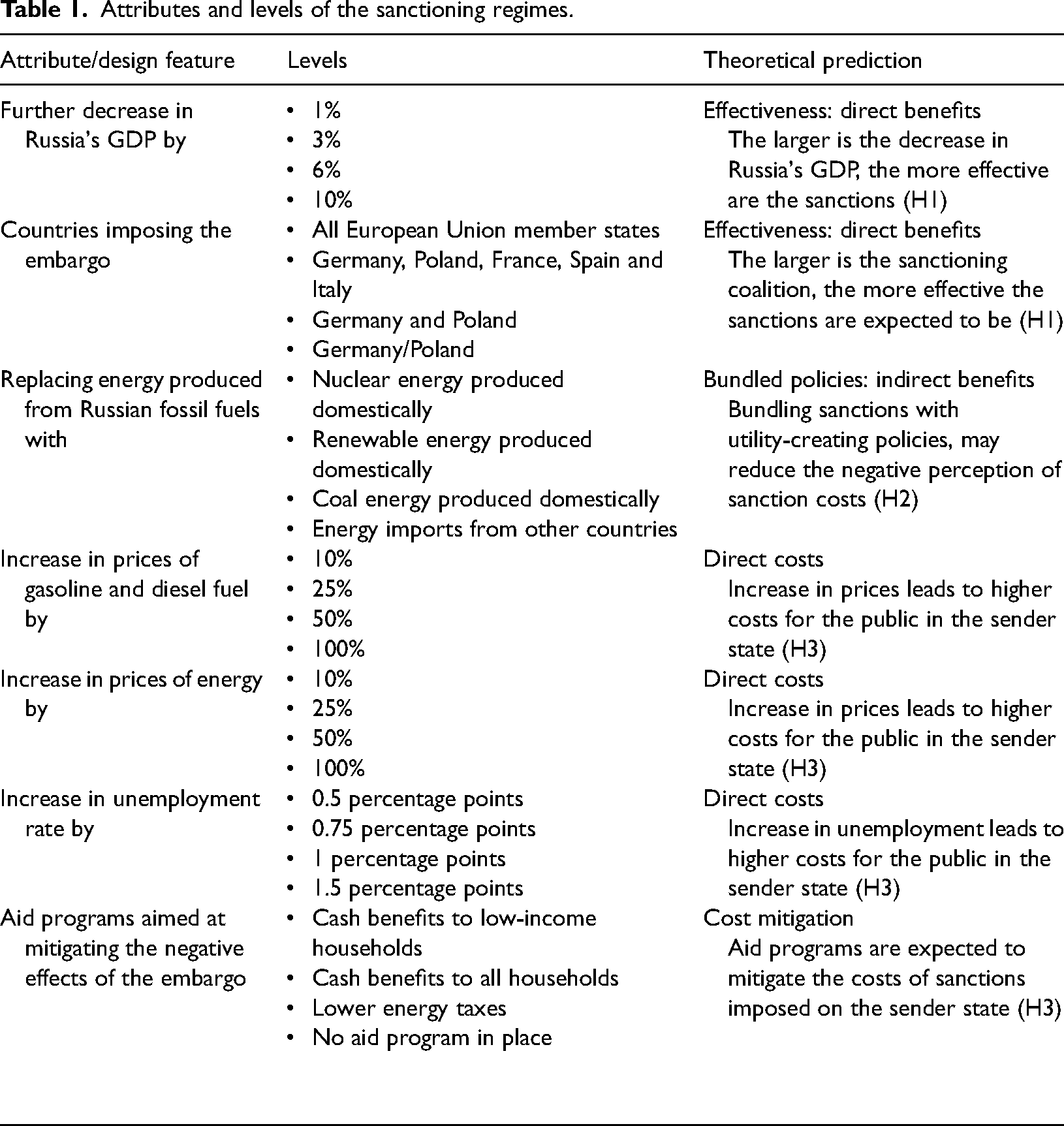
To test H1–H3, we employed a conjoint (choice) experiment with close to uniform distribution of attributes’ levels. 3 All participants were exposed to two potential proposals for an embargo on Russian fossil fuels and were asked to choose which proposal they would prefer for their country to follow. Such paired conjoint design was chosen to help respondents compare various alternatives and incentivize them to more meticulously consider trade-offs. The proposals included different consequences and conditions of the embargo (attributes), namely, the costs to the target, the size of sanctioning coalition, the type of costs to the public aid programs, and energy alternatives. For each participant, and for every choice, design attributes randomly varied. The full list of attributes, their levels, and their connection to the theoretical expectations, are displayed in Table 1.
Attributes and levels of the sanctioning regimes.
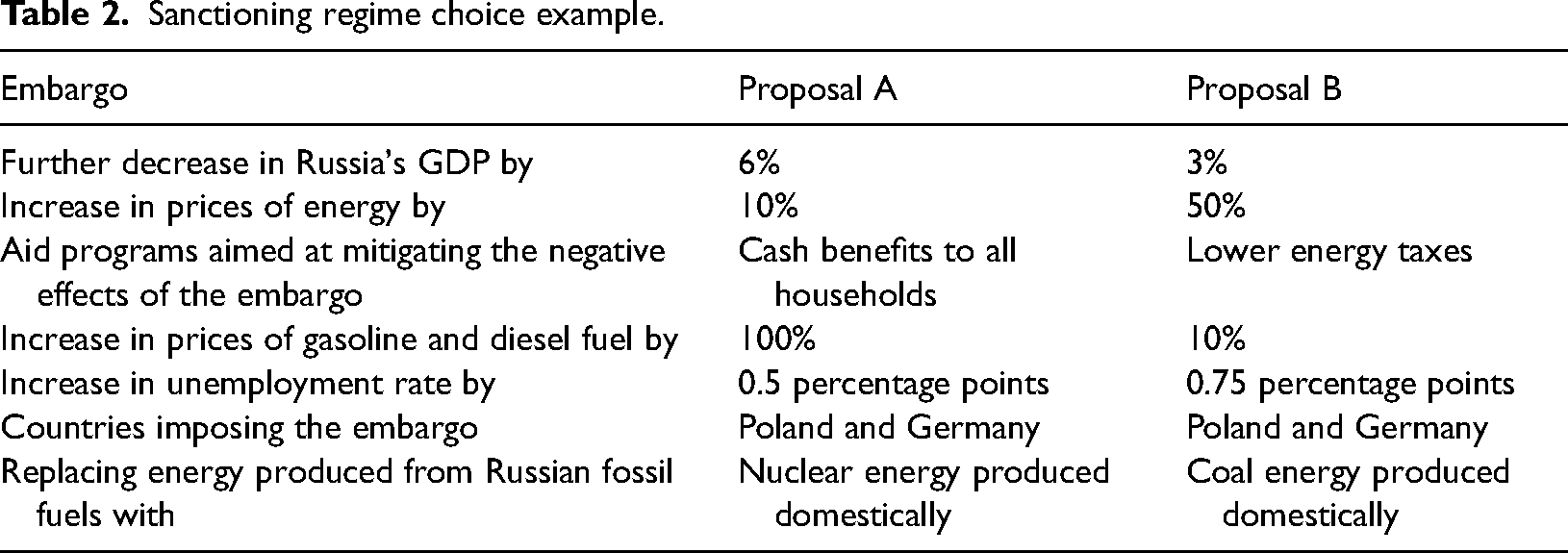
Each participant was asked to make a choice between two sanctioning proposals six times. For an example of the way the choice has been presented to the participants, see Table 2. For convenience to the participants, the order of the attributes was held constant for each participant, but randomly varied across participants. For instance, one participant always saw the coalition attribute first, while another participant always saw the costs to Russia first. Besides choosing between the two proposals, in each task the respondents were also requested to rate how strongly they support each of the two displayed proposals on a 1–7 Likert scale where 1 meant “do not support at all” and 7 “strongly support”. Consequently, this study employs two outcome variables: forced choice binary and rating outcomes. While in the main body of the paper, we report the results based on the former, the evidence for the rating question can be found in the Supplementary Material.
Sanctioning regime choice example.
The conjoint experiments are well suited for eliciting stated preferences in multidimensional choice setups. They provide several crucial advantages over the more standard factorized vignette experiments. First, they allow us to gather many more observations, test multiple hypotheses simultaneously and measure the importance of various factors influencing choices. Second, conjoint experiments allow respondents to more carefully assess trade-offs between the various choice options. Third, they allow to suppress ordering effects. Fourth, and most importantly, through their resemblance to list experiments, conjoint experiments can reduce the social desirability bias. For a more thorough discussion of the best practices of conjoint experiments and their methodological advances, see, e.g. Hainmueller et al. (2014), Bansak et al. (2020), Horiuchi et al. (2022), and Kantorowicz (2022).
Results
In Figure 1 we report average marginal component effects (AMCEs), which are standard estimators for conjoint experiment data (Hainmueller et al., 2014). These effects capture the change in probability of choosing a given profile vis-à-vis a reference category. It is to note that we estimate (close to) uniform AMCE as the actual distribution of embargo profiles in the real world is not available (see de la Cuesta et al. (2022) for a discussion about uniform and population AMCE). We apply the standard errors clustered at the level of respondents and raking survey weights to correct for possible imbalances between target and sample quotas (see the Supplementary Material for the distribution of both types of quota).
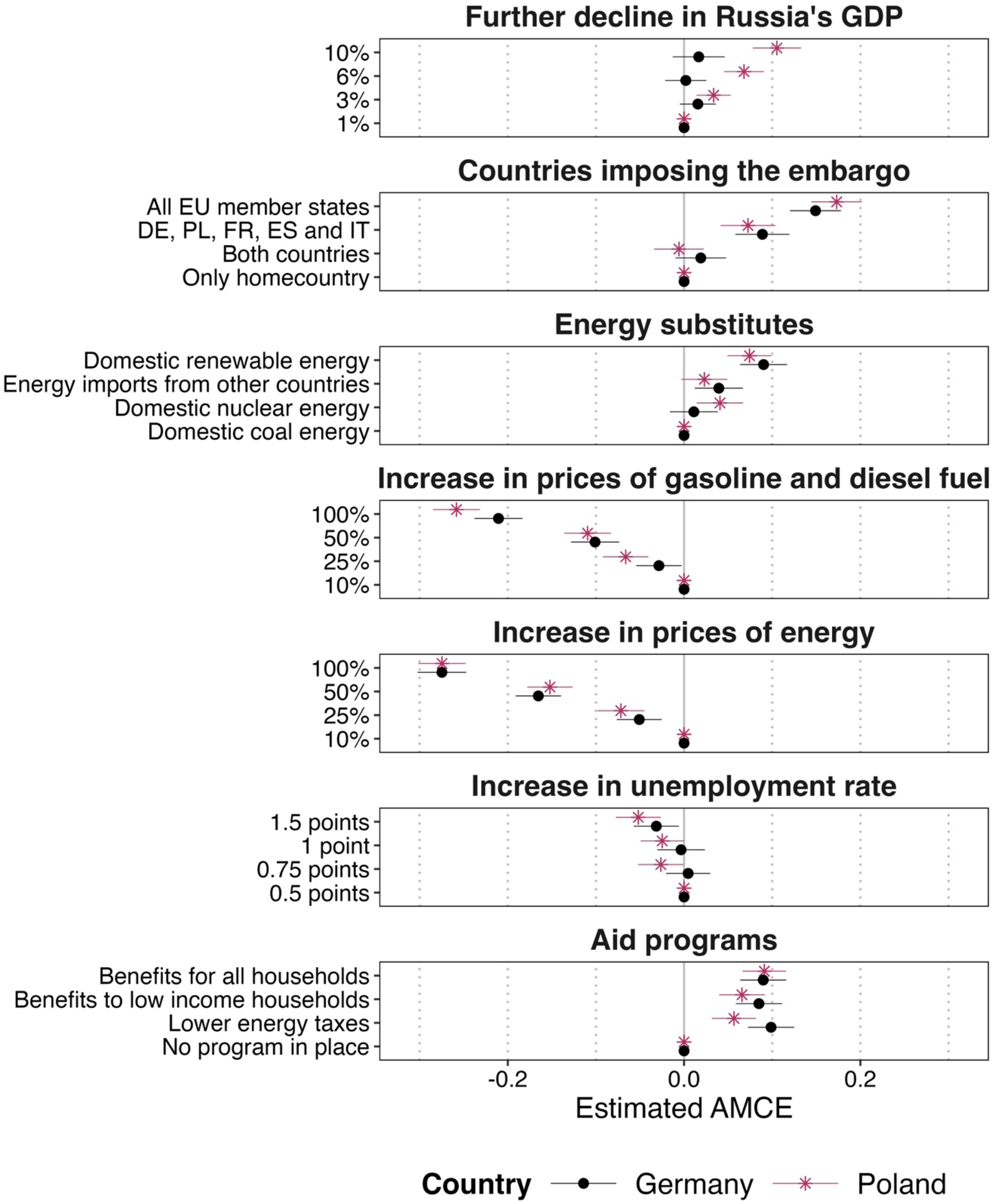
Conjoint results.
We present the results following the order of hypotheses put forward in the theoretical section. The first hypothesis referred to the direct benefits in the form of effectiveness of sanctions. Effectiveness in the current sense meant the costs that the sanctions impose on the target state and the size of the sanctioning coalition. As to the former, we find partial support for H1. It is evident from Figure 1 that the Polish public is more likely to select embargo packages leading to a further loss in the Russian GDP. The AMCE for the most severe level (10% drop in the Russian GDP) is about 0.11 (|t|=6.33, p < 0.001). This finding does not hold for the German public where the most severe package towards Russia (10% loss of GDP) is not more likely to be chosen than the package assuming a very small (1%) loss of GDP (|t| = 0.93, p = 0.352).
The size of the sanctioning coalition and, thus, cooperation between countries is another proxy of the expected effectiveness of sanctions. We anticipate that the larger the sanctioning coalition, the stronger the support of the public for the sanctions will be. We indeed find that the strongest support is provided to an embargo proposal which includes a sanctioning coalition of all EU member states. The corresponding AMCE is 0.17 in Poland (|t| = 9.95, p < 0.001) and 0.15 in Germany (|t| = 8.48, p < 0.001). The least supported proposals are those where only Poland and Germany together are imposing an embargo, or when only the country of the participants is imposing the embargo. Therefore, we find support for H1 when the effectiveness is approximated by the size of the sanctioning coalition.
In addition to direct benefits, we hypothesized that indirect benefits that steam from the sanctioning scheme could also have a positive effect on how people perceive such sanctions (H2). The sanctions on Russian fossil fuels posed an opportunity to search for sustainable energy alternatives. Given that the great majority of the public are aware of climate change, its causes, and dangers (for the European context see, e.g. Special Eurobarometer 513 on Climate Change), we expected that the potential for sustainable energy alternatives (higher-utility climate policies bundles) will increase the support for the sanctions.
The alternatives include either an environmentally damaging alternative in the form of coal energy produced domestically, or more sustainable energy produced domestically either in the form of renewable energy or nuclear energy. An additional option is to import energy from other countries. We found support for H2 as the probability of choosing an embargo significantly increases when the proposed alternative is renewable energy as compared with the coal energy produced domestically. The corresponding AMCE is 0.09 in Germany (|t| = 6.75, p < 0.001) and some 0.07 in Poland (|t| = 5.81, p < 0.001). Poles are furthermore quite favorable to nuclear energy produced domestically (|t| = 3.03, p = 0.002) and Germans tend to favor energy imports from other countries (|t| = 2.83, p = 0.005).
The divergent approaches with respect to nuclear energy in the two countries is not surprising. Nuclear power plants in principle are considered a sustainable form to produce energy (Kharecha and Hansen 2013). Yet it is not without risks. Despite the low probabilities of accidents, the effects of an accident in a nuclear plant are vivid and can be catastrophic. Following the 2011 explosions in the nuclear plan in Fukushima, there was public pressure in Germany to shut down the nuclear plants. As a result, and after a long phase-out period which started in 2011, in April 2023, the last three power plants were shut down in Germany. 4 On the contrary, Poland has recently contracted the construction of the first nuclear power plant in its country. 5
In line with H3, we find evidence that an increase in costs for the public in the sender country reduces the support for the sanctions. The probability of choosing the proposal declines as prices of energy and fuels increase. The estimated AMCE reaches the level of nearly −0.30, suggesting a close to 30-point drop in the probability of choosing the costliest options (these effects are statistically significant at any conventional level).
The effects of growing unemployment are much smaller in magnitude. The public seems to react negatively towards these proposals that stipulate a drop in unemployment by 1.5 points. In this case, the AMCE reaches the level of roughly −0.03 for Germany (|t| = 2.42, p = 0.016) and −0.05 for Poland (|t| = 4.00, p < 0.001).
The difference in magnitude between energy costs and unemployment level can potentially be explained by the relevance of each of these events for the participants. While some people were at risk of losing their employment opportunities, energy prices affected everybody. This effect could be direct through energy bills, or indirect thought increase in prices of goods and services.
As there might be ways to mitigate the costs to the public in the sender states, we expected that different aid programs might increase the support for the sanctions. This serves as further support for H3 as participants in both countries are more likely to choose the embargo packages when there are some cost mitigation programs in place. The probability of choosing the sanction proposal with the most desired aid programs is larger by some 9–10 points. Furthermore, while in Poland we find that the aid to all respondents is more favored than the more targeted aid to low-income households (|t| = 2.05, p = 0.041), we do not find this difference in Germany (|t| = 0.38, p = 0.700).
In the Supplementary Material, we provide several extensions of the results presented here. First, we report the results for the rating questions, which proved to be very much in line with the results stemming from the binary outcome variable. The rating question also generally confirm that the support for sanctions is higher in Poland (4.12) than in Germany (3.77).
Second, to address the problem of multiple hypothesis testing, which is prevalent in conjoint analysis, we apply the adaptive shrinkage (Ash) procedure in line with Liu and Shiraito (2023). Although some attribute levels with small effect sizes lose statistical significance, the results largely remain consistent.
Third, we acknowledge that the conjoint experiment was part of a larger survey on sanctions. Notably, the purpose of the experiment preceding the conjoint was to study how information about the actual costs of sanctions changes people's support for sanctions. To this end, three-fourths of respondents were informed of these costs, while one-fourth (control group) were not informed. To test whether such information could change people's perceptions of cost attributes in the conjoint, we performed a subgroup analysis. Based on differences in marginal means for both groups—the control and treatment (cost) groups—we did not find evidence that such prior information significantly changed respondents’ preferences over attributes.
Fourth, and finally, we examine whether the results vary depending on respondents’ ideological stance. In the Supplementary Material, we show that left- and right-leaning respondents have quite different preferences regarding cost mitigation programs and alternative energy resources. As expected, left-leaning respondents are more inclined to support aid programs for low-income households and more climate-friendly energy resources compared to right-leaning respondents. While this is a substantively interesting finding, it also provides validity for the survey data employed in this study.
Discussion
In this paper, we focused on the public perception of international sanctions in the sender state. In democratic countries public opinion and support are crucial for sustaining long-lasting foreign policy interventions, including sanctioning regimes. Hence, studying public support and examining tools that have a potential to enhance this support is key.
We have used the salient context of the 2022 Russian aggression against Ukraine and conducted two experimental surveys on quota samples of Germans and Poles. Both countries provide extensive support to Ukraine and impose sanctions on Russia. The specific sanction we used to provide a real, rather than a hypothetical, context was a full embargo on Russian coal, gas and oil—a sanction which was saliently discussed in those countries just before we conducted our studies.
We used a conjoint experiment with the goal to examine the preferences of the public with respect to different designs of a sanctioning regime. Policymakers have wide discretion regarding which sanctions to impose and how to design them. This discretion provides an opportunity to impose economic costs on the target state, while increasing the domestic support for the sanctions despite the hardship they entail. In general, and as expected, the public is less supportive of sanctions that result in high domestic costs, either individually via higher prices of fuels or more broadly via a higher level of unemployment.
Crucially, our results show that sanctioning governments can use domestic policies to mitigate the negative effects of costs and enhance the overall support for sanctions. For example, introducing aid programs to alleviate domestic costs can sustain public support when hard and long-term sanctions are required. In addition, finding the sweet in the bitter may also increase support for sanctions. In the context of a full embargo on Russian coal and oil, using this opportunity to develop domestic sustainable energy had a clear effect on participants in both countries to increase their support for the sanctions. This is a novel finding, which shows that creativity in designing the sanctions and policies around them can have important effects.
In terms of effectiveness, the support for sanctions can likewise be increased if the burden imposed on the target state is sufficiently high. Also, despite the lack of consensus on whether a larger or a smaller number of countries is needed to impose effective sanctions, it is evident that the size of the sanctioning coalition matters for public support for the sanctions. Participants in both countries strongly supported a full embargo if all European countries join this effort. This finding can potentially serve policymakers who might face the problem of collective action from the side of their public. Making it salient to their constituencies that not joining the sanctioning coalition will result in its collapse might increase the support for the costly sanctions.
Our results contribute to the rational choice approach to international sanctions. Previous research has suggested that in cases of salient international disputes, voters primarily care about their leaders taking actions, while lacking strong preferences regarding the specifics of the intervention, leaving those details to the policymakers (Knecht, 2015: 27–28; McLean and Whang, 2014: 592). However, our findings challenge this assumption. We demonstrate that voters do, in fact, have clear preferences regarding the design of sanctioning regimes, and their support for sanctions can be significantly influenced by these details.
While general voters are not the only stakeholders in domestic politics—and may not even be the most influential—their preferences cannot (and are not expected to) be entirely disregarded in democratic systems. As such, understanding these preferences provides valuable insights into the dynamics of public opinion and its relevance for the formulation of international policies.
While contributing to the literature on international sanctions perception, and providing important policy implications, our study leaves several open questions, which should be tackled by future research on this topic. For our research, we have chosen a specific type of sanction, i.e., fossil fuels embargo. Despite being a prominent issue in the context of the current war, and widely relevant for other contexts, there are other types of sanctions. Therefore, in future research perception of other types of sanctions should be examined. Likewise, we suggest broadening the geographical focus of the analysis by investigating countries located farther from the conflict zones, where the basic public calculus may differ. Lastly, it would be beneficial to examine whether these findings replicate in a purely hypothetical scenario. This would provide some insights into whether certain findings are conditional on a more realistic (“skin in the game”) settings.
Supplemental Material
sj-pdf-1-cmp-10.1177_07388942251334955 - Supplemental material for What matters to people when we sanction states? A conjoint experiment
Supplemental material, sj-pdf-1-cmp-10.1177_07388942251334955 for What matters to people when we sanction states? A conjoint experiment by Jaroslaw Kantorowicz and Elena Kantorowicz-Reznichenko in Conflict Management and Peace Science
Supplemental Material
sj-docx-2-cmp-10.1177_07388942251334955 - Supplemental material for What matters to people when we sanction states? A conjoint experiment
Supplemental material, sj-docx-2-cmp-10.1177_07388942251334955 for What matters to people when we sanction states? A conjoint experiment by Jaroslaw Kantorowicz and Elena Kantorowicz-Reznichenko in Conflict Management and Peace Science
Supplemental Material
sj-rds-3-cmp-10.1177_07388942251334955 - Supplemental material for What matters to people when we sanction states? A conjoint experiment
Supplemental material, sj-rds-3-cmp-10.1177_07388942251334955 for What matters to people when we sanction states? A conjoint experiment by Jaroslaw Kantorowicz and Elena Kantorowicz-Reznichenko in Conflict Management and Peace Science
Supplemental Material
sj-r-4-cmp-10.1177_07388942251334955 - Supplemental material for What matters to people when we sanction states? A conjoint experiment
Supplemental material, sj-r-4-cmp-10.1177_07388942251334955 for What matters to people when we sanction states? A conjoint experiment by Jaroslaw Kantorowicz and Elena Kantorowicz-Reznichenko in Conflict Management and Peace Science
Supplemental Material
sj-rds-5-cmp-10.1177_07388942251334955 - Supplemental material for What matters to people when we sanction states? A conjoint experiment
Supplemental material, sj-rds-5-cmp-10.1177_07388942251334955 for What matters to people when we sanction states? A conjoint experiment by Jaroslaw Kantorowicz and Elena Kantorowicz-Reznichenko in Conflict Management and Peace Science
Footnotes
Acknowledgments
This research was partially undertaken within the framework of the EUMOTIONS project (The Role of Emotions in EU Foreign Policy) financed by the Starters Grant from the Dutch Ministry of Education, Culture and Science. We would like to thank the participants of the 2023 Politicologenetmaal, the 2023 Conference on Empirical Legal Studies, the 2023 European Empirical Legal Studies Conference and the 2024 European Political Science Association (EPSA) Conference for their comments on an earlier draft of this article.
Data availability statement
Replication data are available in the Supplementary Material.
Ethics approval statement:
This study has been approved by the Ethics Committee of the Erasmus School of Law, no. ETH2122-0576.
Funding
The authors received no financial support for the research, authorship, and/or publication of this article.
Permission to reproduce material from other sources:
All materials are original from the authors, thus there is no need to obtain any permissions.

Supplemental material
Supplemental Material for this article is available online.
Notes
References
Supplementary Material
Please find the following supplemental material available below.
For Open Access articles published under a Creative Commons License, all supplemental material carries the same license as the article it is associated with.
For non-Open Access articles published, all supplemental material carries a non-exclusive license, and permission requests for re-use of supplemental material or any part of supplemental material shall be sent directly to the copyright owner as specified in the copyright notice associated with the article.
