




Abstract
Recent studies of party politics suggest that non-policy attributes, or valence, of political parties significantly influence voter decision-making. However, no research to date has established exactly what types of valence matter and how they interact with parties’ policy platforms. This study therefore conducted a conjoint experiment in Japan and found that voters care more about party valence attributes with respect to presence, power, and legislative productivity, as well as the prevalence of scandals, compared to the level of continuity and experience. This pattern persists regardless of electoral system and partisanship. The results also imply that valence is not a substitute for policy and that the effects of valence and policy behave additively. These findings paint a picture of electoral competition centered on both a party’s policy offerings and its ability to meaningfully engage in the legislature rather than its continuing existence or the prevalence of incumbent members.
How policy and valence drive electoral outcomes
The cornerstone of democracy, elections determine who has the power to make decisions that affect all aspects of society. At the national level, those that win power are almost always affiliated with one of several political parties, each with their own priorities and agenda for the future of the country. With how significant the consequences of elections can be, political scientists have continually sought to better understand how parties contest elections and what about them appeals to voters. The culmination of their efforts is a dichotomous taxonomy of electoral appeal with policy positioning on the one hand and valence attributes on the other (Magyar et al., 2023; Stiers, 2022).
Policy is the more straightforward of these two broad categories, comprising the platform a party puts forward, what laws they will enact, and what types of programs they seek to implement. Political parties’ policy appeals can range from unidimensional to multidimensional, involve big tent issues or niche positions, but ultimately the goal of a party’s policy positioning is to try and win voters over based on the programmatic goods it promises to deliver. Scores of spatial models, survey experiments, and observational research have found that party elites strategically position themselves in ways to boost their electoral performance (Adams, 2012; Dassonneville et al., 2024; Downs, 1957; Dragu and Fan, 2016; Soontjens and Sevenans, 2022; Öhberg and Naurin, 2016).
Valence attributes are less concretely defined than policy appeal. The most general definition of party valence is that it is the complement of policy; thus, anything that appeals to voters that is not based on policy falls under valence (Butler and Powell, 2014; Green, 2007). The perceived competence of the party, its trustworthiness, how charismatic candidates or party leadership are, and even the financial resources at a party’s disposal are just some of the possible elements of party valence (Evrenk, 2019). In some cases, valence is relatively balanced between the parties (e.g., the United States), but in most cases, there is a varied distribution of valence across the parties. Regardless of which aspect of valence we wish to focus on, the key difference between valence and policy is that where policy is positional, with flexibility in where a party places itself and the ideal position relative to the voting base, valence is more inelastic and universally desirable. Voters should want parties with more competence and more trustworthiness, not less.
Herein lies one of the core issues with the literature. Although scholars have demonstrated the general relevance of valence, there is little consistency in how they operationalize it. The very nature of valence, a sprawling collection of nonpolicy attributes, lends itself to numerous potential measurements. For some, valence is represented through the likeability of candidates and leadership (Johnston et al., 2021; Laustsen and Bor, 2017), for others valence is the confidence of voters in the ability of parties to govern effectively (Pardos-Prado, 2012; Vliegenthart and Lefevere, 2018). Valence has even been measured through issue ownership—-policies on which there is a broad consensus such that parties that “own” the issue are uniquely rewarded or punished for their performance on that issue (Craig and Cossette, 2020; Green, 2007; Therriault, 2015). At this point, it is safe to say that valence matters, but which valence attributes matter and by how much remain unclear.
To complicate things further, research suggests that political parties do not appeal to voters exclusively by policy or valence alone but through a mixture of the two. For example, large parties that are valence advantaged relative to smaller parties are more likely to deemphasize their policy and focus on valence attributes in their campaigns (Abney et al., 2013; Adams and Somer-Topcu, 2009; Ashworth and Bueno De Mesquita, 2009). Meanwhile, parties that try to moderate policy without sufficient valence to back them up often find themselves crushed by higher valence parties with less moderate policy positioning (Zur, 2021). The findings of the literature here present a world where the efficacy of policy positioning is dependent on the valence landscape of the party system. However, as with the valence literature, research on policy and valence dynamics typically rely on a singular measure of valence to represent the entire concept. There is growing empirical evidence to support the relevance of policy-valence dynamics, but we need more robust analysis on what voters actually want from parties with respect to valence.
What do voters demand?
Regardless of the balance between policy and valence across parties, political parties ultimately exist to seek votes and win seats. In order to be competitive, parties must supply what voters demand. But what is it that voters demand exactly? Observing what a political party is openly campaigning on is much easier than observing what motivated a voter to ultimately choose a party. Did they choose a party because they liked some or all of its policies? Was this in spite of valence issues or did they not care about valence in the first place? Are voters concerned about some aspects of valence over others? We may be able to see what parties are supplying, but we are often assuming that parties are meeting voter demand.
At its core, the issue is that just as different parties can occupy different spaces on the spectrum of policy and have differing levels of valence appeal, some voters may be policy-motivated while others may care more about valence or even specific valence attributes. It is difficult to empirically ascribe a party’s electoral performance to its superior valence or its positioning on policy after the fact. Ideally, we would be able to measure voters’ individual proclivities for policy and valence appeals and then see if their party selection is consistent with those preferences. Policy-motivated voters should choose parties that have policies that match closely with the voter, and valence-motivated voters should choose parties that exhibit the valence attributes that those voters care about.
Some scholars have endeavored to tackle the issue through conjoint analysis, a method of survey experimentation that allows researchers to measure how much value respondents place on the various attributes of options presented to them (Franchino and Zucchini, 2015; Horiuchi et al., 2018; Leeper et al., 2020). Conjoint surveys address many of the issues in identifying what voters demand from parties. Respondents are provided a series of party “profiles” that can vary on policy and valence attributes. By analyzing the cumulative choices of the respondents, researchers can gain insights into the degree to which specific aspects of the profiles sway respondents the most. For example, one party profile may have center-right policies, a popular leader, and high legislative output while another has center-right policies, an unpopular leader, and middling legislative output. We have the respondent choose one of the two, then present them another set of profiles, giving them more policy and valence variation. A single choice does not tell us much about what the respondent cares about, but a series of choices can reveal what they prioritize overall. Essentially, researchers manipulate the supply side of party valence and policy to extract the voter demand side.
Research using conjoint surveys has established that voters do in fact choose parties based on valence and policy considerations (Horiuchi et al., 2018; Kuriwaki et al., 2025). Horiuchi et al. (2018) created policy profiles for voters to choose from while manipulating what party label was tied to those profiles, revealing that voters can select parties despite their policy platform rather than because of them. While their findings suggest valence factors are mitigating or even overriding policy, the focus of their survey was deconstructing policy measures, leaving valence relegated to the party label.
Voters could very well be sensitive to some aspects of valence over others, which, in turn, could shape the policy-valence dynamics in their selection of political parties. Kuriwaki et al. (2025) use their conjoint survey to address the nature of this dynamic, once again manipulating the party label and this time attempting to explain the size of the party label’s effect by hosts of respondent-level factors, such as priorities of policy and candidate personality considerations in voting, retrospective evaluation of the cabinet’s policy performances, and perceived trustworthiness of parties and party leaders. They conclude that a voter’s trust in the party, and not the considerations related to its policy capability or candidate-level valence, was a critical factor in determining the party label’s effect. While this initial evidence is compelling, it does not show what exact attribute of the party was shaping voters’ attitudes and perceptions. Overall, the volume of empirical research on the policy-valence relationship is still lacking, particularly with respect to the range of valence attributes that could sway voter choice.
This paper addresses the shortfall in current analyses of valence dynamics through a conjoint experiment during the 2022 Japan House of Councillors election, focusing not just on how much voters place value on party policy versus party valence, but also what specific aspects of valence voters care about the most. We find that in aggregate, voters do care about both party policy and party valence, though there is evidence that they care more about particular types of party valence than others. Specifically, voters were most responsive to measures for effective governance and credibility, while they were less swayed by the experience of party candidates, party incumbency, and party leadership. We also find that the effects of valence and policy behave additively, which implies that valence is not a substitute for policy.
Competition in the House of Councillors
We conducted our voter survey just prior to Japan’s 2022 House of Councillors (HoC) election to maximize the relevancy of electoral competition and vote choice in the minds of voters. The HoC is the upper house in Japan’s legislature, the other chamber being the House of Representatives (HoR), with both houses collectively called The National Diet. HoC representatives are elected through a combination of single nontransferable vote (SNTV), first-past-the-post (FPTP), and flexible-list proportional representation (PR) in a nationwide district. 1 Voters each have two votes—one for a candidate in either an SNTV or FPTP district and one for a candidate or party in the nationwide PR district. The total seats are divided between the two votes such that 75 seats are allocated to SNTV/FPTP districts and 50 seats are allocated to the open list PR district, in which the supermajority (78%) of PR ballots was cast using only party names in 2022 (Ministry of Internal Affairs and Communications, 2022). In isolation, the HoC’s electoral system splits its focus between candidate and party appeal since the majority of voters are casting ballots for both candidates and parties (Carey and Shugart, 1995). 2 While there is a consensus that the state of electoral competition in Japan is one that has become increasingly policy- and party-focused (Catalinac, 2016; Hamzawi, 2022; McElwain, 2012), this mixed system makes room for both policy and valence-based appeals from parties and candidates. Futhermore, the HoC serves as a nice baseline for systems outside of Japan as it does not lean too heavily into either majoritarianism or proportionality.
Party competition in Japan currently involves the long-time dominant LDP, its coalition partner Komeito, and a collection of opposition parties. Policy-wise, the LDP takes center-right to right-wing positions on most issues, while the opposition parties take various positions on the rest of the policy spectrum. Despite the LDP securing control of government in almost every election, Japan scholars have found that voters generally prefer non-LDP policies (Horiuchi et al., 2018). Additionally, voters in Japan have become increasingly unaffiliated with any one party (Kabashima and Steel, 2018). These floating voters may vote for a leftist party in one election and the LDP in another. The lack of strict partisanship opens the door for analysis into what exactly motivates these voters in their choice of party.
One major motivation for many voters’ repeated choice of the LDP despite its less than popular policies could be its valence. Some researchers have found preliminary evidence that the valence appeal of the LDP relative to its rivals has kept it in power (e.g., Kuriwaki et al., 2025). However, as with many other analyses that incorporate valence, research on LDP dominance tends to focus on a single dimension of valence such as candidates making personal appeals (Adams et al., 2016), how qualified candidates are (Hamzawi, 2022), and the general appeal of the party label over party policies (Horiuchi et al., 2018). Voters clearly prefer the LDP over the other options, and the evidence indicates the reasons for that preference are valence-based. While some research like Kuriwaki et al. (2025) deconstructs valence in a more meaningful way, robust analysis of valence measures is severely lacking. We attempt to expand on the growing evidence of the significance of valence by continuing to dial into which aspects of valence matter. The floating nature of Japan’s voters, the numerous party options, and the lopsided distribution of valence between those options give us the necessary variation to see not only how much policy motivates party choice relative to valence, but also what specific types of valence attributes matter most.
Policy, valence, and expectations of voter preferences
Following the expectations of previous research on policy and valence, we can expect a few things from a conjoint experiment of voter preferences. First, as previously mentioned, voters should, ceteris paribus, prefer the party with the higher valence. Though valence attributes can take a variety of forms (competence, credibility, charisma, etc.), given two identical parties differentiated only by a single valence attribute, voters should prefer the party with higher valence every time:
The logic underpinning the relationship between valence and voter choice is sound, but there remains the issue of voter perception of valence. Where one voter sees evidence of party competence, another might see incompetence. While we cannot completely avoid the influence of differing voter perceptions of valence, our conjoint survey uses multiple measures of valence in an effort to assess how responsive voters are to different valence attributes and how intensively they value those attributes. Between multiple valence measures and the survey format presenting these measures in a more objective fashion, we expect the general relationship to hold: higher valence should correspond with a higher preference from voters.
On the policy side of the equation, research on policy preferences and voter choice shows that voters generally prefer parties that are closer to them on policy (Adams et al., 2011; Seeberg et al., 2017). Thus, voters in Japan should follow suit and choose parties that are more closely positioned to their own preferences:
As with valence, the conjoint experiment assesses voter policy preferences and party policy positions through multiple measures. We use several salient issues during the 2022 election with the expectation that the greater the matchup between voter policy preferences and party positioning, the more likely that voter chooses that party.
While we have straightforward expectations about valence and policy, the literature is clear that they do not operate in isolation. What happens when a voter is faced with a choice between a party closely positioned to it with lower valence and a party that is further away on policy but has higher valence? While some voters may be highly policy-motivated, given the choice between a party that perfectly aligns with a voter’s preferences and a party that has some policy divergence from that voter but with the capability to effectively govern, it seems more likely that a voter would prefer the party that can deliver on at least some policies over a party that is incapable of affecting policy. While valence should not completely supersede policy, it may moderate the influence of policy on voters’ party choice. In Europe, there is evidence that the power of policy preferences to determine the support of moderate mainstream parties is somewhat weaker than that of smaller niche parties (Costello et al., 2021; Häusermann and Kriesi, 2015). Research on Japan corroborates these broader findings, with the LDP’s continued electoral victories unlikely to be a function of the party’s policy platforms (Horiuchi et al., 2018). Therefore, we expect the following relationship between policy and valence:
Finally, there is evidence that larger and governing parties are evaluated differently by voters, with special emphasis placed on the valence attributes of those parties (Abney et al., 2013; Green and Jennings, 2012). Parties in government have different expectations placed upon them. They have promises made on the campaign trail that voters expect to see fulfilled and actually have the ability to enact legislation. In the Japan case, the LDP is consistently the largest party and with vanishingly few exceptions, the party in government. Since our conjoint experiment assesses Japanese voters, we expect that valence considerations will be uniquely pronounced for the supporters of LDP:
Measuring voter preferences through conjoint experiment
To examine the above theoretical expectations, we conducted an online survey conjoint experiment in Japan between July 1 and 3, 2022, on the eve of the HoC election occurred on July 10, 2022. 6 Respondents are recruited through the online survey company Rakuten Insight and responses are collected through the survey platform Qualtrics. In total, our dataset includes 1866 valid respondents for the analysis. 7 In designing the experiment, we utilized the conjoint design to gauge the respondents’ preferences toward party platforms (e.g., Horiuchi et al., 2018). In each task within the experiment, respondents are forced to make a choice between two hypothetical political parties with randomly-generated valence and policy attributes. We then set this choice task in two different contexts of the HoC election to cover the breadth of the choice environments. The first five iterations asked about the choice of candidates affiliated with given parties in the context of single- or multi-member district election. The next five iterations instead asked about the choice of political parties in the context of proportional representation election. We flipped the electoral context ordering for a random half of the respondents. After excluding invalid cases, we have 18,122 cases for the member district context and 18,150 cases for the proportional representation context. 8
Conjoint attributes and levels.
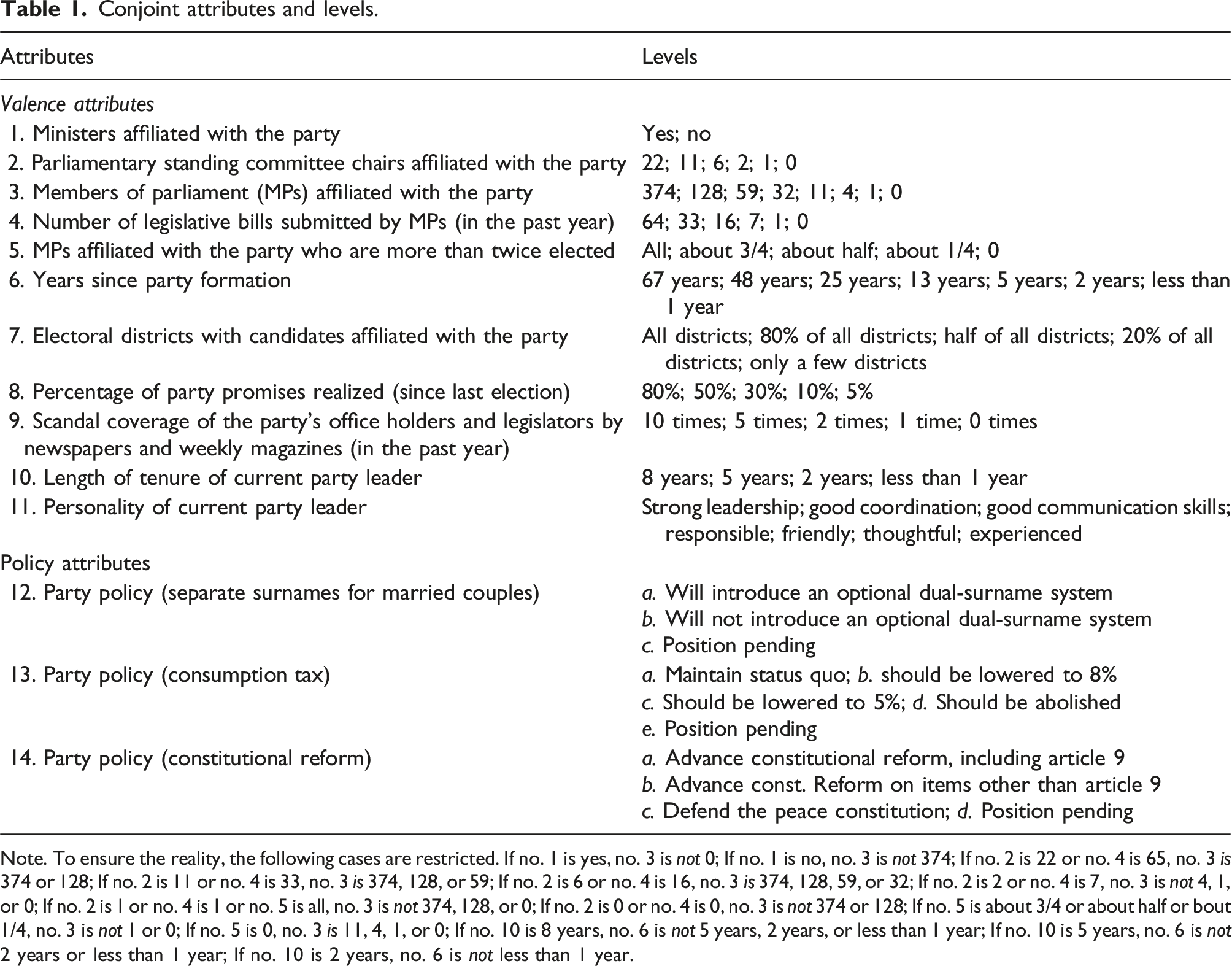
Note. To ensure the reality, the following cases are restricted. If no. 1 is yes, no. 3 is not 0; If no. 1 is no, no. 3 is not 374; If no. 2 is 22 or no. 4 is 65, no. 3 is 374 or 128; If no. 2 is 11 or no. 4 is 33, no. 3 is 374, 128, or 59; If no. 2 is 6 or no. 4 is 16, no. 3 is 374, 128, 59, or 32; If no. 2 is 2 or no. 4 is 7, no. 3 is not 4, 1, or 0; If no. 2 is 1 or no. 4 is 1 or no. 5 is all, no. 3 is not 374, 128, or 0; If no. 2 is 0 or no. 4 is 0, no. 3 is not 374 or 128; If no. 5 is about 3/4 or about half or bout 1/4, no. 3 is not 1 or 0; If no. 5 is 0, no. 3 is 11, 4, 1, or 0; If no. 10 is 8 years, no. 6 is not 5 years, 2 years, or less than 1 year; If no. 10 is 5 years, no. 6 is not 2 years or less than 1 year; If no. 10 is 2 years, no. 6 is not less than 1 year.
The valence measures in this experiment are based on commonly used concepts in the literature. Regarding party competence, researchers mainly focus on voters’ perceptions of a party’s ability to govern, often combining various measures into “macro-competence” (Green and Jennings, 2012, 2017; Johns and Davies, 2012). Macro-competence includes legislative productivity, fulfillment of campaign promises, and the share of seats held by a party. Our survey asks respondents to evaluate parties directly, so we included attributes under the competence umbrella; specifically, numbers of cabinet ministers and committee chairs, party size in the legislature, and the number of bills introduced. Each measure reflects the capability of parties to utilize government powers in the future. Moreover, we included a measure of how well parties delivered on their promises to give respondents a sense of past performance. Together, we have a robust set of competence measures.
Beyond competence, we considered a few other common valence measures. Research shows that the incumbency advantage of politicians, scandals, and the degree of party establishment can meaningfully influence a party’s valence (Butler, 2014; Liu, 2022; Nyhuis, 2016). We included measures for each attribute to give respondents a full range of valence criteria for selecting their preferred party. We also added measures for leadership personality and tenure, as research indicates that party leadership can sway voter evaluations of political parties (Abney et al., 2013; Magyar et al., 2023). Collectively, the valence measures in our survey aim to assess the overall influence of party valence on voter preferences while allowing testing of individual valence attributes against each other.
Policy attributes are more straightforward. Since a party’s raw policy position doesn’t theoretically link to a respondent’s choice, we created policy proximity scores to capture the proximity between respondents’ policy preferences and party attributes. In the pretreatment questionnaire, we ask about respondents’ preferences on each policy in the experiment (see Online Appendix A.2 for detailed wording). For the policy on separate surnames for married couples, we ask respondents to rate their support for “introduce an optional dual-surname system” on a seven-point scale from −3 (against) to 3 (in favor). Denote an individual response to this question as
For consumption tax and constitutional reform, we rate the distance from each attribute level on a four-point scale: distant (0), neither distant nor close (1), somewhat close (2), and very close (3).
11
Denote an individual response to the attribute level k as Distributions of policy proximity scores.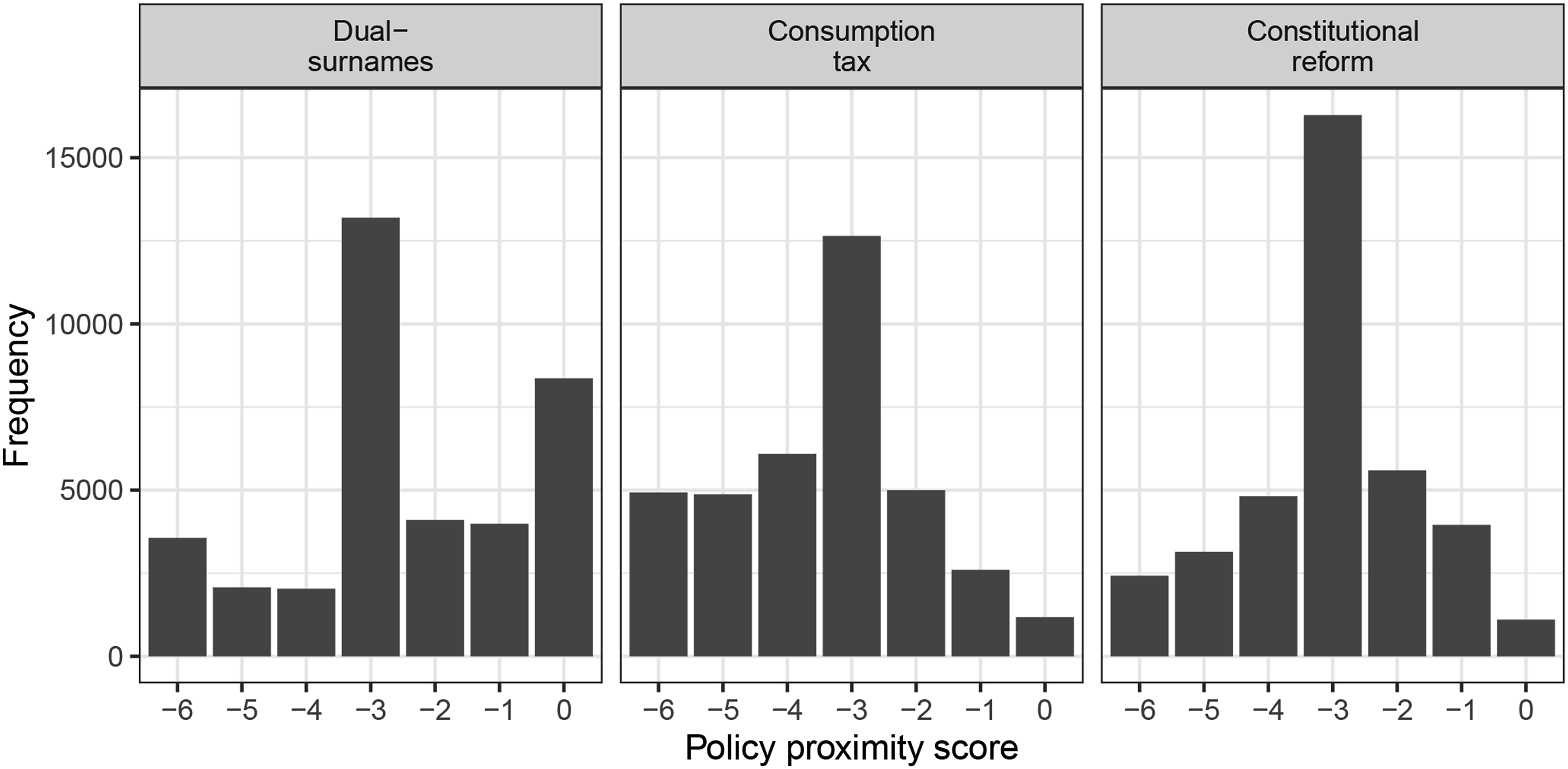
Analysis: Which of the valence and policy attributes matters?
To examine the effect of each political party’s valence or policy attribute on electoral choice, we use marginal means (Leeper et al., 2020). Marginal means indicate the probability that respondents select party profiles with a specific attribute level, independent of other attributes.
12
Figure 2 presents our main results, divided by two electoral contexts. The left column shows the hypothetical choice under HoC’s single- or multi-member district election, i.e., (S/M)MD, while the center column shows the choice under HoC’s proportional representation election, i.e., PR. The right column assesses the difference between the two electoral contexts. Main results from conjoint experiment.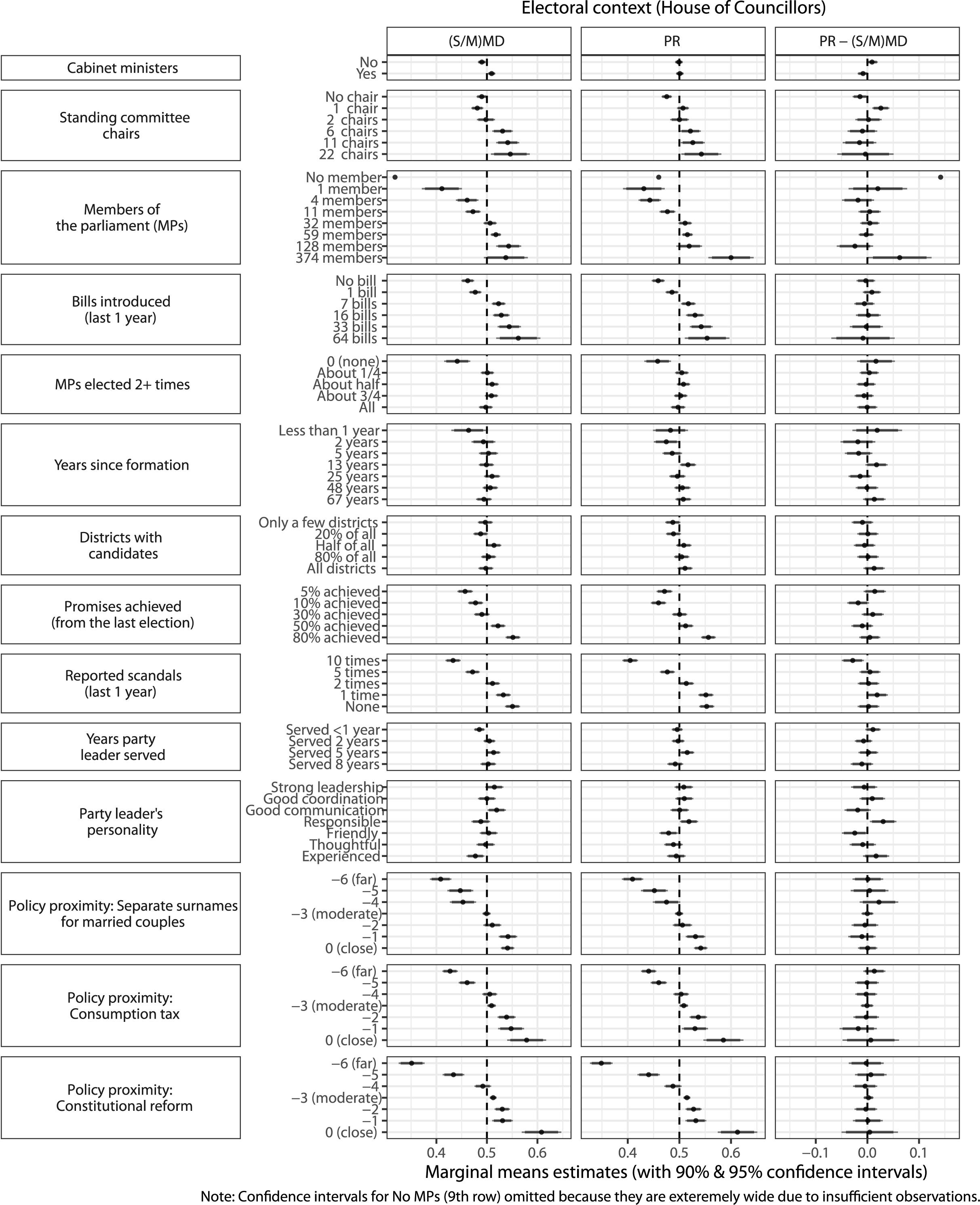
Overall, patterns align with H1A and H1B. Higher valence and closer policy proximity increase the likelihood of party selection. Comparison of electoral contexts shows that choices in single- or multi-member districts and proportional representation are highly similar. Some differences meet a conventional statistical significance threshold (p < .05), but their magnitudes are marginal, lacking clear systematic patterns that deserve theoretical attention. This result indicates common underlying dynamics in party-based electoral choice in HoC elections, regardless of electoral systems’ influence.
The comparison across attributes shows that all policy proximity attributes have clear linear relationships with party choice, confirming conventional logic in spatial voting literature (e.g., Adams et al., 2005; Downs, 1957). In contrast, variations in valence attributes merit theoretical discussion. To start, we see consistently linear relationships between valence and selection when valence attributes refer to the power, presence, and legislative productivity of a party in parliament. For the number of committee chairs, MPs, bills introduced, and proportions of electoral promises achieved, an increase in valence almost always leads to a higher likelihood of selection. The same pattern applies to the (lower) number of reported scandals. However, when valence attributes relate to the experience and seniority of parties and party leaders, valence’s effect is weak and potentially nonlinear. For the proportion of MPs elected more than twice, years since party formation, and years the current leader has served, higher valence does not necessarily lead to a higher likelihood of selection. Respondents tend to penalize a party or leader with almost no experience, such as having no MPs elected more than twice or less than 1 year since party formation. Yet, once a minimum threshold is met, more experience does not contribute to (or may even lower) the likelihood of selection. Finally, we observe weak and mixed results for valence attributes linked to cabinet ministers, the proportion of electoral districts with candidates, and party leaders’ personalities.
To further illustrate the variations across valence attributes discussed above, we conduct Wald tests to compare linear regression models with only a constant (null model) and with each of the conjoint attributes. Figure 3 shows F-statistics from those Wald tests, which indicate the overall importance of each conjoint attribute in explaining the selection of party in our experiment. The result conforms with our findings in Figure 2 that such valence attributes as scandals, achieving promises, introducing bills, and having more MPs are substantively more important in explaining party choice than having more experienced members, having candidates in more districts, and party (leader) serving in politics for a longer time. The assessment of conjoint attribute importance through Wald tests.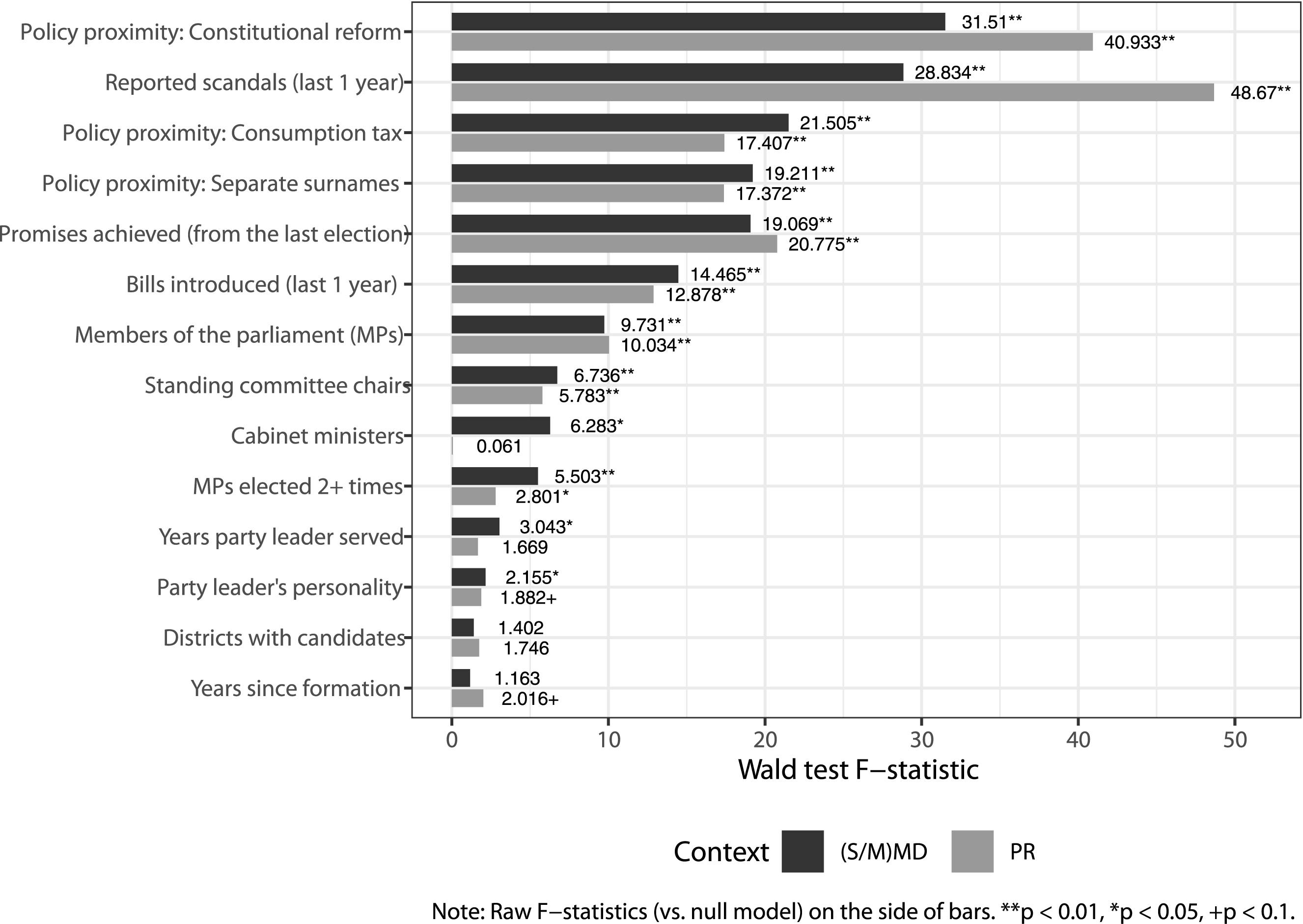
In Figure 4, we assess H2. This hypothesis posits that higher valence weakens the impact of policy proximity on party choice. To extract general implications for this thesis, we create a unified valence score by scoring and aggregating the valence attribute levels (excluding party leaders’ personalities). We rescale valence levels from 0 (lowest) to 1 (highest) for each attribute and calculate their average across all valence attributes. Figure 4 presents the marginal means of policy proximity for low and high valence subgroups (split by the median valence score). Results show that party profiles with a higher valence score are more likely to be selected, but higher valence does not weaken the effect of policy proximity on party selection. Policy proximities are equally influential in both low and high valence subgroups. Valence is also equally influential at any policy proximity level (see Online Appendix B.1 for a graphical illustration). This result does not support H2, implying that policy proximity and valence have independent additive effects on party choice. Policy proximity treatment effects moderated by valence treatment score.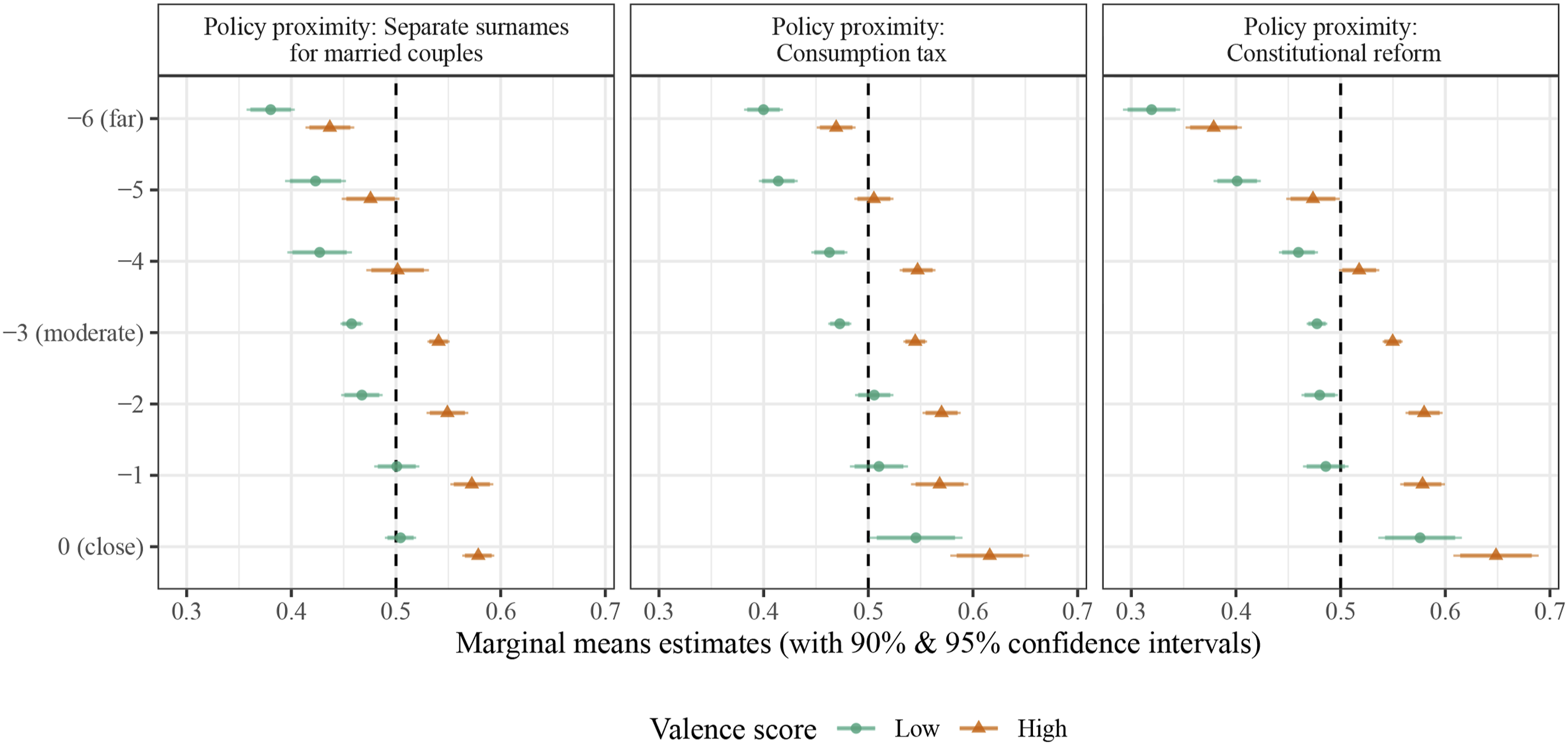
As an alternative analytical strategy to assess H2, we also estimate logit models using continuous policy proximity scores as treatments and continuous valence score as a moderator. Online Appendix B.2 show that the results support the implications from Figure 4, that higher valence do not weaken the influence of policy proximity. 13 Furthermore, logit estimates give us an opportunity to make a rough comparison of effect sizes of valence and policy proximity scores. Holding policy proximity at its mean, increase in valence from two standard deviations below to two standard deviations above the mean moves the probability of selection from 40% to 60%. The same simulation for policy proximity moves the probability of selection from 37% to 63%. These numbers are dependent upon our selection of valence and policy attributes in the experiment, but they strongly imply that valence and policy have comparable influences on Japanese voters’ preferences for parties.
For H3, we focus on differences between those who regularly support LDP (n = 9180) and those who do not. To add nuance, we divided non-LDP supporters into three groups: non-partisan (n = 13,120), supporters of new opposition parties (n = 5420) and supporters of established opposition parties (n = 4000). New opposition parties include young parties outside the traditional lineage in Japan, such as the Nihon Ishin Party, Reiwa Shinsengumi, and NHK Party. Established parties are those from the traditional lineage of Japanese political parties, including the Constitutional Democratic Party, Japanese Communist Party, Democratic Party for the People, and Social Democratic Party.
14
Figure 5 presents the relevant results for H3. The first column shows the marginal means for LDP supporters, while the second to fourth columns display marginal means for each non-LDP supporter group. Due to space limitation, the differences in marginal means between non-LDP supporter groups and LDP supporters are shown in Online Appendix C. Moderation by supporting parties.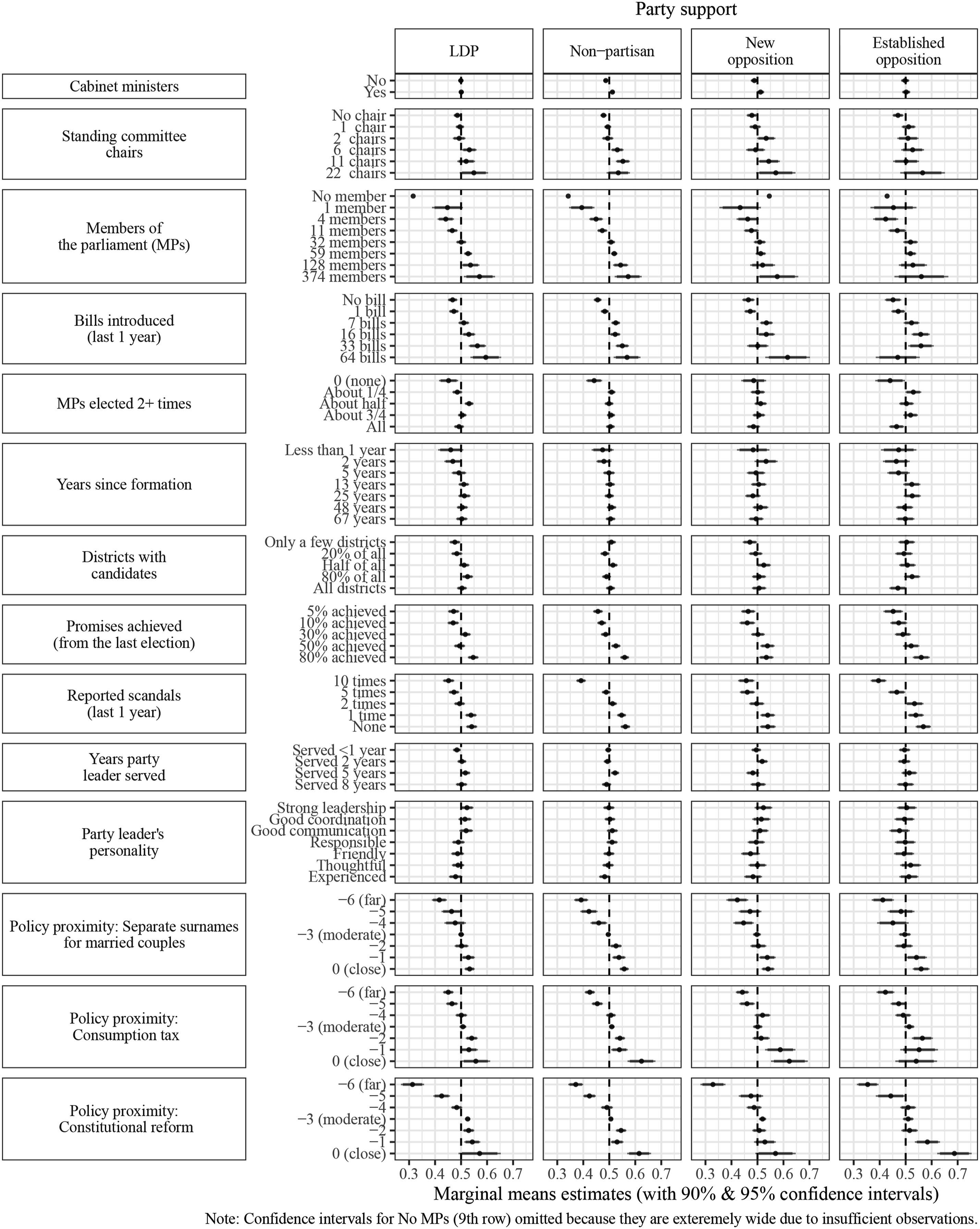
The general takeaway from Figure 5 is that party support affects how respondents use valence and policy attributes in selecting a party only minimally. The differences in marginal means between non-LDP and LDP supporters are mostly null, and when present, they are minor. 15 However, some differences merit discussion. First, regarding the attribute, “MPs elected 2+ times,” LDP supporters show that (1) the likelihood of choice is significantly lower with no affiliated MPs elected more than twice, and (2) the likelihood is highest with a moderate proportion of experienced members, around half. In summary, LDP supporters value a moderate number of experienced members, but too many senior members are less preferred. Compare this with non-LDP supporters. For non-partisans and established opposition supporters, pattern (1) persists, but pattern (2) does not. Supporters of new opposition parties appear indifferent to the presence of experienced members. Another attribute to note is the number of reported scandals. Here, the magnitude of its effect is evidently larger for non-partisans and established opposition party supporters. They respond more strongly to scandals than LDP supporters, punishing parties with many scandals (10 times more than LDP supporters) and slightly rewarding those with few or no scandals. Marginal means for new opposition party supporters are nearly the same as for LDP supporters. These findings suggest that, while tentative, new opposition party supporters evaluate parties differently, showing less concern for experienced members and scandals compared to other non-LDP supporters, mirroring LDP voters’ patterns.
Conclusion
In light of the increasing attention paid to the valence attributes of political parties both in and outside of Japan (Horiuchi et al., 2018; Kuriwaki et al., 2025), this article conducts a conjoint survey experiment that explores what type of party valence attributes matter for who and when and whether valence moderates the connection between policy and electoral choice. Our evidence confirms what other scholars have found that, in general, better party valence increases voter support for that party. But we took the analysis one step further, finding that some valence attributes have larger impacts than others. Specifically, the presence, power, and productivity of a party within the national diet, as well as the prevalence of scandals, sway voters more than the experience and party continuity. Moderation analysis suggests that a higher valence does not mitigate the effect of policy proximity on voter choice calculus, and also that valence consistently influences party choice regardless of policy proximity. We also find that valence effects persist similarly across electoral contexts, i.e., single- versus multi-member districts and proportional representation, though this institutional variation is nested within one electoral system. The findings for Japan’s party system indicate that supporters and non-supporters of the Liberal Democratic Party responded to valence dynamics similarly, while there is also tentative evidence that shows supporters of new opposition parties such as Nihon Ishin Party may care less about the presence of experienced MPs and incidences of scandals compared to other opposition party supporters or non-partisans.
Our results confirm what many others have found—that a combination of a party’s policy positioning and its valence attributes influences voter choice. At the same time, our findings indicate that there is nuance as to which valence attributes matter most to voters. Some of the valence qualities like delivering on campaign promises or legislative productivity exhibit a strong influence on voters. For other measures, like the proportion of incumbents within the party and the organizational continuity, voters were less responsive. This may seem surprising given the wealth of evidence showing electoral advantages caused by incumbency and seniority, but there are a few key differences with how scholars have typically used these valence measures and how the conjoint experiment presented them to voters. Incumbency and seniority may benefit the individual candidate, which in aggregate can boost the party’s electoral performance as a whole, but that does not mean that voters respond to incumbency and continuity at the party level. The implication here is that party valence and candidate valence may have separate influences on voter decision-making and that valence measures that are significant at the candidate level do not necessarily translate to the party level. We also find that no one positive personality attribute of a party leader matters significantly more than any other. This result is surprising, though it does not necessarily imply the absence of personality influence in general, given that our experiment lacks a neutral personality condition as a reference.
Another important implication of our results for subsequent valence analysis is a potential asymmetry in valence influence. For almost every measure of valence we used in the survey, voters were responsive to the lower end of its levels. Parties with no standing committee chairs, no current MPs, no bills, zero incumbents, no history, no candidates running in districts, minimal promises fulfilled, and excessive scandals all dissuaded voters from choosing them. However, on its higher end, not every valence attribute was able to sway voters. In particular, parties with an excessive number of incumbents, a very long history, and candidates running in every district were not the most popular parties in our experiment. Taken together, it seems that voters are more sensitive to negative valence rather than positive valence, though we still run into the issue of the possible disconnect between the relatively objective nature of valence in our survey versus the more subjective nature of valence in the “real world”. It should not be too surprising that voters are consistent on valence when they are stripped of partisan attachment or other filters through which they might evaluate party valence. The results indicate that negative valence is more influential than positive valence, but future research is needed to establish how voters ascribe valence to parties in their actual electoral context.
Furthermore, the fact that a system with a mix of candidate and party-based voting shows a persistent party valence effect suggests that in most cases, party valence should influence voter choice. Still, while we can confidently say what valence elements matter to voters in this election, more research is needed to determine if voters are consistent in their valence preferences spatially and temporally. Though this conjoint survey has institutional variation as a result of the HoC’s mix of single and multi-member districts and PR, there are radically different electoral institutions within and beyond Japan that could filter party valence differently. A purely closed list PR system with zero candidate voting may alter the sensitivity of voters to party valence and even what types of valence matter. On the reverse, intensively candidate-centered electoral systems could reduce the influence of party valence.
As for Japanese politics, our findings help drive a deeper understanding of what has kept the LDP in power despite electoral reform and changes to the party system over the years. We back up existing scholarship that posits the LDP’s dominance is reinforced by party valence but add to that scholarship by demonstrating specific elements of valence that inform the LDP’s advantages. Respondents in our conjoint experiment preferred larger, legislatively productive parties that are able to deliver on their promises. As brief periods of non-LDP coalition governments in 1993–1994 and 2009–2012 failed to demonstrate the ability of oppositions to become such a party, the LDP is seen as the only party that possesses these attributes. While it is possible that voters, when presented with party profiles with these characteristics, are projecting the LDP onto the profile, the fact that these valence effects persist between LDP and non-LDP supporters suggests that voters prefer these valence attributes independent of party labels. Our findings also give us a peek at how Japan’s opposition parties might be able to gain ground on the LDP. Even the regular LDP supporters in our experiment are not necessarily rewarding the LDP’s excessive experience and continuity. This pattern is even more prevalent for nonpartisans, and securing nonpartisans’ votes is crucial in winning a majority of seats in Japanese elections. Once the LDP is seen as a counterproductive party that does not deliver promises (and is covered with scandals), these voters may be quick to dismiss the LDP and give a chance to another sufficiently large party (as the size still matters).
Overall, voters care about both the policy positions and valence attributes of political parties. Our results indicate that they behave consistently with logical expectations outlined by the policy and valence literature and that they likely care about valence attributes relating to the party’s meaningful engagement in the current legislature more than those relating to the party’s accumulated experience. Furthermore, valence does seem to moderate the influence of policy on voters. While it may be tempting to attribute these findings to the Japan case alone, there are many reasons to consider Japanese voters and their motivations for choosing political parties as generalizable to other democracies. Further research is needed to understand how sensitive voters are to different electoral contexts and explore other potential valence measures, but our research shows promise for subsequent scholarship into the nature of parties, voters, and what determines elections.
Supplemental Material
Supplemental Material - What brings you to the party? Voter preferences on parties through policy and valence dynamics
Supplemental Material for What brings you to the party? Voter preferences on parties through policy and valence dynamics by Jordan Hamzawi, Gento Kato and Masahisa Endo in Party Politics
Footnotes
Acknowledgements
Jordan Hamzawi and Gento Kato contributed equally to this work. Previous version of the manuscript was presented at Midwest Political Science Association Annual Conference, Chicago, IL, April 4, 2024. The pre-analysis plans for the analysis are registered at OSF (https://osf.io/9qmsr). Replication materials for the analytical results in this study are available on the Harvard Dataverse ( ).
).
Declaration of conflicting interests
The author(s) declared no potential conflicts of interest with respect to the research, authorship, and/or publication of this article.
Funding
The author(s) disclosed receipt of the following financial support for the research, authorship, and/or publication of this article: This work was supported by JSPS KAKENHI (grant number 19H00584).
Ethical statement
Supplemental Material
Supplemental material for this article is available online.
Notes
Author biographies
References
Supplementary Material
Please find the following supplemental material available below.
For Open Access articles published under a Creative Commons License, all supplemental material carries the same license as the article it is associated with.
For non-Open Access articles published, all supplemental material carries a non-exclusive license, and permission requests for re-use of supplemental material or any part of supplemental material shall be sent directly to the copyright owner as specified in the copyright notice associated with the article.
