




Abstract
Individualized work arrangements (“i-deals”) negotiated by employees are increasingly common in contemporary employment. Existing research largely focuses on phenomena emerging after the creation of i-deals, particularly their consequences for employees and organizations. This focus overlooks the fundamental processes associated with negotiating i-deals in the first place. I-deals research originating in the last two decades can benefit from the more advanced body of research on negotiations, particularly in its attention to negotiation preparation and the bargaining process. We examine how negotiation research and theory inform our understanding of the dynamics operating in the creation of i-deals. In doing so, we identify key features of negotiation research that apply to i-deal formulation and use these to develop an agenda for future research on i-deals.
Keywords
Idiosyncratic deals (“i-deals” for short) are customized employment arrangements individuals negotiate with an employer (Rousseau, 2001, 2005). Once exceptional, i-deals are increasingly part of the human resource (HR) tool kit with HR consultants advising managers to use i-deals to attract, motivate, and retain employees (Half, 2018). Once limited to stars (Frank & Cook, 2010) and high status employees (Hochschild, 1997), the increased frequency of i-deals introduces more diversity in the conditions under which they occur. An important and understudied aspect of these conditions is the negotiations they involve. Fortunately, over 50 years of negotiation research (Pruitt, 2012; Pruitt & Rubin, 1986; Walton & McKersie, 1991) offers insights relevant to the pursuit and creation of i-deals. As i-deals are negotiated agreements intended to benefit both individual workers and the employer (Rousseau, 1995), they align with the conceptualization of negotiation offered by Thompson, Wang and Gunia (2010, p. 2), “an interpersonal decision-making process by which two or more people agree how to allocate scarce resources.” At the same time, little direct investigation exists of the actual negotiations and related interactions involved in creating i-deals. This integrative review identifies how negotiation research, generally conducted in the laboratory, can inform research on i-deal creation, largely studied in the field.
In i-deals research, the negotiations that led to i-deal agreements tend to be treated as a black box from which individualized arrangements emerge. I-deals are largely studied as a fait accompli, after their creation. How the i-deal agreement was realized, including the interactions that led to their creation, is largely unknown. Qualitative data suggest that the nature of i-deal negotiation can vary from explicit bargaining to more subtle persuasion (Clark, 1999; Corwin, Lawrence & Frost, 2001; Rousseau, 2005), but little systematic study of their creation exists. Thus, taking a negotiation lens to the examination of i-deal pursuit and creation will enable a deeper understanding of i-deal dynamics. By revisiting negotiation literature, we aim to identify insights from negotiation research that call attention to gaps and opportunities in the study of i-deal creation.
In the sections that follow, we first address what generally is known about i-deals, the outcomes they yield, and conditions that give rise to them. We then provide a framework linking the study of i-deals with negotiations. We focus on how findings from research on negotiations can inform the dynamics and phases of the i-deal creation process. Finally, we present an agenda for developing future i-deals theory and research informed by insights from negotiation research. We begin with a brief overview of research on i-deals and its gaps.
Overview of I-Deals Research
I-deals research falls into several broad categories. The largest body of research addresses the consequences i-deals have for individuals and organizations (e.g., Liao, Wayne & Rousseau, 2016). The second largest examines antecedents, that is, the individual and contextual factors associated with creating i-deals (e.g., Hornung, Rousseau & Glaser, 2009). Although these two bodies of research focus on actual i-deals that have been granted, a third stream focuses on i-deal requests, investigating the antecedents and contextual factors associated with i-deal requests (e.g., Lee, Bacharach & Rousseau, 2015) or their denial (e.g., Davis & Van der Heijden, 2018). As we begin this overview, it is useful to understand the types of i-deals that have been identified.
I-Deals Differ in Timing and Content
I-deals research differentiates types of i-deals according to their timing and content. Regarding timing, i-deals may be negotiated at hire (ex ante) or on the job (ex post). Although how an i-deal is actually negotiated is rarely studied, the information used and ways negotiations are framed are likely to depend on timing. Ex ante i-deals negotiated between job applicant and employer occur in the absence of a relationship between the parties and tend to focus on economic issues (Rousseau, Ho & Greenberg, 2006). In contrast, ex post deals emerge during ongoing employment and involve diverse issues including preferred tasks and development opportunities since their negotiation requires insider knowledge and a relationship between the parties.
I-deals research largely examines ex post deals, which are likely to be more common than ex ante deals (Liao et al., 2016; Rousseau et al., 2006). Some i-deals involve an exchange of new contributions or inducements (e.g., accepting new responsibilities in order to gain flexibility or developmental opportunities). Others are a means of solving a problem, as when the individual employee needs flexibility in order to manage personal life demands, or the employer needs a worker to accept a less than attractive new assignment. Ex post i-deals can also take the form of disputes where an employee threatens to quit unless offered special incentives. A distinctive feature of ex post deals is the greater knowledge the parties have about each other. The employee may know what other deals have been made, opportunities available inside the organization, and the potential receptivity of his or her supervisor. At the same time, the employer, particularly the supervisor, is more familiar with the employee’s specific skills, contributions, and interests. An existing relationship and greater knowledge on the part of each party create opportunity for considerable variety in the ex post i-deals that can be negotiated.
I-deals are also differentiated by their content, that is, the individualized resources workers receive. Developmental i-deals are special opportunities for training and advancement (e.g., funding and time off to attend an executive program) (Liao et al., 2016). Task i-deals entail negotiated changes to job content that make work more intrinsically interesting (Hornung, et al., 2009; Hornung, Rousseau, Weigl, Mueller & Glaser, 2014; Rosen, Slater, Chang & Johnson, 2013). These two kinds of i-deals tend to be negotiated by high performers and those motivated to improve their experiences at work (Hornung et al., 2009). Customized financial arrangements provide individualized incentives, pay raises, or other adjustments to compensation and benefits (Rosen et al., 2013). Flexibility i-deals allow customized work schedules or locations, while reduced workload i-deals permit the employee to have fewer work demands or work hours than peers (Hornung, et al., 2009).
Consequences of I-Deals
In a meta-analysis, Liao et al. (2016) reports that i-deals influence a wide range of work-related employee perceptions, attitudes, and behaviors. Empirical studies report i-deals’ association with affective commitment (Ho & Tekleab, 2016; Hornung, Rousseau & Glaser, 2008), voice, and organizational citizenship behavior (Anand, Vidyarthi, Liden & Rousseau, 2010; Bal, De Jong, Jansen & Bakker, 2012; Ng & Feldman, 2015). I-dealers also show higher contributions to organizational goals (Anand et al., 2010; Hornung et al., 2008) and higher motivation and intention to remain with their organization (Bal et al., 2012; Ho & Tekleab, 2016; Hornung et al., 2009; Las Heras, Van der Heijden, De Jong & Rofcanin, 2017).
I-deals research suggests the content of i-deals, that is, the kind of resources involved, matters to the ultimate success of the negotiation and its outcomes. Importantly, research finds consistent positive effects on employee and organizational outcomes from developmental, flexibility, and task i-deals (Ho & Kong, 2015; Hornung et al., 2014; Liu, Lee, Hui, Kwan & Wu, 2013; Kong, Ho & Garg, 2020; Ng & Feldman, 2015; Rosen et al., 2013). More inconsistent and at times more negative outcomes are tied to reduced workload i-deals (Oostrom, Pennings & Bal, 2016; Rousseau, Ho & Kim, 2003) and financial incentives (Oostrom et al., 2016; Rosen et al., 2013).
Importantly, scholars recognize that the short- and long-term consequences of i-deals can differ. Flexibility i-deals, for example, are associated with employee satisfaction (Ho & Tekleab, 2016; Rosen et al., 2013) but over time may disrupt peer relationships (Greenberg et al., 2004; Hochschild, 1997). Workers with such arrangements ultimately may experience lower performance ratings and fewer advancement opportunities due to their nonconforming work situation (Hornung et al., 2009; Simosi, Tomprou & Rousseau, 2019). Reduced workload i-deals thus may help retain an employee but in doing so tend to reduce his or her future career opportunities (Simosi et al., 2019).
Antecedents of I-Deals
Research on the antecedents or predictors of i-deals investigates the role of employee and managerial perceptions and attributes. In terms of employee perceptions, workers are found to pursue i-deals when they believe they have earned them or are likely to have them granted (Bal, 2018). Other employee perceptual antecedents include high quality relations between supervisor and employee (Hornung, Rousseau, Glaser, Angerer & Weigl, 2010; Hornung et al., 2014; Rosen et al., 2013) which correlate with an array of ex post i-deals. Quality relationships with the employer and/or colleagues and a climate of flexibility and openness to experimentation appear to encourage employees to pursue i-deals (Bal, 2018). Ng and Lucianetti (2016) find that employees pursuing goals of achievement and status more successfully negotiate i-deals. In terms of managerial perceptions, supervisor beliefs regarding unfulfilled employer obligations increase the likelihood that an i-deal will be granted (Hornung et al., 2009). In a study of both i-deals granted and denied, managers were more likely to grant deals that they believe benefitted both the employee and organization (Davis & Van der Heijden, 2018).
Both employee and managerial characteristics play a role in the formation of i-deals (Liao et al., 2016). Employee initiative, emotional intelligence, and employee political skills (i.e., interpersonal influence and social astuteness) are each associated with receiving different types of i-deals, including those that allow for development, flexibility, and task responsibility (Hornung et al., 2008; Huang, Niu, Lee & Rousseau, 2009; Rosen et al., 2013). Relatedly, employees lacking self-confidence and business knowledge are thought to find it difficult to negotiate a successful i-deal (Davis & Van der Heijden, 2018). However, research is limited on the manager’s attributes related to i-deals. A supervisor’s own experiences influence the granting of i-deals for their subordinates. There is a positive relationship between i-deals received by a supervisor and i-deals granted to their subordinates (Laulié, Tekleab & Lee 2019). More specifically, supervisors with personal caregiver responsibilities have been shown to be more likely to grant schedule i-deals to subordinates (Las Heras et al., 2017). Finally, employees who perceive their supervisor as being considerate report higher rates of developmental and schedule i-deals (Hornung, Glaser, Rousseau, Angerer & Weigl, 2011).
I-Deal Requests
Important to understanding the conditions under which i-deals are created is studying the occurrence of i-deal requests, regardless of whether they are actually granted. Lee, Bacharach, and Rousseau (2015) report lower incidence of i-deal requests in firms with internal labor markets (ILMs), which reward seniority and develop workers’ organization-specific skills. However, i-deal requests were greater when workers had high firm-specific human capital. They note that workers with high firm-specific human capital were inclined to request i-deals even where ILMs operated. Requests for i-deal thus were lower among workers less valuable to the firm where ILMs are present, while highly valued workers continued to make i-deal requests.
Bal (2018) reported two employee motives for requesting ex post i-deals. First, employees request i-deals when they feel that they deserve (i.e., “have earned”) them. Deservingness takes a variety of forms including outperforming others or perceiving coworkers to be treated better. Second, employees pursue i-deals to solve a problem (e.g., resolve work/family conflict, reduce stressful job demands, or improve performance).
Ho and Tekleab (2016) call attention to differences between requesting and actually being granted an i-deal. Focusing on ex post i-deals, they set out to examine moderating conditions affecting the likelihood of a successful i-deal request. Experience and gender acted as moderators but only in the case of financial i-deals. Less experienced employees were more likely to have requests for financial i-deals granted, possibly because they are younger. Gender also played a moderating role: Men were more likely than women to have financial i-deal requests granted. Finally, leader–member exchange increases the likelihood of a request being granted.
This overview calls attention to several key points. First, although considerable research addresses the consequences of i-deals, their antecedents or predictors are less well understood, raising questions regarding the factors associated with pursuing and successfully negotiating an i-deal in the first place. Second, most research focuses on i-deals that have been granted. Yet, understanding the dynamics involved in creating i-deals requires research that differentiates i-deal requests from receipt and that investigates i-deals that are granted from those that are denied. We note the minimal attention given to date to what happens before an i-deal negotiation is initiated including how the parties collect information and prepare for the negotiation. Moreover, little is known regarding the behaviors and perceptions of the parties relative to the process through which i-deals are created. Thus, we currently know little about the strategies and tactics used in i-deal negotiation. Further, because many i-deals arise in the context of ongoing employment arrangements, conventional market-oriented bargaining need not always apply in i-deal creation. I-deal negotiations are likely to overlap partially with conventions regarding employment negotiation (Kyl-Heku & Buss, 1996; Marks & Harold, 2011), while also operating in a more distinct relational space where persuasion and interpersonal support also contribute to their creation (Cialdini, 2007). These gaps suggest the value of examining how negotiation research can inform the understanding and study of i-deals and where new theorizing may be needed to explicate the dynamics of i-deal creation.
An Integrative Framework Linking Negotiations and I-Deals Research
I-deal negotiations are a type of employment negotiation that rise to customized work roles and organizational relationships. The employment negotiation literature (cf. Brett & Thompson, 2016) focuses primarily on bargaining either between labor and management (e.g., Walton, Cutcher-Gershenfeld, McKersie, 2000; Walton & McKersie, 1991) or employers and new hires, and to a lesser extent current employees seeking promotion or to leverage outside offers. Negotiation research and theory has a lot to say about the factors that influence these negotiations and how they transpire. Applying that theory to i-deal negotiations can both pull back the curtain on how people develop mutually agreeable work arrangements, allowing us to predict when they will be successful, in terms of reaching high quality, mutually beneficial outcomes. It also has the potential to broaden our understanding of employment negotiation more generally, as we expand our framing of what constitutes a job negotiation and how the broader organizational context comes into play.
Integrating I-deals and negotiation literature.
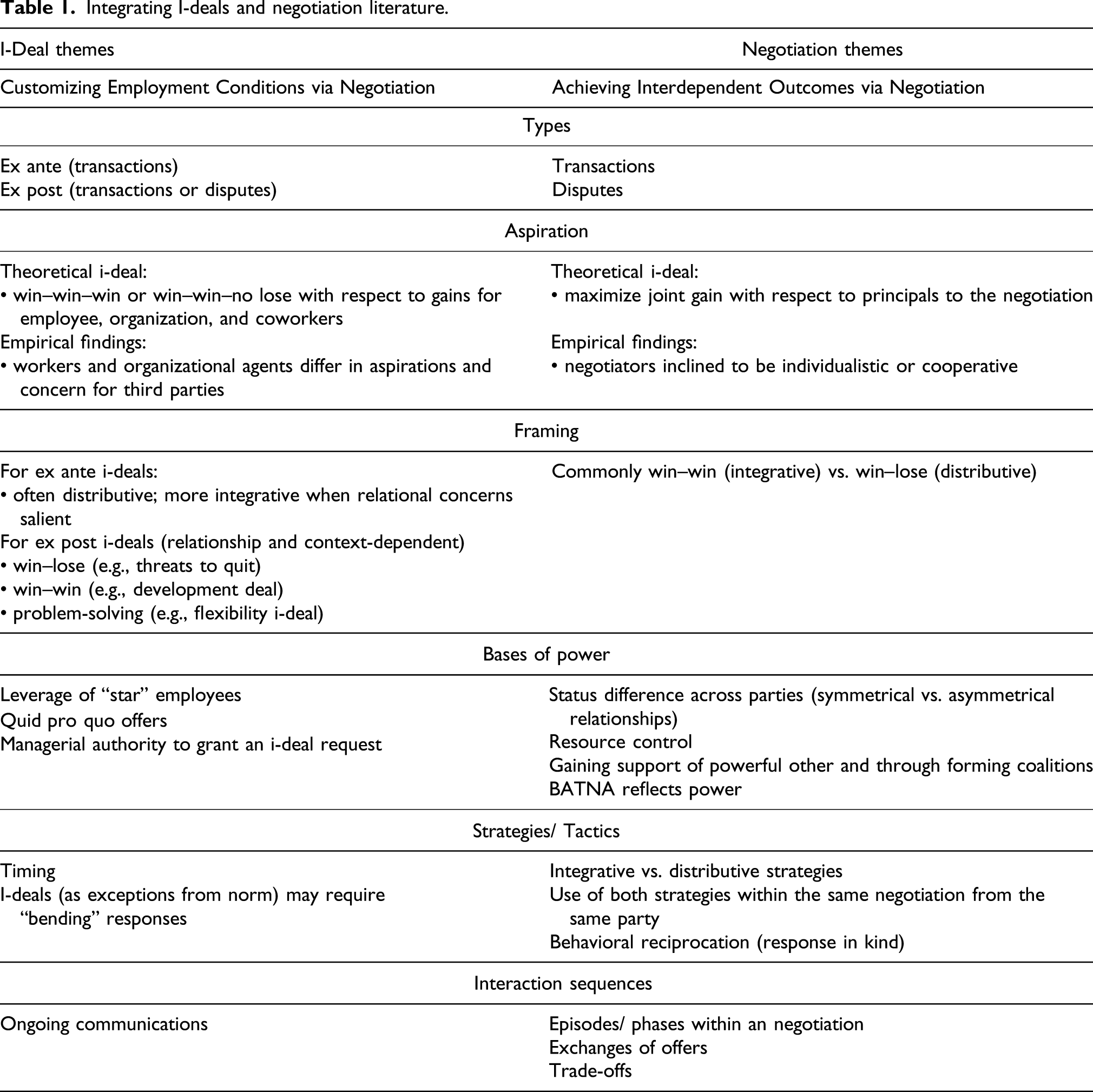
Core Concepts in Negotiation as They Relate to I-Deals
Negotiation types
Negotiation is a discussion used to reach agreement in order to resolve transactions and disputes (Brett, 2014). Transactions are exchanges of resources controlled by each party and tend to involve muted emotions. Disputes are conflicts where one party believes the other has treated them inappropriately and can be highly emotional (Ury, Brett & Goldberg, 1988).
Most i-deals are likely to take the form of transactions where the negotiation focuses on an individualized exchange of different resources than the employer typically offers. Ex ante i-deals are transactions largely with an economic focus; they typically involve muted emotions, given the “arm’s length” nature of the relationship between job applicant and employer. In contrast, ex post i-deals involving a threat to quit can at times take the form of a dispute, where emotions are high. Other ex post i-deals may take a transactional form in an ongoing employment relationship in which new resources are offered and exchanged through i-deal negotiation. However, a third type of negotiation process, problem-solving, can also arise in the latter case, whereby i-deals are a means to resolve a problem of concern to both parties (Babcock & Laschever, 2009; Rousseau, 2005). How the parties approach the i-deal negotiation bears on both its emotional tenor as well as how the parties conceptualize the discussion in which they are engaged.
Aspirations
Aspirations refer to the goals that parties pursue. Goals derive from the parties’ needs and interests and help regulate their behavior to achieve desired outcomes. Negotiator goals can take several forms including economic, relational, and status or face-related goals (Roloff & Jordan, 1992). Status or face-related goals involve the negotiator’s focus on restoring self-image or establishing a position of strength. As Olekalns & Weingart (2008) point out, goals differ in their types (cooperative vs. individualistic), strength (strong vs. weak), and congruence (goal similarity across negotiators). These aspirations may be redefined as a negotiation progresses and perceptions of their feasibility change (Prietula & Weingart, 1994). In the context of i-deals, employees pursue i-deals for an array of reasons (Bal, 2018; Rousseau, 2005) in circumstances where standard employment practices fail to meet their needs or interests. However, the link between aspirations and i-deal negotiation-related behavior is largely unknown.
Negotiation theory often treats the aspirational outcome of negotiations to be Pareto optimality, in which the parties maximize their joint outcomes (Nash, 1951; Raiffa, 1982). I-deals theory also offers a normative aspiration, for three parties, that is, benefiting the principals to the i-deal, employee and employer, while attaining, at minimum, acceptability to coworkers (Rousseau, 2005; Rousseau et al., 2006). Note that the principals to an i-deal can differ in their concern for third parties, which in turn affects the consequences i-deals have—not only for third party perceptions and well-being but also for the organization’s justice climate (Greenberg et al., 2004; Lai, Rousseau & Chang, 2009). The aspirations employees pursue in i-deals are expected to differ with respect to concern for coworkers from seeking equal standing to peers, to ensuring a better relative position (Liu et al., 2013), or maintaining good relationships (Rousseau, 2005).
The most diverse aspirations are likely to involve ex post i-deals. Employees and employers in long-term employment relationships are likely to have higher and more diverse aspirations for the benefits sought, the relationship quality pursued, and the acceptability of the i-deal to others. In contrast, aspirations are expected to be narrower and more limited in the context of ex ante i-deals. Such deals are negotiated by job candidates who have limited knowledge of the organization and less attachment to it. Thus, it is likely that the aspirations each party has regarding effects of an i-deal on coworkers will influence the i-deal negotiated.
Aspirations the parties have influence the demands negotiators make and the outcomes the negotiation yields (Thompson, 1995). In both i-deals and negotiations generally, aspirations affect the kinds of issues the parties seek to address and influence—and are influenced by—the negotiation’s framing to which we next turn.
Framing
Framing is a well-studied issue in negotiations (Pinkley, 1990; Schweitzer & DeChurch, 2001; Schweitzer, DeChurch & Gibson, 2005). Frames are mental structures or preexisting beliefs that affect how individuals interpret perceptual cues (Minsky, 1975). Frames reflect negotiators’ assumptions including normative beliefs regarding the nature and course of negotiations. As such, frames shape the expectations of negotiators (and i-dealers). Two frames receive the most attention in negotiation research, the fixed-pie (win–lose) frame and the expanding-pie frame (win–win) (Harinck, De Dreu & Van Vianen, 2000; Pinkley, 1990). Parties with a win–lose frame assume that the negotiation outcome cannot satisfy all parties’ needs. Intertwined with the idea that one has to “pay a price” in order to get something, this frame gives rise to negotiation strategies and tactics that are distributive in nature (Rubin, Pruitt, & Kim, 1994; Yang, Cheng & Chuang, 2015). In contrast, an expanding-pie frame has the potential to increase the array of features bargained for, facilitating integrative or cooperative solutions (De Dreu, Weingart & Kwon, 2000; Olekalns & Weingart, 2008). Power seems to have an effect on how negotiations are framed: Wiethoff, Lewicki, and Davis (2003) find that disputants who see themselves as having more power tend to frame the issues as gains, whereas those seeing themselves with less power tend to adopt loss frames. Irrespective of the frame applied, convergence in frames increases the likelihood of reaching agreement (Pinkley & Northcraft, 1994).
In i-deals, framing is likely to be affected by timing (Rousseau, 2005). Ex ante i-deals involve the economic conditions of employment (e.g., job level, going rates of wages, and benefits) and are likely to be framed as win–lose, though they may be win–win depending on whether the bargain expands to include multiple issues. Ex post i-deals involving “threats to quit” tend to be framed in win–lose terms, for example, when an employee brandishes an alternative job offer to gain more advantageous economic terms (Rousseau et al., 2006). Other ex post i-deals can have a diverse array of frames (Rousseau, 2005; Rousseau et al., 2006). An employee may deploy a win–win frame by offering to contribute future value to the organization in order to attain a customized resource like development opportunities. Or, an employee may frame the i-deal negotiation as a problem-solving opportunity and ask for a flextime work arrangement by noting that caring responsibilities could otherwise interfere with task completion. Bal (2018) notes that the problem-solving frame directs attention toward addressing a problem on the job (e.g., a task i-deal) or outside it (e.g., a flextime i-deal). On the other hand, a win–lose frame is likely to characterize employees who feel entitled to i-deals (e.g., as “stars”). Employees who seek to claim more for themselves without offering additional reciprocity can be described as using a win–lose frame. A variety of frames are thus likely to operate in the negotiation of i-deals. Frames are tied to negotiation strategy and tactics.
Stages of I-Deal Negotiation
Negotiation is conceptualized in three broad stages: (1) Pre-negotiation (preparation and planning), (2) negotiation or bargaining (exchanging information and solution seeking), and (3) aftermath or post-negotiation (solution implementation). These stages align with the sequence theorized in the development and execution of i-deals: Prework, negotiation, and managing the aftermath (Rousseau, 2005; Rousseau, Tomprou & Simosi, 2016). Negotiations generally, and i-deals specifically, progress through these stages although the sequence need not be linear. The parties may return to previous stages in their effort to realize agreement. Negotiation scholars have fairly robust knowledge of how people behave during the middle “bargaining stage” (Jang, Elfenbein & Bottom, 2018) and have rich insights regarding what happens before bargaining starts. We now turn to insights gained by examining the three stages of negotiation that can inform our understanding of i-deal creation. Figure 1 outlines the concepts we use to better understand i-deal negotiation and their functioning across different negotiation stages. Dynamics of I-deal negotiation across stages.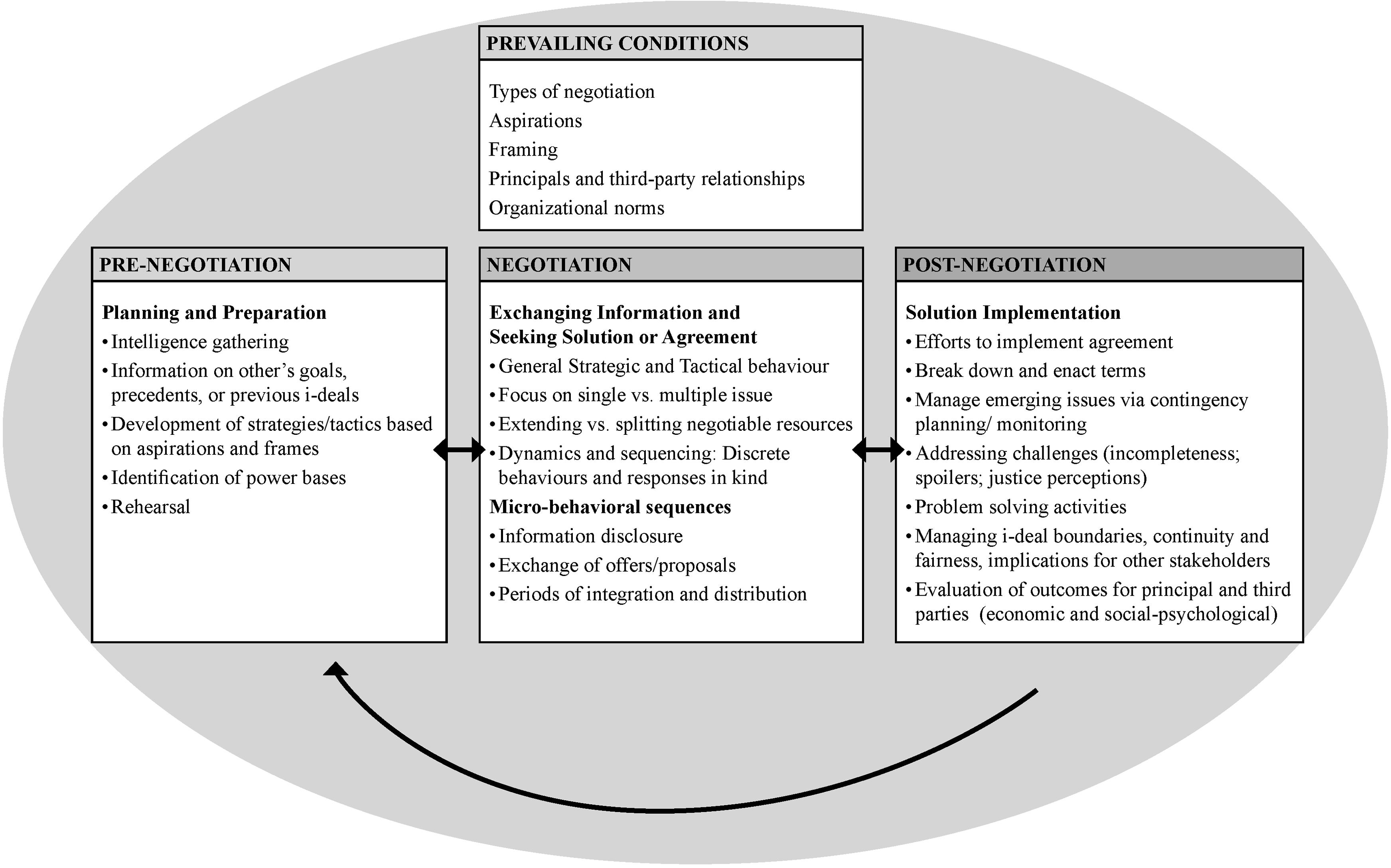
Pre-negotiation (preparation and planning)
The pre-negotiation stage refers to what the parties do to prepare and plan before “sitting at the negotiation table.” This stage influences how the parties enter the negotiation, including their aspirations, expectations, and initial framing. It often begins with intelligence gathering, acquiring information about the other party such as goals and existing precedents (De Dreu & van Kleef, 2004), including previous i-deals made in the organization (Clark, 1999; Hochschild, 1997). Preparation and planning help the negotiator develop pertinent aspirations, frames and positions, anticipate strategies and tactics to pursue, and conceptualize the other party’s potential responses (De Dreu & van Kleef, 2004; Lewicki, Barry & Saunders, 2010). The negotiator may rehearse verbal communication and gather supporting facts (Peterson & Lucas, 2001; Simons & Tripp, 1997). Several qualitative studies identify the value of extensive “prework” in strengthening an individual’s case for an i-deal (Corwin et al., 2001; Hochschild, 1997; Perlow, 1997). In her qualitative study of professionals negotiating part-time work arrangements, for example, Clark (1999) reports an array of preparatory activities like gathering information regarding precedents and attention to the timing of requests.
A key aspect of preparation is identifying the negotiator’s bases of power. As the potential to influence others (Bacharach & Lawler, 1981), power derives from a variety of bases including the relative status of the parties and control over valued resources like expertise (Coleman & Vronov, 2005; Hong & van der Wijst, 2013; Podsakoff & Schriescheim, 1985; Yukl & Falbe, 1991). Dependence is a determinant of power in negotiation (Bacharach and Lawler 1981), reflecting whether the parties have alternatives for satisfying their needs outside the negotiation (Brett, 2014). Recognition of one’s power shapes the strategies used in the bargaining phase below (Thompson et al., 2010).
On the other hand, i-deals research gives power little explicit attention beyond the greater leverage “stars” and highly valued employees may have in obtaining them (Frank & Cook, 2010; Lee et al., 2015; Perlow, 1997). Narrative evidence suggests that the ability to offer a valued resource is important to negotiating an i-deal (Rousseau, 2005). An employee may offer a quid pro quo in order to obtain something of value via an i-deal. For example, in ex post i-deals, the employee can use an offer to contribute in ways the employer values like accepting a new assignment or agreeing to help a coworker in order to obtain sought after development opportunity or greater flexibility. Similarly, i-deals can emerge in response to an employer’s needs, for example, to fill a specific position or motivate employee acceptance of greater responsibilities (Rousseau, Tomprou & Simosi, 2016). Power is also important in terms of whether a supervisor believes she has the power to grant an employee’s request or requires approval from senior management or the HR department. Incorporating the concept of power bases, as applied in negotiation research, can advance understanding of the i-deal negotiation process.
Negotiation (Bargaining)
The second stage of the negotiation process entails the actual discussions through which agreement is sought. It involves talking about issues and exchanging offers in the attempt to arrive at a mutually acceptable agreement (De Dreu & van Kleef, 2004; Prietula & Weingart, 2011). Bargaining may end with agreement or impasse, and in the context of i-deals, a denial of the request is an impasse. The black box of i-deals research refers to what happens when parties actually negotiate an i-deal, including whether they indeed “sit at a table,” informally chat over time, involve third parties, or whatever process may precede the creation of an i-deal.
Negotiation behaviors: Strategies and tactics
The bargaining phase involves specific tactics or behaviors that together form a strategy for reaching agreement in line with the negotiator’s goals (Pruitt & Carnevale, 1993; Weingart, Thompson, Bazerman & Carroll, 1990). Tactics are discrete actions that can vary in their usage over the course of a negotiation. Negotiation research tends to cluster tactical behaviors in terms of their strategic orientation, that is, whether they create value (integrative) or claim value (distributive) (Weingart, Brett, Olekalns & Smith, 2007). In line with the frames described above, integrative strategies pursue joint gain, focus on learning about interests and needs, deploy problem-solving tactics, and search for mutually acceptable trade-offs and discovery of creative solutions consistent with expanding the pie (Ury et al., 1988). In contrast, distributive strategies seek to allocate existing resources in pursuit of individual goals, focusing on a single issue or on issues in isolation from one another, and use assertive behaviors including aggressive first offers and refusals to yield (Hüffmeier, Freund, Zerres, Backhaus & Hertel, 2014). Negotiators typically blend integrative and distributive strategies within the same negotiation as they work toward an agreement (e.g., Putnam, 1990). Choice of negotiation strategy is affected by the parties’ emotions (Van Kleef & Côté, 2018). For example, people who felt guilty after not cooperating in a social bargaining game tended to use more cooperative strategies in future rounds (Ketelaar & Au, 2003), perhaps one reason why supervisors are inclined to grant i-deals to workers with psychological contract violations (Hornung et al., 2009).
As i-deal negotiations are typically between bosses and their subordinates in organizational settings, recent research by Bowles, Thomason, and Bear (2019) is especially pertinent. They find that the strategies used in employee–manager negotiations depend on whether the request is in line with norms or precedent. Asking refers to requests recognized as “standard issues.” Bending involves requests that are exceptions from organizational norms. Last, shaping encompasses requests that alter organizational norms and practices. Bowles et al. (2019) suggest that bending is relevant to workplace flexibility, a potential link between i-deals and research on negotiation strategies. They also note that women use more bending strategies than do men.
Interaction sequences and phases in dynamic negotiations
The conversations that negotiations entail have been studied in terms of micro-interaction sequences comprised statements and responses (Brett, Weingart, & Olekalns, 2004). Reciprocal sequences are most widely observed whereby one party engages in a tactical behavior (e.g., makes offers or creates value) and the other reciprocates with a similar tactic (Weingart et al., 1999, 2007). When those behaviors are integrative (e.g., the exchange of priority information or attempts to problem-solving), the reciprocal sequences promote positive expectations about the other’s intentions (Olekalns & Smith, 2007). Many discrete behaviors including offers and threats are found to trigger reciprocal behavior (Putnam, 1983; Weingart et al., 1990). Reciprocation of offers is a key strategy in the search for agreement. Offers can be partial (i.e., negotiator specifies content options for a subset of the issues) or comprehensive (i.e., options specified for all issues), and issues are often packaged together or traded off across the parties (Prietula & Weingart, 2011). Negotiator willingness to accept an offer or walkaway is predicated on the alternatives perceived (N.B. the concept of BATNA or “best alternative to negotiated agreement”; Kim & Fragale, 2005; Magee, Galinsky & Gruenfeld, 2007). Power symmetry increases the likelihood of reciprocity (Druckman & Wagner, 2016) and obtaining optimal joint outcomes (Raiffa, 1982).
Although i-deals research has not examined sequences of communication in negotiations, the creation of ex post i-deals is indeed conceptualized as a series of ongoing communications (Rousseau, 2005; Rousseau et al., 2016), which need not conclude in a single interaction. This is particularly the case in the context of ex post i-deals arising in a supportive relationship between employee and supervisor (Anand et al., 2010; Liao et al., 2016), which can involve numerous conversations regarding the i-deal over time. In a qualitative study, McGinn and Keros (2002) illuminate micro-processes underlying what they called “embedded” transactions, which bear similarities with i-deal negotiations. Unlike “arm’s length” transactions where the dominant logic is that of profit maximization, “embedded” transactions (e.g., between employee and immediate supervisor) go beyond a focus on economic outcomes, and instead follow a shared logic of exchange. The negotiation characterizing these embedded transactions follows the rules implied by the nature of the ongoing relationship between the parties. McGinn and Keros (2002) report that when relationally connected negotiators experience difficulty in moving to agreement, they use three dynamic processes (transitions): Trust testing (i.e., informational acts where parties openly question the information coming from the other), process clarification (i.e., using procedural acts to question the underlying rules of interaction), and emotional punctuation (i.e., relational acts, either positive like humor or negative like anger). Viewing i-deal pursuit and creation through the lens of research on such relational bargaining processes suggests that more than integrative or distributive strategies can be involved, including behavioral sequences that offer support and persuasion in order to reach agreement.
Post-Negotiation Stage
Reaching an agreement is the final step in the bargaining phase and a transition to post-negotiation considerations. Our review uncovers three facets of post-negotiation implementation addressed by i-deal and negotiation research: the efforts by the principals and others necessary to implement a negotiated agreement, the challenges or difficulties of doing so, and the short- and long-term outcomes associated with the agreement.
Efforts to implement the agreement
Both the negotiation and i-deals literature studies recognize the importance of efforts taken to implement the agreement (Ury et al., 1988; Rousseau, 2005; Rousseau et al., 2009; Thompson et al., 2010). This involves breaking down the agreed-upon solution into implementable terms (Thompson et al., 2010). Since agreements are promises made regarding a future course of action, there is need for contingency planning, ongoing communication, and monitoring as well as provision of safeguards to ensure successful implementation over time (Jang et al., 2018).
The post-negotiation stage is particularly consequential for i-deals (Rousseau, 2005; Rousseau et al., 2009). They are often negotiated on a rather abstract level (e.g., “schedule flexibility”), but their day-to-day execution can evolve over time (Bal, 2018; Rousseau, 2005). Reducing hours may raise problems with how certain tasks get completed, in turn, raising questions about what parts of the job remain the same, and tasks need to be restructured or reassigned to others. Over time, managing the i-deal’s aftermath can involve addressing unforeseen issues (e.g., the effects a reduced workload i-deal has on opportunities for promotion) as well as decisions regarding whether to continue or end the deal over time. I-deal implementation can involve problem-solving to ensure successful implementation, a matter receiving little attention beyond narrative evidence (Rousseau, 2005). Given the nonstandard nature of i-deals, misinterpretation of implementation details or problems in execution may lead to the i-deal being terminated or initiate a new cycle of negotiation.
Challenges to agreement implementation
Difficulties in implementing negotiated agreements are a function of features of the deal itself, reactions by third parties, and the deal’s unforeseen implications. Common difficulties for all agreements include their incompleteness, the existence of spoilers, and concerns regarding fairness and justice. Incompleteness is a first challenge to agreement implementation. In general, incompleteness derives from two sources: a) unforeseen contingencies such as changes in environmental or personal circumstances and b) lack of specificity in the language or terms of the agreement. Although unforeseen events can require the reopening of negotiations, incompleteness arising from lack of specificity is often resolved by interpersonal communication (Klein, Faratin, Sayama & Bar-Yam, 2003; Pruitt & Lewis, 1975). Incompleteness is endemic to many i-deals with a key part of managing their aftermath being conversations between i-dealer and manager that flesh them out over time. For example, a flexibility i-deal might stipulate little about how coordination of issues will be handled. However, in implementation, the employee may learn to adhere to certain in-office hours in order to better coordinate with coworkers. Incompleteness can give rise to the need for learning and problem-solving as the deal is executed. Spoilers are a second challenge. Druckman & Wagner (2016) point to the existence of spoilers, parties inside or outside the negotiation threatened by the agreement. Spoilers may be managed by offers of benefits for themselves and opportunities for voice in the future. At times, spoilers may need to be persuaded to adhere to a common set of norms based on procedural justice, a strategy that works better in organizational negotiations where internal spoilers may be reluctant to undermine relationships with the parties involved. In i-deals, their legitimacy may be challenged as a result of the private and covert nature of these arrangements (Greenberg et al., 2004). Coworker equity judgments are likely to be affected since the very nature of i-deals often involves rule bending away from standardized HR management practices. Perceived legitimacy of negotiated agreements is also likely to be influenced by the changes in either work inputs like time/effort or outputs like increased rewards, as well spillover effects such as burdens placed on coworkers. Challenges related to the responses of third parties are directly related to issues of justice and fairness. Justice and fairness, which receive attention in both literature studies, constitute the third challenge. In negotiation research, special attention is given to distributive justice, the perceived fairness of allocated outcomes, and procedural justice, the fairness of how outcomes are allocated and disputes resolved. The negotiation literature focuses on four principles pertinent to distributive justice, equality, proportionality or equity, compensation, and need (Druckman & Wagner, 2016), the preference for which depends on context. Negotiators who adhere to procedural justice principles during negotiation reach agreements more likely to endure (Albin and Druckman 2010; Pruitt & Carnevale 1993; Wagner & Druckman, 2012).
Justice is also a critical concern in i-deals, given the multiple parties affected including third parties like coworkers. Third parties tend to ascribe fairness differently to i-deals depending on their type (Rousseau et al., 2006). For instance, workload reducing i-deals are judged significantly fairer than work-hour flexibility i-deals since the former often comes with a reduction in pay (Marescaux & De Winne, 2016). Similarly, coworkers tend to use voice in order to restore equity when they consider colleagues’ i-deals as distributively unfair (more in the case of financial i-deals), making the i-deal less effective (Marescaux, De Winne & Sels, 2019). However, such effects may not be applicable in the case of ex ante i-deal negotiations since relationships with coworkers are not yet formed and financial i-deals may be less observable. Even though ex post i-deals improve perceptions of distributive justice for the i-dealer (Hornung et al., 2010), their nonstandard nature can raise issues of fairness among coworkers (Greenberg et al., 2004). Last, context can influence justice perceptions: When coworkers are interdependent with the i-dealer, an i-deal may be considered less distributively fair (Marescaux et al., 2019).
Negotiation outcomes
Success at the implementation stage is reflected by the outcomes the parties obtain. I-deal research tends to focus on subjective and psychological outcomes without evaluating whether all potential gains were captured. In contrast, negotiation research focuses on objective outcomes giving considerable attention to quantifying economic outcomes (Brett & Thompson, 2016; Olekalns, Brett & Weingart, 2003; Weingart & Olekalns 2004) with respect to optimality in obtaining potential gains available to both parties.
The focus in negotiation research is largely on economic outcomes due to its rational and normative perspective (Thompson, 1990). Negotiation research distinguishes between individual economic value (i.e., the payoff an individual negotiator receives) and joint economic value (i.e., extent to which the settlement extended the pie) (Sharma, Bottom & Elfenbein, 2013). Social psychological outcomes are also assessed in negotiation research in terms of subjective value, including the social, perceptual, and emotional consequences of negotiation (Curhan, Elfenbein, and Xu, 2006). These socioemotional outcomes can be more important to future relationships among parties as compared to economic outcomes (Curhan et al., 2006, 2010). Sociopsychological outcomes may also include organizational climate, interpersonal trust, and future intentions to collaborate with each other (Kong, Dirks & Ferrin, 2014; Sondern & Hertel, 2019; Van de Vliert, Euwema & Huismans, 1995).
I-deal research addresses short- and long-term economic and socioemotional outcomes for both the principals to the negotiation and third parties. From an economic perspective, Simosi et al. (2019) find the differential effects of i-deal types on the pay raise and promotion opportunities of i-deal employees: Although developmental i-deals can have career benefits, flextime and reduced workload i-deals can reduce promotability and future pay raises. These outcomes can be attributed to the effects of the views managers and HR representatives hold regarding what i-deals signal regarding employee motivation and value to the organization (cf. Hornung et al., 2009). At the same time, lower rates of pay for women relative to men have been attributed to the effects of “noncash compensation” women are thought to obtain in the form of flexible work hours or duties, which in turn may disadvantage them in terms of future raises (Dreher & Cox, 2000).
I-deals are also evaluated in terms of psychosocial outcomes (Liao et al., 2016; Ng & Feldman, 2010; Ng & Lucianetti, 2016). Employee work–family conflict, satisfaction, motivation, and the affective commitment of both employees and managers are each associated with different forms of i-deals (including flexibility and developmental i-deals) (Ho & Tekleab, 2016; Hornung et al., 2008, 2009; Liu et al., 2013; Rosen et al., 2013; Vidyarthi et al., 2016). However, negative consequences can arise when i-dealers are seen by others to make fewer contributions (Lai et al., 2009; Liao et al., 2016).
Importantly, the perspectives of both employer (Hornung et al., 2009; Simosi et al., 2019) and coworkers (Bal et al., 2012; Kong et al., 2020) have bearing on i-deal outcomes. As observed by Bal et al. (2012), a positive relationship between development i-deals and employee intentions to work beyond retirement exists only when the organization and coworkers are supportive of such i-deals for older employees. Moreover, customized work arrangements granted to individuals can ultimately become proof of concept, turning i-deals into more broadly available HR practices (Rousseau, 2005).
Agenda for Research on I-Deal Negotiation
Research implications for I-deals from a negotiation lens.
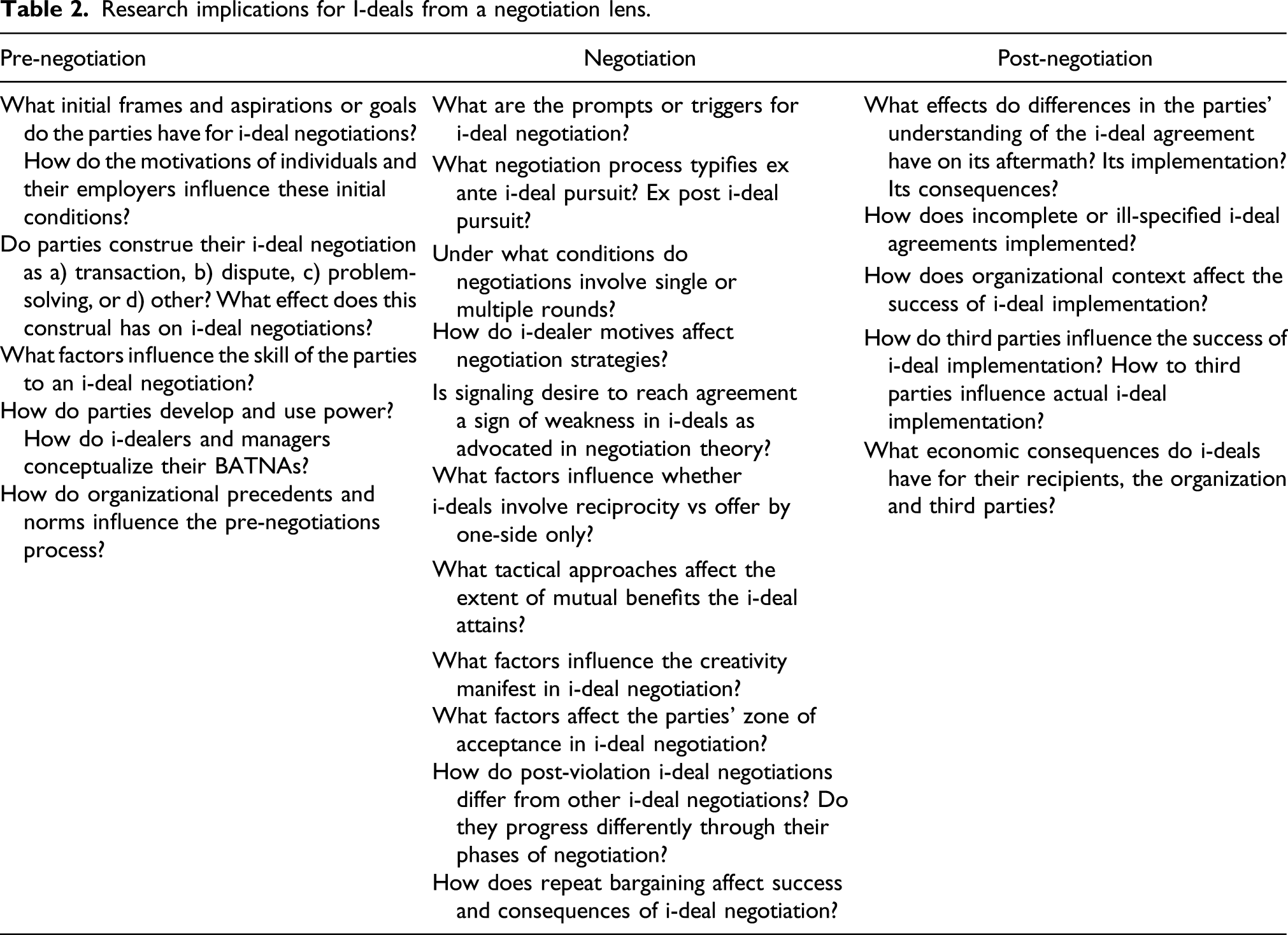
Pre-Negotiation (Preparation and Planning)
Integrating the negotiations literature into i-deals research directs attention to the cognitive and behavioral inputs that contribute to the i-deal negotiation process. In pre-negotiation, what initial frames and aspirations/goals do the parties have for i-deal negotiations? How do the motivations of individuals and their employers influence these initial conditions? Framing is informed by context and can change in the course of the i-deal negotiation. Negotiations over financial issues are more likely to be seen as zero-sum situations (i.e., fixed-pie frame where one’s gain is the other person’s loss). Other possible frames include a focus on present and future relationships or efforts to motivate deal acceptance, as in the case of i-deals framed as an “experiment” whose outcomes can be used to determine their future. How goals are set in i-deal negotiation is likely to depend on the motivations of the parties. Those motivated by their standing in comparison to others (either a “star” employee or one who has been treated poorly) are likely to have a goal with a comparative element (e.g., “I want more than what X has” or “I want what X has”). In contrast, solving a problem is less likely to be construed as comparative. Similarly, employers and their agents have their own goals regarding the specific employee (e.g., retention or motivation), tasks (e.g., getting a job done or keeping costs down), or concerns informed by the broader context (e.g., precedent setting). These goals in turn are expected to shape bargaining behavior. Little research exists on the initial goals of i-deal negotiators. Their likely importance in shaping i-deal negotiations and outcomes makes attention to goals important in i-deals research.
How do parties characterize or construe their negotiation? Do they think of it in terms of a transaction, dispute, problem-solving, or some other construal? What effects does this conceptualization have on i-deal negotiations? Cognitive construals reflect the mental categories or schema individuals apply to a situation (Schwarz, 2006). Transactional construals typically involve tit for tat exchange and can be emotionally cool, while disputes tend to be concerned with losses, the desire to win, and involve hot feelings. Whether participants adopt these construals or operate from a more relational view focused on mutual concern or problem-solving can be important to both the course of i-deal negotiation and its outcomes both socioemotional and economic. We have reason to expect that the timing of i-deals (prehire, on the job, or threatening to quit) influences whether the parties experience the negotiation as a transaction, a dispute, or some other construal, each prompting specific negotiation strategies and tactics.
What factors influence the skills the parties bring to i-deal negotiation? How do parties develop and use power? How do i-dealers and managers conceptualize their BATNAs? The negotiation skills of both the i-dealer and the employer’s agent can contribute to their plans for the negotiation, what they aspire to, and the behaviors they demonstrate during negotiation. Skills are also likely to influence how the i-deal negotiator seeks or acquires power prior to the negotiation as well as how that power is deployed during it. The power associated with organizational roles also contributes to the leverage exercised in i-deal negotiations (Rousseau et al., 2006). Hochschild (1997) noted that secretaries often were less successful in negotiating flexibility than were higher-level workers. Hierarchical relationships matter in organizational negotiations: when a manager bargains with an employee that manager may constrain the other party’s actions. Apart from negotiation power which tends to be position-based (i.e., authority derived from one’s hierarchical position or control over rewards), power can come from information, expertise, relationships, and available alternatives. The negotiation literature gives little attention to the hierarchical position of the principal parties (Jang et al., 2018), and more explicit attention to it in i-deals negotiation is warranted. We note that the BATNAs of i-dealers and their managers are largely unstudied—but to take into account the effects of power on i-deal creation, BATNA development needs to be better understood.
How do organizational precedents and norms influence the pre-negotiation process? Social networks and social information are likely to play a role in i-deal negotiation (e.g., Lai, et al., 2009), particularly in terms of information gathered prior to negotiation. Part of the information so conveyed involves past i-deals, evidence of feasibility, and normative beliefs regarding both customization and the acceptability of differential arrangements. Since i-deals are a potential source of HR innovations, precedents and norms also can contribute to their long-term consequences.
Negotiation Processes (Bargaining)
Given the known effects of information and relationships on negotiation processes (Greenhalgh & Chapman, 1998; Lewicki et al., 2010), we expect that the processes characterizing the largely economic ex ante i-deals are likely to differ from those involved in creating the more heterogenous ex post i-deals. We know that i-deals, especially ex post ones, are often negotiated in a nonlinear fashion, not a one-and-done meeting (e.g., Clark, 1999; Rousseau, 2005). This observation raises several questions. What are the prompts for i-deal negotiation? How important are signals from the leader regarding receptivity? Under what circumstances do accomplishments by the employee prompt the start of an i-deal negotiation?
As ex ante and ex post i-deals are differentiated in both their terms and their effects, a central question is what negotiation processes are associated with ex ante i-deals and how do these compare with ex post i-deals? This basic issue of differences in i-deal timing and context raises related questions: When and why does the i-deal negotiation process involve multiple rounds or just one? When are i-deal negotiations protracted and when are they of brief duration? Given that i-deals often arise in the context of an ongoing employment exchange, is signaling the desire to reach an agreement a weakness in i-deal creation (as it is considered in other forms of negotiation)?
How do i-dealer motives affect negotiation strategies? The different motives i-dealers have for negotiating them have implications for the strategies they pursue. Is an employee motivated by the desire for reciprocity or feelings of entitlement more resistant to yielding compared to a person with a problem-solving motivation? Is the latter more willing to seek a creative solution? To that end, does having inside knowledge as a current employer help or hurt the creativity manifested in a negotiated agreement?
What factors influence whether an i-deal involves reciprocity or a contribution by one-side only? I-deal negotiations differ in the extent to which both sides are expected to contribute to the agreement or there is merely acceptance or rejection of an offer. For example, i-deals negotiated when a worker threatens to quit often involve monetary conditions provided by the employer with little expectation of new contributions by the employee, whose response to the offer is the decision whether to remain or quit. Similarly, in the context of ex ante i-deals, workers who negotiate customized job titles, duties, or compensation packages granted by the employer need only decide whether to accept the offer without offering up any other performance conditions. On the other hand, a customized work arrangement may be negotiated as a request for reciprocity (“pay back”) based on an employee’s already high contributions or as an offer to “pay forward” when the worker commits to make a future contribution in exchange for the i-deal.
I-deals are likely to differ with respect to the level of give-and-take they involve. Developmental i-deals for example, typically involve a quid pro quo where the employee agrees to contribute in certain ways in order to gain the additional training or developmental opportunity. Flexibility and reduced workload i-deals need not necessarily require the employee to contribute in different ways, potentially emphasizing the continuity or prorating of current contributions. Perhaps the best example of an i-deal without a quid pro quo is the employee who threatens to quit unless he or she receives a raise, promotion, or other emolument. That employee typically offers nothing more in return except to remain with the organization. In i-deals, more than in negotiation research, attention is drawn to the nature of the resources exchanged, as a factor in their effects on the parties. Insights from negotiation research can help shed light on this dynamic by addressing questions like, “What tactical approaches should employees and supervisors use to ensure mutually beneficial agreements?” and “What tactical sequences are most likely to transition i-deal negotiations from requests for resources to creative solutions?”
What factors shape the zone of acceptance in i-deal negotiation? I-deal research has referred to a “zone of acceptance” (Rousseau, 2005) in terms of arrangements regarded as reasonable by each party. The zone of acceptance is important to i-deals negotiation, given their exceptional nature. Such agreements can prompt revision of what is considered acceptable, bending, or “remaking” the zone of acceptance so that an i-deal creates a new organizational norm. However, the factors shaping offer acceptability in the context of i-deals are not well understood. I-deals research can benefit from considering the vast research on job offer negotiations.
How do post-violation i-deal negotiations differ from other i-deal negotiations? Do they progress differently through phases of negotiation? Given that i-deals can involve disputes as in the case of a deal pursued as a remedy for psychological contract violation (Hornung et al., 2009), we know virtually nothing regarding how these deals are created and whether they parallel or differ in their negotiation processes. I-deals research can benefit from consideration of the dispute-resolving tactics of acknowledgment and apology in addition to the study of offers of tangible resources since the former are important to restorative justice (Lewicki, Polin & Lount, 2016).
Last, how does repeat bargaining affect the success and consequences of i-deal negotiation? As Liao et al.’s (2016) review identifies, there is no research on repeated bargaining in the context of i-deals. Whether subsequent bargaining involves similar terms taking the form of updates and revisions or involves separate pursuits of new and different resources, further bargaining activities by the individual with an i-deal can impact both the relationship with the employer as well as with third parties. A common concern for employers is the risk of employees using their personal leverage to repeatedly negotiate, typically for economic benefits (Greenberg et al., 2004). Third parties can be particularly resentful of repeat bargainers (Rousseau, 2005).
Post-Negotiation (Implementation or Negotiation Aftermath)
I-deals research is ripe for deeper investigation of how an i-deal agreement is implemented and managed after its creation. The negotiated agreement has been described as a psychological contract (Jang et al., 2018), that is, the belief a party holds regarding a mutual agreement between that party and another (Rousseau, 1995). A basic post-negotiation research question is as follows: What effects do differences in the parties’ understanding of the agreement have on its aftermath? Its implementation? Its consequences? I-deals are often not written down but emerge through oral agreement. How the parties interpret this agreement has considerable impact on actual implementation as well as the economic and socio-psychological benefits the parties enjoy. Attention to the understanding parties have regarding the terms and conditions of the i-deal and the extent to which these terms are mutually understood and implemented is critical to understanding the aftermath of i-deal negotiation.
Another basic question raised in this phase is how are incomplete or ill-specified i-deal agreements implemented? Due to their exceptional nature, there can be difficulty spelling out all the employment features that need to change as an i-deal is implemented. This inherent incompleteness means that the learning by doing occurs as the deal is implemented. The conditions that characterize these emergent experiences provide an opportunity to examine how new roles are made and practices emerge. New negotiations may emerge over time in response to issues that arise when i-deals are implemented. The process is likely to be iterative as employees try out their understanding of the newly agreed-upon schedule, tasks, or workload. Implementation gives rise to new information, yet i-deals research has paid little attention to the potential updating, revision, and even sunsetting of i-deals over time.
Conceptualizing the outcomes of negotiated agreements in the context of their multiple constituents and the broader situation is important in order to evaluate their effectiveness (Jang et al., 2018). I-deals raise several questions in response to the challenges of thoroughly evaluating their effects: How does organizational context affect the success of i-deal implementation? How do third parties influence the success of i-deal implementation? How do third parties influence actual i-deal implementation? I-deals research calls attention to the constituents of negotiated agreements on how their specific interests and information can affect response to an agreement particularly in its implementation phase. Contextual factors affecting implementation and outcomes include the quality of workplace relationships and the normative (or counter-normative) nature of the agreement, which can ease implementation or raise barriers as a function of congruence with organizational norms.
Finally, a distinct characteristic of negotiation research, its emphasis on maximizing economic outcomes for individuals and jointly for dyads, raises a fundamental question: What economic consequences do i-deals have for their recipients, the organization, and third parties? Successful i-deal negotiation need not mean an individual is economically better off. Dreher and Cox (2000) suggest that women may be underpaid relative to men due to their acceptance of nonstandard forms of flexibility in lieu of pay and advancement. I-deals research tends to focus on socio-psychological consequences leaving the economic impact of i-deal negotiation unexamined. Economic consequences for i-dealers, their coworkers, and employer can differ as a function of the nature of the i-deal—whether the agreement positions the individual favorably or unfavorably with respect to present and future economic opportunities. The individual, joint, and multiparty economic consequences of i-deals can engender issues of equity, fairness, and justice. In this context, we note that research in line with the agenda we suggest offers the added benefit of providing via the study of i-deals the opportunity for field studies on negotiation processes.
Conclusion
Insights from negotiation research offer a powerful avenue for better understanding the phenomenon of idiosyncratic deals in employment. I-deal negotiations are inherently organizational in nature, introducing issues of hierarchy, embedded relationships, and multilevel antecedents and consequences into the bargaining process and its phases. As scholars look inside the black box of i-deal negotiations, we anticipate learning much about the role of information, power, strategy, and tactics in efforts to create and manage i-deals. Last, taking a page from the negotiation research playbook, more comprehensive attention to the economic outcomes i-deals have can provide critical evidence regarding their role in advancing or undermining workplace equity and justice.
Footnotes
Declaration of Conflicting Interests
The author(s) declared no potential conflicts of interest with respect to the research, authorship, and/or publication of this article.
Funding
The author(s) received no financial support for the research, authorship, and/or publication of this article.

Associate Editor: Lucy Gilson