



Abstract
I-deals (that is, personalised, non-standard employment arrangements negotiated between employees and their employers) arise at different stages of the employment lifecycle. I-deals can vary by timing, such as those created before hire (ex-ante) versus after hire (ex-post). However, scholars have not fully considered the impact of the temporal context (environmental, social, economic, individual) on I-deals or how a range of organisational actors may respond to enabling/constraining conditions when creating I-deals. Our paper focuses on the under-explored issue of I-deals’ timing by applying the theoretical lens of institutional entrepreneurship (IE). Key IE concepts enable a more critical understanding of broader temporal context impacts and the role of various actors (I-dealers, organisational agents) in creating I-deals. Drawing on a multicase study of 3 Nigerian organisations (62 semi-structured interviews, including fieldnotes and organisation-specific documents), our data revealed that field-level conditions and actors’ social positions interact to highlight (i) several distinctive temporal contexts, (ii) with differential impacts on I-deals’ timing and subsequently (iii) organisational actors adopting a range of tactics in response to enabling/constraining conditions. Based on these findings, we offer a theoretical model that reconceptualises I-deals’ timing by specifically focusing on the invisible concept of time. Finally, we discuss our study’s implications for I-deal research and offer future research directions and recommendations for practice.
Introduction
An increasingly individualised employment relationship (Bal & Hornung, 2019) and the associated freedom to initiate/negotiate non-standard employment arrangements through I-deals (idiosyncratic deals) have generated considerable interest in contemporary organisational research (Rousseau, 2001; Simosi et al., 2021). Moreover, the business case for negotiating I-deals becomes even more compelling against the backdrop of recent labour market changes such as the rising popularity of alternative work arrangements (Dalton et al., 2021), greater uncertainty at work (Katou et al., 2020), as well as the impact of external shocks like COVID-19 across different employee groups (Aldossari & Chaudhry, 2020; Rudolph et al., 2021).
Similar to micro-level institutional theorising that highlights the role of individual actors in the reproduction and/or transformation of organisational practices (Thornton et al., 2012; Zucker & Schilke, 2019), I-deals offer employees an avenue to preserve, change or alter established organisational practices, with the support of employer agents who authorise such non-standard work arrangements to meet the needs of valued employees (Rousseau, 2005). Crucially, individual approaches to I-deals are likely to be distinctive, given variations in I-deals’ timing and the temporal context of the negotiated I-deal (Simosi et al., 2021). By I-deals’ timing, we refer to the moment, occasion or phase in the employment lifecycle when an individual, group or organisational agent initiates I-deals’ negotiations (Rousseau, 2005). The temporal context we conceptualise as multiple temporalities (including economic, psychological and social) that occur simultaneously when an observable organisational behaviour occurs, thereby illuminating the conditions shaping such behaviour (Johns, 2006; Lippmann & Aldrich, 2016; Sonnentag, 2012), including I-deals’ negotiation behaviour.
Extant literature’s treatment of the concept of I-deals’ timing specifically highlights two main time points: ex-ante (negotiation during hire) and ex-post (negotiation after hire) (Rousseau, 2001; Rousseau et al., 2009). However, beyond Rousseau’s (2005) consideration of distinctive I-deals’ timing, empirical investigations of I-deals’ timing have been limited. I-deal research has mainly focused on ex-post I-deals’ timing, specifically performance-based ex-post I-deals (Rosen et al., 2013). This restrictive approach has resulted in a linear, homogenous and predictable consideration of I-deals’ timing (Shipp & Jansen, 2021) within I-deal scholarship. Thus, we have a limited understanding of I-deals’ timing and even less of an appreciation of the role of the broader temporal context and actors operating within specific temporal contexts.
As noted earlier, we describe the temporal context as the multiple temporalities (environmental, social, economic, individual) surrounding any aspect of organisational behaviour, including I-deals. Temporal contexts can exist simultaneously in the past, present and future (Emirbayer & Mische, 1998) and can have numerous layers ranging from historical, economic, organisational and individual temporal contexts (Sonnentag, 2012). For example, the temporal context vis-à-vis I-deals’ creation may refer to the life stage of individuals (such as employees with childcare responsibilities), the nature of projects employees undertake, the composition of workgroups/teams, an organisation’s overall financial health, significant organisational changes (such as a merger or acquisition), organisational dynamics in specific industries/sectors, disruptive technology and the fluidity and mobility of labour in the external labour market or a global pandemic.
Crucially, the temporal context can enable and/or constrain I-deals’ creation through temporal conditions like the pandemic increasing employer willingness to grant I-deals (Rudolph et al., 2021) or industry dynamics limiting what can be negotiated. Furthermore, we simultaneously consider the temporal context from a macro (the settings where individuals, teams and firms operate) and micro (their constitutive parts) lens (House et al., 1995). An investigation of these under-considered temporal contexts and associated enabling/constraining conditions will facilitate a more nuanced understanding of how I-deals emerge. More importantly, focusing on distinctive temporal contexts facilitates an examination of the various mechanisms deployed by organisational actors at various points in their employment relationship during I-deal creation.
Therefore, a key research objective of this paper is to expand the extant conceptualisation of I-deals’ timing. Specifically, we explore broader temporal contextual conditions that shape the creation of I-deals as well as the range of time orientations of I-dealers (individuals who negotiate and/or obtain I-deals). Furthermore, we aim to investigate how different actors (principally, employees and organisational agents), during the process of I-deal creation, seek to preserve, adapt or alter existing organisational practices when facing enabling (such as a flexible organisational culture) or constraining (such as traditionally inclined employers/managers) conditions. We draw on the institutional entrepreneurship (IE) literature (Battilana et al., 2009; DiMaggio, 1988; Mutch, 2007) to understand the multiplicity of forces impacting the emergence of I-deals at specific time points and the agentic role of organisational actors in preserving, adapting or altering established organisational practices during I-deal creation.
This paper aims to answer two central questions:
In the following sections, after a brief overview of existing literature that elaborates on I-deals’ content and timing, we introduce IE literature and highlight its relevance as a theoretical backdrop for understanding I-deals’ creation. Next, we describe our methodological approach and outline our key findings, concluding with our main theoretical contributions, future research directions, limitations and implications for practice.
Theoretical Framing
I-deals are conceptualised as ‘voluntary personalized agreements of a non-standard nature negotiated between individual employees and their employers’ (Rousseau et al., 2006, p. 978) at distinct time points in the employment lifecycle. I-deals may involve opportunities to develop skills and competencies in line with personal career aspirations (known as developmental I-deals) (Guerrero et al., 2016), customisation of work hours and location to meet individual work and family demands (that is, flexibility I-deals) (Las Heras et al., 2017) or financial negotiations aimed at increasing employee satisfaction and commitment (financial I-deals) (Abdulsalam et al., 2021).
Extant literature has highlighted two main time points for I-deal negotiations: ex-ante (before hire) and ex-post (after hire) (Rousseau et al., 2009, 2016). Rousseau’s seminal work (Rousseau, 2005) elaborates on ex-post I-deals by distinguishing between I-deals negotiated/granted to employees based on their performance (performance-based ex-post I-deals) versus those negotiated/granted based on employer desire to retain high-performing, talented employees (retention-based ex-post I-deals). Crucially, Rousseau (2005) clarifies that while performance-based ex-post I-deals are often proactively initiated by employees who believe they offer unparalleled value to the employer, retention-based ex-post I-deals may either be initiated by the employee (based on threats) or initiated by the employer to retain valuable employees.
Employees’ progression through the employment lifecycle (from their entry into the organisation to their exit) signals additional subcategories whereby retention-based ex-post I-deals may be negotiated. We argue that I-deals’ timing can be expanded to consider resignation I-deals (created to retain employees intending to resign or after the resignation process has commenced) and retirement I-deals (created to retain older workers nearing retirement). Most significantly, the literature on boomerang employees (i.e. employees rehired after organisational exit) (Arnold et al., 2020; Shipp et al., 2014) has highlighted I-deals that may emerge when a former employee is rehired. Rehiring I-deals (occurring ex-post/ex-ante) highlight an additional I-deals’ timing that needs to be considered in more detail. Figure 1 highlights all the potential time points for I-deals’ negotiations, as well as the stakeholders most likely to initiate the deal. This more expansive consideration of I-deals’ timing, in turn, highlights distinctive temporal contexts that impact I-deals’ creation and organisational actors’ response to these temporal contexts. A conceptual expansion of I-deals’ timing through the employment lifecycle.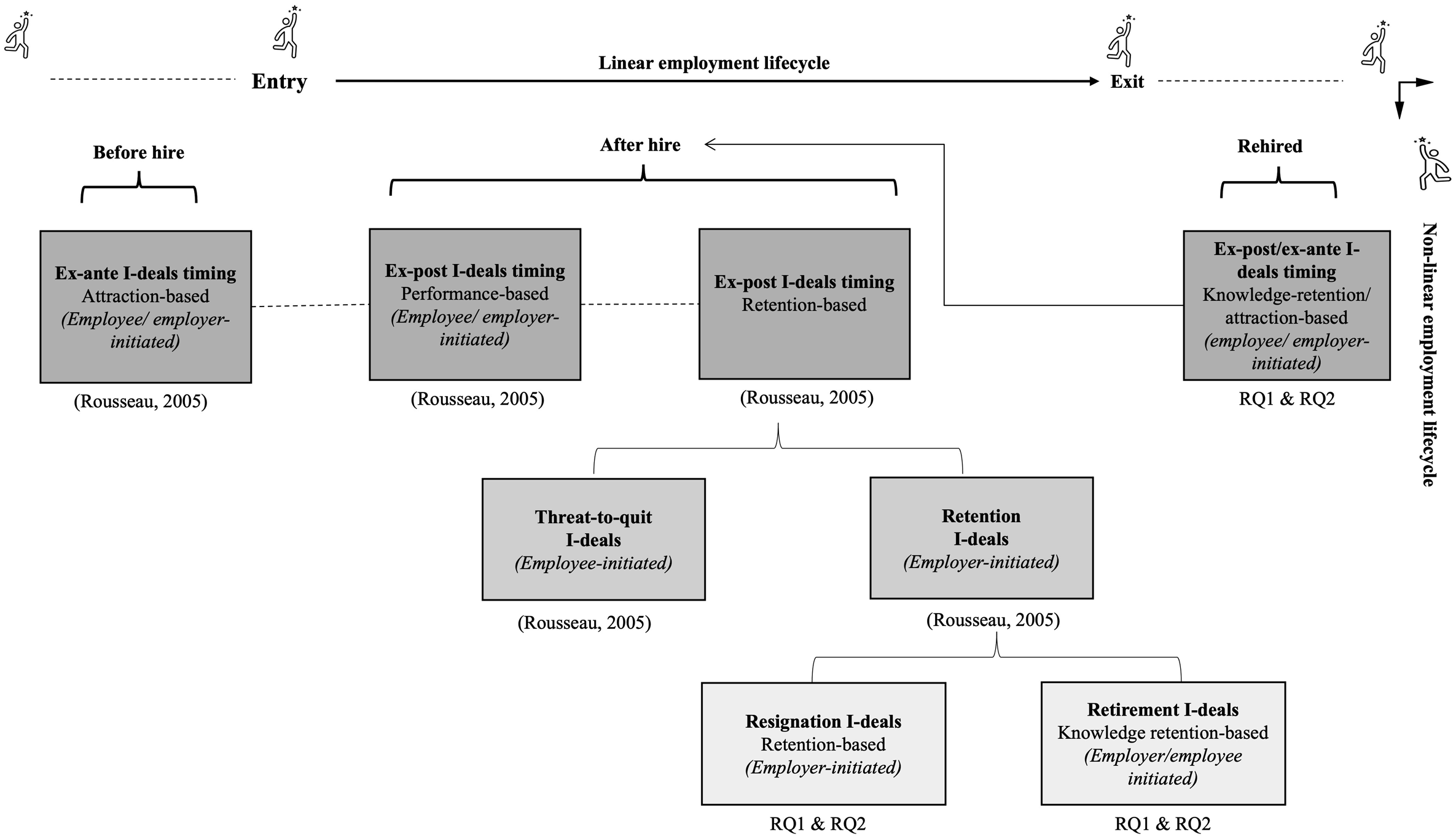
To date, there has been limited empirical investigation of I-deals’ timing specifically. Few studies considering I-deals’ timing predominantly adopt the social exchange theory (SET) lens (Blau, 1964; Shore & Barksdale, 1998), where the employment relationship is conceptualised as an exchange relationship in which I-deals’ timing signals the nature of the employment relationship (as an economic exchange with low mutual obligations or a relational exchange with high mutual obligations) (Katou et al., 2020; Rousseau et al., 2009). However, while SET explains employee attributions about I-deals’ timing, crucially, it does not explain the broader temporal context against which I-deals emerge or actors’ response to enabling and/or constraining temporal conditions during I-deals’ creation.
Timing within organisations can be viewed as ‘a process of temporal structuring where people (re)produce (and occasionally change) temporal structures to orient their ongoing activities’ (Orlikowski & Yates, 2002, p. 685). During this ‘temporal structuring’, individuals may capitalise on opportunities created through the recognition of a problem (Tyre et al., 2016) or the introduction of a new process or policy (Greer, 2015) to negotiate I-deals. However, while extant literature acknowledges how I-deals’ timing can impact actor experience of I-deals (Rousseau et al., 2009), no studies, to date, have explored how the broader temporal context impacts I-deals’ creation and, crucially, the role of organisational actors in negotiating I-deals. We draw on the theory of IE to frame these research gaps.
I-deals Through the Lens of Institutional Entrepreneurship (IE)
IE literature is a micro-institutional research area (Zucker & Schilke, 2019) that focuses on how institutional entrepreneurs (that is, actors) deploy strategic resources or pursue courses of action that enable change that alters established organisational practices (DiMaggio, 1988; Mutch, 2007). Although institutional entrepreneurs may also seek to preserve institutions (Greenwood & Suddaby, 2006), however, Mutch (2007) suggests that by pursuing nonconforming options, institutional entrepreneurs often unintentionally set in motion events that lead to change. Below, we will argue that IE literature is suitable for studying I-deals, specifically I-deals’ timing, because it can help to explain why and how specific temporal contexts enable or constrain agentic behaviour vis-à-vis I-deals’ creation.
IE literature conceptualises change as the emergence of new practices and/or the intentional or unintentional dismantling of existing practices (Hardy & Maguire, 2017). Such changes may be moderate (Reay et al., 2006), incremental (Hardy & Maguire, 2017) or radical (such as when individually-negotiated I-deals lead to broader HR policy changes) (Rousseau et al., 2006; Tuan, 2016). Therefore, in this paper, we take an expansive approach to change by investigating how actors, when seeking non-standard arrangements through I-deals, may preserve, alter or dismantle established organisational practices. These actors may be individual employees, groups and/or supervisors/managers (Ren & Jackson, 2020). Crucially, they possess either key strategic resources and/or occupy power positions (Garud et al., 2007), which may induce other actors to engage in activities that lead to change.
IE literature is a theoretically relevant lens to study I-deals’ creation since these negotiations are inherently power-centred, whereby actors involved in the process are either successfully able to negotiate or offer I-deals (Kim et al., 2005). Specifically, IE’s consideration of the ‘paradox of embedded agency’ (Seo & Creed, 2002) can be applied to the study of I-deals’ timing. The paradox questions how individuals embedded within institutional environments (which regulate, constrain and mould their interests/actions/identities) can alter these institutions (Garud et al., 2007; Holm, 1995; Seo & Creed, 2002). Therefore, with respect to I-deals, existing employees may be more or less likely to negotiate I-deals because their very embeddedness within the organisation informs their understanding of what actions are perceived as natural and legitimate (Bal, 2017a; Rousseau, 2005).
However, while high levels of institutional embeddedness may limit agents’ alteration of existing practices (Greenwood & Suddaby, 2006), a consideration of the broader temporal context highlights that resource-rich agents have the power to pursue individual interests (such as alternative working arrangements) irrespective of this embeddedness (DiMaggio, 1988; Hardy & Maguire, 2017). Access to power and resources may be tied to agents’ control over the use of their labour, the possession of valuable market knowledge and the self-knowledge of being in a position to negotiate (Bal & Hornung, 2019; Rousseau, 2005).
IE literature offers two key concepts that help unpack the impact of the temporal context on I-deals’ timing and the agency of I-dealers: ‘field-level conditions’ and ‘actors’ social positions’. Field-level conditions represent the multiple contextual layers that impact organisational life (Greenwood & Suddaby, 2006; Holm, 1995). They may be externally driven by exogenous jolts (such as demographic changes, political unrest, technological disruption and presence/absence of social infrastructures) that create opportunities for change (Forbes et al., 2020; Sine & David, 2003). For instance, the recent pandemic is an external field-level condition that created a need for customised, flexible work arrangements (Rudolph et al., 2021) – generating opportunities for both employees and employers to negotiate I-deals (Forbes et al., 2020). Heterogeneity in norms and practices across industries (Battilana et al., 2009; Seo & Creed, 2002) is another external field-level condition. For example, IE literature highlights that high regulatory pressures at the industry level may restrict managerial autonomy and encourage employee compliance, thereby limiting I-deals’ creation. Conversely, a more flexible external environment allows more fluidity in norms and practices, encouraging I-deals’ creation at multiple time points in the employment relationship (Chuang et al., 2013; DiMaggio, 1988).
Internally driven field-level conditions are represented by the degree of institutionalisation, that is, (i) the degree to which specific practices are taken for granted by organisational actors (Seo & Creed, 2002) and (ii) the presence of distinctive organisational characteristics (such as reputation, culture, age, size, processes, structure and profit orientation) (Battilana, 2006; Baum & Oliver, 1991). Internal field-level conditions are also likely to impact I-deals’ timing. For example, larger, more bureaucratic organisations may discourage I-deals ex-ante or ex-post because of well-established organisational policies. However, smaller organisations with greater flexibility may encourage I-deals across various time points (Atkinson & Sandiford, 2016). Therefore, both internal and external field-level conditions impact I-deals’ timing by acting as enablers or constraints.
However, actors’ ability to negotiate I-deals in the face of enabling field-level conditions is likely impacted by their social positions (Battilana et al., 2009). Actors’ social positions refer to the ‘situatedness of actors in multiple and temporally evolving structural contexts’ (Emirbayer & Mische, 1998, p. 969); internally (such as hierarchies, networks and groups) or externally oriented membership (such as professional or regulatory bodies) (Bal, 2017a; Guerrero & Challiol-Jeanblanc, 2017; Rousseau, 2001). The social position of actors shapes their perception of the field (that is, the organisation/industry) and crucially impacts their access to resources such as links with powerful organisational actors who can help negotiate I-deals (Battilana, 2011; Bourdieu, 1988; Wacquant, 1989).
For example, high-potential employees may have easier access to powerful organisational actors and greater opportunities to negotiate I-deals at specific time points in their employment journey (that is, ex-post after hire and ex-post resignation) because of their talent status, compared to employees not classified as key talent (Çalışkan & Torun, 2019). Similarly, potential hires with recognised professional/occupational status (such as chartered accountants, chartered HR professionals and project managers) may capitalise on their externally recognised professional credentials and expertise to negotiate financial rewards/benefits ex-ante (Albert, 2017).
Furthermore, an actor’s position within the organisation (such as hierarchical position or employment within a specific project team or department) can also shape actors’ negotiation of I-deals at different time points. For instance, a more senior hierarchical position may confer legitimacy on individuals, enabling I-deals’ creation, while a lower/junior hierarchical position may constrain an individual’s ability to deviate from organisational norms. However, lower-placed actors may seek to enhance their legitimacy by seeking support from actors in higher social positions (Battilana et al., 2009).
Interestingly, actors in higher hierarchical positions are more likely to preserve established organisational practices rather than subvert them (Wacquant, 1989). Therefore, the social position of organisational actors has significant time implications, impacting both actors’ negotiation of I-deals (by capitalising on their position or aligning themselves with their seniors) as well as granting of I-deals (such as senior members rejecting I-deals to preserve status quo). However, while some scholars present field-level conditions and actor’s social positions as mutually exclusive (Abdelnour et al., 2017; Sine & David, 2003), Battilana et al. (2009) argue that field-level conditions and actors’ social positions can function contemporaneously, creating opportunities for agency and subsequently for actions leading to I-deals. In our discussion of IE literature (DiMaggio, 1988; Holm, 1995), we unpack how key theoretical concepts such as field-level conditions and actors’ social positions can impact the temporal context of I-deals (Battilana, 2011; Seo & Creed, 2002). Our theoretical bricolage of IE and I-deal literatures enables us to tackle two research gaps: (i) an exploration of the temporal context of I-deals and (ii) actor responses to the enabling and constraining conditions that impact I-deals’ creation.
Methodology
Given our research focus, we adopt an interpretivist framework, particularly suited to observing micro and macro temporal contexts (that is, individual, economical, organisational, socio-institutional and historical) across which I-deals are enacted as well as reflexively capturing participants’ subjective experiences within these contexts (Lincoln et al., 2018). Moreover, temporally situated phenomena like I-deals require a framework sensitive to individuals’ construction of multiple realities at different times (such as negotiating I-deals at different times in the employment lifecycle) and the subsequent implications for actor interactions (that is, the impact of I-deals on those actively initiating as well as those passively experiencing I-deals) (Patton, 2002). In line with recent calls for qualitative work in I-deal research (Liao et al., 2016), a qualitative multicase approach was adopted to observe the similarities, differences and contextual complexities (Stake, 2006) shaping I-deals’ timing across cases.
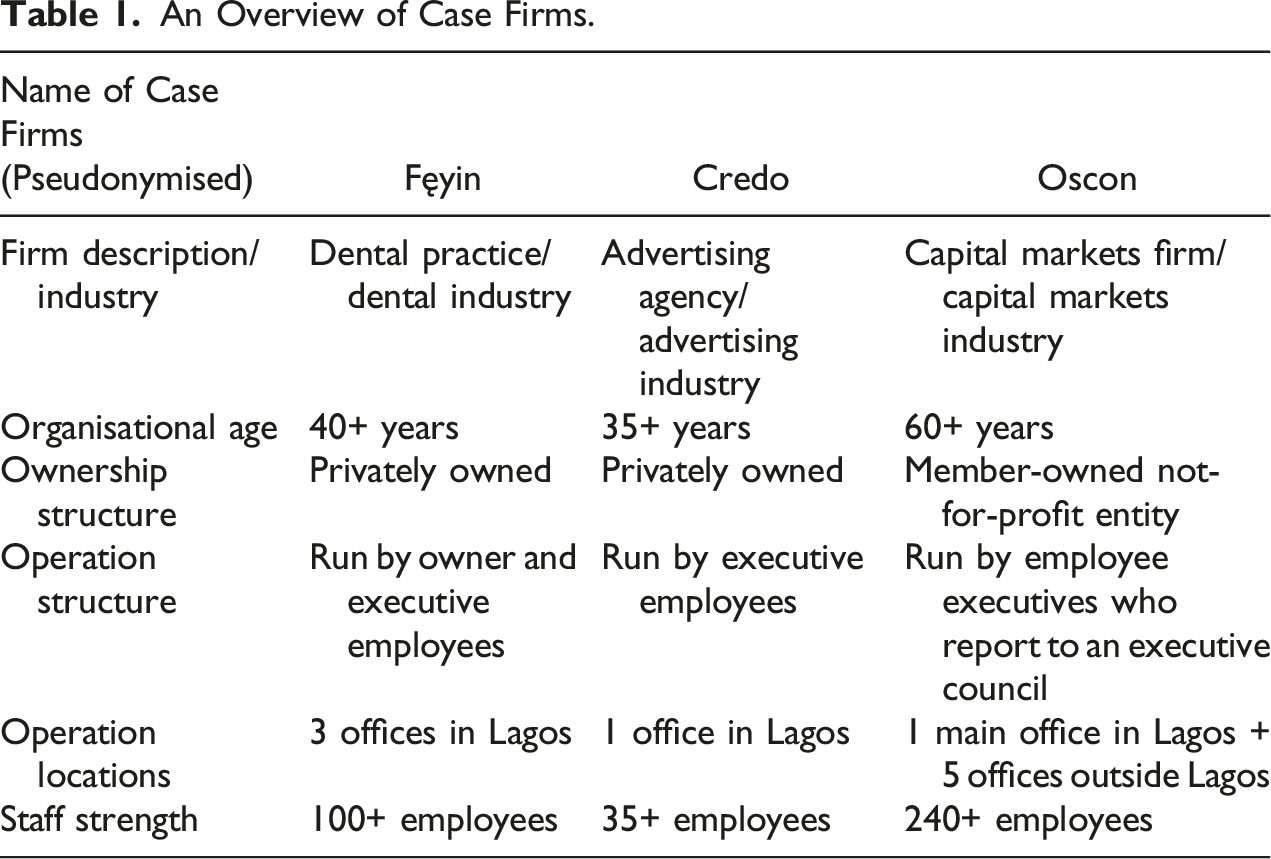
We offer empirical evidence from three organisations operating in Lagos, Nigeria; a particularly significant setting for I-deal research given its reputation as a hub for highly skilled, well-educated, highly mobile employees with considerable market power (da Costa, 2019), simultaneously experiencing outward migration of skilled and highly educated talent (Imafidon, 2018). The local context is also characterised by incessant traffic bottlenecks, declining social infrastructures (including failing healthcare systems, poor power supply, high insecurity and transportation systems) and high inflation rates (Fajana et al., 2011).
An Overview of Case Firms.
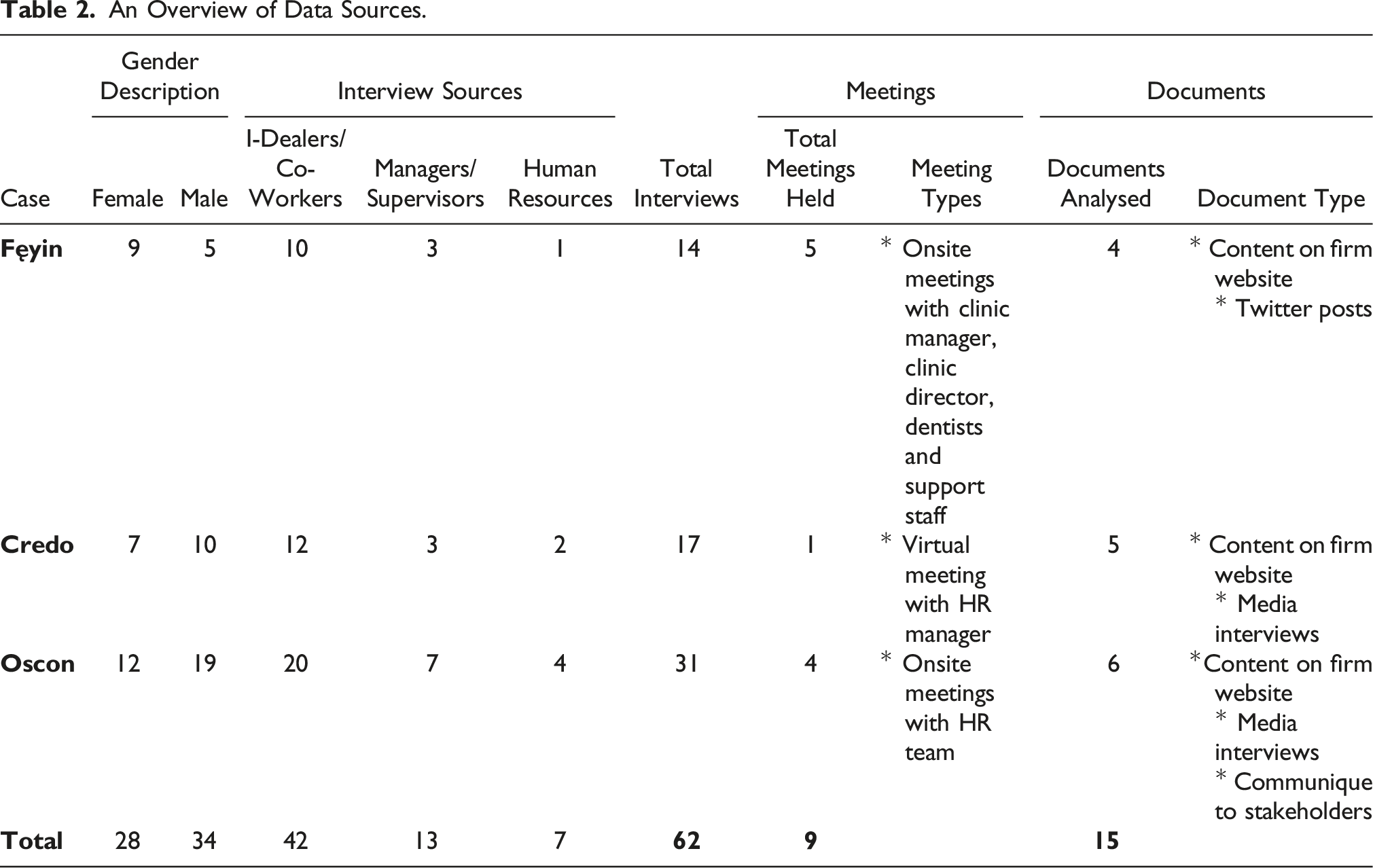
Utilising Patton’s (2002) matrix of questions, we designed interview guides to investigate participants’ opinions, experiences, feelings, values, knowledge and actions regarding I-deals in the past, present and future, thus accounting for the role of actors’ social positioning each time an I-deal was negotiated. Interview guides were created for 3 distinct participant categories: I-dealers/Co-workers, Line Managers/Supervisors and Human Resources Managers, to generate rich and nuanced evidence from a range of organisational actors likely to be impacted by I-deals (see appendix 2). Given the paucity of research on I-deals in the Nigerian context, we initially conducted 5 pilot employee-level and organisational-level interviews across 4 different firms. Doing this sensitised us to the value of including vignettes in describing I-deals to our participants (Barter & Renold, 1999). Data collection lasted 10 months (January–October 2020). To generate a diversity of opinions (Stake, 2003, 2006), a technique analogous to triangulation (Fearon et al., 2021) but epistemologically closer to crystallisation (Ellingson, 2009), we incorporated multiple genres of data sources, including semi-structured interviews (in-person and virtual), in-person meetings, non-participant observations and analysis of publicly available organisational documents.
Potential participants for interviews were initially identified via their organisation’s LinkedIn pages based on their work function, supervisory role, tenure and gender and cross-checked with our HR gatekeepers. Given our focus on I-deals’ timing, it was essential to include participants who were likely to have negotiated at the time of hire/ex-ante, after hire/ex-post, during/after resignation, before retirement and/or when rehired. Therefore, we specifically requested interviews with employees of varying tenures (from 6 months to 15 years and over) and across different hierarchical levels (that is, entry-, mid- and senior-level management). Additional information such as age, care responsibilities and parental status were also collected to understand the impact of these demographic attributes on the individual temporal context and consequently on the emergence of I-deals.
An Overview of Data Sources.
Data Analysis
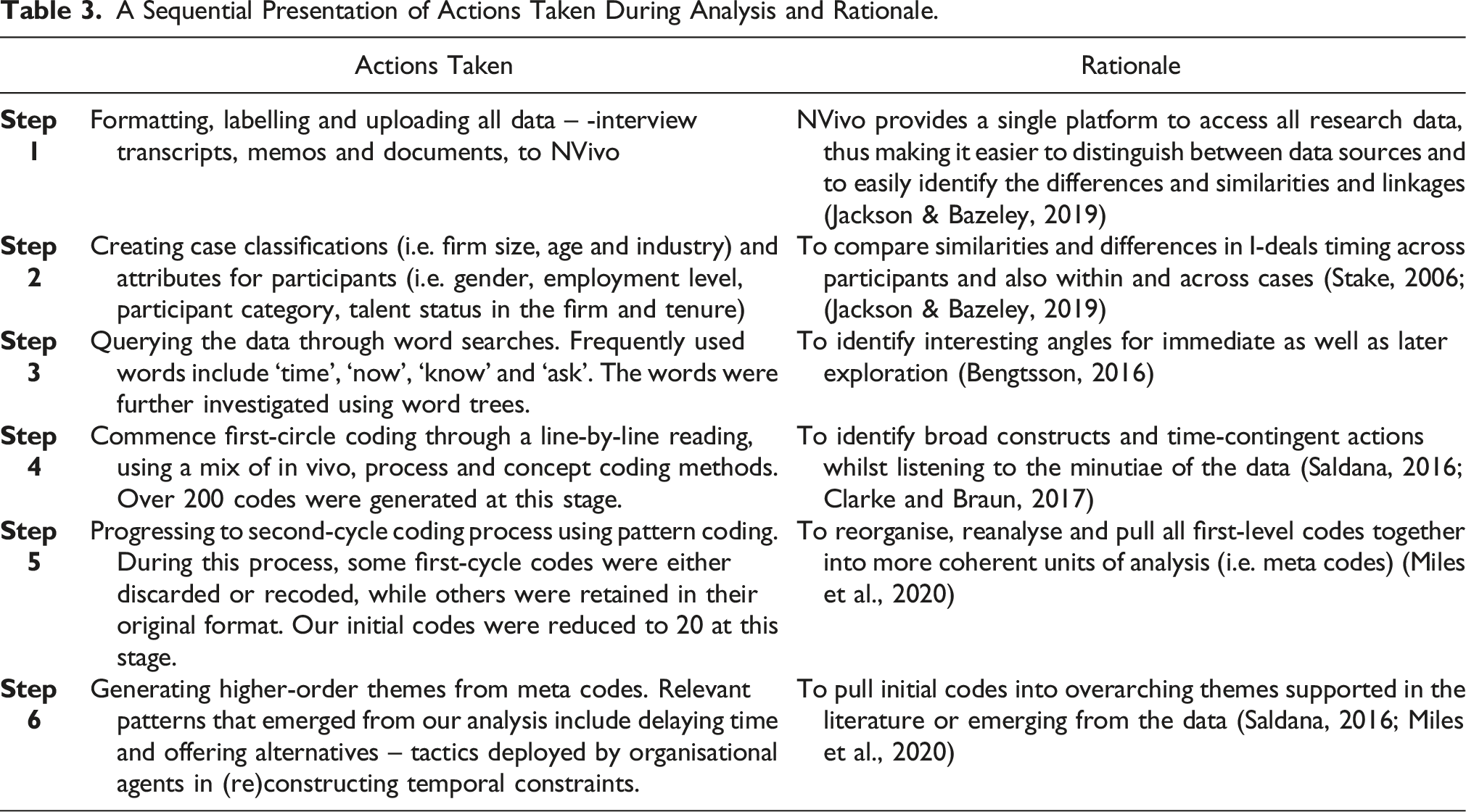
A Sequential Presentation of Actions Taken During Analysis and Rationale.
An Overview of Codes and Illustrative Quotes.

Findings
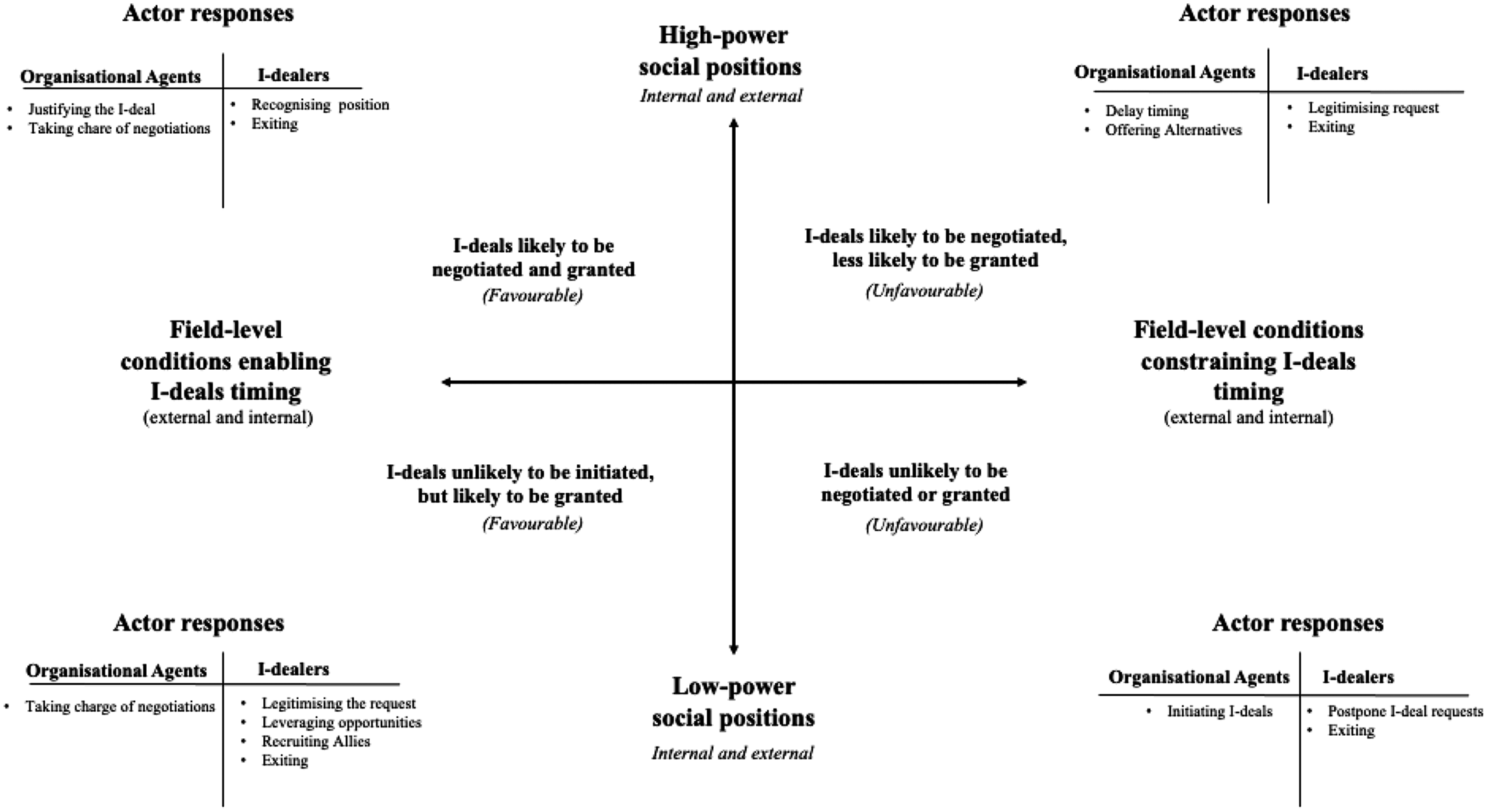
This section highlights two predominant themes emerging from our data analysis: (i) I-deals emerge based on field-level conditions and actors’ social positions, which in turn impact I-deals’ creation across four distinct temporal context typologies (RQ1) and (ii) organisational actors adopt a range of tactics during the process of I-deal creation, contingent on enabling and constraining conditions (RQ2). Based on these findings, we offer a theoretical model (see Figure 2) to illustrate the interactions between field-level conditions and actors’ social positions and actors’ responses to different temporal context typologies (see Figure 3). A typology of temporal contexts impacting I-deals’ timing. Actors’ responses to typologies of temporal contexts.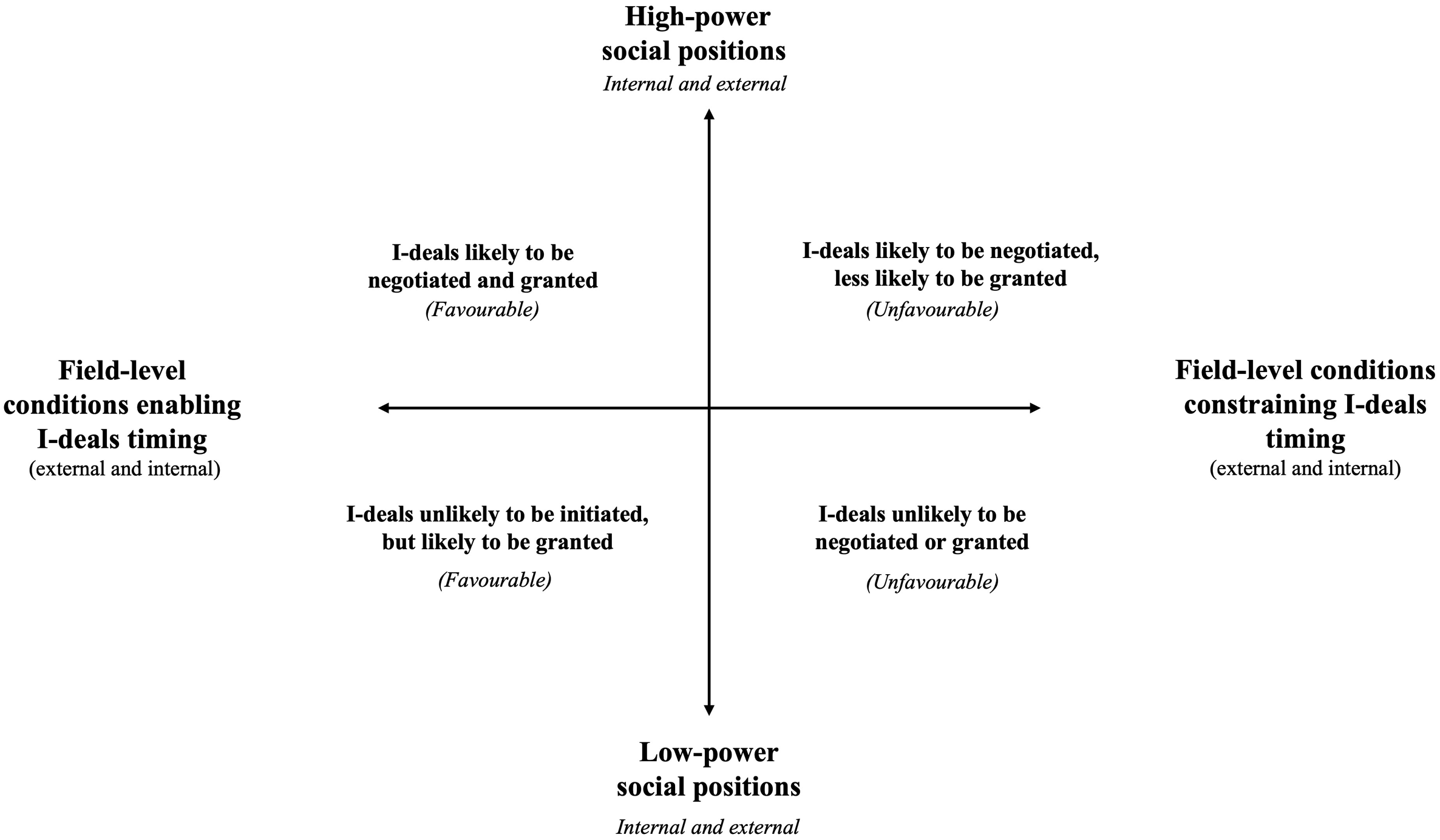
Impact of Field-Level Conditions on I-deals’ Timing
Our findings identified a range of field-level conditions impacting I-deals’ timing in all three firms. For example, a range of external jolts created a favourable temporal context for I-deals, principally ‘migration’ of skilled talent and associated talent shortages in external and internal labour markets …it started from 2016 when we began to experience as an organisation, (and) as a country …a lot of employees leaving organisations, going abroad. At Oscon, we experienced a lot of flights. So obviously, we had to look inwards, and we had to change the way we were going about things…we have tried as much as possible to be more accommodating in terms of people coming in and the requests they’re making…
Therefore, talent scarcity (as a result of brain drain) was a key field-level condition inducing the organisation to accommodate ex-ante I-deals requests rather than applying standardised practices for all employee categories during the hiring processes. Incessant traffic congestion was another field-level condition that impacted I-deals’ timing across all three cases due to the geographical location. For example, two participants at Credo (an I-dealer and HR Manager) shared their perspectives on how an ex-post threat-to-quit I-deal emerged as a result of the traffic situation: …the traffic situation was very amazing (chuckles). I'll find that I'm on the way for like 3 hours. And then I get… to my daughter’s school, (and) she’s the only one left there. It was emotionally disturbing for me. I wasn't happy. Even though I loved my job, I didn't like the hours… It was a case of ‘I'm going to resign if this is going to continue… …I have someone who is one of our A players. She has a toddler who (finishes) by 4 o'clock… and there's nobody at home. She came to me to say (I want to resign). I said, can't you close at 3 pm so that your daughter will get home (when you get home?)…She says…I can even leave at 4 pm….I said so why are you resigning? You're just leaving an hour earlier than the closing time. I think it's fair…
The threat-to-quit I-deals’ timing example given above was a particularly salient finding as it ran contrary to extant conceptualisations of threat-to-quit I-deals in the literature – typically initiated by employees capitalising on alternative employment and focused on requesting either higher pay or promotion (Rousseau et al., 2016). In this instance, a threat-to-quit I-deal was tied to jolts in the external environment and involved flexibility content initiated by the employer.
Jolts created by the pandemic also created favourable conditions for I-deals’ timing. However, perceptions around COVID-19 being favourable for I-deals’ timing were more predominant at Credo and less so at Oscon and Fęyin. For example, when asked about how COVID-19 may impact future I-deals requests, participants at Credo and Fęyin noted: …So, before the lockdown, some people have certain arrangements, but I think now, more people will come forward, and the organisation will be willing to make arrangements with people as long as the KPIs… are met… …With Covid-19 comes fear, and with fear, you'll want to enter into your shell. So, I expect more rigidity…
We attribute these contrasting findings to differences in industry norms. For instance, a large section of participants alluded to how certain industry norms resulted in very different idiosyncratic arrangements at Oscon and Credo: … I think that’s one thing that is not good in the industry. You can have three people at the same level, but they're earning different salaries. Different packages. And they're doing the same (job, both in the same position. So those feelings don't always go down well… …you will find that financial services are perhaps the most ruthless when it comes to going outside what would be considered best practice [such as ensuring equal treatment for all], especially where human capital management is concerned…
However, our findings suggest that I-deals were less likely to emerge when broader industry practices discouraged agentic behaviour. For instance, a large section of participants at Fęyin attributed employee reluctance to negotiate, as well as organisational aversion to granting I-deals, to norms in the medical profession which discouraged deviation from established practices: …the medical profession in Nigeria…is regimented. It's like the military. You know who your superiors are by your year of graduation… and you defer to that person. So, you find that a lot of people coming in, they're already…disadvantaged when it comes to bargaining… or a little bit disempowered… The average junior doctor will not readily come to you and say, "I should be getting more pay’… because they expect you to be fair to them…
Nevertheless, some interesting variations emerged with respect to external field-level conditions. First, there were some instances of employers/managers initiating I-deals ex-post after an employee ‘sends in (their) resignation letter’ …I asked not to work on Sundays and asked about vacation. I wanted to be able to take any time I wanted in a year. And they told me, "Yeah, you can do that because as long as you are not working, you are not getting paid…
Similarly, a new hire at Oscon who had been headhunted to lead a newly established technology department was also able to negotiate an ex-ante I-deal that contravened the standard dress code policy. Oscon instituted a strict and formal dress-code policy for all employees: …we all have to wear ties…(however) there’s a department that doesn't wear ties. When…the Head of (the department) …was coming in… … he negotiated in his contract that he didn't have to wear ties…Whenever we see them, we know they are the exception…
These findings suggest that industry norms can create unique field-level conditions and that incumbent employees’ embeddedness in specific temporal contexts may contribute to their propensity to initiate I-deals as well as organisational agents’ willingness to grant I-deals. Our findings also demonstrate that the degree to which a firm conforms with external institutional arrangements (such as high formality in the financial sector) may be circumvented by individual employees’ exposure to different institutional arrangements (such as low formality in the tech industry), which in turn creates opportunities for I-deals to emerge, particularly during the hiring stage.
A range of internal organisational characteristics such as levels of flexibility, poor pay, delayed promotions, firm culture and degree of financial stability also created opportunities for I-deals to emerge across all three cases. At Credo, ‘loss of revenue’ (News archive, 2021, Credo) created an atmosphere for problem-solving wherein employers/managers encouraged individual employees to seek out I-deals ex-post to engage in ‘side hustles’ …they’ve come to us to say…let us know what you're doing. If It's something we think is very profitable or we see potential in it, we can invest and it’s a win-win for us…I have a friend that is a writer and is into music. He loves music. He actually turned down an offer from another agency and stayed with Credo because they allowed him to take a day off to pursue his music…
Furthermore, the impact of organisational culture as an internal field-level condition on I-deals’ timing was also visible in all three cases. For example, the firm culture in Credo, which participants described as ‘very flexible’
Interactions of Field-Level Condition and Actors’ Social Positions: Impact on I-deals’ Timing
Critical to our research question on how temporal contexts impact I-deals’ timing is the idea that favourable field-level conditions on their own do not guarantee I-deal creation. Therefore, while field-level conditions may create enabling conditions for I-deals, our findings suggest that not all organisational actors explore or can benefit from these enabling field-level conditions, for ultimately, the social positions of individual employees (such as their position in the organisational hierarchy) can impact employers’ willingness to grant I-deals and the success of I-deal requests as the following quote reveals: …When I made that request that "Oh please, can I leave (the office) by 5:00 pm so that I can get home on time?" That request was turned down. (They were like)"oh, your seniors are here. They're doing it… You have to wait till that time…they've paid their dues…you too have to pay your dues'…
Crucially, employees in high-power social positions were more successful in negotiating I-deals, particularly under favourable field-level conditions. For example, a participant shared how being in a powerful social position helped her successfully negotiate a threat to quit I-deal: …this is what these guys are offering me. If you want me to stay, can you at least make sure that you train us like this and like this? Let everybody get access to a certain number of training. And then, I’m not saying match up to salary, but at least, just give me something good for effort for staying (chuckles). So, they did that, and they sent a lot of people on training, so, I stayed back. Yeah…I’ve been a recipient
Interestingly, the participant had leveraged a powerful social position not only to negotiate increased pay for herself, but also to negotiate a development I-deal content (training) for team members. This example underscores that occupying powerful social positions also creates opportunities for I-dealers to negotiate for others in less powerful positions. Crucially, being in a powerful social position can also create opportunities for I-dealers to introduce specific I-deals contents that have never been granted before, thereby paving the way for others to receive such accommodations in the future, either as I-deals or as a standardised benefit for all. For example, an employee who requested a company-sponsored break to pursue a one-year fellowship programme noted how her I-deal paved the way for others: …I was the first one to go on something like this. And I think it took three years. There was never a policy that allowed for these kinds of things. My going did set a precedence (because) someone else has gone after me……because before then, it never happened…
This quote illustrates how high-power social positions interact with field-level conditions to create opportunities for I-dealers to become agents of change. Our findings also reveal that actors’ previous positions within a firm and/or positions in other organisations, in conjunction with broader industry knowledge/experience, can coalesce to create an opportune timing for ex-post/ex-ante rehiring I-deals: …I left to work for a company for about a year and a half. And then, the role that I was reporting to previously was vacant. They approached me to take up this new role… The role that I was going to take up was (called) the client service director role, and I said no. I refused to accept the title…. I said change that to…business director …So, that did happen…Our industry is such that (titles matter
Social positions may also be linked to employee performance, whereby employers/managers are induced to offer I-deals to high-performers, although field-level conditions such as organisational characteristics/processes may constrain I-deals. For instance, despite high standardisation across the industry, which impeded employees’ initiation of I-deals at Fęyin, we found instances of employer-initiated ex-post I-deals arising from field-level conditions (poor pay) and actors’ social position (recognition as a high performer): …I've had the privilege of my salary being increased in a way that’s not generalised… It was actually initiated by the MD (managing director). So, there are cases like that based on productivity…When everybody was due (for a pay increase), I (again) got the privilege. Management could not really say ‘because he just recently got this special arrangement from the director, let’s (exclude) him’…(so) I still benefited from the general increment (as well)…
Our findings show that actors in less powerful social positions can also take actions resulting in the emergence of I-deals. Such actions may involve exiting the organisation without threats, thereby creating a space for other organisational actors (that is, co-workers and organisational agents) to initiate I-deals on their behalf, particularly with respect to ex-post resignation I-deals. As our expanded framework for I-deals’ timing suggests (see figure 1), I-deals may also emerge after an employee resigns. Evidence from our data reveals that ex-post resignation I-deals’ timing may arise when high-performing incumbent employees announce impending resignation, during the resignation notice or after the resignation notice is observed. Crucially, ex-post resignation I-deals emerged without threats: …the second time, I resigned. This time around, I had left. But my fellow employees, my fellow teammates, were making a case for me. They say this is the guy that understands the brand…that nurtures the brand. You can't let him go… It was when I was called back that they were telling me this. And the MD was compelled to make an increase-an offer for me…’
Therefore, our findings demonstrate that actors’ social positions both within and outside their organisation (Emirbayer & Mische, 1998), such as their position in a talent pool, position in specific work teams or professional/occupational status, interact with enabling and constraining field-level conditions to impact I-deals’ timing (see figure 2).
Actors’ Responses to the Temporal Context
Our findings highlight that organisational actors do not necessarily experience the temporal context, and associated enabling or constraining conditions, passively. Instead, they proactively adopt tactics allowed by both field-level conditions as well as their respective power positions (see Figure 3) (Orlikowski & Yates, 2002). At the employee level of analysis, we identified five key tactics: (i) recognising position, (ii) leveraging opportunities, (iii) legitimating requests, (iv) recruiting allies and (v) exiting the firm. At the employer/manager level of analysis, key tactics include (i) justifying the I-deal, (ii) delaying timing, (iii) suggesting alternatives, (iv) taking charge of negotiations or (v) initiating I-deals.
Individual Employee Responses to the Temporal Context
Recognising Position
Recognition of social positions was a prominent finding in our data whereby individual employees capitalised on their position(s) of advantage or deployed resources to negotiate I-deals. Our findings suggest that recognising position tactic may be a more effective strategic option when field-level conditions are favourable and I-dealers are in powerful social positions. For example, a participant at Credo shares how her organisational position facilitated an ex-ante I-deal whereby she could leave work at a specific hour. This was a unique request, given that advertising agencies typically work long hours. There’s a word we use in agencies. We say poached. It wasn’t that I was applying and saying oh (employ me). It was a case of look, we’ve heard that you’re good, so please come to our agency. (
Leveraging Opportunities
Another tactic individual employees adopted to counter temporal constraints was what we labelled leveraging opportunities. Leveraging opportunities involved information gathering, pre-empting outcomes and looking out for potential I-deal opportunities. Furthermore, our findings suggest that leveraging opportunities may be a preferred strategy for I-dealers in less powerful social positions who perceive enabling conditions. For example, a participant leveraged an opportunity created unintentionally when a co-worker shared their intention of seeking a financial I-deal from the organisation to support the cost of a professional examination: … somebody just said it in passing that, ‘I (could) tell management to support this programme…’ The person did not go ahead to tell management. I said let me try it. …The next thing I did was to go meet HR to say, ‘please sir, I need you to support (this). I want to become an associate member of APCON. However, I don't have the money to pay for induction… And lo and behold…they approved the money for me…Till today, he (co-worker) …does not know he was the one that helped me accomplish that feat 5 years ago…
Furthermore, in situations when field-level conditions such as firm culture constrained I-deals, employees in more powerful social positions created opportunities for I-deals by taking proactive steps towards understanding what may be potentially negotiable: ‘generally, it is usually the guys who have stayed longer that know what to ask, how to ask and when to ask… You have to understand the structure before you start jumping to it’
Legitimising the Request
When proactively negotiating, employees sometimes needed to carefully frame requests to enhance their legitimacy by highlighting what organisational agents consider legitimate, referencing I-deals received by co-workers or emphasising loyalty through tenure as revealed by a participant: …I used the years I had worked here as my-. That was my upper hand, really. Other people that came in were newer to the department…
Recruiting Allies
Recruiting allies may involve enlisting the support of organisational actors in vantage positions – a strategic option for potential I-dealers in less powerful social positions who perceive enabling conditions, and leverage these conditions by relying on the help of others. Crucially, recruitment of allies was also seen to create opportunities for we-deals (I-deals negotiated by groups) – a concept as yet underexplored in extant I-deal literature (Liao et al., 2016). For example, a participant revealed how recruiting co-workers as allies motivated the successful negotiation of an ex-post performance-based I-deal: …We asked together because we came into the graduate training program together… If it was just me, I may not have asked. I’m more laid back …(but together) I think it was a strong motivation for me to ask…
This finding is salient as it sheds some preliminary light on the conditions under which jointly negotiated I-deals are most likely to occur.
Exiting
Exiting was a non-confrontational alternative chosen by both powerful and less powerful employees in response to organisational practices that individual employees considered unethical, unjust or dysfunctional. Our findings highlighted that this tactic was likely to be adopted in instances of both enabling and constraining conditions. Crucially, it could induce other employees remaining within the organisation to speak out, thereby creating unintended advocates (such as co-workers or organisational agents) to request I-deals on others’ behalf. In the next sub-section, we offer evidence to show how employers and managerial-level organisational agents may respond to temporal context typologies during I-deal creation.
Organisational Agent Responses to the Temporal Context
Justifying the I-deal
When field-level conditions enable I-deals, and organisational agents perceive that an I-dealer occupies a powerful social position, the prominent tactic deployed by agents is to justify the I-deal to other (often more senior) organisational stakeholders. Justifications for the I-deal involved referencing employee loyalty, performance, retention imperatives and other organisational benefits. Crucially, deploying justifications gave organisational agents a basis for creating I-deal legitimacy and prevented antagonistic attitudes to I-deals in the future: …fortunately, the hiring manager was quite understanding because this is a key hire. (I asked) do you want this guy or not, and the hiring manager wanted him as well. We said, look, this is a point where we have to make all these exceptions…
Delaying Timing
When organisational agents receive requests for I-deals, internal field-level conditions such as HR policy and practices, the firm’s financial situation, as well as an agent’s position in formal organisational hierarchies may prevent outright approvals or accommodations. In such situations, our findings suggest that employers/managers may choose to delay I-deals’ timing either by referencing formal policy or promising future opportunities for negotiation. Crucially, delay tactics are likely to be adopted when field-level conditions constrain I-deals and I-dealers occupy mid-range to high-power social positions: …there are some things that you might ask for when you're just being employed that we will tell you that we can consider after your employment has been confirmed… ‘It's not like we cannot. It's not impossible. Maybe when your employment is confirmed, then we can grant that kind of request’…
The dark side of delayed timing is that promises for future I-deals may remain unfulfilled, which can precipitate employees choosing non-confrontational exit as an agentic option: …I was approaching two years at OSCON, it didn’t look like anything was going to happen. I went to my head of department and told her the conversation (I had with HR during entry)… I didn't think I was getting (a good) response… So, I got an offer (from another employer) and accepted…
Suggesting Alternatives
Our findings also highlighted that creative employers/managers were also likely to suggest feasible alternatives to employees to create a win–win situation for all parties involved in the I-deal creation process. Suggesting alternatives was deployed most in temporal contexts where the I-dealer occupied a powerful social position, but field-level conditions acted as a constraint. In such a scenario, the suggested alternatives could move the I-deals negotiation to a point where field-level conditions become more favourable (see figure 3). …(I’ll say) at this time, I’m not sure we’ll be able to do it. Can we see other options? I will begin to give them options. So, at times they will even see options that I’m giving them (as) better than what they’d come (in) to request…
Taking Charge of Negotiations
While the tactics above were preferred options adopted by employers/managers unable or reluctant to authorise divergent I-deals, there was evidence of more proactive negotiations by organisational agents. Sometimes, employers/managers proactively took over negotiations across a range of I-deals’ timings such as ex-ante (that is, a supervisor looking to recruit a highly needed yet expensive hire), or during ex-post I-deals negotiations for less proactive I-dealers or for active I-dealers who might be unsuccessful because of their social positioning. For example, a manager at Oscon noted how he negotiated flexible work arrangements for his team at the senior management level as a result of individual requests for flexibility: …it was as a result of some of the requests I was getting from my team that I pushed for a flexible working arrangement which was a policy that started at Oscon in January. Indeed, after the policy was announced, it was my department that started the implementation first…
This manager’s decision to take charge of negotiations resulted in the creation of an organisation-wide flexible working arrangement policy, with this manager and his team spearheading the pilot phase of the policy implementation process. Unsurprisingly, employers/managers who took charge of negotiations often occupied vantage social positions, giving them the resources needed to negotiate successfully. In rare instances, especially in the case of employees who faced considerable field-level constraints and occupied less powerful social positions, employers/managers were seen to initiate I-deals for ‘deserving’ employees.
Discussion, Theoretical Implications and Future Research Directions
This paper applied key IE concepts such as the paradox of embeddedness, field-level conditions and actors’ social positions (Battilana et al., 2009; DiMaggio, 1988; Mutch, 2007) to address two research gaps: First, to investigate the ways in which the broader temporal context impacted the creation of I-deals at various time points and second, to identify the key enabling and constraining conditions that impacted I-deals negotiations and how a range of actors enacted their agency in response to these conditions.
The literature suggests that I-deals’ timing matters (Rousseau et al., 2016), as timing can reveal what may motivate actors to initiate/grant I-deals as well as what strategies actors deploy during the I-deals’ creation process (Simosi et al., 2021). However, empirical research thus far has predominantly focused on ex-post performance-based I-deals, neglecting other equally crucial I-deals’ timings (Liao et al., 2016). Our paper offers an expanded, empirically grounded exploration of different time points in the employment lifecycle when I-deals may emerge (Figure 1). We consider the temporal context for I-deals (Figure 2) and explore how actors (both individual employees and employers/managers) respond to distinctive temporal contexts when creating their I-deals (Figure 3).
Based on our findings, we highlight four distinctive temporal contexts that are likely to impact I-deals’ timing: (i) enabling field-level conditions and high-power social positions, (ii) enabling field-level conditions and low-power social positions, (iii) constraining field-level conditions and high-power social positions and (iv) constraining field-level conditions and low-power social positions. These temporal contexts impacted I-deals’ timing and crucially informed actors’ responses during the process of I-deal creation.
Enabling field-level conditions and high-power social positions provided the most favourable temporal context for I-deals’ timing in our study as it induced employers to grant I-deals and emboldened employees seeking I-deals to request. However, the combinations of constraining field-level conditions (such as industry-wide intolerance for idiosyncrasy in employment arrangements) and low-power social positions created the least favourable temporal context for I-deals’ timing by limiting employer motivations to grant I-deals and employee propensity to negotiate. These findings are consistent with Rousseau et al.’s (2006) proposition that the success of I-deals’ timing, particularly ex-ante I-deals, is likely to be shaped by the dynamics of the labour market and the strength of one’s position vis-à-vis the employer.
Our multicase study has several implications for I-deal scholarship. First, I-deal scholarship has predominantly adopted a social exchange theory (SET) lens to understand the notion of I-deals’ timing (Liao et al., 2016), specifically to understand the differences in motivations between employees negotiating ex-ante and those negotiating ex-post and how employees frame the conditions shaping I-deal’s timing (Rousseau et al., 2009; Rousseau & Kim, 2006). However, while SET is beneficial for these purposes, it is relatively less efficacious when field-level conditions and power positions are considered. We argue that our identification of a range of temporal contexts, informed by the IE literature, offers a sophisticated heuristic to theorise the key conditions (both enabling and constraining) that make certain I-deals’ timing (such as resignation I-deals) more prominent than others as well as understanding how a range of actors navigate these conditions. Therefore, there is considerable promise in future I-deal research looking beyond the oft-applied SET lens and applying alternative theoretical lenses when answering under-explored themes such as I-deals’ timing.
Second, in terms of how I-dealers (re)construct temporal constraints, our study shows that (re)construction begins with individual employees recognising their vantage position. This finding is supported by Simosi et al. (2021), who argue that recognising one’s position of power shapes the tactics deployed to create I-deals. Such positions may emanate from hierarchical status, talent status or professional status (Çalışkan & Torun, 2019; Rousseau, 2001). Furthermore, findings on recruiting allies as a means of subversion offer a compelling addition to the literature as recruiting allies can improve chances of success for individuals who may feel disempowered or unmotivated to initiate I-deals.
The literature has called for future research on the conditions that make collectively negotiated I-deals possible (Liao et al., 2016). Our study shows that we-deals can be a strategic negotiation option when temporal constraints (such as organisational culture) and individual proclivities (such as an introverted personality) may limit negotiation. In such situations, recruiting allies in more favourable social positions and/or those who share the exact needs can help to subvert temporally conditioned constraints. Negotiating we-deals may also help reduce perceptions of inequity and unfairness (Marescaux et al., 2019), commonly underpinning I-deals. Granting we-deals with the same content to two or more people may be more palatable to co-workers’ and managers’ sense of fairness, particularly in work environments with high levels of consultation and unionisation.
We also highlight our findings on exit as a non-confrontational option deployed by individual employees to subvert temporal constraints. There is, as yet, no research examining how I-deals emerge in response to impending organisational exit. Our findings show that exiting the organisation is a strategic option for individual employees who may be disillusioned by organisational processes and systems (such as broken promises, delayed promotions and others being granted I-deals). However, exit decisions are also shaped by possibilities of external job opportunities (Ng & Feldman, 2012) – a function of actors’ social positioning within internal and external organisational groups. Resignations by well-positioned actors may, in turn, provoke other organisational agents to initiate and/or negotiate ex-post resignation I-deals. Future investigations of ex-post resignation I-deals may offer insight into the dynamics that shape decisions to exit as a strategic response to temporal constraints and implications of ex-post resignation I-deals for the employment relationship.
Very few empirical studies consider the responses of employers/managers (such as HR managers, supervisors and top management teams) to temporal constraints that may limit I-deals. Our more expansive consideration of organisational actors that explicitly included employers/managers highlights that a range of tactics such as delaying timing, offering alternatives, taking charge of negotiations and initiating I-deals are strategically deployed by these agents to (re)construct temporal constraints. For example, strategies involving delay may involve a promise of future I-deals. Research has highlighted the positive aspects of the promise of future I-deals, such as motivating employees to engage in organisational citizenship behaviours, including commitment and hard work (Ng & Feldman, 2012), as well as negative implications of breaking promises of future I-deals such as organisational exit (Montes & Zweig, 2009). Our study extends this conversation by highlighting that the tactic of delaying timing and offering alternatives in the interim may be a preferred strategy for employers/managers unable to accommodate I-deals due to unfavourable field-level conditions. This finding also underscores the broader importance of temporality with respect to the study of I-deals.
Additionally, taking charge of negotiations is a significant finding. While extant I-deal literature predominantly focuses on individual employees’ negotiation of I-deals, our findings highlight that employers/managers may also actively negotiate on behalf of I-dealers, even if they do not initiate the I-deal and/or may not directly benefit from it. Employers/managers who take charge of I-deal negotiations may adopt this strategy to support employees in low-power social positions or perfunctory I-dealers (I-dealers lacking the zeal to see negotiations through). Initiating I-deals may be another strategic option deployed by employers/managers, underpinned by the human dignity perspective (Bal, 2017b). Not all employees occupy vantage positions necessary for initiating I-deals (Miles & Clenney, 2010); therefore, initiating I-deals for deserving employees can support institutionally disadvantaged employees. Future research in this area may include unpacking why employers/managers take charge of I-deal negotiations and/or initiate I-deals for employees, the contextual conditions (i.e. historical, economical and organisational) underpinning such actions and how employees participate in such negotiations.
Finally, our study generates questions on the extant conceptualisation of ‘I-dealers’, underscoring the need for a more refined appreciation of the key qualities that distinguish I-dealers from other parties to the deal. For example, although the literature agrees that either the employee or the employer may initiate I-deals (Rousseau, 2005), the identity of the individuals who actually help secure the I-deal (such as co-workers, allies and employers/managers) after it has been initiated is less known. Our study demonstrates that the distinctions between the party who initiates and the party who negotiates/secures the I-deal are not as clear-cut as the literature suggests. Indeed, multiple organisational actors (individual employees, co-workers, supervisors, clients) can initiate and negotiate I-deals, contingent on field-level conditions and social positions. Closely linked to our discussion here is the need for distinctions between active, perfunctory and unintending I-dealers and implications for how scholars understand and study I-dealers. The literature predominantly offers a view of I-dealers as proactive individuals who seek out the changes they desire (Rofcanin et al., 2016). However, our study reveals that not all I-dealers actively or intentionally seek out I-deals. For example, our paper shows that individual employees may receive a much-desired I-deal through organisational agents who actively negotiate on their behalf. Future studies will benefit from identifying the roles of different actors in I-deals’ timing and the implications of role change during I-deal negotiations for how we conceptualise I-dealers.
Practical Implications
In practical terms, our findings highlight that organisations experiencing considerable environmental flux should anticipate increased requests for I-deals, particularly in view of enabling field-level conditions. As shown in Figure 3, organisational agents may adopt a range of responses to conditions that enable or constrain I-deals. If an option of preservation (such as delaying timing) is chosen, supervisors and HR managers should consider negative implications, such as demotivation, reduced commitment and higher turnover intentions, especially when promises of future I-deals remain unfulfilled or the alternatives available are less than optimal for the I-dealer(s). However, organisational agents who choose to subvert temporal constraints by taking up negotiations or initiating I-deals must also consider both negative implications such as co-workers’ perception of inequity and injustice (Marescaux et al., 2019) as well as positive implications such as remedying inequities in the system, particularly with respect to less-advantaged employee segments (such as disabled workers, older workers and back-end/support staff) (Bal, 2015; Lepak et al., 2007).
This study also has significant implications at the micro/employee level of analysis, given the dynamics of I-deals’ negotiation at different time points in the employment relationship. For instance, during hire, employees may need to capitalise on their vantage positions when engaging in ex-ante I-deals. While employees should anticipate promises of future I-deals being unmet/broken and employers/managers adopting delay tactics, all delays should not be viewed negatively. Employers/managers must reconcile temporal constraints when attempting to accommodate a divergent request or risk losing a potential hire. After hire, employees may choose a temporal subversion tactic (such as leveraging opportunities, legitimising the request, recruiting allies or exiting) that offers them the greatest benefit. Finally, since the employment relationship is not always linear, rehired employees in high-power social positions may simultaneously leverage previous organisational knowledge and their social positioning to negotiate favourably.
Limitations and Conclusion
This study has many limitations. First, despite collecting data through multiple methods (interviews, meetings, observations, publicly available documents), our study can be further enriched with focus group discussions to explore employer agents’ reactions to other’s I-deals negotiation tactics. However, this approach comes laden with several methodological complications: principally, participants not having a direct working relationship with one another in order to facilitate an open exchange of information. Furthermore, given the power position of our gatekeepers (that is, HR managers), we found that some participants were reluctant to discuss I-deals they had offered to direct reports (especially managers who had worked in the organisation for less than one year). Finally, given our multicase design and the breadth of data collected, some promising themes, such as the role of other organisations’ practices vis-à-vis I-deals’ timing, were not explored. In the future, a single-case study may be deployed to explore these promising themes.
Notwithstanding these limitations, our study is valuable for I-deal scholarship and practice, given our expanded conceptualisation of I-deals’ timing and our multicase design. Furthermore, we identified four distinctive temporal contexts that impact I-deals’ timing. We also highlight the range of strategies deployed by I-dealers and organisational agents during I-deals’ creation, in response to enabling/constraining conditions. Finally, by showing the complexities and nuances involved in I-deals’ creation, this study underlines the need to revisit/expand the conceptualisation of I-dealers within I-deal scholarship.
Footnotes
Appendix 1: Participant attributes across case firms
Credo
Experiences of I-Deals Timing
Participant (Pseudonymised)
Interview Category
Gender Description
Age-Range
Parental Status
Caring Responsibilities
Tenure
Employment Level
Ex-Ante
Ex-Post
Ex-post/ex-ante Rehiring
1
Aria
I-dealer/Co-worker
Female
26–30
No
No
5–6 years
Middle management
0
0
0
2
BH
I-dealer/Co-worker
Male
31–35
No
Yes
5–6 years
C-level executive
0
1
0
3
Charlotte
I-dealer/Co-worker
Female
26–30
No
Yes
3–4 years
Entry level
0
1
0
4
Dami
I-dealer/Co-worker
Female
31–35
No
No
3–4 years
Middle management
0
0
0
5
Niyo
I-dealer/Co-worker
Female
31–35
Yes
Yes
1–2 years
Senior management
1
3
0
6
Ellajo
I-dealer/Co-worker
Female
26–30
No
Yes
1–2 years
Entry level
0
1
0
7
Giwa
I-dealer/Co-worker
Male
31–35
Yes
Yes
5–6 years
Middle management
0
0
0
8
Kingsley
I-dealer/Co-worker
Male
31–35
No
No
6–12 months
Middle management
0
0
0
9
Lati
I-dealer/Co-worker
Male
41–45
Yes
No
11–12 years
Senior management
0
1
0
10
Lol
I-dealer/Co-worker
Male
36–40
Yes
No
11–12 years
Senior management
0
1
0
11
Lolo
I-dealer/Co-worker
Male
31–35
Yes
Yes
1–2 years
Senior management
0
3
0
12
Tobi
I-dealer/Co-worker
Female
36–40
Yes
No
9–10 years
Senior management
0
1
0
13
Abosede
Line manager/Supervisor
Male
41–45
Yes
No
13–14 years
C-level executive
3
1
0
14
Padi
Line manager/Supervisor
Male
36–40
Yes
No
9–10 years
C-level executive
2
3
1
15
Kels
Line manager/Supervisor
Male
51–55
Yes
Yes
15 years or greater
C-level executive
2
2
2
16
Tokini
Human Resources
Female
36–40
Yes
No
9–10 years
Middle management
0
0
0
17
Tonye
Human Resources
Male
46–50
Yes
Yes
5–6 years
Senior management
2
2
0
Feyin
Experiences of I-deals timing
Person (Pseudonymised)
Interview Category
Gender Description
Age-Range
Parental Status
Caring Responsibilities
Tenure
Employment Level
Ex-Ante
Ex-Post
Ex-Post/Ex-Ante Rehiring
1
Abidemi
I-dealer/Co-worker
Male
36–40
No
Yes
1–2 years
Entry level
0
0
0
2
Brenda
I-dealer/Co-worker
Female
41–45
Yes
Yes
13–14 years
Senior management
0
3
0
3
Charles
I-dealer/Co-worker
Male
41–45
Yes
No
9–10 years
Senior management
0
1
0
4
Chinedu
I-dealer/Co-worker
Male
26–30
Yes
Yes
3–4 years
Entry level
0
1
0
5
Fidel
I-dealer/Co-worker
Female
31–35
No
Yes
5–6 years
Middle management
0
0
0
6
Hauwa
I-dealer/Co-worker
Female
36–40
No
No
9–10 years
Senior management
0
0
0
7
Lade
I-dealer/Co-worker
Female
31–35
No
No
7–8 years
Entry level
0
0
0
8
Mebo
I-dealer/Co-worker
Male
31–35
No
Yes
5–6 years
Middle management
0
1
0
9
Pelumi
I-dealer/Co-worker
Male
31–35
Yes
No
5–6 years
Entry level
0
0
0
10
Shiela
I-dealer/Co-worker
Female
41–45
Yes
No
5–6 years
Middle management
1
0
0
11
Pearl
Line manager/Supervisor
Female
31–35
No
Yes
1–2 years
Entry level
0
0
0
12
Brandy
Line manager/Supervisor
Female
36–40
No
No
1–2 years
Senior management
1
2
0
13
Tao
Line manager/Supervisor
Male
41–45
Yes
No
7–8 years
Senior management
0
0
0
14
Seke
Human Resources
Female
41–45
Yes
Yes
5–6 years
Middle management
0
2
0
Oscon
Experiences of I-deals timing
Person (Pseudonymised)
Interview Category
Gender Description
Age-Range
Parental Status
Caring Responsibilities
Tenure
Employment Level
Ex-Ante
Ex-Post
Ex-Post/Ex-Ante Rehiring
1
Alaba
I-dealer/Co-worker
Male
41–45
Yes
Yes
5–6 years
Middle management
0
1
0
2
Amanda
I-dealer/Co-worker
Female
26–30
No
No
1–2 years
Entry level
1
1
0
3
Bengo
I-dealer/Co-worker
Male
31–35
No
No
1–2 years
Entry level
0
0
0
4
Benue
I-dealer/Co-worker
Male
36–40
Yes
Yes
7–8 years
Middle management
0
0
0
5
Bubbles
I-dealer/Co-worker
Female
31–35
No
Yes
7–8 years
Entry level
0
1
0
6
Dara
I-dealer/Co-worker
Female
36–40
Yes
Yes
9–10 years
Middle management
0
0
0
7
Demi
I-dealer/Co-worker
Female
31–35
Yes
No
3–4 years
Middle management
0
0
0
8
Dera
I-dealer/Co-worker
Female
41–45
No
No
5–6 years
Middle management
1
0
0
9
Eddy
I-dealer/Co-worker
Non-binary
26–30
No
No
3–4 years
Entry level
0
1
0
10
Joko
I-dealer/Co-worker
Male
41–45
Yes
Yes
3–4 years
Middle management
0
1
0
11
Kaylah
I-dealer/Co-worker
Female
36–40
No
No
5–6 years
Senior management
0
3
0
12
Leo
I-dealer/Co-worker
Male
41–45
Yes
No
7–8 years
Middle management
0
0
0
13
Omo
I-dealer/Co-worker
Male
31–35
No
Yes
5–6 years
Middle management
0
0
0
14
Osapa
I-dealer/Co-worker
Male
31–35
No
No
3–4 years
Middle management
1
1
0
15
Prosper
I-dealer/Co-worker
Male
36–40
Yes
Yes
1–2 years
Middle management
0
0
0
16
Sunita
I-dealer/Co-worker
Female
31–35
No
Yes
9–10 years
Middle management
0
1
0
17
Sydney
I-dealer/Co-worker
Female
46–50
No
No
1–2 years
Middle management
0
1
0
18
Timi
I-dealer/Co-worker
Male
41–45
Yes
No
1–2 years
C-level executive
1
0
0
19
Turayo
I-dealer/Co-worker
Male
36–40
Yes
No
1–2 years
Middle management
0
0
0
20
Dola
Line manager/Supervisor
Male
36–40
Yes
No
7–8 years
Senior management
2
2
0
21
Malom
Line manager/Supervisor
Male
36–40
Yes
No
1–2 years
Senior management
1
2
0
22
Busari
Line manager/Supervisor
Male
41–45
Yes
Yes
5–6 years
Senior management
0
2
0
23
Lady Z
Line manager/Supervisor
Female
36–40
Yes
Yes
9–10 years
Middle management
2
0
0
24
Debora
Line manager/Supervisor
Female
41–45
Yes
No
7–8 years
Senior management
0
3
0
25
Denko
Line manager/Supervisor
Male
51–55
Yes
Yes
5–6 years
Senior management
0
2
0
26
Jimi
Line manager/Supervisor
Male
46–50
Yes
No
9–10 years
C-level executive
0
2
0
27
Bada
Line manager/Supervisor
Male
41–45
Yes
Yes
9–10 years
Senior management
0
2
0
28
Bodey
Human Resources
Male
41–45
Yes
No
1–2 years
Middle management
2
3
0
29
Etuka
Human Resources
Male
36–40
Yes
No
1–2 years
Middle management
0
0
0
30
Preye
Human Resources
Female
26–30
No
No
3–4 years
Middle management
0
0
0
31
Desade
Human Resources
Female
31–35
Yes
Yes
1–2 years
Middle management
0
0
0
Declaration of Conflicting Interests
The author(s) declared no potential conflicts of interest with respect to the research, authorship, and/or publication of this article.
Funding
The author(s) received no financial support for the research, authorship, and/or publication of this article.

Notes
Author Biographies
Dr
Dr
Associate Editor: Maria Simosi