




Abstract
This article contributes to the idiosyncratic deals (i-deals) literature by explicating and theorizing market-based and supportive i-deal pathways. In so doing, it enhances understanding of how i-deals are negotiated, addresses gaps in theoretical understanding about how outcomes emerge and reconciles divergent narratives regarding the availability of i-deals to stars or a broader pool of employees. To achieve this, the study explores the inputs, process, and outcomes of flexibility and financial i-deal creation using a qualitative approach. It addresses a deficit in multi-stakeholder i-deals research, drawing on 42 semi-structured interviews with employees, line managers and HR representatives in a financial service and a construction company. Findings detail how market-based i-deals are premised on economic exchange. They respond to employer needs to secure star performers, while employee needs may be flexibility or financially focused. The negotiation of market-based i-deals is distributive, and their creation is perceived by employees as special treatment to which they are entitled, leading to purely functional benefits for organizations (e.g., recruitment/retention). In contrast, supportive i-deals are relational, responding to employee needs for flexibility and employer needs to build high-quality employment relationships. Their negotiation is integrative. Perceived by employees as a reflection of being valued, supportive i-deals lead to broader reciprocation. Researchers and practitioners should consider the implications of these pathways. In particular, the article emphasizes the broad benefits of supportive i-deals but serves to manage expectations regarding the potential limitations of market-based i-deals, that may lead to functional benefits (e.g., recruitment/retention) but not positive attitudes and behaviors.
Keywords
Introduction
Idiosyncratic deals (i-deals) are personalized employment arrangements that employees and their employer agree upon (Rousseau, 2001). Bargained for individually, they can customize a small part or all of an individual’s employment package (Rousseau, Ho & Greenberg, 2006). I-deals lead to within-group differences in conditions of employment, intended to benefit employees by satisfying personal needs, and employers by supporting the attraction, motivation and retention of their workforce (Conway & Coyle-Shapiro, 2016; Liao, Wayne & Rousseau, 2016). They have been found to lead to outcomes with individual and organizational benefits, including job satisfaction (Rosen, Slater, Chang & Johnson, 2013) and organizational citizenship behavior (Anand, Vidyarthi, Liden & Rousseau, 2010).
Underpinning i-deals is advocacy of heterogeneity in employment arrangements under certain conditions (Rousseau, Tomprou & Simosi, 2016). Yet existing i-deals research has largely focused on the consequences of i-deals for employees and organizations, at the expense of understanding i-deal pathways: how i-deals and their outcomes emerge (Simosi, Rosseau & Weingart, 2021). This has contributed to a lack of clarity regarding the theoretical mechanism(s) that link i-deals to outcomes (Conway & Coyle-Shapiro, 2016), including whether these differ for stars versus regular employees (Bal, 2017). Here we explore two sets of influences on i-deal pathways with scope to enhance understanding of their inputs, process, and outcomes: i-deals as multi-party exchanges, and the nature of the exchange.
First, holistic understanding has been impeded by a deficit in research considering i-deals from multiple perspectives (Conway & Coyle-Shapiro, 2016; Liao et al., 2016), despite their multi-party nature (see Rousseau 2005). There has been a tendency to prioritize the employee perspective (Liao et al., 2016) while the perspectives of the line managers who usually grant i-deals (Hornung, Rousseau & Glaser, 2009) have been comparatively overlooked. In addition, despite the frequent claim that HR representatives may be involved in negotiating i-deals, no research has explored the phenomenon from their perspective (Liao et al., 2016). Second, most studies consider i-deals as social exchange processes that have positive outcomes for organizations through employee acts of reciprocation (Conway & Coyle-Shapiro 2016; Liao et al., 2016). However, this explanation is confounded by the overriding narrative framing i-deals as exclusive arrangements for star performers (Bal, 2017), leading to questioning as to whether employees would reciprocate for terms to which they feel entitled (Conway & Coyle-Shapiro, 2016). Further, empirical research reveals i-deals vary in the extent they are social/relational versus economic/transactional in nature (e.g., Lee & Hui, 2011).
We explore influences related to the nature of the exchange and to how the i-deal process unfolds (Rousseau et al., 2006; Simosi et al., 2021) from multi-stakeholder perspectives. Specifically, our research questions ask: (1) Why are i-deals requested by employees and granted or denied by employers? (2) What is the negotiation process and basis of exchange? (3) What responses emerge and why? To address these questions we examine i-deal pathways from the viewpoint of employees and employers (HR and line managers), adopting a qualitative, exploratory approach that complements existing quantitative analyses predominant in research on i-deals (Liao et al., 2016). We explore ex-ante (frequently overlooked) and ex-post flexibility and financial i-deals (with the latter empirically under examined to date), to gain a rounded understanding of the formation and functioning of i-deals. By exploring i-deal pathways broken down into the inputs, process and outcomes of i-deal creation, we gain insight into how the neglected act of negotiating i-deals (Simosi et al. 2021) influences i-deal arrangements (motivations, timing, content and basis of exchange) and their outcomes in combination.
Theoretically, based on our research findings, the paper develops a model of two i-deal pathways premised on economic vs. relational exchange. These pathways differ in relation to (1) stakeholder needs as inputs, (2) the process of negotiating i-deals and (3) their outcomes. Market-based i-deals are created in response to the flexibility or financial needs of employees, and employer need to secure (recruit/retain) star workers. The negotiation of market-based i-deals is distributive. The employee strategy for requesting these arrangements is to leverage their market power to access their preferred terms, and employers’ granting of these arrangements is conditional on market-value. Market-based i-deals have narrow and functional outcomes. They support organizations in successfully recruiting or retaining employees, but broader positive employee responses (attitudes and behaviors) may not materialize due to feelings of entitlement. Supportive i-deals are created in response to employee needs for flexibility, and employer need for high-quality employment relationships. The negotiation process is integrative, as employees adopt a collaborative strategy to requesting i-deals. Employers are willing to grant supportive i-deals widely, once conditions of trust are met. Supportive i-deals have broad attitudinal and behavioral outcomes and employers benefit from the creation of a committed workforce. These arrangements leave employees feeling valued, and they reciprocate by, for example, engaging in organizational citizenship behaviors.
Practically, the inclusion of supportive i-deals in the toolkit of good management practice is encouraged and may act as innovative pilots to wider policy and practice change (Rousseau et al., 2006). Further, the paper affirms the functional benefits of market-based i-deals, but also acknowledges their potential limitations. These alone may not support the development of quality employment relationships with high performing employees, while risking negative reactions from co-workers (Conway & Coyle-Shapiro, 2016).
Literature Review
I-deals as Social Versus Transactional Exchanges
Scope for co-existing i-deal pathways is indicated by research highlighting different i-deals as relational/social in orientation versus transactional/economic (c.f. Lee & Hui, 2011). The employment relationship can be characterized by the extent of these exchanges (Blau, 1964). Social exchanges tend to suggest a supportive relationship based on broad mutual contributions, trust, and voluntary reciprocity (Cropanzano & Mitchell, 2005). Transactional or economic exchanges tend to be narrow and explicit in their terms, for example, market-based compensation for labor, where an employee specifies the compensation required for them to accept or remain in a role.
Most of the research into i-deals adopts social exchange theory as its theoretical foundation and as an explanation for the positive outcomes associated with i-deals (Rosen et al., 2013; Conway & Coyle-Shapiro, 2016). It has been suggested that i-deals have a positive influence on employee attitudes and behaviors because they signal to recipients that their employer is committed to maintaining a high-quality relationship (Rousseau et al. 2006). Yet, as highlighted above, empirical work suggests that i-deals can also be underpinned by transactional/economic rather than social exchanges. Greater understanding of i-deal pathways will therefore help to clarify the theoretical mechanism(s) linking i-deals to employee responses under different conditions. For this reason we consider potential inputs to (need) and influences on (negotiation strategies and parties, timing, content) i-deal pathways in the ensuing sub-sections.
Why I-deals Are Needed
Questions of why i-deals are needed are relevant to i-deal pathways as existing research suggests that employee motivations for requesting i-deals influence their outcomes (Bal & Vossaert, 2019). Based on different employee motivations, Bal and Vossaert (2019) proposed “accommodative” i-deals, for solving conflicts in an employee’s job and personal circumstances, and “growth” i-deals, for employee learning and development. However, there is a dearth of evidence regarding why employees need financial i-deals (found to be unrelated to growth or accommodative motivations), and how these may correspond to i-deal outcomes (Bal & Vossaert, 2019). Further, despite acknowledgment that i-deals are co-created and intended to benefit both the employer and employee (Rousseau et al., 2006), we have limited understanding of why employers need i-deals, and how their needs influence i-deal pathways.
I-deal Negotiation
Research has largely focused on examining the outcomes of i-deals at the expense of understanding the process of negotiating these arrangements (Simosi et al., 2021). Little is known regarding the strategies and tactics employed during i-deal negotiation. For example, parties may adopt integrative or distributive negotiation strategies. Integrative negotiation strategies pursue joint gain, are focused on each other’s needs, and adopt a problem-solving approach to find a mutually acceptable solution (Weingart, Brett, Olekalns & Smith, 2007). In contrast, distributive strategies are focused on the allocation of resources to meet individual rather than collaborative aims, and are characterized by more assertive behaviors (Hüffmeier, Freund, Zerres, Backhaus & Hertel, 2014). The strategy adopted is likely to influence not only the agreed terms of an i-deal, but also any spill over benefits (or downsides) resulting from the arrangements (Simosi et al., 2021). By exploring i-deal pathways from multi-stakeholder perspectives, we gain insight into different viewpoints on the process of i-deal negotiation including how this corresponds to stakeholders’ needs and concomitant outcomes.
Who is Party to Negotiations? Exclusive Versus Broadly Distributed I-deals
The conceptualization of i-deals “has primarily developed around the notion of stars or high performers in organizations” (Bal, 2017, p.14), suggesting that i-deals are exclusive arrangements. Yet, empirical studies frequently report high levels of i-deals (Conway & Coyle-Shapiro, 2016), bringing into question whether i-deals are truly only available to a chosen few. Bal (2017) highlights that i-deals are requested by employees who perceive themselves as high performers and workers who are experiencing problems related to their work. It is therefore evident that i-deals can be given to organizational stars (e.g., Hornung et al., 2010; Rousseau, 2001) and be more broadly distributed to “regular people, too” (Rousseau, 2005, p.16). This more encompassing approach reflects a changing labor market where a wider range of workers can seek out and receive personalized working arrangements. Used in this way, i-deals can fulfill employee needs unmet by existing policy and can constitute an early adoption of innovation that becomes subsequent standard practice (Rousseau, 2001; Rousseau et al., 2006). Such i-deals can offer individual responsiveness and consistent implementation: a combination with stronger associations to individual job performance than HRM practices that are either only consistent or individually responsive (Fu, Flood, Rousseau & Morris, 2020). Plus, managers being open to granting i-deals to many workers can help to maintain perceptions of fairness (Rousseau et al., 2016).
Although the above provides a seemingly strong case for the broad distribution of i-deals, there are disincentives. Employees may be concerned about managerial reactions to i-deal requests (Rousseau et al., 2006). I-deals create work and dilemmas for managers (Rousseau, 2005). They take time and effort to negotiate, including potentially gaining HR approval. I-deals also create tensions between consistency and flexibility and the requirement to manage the implications of precedent with co-workers (ibid). Thus, employers may have conditions for granting more broadly distributed i-deals. However, these are not yet clear - something exacerbated by both the limited research examining the process of negotiating i-deals (Simosi et al., 2021), and the tendency to prioritize the employee perspective (Liao et al., 2016). Further, it is not known whether exclusive i-deals granted for stars versus those that are more widely available lead to similar benefits for organizations. Nor is the pathway to these outcomes understood.
I-deal Timing
I-deals can be negotiated ex-ante (prior to employment commencing) or ex-post (once on the job) (Rousseau, 2001; Rousseau et al., 2006). Because more information regarding both the other party and the work is available during ex-post negotiation, these arrangements are considered more reflective of the employee-employer relationship (Rousseau et al., 2006). In contrast, ex-ante i-deals are considered to reflect the labor market and whether an individual’s skills are in high demand but short supply (ibid). Rousseau et al. (2009) and Lee and Hui (2011) support this: ex-ante i-deals were found to be more economic than social-relational in orientation, and ex-post arrangements more relational than ex-ante deals. This suggests that the timing of i-deals may influence the pathway that i-deals follow in terms of the negotiation process and outcomes. However, a lack of empirical work examining ex-ante i-deals constrains understanding of how i-deal timing corresponds with i-deal formation and functioning (Liao et al., 2016).
I-deal Content
Finally, existing research suggests that the resources on offer influence the process and outcomes of i-deal creation (Simosi et al., 2021). I-deals are broadly categorized as follows: developmental (to expand employee knowledge and skills and/or pursue career advancement), task (related to job content), flexibility (around working hours, schedule or location), workload (altering the amount of work), and financial (related to pay and/or benefits). Financial i-deals have received relatively little attention in the literature to date (Rosen et al., 2013). Here, examining them alongside flexibility i-deals allows for the exploration of different i-deal pathways. Financial i-deals are economic in nature (Rosen et al., 2013), whereas flexibility i-deals may be construed as more relational given that supervisors expect them to improve an employee’s work-life balance (Hornung et al., 2009). These also support consideration of the role of timing in i-deal pathways as financial and flexibility i-deals may be negotiable ex-post or ex-ante. In contrast, task and developmental i-deals require insider knowledge and tend to require ex-post negotiation (Simosi et al., 2021).
Next, we consider the methods adopted to answer our three research questions, focused on understanding why i-deals are requested as well as granted/denied; exploring the negotiation process, basis of exchange and influencing factors; and identifying the range of responses that emerge and why.
Methods
Research Approach, Data Collection and Sample
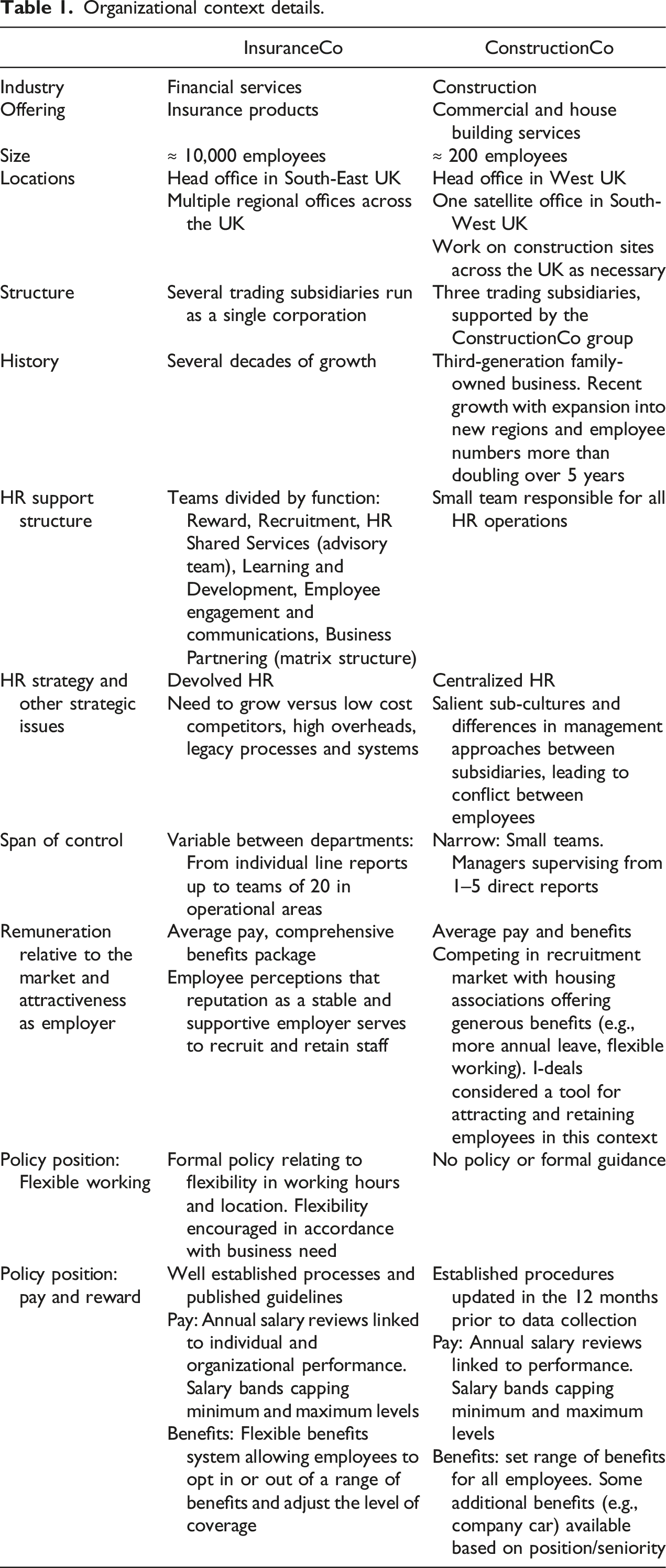
Organizational context details.
Breakdown of sample characteristics.
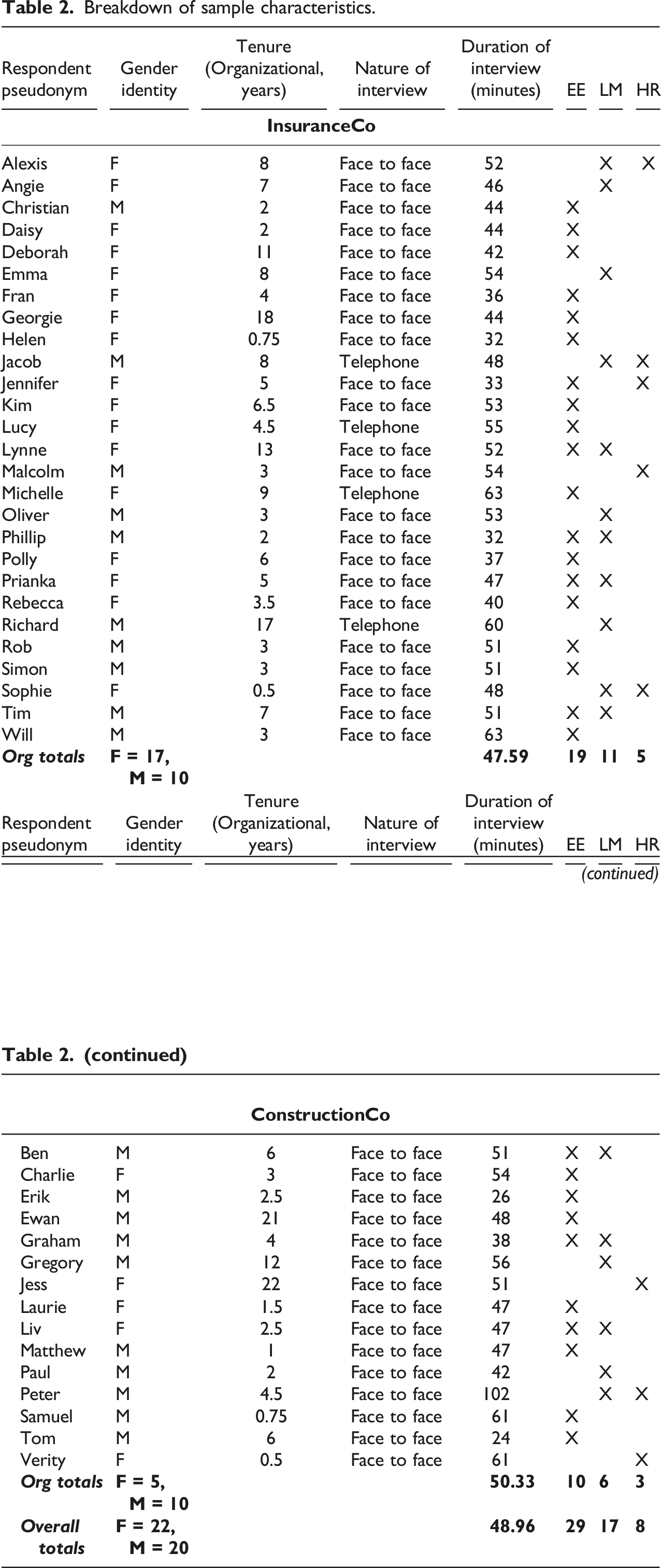
Interviews lasted an average of 50 minutes (ranging between 30 and 100 minutes). Interviewees were asked about their biographies and work roles. Employees with i-deals were questioned on the content and timing of their i-deals; why they requested their i-deal; the process of requesting the arrangement; their responses (attitudinal and behavioral); and, generally, to whom i-deals are granted (or denied). Employer representatives (LMs and HR) were questioned on their role in granting or denying different i-deal requests; the content and timing of the requests they had considered; why they grant i-deals; the benefits of i-deals; to whom they grant or deny i-deals; and employee responses to i-deals. HR and line managers were also questioned on the structure and history of the organization, and the organizational policies related to flexible working and reward.
A decision to focus on stakeholder experiences of financial and flexibility i-deals was informed by limited discussion of other types of arrangement by interviewees. Further this combination captures economic and more relationally oriented arrangements (Rosen et al., 2013; Hornung et al., 2009). Throughout data collection and analysis, the findings related to ex-post flexibility i-deals emerged repeatedly and consistently, suggesting that theoretical saturation was reached. In relative terms, data relating to financial i-deals and ex-ante flexibility i-deals were more limited. This may be a consequence of these i-deals being less common (and visible, in the case of financial i-deals). Theorization from the findings of this qualitative, exploratory study reflects theoretical rather than statistical generalizability.
Conceptualization of I-deals
Given the qualitative nature of the study, a clear conceptualization of i-deals was necessary to distinguish them from standard organizational policy or practice. Particular attention was paid to ensuring described arrangements consistently matched the following literature informed characteristics of i-deals: (1) they are bargained for individually and (2) they are heterogeneous, offering terms that differ to those offered to other employees, thus creating within-group differences in employment conditions (Liao et al., 2016; Rousseau et al., 2006). To achieve this heterogeneity, i-deals may be exclusive arrangements, or be more broadly available but responsive to individual employee needs unmet by standardized policy (Rousseau, 2001; Rousseau et al., 2006). For flexibility i-deals, arrangements needed to have been explicitly authorized and not simply be a consequence of normative flexible work arrangements available in an individual’s organization or team. For financial i-deals, the arrangement - again - needed to have been explicitly requested and agreed to. Further, if related to pay, it needed to have led to an increase in salary separate to that provided by the organizations’ annual review process, and/or above the level capped by the relevant salary band (see Table 1). For an arrangement related to benefits to qualify as an i-deal, an employee needed to have negotiated for a higher level than normally available, or for a new benefit not normally offered.
Data analysis and presentation
Interviews were recorded and transcribed verbatim. Thematic analysis of data (see Braun & Clarke, 2006) relating to the employee and employer perspective took place in parallel. Data analysis followed a broad a priori framework, focused on identifying the inputs, process and outcomes of i-deal creation. Analysis involved the generation of first level codes, informed by participants’ language. These were categorized into second level codes, acting as potential themes. The final stages of analysis involved reviewing and defining these themes to form finalized aggregate dimensions that reflect the entire data set (ibid). These aggregate dimensions revealed dichotomies: two distinct employee/employer needs for i-deals (inputs), two overarching employee approaches and employer conditions for negotiating i-deals (process), and two categories of employee perceptions of and responses to i-deals (outcomes). By coding the data in relation to the content (financial vs. flexibility) and timing (ex-ante vs. ex-post) of the i-deals discussed by interviewees, it was possible to track and sequence these dichotomous themes from the initial needs, through to the negotiation processes, and subsequent perceptions and responses.
Despite the numerous contextual differences (including the variation in size, sector, and the level of formality in the policy approach to managing flexible working and reward, see Table 1), the individual themes and overarching i-deal pathways that emerged were remarkably consistent across the case organizations. Findings are evidenced by quotations selected to most clearly demonstrate the range of experiences and attitudes expressed across interviewees. Next, the findings section details the inputs, process, and outcomes of i-deal pathways from employee and employer perspectives.
Findings
I-deal Inputs: Employee and Employer Need
Employee Need for I-deals: Support Versus Securing Market-Value
The most common reasons provided for employees requesting a flexibility i-deal were to support childcare arrangements, wanting to spend more time with family or to reduce the impact of a difficult commute (e.g., avoiding traffic or traveling to the office less often). Additional reasons included other caring responsibilities, engaging in hobbies, making time for exercise and to manage stress and overworking. Common amongst these reasons is that employees needed i-deals to reduce conflicts between their work and personal lives: …with the baby [the arrangement] was a necessity. There were no other options for us. (Laurie: EE, ConstructionCo) I was driving 120 miles, round trip, every day, which is a lot. …By Wednesday I was exhausted from the commute, it wasn’t sustainable. At first I thought I could do it, but I needed something to change. (Phillip: LM with i-deal, InsuranceCo)
In contrast, employees requested financial i-deals to secure an equitable remuneration package that reflected their perceived market-value. Employees explained that they’d requested their i-deal because “I knew my worth… [and] the conditions weren’t equal to what I’d had before” (Matthew: EE, ConstructionCo), and the terms they wanted were “what I deserve” and “what I can get elsewhere” (Will: EE, InsuranceCo).
The two employee needs identified corresponded clearly to flexibility versus financial i-deals: flexibility i-deals were needed to support conflict reduction between employees’ work and personal lives, and financial i-deals were needed to secure their perceived market-value. However, employer need for i-deals did not align so directly to i-deal content and is discussed next.
Employer Need for I-deals: Supporting Employees and Enhancing Commitment Versus Securing Star Employees
The findings revealed two separate employer needs that led to the creation of i-deals. However, unlike the distinct employee needs that aligned to i-deals of specific content, both employer needs led to the creation of flexibility i-deals dependent on their timing. Ex-post flexibility i-deals responded to employer needs to support employees and enhance commitment to the organization: …it’s actually an opportunity for the business to support people. …it takes people away from the office etc., but actually there’s a tremendous amount of good will that you get back and relationships that get built with your employees that have a lot of spin-off benefits to the company. (Ben: LM with i-deal, ConstructionCo) So, it’s helping them, supporting them, but it also helps us as a business. (Phillip: LM with i-deal, InsuranceCo)
In contrast, ex-ante flexibility i-deals were needed to secure star employees. HR representatives at both sites explained that being able to grant flexibility i-deals was “a good option to have when you’re competing in the [recruitment] market” (Peter: HR, ConstructionCo) and “can help you attract the best and more diverse candidates” (Malcom: HR, InsuranceCo). Angie, a LM at InsuranceCo, described this: I’d offered [her] the job and she was pushing for four days a week. … [her] predecessor was full-time so I suppose I could’ve said no initially and seen if she’d accepted… [but] I didn’t want to lose her. I was happy to give her that rather than risk her interviewing with anyone else.
This employer need to secure star employees also led to the creation of financial i-deals. Ex-ante financial i-deals were granted to secure the recruitment of certain candidates. HR representatives at ConstructionCo described how, for highly desirable individuals, the management team will “give over and above to, to get them on board” (Jess: HR, ConstructionCo). Verity (HR, ConstructionCo) described a specific example: It was the same for [the employee] who gets more annual leave days than others: that’s what she wanted when she was recruited. The [senior manager] had worked with her previously, they really wanted her.
Yet, unlike flexibility i-deals, financial i-deals could also be used ex-post to secure star employees and retain “key” individuals: For one person we did it, we identified them as key so we agreed to a tactical increase to their base pay, outside of pay review… (Alexis: LM and HR, InsuranceCo)
In summary, the findings identify two employee and two employer needs that prompt the creation of flexibility and financial i-deals and highlight that these are not in complete alignment. Financial i-deals can meet the employee need for equitable remuneration and to secure their market-value, as well as the employer need to secure desirable employees. Flexibility i-deals support employees’ need to reduce conflicts between their work and personal lives, but correspond to different employer needs dependent on their timing. Ex-post, employers see these arrangements as a route to supporting employees and, consequently, enhancing employee commitment to the organization. However, ex-ante flexibility i-deals, like financial i-deals, remain tools that can be utilized to meet an employer need to recruit desirable candidates.
Crucially, employee and employer needs for i-deals play a role in shaping different processes for negotiating these arrangements and influence the pathway to i-deal outcomes.
The Process of Negotiating I-deals: Employee Requests and Employer Conditions
Employee Requests for I-deals: Seeking Mutually Agreeable Solutions Versus Leveraging Terms
An employee’s approach to requesting an i-deal is influenced by the different needs described above, plus, in the case of flexibility i-deals, by the timing of their request. When requesting flexibility i-deals ex-post, the findings reveal employees explaining their need for the arrangement to their employer, and focusing on finding an agreeable solution for both parties. For example, Emma (EE, InsuranceCo) explained that when requesting her ex-post flexibility i-deal she had considered how her arrangement would work for the organization without impairing her ability to do her job: Initially I really wanted the Wednesday [off] because that fitted with the days my first choice nursery had, but I knew that would be more disruptive to my projects. … [My manager and I] sat down and chatted about it and… [decided] Monday off would work the best. …I was so pleased we could make it work and… my stakeholders hardly notice, I don’t think.
Similarly, Laurie (EE, ConstructionCo) explained that when she had requested her ex-post flexibility i-deal, she was transparent with her manager about her need for the arrangement and emphasized her willingness to be flexible with the terms agreed: I spoke to [my manager] and explained that we were struggling a bit: who isn’t with a newborn? She totally got it and it really was like we were working together to find something that would work. …I made it very clear that if there were ever weeks she needed me in on a Tuesday, I would make it happen.
However, when requesting flexibility i-deals ex-ante, employees adopted a different approach. Even though their need was the same, the findings reveal that instead of focusing on reaching a mutually agreeable solution, employees use the leverage afforded to them by the recruitment market to secure their preferred terms as described below: I need the compressed hours because I do the childcare one day a week… I thought if they really wanted me they would go for [the arrangement], so I tried to use it as a negotiating point really. …because the hours you work, salary, benefits: it’s all on the table when you first start somewhere. (Samuel, EE, ConstructionCo)
This leverage was also used by employees when requesting financial i-deals. In this case, employees used threat of resignation or alternative offers of employment as leverage to secure these arrangements, reemphasizing the market orientation of financial i-deals. Charlie (EE, ConstructionCo) described threats being used to secure ex-post financial i-deals:
…sometimes you’ve got to play the game and you say “right, can I have a pay rise?” and they are like “mmm, thing is..” and give all these excuses and then you have to be like “okay, thank you, there’s my resignation letter” and then, if they really want you, they are like “ah, okay, about that pay rise” and it’s that game.
Similarly, when requesting financial i-deals ex-ante, employees leveraged the employer’s desire to secure their recruitment. For example, Matthew (EE, ConstructionCo) had negotiated an ex-ante financial i-deal, and believed that the terms of his arrangements “would have been more difficult to push through” ex-post, and that he was in “a position of strength” to negotiate those terms before he took up his post.
These findings emphasize the market-oriented nature of financial i-deals and highlight the leverage that assists employees in negotiating these arrangements. When these i-deals are negotiated ex-post, threats to resign or alternative employment offers provide the employee with leverage. Ex-ante, this is provided by the influence of the recruitment market.
Employer Conditions for Granting I-deals: Market Value and Trust.
Employer needs to support employees and enhance organizational commitment, and to secure star candidates, led to the adoption of different conditions for granting i-deals: trust versus market-value. Prianka, a LM with a flexibility i-deal at InsuranceCo, highlighted the difference between financial i-deals granted under conditions of market-value, versus flexibility i-deals under conditions trust: …people who are really high performers, there’s not that many of them really, …I’m not one of those: I’m good at what I do but I’m not one of these massively outstanding, star performers, but I have an arrangement. I think those people, they will want to look after in many ways. They will look after them, probably, more so financially… flexibility agreements are [granted] …as long as the trust is there.
Conditions of trust for granting (ex-post) flexibility i-deals were further highlighted by managers who provided examples of being inclined to deny requests to poor performing employees who, for example, “weren’t delivering yet” or where their “standard [of work] was low” (Lynne: LM with i-deal, InsuranceCo). Some managers also expressed reluctance to grant i-deals to new or junior employees due to a lack of trust: [The company has] core hours and I’m quite strict with that really, and an element of that is probably due to their age, in honesty. I think you have to reach a level of maturity to be able to properly utilize a flexible arrangement without taking the mickey… it’s all about trust…and some people you feel you can trust more than others… (Gregory: LM, ConstructionCo)
Despite this need for trust preventing some employees from accessing flexibility i-deals, trust was generally presented as a non-exclusive condition by interviewees (HR, LMs and EEs). This led to flexibility i-deals being described as more widely available than financial i-deals. For example, Prianka (LM with i-deal, InsuranceCo) described flexibility i-deals as available “almost to everyone” and Jacob (LM and HR, InsuranceCo) explained that he was “open to making these arrangements whenever I can.”
Nevertheless, the need for trust meant that ex-ante negotiation could act as a potential barrier to the creation of flexibility i-deals. Both LMs and HR representatives described discomfort in granting flexibility i-deals to new recruits due to a lack of built-up trust. They first “would want someone to come in and, kind of, prove themselves” (Oliver: LM, InsuranceCo), because when an employee initially joins “you don’t know that person to trust from day one” (Verity: HR, ConstructionCo). However, the suggestion that new recruits could not be trusted to have flexibility i-deals was not universal. Some LMs believed that “you start off with an implicit trust relationship. I don’t believe you have to earn it first, but you can lose it quickly” (Graham: LM, ConstructionCo).
These findings highlight how ex-ante negotiation, when there is no established relationship between the LM and employee, can be a barrier to the creation of flexibility i-deals conditional on trust. However, the findings further reveal that flexibility i-deals could also be granted ex-ante under conditions of market-value. For example, Graham (LM at ConstructionCo) described granting an ex-ante flexibility i-deal to a desirable candidate who had received a higher remuneration package in her existing role: It was part of the conversation that I had with [her] about how would this work for her because the rest of the package that she had wasn’t necessarily quite as good as what she had in her previous role, but the flexibility was important to her. … So, it enabled us to find the trade-off that worked for us all, for both of us.
Employers granting of financial i-deals was also conditional on market-value. Richard (LM: InsuranceCo) highlighted this when explaining that when employees had been “offered another job on higher money… I am more inclined to look into [requests made by employees].”
Market-value as a condition for granting financial i-deals resulted in these arrangements being exclusive in nature. This was noted by both employer and employee representatives. For example, Charlie (EE: ConstructionCo) had “noticed that they are very reluctant to agree to people asking for pay rises.” Alexis, a LM and HR Business Partner at InsuranceCo, described financial i-deals as “rare,” explaining that:
…it’s company money, so we’re pretty rigid, and when I say rigid, I mean it would be by exception that we had to agree to a tactical pay increase outside of pay review.
Their exclusive nature, and the market-based conditions employers adopt for granting financial i-deals also support understanding of why employee requests for these arrangements may be declined. For example, Richard (LM, InsuranceCo), explicitly objected to granting financial i-deals when employees had made the request to support their lifestyle:
…on a couple of occasions people have asked because of lifestyle choices they’ve made and they need more money to support that and I am not as willing, well not willing at all, to accommodate that: that’s not appropriate.
In summary, employees adopt different approaches for requesting i-deals dependent on their need for the arrangement and the timing of their request. While they seek mutually agreeable solutions when negotiating ex-post flexibility i-deals, they use their market-value to leverage financial and ex-ante flexibility i-deals. Concurrently, employers apply conditions to their negotiation of i-deals: trust when granting ex-post flexibility i-deals, versus market-value when granting financial or ex-ante flexibility i-deals.
I-deal Outcomes: Perceptions and Responses
Perceptions and Responses to Supportive I-deals: Feeling Valued and Reciprocation
The findings reveal employees reciprocating for i-deals that support them to reduce work–life conflicts. Employees with ex-post flexibility i-deals provided examples of reciprocity, such as adjusting their arrangements and agreed work schedules in accordance with business need. For example, Ben (LM with i-deal,ConstructionCo) noted “it’s not a problem: every now and again I can come in earlier.” Tim (LM with i-deal, InsuranceCo), whose flexibility i-deal allowed him to work from home once a week, provided another example:
At the moment I am having quite a lot of meetings as well, so that means I’m engaged with the business a bit more at the moment and I need to be here. I’m not always taking my days at home, but I don’t mind doing that.
These employees were willing to occasionally adapt the terms of their flexibility i-deal because they perceived the arrangement as relational and reciprocal and believed “it works both ways” (Phillip: LM with i-deal, InsuranceCo). They were responding in kind: willing to be flexible and supportive because their employer had done likewise.
This theme of reciprocity extended beyond employees being flexible with their agreed work schedule and location, to more generally, for example, “working outside of my working hours or outside of my job description” (Laurie: EE, ConstructionCo) to complete certain work or meet deadlines: I’ve got to probably log on tonight and do bits and pieces, but that’s really how that flexibility works for me. For me, I think, it’s very two way. …They’ve been so flexible and accommodating with me, allowed me to make my job work around my life, so it makes me more loyal and want to work harder for them. (Georgie: EE, InsuranceCo)
Such acts of reciprocation corresponded with explanations that supportive flexibility i-deals “makes [them] feel valued” (Prianka: LM with i-deal, InsuranceCo). Employees reported believing that their i-deal reflected the quality of their relationship with their employer (or specifically their line manager): They are really supportive with it and I think I give back. I do feel like I’ve got respect off my line manager, that we’ve got a good working relationship, but that’s all true whether or not only I have it or lots of people have it. …I think it’s more about having that fairness across the board, rather than having that special treatment, because it’s not a nice environment to work in if someone is like “well, how come she’s gets a day off to do a course and I don’t?”: that’s a bit of a petty environment. (Charlie: EE, ConstructionCo)
Charlie also distinguishes between her arrangement and special treatment, suggesting that there could be downsides to having a more exclusive arrangement - something also acknowledged by other employees and employer representatives: …you don’t really want to feel like you’re special because you get this or you get to work from home one day a week, because that feels unfair. If everyone does it and you feel valued then that’s fine… (Verity: HR, ConstructionCo)
These findings illuminate the outcomes of flexibility i-deals that are supportive in nature, from the perspective of the employee and employer. Employees with ex-post flexibility i-deals reciprocate for their arrangement by, at times, being flexible with their agreed work schedule, and/or working beyond their contracted hours and duties to meet outputs and deadlines. These are beneficial behaviors for the organization. This reciprocity occurs due to employees feeling valued and wanting to give back because they believe their i-deal reflects the quality of their relationship with their employer.
Perceptions and Responses to Market Oriented I-deals: Feelings of Entitlement and Functional Outcomes.
In contrast, the findings reveal that market-oriented financial and ex-ante flexibility i-deals lead to purely functional outcomes (recruitment or retention of employees). For example, Matthew (EE, ConstructionCo) explicitly stated that his ex-ante financial i-deal had secured his recruitment into the business, but that it had not led him to change his behavior or reciprocate for the arrangement. He believed the i-deal reflected his value in the market and was “appropriate compensation, so I don’t really think I owe anything … in return.”
Despite more limited discussion of employee responses to ex-ante flexibility i-deals, interviewees who had negotiated this form of market-oriented i-deal expressed similar sentiments to those with financial i-deals. They neither described positively changing their behavior in response to their arrangement, nor suggested any inclination to do so. Indeed, one employee explicitly described their reluctance to adjust the arrangement negotiated prior to their employment commencing, presenting a transactional view: …There have been a few occasions where …I get something put on me that’s huge, at like half 4, I’ll just be like “no, I’ve had all day of asking for work and nothing to do, you know this is my time to go home now, I’m going to have to do it in the morning.” (Helen: EE, InsuranceCo)
Employees who had negotiated market-oriented i-deals did not feel the need to reciprocate because they felt entitled to the terms agreed. For example, Simon (EE, InsuranceCo) believed the terms negotiated via his ex-ante financial i-deal reflected his worth. He had felt unhappy with the initial salary offer made, commenting that he’d have “found it a bit insulting” if the terms of his i-deal request had not been granted. Similarly, Rob (EE, InsuranceCo) explained that “if he could go elsewhere and get that wage then really that is what he’s worth: you’re worth what someone will pay you.”
Will (EE, InsuranceCo) also believed the terms of his ex-post financial i-deals were “what I deserve” and “what I can get elsewhere” in the recruitment market. Further, he revealed the potential detrimental impacts on the employment relationship of employees negotiating i-deals to receive terms that they feel entitled to. He described the relational cost of having requested and successfully negotiated an ex-post financial i-deal. This had led him to believe that his employer did not have his best interests at heart, rather than feeling valued:
…that has shown me that this company isn’t going give me the best offering. They’re thinking of themselves unless I’ve taken the initiative and done all that work just to get what I deserve.
The outcomes of market-based i-deals can include employer success in recruiting/retaining employees for the organization. However, they may not lead to positive employee attitudes or broader behavioral responses. This corresponds to employees perceiving their market-based i-deal to reflect their worth, such that they feel entitled to the terms negotiated. Further, negotiating such arrangements may itself impair the employment relationship.
I-deal Pathways
Cumulatively the findings reveal a pathway from employee and employer needs, through to the negotiation and subsequent outcomes of i-deals. This is illustrated in Figure 1. Flexibility and financial i-deals are created in response to employee and employer needs. Some employees need to reduce conflicts between their work and personal lives, and others need to secure remuneration at their perceived market-value. Employers need to support employees and encourage organizational commitment, and to secure (recruit and retain) star employees. These needs inform the process of negotiating i-deals. To reduce conflicts between their work and personal lives, employees desire flexibility i-deals. However, the timing of their request corresponds to different approaches to requesting these arrangements. Ex-post, employees emphasize their need for the arrangement and seek to find a mutually beneficial solution. In contrast, ex-ante, they use the leverage afforded to them by the recruitment market to try and negotiate their preferred terms. Employees also adopt this approach when requesting financial i-deals ex-ante, and ex-post they use counter offers or threats to resign to leverage employer agreement. To ensure i-deals meet the needs of the organization, employer representatives apply conditions to their granting. Although employers grant (ex-post flexibility) i-deals to support employees broadly, this is conditional on trust. In contrast, i-deals used to secure star employees (financial and ex-ante flexibility i-deals) are exclusive and conditional on market-value. The outcomes of i-deals are influenced by the needs and negotiation process that led to their creation. When i-deals are granted broadly in support of their needs, employees believe the arrangement reflects the quality of their employment relationship, leading them to feel valued and reciprocate. The organization benefits due to the positive behaviors the employee engages in. When i-deals are granted exclusively to those with the highest market-value, employees perceive the arrangement to reflect their existing contributions and/or worth. Employees feel entitled to these terms and do not modify their behavior in response to the i-deal. The employer is successful in securing (recruiting/retaining) the employee, but positive attitudes and behaviors may not emerge. Ex-ante and ex-post financial and flexibility i-deals: needs, negotiation, and outcomes.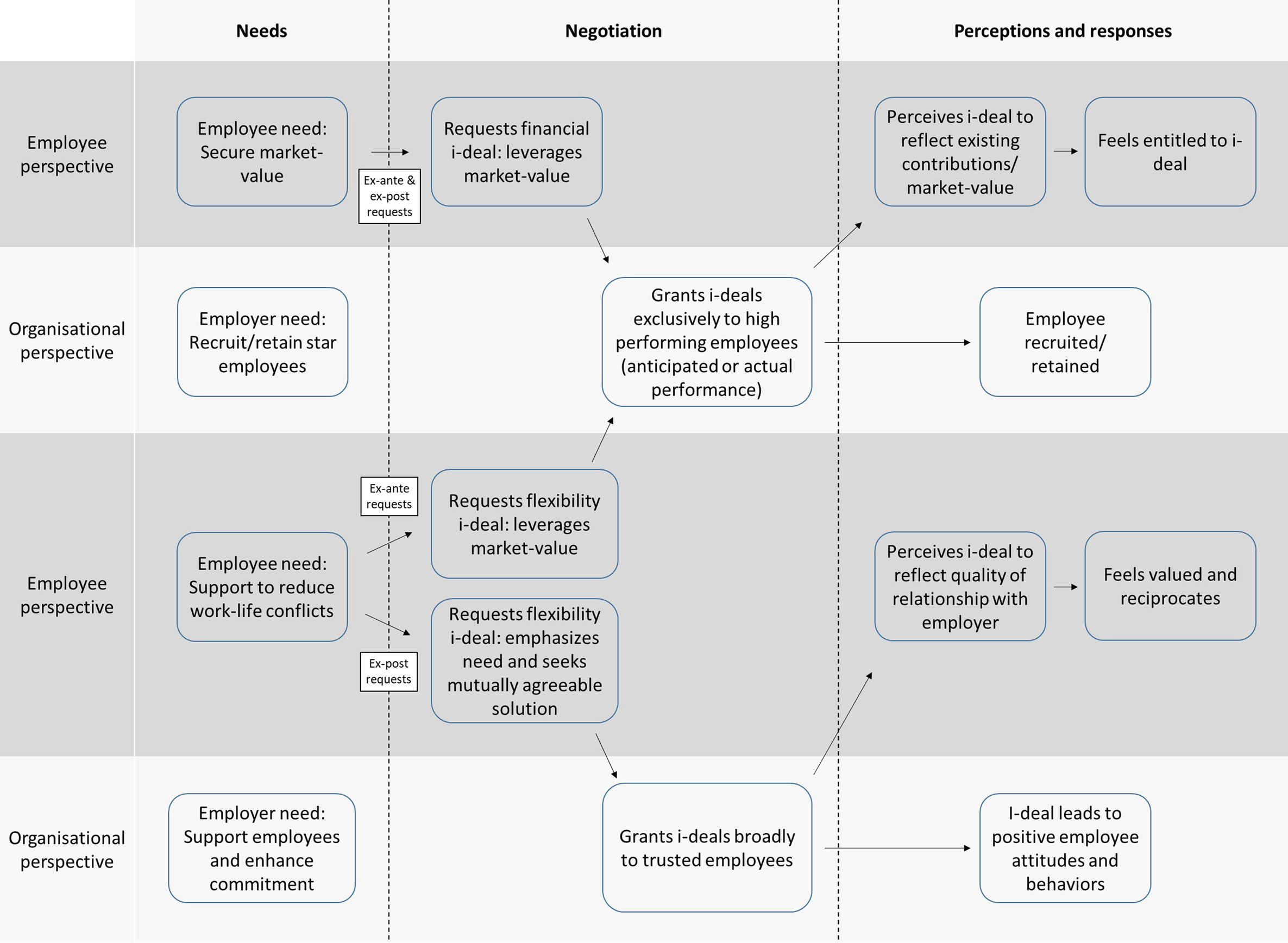
Discussion
The qualitative approach adopted in this study enabled exploration of i-deal pathways (the inputs, process and outcomes of i-deal negotiation) from employer and employee perspectives. Previously, multiple perspectives were absent in the literature, with the organizational vantage point particularly neglected (Conway & Coyle-Shapiro, 2016; Liao et al., 2016). The findings help to reconcile the existence of diverging narratives regarding to whom i-deals are available (high performers and trusted “regular people” too) and how this shapes i-deal outcomes. Two lenses taken to i-deals are evident: one of economic exchange and another of providing support to employees. Crucially the resulting i-deal pathways, their sub-components and implications are different.
Theoretical implications
Market-Based Versus Supportive I-deal Pathways
Figures 2a and 2b provide a theoretical abstraction of the findings. They illustrate market-based and supportive i-deal pathways characterized by differential inputs, process, and outcomes of i-deal creation. Existing research has focused on the characteristics of i-deals, with particular interest in their timing and content, and how these impact i-deal formation and functioning. Importantly, while this research reaffirms that the content and timing of i-deals influences their creation and outcomes, the pathways these arrangements follow ultimately supersede these effects. I-deals are created in response to employee and employer needs. For market-based i-deals (see Figure 2a) employees may need flexibility to reduce personal/work-life conflicts, or increased remuneration (financially oriented) to be satisfied with their employment terms. Simultaneously, employers need to secure (recruit/retain) star employees. The process of negotiating these i-deals is distributive in nature. Employees attempt to leverage the best possible terms through market power, and employers seek to determine the lowest offer that will successfully recruit or retain the desired employees. The outcomes of these arrangements are narrow and functional: organizations can successfully recruit or retain the employee, but broader positive employee attitudes and behaviors may not materialize. Market-based i-deals are limited in scope and reflect the principles of transactional/economic exchanges (c.f. Blau, 1964). Market-based i-deal pathway. Supportive i-deal pathway.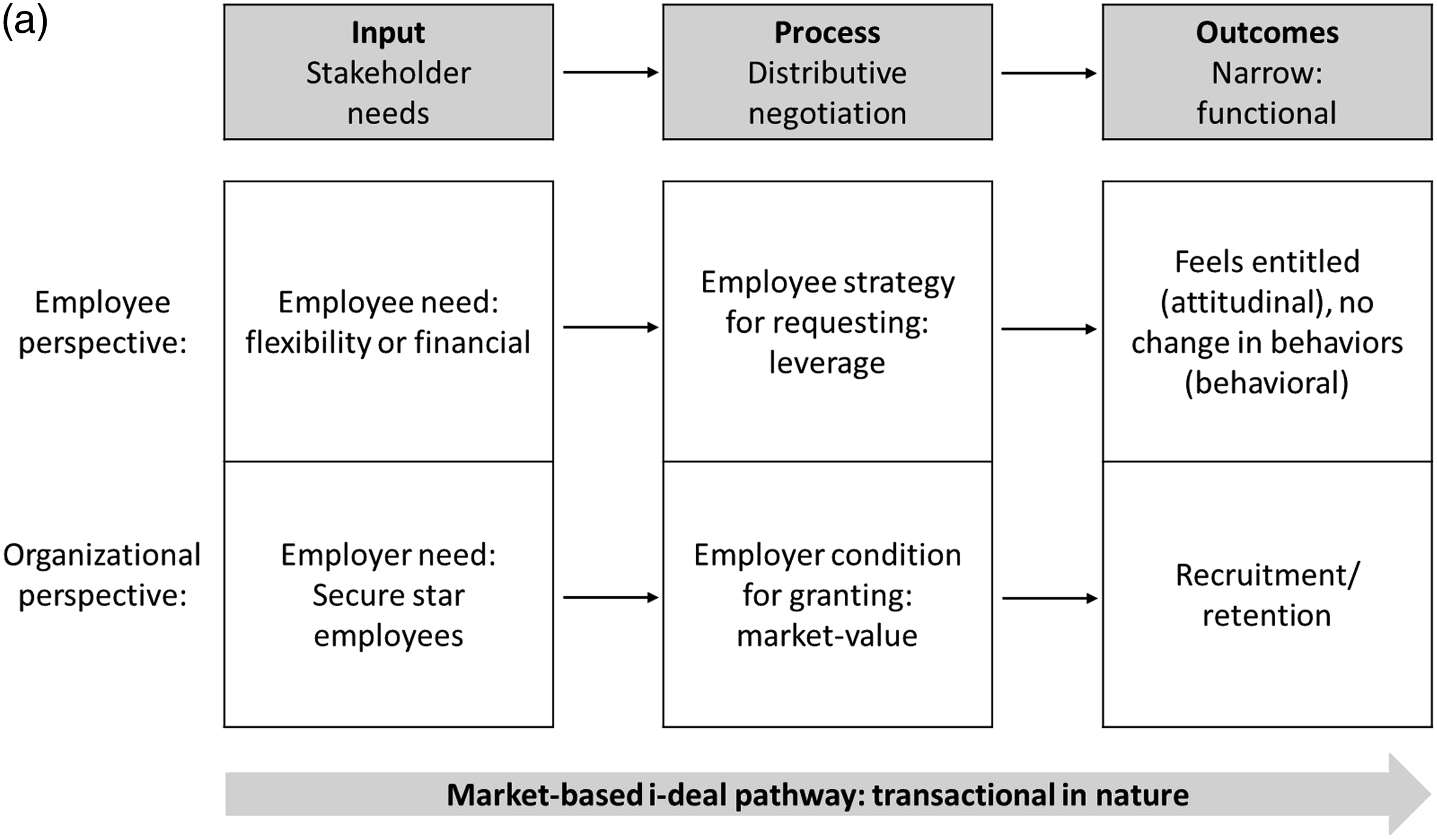
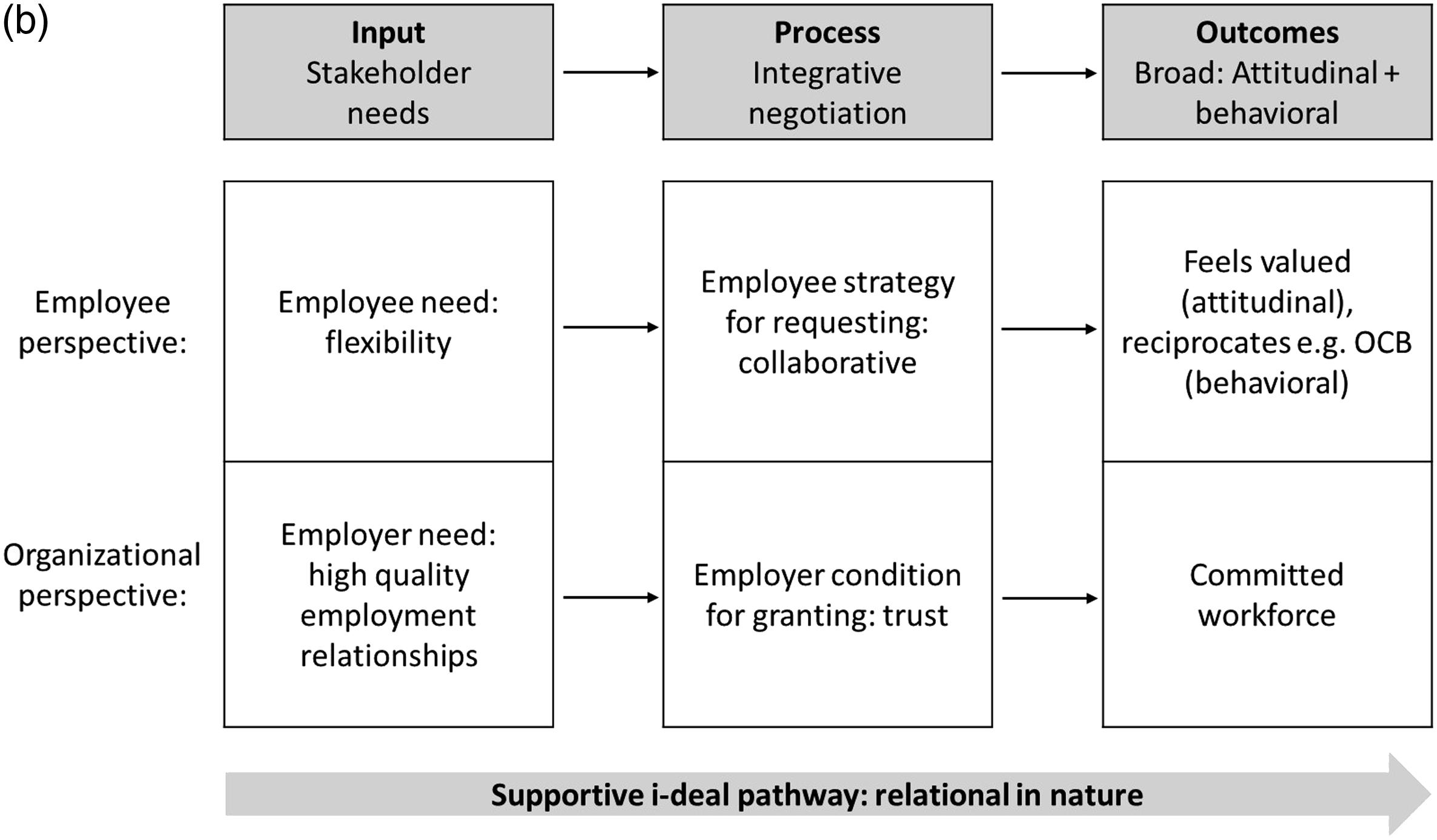
Supportive i-deals (see Figure 2b) are created in response to employee needs for flexibility, and employer needs for high-quality employment relationships. In this case, the negotiation process is integrative, as employees adopt a collaborative strategy to identify terms that work for both parties, and employers are willing to grant supportive i-deals once conditions of trust are met. Supportive i-deals therefore offer customization of employment while being available widely (c.f. Bal, 2017; Hornung et al., 2010; Rousseau, 2001; Rousseau et al., 2006) rather than being exclusive in nature. Supportive i-deals have broad and behavioral outcomes, with employees, for example, engaging in organizational citizenship behavior (OCB) and employers benefitting from a committed workforce. Supportive i-deals may also have functional benefits, such as the retention of employees, but are not primarily created with this aim. Unlike market-based i-deals, the benefits of supportive i-deals spill over to other components of the employment relationship and are social/relational in nature (Blau, 1964).
Future research should consider co-existing market-based and supportive i-deal pathways (e.g., agreed up-front or built-up over time) and how this influences employee responses. I-deals of this nature may, for example, combine supportive and market-based components, and act as a route to organizations reaping the relational as well as functional benefits of i-deals offered on an exclusive basis. Further contributions and future research considerations relating to the inputs, process and outcomes of the pathways are considered below.
Inputs to I-deal Creation
The negotiation of i-deals and their resultant outcomes are prompted by specific employee and employer needs. These needs influence the content of the i-deal that is created (financial vs. flexibility). Financial i-deals are transactional in nature and follow the market-based pathway. In comparison, flexibility i-deals seem more supportive and relational (although ex-ante negotiation can influence the pathway they follow). Prior research suggests that, relative to flexibility i-deals, “developmental i-deals appear to be more strongly associated with perceiving the employee–employer relationship as a social exchange” (Liao et al., 2016: S17). The potential existence of a market-oriented (transactional) - supportive (relational) continuum of financial, flexibility, and developmental i-deals merits further research. Future attention should also be afforded to the needs prompting, and the pathways followed by, task or developmental i-deals from multiple perspectives. For these and other types of i-deals, we emphasize scope for alignment and/or differentiation between employer and employee needs.
The Process of I-deal Creation
Our study responds to recent calls to enhance understanding of the negotiation of i-deals (c.f. Simosi et al. 2021). By examining employees’ requesting of and employers’ granting of i-deals, this article provides evidence of the different negotiation strategies that underpin i-deals, and how this impacts outcomes. Supportive i-deals are created following integrative negotiation. The resultant i-deals are reciprocal in nature and benefits spillover beyond the terms of the arrangement. In contrast, market-based i-deals follow distributive negotiation and their outcomes remain specific to the negotiated terms. However, a limitation of the data utilized here is that all i-deals considered stemmed from employee requests. In principle, i-deals may also be proposed by employers (Liao et al., 2016). Future research should examine whether and how employer initiation of i-deals alters the approach to meeting stakeholder needs and/or the pathway and outcomes of the arrangements. For example, employers may look beyond financial i-deals and initiate flexibility i-deals with the primary aim of retaining employees. Further, financial i-deals initiated by employees are associated with relational risks. Employees having to request terms that they feel entitled to may undermine the experience of feeling valued associated with supportive i-deals. Future research should therefore explore whether financial i-deals initiated by employers follow a different i-deal pathway and are more relational in nature.
Outcomes of I-deal Creation
This study distinguishes between i-deals that are requested and granted, something often overlooked given the tendency to examine i-deals from the employee perspective (Liao et al., 2016). We expand understanding of when requests for i-deals may be denied, and why. Ex-ante negotiation and poor employee performance may lead to denied requests for flexibility i-deals. Future research should explore the possible consequences of denying i-deals that, if granted, would have been supportive in nature. For example, denied requests for flexibility i-deals may lead to reduced perceived supervisor support (PSS). Further, managers being unlikely to grant financial i-deals to all but those with the highest market-value creates potential for “winner-take-all” effects (Frank & Cook, 1995), where the leverage afforded to those at the top can lead to the receipt of rewards that are disproportional to actual differences in performance (ibid). Further research should continue to question the reasons managers deny financial i-deal requests and possible repercussions (c.f. Hornung et al., 2010). Distributive justice perceptions with regards to pay have been found to play an important role in job satisfaction and satisfaction with the organization (Tremblay, Sire & Balkin, 2000). Equity implications should also be considered. For example, do denied requests for financial i-deals risk employees engaging in behaviors to restore equity, such as decreasing effort (Colquitt et al., 2001)? The influences on and consequences of denying i-deal requests should also be explored for developmental and task i-deals not examined here.
Practical Implications
Line managers should be empowered to utilize i-deals to achieve different desirable outcomes with current employees and/or to attract new talent. Supportive i-deals have broad benefits and are HRM practices than can offer both consistency and individual responsiveness (c.f. Fu et al., 2020). They may also be a precursor to a change in standard practice (Rousseau, 2001; Rousseau et al., 2006). The potential for line managers to use market-based i-deals in the recruitment or retention of star performers is highlighted, but this should be weighed up against the possible limits and risks of these arrangements. Market-based i-deals are likely insufficient to build quality relationships with high performing employees or be accompanied by positive employee attitudes. Employers’ reluctance to grant financial i-deals widely is supported by understanding that the cost of giving is higher for universalistic than particularistic resources (Törnblom, Jonsson, & Foa, 1985). Extrinsic motivation has been found to be negatively or unrelated to positive outcomes such as work performance and affective commitment, but positively associated to negative outcomes including turnover intention and continuance commitment (Kuvaas, Buch, Weibel, Dysvik & Nerstad, 2017). For example, financial i-deals have been associated with continuance commitment (Rosen et al., 2013). Plus, financial i-deals can create pay inequity for co-workers. Where i-deals are granted in response to threats to leave, line managers should particularly consider whether the i-deal is individually merited or reflects sub-market compensation for a cohort of workers.
HR representatives are encouraged to advocate for the creation of supportive i-deals that might otherwise be seen as undesirable inconsistencies. I-deals offered widely are more likely to be perceived as fair by co-workers (Rousseau et al., 2016). However, given the previously highlighted limitations and/or risks of financial i-deals, HR practitioners should consider taking on a gatekeeper role in granting these.
Given the benefits of supportive i-deals, employees should also be encouraged to initiate conversations with their employer regarding the individualization of their employment terms in support of their needs. Employees are, however, warned that market-based financial i-deals may lead to negative reactions from co-workers if they create internal inequity. Employees are also encouraged to consider their approach to requesting their i-deal. Adopting a collaborative and problem-solving mindset, focused on determining mutual agreeable solutions, can encourage integrative negotiation and may lead to broader benefits for both themselves and their employer.
Conclusion
This article contributes to the existing literature by explicating i-deal pathways, serving to enhance understanding of how i-deals are negotiated and reconcile divergent narratives regarding the availability of i-deals and how they lead to outcomes. We address a deficit in multi-stakeholder i-deal research by exploring the inputs, processes and outcomes of i-deal creation from the employee and employer perspective. Based on our findings, we propose a model of two theoretical pathways. Market-based i-deals are exclusive and premised on economic exchange. Concurrent employer and employee needs shape distributive negotiation strategies. While these arrangements have specific, functional benefits to organizations, they yield little employee reciprocity. When in the form of financial i-deals, potential unintended consequences may undermine the mutual benefits i-deals have been suggested to achieve. In contrast, broadly distributed supportive i-deals are prompted by employee and employer needs that encourage integrative negotiation. They have broader relational organizational benefits through positive employee behaviors based on enhanced reciprocity.
Footnotes
Acknowledgements
We thank Denise Rousseau, our editor Maria Simosi and our anonymous reviewers for valuable feedback on an earlier draft of the paper.
Declaration of Conflicting Interests
The author(s) declared no potential conflicts of interest with respect to the research, authorship, and/or publication of this article.
Funding
The author(s) disclosed receipt of the following financial support for the research, authorship, and/or publication of this article: This work was supported by the Economic and Social Research Council [grant number: ES/P00069X/1].

Author Biographies
Associate Editor: Maria Simosi