




Abstract
Certain countries are well known for being destination countries for sexual exploitation of children in the context of travel and tourism (SECTT). Various factors are assumed to be at play to increase the vulnerability of countries, and the children that live within them, to being destinations for SECTT. The current study uses a cross-national, quantitative approach to examine these assumptions, by investigating macro-level factors relating to tourism, children's living conditions, governance, and economic development that may account for the variation in SECTT occurrence. Our findings indicate that destination countries are, on average, characterized by lower economic wealth and are located closer to the equator. Unlike assumed in previous literature, governance and tourism are not significantly related to destination countries for SECTT. The results for children's living conditions are unexpected: while bivariate analyses show that destination countries have poorer children's living conditions, a positive relation emerges in multivariate models when controlled for economic development. More specifically, we find that within the group of countries with poor economic conditions, SECTT is more likely to occur in countries with better protection of children's rights to life and education. We explore potential explanations for this finding.
Introduction and Overview
Sexual exploitation of children in the context of travel and tourism (SECTT), also known as “child sex tourism,”
1
is a global problem that has received growing policy attention over the years. The typical image is that of an offender traveling from a wealthy country of origin to a poorer country where the child is sexually abused (the so-called “destination country”). Although the perception of the phenomenon has been broadened in recent years—for example, nongovernmental organizations (NGOs) have emphasized that there is no “typical offender,” and that offenders can come from western countries as well as countries within the region (Hawke & Raphael, 2016)—certain countries appear to be particularly well known for being SECTT destinations. This dual message of, on the one hand, a call for a broader perspective about destination countries, and on the other the acknowledgement that there are particular hot spots in the world, is illustrated, for example, by the following statement from the UN Special Rapporteur on the sale of children, child prostitution, and child pornography: Although [SECTT] tends to occur more commonly in developing countries, this phenomenon can occur anywhere in the world and no country or tourism destination is exempt. Between the supply generated by low income countries and the demand from industrialized countries, the choice of the destination depends on languages and connections, but also preferences and tastes. While Western Europeans would tend to travel to Eastern Europe to exploit children, 18 out of 50 (36 per cent) American [SECTT] cases between 2003 and 2006 involved crimes committed in Mexico. (M’jid, 2012, p. 6)
But why do certain countries in the world become destinations for SECTT, and others do not? In academic and grey literature, many factors have been hypothesized to contribute to the vulnerability of specific countries, and children within these countries, to be(com)ing destinations for SECTT. For instance, in their theoretical model of the SECTT “ecosystem,” George and Panko (2011, p. 137) construe a multitude of drivers in destination countries, including “underdevelopment, poverty, marginalization, avarice, lack of empowerment, corruption, lackluster law enactment and enforcement, frail morality, and widespread insensitivity to the rights of children.”
Yet hardly any of the hypothesized risk factors that could allow SECTT to thrive in a specific country are substantiated by cross-national quantitative research. The literature in this field has been described as “based on assumptions rather than research” (Spurrier & Alpaslan, 2017, p. 389), and there is a dearth of studies identifying risk factors which could advance prevention efforts (Miller-Perrin & Wurtele, 2017). While some research has examined individual or micro-level risk factors, for instance on child victimization (Spurrier & Alpaslan, 2017) or offending (Koops et al., 2017), the macro-level risk factors have hardly been explored.
This study aims to contribute to this research gap by looking for variation in societal circumstances across countries that may account for the variation in the occurrence of SECTT. What differences can be found between those countries that are labeled “destinations,” and those that are not? Through the use of open source data from 190 countries about SECTT and factors that have been reported to contribute to SECTT, we can gauge the validity of some common assumptions about country-level risk factors for SECTT. To our knowledge, this is the first study to do so.
In the next section, we describe key risk factors from academic and grey literature that have been assumed to contribute to the occurrence of SECTT, focusing on tourism, children's living conditions, governance, and economic factors. In the section “Data and Methods,” we describe our data and strategy of analysis. In the section “Results,” we present the main results. Sections “Discussion” and “Implications and Limitations” conclude and discuss implications and limitations.
Theoretical Background
This study focuses on four key factors that are hypothesized to explain why certain countries are destination countries for SECTT: (1) presence of tourism in the country, (2) living conditions of children and protection of their fundamental rights, (3) quality of government, and (4) economic factors. For the first two factors, we build on scholarship in the area of sexual exploitation and human trafficking that recognizes the sex trade as a global market shaped by a demand for sexual services on the one hand (in this case by tourists and travelers) and a supply of vulnerable victims (in this case children) on the other. In addition to supply and demand, we examine the political and economic context that influences to what extent the government can act as a capable guardian, thereby loosely building on routine activities theory (Cohen & Felson, 1979). Lastly, we integrate the economic context which interacts with each of these areas.
Tourism
Although tourism has created economic advancement and job opportunities in many countries, tourism flows can also (inadvertently) uphold and support an industry for sexual exploitation of children. Many have noted that increasing numbers of tourists and travelers can coincide with increased vulnerabilities for sexual exploitation of children (e.g. Shafe & Hutchinson, 2014; UNODC, 2014). Mass tourism in particular has long been linked to aggravating or sometimes introducing practices of child prostitution in a country (Hodgson, 1994), and is often reported to contribute to the occurrence of SECTT (ECPAT International, 2008; Hawke & Raphael, 2016). As affordable flights to well-known destination countries become more available, and previously distant or hard-to-travel areas of the world become more accessible, the risk of SECTT is believed to increase (Eirienne, 2009; Thomas & Mathews, 2006). This risk could be exacerbated by the emergence of new and more informal types of travel and tourism, such as voluntourism (Hawke & Raphael, 2016; Lyneham & Facchini, 2019). In short, one could say that globalization and the growth of the tourism industry have created a “perfect storm of poverty-stricken children encountering wealthy tourists” (Spurrier & Alpaslan, 2017, p. 404).
Just like other forms of prostitution, commercial sexual exploitation of children flourishes in circumstances where there is a high demand for sexual services. Miller-Perrin and Wurtele describe this community risk factor as “proximity to transient adult males” (2017, p. 132). Being away from home, separated from family or normal societal conditions, decreases inhibitions for tourists, business travelers, soldiers, or migrant workers to engage in norm-violating behavior. In this context, major sporting events, such as soccer tournaments, have also been discussed as a breeding ground for child sex trafficking (Castilho et al., 2018; Finkel & Finkel, 2015).
On a country level, we expect that the risk of a country being a destination for SECTT increases as the number of tourist arrivals grows, as there is a larger demand by potential offenders entering the country.
Children’s Living Conditions
Despite international legal obligations to protect children from sexual exploitation, in practice, the protection of children's fundamental rights varies greatly between countries in the world. Decent living conditions for children, including access to healthy food, education, and healthcare, are not guaranteed—whether because of economic hardship and poverty, marginalization and discrimination, or policy choices. In the absence of proper protection, exploitative practices, including child sexual exploitation, can flourish, as the pool of potential victims of sexual exploitation increases.
Previous research has identified a range of individual vulnerabilities that increase the risk for children of being sexually exploited (Franchino-Olsen, 2019). Poverty, illiteracy, and lack of protection from a family unit are believed to be important factors that drive children into the sex industry (Beyer, 2001; Washington, 2018). Yet little is known about country-level risk factors. NGOs have suggested that countries with weak child protection mechanisms are particularly attractive destinations for child sex offenders (ECPAT International, 2007), and, vice versa, that strong implementation and enforcement of child protection laws have protected children in one country but driven offenders away to areas without such laws (Terre des Hommes, 2013). Gender discrimination, sexual objectification, and unequal educational opportunities for girls further drive the underage sex trade (Beyer, 2001).
On a country level, we expect that the risk of a country being a destination country for SECTT increases as children's living conditions are more dire, leaving children more vulnerable to exploitation; in other words, there is a greater supply of potential victims.
Quality of Government
“Governance,” which reflects various aspects of a country's institutional or governmental quality, and other political factors are often cited as contributing to a context in which SECTT can thrive. Overall, bad governance diminishes a government's capable guardianship for protecting potential victims, and makes a country more susceptible to becoming a breeding ground for sexual exploitation, including by foreigners. Proponents of this theoretical perspective would propose improving the quality of government in destination countries as key solution.
Although governance is composed of different aspects that could influence the occurrence of SECTT, two are of particular relevance: corruption and weak rule of law. Corruption can violate a range of children's rights, including the right to be protected from trafficking and sexual exploitation (International Council on Human Rights Policy, 2009). The effective enforcement of legal instruments that should protect children from sexual exploitation is impeded by corruption among public officials and police officers (Curley, 2014; Johnson, 2011; Rafferty, 2013). These corrupt practices can range from turning a blind eye to signals of exploitation, to, in some examples, serving as active patrons for brothels with children (Andrews, 2004). In the legal void shaped by corrupt practices and lack of accountability, child sex offenders perceive themselves safe. While strict and effective governance in other countries can displace offenders away, the negligible risk of prosecution and punishment can attract offenders to destinations where they believe they can act with impunity (ECPAT International, 2008; Johnson, 2011; M’jid, 2012; Thomas & Mathews, 2006).
Other aspects of governance also impact the development of SECTT. Political instability creates opportunities for SECTT to occur. For instance, countries with environmental, political, or social upheaval have been recommended in Internet forums to those wishing to sexually exploit children, as children are separated from their family and the risk of prosecution is especially low (Child Exploitation and Online Protection Centre, 2013). Likewise, NGOs profess that constraints to civic space can affect their capacity to protect children from sexual exploitation (Down to Zero Alliance, 2018).
Therefore, on a country level, we expect that a country is more likely to be a destination for SECTT as the quality of government decreases.
Economic Factors
The most frequently cited risk factors for SECTT, from micro to macro level, are economic: poverty and inequality are believed to be very important contributing factors in many publications (e.g., Curley, 2014; George & Panko, 2011; Hawke & Raphael, 2016; Miller-Perrin & Wurtele, 2017; Rafferty, 2013; Washington, 2018). Lack of economic development can contribute to an environment in which SECTT thrives in a multiplicity of ways. First, poverty can increase the availability of vulnerable victims. Various studies describe how children from poor families rely on goods or money for their survival, which they obtain in exchange for sex (Johnson, 2011; Spurrier & Alpaslan, 2017). In some cases, underage children become “entrepreneurs” in the informal tourism sector (Brown, 1992; Miller, 2011); in others, parents sell their children to traffickers or facilitate their children's sexual exploitation in other ways (O’Connell Davidson & Sanchez Taylor, 1996; Rafferty, 2013). This highlights that poverty can also motivate more facilitators and exploiters, such as pimps, traffickers, or brothel owners.
Moreover, SECTT is shaped by the power imbalance that stems from global economic inequalities. It has been noted that offenders “tend to be better off than their victims (even if only marginally) and more highly ‘valued’ as countries and communities pursue tourist dollars” (Hawke & Raphael, 2016, p. 116). Differences in economic development, and the associated attributions about power and status, between the offenders’ country of origin and their travel destination can make offenders feel entitled to abuse children.
By emphasizing the role of economic factors in shaping where in the world SECTT occurs, previous scholarship (albeit implicitly) advances a theoretical perspective arguing that structural and historical circumstances that cannot easily be changed should be viewed as the root cause of sexual exploitation of children by travelers. One such structural factor is a country's geographical location. In macroeconomic research on the deep determinants of development and growth, the relationship between distance from the equator and economic development has consistently been demonstrated, with tropical countries lagging behind compared to temperate zones (Gallup et al., 1998; La Porta et al., 1999; Spolaore & Wacziarg, 2013). The dominant theoretical explanation for this finding is that temperate zones have profited from more economic prosperity due to the healthier climate and increased agricultural productivity there compared to countries on the equator (Diamond, 1999; Landes, 1998). Previous country-level studies on economic development have therefore included in their models not only per capita income, but also latitude (La Porta et al., 1999).
On a country level, we therefore expect that the risk of being a destination country for SECTT is larger in countries with poor economic development and more proximity to the equator.
Data and Methods
Our analysis is based on a dataset about countries’ relationship to SECTT and possible determinants, covering most countries and territories in the world. Data were combined from a number of datasets from different sources, described below.
Measuring Sexual Exploitation of Children in Travel and Tourism
To investigate risk factors for SECTT, we need a measure for each country's involvement in SECTT as dependent variable. To enable cross-national comparisons, it is important that data are comparable across countries and available on a (near) global scale; yet especially for transnational crimes, such as trafficking in human beings and crimes concerning children, this can be problematic (Kangaspunta, 2007; Van Dijk, 2008). Official statistics and “hard data” about SECTT are rarely available (George & Panko, 2011). 2
As an alternative measurement to official statistics, we used information from the Trafficking in Persons (TIP) reports as a source to determine whether each country is a destination country for SECTT. The TIP reports are released yearly by the United States (U.S.) State Department and provide an extensive description per country about the policy and situation regarding TIP, as well as child sexual exploitation and “child sex tourism.” Its global coverage and influential role in the anti-trafficking field elevates the TIP reports over other potential sources, while its clear structure enables a systematic document analysis.
Based on the text in the TIP reports, every country included therein (N = 190) was classified for its involvement with SECTT as a (non)destination country. To gain robustness, we investigated two recent editions of TIP reports: 2018 and 2016. To reduce the risk of bias from framing in the reports, we developed a transparent coding protocol. A country was coded as a destination country for SECTT if it, at the minimum, met the following criteria: (1) the offender (most probably) comes from a country of origin which is foreign to the destination country (i.e., they have crossed an international border); 3 (2) the victim is a minor of any nationality; (3) sexual abuse or sexual exploitation takes place in the destination country, where the offender is the person engaging in sexual contact with the child (see Supplemental Appendix A for the full coding protocol). To assess reliability of the coding, an independent coder coded a sub-sample of 20% of cases using the same coding protocol. There was strong agreement between coders on whether countries could be classified as destination countries (κ = 0.943 [95% CI, 0.814 to 1.000], p < .001). Ultimately, 65 countries were coded as destination countries for SECTT at least once in these two editions; 125 were not. Of the 65 destination countries, 51 (78%) were coded as a destination in both editions. Figure 1 shows the global distribution of SECTT, with destination countries primarily in Latin America, East Asia, and Africa.
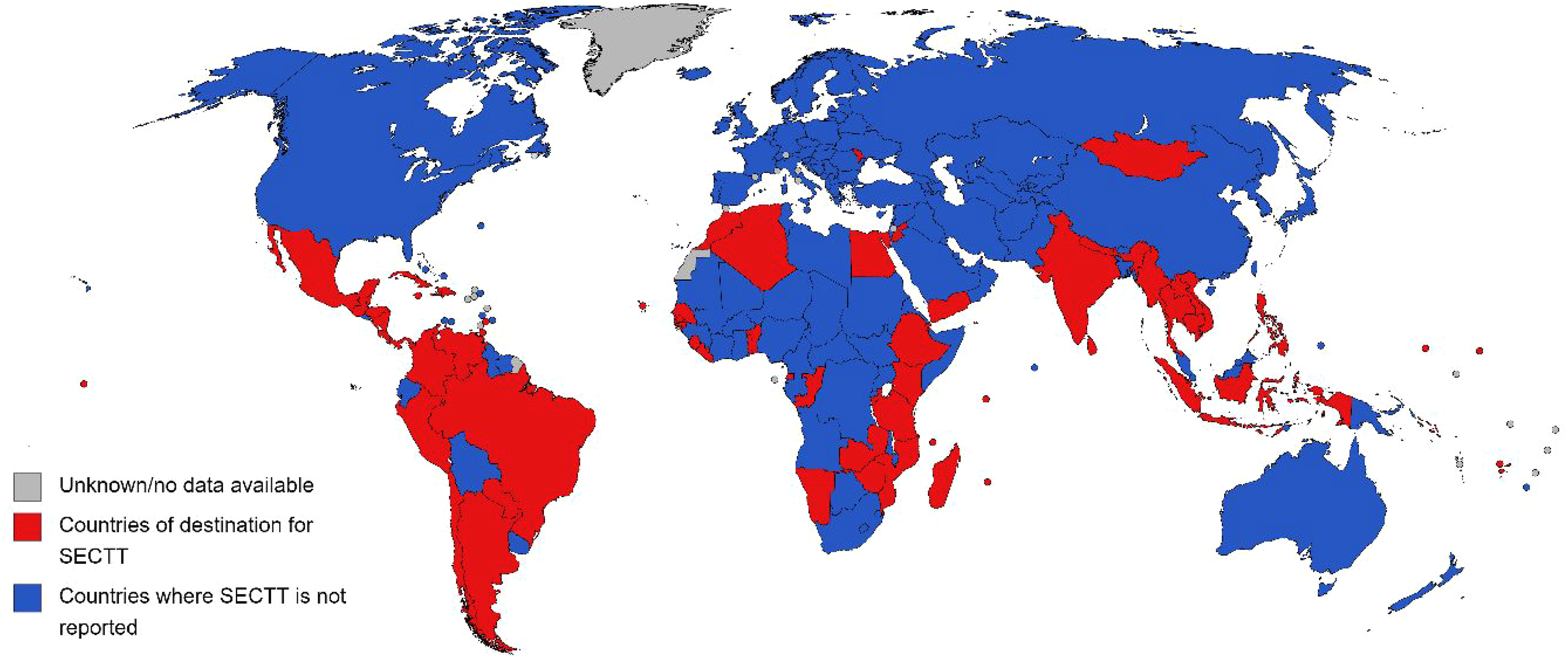
Countries of destination for SECTT.
Recognized as a valuable source for human trafficking research (see e.g., Van Dijk & Klerx-Van Mierlo, 2014; Zhang & Pineda, 2008), the application of the TIP reports to the study of SECTT offers new opportunities. Although using this particular source could introduce its own intrinsic biases, which we briefly reflect upon, we nonetheless argue that these do not pose a substantial problem for our current analysis. First, unlike other international monitoring or compliance mechanisms, TIP is not negotiated through international legal channels and is unilateral by nature. Nevertheless, the TIP reports are seen as the dominating anti-trafficking monitoring reports worldwide, and its influence stretches far beyond the United States. For the current analysis we solely utilize TIP as a source of information, and make no claims about the effects of the policy framework it pertains to. Second, the TIP reports have been criticized for perpetuating ill-founded claims about the magnitude of the trafficking problem (Merry, 2016; Weitzer, 2015). Acknowledging that quantifications in this domain are often unreliable, we systematically coded the dependent variable in a binary way (destination or not), thereby circumventing measurement issues. Thirdly, TIP reports’ lack of transparency and accountability about data collection methods has been criticized (Sikka, 2019; Weitzer, 2015). Nevertheless, this lack of transparency only poses a problem if there is reason to believe that data are vulnerable to systematic bias across countries in the coding of SECTT involvement, of which we found no indication. All countries are reported on using uniform definitions, and our coding protocol ensures a systematic approach independent from “child sex tourism” framing. Sensitivity analyses show no evidence of systemic bias in the State Department's judgment on SECTT destination countries depending on Tier allocation. 4 In conclusion, despite its limitations, we believe TIP is the most suitable source available for the purpose of the current study, specifically the codification of each country for its involvement in SECTT as a (non)destination country.
Independent Variables
We include variables in four areas that may be related to the occurrence of SECTT in a country: tourism, children's living conditions, governance, and economic development.
The number of incoming travelers and tourists represents the possible offenders of SECTT traveling into a country (“demand side”), while the (lack of) protection of fundamental children's rights in the country represents the availability of children who could be vulnerable to sexual exploitation (“supply side”). The latter is measured by the KidsRights Index (KRI; KidsRights Foundation and Erasmus University Rotterdam, 2018), which we selected due to its wide coverage of countries of the world. The index (α = 0.957) represents the extent to which countries adhere to children's rights based on estimates on five domains: (1) life (i.e., under-five mortality rate; life expectancy at birth; maternal mortality ratio); (2) health (i.e., underweight; immunization; use of improved drinking water sources; use of improved sanitation facilities); (3) education (i.e., expected years of schooling girls & boys; gender inequality in expected years of schooling); (4) protection (i.e., child labor; adolescent birth rate; birth registration); and (5) enabling environment for child rights (i.e., non-discrimination; best interests of the child; enabling legislation; best available budget; child participation; collection and analysis of disaggregate data; state-civil society cooperation for child rights). The first four domains use quantitative data from UNICEF and UNDP, while the fifth is coded from the Concluding Observations adopted by the UN Committee on the Rights of the Child. In turn, tourism is operationalized as the number of inbound international tourist arrivals (per million) in 2017 (World Bank, 2020b).
Governance reflects various aspects of a country's institutional or governmental quality, including rule of law. Here, we use the Worldwide Governance Indicators (World Bank, 2018), an index (α = 0.961) based on six domains: (1) voice and accountability; (2) political stability and absence of violence/terrorism; (3) government effectiveness; (4) regulatory quality; (5) rule of law; and (6) control of corruption.
Fourthly, in line with much comparative research, we use GDP per capita, based on purchasing power parity in current international dollars (per thousand) in 2017 (World Bank, 2019), as a measurement of affluence of a country, and more broadly as a representation of economic development. Following La Porta et al. (1999), we also include latitude (i.e., distance from the equator) as a more stable proxy for economic development and relevant control variable (Google, 2020).
In addition, we conducted sensitivity analyses with two alternative indices for children's living conditions and governance, and with population size; the results for these checks were very similar to the overall model (see the section “Sensitivity Analyses”).
Multicollinearity and Correlations
The dataset was screened for outliers (none were found) and checked for common sources of bias. Multicollinearity is a particularly relevant potential source of error, since the number of countries is limited by definition, and country characteristics are known to be interrelated. For example, previous research has shown a relation between economic factors and the quality of government in a country (La Porta et al., 1999), between governance and children's living conditions (Emamgholipour & Asemane, 2016), and between tourism growth and economic development (Cárdenas-García et al., 2015). Therefore, the number and kind of variables that could be entered into the model was limited, and we performed careful checks of multicollinearity potential. As a first indication, Table 1 displays the relations between the independent variables in our model. Correlation coefficients vary between moderate (.277) and quite strong (.685). Inspection of the variance inflation factor (VIF) scores indicated no serious problems with simultaneous inclusion in the model. 5
Pearson Correlations Between Independent Variables.
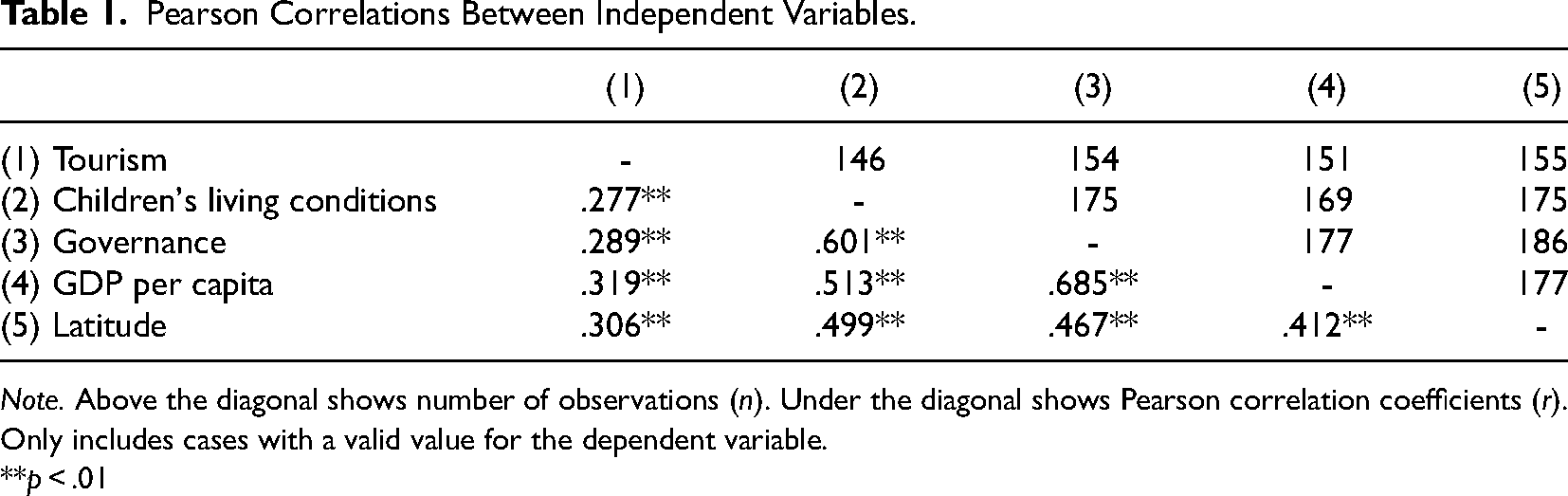
Note. Above the diagonal shows number of observations (n). Under the diagonal shows Pearson correlation coefficients (r). Only includes cases with a valid value for the dependent variable.
**p < .01
Overall, the correlations between the independent variables show a trend that living conditions for children are generally better in countries with a high quality of government, which are richer, farther from the equator, and receive more tourists. While countries with more inbound tourists also have a higher per capita income and stronger governance, as well as better children's living conditions, distance away from the equator is correlated to more tourism. This correlation likely reflects an indirect relationship, demonstrating that more tourists tend to travel to more developed countries.
Results
Bivariate Analyses
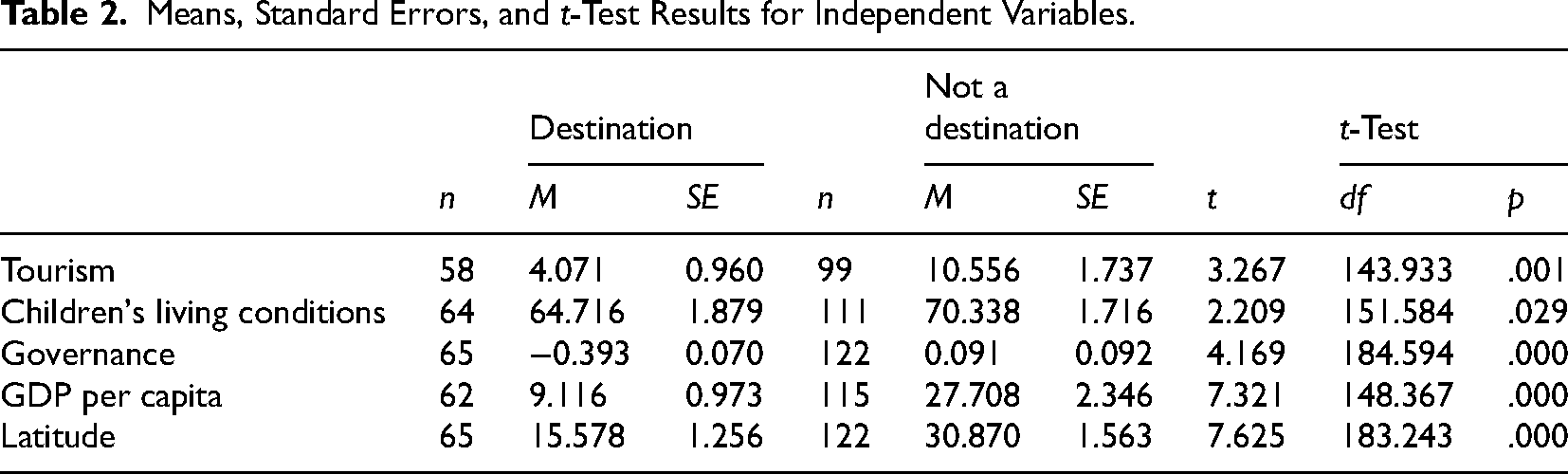
Independent-samples t-tests were conducted to compare the independent variables in SECTT destination countries to non-destinations (Table 2). On average, destination countries are significantly closer to the equator and poorer. Destinations also score significantly lower on governance and the protection of children's rights in the country. Finally, destination countries have significantly less inbound tourists than non-destination countries. While contrary to our hypothesis, this reflects the emanating pattern from the correlation matrix.
Means, Standard Errors, and t-Test Results for Independent Variables.
Regression Models
Due to the nature of the dependent variable, binary logistic regressions were conducted of determinants of SECTT destination countries. The regression results are presented hierarchically (step-by-step) to better understand how the effects of one variable are strengthened or diminished after the inclusion of other variables into the model.
The first step of the regression model in Table 3 assesses the influence of tourism and children's living conditions, thereby exploring theories about the “demand” and “supply” side. Although the negative effect of tourism is contrary to our previous expectations, the finding is consistent with the pattern in the correlation matrix (Recall that the number of incoming tourists is positively correlated with the other variables.). As expected, children's living conditions significantly and negatively affect the odds of being a SECTT destination. Countries where children's rights are not well protected are more likely to attract SECTT.
Coefficients of the regression model predicting whether a country is a destination for sexual exploitation of children in travel and tourism (N = 144).
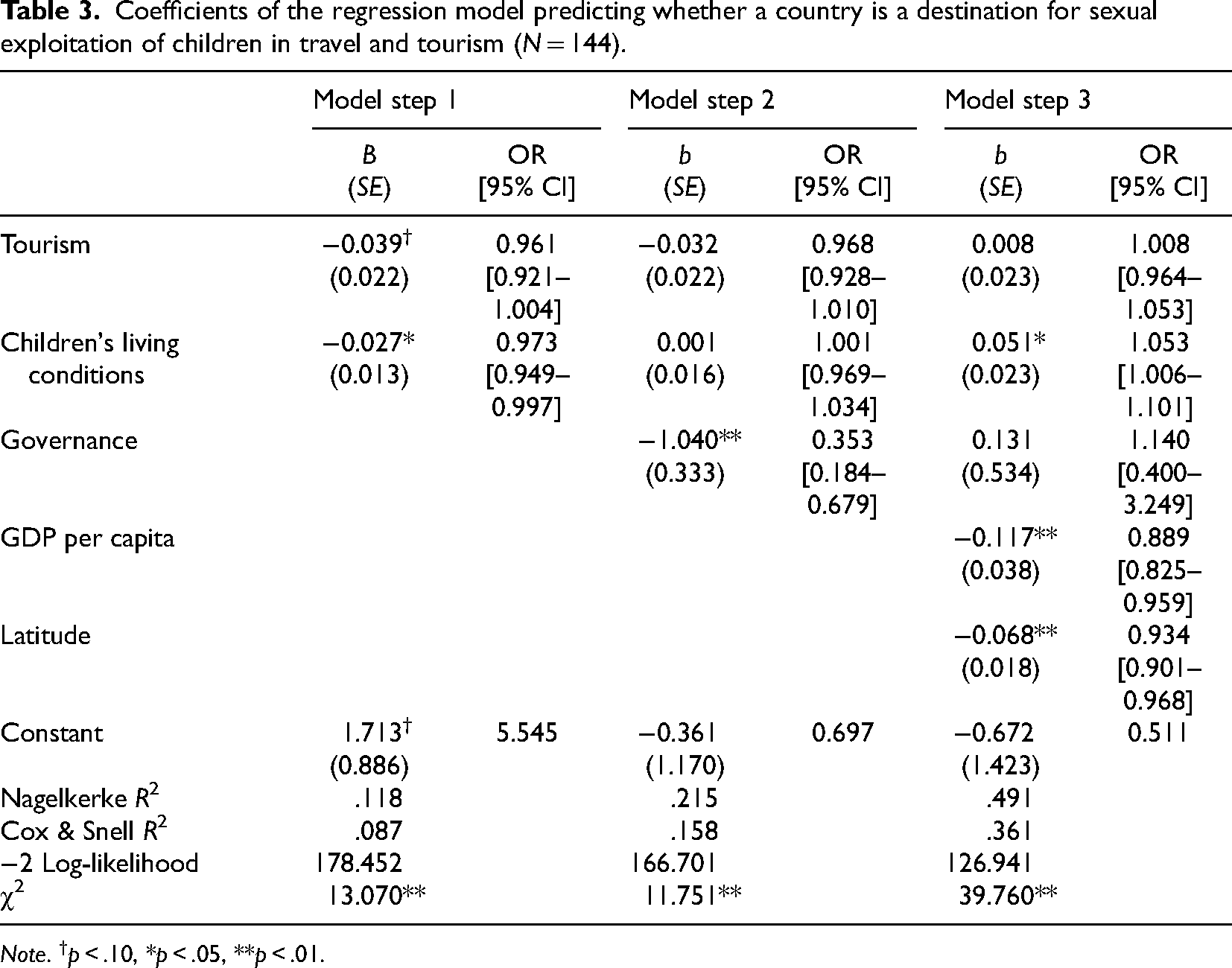
Note. †p < .10, *p < .05, **p < .01.
In the second step, the effects of tourism and children's living conditions become insignificant when controlled for governance. As predicted, stronger governance decreases the odds of becoming a destination country for SECTT. In the final model (step 3), however, the negative effect of governance loses significance when controlling for per capita income and latitude. In other words, when taking into account how poor they are, countries with weak governance do not specifically have a larger chance of being a destination country for SECTT.
Most prominently, the final model reveals the significant adverse effect of both per capita income and latitude on the odds of being a destination country, indicating that poorer countries and countries closer to the equator are more likely to be a destination country for SECTT.
The results of children's living conditions in the final model are striking: the initial negative effect is reversed when per capita income and latitude are entered into the model. The positive sign suggests that countries with better conditions for children have a higher chance of being a destination country for SECTT, when we take their economic development and geographic location into account. Thus, although on average destination countries score lower on children's living conditions (Table 2), a reversed relation between children's living conditions and occurrence of SECTT appears when correcting for factors related to affluence.
Sensitivity Analyses
To assess the stability and robustness of these results, we conducted four sensitivity checks. 6 First, analyses were repeated with an alternative measurement for children's living conditions. Replacing the KRI with the Child Development Index (Save the Children, 2012) yielded similar results, with a positive significant effect of children's development on the odds of being a destination country in the final model. This indicates that our findings are robust, even with an alternative measure for the protection of children's rights. Second, additional analyses were conducted with corruption, measured by the Corruption Perception Index (Transparency International, 2018), as substitution for the governance variable. This also led to similar results. Third, we repeated the analyses on only the poorest half of the countries to see if this revealed clues of nonlinear relationships or otherwise supported alternative explanations. The results substantiated the findings and interpretations of the above model. Fourth, population size (World Bank, 2020a) was added as additional control variable to test the hypothesis that smaller countries would be less likely to become SECTT destinations. This was not the case, and the results of the model in Table 3 were substantiated once more.
Additional Analyses on Children's Living Conditions
To further investigate what could explain the unexpected finding about children's living conditions, we zoom in on subdomains composing the indices. Note that the KRI is composed of indicators in five domains: protection of the rights to life, health, education, and protection, and an enabling environment for child rights.
Bivariate analyses (not displayed) show expected and similar patterns for the first four domains, but child rights environment has a divergent trend. Destination countries score significantly lower on the domains of life, health, education, and protection than non-destination countries. However, there is no significant difference in the child rights environment; destination countries do not have a less or more enabling environment for children's rights than non-destination countries. Furthermore, the life, health, education and protection indicators significantly and strongly correlate with each other and with all independent variables. In contrast, child rights environment relates to no other domain and only significantly correlates to governance (r = .154, p = .037).
Table 4 shows the complete regression models with each of the child rights subdomains. Overall, the established pattern is repeated: when controlled for per capita income and latitude, the direction of the effect on the risk of being a destination country for SECTT reverses. Two subdomains have positive effects that cross the threshold of significance: life and education. This means that, controlling for GDP and latitude, countries that have better protected children's right to life (i.e., higher life expectancy, lower under-five mortality rate, less maternal mortality) and education (i.e., more expected years of schooling for both girls and boys, lower gender inequality in schooling) are more likely to be a destination country for SECTT. In turn, health and protection are not significant predictors in the complete model. Child rights environment once again does not predict SECTT destination countries. Sensitivity checks indicated overall robustness of the results.
Coefficients of the model predicting whether a country is a destination for sexual exploitation of children in travel and tourism.
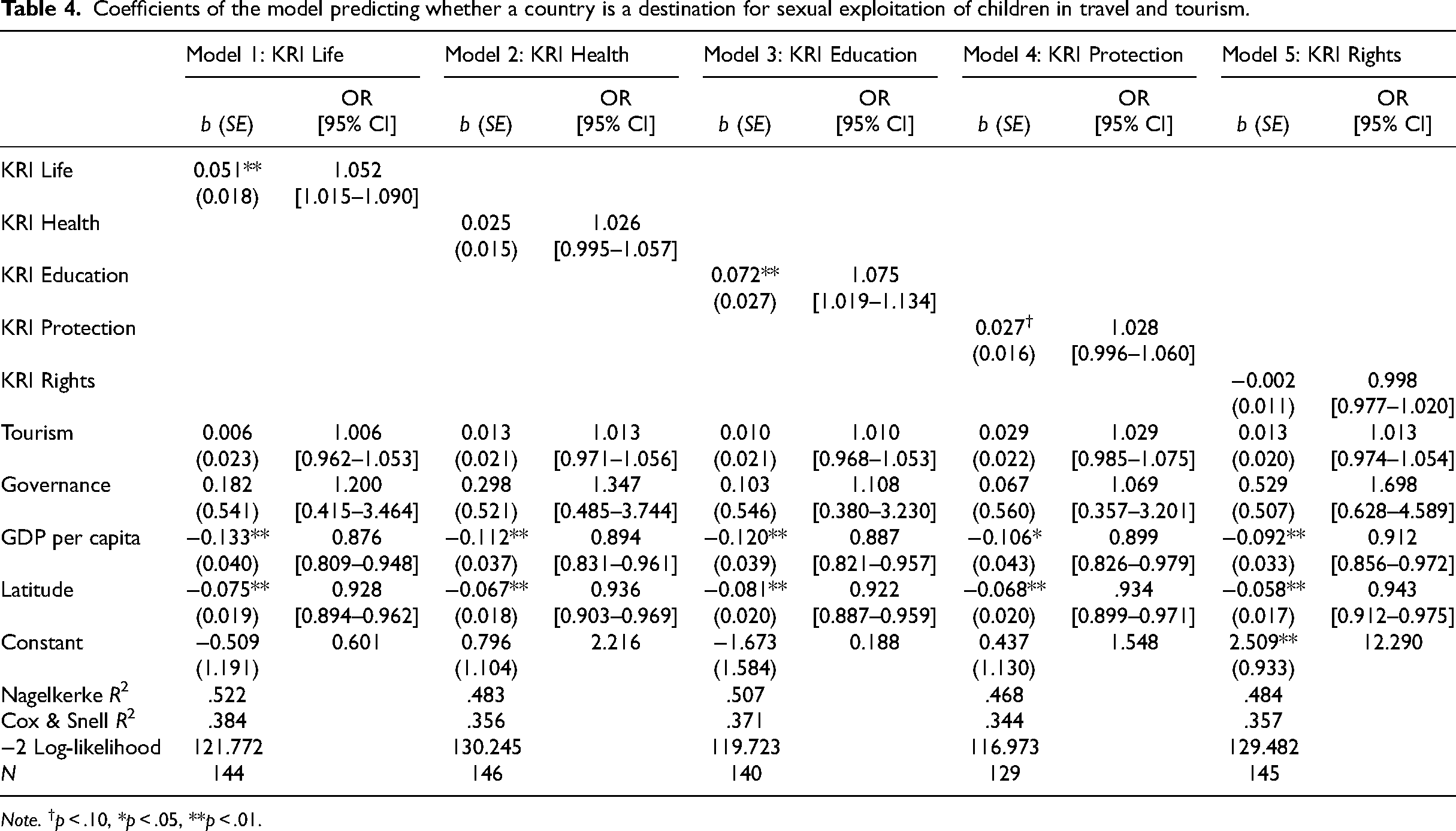
Note. †p < .10, *p < .05, **p < .01.
Discussion
This study examined factors that are assumed to relate to the occurrence of SECTT in a country. Why are certain countries more likely to become a destination for this phenomenon than others? We test the assumptions from previous scientific and grey literature statistically and in doing so assess different potential explanations. To our knowledge, this is the first effort using cross-national comparative data on SECTT in combination with data on contextual characteristics that may hamper or facilitate SECTT to study risk factors at a global scale. So far, the scarce empirical research on SECTT has typically been case studies of countries (e.g., Chemin & Mbiekop, 2015; Miller, 2011; Montgomery, 2008) or, at best, comparisons of a few countries (e.g., Blackburn et al., 2010; Huynh et al., 2010; Tanielian, 2013).
As potential risk factors, we focused on the number of potential offenders entering a country (demand for sexual exploitation of children by foreigners), children's living conditions (supply of potential victims), quality of government, and economic development. We find that poor countries are more likely to be a destination for SECTT than rich ones, and countries closer to the equator are more at risk than countries closer to the poles. The inclusion of economic development in the model diminishes the effect of governance, and reverses the effect of children's living conditions on the risk of becoming a destination country. The findings prove to be robust if alternative indicators for key concepts are used, such as for children's living conditions.
These results present evidence of the systematic relationship of (geo-)economic variables, which are known to be quite constant over time, with being a destination for SECTT. Lack of economic development, more than any of the other indicators, is associated with the occurrence of SECTT in certain countries of the world. This supports the thesis that structural global inequalities lie at the root of the problem. In terms of solutions to combat SECTT, it implies that SECTT needs to be addressed within a development framework, with attention to reducing economic inequality between and within countries. In the long run, poverty alleviation could be the most effective measure to combat sexual exploitation of children by travelers.
Contrary to expectations, neither governance nor corruption had a significant direct effect in the final model. Overall, destination countries for SECTT have weaker governments than non-destination countries, but this effect is diminished when economic variables are taken into consideration. We believe these results reflect the relationship between economic development and quality of government. Generally speaking, more economic development is related to stronger governments; a relationship which has been previously illustrated and examined in a multiplicity of research (e.g., La Porta et al., 1999). Furthermore, many developing countries lack adequate resources for criminal justice agencies, including for material and training (Andrews, 2004), which weakens their ability to effectively protect their citizens and children. Hence, governance (and/or fighting corruption) matters, but it is economic development that matters most evidently. Nonetheless, we would not interpret this finding to reject the notion that strengthening governance could protect countries from becoming breeding grounds for SECTT.
With regards to theories about demand and supply, the results are more difficult to interpret. On the demand side, we find that the number of incoming tourists does not explain which countries become SECTT destinations. This finding holds true when corrected for economic circumstances, and when we only analyze the poorest countries of the world. The question of why is open for future research; a number of potential explanations can be considered. First, as the acronym SECTT (sexual exploitation in the context of tourism and travel) indicates, the problem reaches beyond the tourism industry. This is also reflected in the TIP reports, which occasionally mention migrant workers, such as long-distance truck drivers, fishermen, or construction workers, in connection to sexual exploitation of children. Although the demand for cheap sex also comes from other “transient adult males” (Miller-Perrin & Wurtele, 2017), including migrant workers, business travelers, and volunteers, the operationalization used in this study (based on WTO data) could only include tourists. A second explanation and avenue for further research lies in the types of offenders that are represented (and measured) in the data sources. Perhaps the absolute number of incoming tourists does not predict SECTT destinations, because SECTT offenders differ in their travel destinations from the average tourist. Put differently, it could be that the greatest risk factor isn’t mass tourism, but rather the appeal of a location to those people that are most likely to engage in SECTT or travel for sexual gratification. More research is necessary on offender characteristics and individual risk factors to test this hypothesis. In this context, the relationship between SECTT and international sporting events deserves more academic attention.
On the supply side, the results about children's living conditions are also (partly) contrary to expectations. Overall, destination countries have worse living conditions for children. When controlled for socioeconomic circumstances, however, the effect reverses, so that countries with better children's living conditions are more likely to be a destination country for SECTT. In other words, within the group of countries with similar (poor) economic conditions, SECTT is less likely to occur in countries with worse protection of children's right to life and education. Furthermore, our findings consistently show that children's rights environment, significantly correlated to governance, does not significantly impact the risk. The correlation with governance provides evidence for the idea that the measure for an enabling child rights environment is rooted in a country's institutional quality; or, alternatively, that countries with better governance scores are ranked more favorably by the UN Committee on the Rights of the Child, leading to higher scores on this indicator.
These findings should not be taken to mean that promoting children's living conditions causes SECTT. Instead, we believe our analyses support the interpretation that SECTT occurs in those countries where economic circumstances are dire (and, by extension, the work of institutions that depend on them is weak), but children are nonetheless available as a “commodity” for sexual exploitation. Simply put, within the group of poor countries, SECTT happens in those countries where children have a higher life expectancy and even attend (some) school, rather than in poor countries where children are, for example, dying young, underweight, uneducated, or enlisted as child soldiers or employed in other forms of child labor. Poor countries where offenders can nonetheless expect to meet healthy youth who speak their language are more attractive destinations than parts of the world where the sight of suffering children can trigger feelings of guilt. Possibly, SECTT destination countries go through a transition period in which unfavorable socioeconomic circumstances coincide with improvements in basic living conditions for children, such as food and education; yet despite these improvements, the struggle for economic survival manifests itself in SECTT, where children are commodified. To investigate this further, we urge for longitudinal research about the risk factors for SECTT, relating changes in risk to changes in socioeconomic circumstances and children's living conditions.
Implications and Limitations
This study examined the statistical evidence regarding some of the most frequently made claims in the available scholarly and grey literature about the risk factors for countries to become a SECTT destination. We offer several suggestions for additional variables of interest that might help explain the occurrence of SECTT, based on the findings from our models. First, future research could include measures of relative deprivation of countries compared to their neighbors. Perhaps it is not just absolute prosperity, measured against the rest of the world, that matters, but rather development compared to other countries in the region, which makes countries an attractive destination for travelers and sex offenders from wealthier countries in the region to visit. Second, the effect of conflict and political instability in neighboring countries could be investigated; this could increase the supply of vulnerable children in the country of refuge, but also have a protective effect with regards to the presence of SECTT as countries become less attractive travel destinations.
Finally, a number of limitations need to be considered. First, we underline that the present study examined risk factors for SECTT at a country level. These findings should not be used to make inferences about individual-level risk factors, such as estimating which children are more vulnerable to sexual exploitation (by tourists and travelers) within a country. Second, this study has focused on where in the world SECTT occurs, which is not necessarily the same question as what the causes are of SECTT in general. Eradicating SECTT in one country could pose a real risk of geographical displacement to other countries in the region, or potentially to cyberspace. Whether and under which conditions this occurs is open to future research. Third, the present study was limited to classifying countries’ involvement with SECTT in a simplified binary fashion, due to the lack of reliable data on the occurrence of SECTT. The analysis could be improved by some measure of the magnitude of SECTT in a country rather than just its presence or absence. For the codification of the dependent variable, this study relied on document analysis of a third-party source. As illustrated by our reflection on the strengths and weaknesses of using the TIP reports as source material, the limited transparency about the procedure makes it impossible to eliminate all concerns about potential bias in this document. The development of more nuanced, reliable, and globally available data sources and theories is needed to enable the investigation of more intricate research questions about the occurrence of SECTT.
Given the scarcity and shortcomings of existing data, this study has explored what image emerges from cross-nationally available data about the context of SECTT. Notwithstanding the limitations, this study demonstrates that a systematic codification of TIP reports can be used to test hypotheses about the prevalence of SECTT in a country and its risk factors. In doing so, we hope to advance a research field where untested expert opinions shape most of what we know thus far about the phenomenon.
Supplemental Material
sj-docx-1-icj-10.1177_10575677221081875 - Supplemental material for The Context of Sexual Exploitation of Children by Tourists and Travelers: A Cross-National Comparison of Destination Countries and Non-Destination Countries
Supplemental material, sj-docx-1-icj-10.1177_10575677221081875 for The Context of Sexual Exploitation of Children by Tourists and Travelers: A Cross-National Comparison of Destination Countries and Non-Destination Countries by Anneke Koning and Johan van Wilsem in International Criminal Justice Review
Footnotes
Acknowledgments
The authors are grateful to Masja van Meeteren, Joanne van der Leun, Stephanie Rap, and anonymous reviewers for feedback on previous versions of this paper. Special thanks to Lonneke Wevers for invaluable research assistance.
Declaration of Conflicting Interests
The authors declared no potential conflicts of interest with respect to the research, authorship, and/or publication of this article.
Funding
The authors disclosed receipt of the following financial support for the research, authorship, and/or publication of this article: This work is part of the research program “Child sex tourism: A systematic examination of responses against a global problem” with project number 406.16.564, which is financed by the Dutch Research Council (NWO).

Supplemental Material
Supplemental material for this article is available online.
Notes
Author Biographies
References
Supplementary Material
Please find the following supplemental material available below.
For Open Access articles published under a Creative Commons License, all supplemental material carries the same license as the article it is associated with.
For non-Open Access articles published, all supplemental material carries a non-exclusive license, and permission requests for re-use of supplemental material or any part of supplemental material shall be sent directly to the copyright owner as specified in the copyright notice associated with the article.
