



Abstract
This study examines the impact of social and spatial distance on public opinion about sexual exploitation of children. A randomized vignette experiment among members of a Dutch household panel investigated whether public perceptions of child sexual exploitation were more damning or more lenient when it occurred in a country closer to home, and explored theoretical explanations. The results show that offenses committed in the Netherlands or U.S. are overall perceived as more negative than those committed in Romania or Thailand. Social distance affects public perceptions about crime severity, and victims are attributed more responsibility in socially close than socially distant conditions. The study concludes that public perceptions are contingent upon the crime location, even when applied to child sexual exploitation.
Introduction
Child sexual abuse and sexual exploitation of minors happens all over the world. While some perpetrators offend in their home country, others victimize children across national borders. This transnational child sex offending or “child sex tourism,” here referred to as sexual exploitation of children in the context of travel and tourism (SECTT), 1 has received growing attention in recent decades from governments, NGOs, and academics as a serious issue. It is an elusive and hidden crime, and while “hard data” about the extent of the phenomenon are rarely available (George & Panko, 2011; Montgomery, 2008), estimates suggest that between 1 and 2 million children are victims of sexual exploitation worldwide (Hall, 2011; International Labour Office, 2012). Victimization can have far-reaching and long-term physical, psychological, emotional and social consequences on children (see e.g., Chen et al., 2010; de Jong et al., 2015; Fergusson et al., 2013; Rogstad et al., 2016).
Increasingly in the past decades, countries of origin have implemented policy and legal measures to prevent their citizens from getting away unpunished with child sexual exploitation abroad (Atwell, 2014; Curley, 2014; Curley & Stanley, 2016). Australia, the United States (U.S.), and many European countries have enabled extraterritorial application of their criminal law to prosecute nationals for child sexual abuse crimes committed abroad (Ireland-Piper, 2011; McNicol & Schloenhardt, 2012; Seabrook, 2000). Passport revocation of known sex offenders has been suggested as a demand-side preventive approach (Hall, 2011). It appears that Western governments now widely support the notion that what is not permitted at home should also not be tolerated elsewhere, and that action must be taken to stop wrongdoing by citizens abroad.
Punitive responses against child sex offenders generally receive strong public support public support, and public opinion about child sex crimes is especially condemning (e.g., Mears et al., 2008; Stafford & Vandiver, 2017; Thakker, 2012). Yet research has been remarkably silent about the public perception of sex crimes when they are committed against children abroad. For a crime type such as SECTT, which is by nature hidden, the study of public perception is of particular relevance. Law enforcement frequently relies on public engagement to gather intelligence about crime locations and suspects, and public education campaigns (e.g., ‘Don’t Look Away’ by Defence for Children – ECPAT Netherlands, n.d.) have sought to stimulate travelers to report suspicious signals of potential child sexual exploitation when traveling abroad. A lack of public support for government measures to combat SECTT could undermine the legitimacy and effectiveness of a response, while public convictions about the severity and importance of stopping SECTT could boost efforts to combat the phenomenon. Decisions from policy makers and criminal justice actors are, in various ways, informed and influenced by public opinion (Richards, 2019; Ryberg & Roberts, 2014; Sample & Kadleck, 2008). Understanding which factors shape public opinion about child sex crimes can therefore inform policy debates, legal responses, and more effective prevention strategies, both domestically and abroad (Mears et al., 2008; Pickett et al., 2013; Richards, 2019).
Only two studies have examined public perception of SECTT previously. The latest known investigation of European public opinion about “child sex tourism” dates back over two decades, and shows general consensus that SECTT is not morally acceptable (INRA, 1998). 2 More recently, research from the U.S. found that Americans judge an incident of child sexual exploitation abroad as less serious compared to the same crime occurring in their own country. Moreover, child sex crimes committed in the U.S. and the Netherlands were rated by the American public as more severe than when they occurred in Thailand (Kosuri & Jeglic, 2017). The authors interpret these findings through the lens of in-group bias, nationalism, “Othering,” a distinction between “Western” and “Eastern” cultures, and the negative portrayal of sex offenders in the media; however, the study’s three-condition research design precludes tests of these and alternative theoretical explanations.
This study examines public perceptions with a focus on the Netherlands, which is an interesting unit of analysis for several reasons. First, there is a dearth of academic research on this topic from outside the U.S; as noted by Stafford and Vandiver (2017, p. 464), the majority of studies about public perception of sex offenders are American, “and perceptions of Americans likely differ from those people in other nations.” Second, studying the Dutch perspective mirrors Kosuri and Jeglic’s (2017) research, in which the Netherlands was one of three experimental conditions, making the Netherlands a compelling focal point for a comparison between the Dutch and American public. Third, just like the U.S., the Netherlands is a country of origin for SECTT (Vogelvang et al., 2002). Although the size of the problem of Dutch traveling child sex offenders is unknown (Moerenhout, 2013), research from neighboring Germany estimates that 4.4% of males has sexual fantasies about children, and 0.3 to 0.4 percent has traveled to a foreign country with the intention to have sex with a child (Dombert et al., 2016; Koops et al., 2017). Studying Dutch public perceptions about child sexual exploitation could therefore guide the improvement of government measures and educational campaign messages to combat SECTT from the Netherlands and other sending countries.
Given the dearth of information about public opinion of child sexual exploitation, in particular outside of the U.S., as well as the limited understanding of factors that influence it, the aim of the present study is to gain insight in the role of social and spatial distance in shaping citizens’ public perception about child sexual exploitation, both domestically and abroad. Are public perceptions of child sexual exploitation more damning or, inversely, more lenient when the crime occurs closer to home? And how could these differences between crime locations be explained? This study extends previous research by testing the application of the theoretical framework of social and spatial distance, which is elaborated in the next section. The third section describes the randomized vignette experiment. In the fourth section, the main results are presented, which show that public perceptions differ depending on the crime location. Finally, we conclude and comment on the implications of these findings.
Theoretical Framework
“In the end. . . we are one world, and that which injures any one of us, injures all of us”
– Eleanor Roosevelt
“That’s a far-from-my-bed-show”
– Dutch proverb, signifying that something is far removed from the speaker’s personal life
While some have argued that the rise of technology and globalization has led to the “death of distance” altogether (Cairncross, 1997), construal level theory (CLT; Liberman et al., 2007; Trope & Liberman, 2010) suggests that “far from being dead, distance can fundamentally change the way we think about and behave toward the world” (Henderson & Wakslak, 2010, p. 390). In CLT, the distance of a stimulus from the perceiver’s direct (subjective) experience, i.e. the “psychological distance,” is believed to be related to the way people think about objects or events by affecting the perceiver’s construal of them. The larger the perceived psychological distance, the more people rely on more abstract and general mental representations, which in turn are related to stereotyping (Henderson & Wakslak, 2010; Magee & Smith, 2013). The evaluation of psychological distance is an automatic cognitive process and an important determinant of perception and action (Bar-Anan et al., 2007). Research on psychological distance has focused on four dimensions: social, spatial, temporal, and hypotheticality (Liberman et al., 2007). Of relevance for the current research are the first two: social and spatial distance.
Social distance refers to the subjective perception of distance toward other persons or social groups. 3 In social psychological terms, the idea that people will favor others to whom they feel close (in-group) over people they perceive to be socially distant (out-group) is known as in-group favoritism or intergroup bias. In extremity, this intergroup bias can manifest as “Othering,” that is the construction of a superior self/in-group in contrast to an inferior other/out-group, where this superiority/inferiority is nearly always left implicit (Brons, 2015). From the outset, the concept of social distance was related to the concept of prejudice, with Park (1924, p. 343) defining prejudice as the “disposition to maintain social distances,” and Georges-Abeyie (1992) later linking excessive social distance to xenophobia, discrimination and biases in the criminal justice system. Greater social distance has been associated with increased belief in rape myths and sex role stereotypes (Shechory & Idisis, 2006). As such, social distance may influence attitudes toward both (sex) crime victims and offenders. For instance, Grubb and Harrower (2009) demonstrated that female rape victims were attributed more blame when participants feel more similar to the male perpetrators and dissimilar to the victims. These findings are in line with Shaver’s (1970) work on defensive attribution, which predicts that observers who see themselves as similar to victims will attribute less blame to victims and more to contextual or situational factors. Similarly, research on child sexual abuse suggests that the degree to which members of the public are, or perceive themselves to be, similar to the victims is related to the attribution of responsibility to the victim for the abuse (Back & Lips, 1998; Harding et al., 2010).
The second factor impacting crime perceptions is the spatial distance between the participant and the crime scene: the greater the geographical distance to the crime location, the further away it feels for people. For the average citizen, child sexual exploitation abroad may be quite “far-from-their-bed,” in a literal sense. Like other dimensions of psychological distance, spatial distance has been shown to impact how people think about everyday events and objects (Matthews & Matlock, 2011). However, the impact of spatial distance on perceptions has generally received little academic attention. 4 Moreover, the study design by Kosuri and Jeglic (2017) is limited to only three conditions, which means it cannot shed light on the question whether found differences between conditions could be attributed to the impact of spatial distance (i.e., distance from participants’ home), or to a nationalist focus stemming from the distinction between “domestic” and “abroad.”
Based on the theoretical framework of construal level theory, social distance and in-group favoritism, the following three hypotheses can be formulated:
Hypothesis 1: Participants have more negative perceptions of child sexual exploitation when it happens in their own country compared to abroad (i.e., the crime is evaluated as more severe, violent and morally repulsive; the offender is evaluated as more dangerous, and participants report more anger toward him and less sympathy; and participants report more sympathy to the victim, evaluate the harm as greater, and attribute less responsibility to the victim).
Hypothesis 2: Participants have more negative perceptions of child sexual exploitation when it happens in locations that share a similar culture than in locations that are considered socio-culturally different.
Hypothesis 3: Participants have more negative perceptions of child sexual exploitation when it happens in locations that are spatially close to their country than in locations that are spatially farther away.
Data and Method
Research Design
Online vignettes were used in a between-subjects experimental design to investigate whether perceptions of child sexual exploitation are contingent upon the crime location. Building on and expanding Kosuri and Jeglic’s (2017) research, the current study randomly assigned participants to one of four vignettes, each describing a fictitious story about a 45-year-old married Dutch man who develops a sexual desire for underaged girls. To satisfy his fantasies, he decides to travel outside of his place of residence and, with the help of a specialized travel agency, engages in sexual contact with a 12-year-old local girl (see Supplemental Appendix 1 for the translated vignette text). The vignettes only differed in his destination, that is where the sexual contact with the minor occurred, namely Amsterdam (The Netherlands), Los Angeles (U.S.), Bangkok (Thailand), or Bucharest (Romania).
The selection of these four destinations is based on several considerations. First, the first three countries of destination are the same as those selected by Kosuri and Jeglic (2017), which enables a comparison between the studies (and thus, between the Dutch and American population). Second, the addition of a fourth condition enables the testing of the study’s three hypotheses based on an expanded theoretical framework. These four experimental conditions (see Table 1) were conceived to reflect locations that are spatially far or relatively close, and locations that are perceived as socially distant or close based on the global culture zones (e.g., Welzel, 2011; Inglehart and Welzel, 2005; Welzel et al, 2003). Third, these specific cities were chosen because all (are rumored to) have a flourishing (il)legal sex industry, while being of comparable size and importance within their countries.
Overview of Vignette Conditions by Spatial and Social Distance.
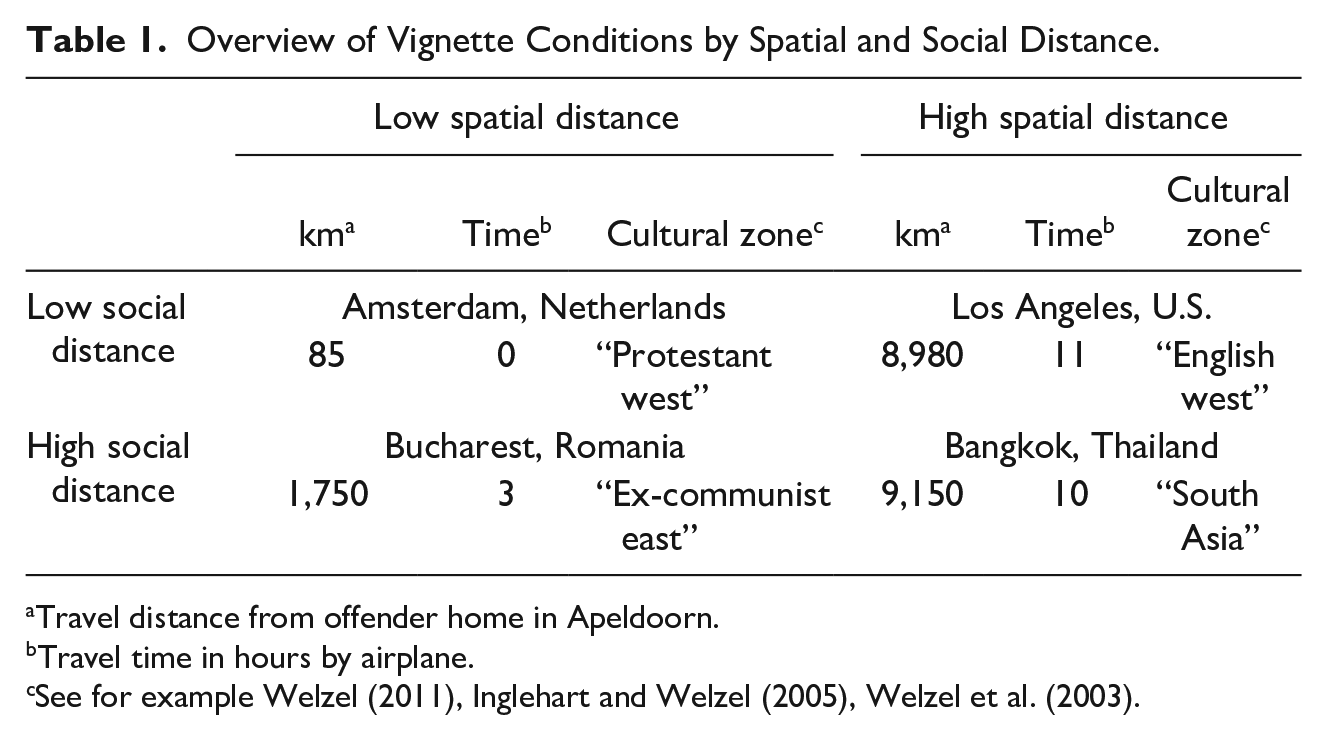
Travel distance from offender home in Apeldoorn.
Travel time in hours by airplane.
See for example Welzel (2011), Inglehart and Welzel (2005), Welzel et al. (2003).
Procedure and Sample
Data were collected through an online research panel bureau among a representative sample of Dutch adults (aged 18 and up). 5 Members of this panel are recruited through random sampling using population records. Participants were compensated for participation through a point system used by the bureau. From 17 until 31 August 2020, a total of 2,000 members were invited to complete the online questionnaire via e-mail. The survey’s estimated completion time was 10 minutes. Panel members were told that the research was about opinions, ideas and decisions about others’ sexual behavior, and that they would read a short fictitious story. The study description was intentionally left neutral to avoid loaded terms such as “child sexual abuse,” which could lead to priming or socially desirable answers. Upon completing the survey, participants were shown a debriefing page that explained the purpose of the study and contact information of two relevant national support organizations relating to sexual victimization and feelings of sexual attraction to children. 6 The research proposal and experiment materials were reviewed by the Ethics and Data Committee of Leiden Law School (no. 2020-015).
A total of 956 participants completed the survey in full (47.5% response rate). 7 Observations from seven participants were excluded because they had tried to participate in the survey twice and seen different vignette conditions. 8 The final sample, then, consisted of 949 Dutch adults.
Demographics
Data were collected on various participant demographics. Items with answer categories similar to the European Social Survey measured participants’ religious and cultural background. 9 For cultural background, participants could check at most two heritage groups or enter an “other, namely” field. 837 participants self-identified their cultural background as solely Dutch. 10 About a quarter (n = 234) indicated to view themselves as a member of a religious faith or community, most frequently Protestant Christian (54.7%) or Roman Catholic (32.3%).
Gender, age group, education level, household composition, and place of residence were obtained from the panel bureau for each participant who completed the survey (i.e., measured independently from the experiment). As seen in Table 2, the majority of the sample was male (54.2%). Nearly a quarter of the sample (n = 231) lived with children in the household. Data on participants’ province of residence and education level largely mirrors that of the Dutch adult population, with 38% indicating an associate or university degree. Preliminary correlation matrices indicated that none of the demographic variables yielded r > .10 with the assigned condition.
Demographics of Study Sample: Age Group, Gender and Cultural Background.
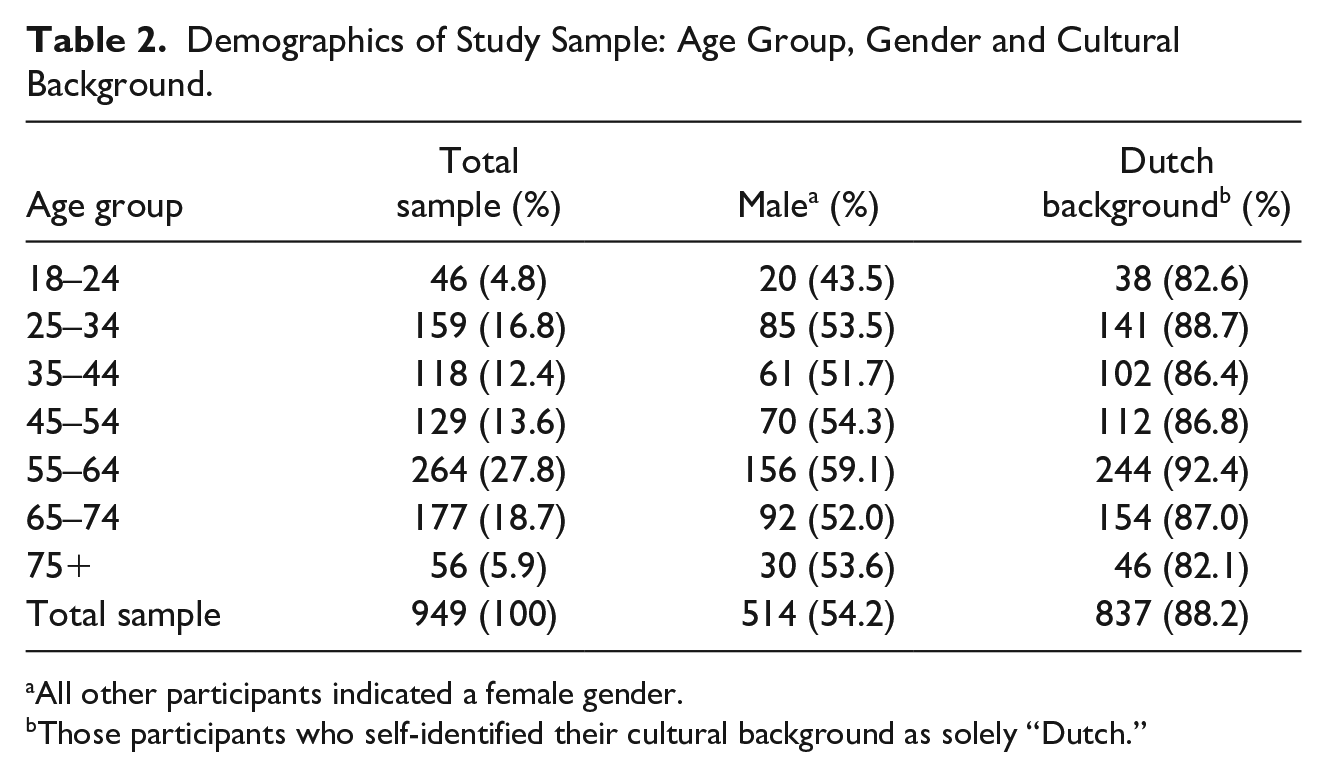
All other participants indicated a female gender.
Those participants who self-identified their cultural background as solely “Dutch.”
Measures
Dependent variables
Nine dependent variables assessed perception of the vignette event on a Likert scale from 0 (not at all) to 10 (extremely). Of these, three examined the overall incident (severity, violence, badness), three focused on the offender (dangerousness, anger, sympathy), and three on the perception of the victim (harm, blame, sympathy). Supplemental Appendix 2 includes the full item wording. Dependent variables correlated significantly with one another, but did not display multicollinearity. 11
Independent variable
To test the study’s hypotheses, the four conditions were recoded into three separate dummy variables. First, to assess hypothesis 1, cases were recoded into Netherlands versus abroad (Romania, Thailand, and U.S.); for hypothesis 2, socially close (Netherlands and U.S.) versus socially distant (Thailand and Romania); and spatially close (Netherlands and Romania) versus spatially distant (Thailand and U.S) to test hypothesis 3.
Control variables
While participant characteristics were not correlated with the independent variable, a few did show moderate relationships with the dependent variables. 12 This finding, and more importantly the theoretical relevance of specific variables based on prior research, invites the question whether these variables should be included as controls in the models. Considering the scientific debate about whether control variable inclusion is necessary or even desired within a randomized experiment, the main results are presented without these measurements. In sensitivity analyses, two relevant variables are included as controls: participant gender and whether participants had visited the vignette country. Prior research has identified gender as an important predictor for opinions about sexual violence, with women showing more empathy for victims (Gerber et al., 2004; Jimenez & Abreu, 2003; Katz et al., 2015) and men supporting more rape myths (Banyard, 2008; Hust et al., 2013; McMahon, 2010). Additionally, attitudes may have been influenced by participants’ exposure to a specific destination, as suggested in Allport’s (1954) intergroup contact hypothesis and applied in tourism research since (Fan, 2020; Reisinger & Turner, 2003).
The online experiment was designed prior to the COVID-19 pandemic, but conducted later in 2020 when the virus had spread all around the world. We feared that results from the study could be influenced by the pandemic and the lockdown measures to combat it: for instance, participants’ opinion about the offender and crime seriousness could differ between the Netherlands and Thailand conditions not because of social distance to the crime location, but because participants would judge a person traveling to Thailand in the midst of the pandemic as more irresponsible than someone traveling within the Netherlands. In other words, the COVID-19 pandemic could introduce an unobserved confounding variable to the model. Several measures were taken to address this concern. First, data collection was postponed until the end of summer 2020: a moment when COVID-19 was relatively under control in the Netherlands and travel restrictions were more lenient than they had been in the beginning of the outbreak. Second, a measurement of participants’ anxiety about the coronavirus was included in the measurements, consisting of eight items on a 5-point Likert scale (Fear of the Coronavirus Questionnaire [FCQ], Mertens et al., 2020). 13 Inclusion of this scale allows for sensitivity analyses with participants’ concerns about the coronavirus as a covariate. Furthermore, we could establish that participants’ fear of the coronavirus was equal across the four experimental conditions, F(3) = 0.758, p = .518. Note lastly that the vignette text is completely set in the past: the story starts “a few years ago.”
Analytic Strategy
Three one-way multivariate analyses of variance (MANOVAs) were conducted to test the hypotheses, followed by univariate tests of between-subject effects to illuminate differences between groups. The value of Pillai’s trace (V), generally considered a conservative estimate, is reported in the results. 14 As sensitivity analyses, three multivariate analyses of covariance (MANCOVAs) were run to examine whether the inclusion of control variables (i.e., attitudes about COVID-19, participant gender, and previous visit to the destination country) altered the main models’ conclusions about the effect of crime location on participants’ judgments about the vignette story.
Results
Main Analyses
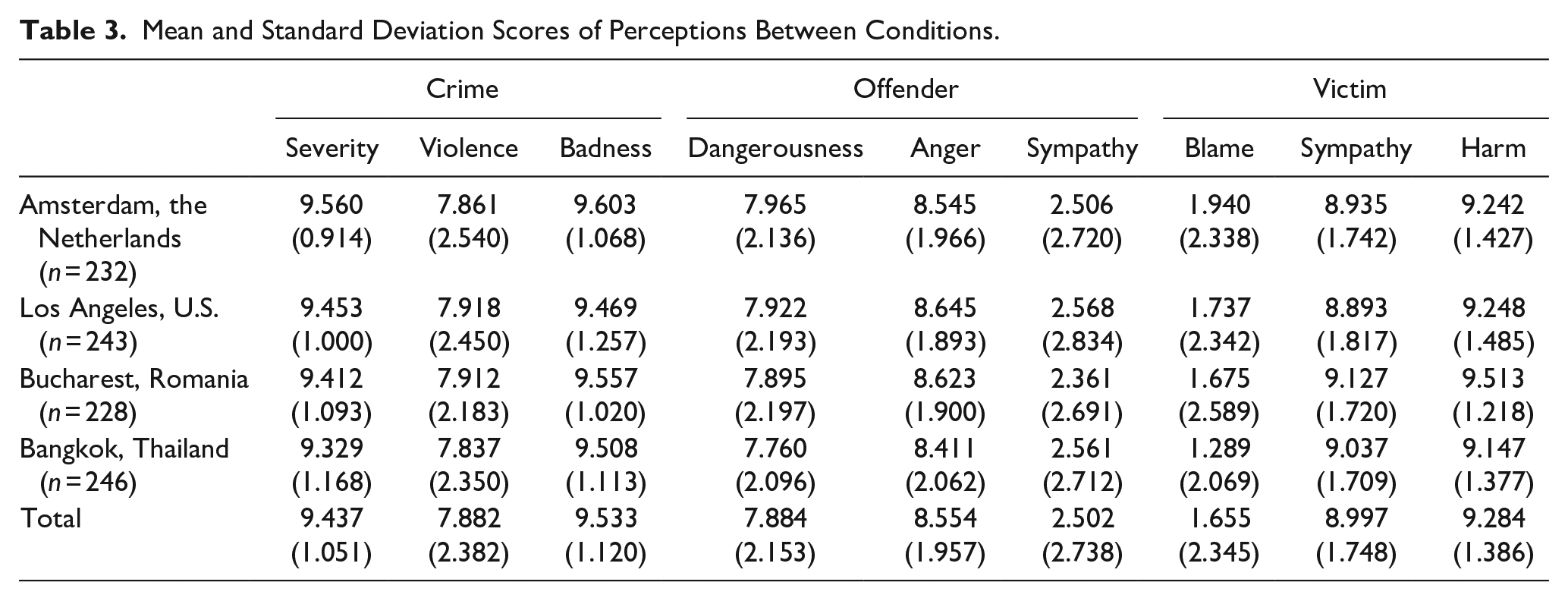
An examination of the means for all dependent variables, as displayed in Table 3, shows that the variation between conditions on mean scores is quite small. Note also that the mean scores tend to be on the extreme end of the 0 to 10 spectrum: there is no mean score at all between 3 and 7. This indicates that the vignette story generally elicits strong negative responses, and that this happens across all conditions. Overall, the public most strongly believes that the incident is bad (9.533 out of 10) and serious (9.437), and harmful to the victim (9.284). Less extreme mean scores with relatively higher standard deviations are found in the public’s sympathy for the offender (2.502), assessment of the incident as violent (7.882), and ascribed danger of the offender (7.884), indicating that opinions about these topics were more diverse in comparison.
Mean and Standard Deviation Scores of Perceptions Between Conditions.
The effect of home country: The Netherlands versus abroad
To test the first hypothesis and determine whether there were differences in the perceptions between the Netherlands as compared to abroad locations, a one-way MANOVA was conducted. The test showed a non-significant effect of foreign location on a linear combination of the dependent perception variables, V = 0.017, F(9, 933) = 1.779, p = .068, η2p = .017. Thus, the first hypothesis is not supported, and perceptions are overall considered equal between the home and abroad location. Means and standard deviations of dependent variables are provided in Table 4 (Home/Abroad).
Mean and Standard Deviation Scores of Perceptions Per Hypothesis.
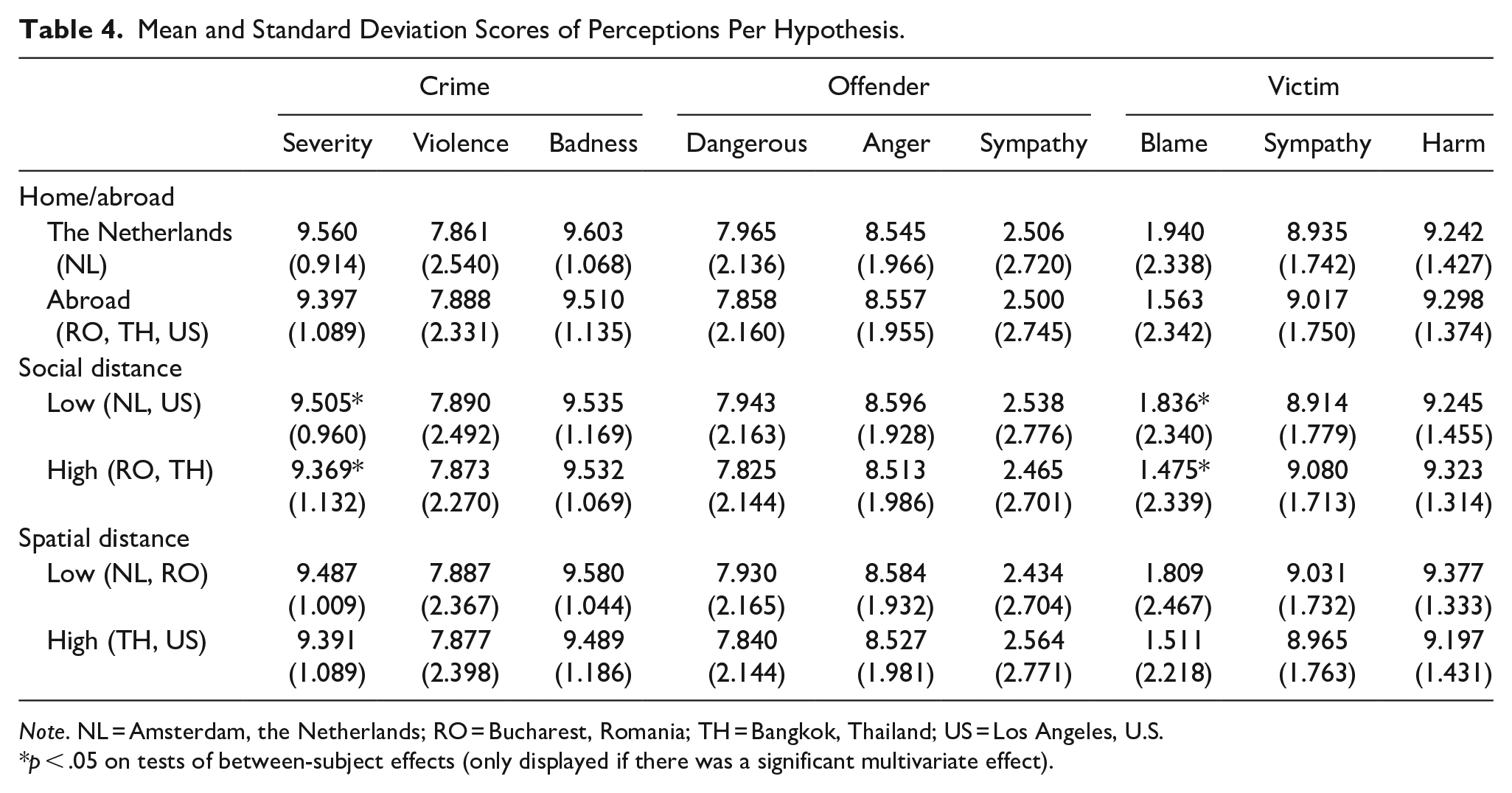
Note. NL = Amsterdam, the Netherlands; RO = Bucharest, Romania; TH = Bangkok, Thailand; US = Los Angeles, U.S.
p < .05 on tests of between-subject effects (only displayed if there was a significant multivariate effect).
The effect of social distance: Similar versus distant cultures
Testing the second hypothesis, the multivariate results from a one-way MANOVA reveal that there is a significant difference on a linear combination of the dependent perception variables based on the social distance of the vignette condition, V = 0.025, F(9, 933) = 2.674, p = .005, η2p = .025. Subsequent univariate tests on the outcome variables, as displayed in Table 4 (Social distance), reveal a significant effect of social distance specifically on crime severity, F(1) = 4.517, p = .042, η2p = .004, such that the vignette story is judged as more serious in Western countries than when the story takes place in socially distant countries. A significant effect is also found for victim blame, F(1) = 5.634, p = .018, η2p = .006. Contrary to hypothesis 2, participants attribute more responsibility to the victim for what happened in socially close countries than distant cultures. No significant effects at the p < .05 level were found for the other dependent variables.
The effect of spatial distance: Near versus far countries
To test the third hypothesis investigating how perceptions are impacted by spatial distance between the Netherlands and the crime location, a one-way MANOVA was conducted comparing the two European vignette conditions to the two more distant conditions. Means and standard deviations are provided in Table 4 (Spatial distance). There is no significant difference on a linear combination of the dependent perception variables based on the spatial distance to the vignette location, V = 0.014, F(9, 933) = 1.453, p = .161, η2p = .014. The third hypothesis is therefore not supported.
Sensitivity Analyses 15
Three control variables were included in the model as sensitivity analyses: fear of COVID-19, participant gender, and whether participants had visited the vignette location. One-way MANCOVAs with these control variables were conducted for each hypothesis. The multivariate results indicate that findings from the main models are robust to the inclusion of covariates in the model: put simply, the sensitivity analyses lead to the same main findings. As displayed in Table 5, even when controlling for participants’ attitude toward COVID-19, gender, and experience visiting the vignette country, social distance remains a significant factor impacting the perception variables, V = 0.019, F(9, 925) = 2.030, p = .033, η2p = .019. On the other hand, the absence of a significant difference on the linear combination of dependent variables between the home and abroad conditions (p = .840), as well as between the spatially close and far conditions (p = .228), remains constant when covariates are added to the model.
One-way MANCOVA Results Per Hypothesis.
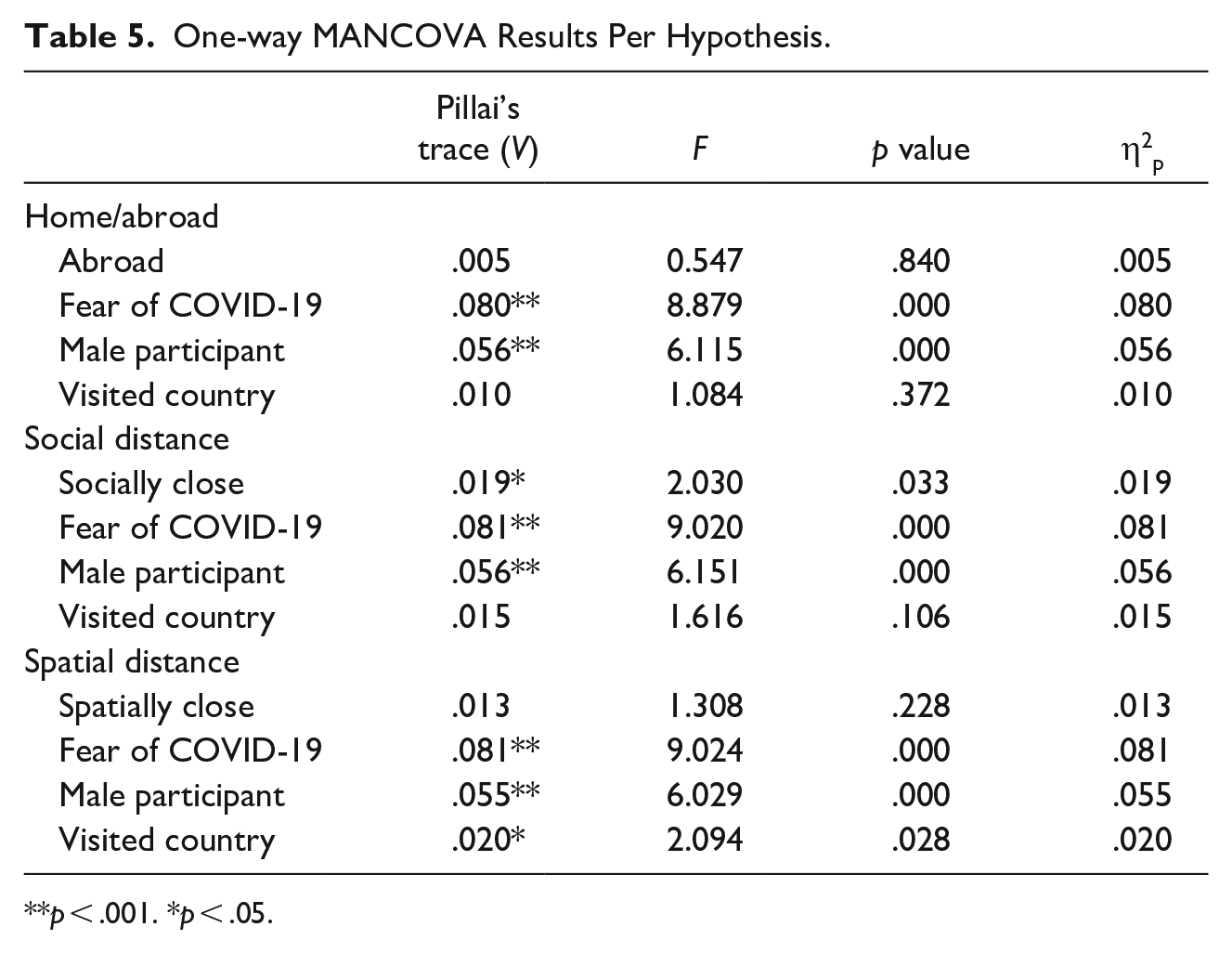
p < .001. *p < .05.
When examining the covariates’ coefficients, it is noteworthy that fear of the coronavirus has a significant effect on a combination of the dependent variables in all three models. Correlation matrices (not displayed) show that participants with higher levels of COVID-19-related anxiety have more negative perceptions of the incident, offender, and harm to the victim. This indicates that participants who worry more about the pandemic condemned the vignette story more strongly. Participant gender impacts public perceptions in the expected direction, with women expressing significantly more negative perceptions than men in all three models. This finding is in line with previous literature about public opinion on sexual violence (Banyard, 2008; Gerber et al., 2004; Hust et al., 2013; Jimenez & Abreu, 2003; Katz et al., 2015; McMahon, 2010). In contrast to the intergroup contact hypothesis (Allport, 1954), perceptions overall do not differ between participants who have and have not previously visited the vignette location.
Conclusion
Public opinion influences decisions from policy makers and criminal justice actors in various ways (Richards, 2019; Ryberg & Roberts, 2014; Sample & Kadleck, 2008). Understanding the factors that shape public opinion about child sex crimes can, therefore, constructively inform policy debates and measures targeting sex crimes, both domestically and abroad (Mears et al., 2008; Pickett et al., 2013; Richards, 2019). This study examined to what extent public opinion about sexual exploitation of minors differs depending on where in the world it occurs. Are public perceptions of child sexual exploitation more damning or, inversely, more lenient when it takes place closer to home? In addition to expanding research on this topic beyond the U.S., this study also extends our knowledge by exploring theoretical explanations for the found differences. Can differences be attributed to the distinction between “home country” versus “abroad”? Is perceived social distance to a country’s culture as meaningful in shaping public opinion about the severity of SECTT as spatial distance to the crime location? Building on theoretical frameworks relating to construal level theory, social distance and in-group favoritism, and using a randomized vignette experiment on a representative sample of the Dutch population, we tested hypotheses to assess these different potential explanations. In doing so, we heed the call for more research on this topic issued by Mears et al. (2008, p. 554), who noted that “vignette-design surveys [are] especially useful for investigating how exactly public views toward sex crime vary depending on the exact crime, the context in which it occurred, and the characteristics of both the victim and offender.”
Our results demonstrate that crime location has an effect on certain, but not all, public perceptions. Most noteworthy are the results regarding social distance, which is shown to affect the public’s perceptions specifically with regard to assessments about crime severity and victim responsibility. Similar to previous research among Americans (Kosuri & Jeglic, 2017), sexual exploitation of children is evaluated by the Dutch public as (somewhat—referring to the small effect size) more serious when it takes place in Western countries than when it takes place in countries which are perceived as socially distant. Spatial distance, on the other hand, did not significantly impact public perceptions of the crime, offender or victim. Put differently, whether the crime occurred in a country that feels culturally similar appears to be a more meaningful factor shaping public opinion about severity of the crime than whether the crime location is de facto close by or far away. These findings support the expectations formulated on the theoretical basis of social distance and intergroup bias, which predict that people would judge injustice more harshly when it happens to people who they feel more kinship to, compared to those who they view as socially distant, “out-group” or “other.”
Contrary to expectations, the results show that participants attribute more blame to the child victim in socially close countries than distant cultures. Although the effect size is small, Dutch citizens believe that the Dutch or American child was more responsible for the incident in which she was sexually exploited than participants who read about a Thai or Romanian girl. From the standpoint of social distance and defensive attribution theory (Shaver, 1970), this finding is surprising, since participants would be expected to judge the victim as more innocent when they felt more socially close to her. The direction of this outcome instead provides support for the expectations that can be formulated on the basis of the ideal victim and belief in a just world literature. Christie’s (1986) theoretical framework—which describes the idealized, stereotypical image of the “ideal victim” as, amongst others, weak in relation to the offender, acting virtuously, being blameless for the event, and having the right amount of power, sympathy or influence to elicit victim status without threatening vested interests—could explain this finding: victims of child sexual exploitation may be seen as more powerless, weak, and innocent in distant cultures than in socially similar countries where they can be believed to have more economic and social agency. Correspondingly, child sexual exploitation occurring in locations similar to the home country could be seen to pose a higher threat to the belief in a just world (Lerner, 1980) than the same event occurring in culturally distant countries (“How could something like this happen in a country like my own?”), which in turn leads to less favorable evaluations of the victim (Dawtry et al., 2020).
These findings present practitioners and policy makers with a paradox: the general public (from a country of origin for SECTT) views child sexual exploitation as more serious and attributes more responsibility to child victims in social contexts the public can relate to; while in socially distant contexts, the public views victims as more innocent but perceives the crime as less severe. This challenging finding has important implications for public reporting campaigns targeting SECTT and victim services. For public reporting campaigns targeting child sexual exploitation abroad to be effective, rather than attempting to increase sympathy for victims, beliefs about the severity of SECTT need to be addressed, for instance by emphasizing that child sexual exploitation is a serious offense wherever it happens in the world. Future research should aim to identify common neutralization techniques which members of the public use to negotiate these beliefs, as well as how these beliefs impact their reporting behavior. For awareness raising campaigns targeting domestic child sexual exploitation and abuse, our findings invite the question to what extent victim blaming occurs for domestic victims of child sexual exploitation in the Netherlands (or other countries viewed as sending countries for SECTT), and what this looks like in practice. Are Dutch and American victims perceived by members of the public as being more able to resist, and consequently in some way consenting to their sexual exploitation? This finding is a reason for concern for victim services, and considering that public opinion can impact treatment options and reporting behavior by victims (Giglio et al., 2011), more work is necessary to establish whether and to what extent these processes operate in the Dutch context.
In contrast to an earlier study which found that Americans evaluated the crime as more serious when it happened in the U.S. as compared to abroad locations (Kosuri & Jeglic, 2017), Dutch perceptions on sexual exploitation were not significantly impacted by whether it happened in the Netherlands or abroad. There are several possible explanations for this unanticipated result. A first explanation is methodological: Kosuri and Jeglic’s sample consisted of predominantly white male Americans recruited through Amazon MTurk, while our sample was representative of the Dutch population. Secondly, these findings could reflect cultural differences, indicating that the distinction of “domestic” versus “abroad” is less meaningful to Dutch people than it is to the American public. Compared to the American population, the Dutch might have more beyond-national place attachments and generally feel more connected to other countries, for instance through their history as a “nation of merchants” and involvement in the European Union. This is reflected, for example, in the number of languages spoken by the average Dutch person (European Commission, 2012). 16 Americans, on the other hand, have been shown to score lower than other countries on global citizenship identification, exposure to information about other countries, and knowledge of the world (Katzarska-Miller et al., 2012). Moreover, while Kosuri and Jeglic (2017) stipulated that a sense of nationalism could have made American participants view the crime as more severe when it occurred in the U.S., the Dutch national identity is considered to be less nationalistic overall, even having been characterized as “anti-nationalistic” (Kešić & Duyvendak, 2016).
Our results suggest that public opinion differs most clearly between crime locations in countries that are seen as socially similar versus those seen as socially distant. Future research could explore alternative explanations for the found differences. Although our experimental manipulation was based on two dimensions (social distance high/low and spatial distance high/low), the specific vignette countries also share differences and similarities on other aspects. Most prominently, the U.S. and the Netherlands are, on average, wealthier countries than Romania and Thailand—as indicated by GDP per capita and the Human Development Index (UNDP, 2020). In the context of the social distance framework, how socially distant or close we feel to a certain group could be impacted by a range of factors, including not just cultural, but also economic (class) differences. Moreover, our operationalization of distance in a binary fashion (near or far) ignores the idea that distance can be perceived on a continuum. Whether a continuous measure of distance would alter the findings, and whether perceived social distance is predicted by opinions regarding a destination country’s culture or assumptions about economic disadvantage, remain questions for future research.
Furthermore, more research could be conducted to expand this study’s findings to other contexts. In coming years, it will be important to document whether differences in perceived crime severity can be interpreted as differences in public support for measures to combat SECTT. Does the public perceive it as legitimate that governments of countries of origin take measures to combat SECTT, and to what extent are these perceptions of legitimacy also influenced by social distance? Second, research in cross-cultural psychology might investigate whether social distance similarly impacts public perception in other national contexts; most interestingly, in cultures which are characterized as interdependent, such as Asia and South America (Liberman et al., 2007). Third, the rise of child abuse through new technological platforms in developing country contexts highlights SECTT’s rapid development and transformation, posing new challenges to law enforcement and prevention (Brown et al., 2020; Dushi, 2020). While participants in the current study responded to a vignette story involving a physically traveling child sex offender, technologically facilitated (or “live-streaming”) child exploitation should be a priority for research wishing to contribute to prevention and awareness campaigns in this rapidly moving field.
In sum, the empirical findings in this study provide a new understanding of how public perception of child sexual exploitation is influenced by crime location. We tested theory-based hypotheses and expanded the theoretical framework relating to this question using a randomized experiment among a large, representative sample of the Dutch public. Public perceptions were on average on the damning end of the spectrum, which was to be expected considering the previous research about the punitive public attitudes toward child sex crimes (Stafford & Vandiver, 2017). While the idea that social distance influences all manner of opinions, perspectives, and attitudes has been well established in psychological scholarship, we show that this theoretical framework extends even to public perceptions about the seriousness of sexual exploitation of a child.
Supplemental Material
sj-docx-1-cad-10.1177_00111287211064786 – Supplemental material for Public Perceptions of Child Sexual Exploitation Abroad: A Vignette Experiment on the Influence of Social Distance
Supplemental material, sj-docx-1-cad-10.1177_00111287211064786 for Public Perceptions of Child Sexual Exploitation Abroad: A Vignette Experiment on the Influence of Social Distance by Anneke Koning in Crime & Delinquency
Footnotes
Acknowledgements
The author is grateful to Janne van Dijk-van Doorn, Joanne van der Leun, Masja van Meeteren, Ilse Ras, Lonneke Wevers, Johan van Wilsem, Sigrid van Wingerden, two anonymous reviewers, the Ethics and Data Committee at Leiden Law School, and Stop It Now! for helpful conversations and feedback on various stages of this project. Special thanks to I&O Research for data collection and Gaëtan Mertens for supplying research materials.
Declaration of Conflicting Interests
The author declared no potential conflicts of interest with respect to the research, authorship, and/or publication of this article.
Funding
The author disclosed receipt of the following financial support for the research, authorship, and/or publication of this article: This publication is part of the research program “Child sex tourism: A systematic examination of responses against a global problem” (with project number 406.16.564), which is financed by the Dutch Research Council (NWO).

Availability of Data and Material
The datasets analyzed in the current study are available from the corresponding author on request.
Supplemental Material
Supplemental material for this article (vignette text and survey questions) is available online.
Notes
Author Biography
References
Supplementary Material
Please find the following supplemental material available below.
For Open Access articles published under a Creative Commons License, all supplemental material carries the same license as the article it is associated with.
For non-Open Access articles published, all supplemental material carries a non-exclusive license, and permission requests for re-use of supplemental material or any part of supplemental material shall be sent directly to the copyright owner as specified in the copyright notice associated with the article.
