



Abstract
Sexual exploitation of children in the context of travel and tourism (SECTT) has been described as a serious and growing problem. This study critically analyzes political debates and policy measures proposed by the Dutch government between 1995 and 2020 to combat SECTT. To understand how SECTT is framed in Dutch political discourse, Bacchi's ‘what's the problem represented to be?’ approach guided a systematic critical discourse analysis of over 200 political documents. Our analysis shows that SECTT has, over time, predominantly become framed as a crime problem. Offender detection, international cooperation, awareness raising, public–private partnerships, and prevention targeted at known sex offenders are the most commonly proposed solutions. Despite the focus on apprehending offenders, the political discourse offers no concrete clues as to who they are; still, conducting research or evaluating policies' effects is seldom proposed as a response. This problem representation overlooks the connections of SECTT with structural issues, such as victim vulnerabilities, colonization, and global inequality on the one hand, and mental health, sexual expression, and cultural values on the other.
Introduction
International tourism is an important source of foreign exchange and economic growth for many developing countries (Jhappan, 2005). However, the expansion of the travel industry and the growth of relatively unregulated tourism-based economies have also had negative consequences, including sexual exploitation of children at the hands of tourists and other types of travelers. Some traveling child sex offenders, ‘preferential’ offenders, travel abroad deliberately pursuing sex with children. Others, called ‘situational’ abusers, are opportunistic rather than having an explicit sexual preference for children, and engage in sexual encounters with locals regardless of their age (Newman et al., 2011). The term ‘sexual exploitation of children in the context of travel and tourism’ (SECTT) is a relatively new name for this transnational form of child sex offending, more commonly known as ‘child sex tourism’ (ECPAT Luxembourg, 2016).
Due to awareness-raising efforts from non-governmental organizations (NGOs) and activists, SECTT has, since the 1990s, increasingly been recognized by governments and academics as a serious, growing problem that must be combatted (Seabrook, 2000). A few ‘destination countries,’ that is, where the child is exploited, have advanced specific legislation aimed at combating child sex abuse by travelers (Johnson, 2011); however, transnational child sex offenders are rarely prosecuted in destination countries due to weak enforcement mechanisms, a lack of resources, corruption, and instability (Seabrook, 2000). Despite the apparent international consensus on its harmful nature, and ample NGO reports about the matter (e.g., Hawke and Raphael, 2016), empirical academic research on the phenomenon of SECTT remains limited, and reliable statistics about the magnitude of the problem are lacking.
Over the past three decades, the countries where these travelers hail from, called ‘countries of origin’ or ‘sending countries,’ have proposed and implemented various measures to deter and detect transnational sex offenders, such as revoking the passport of known sex offenders (e.g., Hall, 2011). In addition to the United States (e.g., Andrews, 2004; Atwell, 2014; Fraley, 2005; Giordanella, 1998), Canada and Japan (Svensson, 2006), and Australia (e.g., Curley, 2019; Curley and Stanley, 2016; David, 2000; Ireland-Piper, 2011; McNicol and Schloenhardt, 2012), some European countries, including the Netherlands, 1 have enabled extraterritorial application of their criminal laws to prosecute their nationals for child sexual abuse crimes committed abroad (e.g., Fredette, 2009; Khan, 2004; Koops et al., 2017; Seabrook, 2000). In practice, however, sending countries largely abstain from extraterritorial prosecution, and typically only utilize this possibility when both evidence and resources are sufficient but local authorities are unable or unwilling to prosecute offenders (Curley, 2014). Since extraterritorial SECTT prosecutions are usually complex, labor-intensive, and require intense international (cross-cultural) law enforcement cooperation, convictions have been few, raising questions about effectiveness (Fredette, 2009). In short, while countries of origin have expanded their legal apparatus to take responsibility for the crimes their citizens commit while abroad, exercising this ability is fraught with legal, political, and practical challenges.
The majority of research on responses by origin countries has focused on the United States and Australia, with substantially fewer investigations into the Western European context. The Netherlands is commonly perceived as a country of origin for SECTT by international sources (Altamura, 2016; US State Department, 2018) as well as by reports commissioned by Dutch government agencies (Koning and Rijksen-van Dijke, 2017; Moerenhout, 2013; Vogelvang et al., 2002). Although the incidence of child sex offenders traveling from the Netherlands is unknown (Moerenhout, 2013), numbers from neighboring Germany suggest that between 0.3% and 0.4% of men have traveled abroad with the intention to have sex with a child, while 4.4% of men sexually fantasize about children (Dombert et al., 2016; Koops et al., 2017).
Following Bacchi's ‘what's the problem represented to be?’ approach (2009), which has previously been applied to policy discourses about sex trafficking (DeLacey, 2022; Heber, 2018; O’Brien, 2016), this study seeks to uncover how origin countries understand the problem of transnational child sex offending by investigating how policymakers and politicians in the Netherlands respond to SECTT. We examine not just how the problem is described but also which responses were proposed and implemented over a 25-year period. Our central question, then, is how the problem of SECTT is represented, or framed, in policy discourse in the Netherlands between 1995 and 2020.
In the next section, we describe the theories and literature that guided our analysis. The data collection process and the research approach are outlined in the section thereafter. When presenting the results, we try to understand the dominant problem frame by examining proposed responses and their discursive presentation and identify missing areas in the policy discourse. The article ends with reflections on the implications and effects of the identified representations of the problem.
Theoretical framework
How we frame social issues profoundly influences our understanding of them, and how we think and talk about solutions. (Kendall-Taylor and Gibbons, 2018)
‘When individuals attend to any current situation,’ Goffman (1974: 8) notes, ‘they face the question: ‘what is it that's going on here?’’; the answer to this question dictates, and can be found in, what these individuals do next. To determine the category of an observed action (Goffman, 1974) individuals rely on what Tannen and Wallat (1987) and Schiffrin (1993) call ‘interactive frames’ or ‘knowledge schemas’: ‘expectations about objects, people, settings, ways to interact, and anything else in the world’ (Tannen and Wallat, 1987: 207). Put differently, frames can be seen as schemas of interpretation that guide how we see the world.
In much media and policy research, ‘framing’ has come to refer primarily to the (re)telling of an experienced or witnessed event, in which the teller often selects ‘some aspects of a perceived reality and make[s] them more salient in a communicating text, in such a way as to promote a particular problem definition, causal interpretation, moral evaluation, and/or treatment recommendation for the item described’ (Entman, 1993: 52). The framing of an event represents the teller's interpretation of the event, but the framing in this (re)telling in turn can affect the hearer's understanding and interpretation of the event. As such, frames both reflect and influence our understanding of social issues and the measures we propose to tackle them (Kendall-Taylor and Gibbons, 2018). Particular frames can come to dominate (media) reporting on the event (Entman, 1991), which affects the likelihood of the issue appearing on the political agenda (Walgrave and Van Aelst, 2006). Furthermore, as frames typically (both implicitly and explicitly) define the cause of a problem and suggest solutions, dominant frames can ‘powerfully [shape] national and international policy discourse and practice’ (Cruz et al., 2019: 191). Conversely, examining the proposed solution to a problem and working backward can uncover the underlying norms, values, and ‘truths’ in the way an issue is understood, as Bacchi's (2009) ‘what's the problem represented to be?’ approach advocates. Of course, even though our interpretations of issues can become so ‘naturalized’ that they feel common sense (Fairclough, 1985), problem frames can be incorrect, incomplete, or stereotypical, which risks producing policies that do not adequately address the issue (Tyldum and Brunovskis, 2005). Studying and problematizing problem framing is therefore not just theoretically relevant, but can also prompt better policy by illuminating inadequacies, silences, unintended side effects, and obstacles introduced by the dominant narrative.
Since no research to date has examined how the specific problem of SECTT is represented in policy discourses, we consulted the more extensive scholarship on discourses on human trafficking, specifically for sexual exploitation (‘sex trafficking’), to guide our research. Although they are distinct phenomena, SECTT and sex trafficking have similarities in definition and practice: both center around (sexual) exploitation, and both often have a transnational element. 2 As such, SECTT is sometimes described under the broader umbrella of human trafficking; for instance, the US State Department's Trafficking in Persons Reports also cover ‘child sex tourism.’ Furthermore, victims of ‘child sex tourism’ are impacted by responses to and discourses about trafficking and modern slavery (Cruz et al., 2019).
Research into representations of sex trafficking has identified certain dominant problem frames. Recurring frame types include the ‘crime’-frame, also known as the ‘criminalization,’ ‘criminal justice,’ ‘law enforcement,’ or ‘transnational crime’-frame (Charnysh et al., 2015; Farrell and Fahy, 2009; Gulati, 2011; Pajnik, 2010), and the ‘human rights’-frame (Charnysh et al., 2015; Doezema, 1999; Farrell and Fahy, 2009; Lobasz, 2009). 3
Over time, sex trafficking has been increasingly defined as a crime problem, necessitating criminal justice system responses. This crime-frame, emerging from a concern with transnational organized crime, focuses attention on the individuals involved in crime (the victims and the perpetrators) and identifies law, law enforcement, and victim protection and support, as key to solving the problem. To the extent that civil society organizations, mainstream businesses, and members of the public can help combat ‘trafficking and modern slavery’, it is by contributing to state efforts to identify the crime and so assist law enforcement with prosecution, and by supporting and/or orchestrating efforts at victim protection and crime prevention. (Cruz et al., 2019: 191–192)
By contrast, when sex trafficking initially arose as a social problem on the (Western) international agenda after the 1948 adoption of the Universal Declaration of Human Rights, it was portrayed as a violation of (primarily women's) human rights (Farrell and Fahy, 2009). Social movements and NGOs were instrumental in the advancement of this rights-centered agenda (Wylie, 2016). Rather than turning to law enforcement to solve the problem, the human rights-frame assigns responsibility to nation-states to ensure a dignified existence for all people (Charnysh et al., 2015). This frame focuses primarily on victims and acknowledges victim agency in a constrained context (Broad and Turnbull, 2018). Similar to ‘wicked’ problems (Rittel and Webber, 1973), the root of (sexual) exploitation is found in wider societal issues, such as poverty or inequality (Gulati, 2011). 4
Relatedly, in recent years, the introduction of a public health-frame highlights the broader needs of those involved (beyond just victims), advocating a holistic approach that draws on healthcare (metaphors) (e.g., Chisolm-Straker and Stoklosa, 2017; Greenbaum, 2019; Willis and Levy, 2002). While the public health- and human rights-frame share a problem definition that moves beyond the actions of individual evildoers, the public health-frame seeks to address risk factors for not just victimization but also for offending. Its ties to the field of public health guide the examination of causes and proposal of solutions.
Overall, since problems with complex causes are not politically attractive (Stone, 1989: 289), these alternative frames have generated limited policy and media attention in sex trafficking discourses compared to the crime-frame (Farrell and Fahy, 2009). We therefore expect to find SECTT mainly framed as a criminal issue.
Methods
Data collection and materials
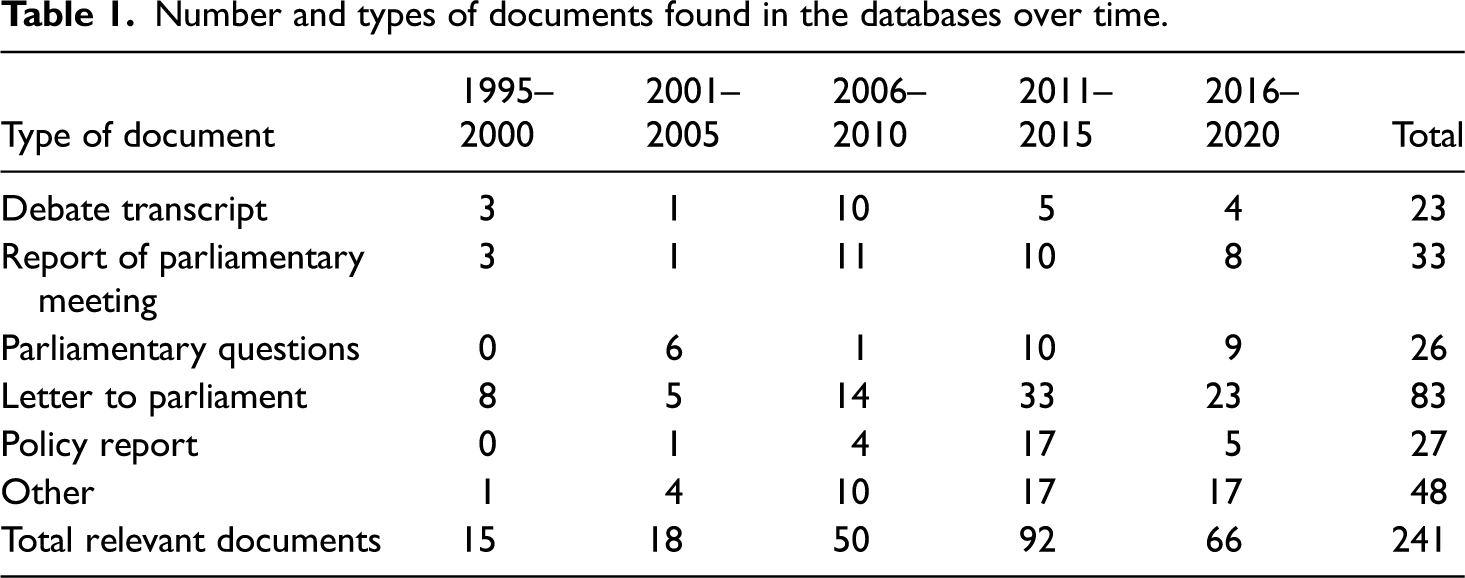
A corpus of Dutch parliamentary and policy documents and debates produced between 1995 and 2020 is the main source for the present analysis, constructed between 14 and 23 June 2021 using the search term child sex tour*, 5 and accessed through digital databases. 6 In total, 427 unique documents were found in the databases, which were systematically assessed for relevance using a decision tree (Appendix A in the online supplements). The final corpus consisted of 241 documents containing relevant information, as shown in Table 1. 7
Number and types of documents found in the databases over time.
Analysis
Van der Meer and colleagues (2014: 752) note that ‘[e]xplicit frames are observable in the words that are chosen in communication utterances, whereas implicit frames refer to latent patterns of words that co-occur in communication.’ This suggests that linguistic analyses are most suitable for uncovering the frames used to discuss any issue. To understand what the most important areas of change have been with regards to SECTT policy, and what the proposed responses say about the underlying problem they are trying to combat, we therefore used a combination of critical discourse analysis augmented through a qualitative content analysis, analyzed in Atlas.ti Web and 9. In general, critical discourse analysis assumes that linguistic ‘choices’—whether intentionally or unintentionally—reflect, reinforce, and modify power relations in both the discursive and broader social context. Fairclough (1992, 2015) identifies three dimensions of discourse analytical research: the primarily sociological macro-level analysis, focusing on the sociopolitical context; the meso-level, which examines the specific discursive context; and the primarily linguistic micro-level analysis investigating the text itself, including lexical and semantic choices as well as grammar. Its eclectic nature is a key characteristic, in that it encourages borrowing methods and insights from a variety of fields and disciplines. Given that Faircloughian discourse analysis enables an interpretation of the meaning of linguistic choices by considering not just the linguistic, but also discursive and social context, it is an especially appropriate choice to identify frames in these texts.
Discursive context
We use the concept of turn-taking (Short, 1996) to examine key players in the political conversation. According to Short (1996), those with longer and more speech turns, and those who control the topic of discussion, have relatively more power in a conversation. Speech-turn regulations function to institutionalize these power relations. Breaches of these (potentially unspoken) rules (and whether the rule-breaker gets away with it) have further implications for the interpretation of power relations in that conversation. Put more simply, turn-taking can illuminate who takes and who is granted ownership over an issue. To analyze this, we focused on the producers and receivers of speech turns, coded on the fragment level, and written communication, coded on the document level.
Qualitative content analysis
We carried out a conventional content analysis to systematically create an overview of the topics in the data (Denton, 2010; Hsieh and Shannon, 2005; Schreier, 2012). Content codes focused on three descriptive questions: (a) how is the problem described and labeled, (b) which actors are described, and (c) which measures are put forth? Following Bacchi (2009), proposed and undertaken measures illuminate implicit assumptions about various causes and aspects of the problem, as does the description of actors (Skilbrei and Holmstrom, 2013). Problem descriptions furthermore illustrate the broader discursive context through references to connected ‘problems.’ The content analysis of these three questions resulted in three code trees (Appendix B in the online supplements).
Problem and actor descriptions were coded on the phrasal level, focusing on content words only (see Corver and Riemsdijk, 2001), enabling greater reliability (Weber, 1990). Descriptions of measures were coded on the sentential level. Measures were coded by a single researcher to increase consistency. For all coding schemes, reliability was further ensured through constant discussion between researchers, which enabled constant refining of the codebook and frequent assessment of the correctness of quotes within codes.
Critical discourse analysis
Jeffries’ (2010) framework was used to offer the depth of critical discourse analysis to the interpretation of the main topics. Aspects of particular interest included the words and phrases used to describe the main topics in these texts. Their emotional value, for instance, serves a rhetorical function in negotiating pathos, whereas metaphors illuminate how a topic is understood and explained (Lakoff and Johnson, 1980). Process types are relevant with regard to representations of actions (Jeffries, 2010), in particular the distinction between material processes (‘actually doing something’) and verbal processes (‘just talking about it’). Other aspects included grammatical agency, which identifies (assigned) responsibility and accountability (Jeffries, 2010), and use of metonymy, which can diffuse responsibility (Thompson, 1980).
Results
Our longitudinal analysis showed that Dutch political discourse on SECTT can be categorized into four time periods (Figure 1). While SECTT received little attention between 1995 and 2006, a growing interest can be observed from 2007 to 2010. Various Ministries are involved in these years, most notably Justice and Foreign Affairs, but also Youth and Families and Internal Affairs. In 2012, the first comprehensive policy plan to combat SECTT was launched by the Ministry of Justice, police and public prosecution. After 2012, discussions about the topic spiked, dominated by the Ministry of Justice, most specifically then-Minister Opstelten. In the final four years in the corpus, the number of mentions decreased, and more variation could once again be observed in the responsible Ministries. While the prominent ownership by the Ministry of Justice suggests an understanding of the issue as one of crime and law enforcement, the (relative) ownership variation in periods 1, 2, and 4 nonetheless indicates competing perspectives.
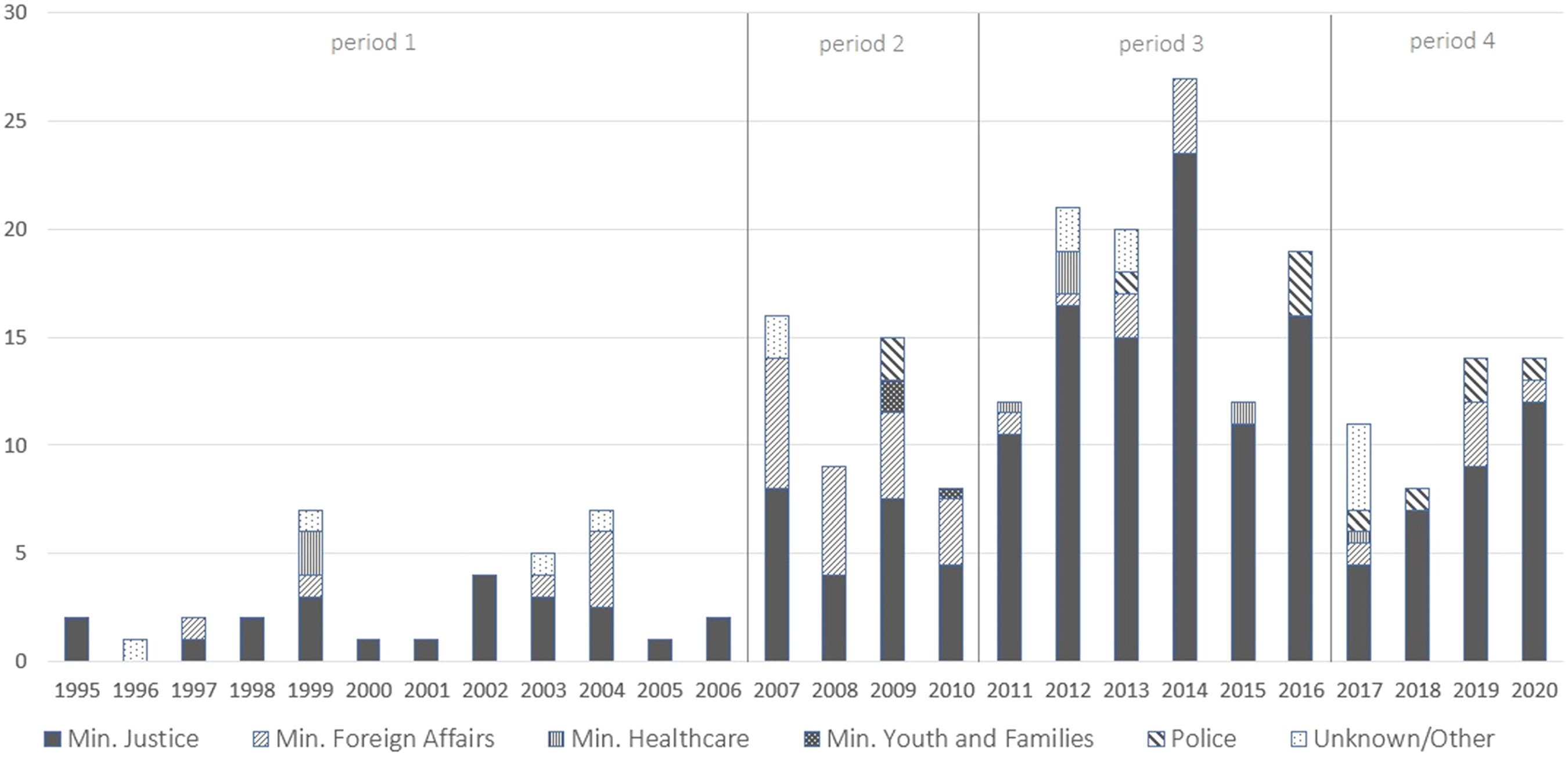
Number of documents over time (absolute) by producer.
Notably, the debate on SECTT is especially strongly conflated with the debate on online sexual abuse or ‘child pornography.’ In different time periods, measures to combat online sexual abuse and SECTT are indistinguishable, and SECTT is seen and treated as part of the ‘child pornography’ problem. In 2015, for instance, the police wrote: ‘A specific part of the fight against child pornography is combating child sex tourism.’ 8 Other topics that are linked to the issue of SECTT include (sexual) violence aimed at children, sex crimes, and human trafficking and other forms of exploitation, with discursive developments in SECTT likely running in tandem with discussions on these topics.
What's the problem represented to be?
The problem is primarily understood from a criminal justice perspective, contrasting with a human rights perspective. Remarkably, however, by far the largest category of reported and proposed actions in this corpus can be classified as purely facilitative. We have found hundreds of mentions of measures such as inventorying possible responses, developing action plans and national policy, learning from earlier interventions, prioritization, or strengthening existing measures; for all of these, it is unclear how they (are expected to) help to ‘solve’ the problem. Often, especially in debates, specific actions could not be made out, such as in ‘the approach will be intensified’ or ‘we will tackle this problem with an iron fist.’ Although policy development, facilitation, and cooperation are certainly necessary, the emphasis on such actions rather than material, intentional actions indicates a pattern of policy inaction (McConnell and ‘t Hart, 2019). It suggests that the Dutch government certainly wants to be seen and heard as doing something, but relatively few policy measures actually do seek to set about some change in the real world. As one parliamentarian notes: ‘Gorgeous words have been spoken, but we have done very little so far.’ 9
Problem representation: Crime
SECTT is predominantly presented as a crime problem, as is evident from the types of measures suggested as well as from who is supposed to act. By far the most frequently described actors to deal with the problem, after descriptions of offenders and victims themselves, are Dutch law enforcement (i.e., police and public prosecutors in the Netherlands). Their involvement with the problem is unchallenged and —both explicitly and implicitly— presented as common sense in the discourse on this issue, for instance by describing actions in nouns (‘nominalizations’) or passive sentences without mentioning the do-er (‘agentless passives’) (Jeffries, 2010).
Detecting and prosecuting invisible offenders
The crime problem representation of SECTT is also reflected in the most commonly discussed solution: detecting and prosecuting offenders. Even though this solution is constantly discussed, much remains unclear about its goals or success. One would expect the number of apprehended offenders to be a key metric of its success or failure: for instance, in 2007, a parliamentarian argued that the lack of ‘numbers about the policy's consequences, being the apprehensions and prosecutions of such kind of suspects […] does not show any real policy against sex tourism by police and justice.’ 10 But while the Ministry of Justice sets quantitative goals for the police regarding the number of child pornography offenders that must be arrested, it does not do so for SECTT. Furthermore, despite the focus on capturing offenders, statistics on the number of SECTT-specific detections and prosecutions are largely absent. 11 This could mean that SECTT is not actually prioritized as a specific phenomenon, despite assertions to the contrary; 12 or perhaps the problem is considered so elusive or insoluble that the Dutch police cannot be expected to devote much capacity to it.
Moreover, despite the focus on capturing offenders, remarkably few concrete cases, or stories of events labeled as SECTT, are mentioned. While ‘offenders’ are frequently mentioned in the debates, this is usually in general terms (e.g., ‘offenders’ or ‘suspects’). Media stories also play a relatively small role in spurring the debate about SECTT: only sporadically does a story about a specific case lead to questions by a member of parliament, and overall, none are so influential as to spur a continuing debate about SECTT. While the problem is represented through a crime-frame focused on apprehending offenders, the discourse offers no concrete clues as to who these offenders are. This absence of referrals to concrete cases, or stories of events labeled as SECTT, in the corpus suggests that attention for the issue is not based on actual stories or incidents, but rather rooted in the (moral) idea that something should be done. Although the consideration of the problem and its offenders lacks key characteristics of a moral panic, such as volatility in attention or strong influence of media stories, this could imply an attempt to establish a consensus against SECTT by tapping into pre-existing discourses in which those with pedophilic or pedosexual preferences are constructed as folk devils (see Jewkes, 2015; Martin, 2018), potentially the ‘long-lasting repercussion’ (Cohen, 1980: 9) of an earlier moral panic around pedophiles.
Even though Dutch law enforcement could use its extraterritorial powers to prosecute Dutch offenders, the government emphasizes that they prefer local law enforcement in destination countries to detect and prosecute them. 13 As such, the need for international cooperation is emphasized repeatedly. Goals of cooperation with other states vary from solidifying a legal framework or establishing international treaties to joint investigations, or exchanging information about (potential) offenders, for instance through Interpol's Green Notice —a warning message notifying another Member State about the imminent arrival of a convicted offender with a high risk of recidivism— or the ambition to establish an International Certificate of Conduct to prevent convicted sex offenders from working with children. Many concrete actions regarding international collaboration chiefly serve law enforcement goals, whether operationally, for example by sharing investigation-pertinent information or collaborating in specific cases, or institutionally, by supporting police abroad with expertise, training, or resources. Under this umbrella, sending Dutch police delegates (‘liaison officers’) abroad is a recurrent measure, receiving specific government funding. The job of these liaison officers is described, in 2007, as, ‘in a general sense, […] to support investigations by Dutch police abroad. They mediate in the exchange of investigative information and in the carrying out of legal assistance requests,’ as well as liaising with delegates from other countries on various law enforcement-related topics. 14 Sending liaison officers abroad underlines the policy's emphasis on transnational criminal justice cooperation, while also legitimizing existing policy plans for police financing reorganization. Essentially, this measure represents the SECTT problem as a result of the incapability of local law enforcement—hence warranting help from the Dutch police, who is assumed to have superior expertise, knowledge, tools, and/or resources to police forces in destination countries.
Public–private collaboration and responsibilization
In more recent years, encouraging public–private collaboration is another way the government seeks to boost the effectiveness of law enforcement responses. For instance, a 2011 police report recommended to: Enter into collaborative partnerships with (inter)national partners, public and private parties, where these parties will have to play a role in detecting and preventing child pornography and child sex tourism.
15
A large component of this approach is targeted at NGOs (both Dutch and abroad), who are esteemed for having access to valuable information through their victim support activities. ‘The industry,’ primarily the tourism sector, is also assigned responsibility, as exemplified by the establishment of codes of conduct (e.g., ‘The Code’) and efforts to train industry personnel to recognize, report, and respond to suspicions of SECTT.
16
Third, several measures seek to engage the Dutch public. A ‘toolkit’ is developed to raise awareness among various ‘target groups’ of Dutch people staying temporarily or permanently abroad. Poster campaigns at airports and other awareness-raising initiatives (e.g., ‘Don’t Look Away’ campaign) seek to encourage Dutch travelers to report suspicions of child sexual exploitation they witness while traveling abroad. These campaigns are at one point so central in the debate that a parliamentarian asks: In press release after press release we read firm language [from the Minister], but what is the Minister doing about child sex tourism for example, except for handing out flyers at [the airport] when cameras are present?
17
The emphasis on public–private cooperation, specifically in the last 10 years, is a manifestation of responsibilization. More and more non-governmental ‘partners’ are called upon to ‘take responsibility’ to solve SECTT together with the government. The problem becomes co-owned. This corresponds to Garland's (2001) observation that states have kept the task of punishment as a core business of the state, but have outsourced crime control to private (non-state) actors and alliances with civil society. In this development, we also recognize Terpstra's (2010) first and third model of responsibilization through public–private partnerships: the public is encouraged to become the ‘eyes and ears’ of law enforcement agencies, and travel companies are stimulated to come up with ways to encourage reports to police. This, too, showcases SECTT as understood through a crime-frame.
Prevention of recidivism by already known offenders
Prevention is, in general terms, recognized as a venue with great potential. In fact, the 2013 National Plan to combat SECTT asserts that ‘efforts targeting prevention will probably yield the most returns.’ 18 However, upon critical examination, almost all preventive measures focus exclusively on the prevention of recidivism by or risk management of already known or prosecuted offenders rather than primary prevention, and focus on child sex offenders or sex offenders with a high risk of recidivism more broadly rather than SECTT offenders specifically. This focus on preventing recidivism, rather than preventing primary deviance (other than through general deterrence by punishment), again fits the inherently reactive crime-frame. Prevention appears to be a topic of more political contention, evidenced by the wide variety of measures discussed in this category, from sentencing and surveillance of convicted offenders to establishing an industry Code of Conduct. Occasionally, members of opposition parties —perhaps more keen on a soundbite than a true solution— argue for more extreme measures, such as ‘chemical castration’; such suggestions are typically dismissed by the government as infringing on the rights of (ex-)offenders. 19
Two main types of preventive measures are worth highlighting. First, efforts to prevent known sex offenders from working with children, both locally and abroad, have persisted in the discourse since 2009. At the start of that timeframe, two prominent cases of child sexual abuse, perpetrated by a swimming instructor and a child care employee, dominated headlines in the Netherlands; while both were (depicted as) cases of domestic child sexual abuse rather than SECTT, the fact that one offender was a non-Dutch European citizen with previous convictions for child pornography possession in another EU-country highlighted the need for international information exchange about previous (sexual) convictions. Meeting this need, the European Criminal Records Information System (ECRIS) initiative facilitates European information exchange on criminal records since 2012. While employees and volunteers could already be obligated to present a Certificate of Conduct (VOG) domestically, the Dutch government announced various measures seeking to increase its use by organizations abroad, for instance by providing English translations and advocating for International VOGs. Although measures regulating workplace access to children initially originated from a desire to protect Dutch children, their reach was thus expanded and applied to SECTT.
The second recurrent type of preventive measure discussed in the discourse is aimed at limiting convicted or suspected offenders from traveling abroad. Whether through imposing travel bans, confiscating passports, or motivating other states to refuse visas, the overarching objective is to stop ‘dangerous’ (potential) SECTT offenders from traveling abroad. Debates about these measures are more volatile in frequency, and their legal and practical feasibility remains contested. After all, who exactly can be considered ‘dangerous’? How can this risk reliably be assessed, and who conducts this risk assessment? With regards to passport confiscation —a measure with inherent limited effectiveness in the Schengen area— the Minister for Justice noted in 2016 that ‘I have to conclude that the possibilities that exist at this moment are not yet used much, very limitedly even.’ 20 The Interpol Green Notice too is plagued by implementation issues, such as legal obstacles, privacy considerations, and insufficient knowledge, limiting the frequency of its use. 21
Problem representation: Human rights
SECTT is represented only occasionally as a human rights problem, in particular when the focus shifts to victims, with solutions targeting aspects like children's rights or systemic factors related to victim vulnerability. This frame can be recognized also through who is taking ownership of the problem. The engagement, albeit limited, of the Ministry of Foreign Affairs does not just illustrate the importance of international law enforcement collaboration but also shows a perception of where the onus of responsibility lies to address the problem: abroad. Destination countries are seen as the source of the problem; literally, since they are often described as ‘source countries’ (Dutch: bronlanden). Issues like poverty, cultural factors, and corruption in destination countries, are mentioned as causes of the problem. The 2013 National Plan to combat SECTT states that: Particularly countries in which there are bad economic conditions, poverty, a lack of or insufficient legislation to combat child sexual abuse, which insufficiently prioritize detection and prosecution and corruption, are making it easier for (potential) child sex tourists to make sexual contacts with children in those countries, often unpunished.
22
Victim rights
The Dutch government takes as a starting point that all children must be protected against sexual violence. Also those children who live or remain abroad. Certainly in the case when Dutch suspects are at play.
24
Protecting children is mentioned repeatedly as the policy's key goal. Nevertheless, this ambition rarely materializes into concrete victim-focused actions. The few statements about initiatives to promote children's rights tend to remain general or vague, offering no targets for which any actor can be held accountable, such as ‘[paying] attention to the rights and well-being of children, especially when they grow up in especially vulnerable circumstances.’ 25 Through budgets labeled as development aid or human rights, the government financially supports UNICEF and international NGOs working on child sexual exploitation; this happens on a project-by-project basis and almost always targets Southeast Asia. These projects’ described aims, such as legal assistance to victims, awareness raising among tour operators and training police, nonetheless suggest development aid is seen as an instrument to achieve law and order goals. 26
In general, there is little attention for the child victims of SECTT. Similar to the ‘invisible’ nature of offenders, child victims also remain faceless in the discourse: influential cases about particular victims are absent, victim characteristics, such as gender or age, are not described, and labels used to refer to victims are factual and abstract (‘children,’ ‘minors’). Responsibility for victim support is transferred to destination countries or non-governmental parties, for example, in ‘The realization [of victim protection measures] depends on building good collaborative relations with local organizations and/or NGOs for the purpose of the availability of aftercare and potential legal support.’ 27
Problem representation: Public health
As noted, primary offender-focused prevention receives little attention. This could be attributed to the politically sensitive nature of being seen to ‘help pedophiles’: as one member of parliament says, ‘[Primary prevention] is therefore pretty difficult to discuss because you’d really rather put them up against the wall […].’ 28
One exception is the funding of help- and hotline Stop It Now!. Stop It Now! specifically focuses on (family members of) people struggling with pedophilic feelings and can refer to treatment options where necessary and desired. By focusing on the needs of (potential) offenders, this measure appears to illustrate a public health-frame. Inspired by a similar British initiative, this measure was first mentioned in the political discourse in 2011; from 2013 on, debates returned annually to the question of whether to extend its funding for another year. In 2016 and 2017, suggestions were made to extend responsibility for funding this helpline to industry partners, particularly internet service providers given their inadvertent facilitating role in the distribution of online sexual abuse material. From 2018 onward, mentions of Stop It Now! are mostly limited to ministerial updates that funding has been extended for another year. The perceived value of this measure is generally emphasized in these debates.
A few aspects stand out about this measure. First, note that —as happens more often in this discourse— the action taken by the Dutch government is financially supporting an NGO, 29 reflecting that the initiatives by Stop It Now! are not seen as a primary responsibility of the government. Second, despite the altogether fairly substantial attention this measure receives in the discourse, government funding per annum does not exceed one million euros, and is not guaranteed for longer periods. 30 Finally, the name of the initiative (‘Stop It Now!’) showcases its focus on the actions of (potential) offenders of child sexual abuse: ‘stop’ implies someone is currently doing this action. We should ask what this framing reflects about the willingness or effectiveness of this initiative to help people who struggle with pedophilic feelings to make sense of their sexual orientation —given that they are addressed exclusively as potential sex offenders.
Discussion
Just because [frames] exist doesn’t mean they have to persist—particularly when they create obstacles to social progress. Changing the frame can help us move toward a stronger, more equitable, and more hopeful world. (Kendall-Taylor and Gibbons, 2018)
This study sought to systematically uncover how the problem of child sexual exploitation by tourists and travelers (SECTT) was understood in the Netherlands, an origin country for SECTT, over a long period of time. To uncover the dominant frames, or problem representations, we investigated how Dutch policy makers and politicians (proposed to) respond to SECTT between 1995 and 2020. With increased ease of travel and (mass) tourism, which has shaped opportunities for SECTT, political attention for SECTT has grown over the past 25 years. Around 2012, the issue became more firmly established on the Dutch political agenda.
Parties across the political spectrum agree that the issue should be prioritized, but remarkably they seldom discuss the actual problem. The absence of relevant statistics, descriptions of the phenomenon, or discussions about influential concrete cases renders both offenders and victims invisible. Regularly, including recently, SECTT and online sexual abuse are discussed as one. This conflation, which interestingly precedes the growing concern about online sexual abuse through ‘live-streaming’ and self-produced images (e.g., Açar, 2017; Brown et al., 2020; Dushi, 2020), complicates the analysis of SECTT-specific measures and results. The phenomenon thus remains elusive, abstract, and hidden. Since data and research on the issue are lacking, conducting more research would be an obvious first recommendation; nonetheless, this action was seldom proposed in the political discourse.
The invisibility of offenders stands in contrast with policy measures focused on apprehending them. While there is an undercurrent of attention to human rights issues, and to an even lesser extent public health issues, relating to SECTT, the offender-oriented crime-frame remains absolutely dominant. The primary ownership of the issue by the Ministry of Justice precipitates a framing as one of crime and law enforcement, while the framing of the issue in that manner also leads to it finding a ‘natural’ home at this Ministry.
Government responses to social problems tend to develop in distinguishable stages (Farrell and Fahy, 2009; Spector and Kitsuse, 1974). As a response to pressure from various NGOs (Seabrook, 2000) about the ‘existence and offensiveness’ of SECTT (Spector and Kitsuse, 1974: 145), the government's law enforcement-oriented measures could have been a catalyzing force to put the topic on the political agenda and define it as a problem. In the years that followed, this crime-frame has remained persistent. Conveniently for Dutch policy makers, this problem representation involves criminal justice actors that they have control over; by contrast, measures called for by a human rights-frame, like development aid or victim support in destination countries, are less clearly within an origin country's sphere of influence. But the crime-frame's attraction is not merely practical; its pervasiveness also speaks to its political appeal, as criminal justice responses continue to be demanded and rewarded in parliamentary debates. Politicians may wish to be perceived as being ‘tough’ on SECTT, given the particularly negative public opinion about child sex offenses (Mears et al., 2008). Moreover, addressing SECTT through a crime-frame allows countries of origin to point the finger elsewhere: at the individual ‘pedophile’ offenders as the ‘bad guys,’ and at the countries they travel to as inadequate in their criminal justice response to these offenders. If the issue were instead perceived through a human rights-frame, its focus on systemic causes would prompt a discussion on why destination countries are (supposedly) unable to deal with the problem, tracing back to global inequality, colonization, imperialism, and exploitation of local populations in the Global South, eventually returning the blame uncomfortably to the Western countries of origin themselves.
All in all, criminalization is an attractive, simplifying option for policymakers to deal with complex social issues (Cruz et al., 2019; Farrell and Fahy, 2009; Jenness, 2004). As such, the criminal justice interpretation can be seen as the default interpretation for social issues, unless and until more fitting frames can outcompete this understanding. Perhaps, then, the issue is not understood as a law enforcement issue, but is not understood at all.
Although the reliance on the crime-frame has conceivably been helpful to draw attention to the issue, we have to be skeptical that the solutions emanating from an understanding of the issue as (only) ‘crime’ have the desired outcome. Evaluations are absent; very few cases make it to court; and the recurrent call for actions like more and better international cooperation, facilitation, or policy development might lead a critical reader to wonder which tangible results in the real world this bureaucratic approach can produce.
With the narrow focus on repression and crime control at the center of most concrete measures, we argue that the Dutch plans to combat SECTT can be characterized as one-legged. The representation of SECTT as a crime problem obscures many relevant aspects. Victims are overlooked and victim-focused responses are sparse, as primary prevention receives limited attention. Helping the victims of the deeds Dutch citizens committed abroad appears not to be regarded as a Dutch responsibility, despite assertions otherwise. Pedophiles who struggle with their sexual orientation also may not receive support, because they are solely being addressed as potential or actual sex offenders. Initiatives targeting pedophiles focus primarily on crime prevention, rather than being aimed at improving their (mental) health. Even the Dutch police are negatively impacted by this problem representation: although the crime-frame is partly used to legitimize their activities, financing and (re)organization, the police are also saddled with the impossible task of arresting their way out of an elusive, emotionally charged problem, while narrow key performance indicators hardly reflect their labor's results. A cynical interpretation would be that the Dutch government's motivation to tackle SECTT is to protect or restore its international reputation, rather than actually solving the issue. 31
In practice, the responsibility for solving the issue, whether through repression or other means, greatly falls on destination countries, which at the same time are predominantly viewed as being incapable (for any number of reasons) of handling the problem, with Dutch police having to fly in to train local law enforcement. While we acknowledge the real limitations and challenges faced by law enforcement in destination countries (see Curley, 2014; de Vries, 2021), this ‘solution’ reminds us of the rescue myth often encountered in human trafficking discourses, whereby heroic (Western) law enforcement paternalistically swoops in to save poor, backward, foreign girls (Soderlund, 2005). Regardless of the accuracy of these depictions, they fit within a dominant narrative of human trafficking as the result of inadequate legislation and enforcement by other nations (Snajdr, 2013).
More generally, the crime-frame oversimplifies the complex reality of SECTT to a problem of (risk management of) ‘bad guys.’ In line with earlier criticisms (Miller, 2011; O’Connell Davidson, 2004), this facilitates the ignoring of underlying, systemic causes of SECTT, such as economic development and structural global inequalities (Koning and van Wilsem, 2022). It closes off consideration for the inherent connections of SECTT with structural issues, such as victim vulnerabilities and global inequality on the one hand, and mental health, sexual expression, and cultural values on the other.
Recognizing the current long-term framing and its evident limitations invites a reflection on how to more accurately and completely perceive the issue, and consequently, how to address it more effectively. Our analysis shows that results are not only limited but also neglected. Future studies should evaluate evidence in destination countries to assess the effects of these responses. More concretely, the experiences of law enforcement liaison officers, their collaborations with foreign partners, and their contributions to evidence gathering, investigations and prosecutions could be investigated. Evaluating these practices more comprehensively, also with other partners such as NGOs, could add to the body of knowledge as well as to more effective policy approaches. Furthermore, policies' impact on technology-facilitated child exploitation and online forms of sexual abuse, which poses new challenges to law enforcement in destination countries (Açar, 2017; Dushi, 2020), should not be overlooked.
To become more effective and credible, serious efforts to develop more concrete and result-oriented actions, moving beyond offender detection, are urgently needed. More fundamentally, the issue must be understood more holistically, by (also) exploring more primary prevention measures such as those linked to human rights or public health understanding. When we look at SECTT through the lens, or frame, of crime, legal instruments, ‘bad’ offenders and ‘innocent’ victims, solutions are discursively confined. What new solutions could be found when ‘offenders’ are seen as citizens who struggle with their sexual orientation; and when ‘victims’ are seen as those who are left most vulnerable through deeply unequal global systems?
Supplemental Material
sj-docx-1-euc-10.1177_14773708231208750 - Supplemental material for Origin stories: Framing 25 years of Dutch political discourse on child sexual exploitation by tourists and travelers
Supplemental material, sj-docx-1-euc-10.1177_14773708231208750 for Origin stories: Framing 25 years of Dutch political discourse on child sexual exploitation by tourists and travelers by Anneke Koning, Ilse A. Ras and Joanne P. van der Leun in European Journal of Criminology
Footnotes
Acknowledgements
The authors are grateful to Masja van Meeteren and Johan van Wilsem for their helpful conversations and feedback on various stages of this project.
Data availability
A full list of documents included in the corpus is available from the corresponding author upon request. The documents are available for open access through the databases described in the article.
Declaration of conflicting interests
The author(s) have no relevant financial or non-financial interests to disclose.
Funding
The author(s) disclosed receipt of the following financial support for the research, authorship, and/or publication of this article: This work is part of the research program ‘Child sex tourism: A systematic examination of responses against a global problem’ with project number 406.16.564, which is financed by the Dutch Research Council (NWO).

Supplemental material
Supplemental material for this article is available online.
Notes
References
Supplementary Material
Please find the following supplemental material available below.
For Open Access articles published under a Creative Commons License, all supplemental material carries the same license as the article it is associated with.
For non-Open Access articles published, all supplemental material carries a non-exclusive license, and permission requests for re-use of supplemental material or any part of supplemental material shall be sent directly to the copyright owner as specified in the copyright notice associated with the article.
