



Abstract
This study examines how the product evokes agency in discursive strategizing. Rather than solely being outcomes of strategizing, products also play a role in the initial formation of strategy, which eventually may both hinder and promote strategic renewal. Theoretically, we draw from ideas of posthumanist performativity, which considers discourse and materiality as inseparable and allows us to elucidate the ways in which materiality evokes agency in managers’ discursive strategizing. Empirically, we conducted a longitudinal real-time study by participating in a software company's strategizing meetings for 2 years. Our findings reveal two forms of material agency evoked by the company product during discursive strategizing: indwelling and outdwelling agency. Indwelling agency manifests when the product's logic starts to frame the scope of strategy discourse. Outdwelling agency manifests when the product attracts unexpected customers, which later alters managers’ strategic scope. These findings enrich the understanding of the contribution of materiality to strategic outcomes.
Introduction
Materiality plays a key role in strategizing in general (Idoko & MacKay, 2021; Kaplan, 2011) and in discursive strategizing in particular (Balogun et al., 2014; Dameron et al., 2015; Kohtamäki et al., 2022; Spee & Jarzabkowski, 2011). While a majority of research in this field has examined the different ways managers use materiality to strategize (Demir, 2015; Jarzabkowski & Kaplan, 2015; Kaplan, 2011; Spee & Jarzabkowski, 2009), a few scholars have suggested that also materiality has agency that shapes strategizing (Cooren, 2010; Pälli, 2018; Vaara et al., 2010). However, studies examining the agentic power of materiality have empirically focused quite narrowly on strategy documents. Thus, our understanding of how other forms of materiality shape strategizing remains partial. Therefore more research is needed to identify the implications of various forms of materiality and their agentic power for both strategizing and its outcomes (Jarzabkowski et al., 2021; MacKay et al., 2021).
In this study, we focus on the material agency of company products. More specifically, we examine how a company product manifests agency in discursive strategizing. To do this, we build on prior work inspired by the ideas of ‘posthumanist performativity’ (Barad, 2003, 2007) that is claimed to be the only approach explicitly suggesting that discursive acts cannot be analyzed separately from materiality (Bencherki, 2016; Orlikowski & Scott, 2015; Putnam, 2015), Thus, it invites us to examine how human and material agencies shape each other in and through discourse (Ashcraft et al., 2009) and to uncover how strategists mobilize material agency in their talk (Cooren, 2004, 2010, 2020). With this approach, we are able to look further to how material agency shapes strategic outcomes.
We conducted a longitudinal, real-time empirical study over a two-year period by participating in strategizing meetings with managers of a software company. Our paper was inspired by a recurring observation; whenever the managers were asked an explicit question related to strategy they responded by talking about the opportunities and constraints of their product. This observation prompted us to re-examine the role of products in strategizing leading to our research question: How do products evoke agency in discursive strategizing?
Our study contributes to strategy discourse research (Pälli, 2018; Spee & Jarzabkowski, 2011; Vaara et al., 2010) by conceptualizing two forms of agency the product evoked in and through discursive strategizing: indwelling and outdwelling agency. First, with the concept of indwelling agency we describe how the logic of the product frames the scope of managers’ strategic discourse, which ultimately shapes strategic outcomes. Second, with the concept of outdwelling agency, we elucidate the way in which the product independently attracts new customers and industries that later shifts managers’ strategic focus. While prior research has shown how the communicative practices of strategy materialize progressively (Bencherki et al., 2021) and how strategy documents, as one form of materiality, evoke agency (Pälli, 2018; Vaara et al., 2010), our findings describe how materiality, specifically a product, ‘discursifies’ and ultimately impacts official strategy. Our conceptualizations of indwelling and outdwelling agency shed light on how material agency may both hinder and promote strategic renewal, challenging the way we typically think about company products. Overall, our conceptualization of indwelling and outdwelling agency enables us to differentiate between the agency that emerges from abstract conceptualizations of an object and that which arises from its concrete use.
Strategy Discourse, Materiality, and Agency
Strategy discourse research has focused on how various forms of language use both enable and constrain organizational strategy-making and strategic renewal (Balogun et al., 2014; Jalonen et al., 2018; Vaara, 2010). However, despite its focus on language, scholars in this field have begun to elaborate various material and multimodal practices as central aspects of discursive strategizing (Bencherki et al., 2021; Cooren, 2010; Dameron et al., 2015; Küpers et al., 2013; Pälli, 2018).
Most of the studies elaborating on the role of materiality in discursive strategizing have drawn from the ideas of the communicative constitution of organization (CCO) (Cooren et al., 2011, 2015; Kuhn, 2008, Schoeneborn et al., 2019; Vásquez et al., 2018). In his pioneering work, Cooren (2004) called for a relational view of agency to explain how materiality and discourse are irreducible aspects of the same phenomenon. Moreover, Cooren (2004) defined agency as the capacity to make a difference and suggested that materiality in general and texts in particular, evoke agency in discourses due to their key role in structuring organizational settings. Later on, by drawing inspiration from Pickering's (1995) and Latour's (2005) work and related Actor Network Theory, Cooren (2010) suggested that strategy scholars also need to acknowledge that material objects may evoke agency at the level of discursive interactions, and more importantly, that the material world plays a role in the emergence of human intention. However, CCO scholars have thus far focused mainly on how discursive practices of strategy materialize progressively (Bencherki et al., 2021; Vásquez et al., 2018), while the ways in which materiality impacts discursive strategizing have received less attention.
Vaara et al. (2010) have, however, illustrated how materiality impacts discursive strategizing. They followed Cooren's (2004) idea of the agency of texts and applied it to strategy discourse research. By drawing from critical discourse analysis, they focused on the discursive and textual strategy processes of local government and showed how strategy documents impact both strategizing and decision-making. Later, building on Vaara et al.'s (2010) findings, Pälli (2018) showed how strategy documents – as one form of materiality – evoke agency when managers treat them like independent participants in their talk. They suggested that theoretically strategy discourse scholars should also consider non-human forms of agency. Strategy discourse research has therefore extended our understanding of strategic agency by shedding light on how material agency is apparent in talk.
In addition, strategy discourse research has a close connection with strategy practice research (Burgelman et al., 2018; Kohtamäki et al., 2022; Vaara & Whittington, 2012), which has begun to recognize the role of materiality in strategizing (Dameron et al., 2015; Lê & Spee, 2015). To date, studies have mainly examined the direct use of various material objects by focusing on the role of strategy tools (Demir, 2015; Idoko & MacKay, 2021; Jarzabkowski & Kaplan, 2015; Kaplan, 2011; Spee & Jarzabkowski, 2009), material artifacts (Jarzabkowski et al., 2013; Whittington, 2015), technology (Leonardi, 2015), numbers (Denis et al., 2006), the crafting of strategic metaphors (Heracleous & Jacobs, 2008), the material aspects of strategy realization (Balogun et al., 2014; Rouleau, 2005), and the materialization of cognitive practices (Stigliani & Ravasi, 2012). Notably, these studies have built on Whittington's (2006) conceptualization of strategy practices, which consists of three key elements: practices in the sense of tools, norms, strategy-making procedures, praxis as a broader activity involved in strategy-making, and practitioners, i.e., strategy-makers.
A few studies in this stream of literature have also examined how materiality evokes agency in strategy-making. Denis et al. (2006), one of the first studies to elaborate the power of materiality, illustrated how a system of numbers played a significant role in a complex decision-making process in public healthcare strategizing. In addition, Demir (2015) showed how a customer analysis tool (CAT) was designed to instill strategic behavior in the actions of bank advisors and by so doing evoked agency in strategy realization. Another explicit example is a theoretical paper by Leonardi (2015), who stressed that while technologies are central to strategy implementation, they also shape strategy-making. Both Leonardi and Demir highlighted that material objects also impact strategy-making beyond formal strategy-making episodes.
Last, in a recent study focusing on a Horizon Scanning tool, Idoko and MacKay (2021) examined how strategy tools influence and are in turn influenced by strategists during a strategy process. In their study, they identified four ways in which a strategy tool evoked agency in a strategy process: enrolling, temporalizing, consolidating, and persuading. Hence their study provided one example of how strategy tools do more than aid strategic decision-making or serve as a technology of rationality, but contribute instead to the formation of social reality in which they are used as an activation device. Even though Idoko and MacKay (2021) do not explicitly employ a discursive method, their primary empirical illustration consists of managerial quotes implying that the agency of the Horizon tool is apparent in the talk of strategists.
In sum, while there are a number of studies illuminating how the use of various material objects shapes strategy practices (Jarzabkowski et al., 2013; Jarzabkowski & Kaplan, 2015) few scholars in strategy discourse research have taken up the challenge to examine how materiality may also evoke agency at the level of discursive strategizing. These studies have illuminated how strategy documents impact strategists (Pälli, 2018; Vaara et al., 2010). In a similar vein, Idoko and MacKay (2021) contributed to our understanding of the various ways in which strategy tools may evoke agency by shaping the strategy process. Despite these contributions, we argue that there is a need for a better understanding of how materiality evokes agency in and through discursive strategizing, but more importantly to identify its implications for strategic outcomes. To do this, we next draw from the ideas of posthumanist performativity (Barad, 2003, 2007) for two reasons: first to look beyond dualisms between humans/non-humans and discursivity/materiality, and second to shift attention to the role of material agency in terms of strategic outcomes.
The Posthumanist View on Discursivity, Materiality, and Agency
In this section, we elaborate the implications of posthumanist performativity for examining material agency in discursive strategizing. First, with the concept of agency, we refer to the capacity to produce action from a distance (Cooren, 2006; Cooren et al., 2007; Robichaud, 2006; Vaara et al., 2010). Second, in line with Cooren (2020), we highlight that materiality has often been approached narrowly, mainly through its tangible and visible forms, thereby giving less attention to its virtual and artificial forms. Thus, we take a broad view on materiality that encompasses all these forms. In addition, we refer to the various distinct forms of materiality (products, documents, and tools) as material objects and to the agency evoked by these material objects as material agency. With these definitions in mind, we start with two assumptions that are relevant for our study: the relational nature of agency (Cooper, 2005; Harris et al., 2020) and the inseparability of materiality and discursivity (Cooren, 2020; Hardy & Thomas, 2015).
First, posthumanist performativity builds on the ideas of relational agency, according to which agency is not an enduring attribute of entities, but rather a shared process that pauses only momentarily on individuals in a perceptible way (Harris et al., 2020). Moreover, agency is not evoked by humans alone but is instead relationally constituted by humans and various forms of materiality that act “for, with and through” each other (Cooren, 2017, p. 142). This means that anyone or anything making a difference in a particular situation can be viewed as evoking agency (Cooren, 2006). While it is analytically helpful to make a distinction between human and material agency, it is necessary to view their relation as a constitutive entanglement (Orlikowski, 2007).
Second, a related assumption of posthumanist performativity deals with the inseparability of materiality and discursivity (Barad, 2007). Posthumanism deviates from the more conventional views, according to which discursivity belongs solely to the realm of human agency and which postulate that discursive acts can therefore be analyzed separately from materiality (Barad, 2003). Instead, various forms of materiality are also seen to co-participate in discursive interactions (Ashcraft et al., 2009). This is because material objects have specific properties that constrain and enable discursive practices (Barad, 2007). Despite multiple debates related to how exactly the relation between the material and the discursive can be articulated (Cooren, 2020; Hardy & Thomas, 2015; Orlikowski & Scott, 2015; Putnam, 2015), we suggest that by highlighting their inseparability, it is possible to trace manifestations of material agency in discursive strategizing. While strategists engage in discursive strategizing, they may, mobilize other forms of agencies when they speak or act on their behalf (Cooren, 2010).
Thus, we emphasize two interrelated aspects that we consider central when considering how materiality is inscribed in discursive strategizing. First, the idea of posthumanism broadens the conventional view of strategic agency by suggesting that it does not always require human intention or subjectivity (Cooren, 2010). This idea is analogous to the dwelling mode of strategizing (Chia & Holt, 2006; Chia & Holt, 2009). Thus, human agency and material agency must not be analyzed separately since taken alone, neither suffices as the locus of explanation (Chia & Holt, 2006). Second, the inseparability of materiality and discursivity enables us to detect material agency from the discursive realm of strategizing. This notion is pivotal because it broadens the role of material agency beyond its direct use and acknowledges that agency can also operate from a distance. This leads us to consider the situated and contextual conditions of discursive acts (Vaara & Langley, 2021).
In summary, posthumanist performativity acknowledges the relational constitution of agency, which does not limit agency to humans, a point already made by some strategy scholars (Pälli, 2018; Vaara et al., 2010). Moreover, it proposes that materiality and discursivity are inseparable, opening new opportunities for an in-depth understanding of the active role that materiality may play in discursive strategizing. While previous studies have already shown how strategizing discourse materializes (Bencherki et al., 2021; Vásquez et al., 2018), the other side of this relation, namely how materiality may ‘discursify’ in strategizing, is still left unexplored. Thus, we argue that to better understand how materiality may contribute to strategy outcomes either by hindering or promoting strategy renewal, we need to explicitly focus on how this ‘discursification’ unfolds. This leads us to formulate our research question as follows: How do products evoke agency in discursive strategizing? To answer this question, we now turn to our empirical study.
Research Setting and Methods
Our empirical study is based on real-time participation in strategizing discussions between the years 2011 and 2013 involving three managers of SoftCo (pseudonym), a small Finnish software company established in 2006. Research collaboration with SoftCo was part of an extensive, national-level research program in Finland, in particular, part of a work package that focused on business-related issues. When collaboration started in 2011, SoftCo had 25 employees and approximately 50 customers in Europe. At the end of the research collaboration in 2013, SoftCo had 31 employees and over 80 customers on four continents.
SoftCo's software product was a visualization tool designed for companies manufacturing or selling furniture. Although the term software product is used here to describe SoftCo's offering, it was not an “off-the-shelf product” in a box, ready for immediate use after purchase. Instead, when a customer purchased SoftCo's product, it first had to be installed in a dedicated server. In addition, SoftCo had to create specific content libraries for each customer before use could begin. SoftCo could also integrate the product with customer sales systems (ERPs). The product itself consisted of four elements that customers did not necessarily have to purchase all at once. Apart from these elements, SoftCo provided customers with tailor-made features for the product through a separate project. Accordingly, sales and implementation were more complicated than those for off-the-shelf software.
Customers used SoftCo's product to help visualize physical products during sales. For example, the product was used by both customers’ salespeople and in some cases online by customers’ customers, namely consumers, to sell furniture that was not physically present. Although the implementation of the product was complex, it was easy to use when up and running. The product was tested by the first author in August 2011.
Collection of Empirical Material
The empirical material consists of 16 recorded face-to-face meetings in SoftCo's premises. All meetings lasted from 1.5 h to almost 4 h. Altogether, the empirical material comprises nearly 34 h of audio-recorded discussions, which were transcribed verbatim (Samra-Fredericks, 2003). For this study, all the excerpts were translated into English. Three managers from the company participated in the meetings – the CEO/Co-founder (CEO), the Chief Operating Officer/Partner (COO), and the Sales Manager (SM). In addition, two researchers participated in the research collaboration with SoftCo. Researcher 1 (R1, not an author of this study) acted as a facilitator of the meetings, thereby having a more consultative orientation. Researcher 2 (R2, the first author of this study) participated in the meetings mostly by observing, asking clarifying questions, and only occasionally commenting on the discussion.
The initial purpose of these meetings was action research-oriented (Reason & Bradbury 2008): to explore new ways to develop SoftCo's business model. However, it became evident after the first meetings that business model development was only one of the many strategic issues the managers wanted to discuss. Hence the meeting discussions ended up dealing with topics the managers considered strategically important based on what was currently happening in their business. However, all the topics discussed were somehow connected with two interrelated strategic objectives, namely internationalization and growth. While we consider them strategizing meetings, they were not part of any formal strategy process.
The meetings may be roughly divided into two categories, based on how they were structured. In nine meetings the discussion progressed freely and in seven meetings various pre-designed strategy workshop tools (Jarzabkowski & Kaplan, 2015) were introduced at the initiative of the researchers, who used them to facilitate discussions and approach topics from various perspectives (see Table 1). However, after having used three workshop tools in the meetings, the focus shifted from the original plan; thereafter the occasional choice of workshop tools was based on how the conversations unfolded. The researchers engaged more in open-ended strategizing discussions with the managers. Consequently, as the structure of the meetings varied, some of them resembled workshops, some open-ended conversations, and others even group interviews. All of these features were usually present at each meeting and thus there were also open-ended conversations about topical strategic issues at meetings where a strategy tool was used. Table 1 summarizes the topics discussed during the meetings.
the Empirical Material of the Study.
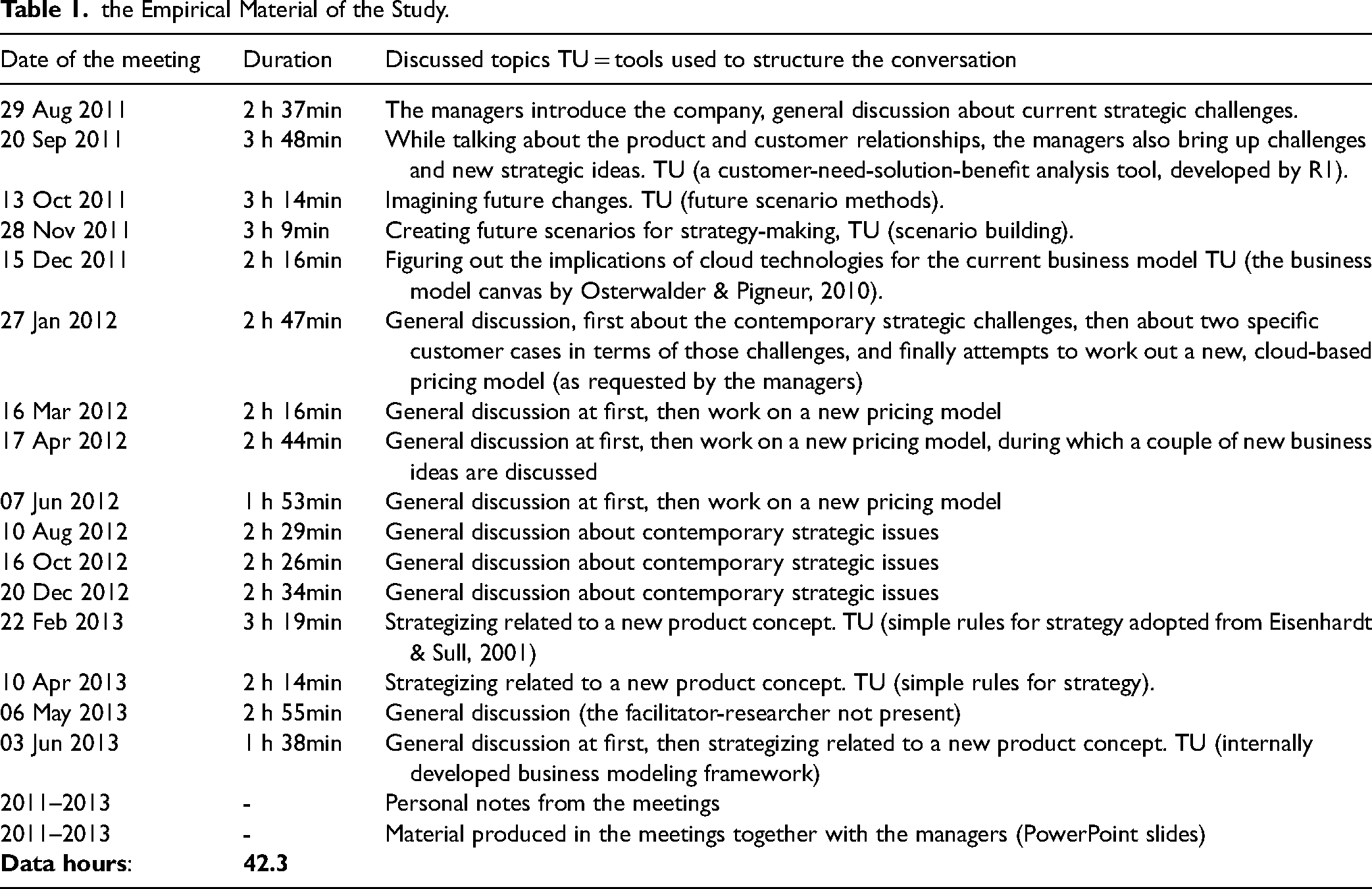
During the collection of empirical material, the role of the software product was not the focus of the study. However, as the meetings progressed, the first author started to recognize a pattern that occurred almost every time the managers were asked about strategy and strategically significant events. In particular, when asked about the strategy, the managers repeatedly started talking about their software product, its technical features, possibilities and limitations. It almost seemed that in the meetings the managers talked about about strategy and the product as if those were interchangeable concepts. This somewhat surprising observation prompted the authors to look at the empirical material from a different viewpoint and reconsider the formulation of the research question to revolve around the role of products in discursive strategizing. Such abductive (Mantere & Ketokivi, 2013; Sætre & Van de Ven, 2021) approach was feasible due to the recorded and transcribed empirical material, which allowed the analysis of how the product was inscribed in strategizing talk even though this was not the initial focus of the research project. The opportunity to record all the meetings made the empirical material exceptional in comparison to previous studies that have used strategy meetings as a primary source of empirical material (Idoko & MacKay, 2021; Jarzabkowski & Seidl, 2008; Kaplan, 2011; Knight et al., 2018).
Each meeting began with a discussion of what was going on in SoftCo at the time. These discussions ranged in length from 30 min to 2 to 3 h, i.e., the duration of the meeting. In these discussions, the managers explained what they were engaged in at that particular moment, thereby also painting a more general picture of the unfolding events. Discussions revolved around events that were mainly related to specific customer relations, competition, software development, and the organization of activities. Moreover, issues of current importance in reference to SoftCo's global growth strategy generally defined what was discussed in a more detailed manner during the meetings.
We acknowledge that in particular by selecting strategy workshop tools and facilitating their use in the meetings (Jarzabkowski & Kaplan, 2015), as well as by asking follow-up questions and commenting on the topics discussed to create dialogue, the researchers influenced the creation of empirical material. However, by letting the managers define the specific topics discussed in the meetings, the researchers were able to address some of the issues emerging from excessive active participation in the data generation process. Especially when the managers talked about ‘what's going on’ in the company, the two participating researchers tried not to interrupt the flow and content of the discussion. Noteworthy in terms of this paper is, that the development of the software product per se was not included in the discussion by the researchers, since the meetings were intended to discuss business development issues. Most importantly, the topic of this study was formulated only after the meetings and therefore it is unlikely that the research design significantly affected or distorted how the managers elevated the product to the discussion.
Finally, the same empirical material has been used in two previous publications (Myllykoski & Rantakari, 2018; Myllykoski & Rantakari, 2022). The open access to participate in and record all the strategizing meetings provided rich empirical material, offering insights into strategy-making from multiple viewpoints. In the first paper, we showed the temporality paradox in strategy-making (Myllykoski & Rantakari, 2018) by empirically focusing on instances where the discursively construct past, present, and future in relation to strategically significant events. The second paper looks at the construction of strategy narratives and empirically focuses on two narratives managers used in investor negotiations (Myllykoski & Rantakari, 2022).
Analysis of Empirical Material
The empirical material was analyzed in a four-phase iterative process (see Figure 1). The second author of this paper had not participated in research collaboration with SoftCo. This enabled the minimization of any biases in the analysis process on the part of the first author due to her active participation during the collection of the empirical material.
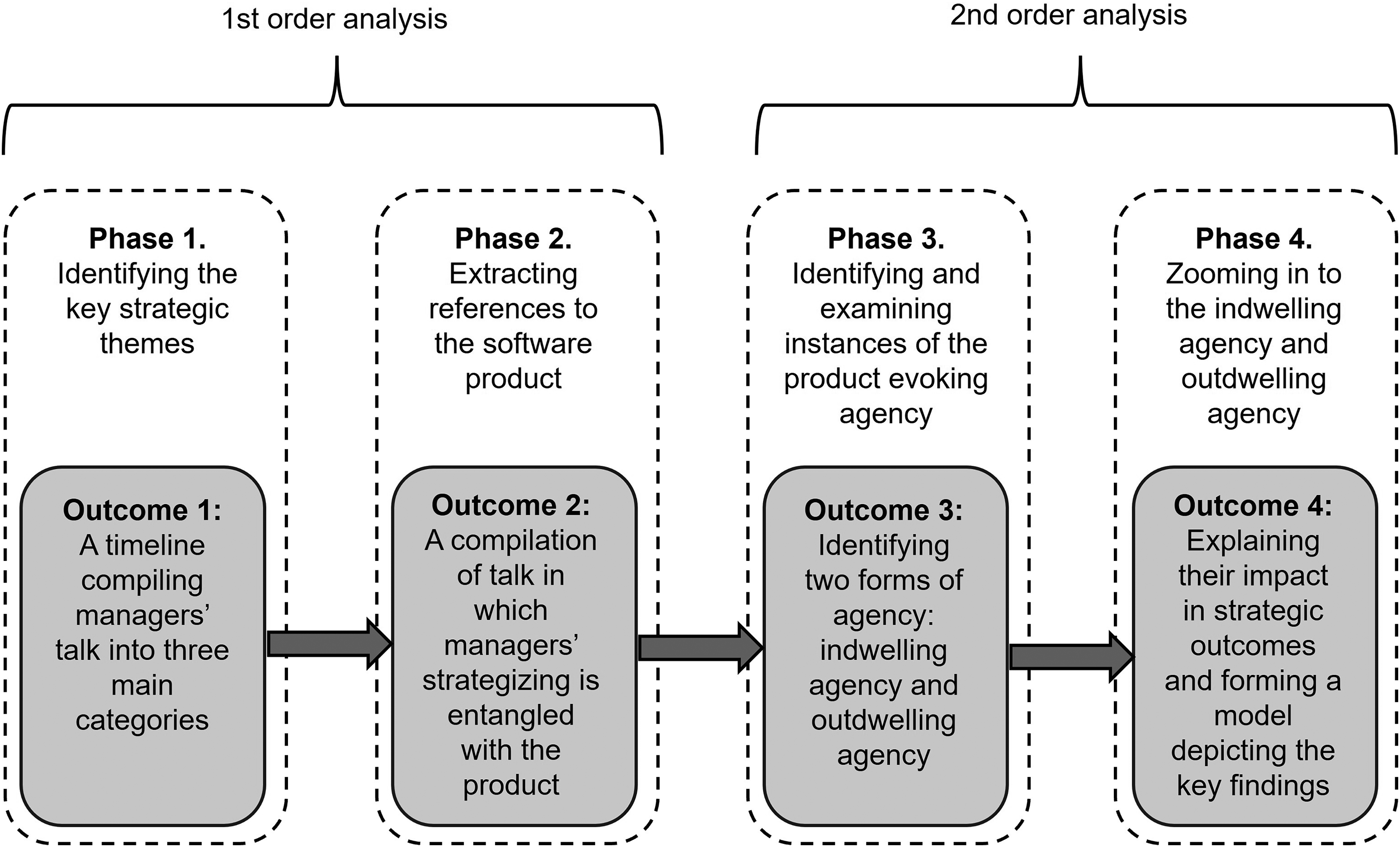
The analysis process.
Phase 1: Identification of Key Strategic Themes: Events, Intentions, and Challenges
The first order analysis started when R2 listened to all the audio recordings during data transcription. The analysis continued with three separate readings of the transcribed recordings and their thematic grouping into NVivo. Here the purpose was to identify key aspects of strategizing in the transcriptions, which comprised over 800 pages. Three main types of strategizing talk were identified through inductive coding. First, the managers brought various concrete organizational events into the discussion when they explained and elaborated their strategic orientation. Second, they elaborated their intentions related to the pursuit of new opportunities, and third, they talked about the challenges they were currently facing in pursuit of global growth. As a result of Phase 1, a timeline was formed compiling their strategizing talk into three main categories, which were called ‘strategically significant events,’ ‘strategic intentions,’ and ‘current challenges’ (cf. Langley, 1999, 2009). These are described in Appendix 1, 2, and 3.
Phase 2: Extracting References to the Software Product
During the second phase, the focus was directed to the role of the product in these three categories of strategizing talk. In this phase, all references to the product and contextual synonyms were highlighted (e.g., product elements, product features, technological details, the implementation process, pricing, and licenses). By identifying utterances in which the managers talked about both the product and strategic issues, a compilation of talk was formed in which strategizing was perceptibly entangled with the product.
In this phase we noticed that the category of ‘strategically significant events,’ which was initially formed inductively, revealed the impact of the broader strategic context on strategy-making, while the ‘strategic intentions’ consisted of the strategic meaning assigned by the managers to the context. However, the instances coded into the category ‘current challenges’ seemed to be related to both events and intentions. Thus, from the perspective of strategy, talk about challenges was apparently a subcategory of both events and intentions. Although the subsequent analysis, therefore, focused on talk about strategically significant events and strategic intentions, talk about challenges was included whenever it was directly related to issues in these two former categories.
Phase 3: Identifying Instances of Product's Agency in Strategizing
The analysis proceeded with identifying instances in which the product perceptibly played an influential role in shaping strategic outcomes. Thus, the compilation of talk extracted in Phase 2 was further analyzed as follows.
First, the ways the managers referred to the product in their talk were analyzed. There were several linguistic indicators of the inseparability of the managers and the software product. The managers often used the pronouns “we” and “our” while they were referring to the product. For example, the managers stated “we are imitated” (SM, Oct 13, 2011) or “our architecture” (COO Dec 15, 2011) to actually refer to the product being imitated and to the product's architecture. Also, at times the managers talked as if the product were a passive object of strategizing while at other times they indicated that the product determined strategic decisions. These latter instances were identified and extracted as manifestations of the product's agency. For example, at the beginning of the meetings, the managers talked as if they were determining the development of the product to enable global growth: “…as a new [product] module we have the AR, which enables us to bring the products into a real space virtually”. However, as the meetings went on, the managers started to more and more talk as if the operational logic of the product determined the conditions for their global growth strategy: “Now, we have limitations in our product platform, so the IP module is not developed enough [for the “V” segment actors]. This is an issue that slows us down.” Second, the managers’ talk was examined in terms of its broader context (Vaara & Langley, 2021). For example, when looking at an instance in which the managers considered a particular event strategically significant, the participants and their impact on the event were unpacked from the perspective of agency (Pentland & Singh, 2012). The analysis revealed several events in which the product could be identified as an active participant.
Phase 3 resulted in identification of two distinct ways in which the product evoked agency in strategizing talk. First, when the logic of the product repeatedly emerged as the primary lens through which managers viewed strategic issues, for example when the CEO stated that the product's logic impacted the way he was looking at the new market and subsequently how he made market entry-related decisions. Second, when product independently participated events with third parties which only later emerged in managers discursive strategizing and shifted managers’ strategic focus. For example, the managers talked about entering a completely new industry and afterwards admit that underlying this strategic shift was an unexpected event – a new partner had independently tested the product. These two manifestations of material agency we labeled as indwelling and outdwelling agency.
Phase 4: Zooming in on Indwelling and Outdwelling Agency
In the final phase of analysis, the broader strategic meaning of the identified forms of agency was further analyzed. The focus was therefore on specifying how these two forms of agency contributed to strategic outcomes. Given SoftCo's explicit strategic objective of rapid global growth, the following aspects of growth were also used to structure the analysis: entering new countries, entering new industries, entering new customer segments in the current industry, growing through establishment of a global reseller channel, and growing by selling more to existing customers. In the following, the findings are presented with illustrative examples from our empirical material.
Findings: Indwelling and Outdwelling Agency in Discursive Strategizing
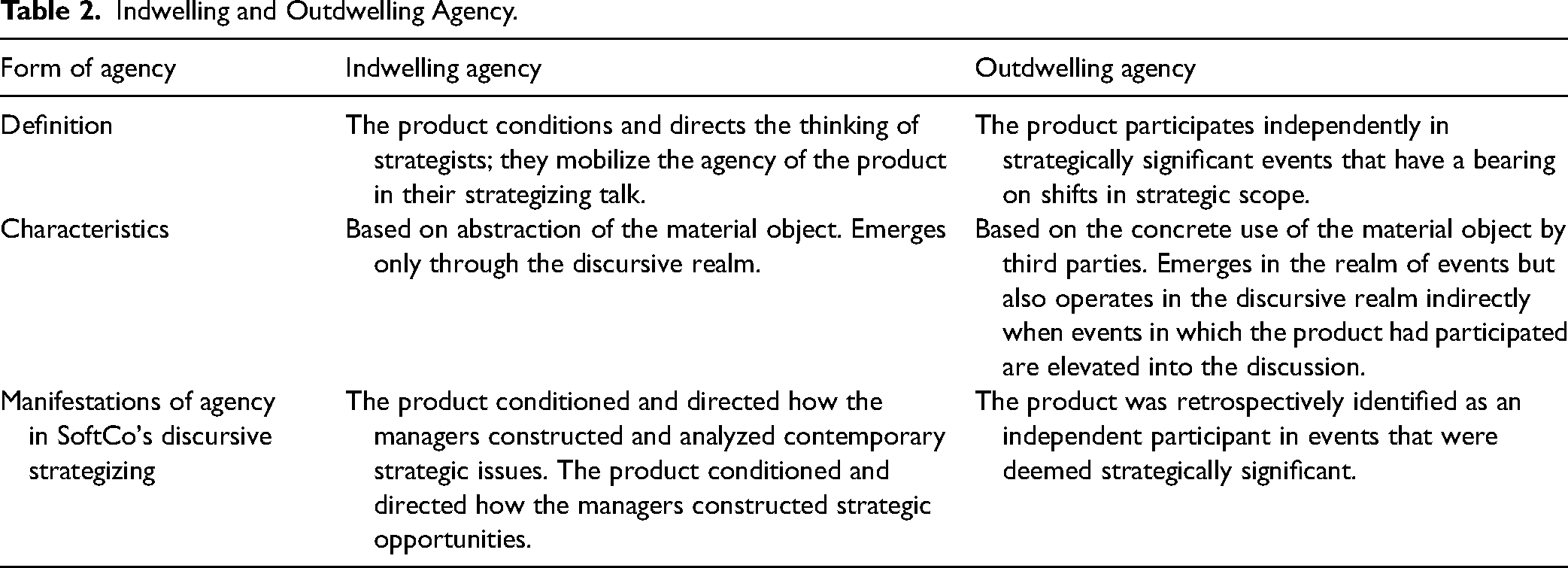
Our analysis revealed two ways in which the product evoked agency in discursive strategizing: indwelling agency and outdwelling agency. Indwelling agency refers to how the logic of the product frames strategic scope in discursive strategizing. While the Merriam-Webster dictionary defines “indwelling” as “being an inner activating or guiding force,” in our case indwelling agency was apparent in managers’ talk when the logic of the product repeatedly emerged as the primary lens through which strategic issues were viewed. In other words, the product evoked indwelling agency when SoftCo's managers talked as if the logic of the software product determined the conditions and possibilities of strategic decisions. In particular, this occurred when managers talked about contemporary strategic issues or constructed strategic opportunities. Characteristically, indwelling agency is directly apparent in discursive strategizing. It is based on the abstraction of the material object and not on its use or physical presence in the strategizing situation. Thus, it is the managers who mobilize the indwelling agency of the product during discursive strategizing by making the opportunities and constraints of the product the boundary conditions of strategy.
Outdwelling agency refers to the independent participation of the product with third parties in events that only later have a bearing on shifts in the strategic focus of discursive strategizing. In our case, outdwelling agency was apparent in discursive strategizing when SoftCo's managers retrospectively denoted the strategic significance of events in which the product had participated independently. Eventually, managers deemed these events root causes for broadening the strategic focus. Although outdwelling agency is characteristically based on events where third parties use the product, it is apparent only indirectly in discursive strategizing when managers talk about these events and link them to strategic outcomes. Since outdwelling agency is based on events where third parties use the product, it is typically apparent only indirectly in discursive strategizing when managers talk about these events and link them to strategic outcomes. Table 2 provides a summary of these forms of agency.
Indwelling and Outdwelling Agency.
Prologue of SoftCo's Global Growth
At the first meeting with SoftCo's managers in August 2011, the managers stated that their key strategic objective was rapid global growth, although they were uncertain about how to pursue it. At that time, most of the customers were based in Finland where SoftCo was the market leader. The competition was not yet intense and according to SoftCo's managers, the company had a slight first-mover advantage thanks to its technologically sophisticated product. Hence the managers stated that they had to capitalize on this momentum by rapidly expanding into the international market. After a strict focus on a clearly defined customer segment in its early years, SoftCo's managers indicated that they might also seek other customer segments. Next, we elaborate with examples how indwelling agency and outdwelling agency were apparent in the strategizing talk of SoftCo's managers.
Indwelling Agency
At the beginning of the meetings, the managers first talked about the product as if it were a mere object of strategizing. However, as the discussions went on and the managers started to speak more freely, the product took on a more impactful role in their strategizing talk. More specifically, the managers increasingly referred to the product as if its operational logic determined the conditions for their global growth strategy, and thereby invited the product to participate in strategizing. To show how indwelling agency was apparent in SoftCo, we first illustrate how managers talked as if the product determined their approach to contemporary strategic issues. Second, we illustrate how the operational logic of the product framed how managers constructed strategic opportunities in their talk.
Indwelling Agency in Approaching Contemporary Strategic Issues
In the first two meetings in August and September 2011, the managers explained that to grow fast and cost-efficiently; one of the central issues was to form a new global ‘sales channel strategy.’ As explained by the CEO in an excerpt below, this strategy entailed outsourcing their time-consuming product implementation to new resellers with the aim that SoftCo would eventually focus solely on selling the product platform. “One of the long-term visions we have is to become more like a product platform provider. This is something we have been thinking [about for] a long time now. At the moment, we deliver the whole thing. But what if we just delivered the technological platform and resellers would take care of the rest?” September 29, 2011 Have you considered this strategic option [becoming a product platform provider] systematically? Well, it is in progress, but as I said, our IP product element does not support it fully now.” September 29, 2011 I think that one option is to start our own webshop. Yes, we have already been thinking of this for four years. (…) You mentioned that you have been thinking about this for a long time, why haven’t you taken this path yet? There are still limitations in our product, in the IP element, that obstruct this.” September 29, 2011 What is the biggest challenge to your growth now? It's our production [product implementation] We must do everything by ourselves now. (…) It's strategically important that we become more aggressive now in removing the content production bottleneck.” December 15, 2011
Another example of indwelling agency is from a discussion about SoftCo's entry to Japan in November 2011. The excerpt shows how the operational logic of the product was inscribed in strategizing talk. Is the market different there? [in Japan] In some ways, yes. Although we still lack an in-depth understanding. In some ways, it's simpler. I mean, when I look at furniture, I see that it consists of rules, namely how it can be built and bought with the help of our software. And when I look at the [Japanese] market through these glasses, it seems simpler than our local one. So, there are fewer modules and furniture systems and more single pieces of furniture. And now we have decided to try to simplify our offering there. So, we’ll basically start with the AR and IP product modules.” (November 28, 2011)
Last, a counter-example of indwelling agency shows how the product conditioned strategic thinking and how detachment from this conditioning effect was a momentary exception. In June 2012, the discussion unintentionally developed into brainstorming about pricing, even though the initial purpose of the meeting had been to discuss strategic issues in general. However, pricing was one of the key challenges at that time because the current pricing model was no longer appropriate for SoftCo's potential customers, which were significantly larger with respect to potential revenue. During this meeting, many ideas that differed radically from previously drafted and analyzed pricing alternatives were discussed, as the following shows. Should we stop our meeting today because it's starting to get pretty wild [laughing] with this pricing? I encourage you in this direction because now you’re thinking from the customers’ viewpoint. You forgot for a moment… We forgot for a moment… Your limitations Our ARs, PCs, and IPs [referring to the software product elements.] We forgot them.” (June 7, 2012)
Indwelling Agency in Constructing Growth Opportunities
Indwelling agency was also apparent in the managers’ talk about growth opportunities. Overall, the empirical material shows that the managers systematically constructed opportunities based on the development potential of the product. Here we elucidate the two growth opportunities discussed most by the managers during the meetings: Business Intelligence (‘BI’ as a new product feature) and Augmented Reality (‘AR,’ an element productized and offered separately). In Business Intelligence the growth potential was based on increasing the sales volume per customer and in Augmented Reality on new customer segments. The managers repeatedly highlighted that these two growth opportunities were strategically important.
When asked about strategy, SoftCo's managers often responded with talk about the product's logic and potential. This is clearly illustrated in the excerpt below where Researcher 1 asked about strategy documents and the COO responded by talking about the growth potential inscribed in the BI product feature. What form is your strategy document in? Is there a scenario…or that kind of analysis behind it? Yes, we have…a kind of basic scenario, a plan, but it's not for five years. That's correct; we don’t have such a long horizon for it. In a way, how we build our channels, how we go forward, hence we have not really changed our basic package, that pattern, it's somehow crystallized. Probably the biggest thing we have thought of – but we have not planned it yet – is Business Intelligence. Business Intelligence and how, what we already discussed a bit, how could it turn our concept around. (October 13, 2011)
The excerpt below shows that the managers had based their assessment of the opportunities offered by BI on the technical potential of their product, rather than on the expressed needs of their customers. Given BI's strategic importance, its technical potential was also the point of departure for strategizing. The problem is that we don't exactly know what BI might be. What kind of data do customers need? We know what kind of data we can get from our product, but what is its value [for the customers]? Where, in that data, can value be found? (November 28, 2011)
In addition, the following excerpt also illustrates how the managers based their AR growth opportunity on their product. The seeds of this idea were actually planted in our investor discussions. Someone there suggested that we envision, without any commitments, an idea that could grow in volumes like this [tracing a steep curve with his hand]. […] This growth idea involves an application; let's say an iPad app, where our AR is the basis. And you could download the app either gratis or for a small fee. And the app would contain a generic product library, for example, scalable tables. And you could rent for example products A, B, and C there, let's say for a month. This is a completely raw idea.” (May 6, 2013)
In addition to the examples above, indwelling agency is apparent in the ways managers used the pronouns ‘we’ and ‘our’ when referring to the product in their strategizing talk. As the excerpt below shows, the COO uses the pronoun ‘we’ when talking about what the product can track and the pronoun ‘our’ when referring to the architecture of the product. Even though these references may be considered informal talk, these are repeated throughout the empirical material. We can track what the [product] users are doing from beginning to end. That is something unique to our architecture; no one else has the same [feature].” (December 15, 2011)
Outdwelling Agency
Outdwelling agency refers to the independent participation of the product together with third parties in events that eventually had a bearing on shifts in the strategic focus of discursive strategizing. In SoftCo, outdwelling agency was apparent in managers’ talk when they pointed retrospectively to the strategic significance of events in which the product had participated independently, for example when it had been tested by potential customers and partners. The product's independent participation was enabled by its growing reputation in the market and because it could be found and tested on the Internet. This resulted in the emergence of unplanned customer relations and led to a broadening of the strategic focus both geographically and industry-wise. We illustrate the manifestations of outdwelling agency with two examples. The first is SoftCo's entry into the Australian market and the second is the emergence of strategically significant customer relations – neither of which was initially part of the company's growth strategy.
Indwelling agency in strategizing talk.
At the beginning of 2012, ‘BetaCo,’ a large Australian company, found and evaluated SoftCo's product online without SoftCo's knowledge. BetaCo operated in a completely different industry and represented a totally new business model, which SoftCo had never considered a strategic option. Also, BetaCo operated geographically outside the focus of SoftCo's global growth strategy. After independently evaluating SoftCo's product, BetaCo contacted SoftCo's sales and proposed collaboration. Their proposal was extremely lucrative. Collaboration with BetaCo proceeded to a trial phase where three “end customers” (BetaCo's customers) tested SoftCo's product. Collaboration subsequently led to a broadening of SoftCo's strategic focus from several perspectives.
Interestingly, BetaCo's representatives found and initially evaluated SoftCo's product without the knowledge of the latter's managers. Initially, SoftCo's software product was the company's sole participant in the Australian market. This was later confirmed by SoftCo's managers. Really, the contact [from the new industry Beta] came totally out of the blue. If one thinks about our current customer industries… Well, where to go looking for new business… [laughing sarcastically] Yep, let's shoot for Beta industry [laughing sarcastically] Definitely, we could not have made this connection by ourselves. Anyhow, it's super interesting that this came to us a year ago. So, in January they tested and evaluated our product and after that contacted us in February and the trials began last summer. Now we are in the commercial phase since the trials are over. Probably we’ll get the full deal in Q3. Is that so? They called you? Well no, they emailed one of our sales contact infos… And there somebody had to check it twice, saying: What? [laughing] At that point, they had already tested the product, can you believe it? Yep, they had already tested one of our customer's applications. This is interesting! This particular customer application is only available on a website located in Finland, and only in Finnish! [laughing] (May 6, 2013)
As a second example of outdwelling agency, we show how strategically significant customer relations representing new industries emerged as a consequence of events where the potential customer and the product were the key participants. And then, in Finland, the first product has now been sold to a new industry. We’ve now been talking for almost a year about these potential new industries. How did you end up now with these particular two [referring to the two new industries]? It's such an…[laughing] Is it an accident? Yes, it's accidental [laughing.] Actually, it's because we’re so well known in the Finnish market. So everyone starts to know us because we’re so visible in the “X” industry [SoftCo's main industry.] And when these companies from these other industries bump into our product, it made them think. So, these new industries have emerged through this. (October 16, 2012)
This unintended entry into two new industries eventually led SoftCo managers to broaden their strategic focus. Events in which the product participated independently appear to have catalyzed a process leading to strategic renewal. As the software product had aroused interest in industries outside the managers’ strategic focus, the contribution of the product's agency to the strategic outcome seems clear. However, it emerged relationally along with that of potential customers. In addition to the above examples, it is noteworthy that the managers mentioned several other strategically significant events where the only participant from SoftCo was the product.
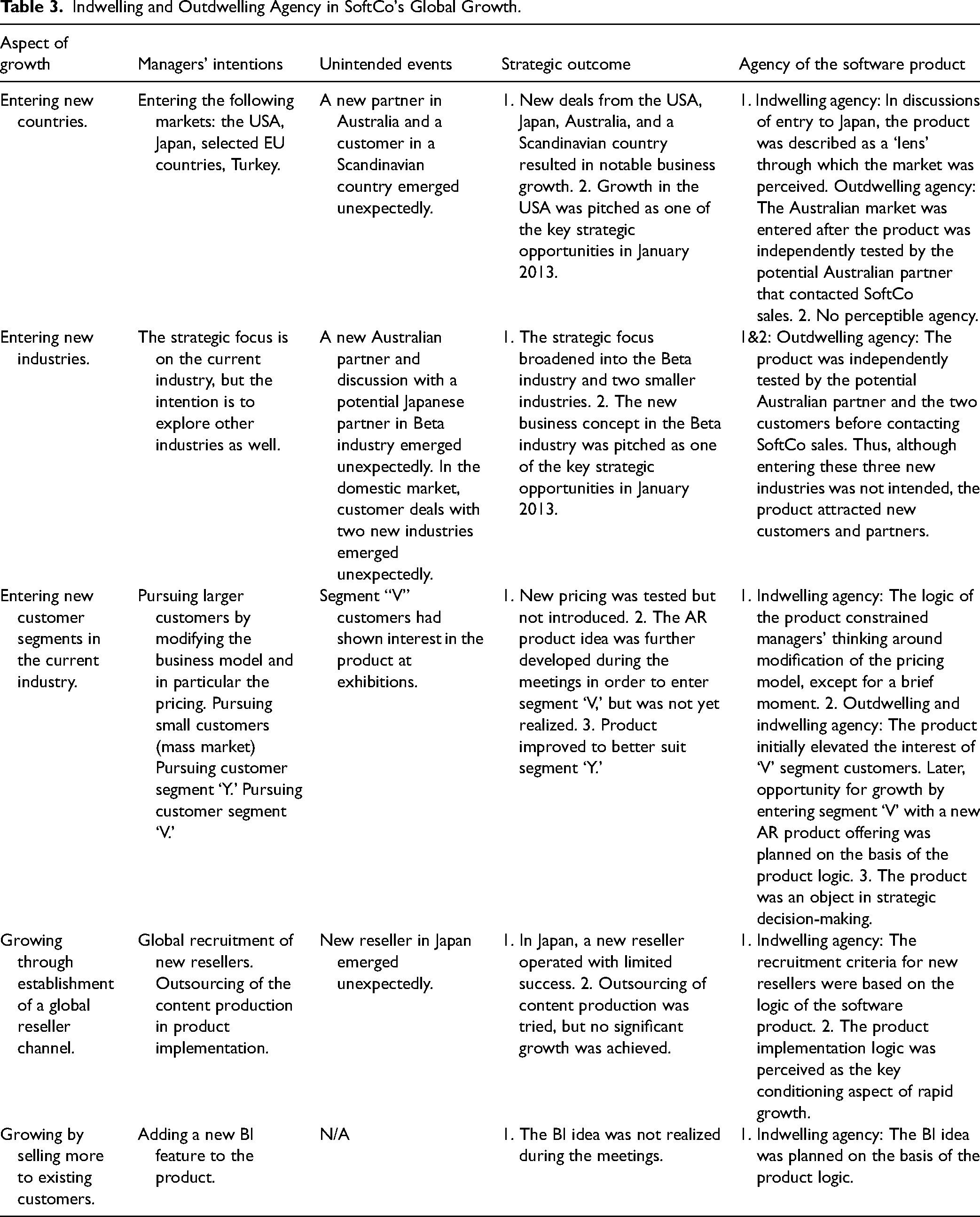
In sum, Table 3 provides an overview of how indwelling and outdwelling agency contributed to strategic outcomes at SoftCo from 2011 through 2013.
Indwelling and Outdwelling Agency in SoftCo's Global Growth.
Conceptual Framework of Indwelling and Outdwelling Agency
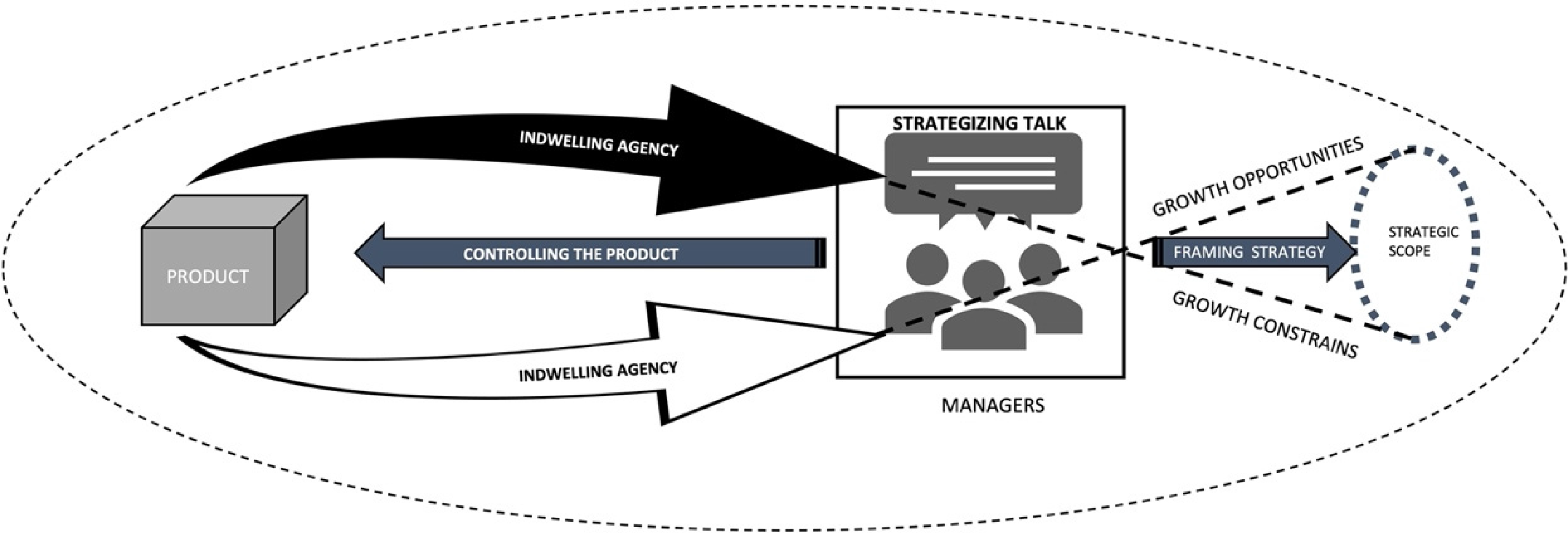
We now draw our findings together into a conceptual framework that illustrates how indwelling and outdwelling agency manifest in discursive strategizing and eventually shape strategic outcomes. Figure 3 elaborates how indwelling and outdwelling agency manifest and connect to both discursive strategizing and organizational events.
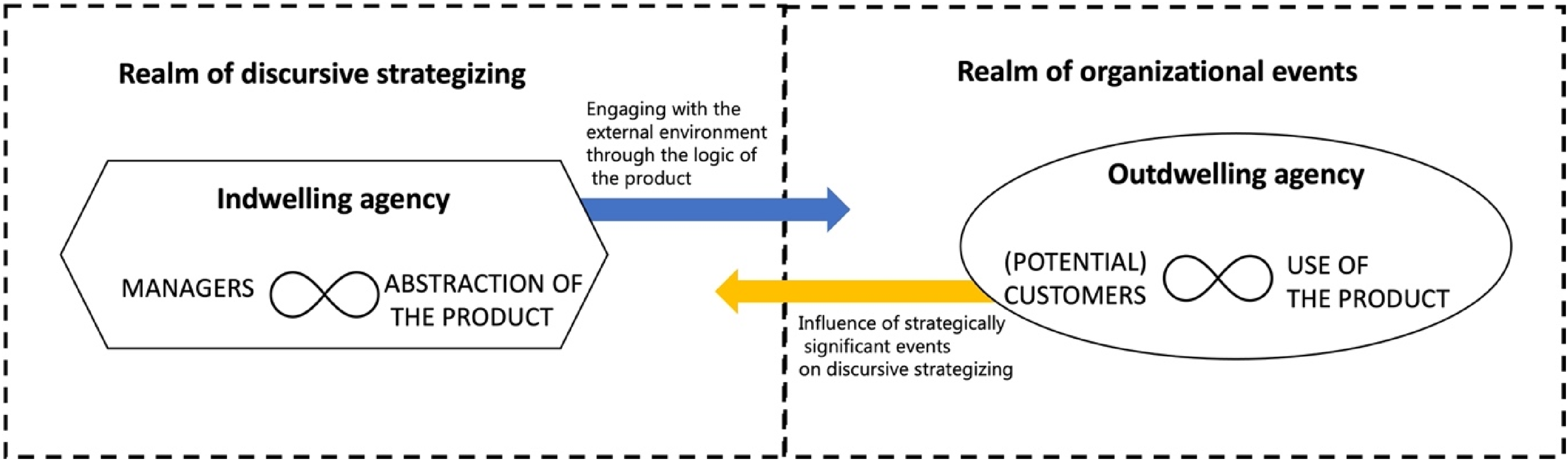
Manifestations of indwelling and outdwelling agency.
Indwelling agency in discursive strategizing refers to how the logic of the material object may frame managers’ strategic scope. In particular, our findings illustrate how the logic of the product conditioned the ways managers constructed and analyzed contemporary strategic issues, as well as growth opportunities and constraints. Indwelling agency is characteristically based on an abstraction of the material object since the logic of the product repeatedly emerged in managers’ talk as the primary lens through which managers looked at strategic issues. Therefore, indwelling agency manifests solely in the discursive realm and can’t be fully separated from the managers’ agency.
Moreover, indwelling agency illustrates how strategists mobilize material agency in their talk (Cooren, 2010; Pälli, 2018). When the managers’ discussions become framed by the logic of the material object, this material object starts to enable, constrain, and alter managers’ strategic scope. While the conditioning role of the existing product might be something to be expected in incumbent organizations, indwelling agency particularly illuminates why it is so difficult for strategists to detach themselves from their existing patterns of thinking and to look ‘outside the box’ to strategize creatively (see Chia & Holt, 2006). Our findings demonstrate the role of material agency in hindering the managers’ ability to recognize strategic novelty, as framing strategic issues through the logic of the product appeared to be ingrained in their thinking. Thus, indwelling agency provides one possible explanation for why managers may end up repeating the same patterns of strategizing.
In addition, in our case, indwelling agency is associated with managers tendency to stick with growth opportunities that were only based on the development potential of the product, but not with market or customer analysis. By repeatedly responding to the questions about strategy by referring to the development potential of the product, the managers implicitly correlated the technical potential of the product with company's growth strategy. Interestingly, these opportunities based on the technical potential, even though reasonably straightforward, or at least technically possible to implement, never realized 1 . This is another indicator that indwelling agency may hamper strategic renewal if the future strategy is viewed mainly from the perspective of the opportunities of a product.
Outdwelling agency refers to how material object may independently participate in events that only later have a bearing on shifts in the managers’ strategic scope. Characteristically, outdwelling agency manifests in realm of events by being used by third parties, in our case when future customers tested the product without managers’ knowing about it. However, outdwelling agency manifests in discursive strategizing only when managers retrospectively designate strategic significance to those events in which the material object had participated independently. Hence, the material object evokes outdwelling agency in discursive strategizing indirectly.
In this way, outdwelling agency illustrates how material objects may evoke agency through their impact on the course of events (Leonardi, 2012, 2017; Pentland & Singh, 2012). A product that is initially created by managers independently “acts back” (Rennstam, 2012) by arousing the interest of customers and partners outside the initial strategic scope. In our case, outdwelling agency is associated with promoting strategic renewal, as the product's participation in events catalyzed the emergence of several radically new avenues of growth.
Overall, our study reveals how a material object may evoke agency in discursive strategizing in two distinct ways. First, indwelling agency is a direct form of agency that is based on an abstraction of the product. Second, outdwelling agency is an indirect form of agency that is based on its concrete use by third parties. These two forms of agency may be associated with almost opposite strategic outcomes, highlighting the complexity of the relation between materiality and discursive strategizing.
While our findings elaborated the material agency of a product, we anticipate that our findings would be applicable to other organizational contexts assuming that other material objects may also evoke indwelling and outdwelling agency. First, we could expect that indwelling agency may also lead to similar outcomes in other research contexts. This is because indwelling agency seems to restrict managers’ thinking to the conditions of product. However, in terms of outdwelling agency we foresee more potential variation of strategic outcomes with respect to different research contexts. While in our case outdwelling agency seemed to be associated with the emergence of novelty, other products may have a reverse impact on strategic outcomes even to the extent of hindering the emergence of novelty.
Discussion
Our study contributes to strategy discourse research (Balogun et al., 2014; Bencherki et al., 2021; Pälli, 2018; Vaara et al., 2010) by conceptualizing two forms of material agency in discursive strategizing: indwelling and outdwelling. More specifically, indwelling and outdwelling agency illustrate how one material object may evoke agency in discursive strategizing in two distinct ways, both directly and indirectly. These findings also shed light on how material agency may contribute to strategic outcomes by both hindering and promoting strategic renewal.
A few strategy discourse scholars have already suggested that materiality may evoke agency in and through discursive strategizing (Cooren, 2010; Pälli, 2018; Vaara et al., 2010). While these studies have been pivotal in extending our understanding of strategic agency beyond humans, they have focused on strategy documents – a very specific form of materiality – and how these documents may evoke agency in the interactions between different organizational members after the strategy has been formulated (Pälli, 2018; Vaara et al., 2010). Our conceptual framework contributes to this line of inquiry in a two-fold manner. First, it illustrates how also other forms of materiality, in our case a company product, may evoke agency in and through discursive strategizing. This helps strategy scholars to broaden the scope of material objects that may play an influential role in discursive strategizing. Second, our framework describes how both indwelling and outdwelling agency shape the initial formulation of strategy itself. This helps strategy scholars to further identify both direct and indirect ramifications of material agency for strategic outcomes.
Furthermore, prior strategy research has so far agreed that materiality and discourse are deeply connected and inseparable (Balogun et al., 2014; Dameron et al., 2015). However, studies empirically illustrating this inseparability have examined how discourses may materialize, for example by showing how strategic concepts contribute to material outcomes (Jalonen et al., 2018) and how discursive practices progressively turn into material arrangements (Bencherki et al., 2021; Vásquez et al., 2018). Our study extends this stream of literature by drawing attention to the reverse logic: How materiality may also ‘discursify’ and ultimately manifest agency in managers’ discursive formulation of strategy. First, the concept of indwelling agency illuminates this ‘discursification’ by showing how discursive strategizing becomes framed by the abstract logic of the material object. Indwelling agency provides explanations to how the material object that was initially created by the managers, ultimately starts to condition their own strategizing. Second, outdwelling agency illuminates how materiality may ‘discursify’ indirectly when managers designate strategic significance retrospectively to events in which the material object had participated independently.
Our findings also contribute to prior research that has focused on how strategists use materiality such as tools and artifacts, and how this use shapes strategizing (Idoko & MacKay, 2021; Jarzabkowski & Kaplan, 2015; Spee & Jarzabkowski, 2009). We extend these studies by showing how a material object may impact strategizing from a distance, by being used by third parties. While few scholars have already argued that materiality may shape strategizing without spatial or temporal presence in a specific strategizing situation (Demir, 2015; Leonardi, 2015), our findings particularly in terms of outdwelling agency demonstrate how a material object may indirectly evoke agency by participating in events with third parties that only later become strategically significant for the company. In other words, our study suggests that materiality does not always have to be used or controlled by strategists or other organizational members to influence strategizing. Instead, it may also evoke agency in and through the usage by external actors.
In addition, our conceptual framework responds to broader calls to better understand the relation between strategic practices and outcomes (Jarzabkowski et al., 2021; MacKay et al., 2021) by highlighting the role of material agency in this relation. Our findings provide possible explanations to connect strategizing practices and their outcomes in two ways. On the one hand, our findings reveal how indwelling agency may be associated with hampering strategic renewal as the managers viewed the market from the perspective of the opportunities and constraints of their product, which didn’t lead to novel outcomes. On the other hand, outdwelling agency seemed to be associated with promoting strategic renewal, as several radically novel avenues of growth emerged as the product aroused the interest of customers and partners outside the strategic focus. Taken together, by focusing on the agency of the company product, our study showcases potential pathways from managers’ strategizing to strategic outcomes.
Our study also has implications for broader strategy practice research (Burgelman et al., 2018; Kohtamäki et al., 2022; Vaara & Whittington, 2012). This stream of literature has defined the key elements of strategy-making as practice, praxis, and practitioners (Whittington, 2006). However, to emphasize the role of the product, we propose including products as a potential fourth element of strategy processes and practices. Rather than treating products solely as malleable objects of strategizing, they can also be considered active participants. In this way, our study responds to prior calls for more strategy research that challenges the prevailing overemphasis on human agency (Chia & Holt, 2006, 2009). By demonstrating the entanglement of strategizing discourse and materiality, we extend ideas about who participates in strategizing (Vaara & Langley, 2021; Vaara et al., 2019).
Conclusions
In this study, we examined how a product – as one form of materiality – evokes agency in and through discursive strategizing to better understand how materiality is consequential for strategizing outcomes. In addition to the theoretical contributions discussed above, our study also suggests implications for managers. Managers would benefit from reflecting on how their formulation of novel strategies is fundamentally entangled with the operational logic of their product. By consciously building awareness of how this operational logic affects their strategizing, managers may avoid the pitfall of addressing new challenges with old remedies. Similarly, our findings provide insights into the central role of unintended events in the renewal of strategic scope and into the role of products in them, both of which are important issues for managers to consider when formulating future strategies.
Despite our contributions, we acknowledge that our study has its limitations. First, while our empirical analysis elucidated manifestations of the product's agency, at the same time we acknowledge that this can lead to downplaying of managerial agency in strategy-making. Second, even though participating in the strategizing discussion enabled us to gain in-depth, real-time data on strategy-making, we acknowledge that observation of the daily operations of SoftCo would have enabled even more profound elaboration of some of the aspects of the agency. In addition, we acknowledge the limitations that emerge from focusing solely on the managerial perspective of strategy-making. Finally, while in our case outwelling agency seemed to be associated with the emergence of novelty, it would be interesting to study the potential ways in which various company products may evoke agency and their impact on strategic outcomes.
Supplemental Material
sj-docx-1-jmi-10.1177_10564926231207304 - Supplemental material for Material Agency in Discursive Strategizing – The Study of a Software Company Seeking Global Growth
Supplemental material, sj-docx-1-jmi-10.1177_10564926231207304 for Material Agency in Discursive Strategizing – The Study of a Software Company Seeking Global Growth by Jenni Myllykoski and Anniina Rantakari in Journal of Management Inquiry
Footnotes
Acknowledgement
We would like to express our gratitude to Professor Eero Vaara Saïd Business School, University of Oxford and Assistant Professor Jeannie Holstein of the University of Nottingham for providing comments and suggestions that helped us in developing the paper. We are also grateful for the feedback and suggestions we received in EGOS Colloquium 2016 and in the Academy of Management Annual Meeting Conference 2021. We would also like to thank the four anonymous reviewers for extremely helpful suggestions for improvement.
Declaration of Conflicting Interests
The authors declared no potential conflicts of interest with respect to the research, authorship, and/or publication of this article.
Funding
The authors disclosed receipt of the following financial support for the research, authorship, and/or publication of this article: This work was supported by the Foundation for Economic Education in Finland (grant no: 16-9273; 20-11685). The empirical material of this study was collected as a part of national research program by DIMECC (Formerly known as TIVIT), funded by TEKES (2011-2013).

Supplemental Material
Supplemental material for this article is available online.
Notes
References
Supplementary Material
Please find the following supplemental material available below.
For Open Access articles published under a Creative Commons License, all supplemental material carries the same license as the article it is associated with.
For non-Open Access articles published, all supplemental material carries a non-exclusive license, and permission requests for re-use of supplemental material or any part of supplemental material shall be sent directly to the copyright owner as specified in the copyright notice associated with the article.
