



Abstract
In this paper, we propose that drawing on our “feeling of being out of place” when seeking research access can be a valuable source for methodological reflexivity. Drawing on the concept of affective spacing, we examine why and how “feelings of being out of place” emerge as we approach research settings, what emerges as matters of concern in this process and what insights attending to these feelings can provide. We conclude by discussing the revelatory and consequential implications that affective spacing can have for our research. This, we argue, can also help better prepare qualitative scholars to acknowledge and navigate their own involvement in their research.
Gaining research access is a critical part of all organizational research that presupposes direct access to an organizational setting. To gain access is, however, not simple; organizations are not necessarily willing to open up to outsiders, either because they do not see the value of the research that is to be performed (Laurila, 1997) or because they do not want to reveal “secrets” (Barley, 1990; Buchanan et al., 2013). As such, the challenge of obtaining access can take a lot of time (Johl & Renganathan, 2010; Smith, 1997) and can imply an unpredictable process to find willing informants (Cunliffe & Alcadipani, 2016; Peticca-Harris et al., 2016). Each participant, in turn, might also regulate how they interact with a researcher in terms of varying degrees of openness (Kara et al., 2023). Along with these difficulties, how access is given has been understood to color the interpretative process of research (Van Maanen & Kolb, 1982) as well as ultimately having implications on its quality (Lincoln & Guba, 1985; Sinkovics et al., 2008).
With this in mind, it is not surprising that a common genre of methodological writing is on advice to navigate the process of gaining research access (Cunliffe & Alcadipani, 2016; Feldman et al., 2003; Grant, 2017; Hammersley & Atkinson, 2007). From linear models of gaining access and building rapport (Dundon & Ryan, 2010; Walford, 2001) to non-linear models that posit the unfolding uncertainty of gaining access (Bruni, 2006; Dutton & Dukerich, 2006; Feldman et al., 2003; Peticca-Harris et al., 2016), the breadth of literature on gaining access provides a rich source of advice for any qualitative scholar. However, while extant methodological literature has produced comprehensive conceptualizations of the challenges of gaining access, much of this literature entails a focus on actionable knowledge for doing empirical research. Although procedures or strategies to gain research access are suggested with care (Cunliffe & Alcadipani, 2016; Feldman et al., 2003; Peticca-Harris et al., 2016), emphasis is commonly placed on navigating the challenges of gaining access in order to do actual research. Indeed, the process and lived experience of gaining research access is seldom considered part of qualitative research itself (Feldman et al., 2003, p. 5; Kara et al., 2023).
The way seeking and gaining research access unfolds, however, constitutes an interesting opportunity for methodological reflexivity. We contend that when we are attentive towards the relationality between the researcher and the researched, i.e., those we study, in the process of seeking access (cf. Cunliffe & Alcadipani, 2016; Kara et al., 2023; Rodriguez & Ridgway, 2023), we can also mobilize our affective responses to the spaces we encounter to acquire insights. The notion that this mobilization can prove revelatory and consequential for research emerged out of our collective attempt to make sense of the unsettling sensation of “feeling out of place” that we individually experienced when seeking access. Drawing on affect theory, we conceptualize such sensations to be a form of affective spacing (Gherardi, 2023), a way in which we feel affected by the spaces we encounter when first meeting with the site to which we are seeking access. With this conceptualization in mind, we ask: What does our “feeling out of place” in seeking research access reveal to us? And what consequences can such a feeling have for how we approach research as researchers?
We answer these questions by drawing on vignettes from our own experiences of gaining research access. Through these, we show how “feeling out of place” may be considered by attuning to affective intensities and space in the process of seeking access, from coming to the site where research (potentially) will be performed to being scrutinized by gatekeepers on site. We note two important aspects at play across this process. First, seeking access to an organizational setting places the researcher in encounters where aspects between the researcher, the research and constituents of the organization reveal themselves. Among these “revelatory aspects” are prejudices, underlying doubts about the (potentially upcoming) research and the contours of the research site—aspects that become more pronounced in relation to how we feel in this process, if paid attention to. Second, we note how “feeling out of place” holds consequences for how we as researchers engage in research. These “consequential aspects” include indications of mysteries to be pursued, our choices to self-regulate on site to “fit in” and how an unexpected sense of belonging can emerge to dispel feeling out of place. These, we believe, hold important implications for our research.
The contribution of this paper lies in showing how sensations of “feeling out of place” may be drawn upon reflexively while seeking research access. As we elaborate on later, focusing on our sensations while seeking research access can prove crucial to understanding the chosen research setting, our own felt involvement and our own research practice. On a more general level, we argue that attending to affective spacing in access processes may help qualitative scholars navigate and acknowledge how affective responses emerge due to the relations between bodies, materiality and space under the early stages of research and, thus, provide complementary insights to understand their own involvement in their research.
The paper is structured as follows. We begin by accounting for the literature on methodological reflexivity in relation to the process of gaining research access. Then, we introduce affect theory and the notion of affective spacing to better understand sensations of “feeling out of place.” Five vignettes follow, illustrating how feelings of being out of place emerge and the implications that these feelings can entail. Finally, we discuss the implications for performing qualitative studies.
Methodological Reflexivity
Scholars writing about methodological reflexivity have, for the most part, built their claims on a processual and relational epistemology. From this perspective, research is understood as continuously unfolding (Alvesson & Kärreman, 2007; Cunliffe, 2003; Cunliffe & Karunanayake, 2013; Hibbert et al., 2014) and inherently messy (Law, 2004), making it impossible for researchers to divorce their subjectivity from it (Shotter, 2009, 2010). This means that while researchers might attempt to cover the tracks of their own personal involvement to legitimize their research findings, qualitative research always implies personal involvement (Langley & Klag, 2019; Shotter, 2006) and personal vulnerability in researcher–participant relations (Rodriguez & Ridgway, 2023). As has been stressed, aspects such as racism, sexism, privilege, or lack thereof (Alcadipani et al., 2015; Rodriguez & Ridgway, 2023) may matter in the research process. Making things more complicated, ethical concerns are also steadily present in both acquiring access and in relating to participants (Kara et al., 2023; Roulet et al., 2017).
To critically explore these issues from a reflexive perspective implies moving beyond what Shotter (2005, 2006) referred to as “aboutness”-thinking. Such thinking is traditionally emphasized in scholarly training and entails constructing the research process as an endeavor to reduce complexity, favoring simpler, retrospective accounts of phenomena and events, with minimal consideration of the researcher's subjectivity. This dramatically underplays the uncertainty and unexpectedness of how research unfolds in the making from within the process itself (Shotter, 2008). Over time, theorists of reflexivity have provided different alternatives to explore how scholars could account for their own involvement in their research process. To name some examples, reflexive scholars have suggested that researchers should be attuned to intersectional reflexivity (Rodriguez & Ridgway, 2023) and ethical reflexivity (Kara et al., 2023) to better understand the role of power in research. In addition, scholars of reflexivity have also suggested affective reflexivity in research (Bergman Blix & Wettergren, 2015; Gherardi, 2019, 2023; Gilmore & Kenny, 2015; Mäkinen, 2016; Rosales & Babri, 2023), highlighting how emotions matter and may be navigated in research. Parts of this latter strand of reflexivity scholarship specifically emphasizes the idea of bringing in bodies—those of the researchers and the researched—into the research process (Thanem & Knights, 2019) to portray the embodied nature of researcher involvement.
Dimensions of methodological reflexivity are thus highly relevant in seeing how researchers are entangled with their research settings and what such entanglement might imply. Such considerations are also relevant for considerations of seeking access. This first phase of the research process necessarily entails an initial encounter that is relational (Feldman et al., 2003, p. 5), marked by unfolding uncertainty (Peticca-Harris et al., 2016), and the task of navigating researcher–participant relations for the sake of accomplishing the upcoming research project (Alcadipani et al., 2015; Rodriguez & Ridgway, 2023). To seek access for the sake of doing qualitative research thus also implies a process where the involvement and vulnerability of the researcher become apparent (Cunliffe & Alcadipani, 2016) and where the researchers’ emotions play a role in how access is obtained and maintained (Bergman Blix & Wettergren, 2015; Rosales & Babri, 2023).
In this paper, we connect our interest in the early research processes of gaining access with recent insights from affect theory to expand our understanding of the emergence and influence of researchers’ emotions in research. We are particularly interested in exploring how (and why) feelings of being out of place may arise as we encounter not only other living bodies but also the materiality and spatiality of research settings in the pursuit of research access.
Conceptualizing “Feeling Out of Place” Through Affective Spacing
Affect theory is a complex body of work which, while spanning various fields (Gregg & Seigworth, 2010; Massumi, 2015), is at its heart a social theory, one concerned with what occurs between interacting bodies. These bodies are often understood to be contextually embedded in complex, political and dynamic configurations (Ahmed, 2014), alternatively referred to as assemblages. Consequently, affect is not reduced to an individual's emotional state(s) alone but naturally imply an interest in the in-between-ness of life (Seigworth & Gregg, 2010).
Insights from affect theory have been suggested to inspire a different style of doing organizational research that emphasizes the role of the body, emotions, relationality and processualism (Fotaki et al., 2017; Gherardi, 2019, 2023; Thanem & Knights, 2019). Moreover, Gherardi (2019) poignantly illustrates how researchers may conceive of themselves as affecting and being affected by those they study. Important in such research is the emphasis on affects as automatic and unmediated bodily forces or “intensities” that occur in response to situations in and encounters with the world, irrespective of language or cognitive processing (Clough, 2008; Massumi, 1995, 2002). Of note, then, is that affect is understood to reflect bodily and emotional responses—including involuntary ones—to other bodies; responses that extend beyond the confines of traditional but static views on cognition and emotion. Organizational scholars have subsequently mobilized affect to illustrate how the unfolding of affect implies also coming to terms with the inability for researchers to hold back their own affectedness (Pullen et al., 2017).
As Gherardi (2023) has also recently emphasized, affect occurs not only between bodies, but also between bodies and the materialities of space. To elaborate on this, Gherardi has coined the notion of “affective spacing” to emphasize how an interest in unfolding affective intensities can coincide with a processual grasp of space, i.e., spacing. Unlike a Euclidean interest in space, and its objective traits, an interest in affective spacing draws on the principles of affect theorizing and applies these to an understanding of how we feel in relation to our unfolding sense of space. As Gherardi notes, organizational scholars ought not only consider how affect emerges, and how actors are affected by or affect others, but also the role of the unfolding spaces in which this occurs. Whereas scholarship on space has shown that geocentric co-ordinates of interactions are not merely physical and economic, but social and political (Massey, 1993), affective spacing posits a greater emphasis on the affective and processual qualities of space. In this sense, space is an affective and relational becoming involving bodies and materiality. Applying the notion of affective spacing implies a re-imagining of how common emotions such as joy, sadness, boredom, or frustration emerge in relation to space. Rather than de-contextualized and disembodied emotional states held by an individual, such emotions are instead envisioned as affective responses between bodies and materiality that happen in space.
We mobilize the notion of affective spacing in our discussion of gaining research access by paying attention to the “feeling out of place” that researchers sometimes may feel when they, for the first time, enter the space of the potential research site. When referring to “feeling out of place” we thus imply the affective spacing during which an alienated sense of being a stranger emerges. This kind of affective spacing may emerge during the research process when a researcher encounters the researched. Importantly, “feeling out of place” pertains not exclusively to the moment of first encountering the space but also to what precedes it and relates to what the researcher carries with them that shapes their responses to the unfolding of events; why they “feel out of place” as they do. Moreover, drawing on the theoretical qualities of affect theory, the affective spacing of “feeling out of place” can emerge unexpectedly and is neither under the control of the individual researcher nor a fixed state.
Our effort of applying insights from affect theory connects well to extant claims that research is a process that unfolds and connects to yet-unknown concerns and stakes (Shotter, 2010), albeit we consider such concerns and stakes to be affective and, importantly, spatial. For instance, both theorists of reflexivity and affect challenge the view that research follows a linear process and the image of the researcher as an independent tactician that is divorced from their study object (Shotter, 2008). Indeed, the researcher may instead be seen as someone who seeks to connect to a research setting, involved “within” an unpredictable process (Cunliffe & Alcadipani, 2016; Peticca-Harris et al., 2016), and consequently affected by it (Bergman Blix & Wettergren, 2015). Research thus always implies the researcher being part of the assemblage of the research setting and its potential affective spacing. Here, we extend beyond acknowledging affects in research to emphasize affects in relation to space. Importantly, gaining access is not only an embodied but also an emplaced process in which a researcher is subjected to affective responses beyond their own control as they encounter the sociomaterial spaces of research.
Having laid out our conceptual view on “feeling out of place” in gaining research access, we next explore this further by illustrating how such affective spacing occurs and examining its implications.
Accounts of “Feeling Out of Place”
In this section, we draw on our experiences as qualitative researchers by presenting five vignettes to illustrate our conceptual arguments. This choice follows the process that preceded our writing of this paper. During one of our meetings to discuss an ongoing research project, one of us had shared a recent uncomfortable experience of seeking research access that had unsettled them. This led to a shared discussion of our experiences of feeling out of place while seeking research access in other projects. As we realized then, we had all kept these experiences to ourselves, although they had impacted us greatly and proved important for our research process and findings. During these discussions, we also realized that our experiences were probably experiences that most qualitative scholars have had. Moreover, we also noted that these experiences and their implications could be better understood by emphasizing the role of affect and space to further understand what “feeling out of place” may imply when seeking access.
Our choice to use vignettes is inspired by others who have noted on how stories can evoke a sense of the open-endedness of events and show the vulnerability of both the research process and the researcher when access is sought (cf. Alcadipani et al., 2015; Cunliffe & Alcadipani, 2016; Freeman, 2000; Thanem & Knights, 2019, pp. 46–53). More so, given that our audience is composed of other researchers who can recognize themselves in these “access stories,” there is also the possibility of being affectively stirred through these kinds of texts (Gherardi et al., 2019; Pullen et al., 2017). In other words, even if affects are always beyond the limits of our common representational approaches in research, we nonetheless hope to evoke a sense of how affect emerged in relation to the spaces we visited through our own writing.
Our vignettes are derived from our own experiences, drawing on research diaries as well as memory, and thus constitute auto-ethnographic research data (Ellis & Bochner, 2000; Humphreys, 2005). In identifying suitable vignettes, we reflected on and discussed experiences of “feeling out of place” that had stuck with us and that in different ways reflected such a kind of affective spacing. This latter part, finding a good set of contrasting experiences, was an important principle in our selection. From multiple years of doing qualitative research between us, we had no lack of experiences to share but rather the opposite. Having to make selections forced us to think more deeply about how “feeling out of place” in gaining access affected our research in different ways. Our selection ultimately sought to highlight contrasting experiences and the kinds of realizations we made by considering how we felt out of place during our experiences. Despite drawing on different kinds of experiences, we believe that important similarities were present in our realizations. Thus, we believe the selection suggests good exemplars of the sort of narrative that many qualitative scholars can relate to through their own experiences (Denzin, 2000; Ellis & Bochner, 2000; Humphreys, 2005).
Our vignettes are presented chronologically in relation to when they occurred in our respective research processes. The first two take place as we approached the research sites, whereas the latter two take place in our meeting with gatekeepers to the sites. Whereas the first four illustrate different ways through which the feeling out of place emerges, the fifth one also illustrates how feeling out of place can dissipate, highlighting the fleeting nature of affect. Together, they shed light on how different aspects of the research emerge as matters of concern through the process of affective spacing.
Vignette 1: On the Way to the Steel Plant—The Site as a Concern
When I, two hours later than planned, get off the train in X-town, I wonder if I am in the right place. It's an industrial town, a working-class city. It's 9.30pm and the platform is lit, but otherwise the town is dark. Very dark. And very quiet. For me, who live in the comfortable, central parts of the Capital, where there's an abundance of light, buzz and culture, also at night, this place has an eerie and alienating feeling to it. I feel grateful both for the GPS on my phone (that I hope will guide me to the hotel), and for the possibility of using the flashlight function. I turn on the phone and say a silent prayer that there won’t be any connectivity problems. It is still winter here, and I’m cold. I put on my hat and gloves and start walking. During my 800-meter-long walk along deserted streets from the station to the hotel I pass an unremarkable building with a sign telling me it's the town's center for culture. It looks very different compared to the grand building housing the center for culture in the Capital, where I’m from. The place is desolate, and I wonder what kind of cultural events take place here.
Even though I walk through the most central parts of town, I don’t meet a soul, and each of the four cars that pass makes me anxious as a woman. What would happen if the drivers stopped? Would I even be able to defend myself if they attacked me? On the train I have exchanged texts with the manager of the unit where I will do my study and he has written that he has a meeting at 8am, but that I can come at 9. He has also sent instructions on how to get to the particular building where they work. He seems welcoming and friendly, and when walking to the hotel in the darkness, I’m thinking that it feels good to already have the telephone number to a local—in case something happens.
The walk seems longer than expected in the quiet darkness. I eventually reach the hotel, enter, and greet the receptionist. It's a woman my own age who bids me welcome. She seems just like any other hotel receptionist; a fact that calms me down. On the desk, there's a timetable of when the free shuttle bus leaves from the hotel to the steel plant—obviously the plant is the main reason why people visit X-town. Being here makes it clear that the plant is the town. I sign up for the 8am tour.
Judging from the map that the receptionist gives me, the steel plant is not far, but other than that, the map does not convey much about the steel plant. The large area where the plant is situated is colored grey, with no specific details or houses marked out. It looks a bit spooky, and I learn later that no maps of the area exist, as a way of protecting the plant from espionage.
I get my key and take the lift to the first floor where my room is situated. When there I lock the door carefully behind me and sigh in relief.
This vignette provides an affective account of how the researcher experiences a feeling of being out of place through her first affective encounter with the town of the research site. Despite having had a brief positive digital interaction with one of the gatekeepers of the research setting, the experience is one of feeling out of place when walking through the town where the organization to be studied is the most important employer.
Multiple elements play a part in constituting the alienating atmospheric quality of her journey to the site. The weather, the darkness of the night, the modest gray buildings that are different to those she is used to having around her in her hometown, the use of the GPS to navigate, the lack of people, and the potential threat of the passing cars blend together to make the trip to a normal industrial town seem threatening and make the researcher feel out of place.
Undeniably, a major role is played by the researcher's own person and her own notion of normality: coming from a rich and bustling city makes for a stark contrast between home and the contours of the research site. To her, having a white-collar background, this industrial town appears threatening. Was it likely that anything could have happened on the way to the hotel? Probably not. However, this fact did not make the initial impression a comfortable experience nor any less striking of how out of place the researcher was. Especially for a woman, such fears are understandable.
Still, the affective encounter with the hometown of the steel plant workers that she later was to meet made her feel different from them. The space and materiality of the industrial town, so different from her own, alienated her from the workers, and without intending to, she already came to form an impression of them. The alienation played a part in forming impressions before meeting any of the participants. Given the strong relation between the city and the organization, the curious experience also became the first indication of a mystery for the research: how far does a research setting stretch outside its own premises? This mystery was reinforced by a contrast of accessibility and inaccessibility; the possibility of taking one of the regular shuttlebuses to the plant, but also the absence of any map to navigate the premises.
Ironically, the researcher later found that the blue-collar workers and their use of technology in work were far more akin to white-collar work and that the work force had recently seen a shift in the gender balance. Initial prejudices connected to feeling out of place in the city came to be challenged as a sharp contrast between expectation and reality became clear. This surprising insight first in part uncovered in visiting the contours of the site thus proved important to cover in the research that followed.
Vignette 2: On the Way to Meeting the Large Retailer—The Research as a Concern
I have secured a meeting with a large retailer associated with a major airport just outside London. They are key, as a client, in helping transform construction in the UK—away from lowest price competition and toward something called “partnering.” So, it's a big deal—if I can get them on board, my research might actually mean something. I am feeling pleased with myself. No one has organized an introduction for me; this was all arranged by me cold-calling them on the phone—a dying skill. A few days later, I organize my travel—deciding to go by coach from Manchester. It will take 8 hours I am told—making me conscious that I cannot afford the train. No matter, I am still winning—still going to interview a nationally important organization for my research. My hope, and presently my expectation, is to get unrestricted access to one of their building projects.
The coach journey passes without incident but also helps to erode my earlier sense of achievement. The coach itself is like any coach one might find around the world. The legroom is adequate but not generous, the seat a little too upright to sleep and not enough space to work. Plastic, synthetic fibres and bland, semiotically blank, patterns complete in their non-descript-ness.
Arriving at the hotel the night before a preliminary meeting is unsettling. I feel the anxiousness of someone getting ready for a job interview. The low-cost hotel room adds to the sense of “out of place-ness” that one can feel before a test of some sort. It is non-descript, small, standardised, basically furnished. Beige and pale orange dominate, calming but also dispiriting. The coach journey had flowed into the low-cost chain hotel stay. Both spaces are public, spartan, impersonal—as much reflecting the desire to keep costs down as to afford comfort and extend care to the user. I feel that these spaces embody some expression of power relations, manifest in the limited comfort, space and visual interest afforded to those on a limited budget. I am on the wrong end of that, a lowly person facing a coming judgement by my betters.
Perhaps for good reason I am nervous, a judgement against me will be costly emotionally and in very practical terms—I need this retailer for my research. I have it all to lose and a bad habit of throwing things away with a flippant comment. I am already looking forward to this being over—to being back on the bus, which it turned out took nowhere near 8 hours. The idea that I’m going home after this settles me a bit.
Next day, I have breakfast, check that my recoding equipment is charged, consider putting on a tie (I decide against it) and head off—it's a short walk from the hotel. The routines and familiar materiality of my “professional” recording equipment have calmed me. They remind me I am not just another person adrift in the budget-travel world, but a researcher—if I can pull off this interview. It's sunny and my mood is lifting. Things change again as I reach the site. The retailer's offices are wretched—moldy, dirty and depressing. A series of what look like multi-story portacabins—not an inviting place—alienating rather than intriguing. As my mood shifts down a gear, I can’t help but reflect on the fact that I’m not particularly interested in business research. I don’t enjoy business talk or interacting with businesspeople. I’ve never felt drawn to this world, yet here I am pursuing this research. Despite feeling the necessity for my career, I can’t help but wonder what on earth I’m doing here.
In this vignette, we see contradictory motivations coming to the fore through a feeling of being out of place. Traveling south to the country's business capital, from the North—a part of the country associated with industrial decline—to meet with representatives for a prestigious case-company, the vignette illustrates how the initial contact—of being allowed to visit—not only connects to a sense of pride but also a disturbing realization about their view of the research setting. Particularly, the vignette illustrates how experiencing the physical place itself as representing the “budget-travel” and “business world” can evoke an unexpected sense of being out of place that not only alienates the researcher from the setting but also from the very purpose of being there to begin with: doing business research.
While these doubts about their research had lingered for quite some time, it was coming face-to-face with the wretched office setting that unexpectedly made them come to the forefront at a critical moment, affecting the immediate interaction with the respondents in how the research was framed and which questions were asked—and not. Could the researcher have known that seeing multi-story portacabins would be so alienating, and that he would be forced to conquer these feelings as he was to meet with possible research participants?
Just as in the previous vignette, we see how the affective experiences of physically moving into the site of research bring forth important aspects of the process of gaining research access. Encountering the materiality of the research site can reveal tacit expectations conjoined with unexpected affects and trajectories of thought and experiences that are not under the control of a researcher—such as class identity and place of residence, making the research itself a matter of concern. It is worth noting that many researchers typically travel to research sites alone—meaning that they typically encounter different spaces on their own with the possible consequence that any eventual feeling out of place resulting from those encounters may be amplified.
Importantly, these accounts and the early experiences of the sites were not reported in texts that resulted from research undertaken in either of the cases accounted for above. The involvement of “being there” (Langley & Klag, 2019) was never represented, nor were the impressions of the cold and dark town (vignette 1) and the moldy offices (vignette 2) reported, even though these experiences formed the researchers' understanding of the settings. In part, these researchers might not have considered covering these experiences as they were experiences had at the outer rims of the settings later studied.
Vignette 3: The Physical Check-Up—The Researcher’s Body as a Concern
The following vignette comes from a mandatory health check-up to gain access to a nuclear plant. As such, it reveals the ways in which a researcher's body can matter in determining whether the researcher feels out of place or whether access will be granted. Here, we begin already in the process of a researcher being examined by a physician. I’ve come to an employee health clinic in the city center not too far from where I live. I’ve walked by this place many times on my way to work but have never entered nor had I understood what kind of services this clinic provided. This is the site of my mandatory health check-up. I sit down in the waiting room and wait for my turn, while I wonder what actually happens here. My name is called. An older female physician with brown hair dressed in her scrubs greets me and asks me to follow her through the mazelike hallway to where I am to be examined. I enter her office, a small and sparsely decorated room with two chairs, a desk, and a bench. The physician sits down at her desk while I am invited to hang my jacket at the door and sit down on a chair facing her. As a first step I’m asked several questions about my age, my lifestyle, my habits and so on. After having answered a series of questions, the physician tells me she wants to check my heart and lungs. I feel slightly nervous. I have put on one of my nicer shirts to make a good impression, but I realize that I must take it off and sit down on the bench behind me. As I do so I feel exposed. While I had expected that I would have to expose my body eventually, I start thinking about being out of shape. Am I not a bit fat? The physician listens to my breathing with a cold stethoscope, measures my blood pressure with an uncomfortable cuff and checks my heart rate with her fingers on my wrist. I’m thinking to myself that this just seems like a normal health check-up; a thought that makes me less uncomfortable. It's just a routine thing. But how many years has it been since I last had one? Eight years? I start to worry about my physical condition. Are there any issues? How is my health actually? “Everything seems fine. You can put on your shirt,” the physician says. I pick up my clothes and dress quickly to cover up as soon as possible. With my shirt on, I feel a bit more comfortable at once. However, my body is still being assessed and next the physician asks me a question I did not expect. “Do you have issues with eczema?” I first say no—thinking only that they probably mean an enduring issue with eczema—but realize I have to correct my answer. “But I can sometimes get eczema when I am in the sun. Especially during summer”. The physician changes her neutral expression and starts to look a bit worried. “The reason I am asking is because eczema is a kind of wound; your skin is partly ruptured when you have eczema, and this is dangerous in this setting. You see, if you go into the nuclear plant, there are radioactive particles, and these particles, they often bump into you when you are in the plant. But if your skin is injured, the particles can enter your skin. And they’ll stay. As you heal, the particles are stuck in you.” I tell her that I didn’t expect this to be an issue. “Yes, it is very dangerous”, she says. "But I only get eczema during the summer if I sunbathe. If I take care of my skin, I don’t", I state, trying to somehow downplay my issues with eczema. Summer is coming. I’ve never been able to fully stop my eczema during the summer so I doubt things will be different now. She answers: “I’m just telling you to be very careful if you get access.”
As revealed here, feeling out of place emerged as the researcher's body was scrutinized. An assemblage of tools and techniques for taking and testing blood, urine and hair samples unfolded after the events of the vignette. These samples were examined to detect other health conditions and to track possible substance abuse that could prevent the researcher from being granted access. This process likely evoked one of the strongest sensations of being out of place in his research career. No amount of social competence could have made this into an event that the researcher was in control of.
To make things worse, the researcher began to feel that the actual site they had hoped to study always would be a place where they were “out of place.” An unexpected concern with his body, their lifelong issue with eczema, revealed itself, leaving the researcher with little hope of ever controlling it. What if his body would be deemed unfit and would not be welcome at the site? These thoughts raised fears of not measuring up—of his body potentially failing the professional goals of the researcher and being at risk in the site of research.
This experience also affected the researcher's personal life. While waiting to hear if research access had been granted, the researcher made sure to stay out of the sun and use generous amounts of sunscreen in the hopes of making any signs of eczema disappear. Even after access had been granted, he started to rethink how he would do his research in case the setting would examine his body for eczema again. An involuntary consequence of feeling out of place was that the researcher tried to stay at a distance. As the body was made a matter of concern, the researcher started to self-regulate his own access and began to book interviews with participants in venues outside of the nuclear plant to avoid making his own body a concern. Consequently, the process came to impact the amount of data collected, limiting the number and extent of observations, privileging interviews held away from the research site and so forth. However, and in addition to these fears, the researcher had gained a sense of a mystery to pursue: Which bodies are welcome at this site—and which are not? And through which procedures are bodies screened to be allowed to enter?
Vignette 4: The Security Interview—The Researcher’s Life Story as a Concern
The health check-up was just one obstacle to gaining entry to the nuclear plant. The next vignette tells the story of the researcher being scrutinized through a security interview, where they had to lay their life story bare for the setting to determine if access would be granted. I’m late. I struggled to find the location for the security interview—the final step necessary to gain research access to the high-security setting. I’m at an unassuming office complex in an industrial area. There are few signs to guide me. As I make my way to the correct building and the correct room in an office maze, I finally meet the interviewer. A white woman in her 50s, well-dressed, greets me as she leads me to a small room with two chairs and a table. "You are late, I was about to call you." She has a neutral expression—but I cannot help but feel I somehow annoyed her by being late. As I take off my winter jacket, I notice that I am sweating. I had dressed up for the occasion to look proper but had not anticipated that I would run around and get lost. "I guess I’m not making a good first impression here. Coming late. I’m sorry," I say as I sit down and do my best to smile in a friendly manner. The interviewer simply nods. "It's okay". She shows little emotion and doesn’t smile back as she sits at the table and asks me to join her. On her side of the table there is a big piece of paper. As I sit down the interview begins with basic questions. She asks me my name, where I live, and where I work—questions I feel she should already know the answers to. Before this encounter, I had already signed documents giving them access to my personal information. As I answer her questions she takes notes on her piece of paper. I try to look at the paper but cannot see what she's writing from my end of the table. After initial questions were asked, the questions turned a bit more personal. She asks about my household economy, if I live alone, if, and how many sexual partners I have, if I have debts—and if so, what kind of debts. These questions proved to only lead to even more sensitive questions. "So, have you been convicted of a crime?" "No," I answer, thinking that she should know the answer. I have already given the organization the right to look at my crime record. Is she asking me this to see how I react? "Do you have any friends of family members who have been convicted of a crime?" "Not that I know of. If they have been convicted, they haven’t told me," I answer. However, at this point I become a bit unsure. I came as a political refugee and have family members who were charged with various crimes in my home country due to their political involvement against the regime. I add "Well, some of my family members might have had some problems in my home country due to political reasons. I don’t know if that counts." The interviewer nods. "My family has not had any problems with the law since," I add just to make sure. The interviewer nods again with a neutral expression and writes down something on her paper. I start to feel increasingly at unease. I had previously heard a rumor that political refugees might be deemed a security risk and that their national loyalty at times is doubted. "Do you have any best friends?" she asks suddenly, a question with no connection to the previous topic. I immediately name my best friend, a native-born citizen, stating his full name. "He's my childhood friend actually, I have known him since I was 7 years old. We still hang out," I say, thinking that this friendship with a native-born citizen makes me seem less of a strange foreigner. Then I remember that my friend had changed his family name after getting married recently. "Wait no, his last name is…what is it?" I have forgotten his new family name and stay quiet while I try to remember. The interviewer looks at me and stops writing as she waits. I feel her eyes looking at me as I look around the sterile room while thinking to myself. What kind of best friend am I if I don’t know my friend's name? "Hmm, I think the name was Y. But you know, he changed it recently. Still, it's embarrassing," I say and put on a big smile. She doesn’t smile back. I continue "I was his best man at his wedding, so I should really know." Saying this was an obvious attempt on my part to "fix" my blunder but she doesn’t react to this either. She asks me instead questions about my ability to make friends in the workplace…and what my colleagues think of me. It goes on and on—until it suddenly ends. "We are done now", she says. I nod and feel relieved as the barrage of questions isover. "After you leave, I will destroy this piece of paper, and we will inform you about the results of our assessment at a later time." The questions have worn me down. Even if I expected intrusive questions, the encounter led to a crescendo-like sensation of doubt about my own suitability for the setting.
The vignette shows how feeling out of place might be amplified by practices of scrutiny when seeking access. Aspects such as coming late due to failing to find the location, a sweating body, a failing memory, and difficulties in determining the reactions of the interviewer all prove to be things that result from the researcher's limitations to assert full control. While some of these, e.g., coming late, could have been avoided, the awkwardness felt in the interaction was probably unavoidable. Importantly, the questions touched upon parts of his history that were beyond his control, e.g., his family's past experiences, making the researcher's life story surface as a possible concern. This led to the build-up of an anxious sensation that made the researcher question not only his chances of gaining access but also the implications of failing to do so. Was failing to pass this interview a sign that they were deemed a possible security risk in their society? Such thoughts implied fears about feeling out of place beyond the scope of the research.
After a month of waiting, access was granted to the researcher. However, this process still had its fair share of implications. Following the interrogation accounted for, the researcher was made aware that his access was contingent on his behavior. It was important for the researcher to act in a secure manner, to store his information appropriately and to refrain from mentioning the research site on his social media. The researcher's access was not guaranteed to last if he behaved suspiciously, a fact that he took seriously with the uncomfortable interrogation in mind. Despite gaining access, the researcher could never shake the feeling that his past was a problem and that he was partly seen as a security liability. Indeed, an indication of yet another mystery was encountered: not only were certain physical bodies unwelcome but also certain life stories.
These feelings also proved important for understanding how the researcher interpreted events during data collection. As he later came to realize, certain questions were also not acceptable in the setting. On one occasion, he realized that different organizational members were given different security clearances although they all interacted in the same meetings. When wanting to explore this aspect, he was quickly shot down by participants, heightening the sense of being out of place. As someone said: “You know that you’re not allowed to ask questions about this, right?”. To make things worse, the researcher quickly learned that aspects of security greatly mattered to determine what level of access to documents he himself was granted, even for meetings he was allowed to attend. These meetings became partly unintelligible spaces where the researcher could neither feel at ease nor ever belong.
Knowing that one was not allowed to ask the “wrong questions,” the researcher was not only hesitant to explore a phenomenon that was highly relevant to understanding the setting but also made a greater effort in trying to fit in so as not to risk his access. Such self-regulation of access (Kara et al., 2023) followed from an underlying sense of being out of place that emerged during the process of gaining access and that remained throughout their entire research project.
Vignette 5: First Meeting with the Gatekeepers—Dissipating Sense of Alienation
In our final vignette, we also want to show how such a feeling of being out of place can unexpectedly dissipate. Here, we return to the research case of the large retailer (cf. vignette 2 above). After a short wait in a surprisingly plush but irritatingly faux, corporatish reception, I am led to Mr X's office by a blue besuited and attractive young woman. None of this is alleviating my sense that I do not belong. On entering the room, I feel like a trap has been sprung, it's not Mr X for a preliminary chat, but a whole collection of Mr Xs, perhaps 5, sitting around a boardroom table waiting for me. I am to be tested. These are the gatekeepers—why was I not expecting this? I float forward toward the most obvious chair—centrally located on the longest and closest edge of the table, and flick into ‘job interview’ mode. The chair is light, metal-framed though cushioned and easy to lift—making it portable, like the portacabins. The initially imposing boardroom table is a collection of smaller light tables put together—familiar from classrooms I have taught in. The room itself exudes the precisely same impersonal disregard for its occupants as my hotel room. I smile and nod as I sit, pull the chair forward so I can place my arms on the table without slouching forward or appearing to seek cover—which I am. I get my notepad and papers out as my nerves subside while I arrange my stuff. The recorder, I decide on the spot, sends the wrong message, I haven’t yet earned the right to record the conversation, but this self-imposed constraint feels more like giving due respect, than a debilitating intractable power imbalance, so it stays in my overly ‘studenty’ bag. I keep that on the floor, out of sight. The faux corporate style is just window dressing, and not aimed at me, or the Mr Xs, it's for those visitors further up the power hierarchy. The Mr Xs begin to introduce themselves and I get an unexpected kick of interest—different regional accents and very varied adherence to corporate linguistic norms dispel the formality of the set-up. The accents match perfectly the utilitarian workman-like surroundings. I quickly realize that these are ‘working guys’ (contractors, project managers, operations managers, partnering evangelists) not the elevated corporate drones that I had imagined would be here. My previous feeling of dejection about doing business research starts to dissipate. I am relieved; I can identify with these guys.
As in the cases of the physical check-up and the security interview, this vignette shows the researcher being scrutinized, although here, the story illustrates an unexpected shift. From first feeling ambushed, to later dismantling the perception of the participants as corporate drones, the researcher also experienced how alienation could dissipate.
Despite the positive sensations, and later identifying with the Mr Xs, there is, however, a sense in which things could have turned out differently. When this series of events played out, the researcher did not know what to expect. It was only when hearing the people speak during the meeting that the setting ceased to be as intimidating as first feared and that the researcher began to feel they could “fit in.” This spurred him to engage as a researcher and to feel some form of connection with the people he had met. The dismissiveness of “the business world” that he had felt when approaching the site was now replaced by curiosity. Because the researcher began to feel at home within the research the assemblage, earlierdoubts about doing research were settled.
This experience helped the researcher believe in his own research again. It was not “boring” business research but interesting research that involved interesting people. Indeed, from the perspective of this researcher, this very encounter might have significantly influenced the trajectory of his career, had it unfolded differently.
Discussion
Across the vignettes, we have illustrated how affective spacing unfolded in our efforts to gain access and how through the affective encounters with materialities and spaces different matters emerged as matters of concern. The positioning of our bodies in relation to the materialities and spaces we encountered—as we either experienced the contours of research settings or were scrutinized within them—implied different aspects of feeling out of place. In no small part, such feelings also revealed to us our own strangeness. To use Sara Ahmed's words, we felt “as strangers, as bodies out of place” (Ahmed, 2014, p. 211). While being a stranger is often implied in qualitative research and is argued to be important in uncovering social phenomena (Simmel, 1964, pp. 402–408), we show that feeling out of place implicates discomfort beyond our control. Furthermore, we also felt estranged from ourselves, surprised by our own affective responses to these encounters with the material spaces of research. Consequently, these experiences remain vividly etched in our memories and bodies. Undoubtedly, they linger due to the discomforting reminder of the limitations of viewing research as a tactical issue alone (cf. Kara et al., 2023).
Next, we discuss these experiences in relation to our research questions. The questions were: What does our “feeling out of place” in seeking access reveal to us? And what consequences can such a feeling have for how scholars approach their research?
Concerning what feeling out of place reveals to us, we note multiple aspects. Firstly, feeling out of place was revelatory regarding researcher prejudices about a setting and its constituents (e.g., vignettes 1 and 5). When reflecting upon our experiences, we became aware of ourselves, of which spaces and ways of thinking we find “normal” or interesting, of our fears and worries, and of our bodies. Our personal involvement as researchers in these situations and sites was impossible to ignore no matter how much we tried (Langley & Klag, 2019) and in extension also raised uncomfortable questions concerning our personal and social identities (cf. Alcadipani et al., 2015; Rodriguez & Ridgway, 2023).
Secondly, feeling out of place also revealed underlying doubts about the pursuit of research that we carried with us. In one case, such doubts concerned the very purpose of doing research (vignette 2); in another, such doubts concerned the personal feasibility to undertake research at all (vignette 3). Hence, due to what a researcher involuntarily or unwillingly brings in to the process of seeking access, and how we affectively encounter these settings (Barley, 1990; Borrelli, 2020; Cunliffe & Alcadipani, 2016; Kara et al., 2023), we find not only a research setting repulsive, intriguing, or threatening and so forth but also find ourselves and our doubts.
Thirdly, feeling out of place also says something about the research settings themselves (e.g., vignettes 2, 3, and 4). The bodies and life stories of us as researchers might not only be strange—they may never “fit in” or even be welcome. Feeling out of place may tell us something about the boundaries of the research sites we enter, about who actually does fit in and makes it in through the doors (cf. Barley, 1990; Van Maanen, 2011). The most obvious example of this here is how the experiences in the high security organization proved important to understand how the organization constructed their barriers to entry, either in terms of appropriate bodies or personal appropriateness (vignettes 3 and 4). Furthermore, this process revealed how it felt to be subjected to scrutiny at the boundary of a setting.
What consequences, then, does this feeling have for how we as scholars have approached our research? First, we see how the initial experiences of feeling like strangers prove important to uncover mysteries (vignettes 1, 3, and 4) that can motivate researchers. The initial encounters that unfold as we seek access can thus prove an insightful source of inspiration before data collection has officially begun (cf. Borrelli, 2020; Kara et al., 2023). Consequently, affective responses may be mobilized to disturb what is originally taken for granted regarding the research (Benozzo & Gherardi, 2019; Koro-Ljungberg & MacLure, 2013).
Second, we note that feeling out of place may also threaten research. When feeling out of place, a researcher can engage in self-regulation to “fit in” (vignettes 2 and 4). This might be because those “who do not sink into spaces, whose bodies are registered as not fitting, often have to work to make others comfortable” (Ahmed, 2014, p. 224; our italics). Such an effort to “fit in” could entail adjusting their choice of dress and behavior but also go as far as refraining from asking certain questions that make the researcher stand out, thereby also implying that certain mysteries in research cannot be approached or even identified.
Third, we also note how feelings of being out of place may dissipate. A researcher may even experience an unexpected sense of belonging with an empirical setting, despite their initial discomfort. For one of us, such a feeling proved important for the coming research trajectory, dispelling uncertainties about their research and fostering a deeper emotional investment in their study (vignette 5). While such feelings may arise at any point during a research process, we emphasize their significance in occurring as early as seeking access.
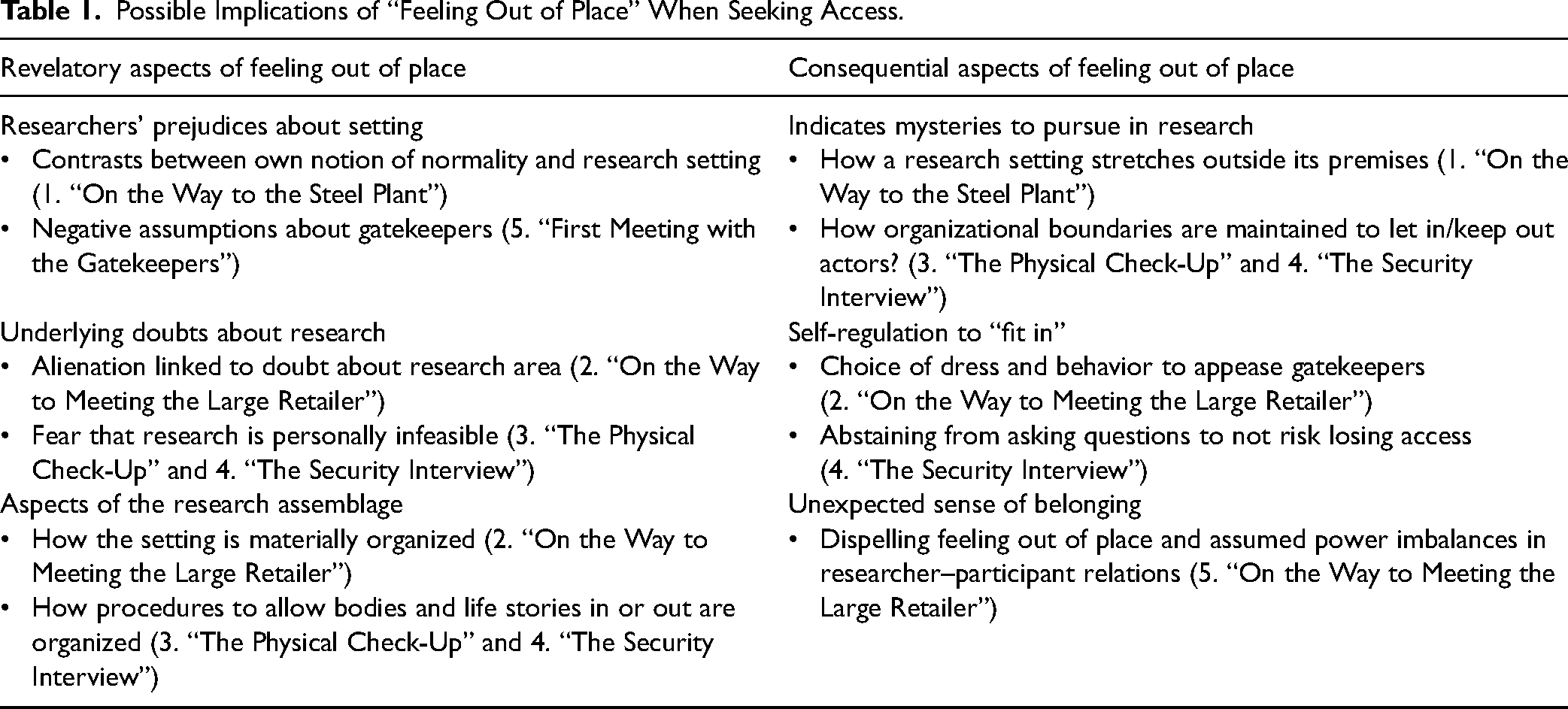
In sum, we would argue that feeling out of place helps unveil various aspects of the researcher and the research sites (revelatory aspects) and that these aspects affect the coming research as the researcher becomes aware of and adjusts to them (consequential aspects) (Table 1).
Possible Implications of “Feeling Out of Place” When Seeking Access.
It must be pointed out that the consequences of affective spacing may not be anticipated beforehand, planned around or mobilized as the researcher sees fit. Our agency as researchers was contingent on unknowable circumstances that revealed themselves as consequential through the unfolding of the processes. While all our vignettes are taken from cases where access was ultimately granted, we hope that our writing portrays the uncertainty they all entailed regarding if, or indeed how, this would come about. Even in the case in which the researcher's feeling of being out of place dissipated (vignette 5), this was experienced as being out of the control of the researcher. Discomfort was felt as part of facing the research sites but also in fear of rejection and what such rejection would imply for the researchers’ identities. After all, doing qualitative research often implies that the process of access is not within one's control.
Despite the lack of control researchers face, we advocate for a stance on affect that favors active reflection on our affects. By engaging in reflection on affective spacing and paying attention not only to affective encounters with other living bodies but also with materialities and space, researchers can deploy their bodies as sensing instruments in the spaces they explore. In doing so, they can interrogate their responses when seeking access to better understand themselves and inquire into which consequences might arise for them in their research. Given the affective spacing of “feeling out of place,” researchers might ask themselves: Why might discomfort, disgust, fear and similar responses arise when encountering a research setting, and what do these feelings reveal about underlying doubts, prejudices and so on? If doubts about research emerge, what does it say about the researcher's relationship with the researched? Might feeling out of place lead a researcher to self-regulate their access, potentially leaving certain mysteries unexplored? The point of such questions is not merely to determine if a researcher has been affected, but to understand how they have been affected, and how such affects might influence the trajectory of the research process in different ways. In our case, many of our reflections were retroactive—after our research projects were finished. While such reflections were possible due to how these experiences lingered with us, we encourage researchers to reflect on these experiences during the process of seeking access and conducting research. Doing so would not only imply an ongoing reflexive practice rather than afterthought but also the possibility to more proactively face the revelatory and consequential aspects of feeling out of place.
Finally, more questions could be asked along these lines also concerning other forms of affective spacing. It is imaginable that we might feel at home, experience joy, feel energized or feel boredom in relation to the spaces we explore while seeking access. These alternative forms of affective spacing could similarly prove revelatory or consequential for research, a matter for future research to consider.
Conclusions
In this paper, we show how researchers’ feelings of discomfort as they seek access are not merely barriers to overcome but have important implications for research. We articulate these implications by extending beyond the acknowledgement of affective reflexivity (cf. Bergman Blix & Wettergren, 2015; Gilmore & Kenny, 2015; Mäkinen, 2016 Rosales & Babri, 2023), to elaborate on how feeling out of place can emerge in relation to sociomaterial space through the notion of affective spacing (Gherardi, 2023). The implications are twofold. First, these feelings carry revelatory insights about the researcher's prejudices about a setting, and their underlying doubts about their research, and offer clues about the research setting itself. Second, they show how consequential aspects can ensue such as finding indications of mysteries to explore, how a researcher might self-regulate to “fit in” and how an unexpected sense of belonging can emerge to dispel our feeling out of place and reshape a researcher's orientation.
While researchers often mobilize their strangeness in qualitative research (Simmel, 1964, pp. 402–408), this paper contributes to an understanding of how our strangeness and discomfort in the early phases of research can affect our research. As we argue, interrogations of our discomfort with regard to affective spacing provide important confessions from the field (cf. Van Maanen, 2011). Such confessions are, we think, also instrumental in further challenging common myths concerning how we gain research access (Alcadipani et al., 2015; Cunliffe & Alcadipani, 2016; Hordge-Freeman, 2018; Thanem & Knights, 2019) and instead “come clean” about this process. In doing so, we specifically challenge the idea of the “un-affected” researcher-hero that seemingly acts without regard for their own unexpected affect(s) or how these might emerge in relation to space, such as when placed in uncomfortable situations and/or in unfamiliar places as they seek research access.
Moreover, we believe our proposed approach aligns with a broader interest in treating access as an integral part of research (Borrelli, 2020; Kara et al., 2023). For instance, affective and emplaced confessions could entail contending with how affective spacing emerges in the unfolding of sensitive researcher–participant relationships while seeking access (cf. Cunliffe & Alcadipani, 2016; Rodriguez & Ridgway, 2023) and in the ethical performances of negotiating access when facing power asymmetries (Kara et al., 2023). Attending to what kinds of affects emerge, and where they emerge, can help illuminate the dynamics of these relationships and the tensions involved in negotiating access.
Finally, we ask: Are researchers-in-training warned of the possibility of feeling out of place in their research, and which implications such feelings might have for their research? We believe that there is a need to share anecdotes that could serve as heuristics for preparing researchers. Such anecdotes would not only address the lack of emphasis on bodies and affects in the training of qualitative researchers (Hordge-Freeman, 2018) but also better portray the difficulties in doing research. Sharing strategies for gaining access or success stories is not enough; let us instead share our embodied and emplaced stories of discomfort and possibly also of disappointment. In our view, these stories might have more to tell us than neat success stories ever could.
Footnotes
Declaration of Conflicting Interests
The authors declared no potential conflicts of interest with respect to the research, authorship, and/or publication of this article.
Funding
The authors disclosed receipt of the following financial support for the research, authorship, and/or publication of this article: This work was supported by the Forskningsrådet om Hälsa, Arbetsliv och Välfärd (grant number 2016-07210).
