



Abstract
Creative processes within and across organizations have not only been associated with freedom but also with constraints. By taking a dialectical process perspective, we examine how creatives actually engage with constraints and how constraints thereby emerge, unfold and terminate over time. Based on ethnographic observations and interviews with popular music songwriting teams, we found that collaborators do not simply experience but also actively utilize constraints. Doing so enables songwriters to process constraints and to organize for an oscillation between stable, generative, and flexible constraint characterizations, fueling the creative process. Notwithstanding the persistent nature of some structural constraints, these findings contribute to research on organizing creativity by conceptualizing constraints as intertwined, malleable and even transformable by actors as they unfold. Thereby, the findings extend the current understanding of creativity with constraints by pointing to the crucial role of certain constraint characterizations that need to alternate procedurally between stability and fluidity.
Introduction
Early on, creativity researchers saw structures and constraints as hampering creative freedom and thus negatively impacting novelty creation (Amabile, 1988, 1996; Amabile et al., 1996; Damanpour, 1991). In contrast, more recent studies have shown that creativity is not only in need of structuring elements to lead to successful outcomes (Figueroa-Dreher, 2012; Gilson et al., 2005; Weick, 1998). Rather, it has been found that even externally imposed constraints, depending on how actors engage with them, can leverage creativity (Ortmann & Sydow, 2018; Stokes, 2006, 2007). As a result, the question of finding the “sweet spot” of freedom and constraint is placed center stage when it comes to organizing creativity (Acar et al., 2019; Rosso, 2014). However, it still remains unclear whether such a spot really exists and how such a balance between these contradictory forces can be achieved and sustained in creative practice. What is more, the idea of a sweet spot remains ingrained in a dualistic conception, which is per se problematic.
Recent creativity research, therefore, has moved away from trying to identify such a sweet spot and, more generally, left dualistic conceptions behind. Instead of continuing to conceive constraint and freedom as a dualism, this research adopts a practice-based approach, follows a relational ontology, and substitutes dualism for duality (cf. Fortwengel et al., 2017). For instance, Sonenshein (2014, 2016) adopts a routine dynamics perspective on creative action that takes on such a duality view and points to the importance of structures (implied in routines) to be enacted by actors and thereby to be reproduced moment-by-moment in more or less creative practice.
By increasingly adopting a practice-based perspective, management and organization research in general (Jarzabkowski et al., 2022; Langley et al., 2013; Vaara & Whittington, 2012) and creativity research in particular (Coldevin et al., 2019; Drazin et al., 1999; Fortwengel et al., 2017) seem better prepared than ever to study creative processes, not least with respect to the enabling and constraining role of structures within them. Among others, practices such as interactive feedback dynamics (Harrison & Dossinger, 2017; Harrison & Rouse, 2015), dialog between ideas and context (Clegg & Burdon, 2021; Coldevin et al., 2019), sharing images about possible futures (Thompson, 2018), and brokering and integrating (Lingo, 2020; Lingo & O’Mahony, 2010) have been highlighted as being central to the creative process. Typically, these practices rely for their performance by organizational actors on structures; as much as structures, in turn, rely for their reproduction or transformation on agents’ practices (Giddens, 1984).
In this study, we adopt this practice-based perspective on creativity that is not only “grounding creativity within practices” (Thompson, 2018, p. 230), but is serious about dualities, asking how actors in this process engage with and utilize constraints for creativity, and how different kinds of constraints thereby emerge, unfold and terminate in their relevance for creative action over time. To answer this research question, we examine creative processes and practices in the highly constrained setting of popular music songwriting. Our findings reveal that, in the course of the creative process, songwriting teams enact and utilize different types of constraints by recursively translating, playing around, aligning, and resetting them. While these practices are related to different constraint characterizations (of being either stable, generative or flexible), what finally matters is how these are performed and eventually transformed in practice.
These findings proffer three main theoretical contributions to the management and organization literature on “creativity from constraints” (Stokes, 2006). First, in contrast to former static and dualistic conceptualizations, constraints were found to be intertwined, engaged with and unfolded by organizational actors in order to unleash their generative potential for creativity; and this not only with regard to self-imposed constraints. Second, and extending common differentiations along constraint types and sources, our findings point to the importance of how different kinds of constraints are enacted and performed in the creative process. Third, instead of being balanced around a sweet spot, constraints and their enactments continuously oscillated between states of stability and fluidity in a rather tension-filled process to sustain the creative practice.
Literature Review
Creativity From Freedom and Constraints
Organizations were originally designed with a rigid, constrained architecture of fixed roles, rules and structure in order to “minimiz[e] variance to ensure consistent operations” (Gilson et al., 2005, p. 523). Building upon this perspective, early creativity researchers have usually seen such constraints as hampering the creative mind by killing intrinsic motivation and discouraging exploration. From this perspective, freedom and autonomy were typically identified as being the central variables that fuel creativity. This ideal of unconstrained creative freedom has been challenged for quite some time, however, by creativity research; not only by the (still dominant and important) tradition of organizational behavior research (e.g., Amabile, 1996) but also by more recent management and organization theory (e.g., Hargadon & Bechky, 2006).
Respective studies in the former tradition point, for instance, to the productive role of moderate time pressure for creativity (Baer & Oldham, 2006), the relevance of team homogeneity/heterogeneity (Hoegl et al., 2004), job autonomy (Bledow et al., 2022) and task conflicts (Petrou et al., 2019). Others showed that, under conditions of avoidance motivation, constraints channel cognitive resources (Roskes, 2015). A recent meta-analysis of more than a hundred studies in fact underlined the significant positive relationship between constraints and creativity, depending however to some extent, among others, on the constraint type (Damadzic et al., 2022).
In less individual- and team-centered studies, creativity was found to be in sustained need of structuring if not constraining elements on which it can rely. For instance, conventions enable artists to create innovative artwork and provide the basis on which participants in the art world can work together and distinguish themselves from others (Becker, 1982). To give another example, musical improvisation is based on structures that can be compared with language acquisition and use: when musicians have learned the basic structure of the alphabet (scales) and have learned sentences (chords), they are enabled to creatively recombine and rethink these elements, and hence to talk (play; Weick, 1998). Even in free jazz, which typically does not have a predefined structure, musicians make use of structuring musical material that they have acquired during training in their musical careers (Figueroa-Dreher, 2012). In such studies, constraints were also found to leverage creativity directly by not only increasing motivation but also limiting the search for novelty in a predefined space. Tight constraints were identified as fostering creativity, because employees are stimulated to think of unique solutions for how to work with them (Sonenshein, 2014, 2016). In contrast, having access to an abundance of resources may provoke creativity-hampering effects by making actors—creators—too comfortable (Csikszentmihalyi, 1996; Shalley & Gilson, 2004). Similarly, artists often deliberately utilize the creativity-enhancing potential of restrictions by means of self-imposed constraints. They introduce constraints to provoke new ways of engaging with old rules, routines, and resources (Ortmann & Sydow, 2018). Additionally, constraints can even provide a backdrop against which radical novelty can be created. Stokes (2006, 2007) showed, for instance, how the 1990s Pop Art movement deliberately challenged Abstract Expressionism by analyzing its major qualities and then settling on constraints for working against its principles.
Instead of opposing freedom and constraints for creativity, these studies point in sum toward a more contradictory or dialectical understanding of constraints, as not only limiting creativity but also enabling and fostering it (e.g., Caniëls & Rietzschel, 2015; Hennessey & Amabile, 2010; Lampel et al., 2014; Ortmann & Sydow, 2018). Importantly, in an extensive, cross-disciplinary literature review on creativity through constraints, Acar et al. (2019), though adopting a more macro-level, quasi-objective rather than practice-based perspective for their comprehensive review of the literature, have already established a useful taxonomy of (1) input constraints, for example, time, financial resources, and equipment; (2) process constraints, for example, formalization, interaction rules, and job autonomy; and (3) output constraints, for example, regulation, standards, and product requirements. These authors distinguish in addition four levels of analysis (individual, team, organizational, and industry), as well as different degrees of constraints (few, moderate, or excessive) and, importantly, ask to move scholarship forward by considering, among others, the malleability of constraints. Taking the necessity for both freedom and constraints together, as well as considering motivational, cognitive, and social mechanisms, the authors nevertheless characterize organizing activities with an “inverted U-shaped effect of constraints on creativity” (Acar et al., 2019, p. 97), meaning that too much as well as too little input, process or output constraints may be detrimental to most if not all levels of analysis. Balancing these two extremes and finding the “sweet spot” (Rosso, 2014, p. 578) between freedom and constraint, therefore, is still often seen to be the major challenge for managing creativity. Yet, it remains unclear whether such a point really exists in situ; what a respective balance could mean; how it may be achieved and eventually sustained or even transformed in creative practice. In particular, due to mostly static depictions of constraints in these studies, it is not well understood how constraints emerge, unfold, or terminate over time. Rosso (2014), focusing on R&D teams in a multinational corporation and on how they experience—in the terminology of Acar et al.—input and output constraints, even points out that the very same constraints can be perceived as either hampering or enabling creativity, depending in his case on a mediating variable of “enabling team dynamics.” Although this finding is likely to be consistent with those expected from a practice-based, duality-emphasizing perspective in his study, “it remains unclear by what specific processes enabling and disabling team dynamics might emerge” (Rosso, 2014, p. 580).
Toward a Practice-Based Perspective on Creativity and Constraints
Management and organizational scholars have advanced our understanding of creativity through constraint by studying this phenomenon from a process perspective. Hargadon and Bechky (2006), for instance, conceptualized collective creativity as a fluid, momentary phenomenon that is actively produced by patterns of social interaction within organizations, namely “help-seeking,” “help-giving,” “reflective reframing,” and “reinforcing.” In their approach, constraints figure as bureaucratic rules in the background, likely to hinder the emergence of such enabling interaction patterns. Sonenshein (2014, 2016) investigated a retail organization from a process perspective and focused on “resource constraints” and on a practice he calls “creative resourcing.” Thereby, he established that creativity goes beyond the deviation from an established routine (as expected from a routine dynamics perspective, anyway; Feldman & Pentland, 2003) and that constraints, such as common understandings and previous enactments of the routines as well as artifacts, are an integral part of organizational routines. As such, they constrain as well as enable routine aspects that are inherent to creative practices.
Continuing this line of process-oriented research, Harvey (2014, p. 337) focused on extraordinary group creativity and even offered a dialectical approach to creative synthesis “in which the constant struggle between conflicting forces is a driver of change and novelty.” Coldevin et al. (2019) recently established a strong process view on organizational creativity with their concept of “idea work,” which acknowledges the multiplicity of ideas and shows how they are constituted in interaction on an ongoing basis. Clegg and Burdon (2021) showed in addition how idea work is instituted in polyarchic forms of organizing. From such a strong process view, constraints, however, tend not (yet) to play a major role in creative processes.
In another process-oriented study, Lingo and O’Mahony (2010) examined how music producers make use of different sets of brokering practices in response to the changing ambiguities inherent to different stages of the creative process (see also Lingo, 2020). Harvey and Kou (2013) showed that evaluation not only happens after idea generation but is actually interwoven into the creative process. These latter authors did this by pointing out two different patterns of interaction, namely generation-centered and evaluation-centered processes, and argued that evaluation is not only a generative process in itself but also “the point at which the process becomes collective” (Harvey & Kou, 2013, p. 375). These two studies mentioned (more or less ambiguously) time, space, information, budget and regulatory constraints on the one hand, and nexus work practices (such as creating slack, bracketing and checking, deferring decisions, and absorbing challenges) or evaluative but nonetheless, generative practices to address such constraints on the other.
So far, only a few process-oriented or practice-based studies of creativity have dealt explicitly and in detail with the role of constraints, leaving room for further investigation. Hence, it comes as no surprise that Chakrabarty (2022, p. 41), who developed a comprehensive multilevel approach to how constraints on three different levels (individual, group, and organization) affect creativity with respect to task, socialization and climate, argued for a relationship-focused but more “fluid and dynamic approach.” Lombardo and Kvalshaugen (2014) pointed out that constraint handling is a source of creativity, but is focused solely on how dissolving constraints enables new creative action; showing that, in ambiguous and poorly structured situations, constraint-shattering practices—namely protesting, proposing, betraying, and sabotaging—are used for breaking constraints. In their process model of elastic coordination, Harrison and Rouse (2014) highlighted how the coordination of modern dancers oscillates between autonomy and constraints, thereby enabling a collective performance even when facing discontinuities in the script. However, these authors focused solely on how constraints negatively impact the generation of new ideas, implying that constraints need to be loosened so that actors can come up with novelty. Wilson et al. (2020), focusing on the classic tension between differentiation (or team diversity) and integration (or team homogeneity), provided one of the few more dialectical process perspectives on creativity. They emphasized the recursive interplay between divergent and convergent forces but did not pay particular attention to the role of constraints. Vogelgsang (2020) demonstrated that creative processes are maintained through shifts between two different organizational constraint sources at different points in time, namely restraint and contingency. When novel insights are created, they can conflict with the formerly enabling constraint source due to them being either too strict or too vague. In these cases, the conflict needs to be overcome by changing the constraint source from organizational restraint to contingency or vice versa. Nevertheless, due to a focus on how different organizational constraints are evaded and introduced, the question of how actors engage with constraints and how they unfold over time remains unanswered. Ortmann and Sydow (2018) conceptualized creative practices in organizations as being a recursive process model of “dancing in chains”: organizational constraints enable creative practices and creative practices, in turn, reproduce or change organizational constraints over time, resulting in “new chains.” These latter authors, building on Nietzsche, make use of the important, though from a practice-based perspective not unproblematic distinction between self-imposed (or self-binding) constraints on the one hand and externally imposed constraints on the other. But due to their focus on the organizational level, it remains unclear how actors engage with such constraints in detail on a micro-level.
Overall, the scholarly discussion has moved definitively beyond the merely negative role of constraints and now points out that constraints can indeed also enable and leverage creativity. What is more, the discussion has moved toward a more process-oriented if not practice-based perspective on the intricate relationship between autonomy and constraint that is increasingly serious about dualities such as this. Nevertheless, it still remains unclear how actors actually engage with what kind of constraints induce creativity in day-to-day practice, how constraints might thereby change over time, and how this affects the creative practice. What is more, problematizing the assumption of “balancing” freedom and constraints to generate creativity, as well as that of aiming for a “sweet spot” between these two poles, may hold important insights for the enigmatic question of why constraints can be perceived as both enabling and hampering an d could reveal how actors turn constraints into an asset evoking creativity.
The thus desirable move towards a practice-based understanding of the dynamic role of constraints in creative processes should be based upon a conception of structure and agency, autonomy and constraint, or stability and change as being dualities rather than dualisms (Farjoun, 2010; Giddens, 1984). Such an understanding is not only highly compatible with the more recent focus of much research in management and organization studies on creative practices (Fortwengel et al., 2017; Ortmann & Sydow, 2018) or idea work (Clegg & Burdon, 2021; Coldevin et al., 2019), but can also help us to unearth the multi-faceted role of constraints in creative processes by finding answers to our two research questions:
How, and with what kind of practices, do organizational actors engage with and utilize constraints for creativity? What different kinds of constraints emerge, unfold and terminate thereby over time, and how does this occur?
Data and Methodology
Research Setting and Sample
To answer these two research questions, we conducted an inductive, qualitative case study informed by purposeful sampling (Gioia et al., 2013; Yin, 2014). Such an approach relies on a transparent, information-based selection in order to find a case where the phenomenon under study is clearly observable and an appropriate source for developing new or elaborating on existing concepts and theories (Flyvbjerg, 2011; Pettigrew, 1990). Regarding generalization, specific cases can generate concepts with relevance to other domains with significantly similar contexts (Gioia et al., 2013; Lincoln & Guba, 2002). Given the theoretical interest of this study, we were eager to find a case that provided a suitable setting for observing how constraints are performed and utilized by creative actors over time. Additionally, we were looking for a collaborative setting to enable transparent observation of activities.
The songwriting teams of popular music and their studios provide an excellent context to observe creative processes because of the enormous creative potential that is needed in this highly collaborative, but also quite constrained setting. Today, songwriting teams have become a music industry standard, because they are seen as being potentially able to create novel and yet recognizable songs with diverse sounds and various musical ideas—similar to the collaborative writing rooms for TV series (Lochbihler, 2009; Plodroch, 2017a, 2017b; Seabrook, 2015). In 2018, the U.S. market's top 10 streaming hits were written by an average of 9.1 songwriters (Ingham, 2019).
In the field of popular music, songwriters have to deal with a great variety of constraints, making it thus a particularly opportune setting for this study. This is because pop songs follow an established set of musical constraints which, when compared for instance with far less but not entirely unconstrained jazz (Barret, 1998), have generated very little variation in the billboard charts over the last 50 years (Bennett, 2012). These (output) constraints encompass, for example, a limited set of melodic scales, a focus on the chorus, a lyrical rhyming scheme, a 4/4 grid, a typical tempo and a 2–4 min duration (Bennett, 2012; McIntyre, 2008). Professional songwriting is also usually commissioned work, where the recording artist is a central (input) constraint that needs to be addressed (de Laat, 2015). With regard to other (i.e., process) constraints, songwriting in the field of pop music often has to follow strict timetables. In effect, with regard to the output of the process, some may question whether professional songwriting that wishes to appeal to a broad audience/market exhibits more than incremental creativity—if even considered creative at all (Madjar et al., 2011). However, not only were the songwriters carefully selected with regard to their creative potential, but the process was also designed in a way that enhances field-appropriate creativity.
We examined constraints in collaborative creative processes in two interconnected popular music songwriting studios, both of which had signed publishing deals with the same major record label. As such, they were responsible for writing a certain number of songs per year for the record label's artists in exchange for a financial advance. Among the songwriters in the studios, a major label contract was seen as being an indicator of the ability to produce highly creative content that also has the potential for commercial success. Both studio managers together employed 23 songwriters in their music publishing companies, which also reflected the emphasis on popular music genres such as hip hop, pop, r&b, rock and Schlager music 1 . Additionally, they managed artists, regularly hosted so-called “songwriting camps” and rented out their studio facilities to other musicians.
Despite the diversity characterizing large parts of the music industry, there was only a small amount of visible racial, ethnic and gender diversity in the two songwriting studios. Out of a total of 33 songwriters met by the first author and observed in the studios, 28 were white and five were persons of color (POC). Among them, 26 were men and seven women, ranging in age from 20 to about 40. Out of a total of seven managers, publishers and organizers, five were white, two were POC, and all of them were male. They ranged in age from about 35 to 60.
Data Collection
Data were collected using the technique of focused ethnography (Knoblauch, 2001), encompassing direct and videographic observations as well as semi-structured and unstructured interviews. In contrast to conventional “open” ethnography, the aim of focused ethnography is not to map a whole social field, but also to focus on the objects of interest (Knoblauch, 2001). Focused ethnography is based on short-time field stays that compensate for long-term field experience and on detailed impressions with extensive data collection supported by technical recording equipment and intense data analysis. The approach particularly suits the logic of popular music songwriting sessions, the typical agenda of which is for each team to write one song per day.
The first author relied heavily on the observations as the main source of data, as they provided rich data regarding social activities and creative processes. The interviews were intended as supplementary sources for understanding the songwriting teams’ creative processes. Choosing informants and songwriting sessions for observation involved an iterative process of collecting data, analyzing data and seeking new and contrasting opportunities for observation. Data collection was completed once it had been possible to observe the same types of activities repeatedly across different settings.
Direct and Videographic Observations
The first author engaged in direct field observation in the songwriting studios from May to June 2018. He was either introduced by the studio owners or he introduced himself and was in both cases quite open about his status as a researcher. Nevertheless, out of respect for the fragility of creative processes when under observation, and as a form of gratitude for being granted access, the interviewer and observer also took on a legitimate role in the field as an assisting intern. As such, he helped to prepare the studio rooms for songwriting sessions and assisted in organizing two songwriting camps.
In total, in-depth data on 10 songwriting sessions were collected. These sessions lasted between 8 and 12 h each. In sum, 25 professional songwriters were observed, either with a major label or big indie label publishing deals in different, sometimes overlapping team constellations. Five sessions included the performing artists (PAs). The first author observed five sessions directly, constantly taking notes and later expanding them into detailed field notes. He conducted overt videographic recordings (Tuma et al., 2013) of another five sessions, which resulted in a total of 26 h and 35 min of video material. The first author later examined the videographic data and, in a first step, took notes in analogy to the field notes of the direct observations, but adding a detailed timeline of the procedures, precisely cataloging basic aspects of the observed activities and events. He then identified all phases of the songwriting-related interactions and negotiations by reviewing the videographic data, and chose recurring as well as contrasting fragments of video for a detailed transcription of the talk and activities. During data analysis, the first author repeatedly reexamined the video notes, then reviewed the videographic data and chose additional fragments of video for transcription to search for further examples of recurring and contrasting interactions.
As interviewer and observer, the first author also spent time in the studio foyers, where he was able to observe the organizing activities of artist managers, A&R managers, publishers, studio owners and songwriting camp organizers, as well as informal gatherings of songwriters who were working in the different studio rooms. All in all, he spent approximately 116 h conducting real-time observations in the field.
Semistructured and Unstructured Interviews
Interviews with studio organizers and professional songwriters were conducted before, during and after the field observations. First, semistructured interviews (Helfferich, 2009) were conducted before entering the field in order to gather general information about the organizational history, its development and status quo, typical organizational procedures, and the embeddedness of the songwriting profession within the wider popular music industry. These initial interviews lasted between 30 and 60 min.
While in the field, the first author conducted unstructured interviews to account for being open to unforeseeable observations. In particular, he asked questions to clarify the meaning of songwriting procedures. When constraints were brought up by the interviewees, he continued to ask questions specifically in that direction. He also asked participants to evaluate the sessions observed in comparison with their other songwriting experiences. The unstructured interviews lasted between 15 and 35 min, depending on how much time participants had available. In shorter situations after the sessions, for example, in the foyer or during a smoking break, additional questions were asked to gather explanations of what had been observed.
After the fieldwork, the first author supplemented his observations and interviews by conducting extensive semistructured interviews (Helfferich, 2009) with professional songwriters he had met during his field stays. In these interviews, informants were asked about the importance of the observed sessions for their career and requested to contrast their current with their best and worst songwriting experiences. When questions that arose during data analysis called for clarification, interviewees were asked back again. These interviews lasted between 45 and 90 min each.
In total, 35 interviews were conducted with various popular music industry personnel, eight of them semistructured and 27 unstructured. All the semistructured interviews were recorded and transcribed verbatim. Of the unstructured interviews, given the spontaneous situations and loud background noise, only 12 could be recorded and transcribed. Instead, notes were taken during and after the interviews, aiming to reproduce statements as close to verbatim as possible.
Data Analysis
While the first author was collecting the data, he began to analyze them, closely following the “Gioia Method” (Gioia, 2004; Gioia et al., 2013). He approached the field notes, videographic notes and transcribed data inductively by conducting first-order analysis and openly coding data passages in which engaging with and utilizing constraints in creative activities were a key theme. Utilizing such a “sensitizing concept” (Bowen, 2006) for data analysis enabled a quicker discovery of particular qualities and idiosyncrasies. The emerging practices were then grouped into thematic sets of practices in second-order analysis, and later distilled into aggregate dimensions. During second-order analysis, the first author repeatedly reviewed the videographic data and field notes to make sure all of the relevant observed activities and events were either accounted for or additionally chosen for transcription and first-order analysis.
After several iterations of data analysis, different sets of practices and tensions emerged, which all revolved around actors engaging with and utilizing four main types of constraints: conceptual, thematic, material, and content-related. Concept constraints were set as relatively stable limitations to specify the outcome requirements and to reproduce or advance a specific artistic profile. Thematic constraints denote limitations resulting from decisions about the overall subject of a song or an element, such as a topic, mood, or rhythmic style that were explored for novelty creation. Material constraints denote the limitations resulting from physical or digital sonic tools, such as instruments, voices or effects that were used and explored for novelty creation. Even though not all of these are actually physical, they are understood as material in terms of embodiments of tools that affect the songwriting process (Leonardi, 2010). Content constraints denote limitations resulting from content-related choices that have been made, for example, in favor of melodies, lyrics, beats, or an arrangement. Songwriters utilized them for exploration and novelty creation as well as to reproduce thematic constraints and a specific artist profile. Temporal constraints mattered as well, but only at the beginning of the songwriting session, when the overall time frame (e.g., four camp days, of which three were spent on writing songs) was set; later on, temporal constraints were referred to by songwriters or organizing actors to avoid stagnation, but they were not considered especially relevant by the actors. For an overview of the constraint types and characterizations see Table 1. An important question with regard to all kinds of constraints is whether, in practice, they tend to be conceived as either “externally” set or self-imposed.
Constraint Types and Their Roles in Creative Practice.
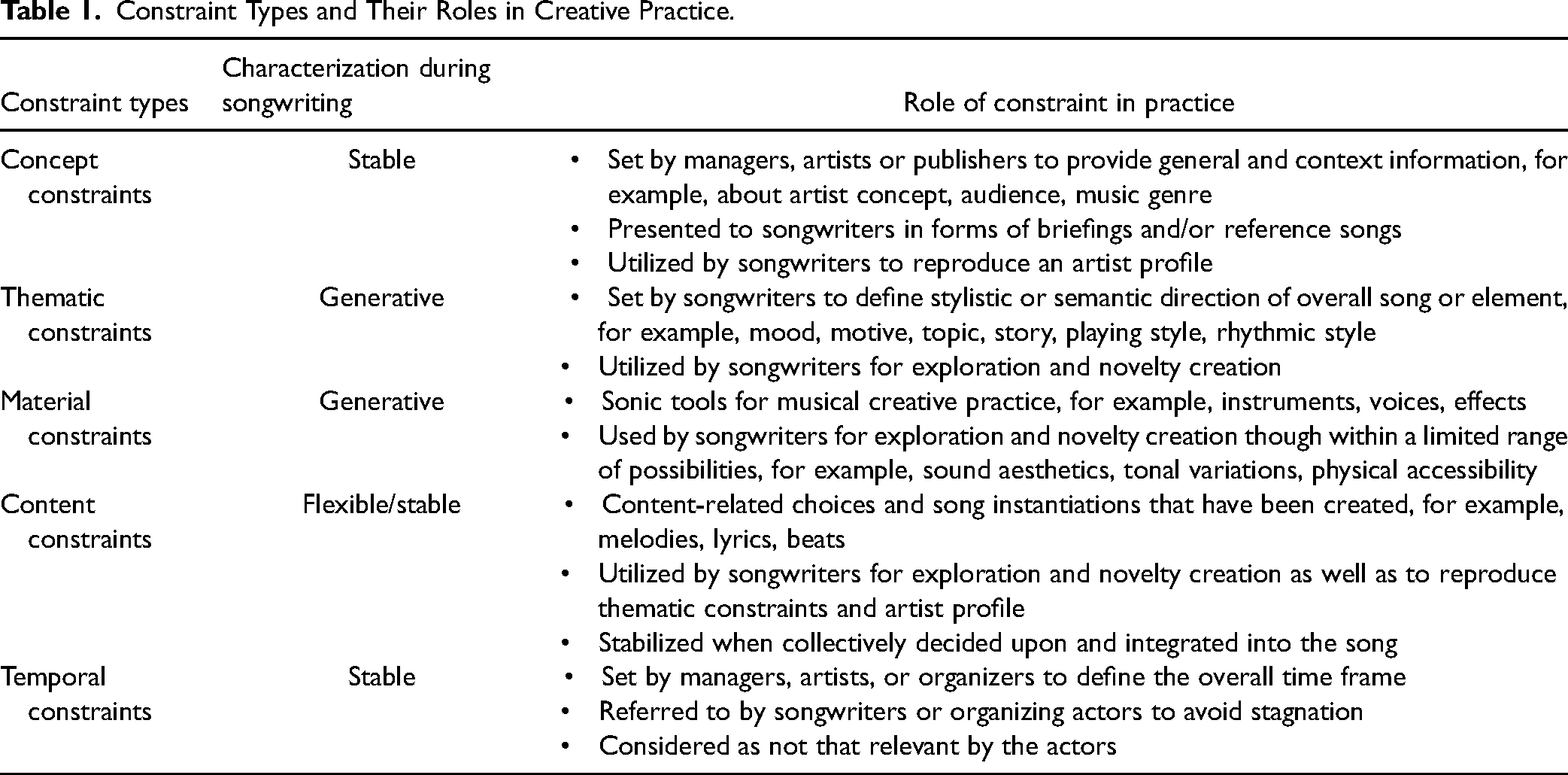
The sets of practices revolving around these types of constraints, even if they were externally imposed on the songwriters rather than an outcome of an endogenous structuring process, did not only relate to limitations but also revealed generative aspects in the sense of creating with constraints. Overall, the activities of engaging with these constraints generated the four aggregate dimensions of practices. In the next step, the interactions and aggregate dimensions identified were mapped in order to shed light on when, how and why constraints were being engaged with and utilized, and how creative activities unfolded over time (Cloutier & Langley, 2020; Fachin & Langley, 2018; Langley, 1999). In addition, doing so revealed the fifth aggregate dimension from the data, that of oscillating between stability and change, as can be seen in Figure 1. These were derived from both interviews as well as observational data.
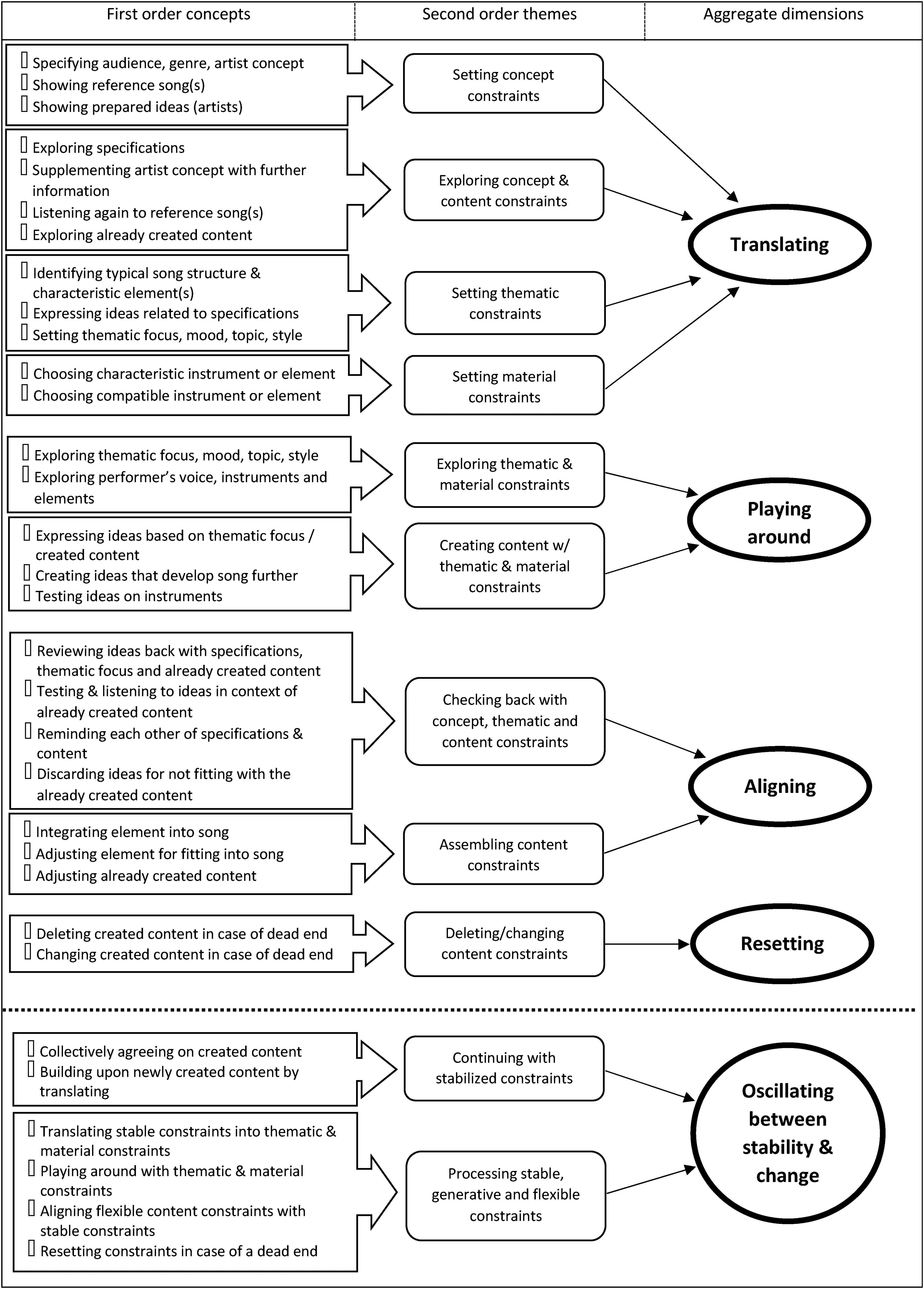
Data structure.
Findings
The analysis of popular music songwriting sessions revealed that over the course of the creative process, songwriters engaged with constraints in a tension-filled process by (a) translating, (b) playing around, (c) aligning, and (d) resetting them. Organized as a recursive sequence, these practices were closely related to how actors approached and enacted the different constraints, treating them as either stable, generative or flexible. As a result of processing and utilizing the constraints, songwriters organized for an ongoing oscillation between constraint characterizations and thereby managed to turn the constraints, not only the self but also externally imposed constraints, into an asset for creativity.
In the following sections, we describe how the constraint-centered practices are situated in the unfolding songwriting process, how they relate to the different constraint types and their characterizations, and how the overall process in the light of unfolding tensions allows for organizing creative processes (see Figure 2). The constraint practices follow a sequential logic: from more or less externally set concept constraints to creating, utilizing, flexibly changing and deleting self-imposed constraints, leading in the end to a recurring oscillation between the stabilization and change of constraints. In this recursive rather than linear process, the agency shifts from camp organizer, artist manager or artist to songwriters, who experience the constraints set by those actors not as self- but externally imposed; in the process, however, they react with a range of self-imposed constraints.
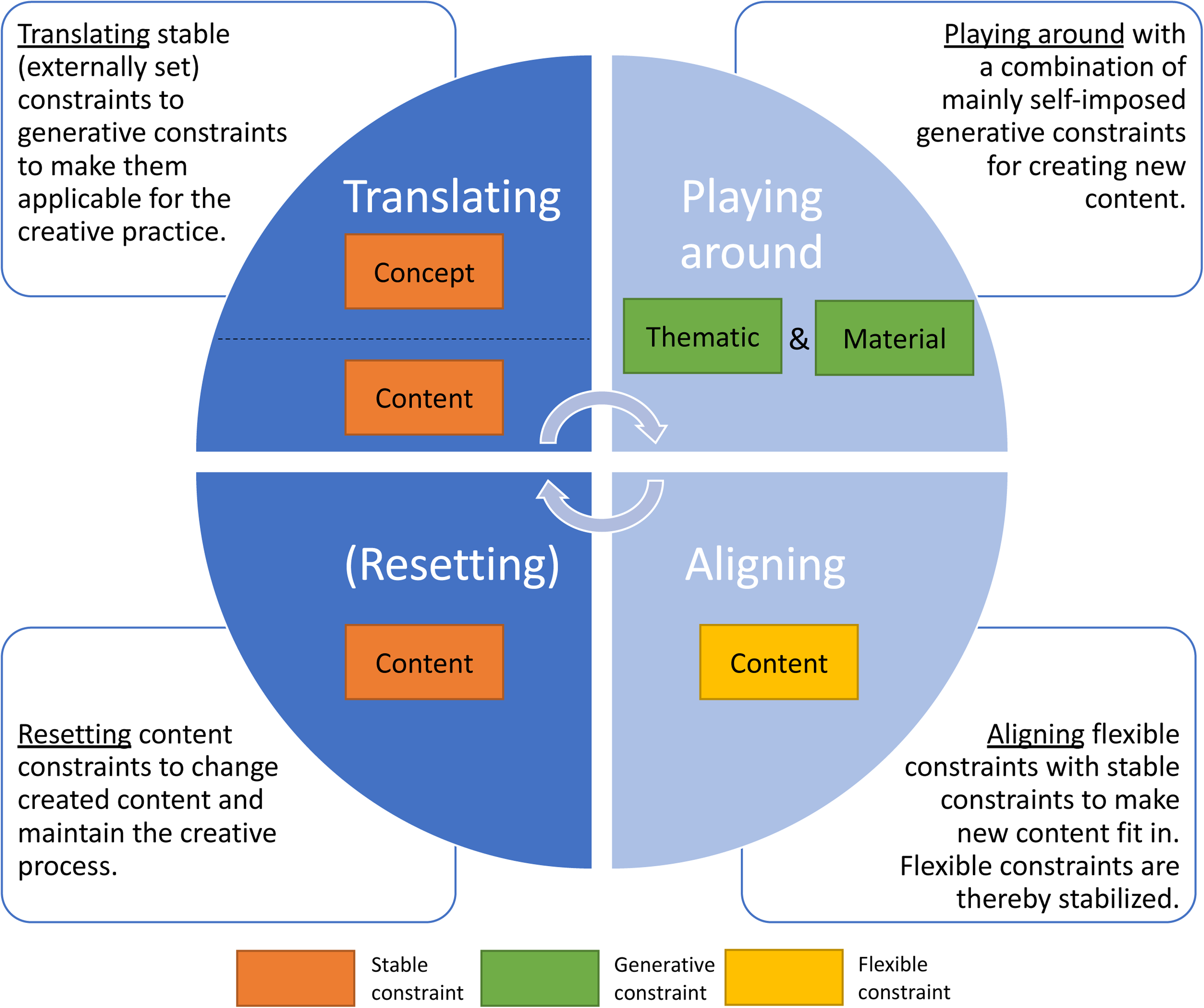
Creative process revolving around constraints.
Translating Constraints
Setting Concept Constraints
Every songwriting session started with an initial briefing, in which concept constraints were set by a songwriting camp organizer, an artist manager or an artist. The briefings informed the songwriters about the artist they were being asked to write for and included her/his name and the artist's concept and thematic niche, often providing information on her/his former and planned career. Briefings also specified the market niche the songwriters were to aim for and stated genre classifications, a target audience (in terms of age, gender, lifestyle, radio vs. club/festival, for instance), and provided reference songs for orientation. Furthermore, the aim to write hit songs was ubiquitous. As the outcome requirements for the song, the externally set concept constraints were characterized and referred to as a giving rather stable orientation by all actors involved throughout the songwriting session. The briefings typically did not provide instructions that could be applied directly by the songwriters, thus leaving room for creative interpretation and tensions, an important feature that encouraged songwriters to accept externally set constraints.
The videography excerpt below highlights how concept constraints were set by a songwriting camp organizer for the sessions of the day. In the briefing, he provided information about the artist's concept and fan base, as well as his career trajectory. The organizer also played two recent reference songs to clarify the musical style they were looking for. The brief is for a really young German pop star. He is called (artist name), so if you’re German, you will know who he is. (…) He is 19 years old; he is super young. This is his third album that they are running for. (…) It's not a German language project. We are only singing in English, right? (…) He had an album out just recently which hit number 2, and he has a massive follower base in Germany. And he is looking for new tracks for his new album. So that is the general vibe. I will play a couple of the most recent tracks of his album, and they want something that is quite similar in style. They are not looking for something that goes crazy like a huge evolution, just something quite similar basically. (Camp organizer plays full song.) And this is another track from the recent album. (Camp organizer plays another full song.) Right. So that was for you to get a flavor of the project. I was watching some of his videos yesterday, and I saw that a lot of teenage girls are massively into him.
(Songwriting camp organizer, Session 9, excerpt from videography)
Exploring Concept Constraints
Once the concept constraints, which always leave some degree of freedom for interpretation and hence performance, had been externally set, the songwriters explored possible specifications. They asked questions for clarification purposes, and collectively discussed the information they had been given. They often supplemented information from the briefings with online research on their smartphones or listened to reference songs again, as well as to related songs on streaming platforms. In doing so, they examined a concept's aesthetic, thematic niche, rhythmic style and typical arrangement structure.
In the following interview excerpt, a songwriter explains the importance of exploring concept constraints to enable the creative process: You start writing a song by listening to a reference song by the artist. That's how you begin a session. Then you already have something to discuss, coattails you can grab on to. (…) It's important for defining the direction, for understanding where you want to march, so that the head can be sorted. That's where we want to go. That's what I'm adjusting to. The mantra of the day, the song, the mood.
(Songwriter, semistructured interview)
Setting Thematic Constraints
After exploring and collectively discussing the externally set concept constraints, the songwriters translated them into thematic constraints to make them applicable to the creative practice. They identified typical topics and song characteristics and then they proposed ideas for applying them as thematic, more self- rather than externally imposed constraints. Such thematic constraints were set to collectively agree upon overall aspects of a song or an element, such as its mood, lyrical motive, song topic or rhythmic style, and limited further choices. The songwriters thereby established, sometimes even in close interaction with either the camp organizer, an artist manager or another artist, generative grounds for collective creativity by providing orientation and fruitful directions for further exploration. In this process, tensions surrounding the interpretation of thematic constraints arise not only between “these others” and the songwriters, but also among the songwriters themselves, who are involved in the collective creative process.
In the field memo excerpt below, three songwriters (S1–S3) were working together with a PA on an indie pop song briefing. The artist manager had set the concept constraint of blending emo rap with indie pop in reference to a recently deceased rap artist. The songwriters translated it into a thematic constraint for the lyrics that turned out to be subject to ambiguous reinterpretations: S1 expresses ideas for the topline theme and sings ‘It ain't enough’. (…) She tries around a lot with the theme of ‘desperate love’ while S2 continues to play the piano melody and S3 prepares drums on the laptop. (…) Although S1 has been working on her idea for a while, S2 brings in a different textual interpretation of the main motif: ‘End of the road’ as a metaphorical dead end. S1 lets it sink in and experiments with it. She worries that the song might become too corny and cheesy. (…) ‘I don't like it.’ S3 laughs: ‘Yeah, what's this song about anyway?’. S1 makes new suggestion along the lines of ‘Find a way out of this misery’ and keeps experimenting with it, but returns to ‘It ain't enough’ shortly after.
Sometime later S1 has taken up the motif ‘End of the road’ once again and experiments with it. Maybe for lack of better alternatives? Anyway, it seems to work better now between S1 and S2 and they are making progress together. After the session I asked S1 why she liked ‘End of the road’ in the end. She said that she wanted a love theme and thought that ‘End of the road’ sounded like death. But after negotiating she liked it, embedded in the story of ‘End of the struggle and a new beginning’.
(Session 7, excerpt from field memo)
Setting Material Constraints
In a similar way to setting thematic constraints, the songwriters translated concept and content constraints into material constraints to make them applicable to the creative practice. Material constraints were set by the songwriters choosing characteristic or compatible instruments of a genre, mood or musical niche—such as a distorted electric guitar in rock music. Material constraints were set by specifying physical or digital sonic tools such as instruments, voices, and effects. Songwriters thereby limited further choices but also provided generative foundations within the respective range of material possibilities with respect to sound aesthetics, tonal variations, and physical accessibility.
In the videography excerpt below, the briefing was for a modern 1990s r&b-style song. The PA brought in an idea for a verse and played three reference songs. The songwriters (S4–S6) identified a “laid back” mood, “organic” sounding drum kits, and the piano as characteristic elements. As a result, they translated the concept constraints into material constraints by deciding to use a Rhodes piano in combination with a hip-hop-oriented Lo-Fi drum kit. S4: ‘And then everything with the e-piano, right? You like that, don't you?’
PA: ‘Yes, that's exactly what I like. I'm like Frank Ocean. He also always has the e-piano.’
S4 then goes to the Rhodes piano in the corner of the room and connects it to the audio interface. Then he grabs a chair for the piano and tries out melodies. […]
S5: ‘For the vibe let's have a vinyl hip-hoppy drum kit that doesn’t sound like too mid-range, kind of. Let's have it sound like it's chopped from a record. That would add to the feel of this 90s style.’
S6: ‘Yeah, sure.’
S5 then prepares a drum kit in the digital audio workstation on his laptop. He tries out single drum kit sounds and tweaks them.
S4: ‘That sounds really cool!’
(Session 8, excerpt from videography)
Playing Around With Constraints
Exploring Thematic Constraints
Using thematic and material constraints, songwriters established the scope and the elements that they would play around with in a recursive process. The songwriters examined the many meanings and branches of the thematic constraints they had set in order to identify their different implications and boundaries and enable content creation. They turned them upside down, shed light on them from different angles, and assessed their connotations in various contexts. By doing so, they aimed at finding interesting new perspectives and connections for ideas.
In the field memo excerpt below, three songwriters were working with a PA on a briefing for an urban hip-hop song. The artist manager referenced multiple famous U.S. artists and wanted a further development of the PA's concept, but no love or party songs. The songwriters (S7–S9) translated this concept into a general thematic constraint, the artist as an adventurous seducer. They then explored multiple directions and options and eventually went ahead and created content when they found the ideas that they wanted to continue with: ambiguous and playful sex references without being too clumsy. The songwriters and the artist decided that the song should basically be about sex references and wordplay, portraying the performing artist as a ‘womanizer’ who is having affairs with several girls at the same time.
S7: ‘You attract me—I undress you.’ 2
The writers discuss this suggestion.
S8: ‘I have heard it many times before, but it could work…’. S8 suggests ideas in the direction of ‘attraction’ because he finds that less played out than ‘to undress’.
Then different fun suggestions are shared by S7 and S8. Everyone laughs.
S9 (laughing): ‘We are not doing Schlager music!’
S8 suggests: ‘If you are feeling sad, we'll have a shag’ 3
Everyone laughs again. (…)
Further ideas and discussions follow. They have found ideas that they are happy with. The artist and writers perform them together as they go through the lines again.
S8: ‘What is the title?’
S7: ‘Every time’, as it is the focus in the refrain
S9: Let us focus on it even more! With multiple repetitions and more hook focus. And let us end with ‘time’ 4 because of the sex association.
(Session 3, excerpt from field memo)
Exploring Material Constraints
Additionally, the songwriters examined the material constraints to find out how their thematic ideas could be realized with the sonic tools available to them in the studios. As professional songwriters, they were familiar with the possibilities and aesthetic implications of the typical musical instruments and did not have to explore them separately in depth. But they typically examined the strengths and the boundaries of the performer's voice.
In the field memo excerpt below, two songwriters were working together with a PA on a briefing for an industrial metal song with rap vocals. The artist had shown the songwriters various reference songs and had brought initial ideas for a song topic called “Eat or die,” in which he sought to portray the daily struggle for survival in the urban “jungle.” While exploring the thematic constraints and creating ideas for the song, one songwriter came up with the idea for a short singing part. He checked on the singing skills of the artist, who made clear that this idea was not compatible with his vocal skills: The performing artist explains that he has taken singing lessons for his solo artist project and that he has also made attempts at singing in already existing songs, but he is not satisfied with them. After trial and error, he has now decided to do a kind of deep-voiced rap in the project and not to sing anymore.
(Session 2, excerpt from field memo)
Creating Content With Thematic and Material Constraints
Building upon exploring thematic and material constraints, the songwriters created content for the song. They did so by playing around with both constraints and expressing, developing as well as testing out constraint-related ideas on the fly and then putting their ideas into practice on the material constraints. Eventually, the songwriters collectively agreed upon a certain idea that they wrote down or recorded, which they treated as a new but still flexible content constraint.
In the videography excerpt below, two songwriters (S10 and S11) set the song's key theme of “I have had enough!” for the lyrics. To create an interesting story for the song, they set the thematic constraint for the first verse to describe a strict, close-knit daily routine as something the protagonist in the lyrics wants to break out of. Then, they created content by interactively proposing and building upon constraint-related ideas, referring repeatedly to the thematic constraint, as can be seen in the excerpt: S10: How do you feel about it? Like that, too? I find: ‘Everything rolls, everything as planned. Da dadadada’ (with a goose step-like hand movement to the front). You know, so that we have this, this attitude, like everything runs according to plan. ‘Everything rolls, everything goes as planned, marching forward, na nanana nana’. From the rhythmic aspect, you know? (…)
S11: Marching under some flags…
S10: Yes, yes, yes. ‘Everything rolls, everything as planned.’
S11: In the latest colors, the latest stuff …. Or something with ‘the machines are producing blablabla’ ….
S10: The machines are producing, everything as planned … ‘Everything is registered’, and then we need something else.
S11: ‘Marching, producing, na nana, without standstill’ or something. To enumerate this machinery a little bit and then later a little bit…
S10: So order, binding….
S11: Exactly, everybody so uniformly in sync (moves upper body back and forth) like in a slave ship … ‘Everything rolls, everything as planned. Everything registered, everything controlled. Da dadadada’, you know? So that you always emphasize the last ones.
S10: Yeah, that works!
(Session 1, excerpt from videography)
Aligning Constraints
Checking Back With Concept, Thematic and Content Constraints
Even though they were creating with constraints, the songwriters repeatedly came up with ideas which they afterward deemed to have insufficiently addressed the concept and thematic constraints, or found that they did not connect well with the content that had already been created. Therefore, after creating content, they checked back with these constraints. In practice, the songwriters reminded each other of the constraints or tested and listened to the newly created content in the context of what had been created before. When the songwriters found that their ideas did not sufficiently address the constraints, the ideas were often simply discarded.
In the following field memo excerpt, three songwriters (S12–S14) were working on a briefing for an urban hip-hop song. They set the thematic constraint of a go-getting cool guy with the song title “Like a bull at a gate.” By playing around with constraints, they created new content for the lyrics. But when testing the newly created content in context with the other parts, they realized that it did not meet the criteria. They decided to discard the newly created lyrics but considered coming back to them later. S12 and S13 throw lines at each other and revel in it. They modify individual words and immediately test their ideas by performing them to the continuously running beat loop. (…) The beat is set and is used for orientation. Then, they test the lyrics for coherence with the already written text. By doing so they notice:
S13: That doesn’t fit into the flow at all.
S12: Oh well, shit.
S13: You can’t do the line from the singing point of view. Maybe if it were not such intelligent rap. (Referring to sentence structure and choice of words)
S14: Okay, then let’s drop it, but let's not forget it. Maybe it will fit in at the end or in the bridge.
So, they go back to the lyrics and rewrite them.
(Session 5, excerpt from field memo)
Assembling Content Constraints
When new content was collectively agreed upon after checking back with the concept, thematic and content constraints, the songwriters engaged with the newly created content to align it to those constraints that were more or less self-imposed in the process. In doing so, the new content often had to be adjusted in order to fit into the song. In some cases, the songwriters also changed the previously created content to allow the new content to fit in. For this reason, they characterized new content at this stage as a flexible constraint. But then the content that had been stabilized already could be reopened and characterized as flexible again to allow for possible changes. When the new content was eventually added to the parts already written, it was characterized as a stable content constraint, too, and was no longer a focus for adjustments.
In the following field memo excerpt, three songwriters (S15–S17) were working together with a PA on an indie pop song briefing. Together, they set an acoustic piano as the material constraint for melodies and chords. By playing around with these constraints, S15 created a melody for the refrain. But when the PA built upon it for the lyrics, they realized that the piano melody did not match her voice. They aligned these two elements by changing the key on the piano. Later, when working on the first verse, S15 proposed piano melodies that included notes that were too high for the PA's voice. But this time, they changed the PA's singing melody to align the two constraints. They start working on the refrain. S15 sits at the piano and plays to himself. Sounds pretty cool already. Did he just come up with that or is he drawing on something prepared?
S16 (laughs): Yep, song is finished.
The PA also really likes the piano melody. S15 records the melody with his cell phone. The PA sits down next to him and tries to build on it by experimenting with phrases for the lyrics. Together, they try out different vocal melodies and then decide to change the key on the piano so that it goes well with the PA’s voice. The argument is that the piano is more flexible in terms of notes. They experiment for about ten minutes and then ask S17 for his opinion.
S17: Very catchy!
(…) They move on to the first verse. The PA thinks the two parts that just came up on the piano are very cool and sings to herself, building on it. I can’t quite figure out if she's singing ‘real lyrics’ or trying out melodies and rhythms with placeholder words. (…) The performing artist interjects that S15 is going too high tonally on the piano for her voice. S15 changes something, but he does not like it anymore. It is also still too high for the PA's voice.
PA suggests: Leave it like that and I'll sing it another octave lower.
Seems to fit and they continue like this.
(Session 7, excerpt from field memo)
Resetting Constraints
Deleting or Changing Content Constraints
Songwriting processes eventually reached a dead end, that is, the songwriters got stuck with their ideas when they could no longer utilize the content constraints for further content creation. In similar situations, no new ideas were expressed, or those that were put forward were rejected repeatedly. The collaborators’ creative flow was at stake. The songwriters therefore reopened the content constraints that had already been characterized as stable—and eventually considered dissolving, changing or deemphasizing some of the agreed-upon content. They did so in order to come back to a point where they could utilize the content constraints again for idea creation and avoid the disruption of their creative flow.
In the following excerpt, three songwriters (S18–S20), who were initially enthusiastic and full of ideas, were no longer happy with what they had created. This developed into a dead-end situation in which they could not get any further. They therefore questioned the previously stabilized content and reopened it for changes. After identifying the piano melody as being a hindrance to their creative flow, the songwriters discussed whether to change the role of that element or dispose of it completely. As a result, they reset the constraint by editing it into a more uplifting piano line and were able to progress with the songwriting process. S18: Shall we stay with this or shall we just, like….
S19: Maybe it is not just that the piano does not have enough breaks, perhaps it should also be played in a major key, because it is a bit too … (makes mechanical arm movements) … too laid-back or something.
S18: Yeah, I think so, too. And there is got to be some additional sound. I mean it is cool, but like this it does not feel right anymore. Maybe we need to add some chords, and we could just use this as a sample or something like that.
S20 (nods): I totally agree. This is supposed to be, like, the little thing in the back. Like a gimmick, you know? (…)
S19: Or it is just wack, and we need to change it.
(Session 8, excerpt from videography)
Oscillating Between Stability and Change
Continuing With Stabilized Constraints
After newly created content constraints were aligned with the other constraints, the content was no longer treated as being flexible, but seen as having been stabilized and typically either written down or recorded. This meant that the collaborators had decided upon a certain element that had been created for the song and was then able to continue with the next one by building upon it. They continued by going through the recursive sequence again: translating, playing around, aligning, and eventually resetting constraints for the next element. Thus, songwriters followed up on created content by translating it into new thematic and material constraints. Overall, content constraints were created on multiple levels of the song and treated as different elements within those levels. For an overview, see Table 2.
Levels and Elements of Content Constraints.
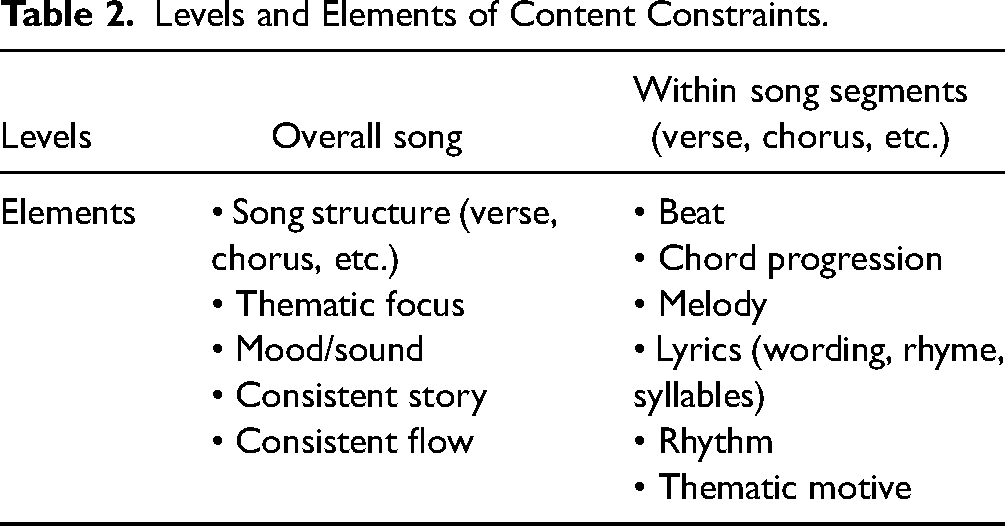
The more elements were addressed by newly created content and the more the songwriters elaborated on the created content as a whole, they typically attributed a certain degree of path dependence to the further songwriting process. Songwriters were eager to create consistency in the song and to create new elements that would build upon the content they had already created. They characterized a song as being finished when all of the levels and elements had been addressed and had been evaluated by them as fitting together.
In the following field memo excerpt from a briefing for an urban hip-hop song, three songwriters (S21–S23) first created a beat and then translated it into a thematic constraint for the lyrics. They set the theme of an exciting, easy-going life in a tropical setting and then continued with the songwriting process: They have the beat playing very loudly in a loop. Few interactions among the writers for a short time. S21 continues to play around with synth and filter curves on the laptop.
S22 finds it very cool: It is so tropical.
The songwriters agree and continue by looking for ideas on the theme of the jungle (…) Then there is a collective performance: the writers stand up, face the laptop and try out ideas for the setting the hook.
S23: It could be more rhythmic.
Then they experiment with various ideas again and are happy with the results. The jungle theme is now set. (…) It is fantastic like that!; (…) The theme serves as an anchor; they are constantly zooming in and out between the anchor and the text details.
(Session 7, excerpt from field memo)
Processing Stable, Generative and Flexible Constraints
Overall, the songwriting process was characterized by an ideal-typical recursive sequence of translating, playing around and aligning constraints—and resetting them if necessary. These practices enabled the songwriters to process different kinds of constraint and fueled an oscillation between constraint characterizations being stable, generative and flexible. Oscillating between these characterizations was central to enabling and maintaining the creative process. We observed only little variation from the sequence of creative practices we pointed out. A rather more frequently occurring variation was the simultaneity of two practices in teams of more than three persons, when songwriters engaged in practices of playing around and another one was at the same time already aligning the ideas they expressed.
Concept constraints were mainly imposed externally and referred to as requirements for a stable outcome throughout the songwriting process; as they were inapplicable for the creative practice, they were translated by the songwriters into thematic and material constraints to allow for practicable creativity and generative grounds. As a result of playing around with these two constraints, the songwriters created new content constraints. To account for unforeseen creative ideas, they labeled these new content constraints flexible in order to be able to align them with the concept constraints and connect them to what had been created before. Formerly stabilized content constraints could also be returned to and labeled flexible again at this point, so that the newly created content would be seen as fitting it. When the new content was integrated into the song, the songwriters stabilized the content constraint and then treated and enacted it as such a stable constraint. They thereby recursively built upon formerly created content in addition to the concept constraint in order to continue the creative process. When songwriters eventually reached a dead end, they returned again to the previously stabilized constraints, either changing or deleting them.
In the iterative loop of engaging with and processing the different kinds of constraints, concept constraints were characterized as stable by the songwriters to ensure that they addressed an artist's concept throughout the process, thereby enabling an organizational reproduction of the artist's profile. To enable and maintain creative processes, however, the stable constraints had to be translated into constraints that could be utilized for immediate practical creativity. In this way, songwriters then enabled novelty creation and organized an unpredictable and ongoing creative journey resulting in new content. By re-labeling flexible constraints to stabilized ones during the creative process, the collaborators—camp organizers, artist managers, other artists as well as songwriters—additionally adjusted new ideas and organized them to ensure the internal consistency of song elements. Taken together, continuously oscillating between labeling constraints as either stable, generative or flexible during the creative process enabled an ongoing creative flow as well as internal consistency for the song.
Discussion
In this study, we found that creative collaborators use different sets of practices to utilize and process various types of constraints, based on how they enacted the respective constraint, whether it was either externally set or self-imposed. Overall, the constraint-centered creative process in popular music songwriting (depicted in Figure 2), was characterized by a recursive oscillation between labeling constraints as stable, generative or flexible.
As a result, the participants in the collaborative process managed again and again to turn constraints into an asset for creativity, structuring the creative process. These findings hold valuable theoretical contributions to the literature on organizing creativity, in particular with respect to the delicate interplay between stability, generativity and flexibility.
Organizing Creative Processes With Constraints
Our findings both affirm and extend the understanding of constraints as not only limiting but also enabling and fostering creativity (Acar et al., 2019; Caniëls & Rietzschel, 2015; Ortmann & Sydow, 2018; Rosso, 2014; Stokes, 2006, 2007). Although management and organization research has long overcome a purely negative understanding of constraints, prevailing conceptualizations conceive constraints mainly from a static, variance-based perspective. These concepts focus on the quantitative degree of constraints as ranging along a continuum from loose to tight, often considering a moderate level of constraints as beneficial for creativity. As a result, they call for a balance between freedom and constraint, as can be seen in the understanding of a “sweet spot” or an “inverted U shape” of constraints (Acar et al., 2019; Chen, 2012; Rosso, 2014; Sonenshein, 2016).
By taking a process-oriented or, more precisely, a practice-based perspective in this study, it has been possible to reveal new insights into creativity through constraints and to provide a “more fine-grained understanding of constraints” (Acar et al., 2019, p. 113) as well as a more “fluid and dynamic approach” (Chakrabarty, 2022, p. 41). In contrast to rather static categorizations that distinguish, for example, between input, process, and output constraints (Acar et al., 2019), our findings show how songwriters navigate dynamically through the creative process by engaging with and eventually transforming constraints in order to deal with the tension between stability and change (Farjoun, 2010). More often than not, they start with externally set constraints (see also Lingo, 2020) but, in a recursive process of exploration, adaptation and creation, increasingly add self-imposed constraints that are, after checking back, also subject to revision, even deletion. For the songwriting setting, we show how creatives translate concept constraints, set by camp organizers, artist managers, and other artists, into material and thematic constraints for idea creation; how novel ideas, which have been recently aptly described as being “continuous” (Hua et al., 2022, p. 634) rather than as having clear boundaries, become constraints themselves; and how these, as content constraints, then, if enacted and reproduced or transformed, form the basis for further creation activities together with the initial concept. Furthermore, constraints are mitigated or even dissolved in the process of songwriting when they no longer serve the purpose of providing ongoing generativity. In sum, constraints are processed, translated, and modified through collaborative practices, thereby fueling the creative process in general and idea work (Coldevin et al., 2019) in particular. Such a practice-based perspective on this kind of work offers a more complex view than given by former conceptualizations: constraints in creative processes are intertwined, engaged with and unfolded by actors in order to create novelty in a patterned but rather tension-filled process. On a meta-level, our results are in sync with those recently stated in a comprehensive review of research on how ideas emerge in creative work: “Ideas emerge throughout the creative process and hence cannot be separated from the process of ideating” (Hua et al., 2022, p. 636). That is, the creation, modification and transformation of ideas “cannot be understood in isolation from the process” (ibid.).
Having focused on the creative process and, in particular, creative practices in detail, the findings presented here highlight constraints as being enacted and performed and, in consequence, dynamically unfolding over time (Cloutier & Langley, 2020). For organizing creativity, the findings show that only considering the “right amount” of constraint is not enough. The essential dynamics which constraints may evoke must also be taken into account in a dialectical process in which stability matters as much as change (Farjoun, 2010). Thus concept constraints, not only but also in songwriting, for instance, need to be designed not only for a moderate level of limitation (Acar et al., 2019) but also for purposeful recursiveness and incompleteness (Garud et al., 2008) so that creatives can utilize them to translate a concept into interesting new constraints. Additionally, creatives need to be provided with or have access to generative material constraints in order to successfully make concept constraints applicable to the creative practice. It was shown that content constraints can provide a basis for ongoing idea creation and are thus built upon recursively. In order to account for this constraint dynamic, creatives need to be able to let go of ideas and reset constraints if these no longer inspire further generativity.
Stability, Generativity, and Flexibility in Creative Processes
When concerned with the role of constraints in creative processes, scholars have focused extensively on different types of constraints as well as their sources. Among others, they have differentiated between resource, product and temporal constraints or distinguished between externally imposed and self-induced limitations in search of novel developments (Lampel et al., 2014; Ortmann & Sydow, 2018; Rosso, 2014; Vogelgsang, 2020). Our findings extend the understanding of constraints that stimulate creativity by showing how the different labeling of constraints as being either stable, generative, or flexible is central to processing them, and thereby turning constraints into an asset promoting creativity.
As stable constraints are more often than not inapplicable to the creative practice, they need to be translated and eventually adapted by creatives. Nevertheless, they are important for providing stability in a creative process which is otherwise hallmarked by fluidity and transformation (Farjoun, 2010; Fortwengel et al., 2017). By recursively building upon and checking back with stable constraints during the process, creatives manage to ensure consistency with the initial artistic concept as well as with the content they have previously created. Through stable constraints, songwriters can organize their working process to create a consistent product and adapt to the requirements of the commissioning recording artist. As a result, constraints are seen to induce stability in creative processes and enable organizational reproduction as well as transformation.
Generative constraints, on the other hand, are necessary for the actual creation of novelty. They are used by songwriters to enable exploration and novelty creation, though within a limited range of possibilities and while still being incomplete in terms of specific content. They are thus indispensable for creating new ideas and for playing around with them, not only in specific events and spaces (Hjorth, 2005) but also in daily, fairly routine practices (Sonenshein, 2016). Together, generative and flexible constraints are needed to provide the fluidity required for creative action (Csikszentmihalyi & LeFevre, 1989; Hargadon & Bechky, 2006) and the survival of organizations more generally (Farjoun, 2010). Dealing flexibly with constraints, if enacted appropriately, is furthermore central to aligning newly created content with already created content and maintaining the creative process. Because labeling constraints as flexible can be changed into making them stable, they can be further processed and utilized for creating new ideas. Furthermore, because such stabilized constraints, depending on their malleability, can be reset to flexible constraints, creative processes can even be continued when collaborators reach a dead end.
In sum, our findings show that constraints in creative processes are not always stable, nor are creative processes completely fluid. Instead, depending on how they were enacted and utilized in the process, different kinds of constraints were found to oscillate recursively between stability and fluidity in order to enable both novelty creation and organizational reproduction. These findings on different kinds of constraints thus contribute to an understanding of organizational creativity as a duality, not only of agency and structure but also of stability and change. Thus, the insight that one factor—stability—requires the other—change—(Farjoun, 2010) also holds true for creative processes in which constraints do not need to be balanced to induce creativity, but actors need to alternate procedurally between stability and fluidity.
Generalizability, Limitations, and Future Research
Qualitative case studies can generate concepts and principles that are relevant to other domains, given that they are situated in significantly similar contexts (Lincoln & Guba, 2002). Gioia et al. (2013, p. 24) state that “many concepts and processes are similar, even structurally equivalent (…) across domains.” This may also hold true for this more practice-based and tension-sensitive understanding of how creativity originates from constraints.
As described earlier, popular music songwriting is both a creative and a highly constrained endeavor. Furthermore, professional songwriting for this genre, but also more generally, is part of the music industry, which is with regard to most genres strongly market driven and marked by high uncertainties (Anand & Peterson, 2000; Bennett, 2012; Lingo, 2020), revolving around providing to some extent incomparable singular goods (Karpik, 2010; Reckwitz, 2020), and having a winner-takes-all market dynamic (Menger, 1999, 2014). Due to high demand uncertainty, the music industry is organized predominantly into projects (Lorenzen & Frederiksen, 2005), that is, in “temporary organizations” (Lundin & Söderholm, 1995; for a recent review, see Burke & Morley, 2016). Such an organization facilitates experimentation and product variety to increase the chances of landing a successful hit (Lopes, 1992; Lorenzen & Frederiksen, 2005; Negus, 1998; Schüßler, 2016). Suitable collaborators can, in particular in popular songwriting, be chosen for each specific project, and a fresh combination of interesting songwriter profiles can leverage new and original products (Austin & Devin, 2003; de Vaan et al., 2015). For popular music songwriters, this means that they often have to deliver on the spot, that is, at short notice and in changing as well as in parallel projects (de Laat, 2015). Such contextual conditions, which call repeatedly for creative ideas and are characterized by professionalization as well as projectification, can be found in many industries, and we would argue that that is increasingly the case (Lundin et al., 2015). In fact, professional creatives in fields far beyond the cultural and creative industries utilize constraint-centered creativity as a strategy for addressing a highly uncertain market demand, not least in times of crisis. Nevertheless, further studies are needed to fully verify the transferability of our findings.
The limitations of this study, which offer opportunities for future research, are related not only to the specific field and activity of songwriting, but also to our methodological focus on creative micro-activities. For this reason, less emphasis could be placed on other aspects which were not inscribed, or only inscribed marginally into these activities. This applies to the field- as well as organization-level structures such as intra- and interorganizational power relations that might influence decision-making processes (Schreiber & Rieple, 2018), as well as to social norms regarding interaction that might play a role in the cocreation process (Rouse, 2016, 2020). Despite our micro focus and the role acknowledged, in principle, to individuals (acting within songwriting teams but nevertheless also enacting and adapting constraints individually), we could not do justice to the influence of personalities and their motivation and competence regarding creative processes (e.g., Amabile, 1988, 1996; Bledow et al., 2022; Roskes, 2015). In addition, some of the constraints playing a constructive role in creative processes need a deeper, probably even more nuanced analysis than the one we were able to provide. This is particularly true of temporal constraints (e.g., April et al., 2019), the relevance of which only mattered in our setting once the overall time frame was clarified. Constraint-centered creativity might not be as important when facing a less uncertain market demand, such as for high-reputation organizations like the elBulli restaurant (Capdevila et al., 2015; Opazo, 2018), or for enthusiastic creative communities (Brinks, 2016; Schiemer et al., 2019; Schmidt & Brinks, 2017). Although the role of technology in creative processes, not least that of artificial intelligence (Ferràs-Hernández, 2018), needs to be explored further, our findings from the domain of songwriting might also be of less importance for creativity in technological domains, where R&D departments seek more often disruptive innovation rather than iterative creativity.
Footnotes
Declaration of Conflicting Interests
The author(s) declared no potential conflicts of interest with respect to the research, authorship, and/or publication of this article.
Funding
The author(s) disclosed receipt of the following financial support for the research, authorship, and/or publication of this article. This work was supported by the Deutsche Forschungsgemeinschaft (grant number FOR 2161).
