




Abstract
In this essay, I examine how different strands of process theorizing might be applied to the phenomenon of the COVID-19 pandemic, offering different answers to the question “What is ‘this’ a case of?” I further argue that the question “What is this a case of?” captures the spirit of intellectual curiosity that can bridge phenomena and theory, making phenomena understandable and theories meaningful for action. For me, this is what Organization and Management Theory, seen as both a discipline within the broader field of management and as a community of scholars is and should be fundamentally about.
It was in February 2020 during a visit to Copenhagen (the last time I was able to travel outside Canada before the COVID-19 pandemic hit) that Eva Boxenbaum invited me to give the Organization and Management Theory (OMT) Division’s Distinguished Scholar Talk at the Academy of Management. What an honor! But what would I talk about? Normally, distinguished scholars develop their talks around key phenomena and theories that are central to their scholarly work, and so I thought I would do the same, with at the back of my mind that it would be important to bring in some of my work on process theorizing and methodology.
But then, August came around, and somehow, the world had changed. We were in the mid of the most important worldwide upheaval that most of us have ever experienced. Things were not normal, and I could not just stand up (or rather sit at home in front of my laptop) and give the “normal” scholarly talk that I had planned. I felt intuitively that it would simply not be right to ignore the situation in which we all found ourselves. But I had never done any research on pandemics, or crises, or extreme contexts, or disruption or . . . whatever this thing was. It was in puzzling over what I could say about “this” that it occurred to me that here was the type of puzzle that we as organization theorists specialize in. We constantly ask ourselves “What is this a case of?” In other words, we try to connect the specific phenomena that we are studying with theories or metaphors that will help us understand them. And we collectively believe, as organization theorists, that by doing that, we can contribute insight that might be helpful for action (Van de Ven, 1989). Here was an angle for my talk, and here is the theme that underpins this essay.
The purpose of this essay, then, is to highlight different ways of conceptualizing a particular phenomenon—in this case the COVID-19 pandemic, by drawing on multiple strands of process theorizing, which, I argue, is particularly relevant to the issue at hand. Specifically, I explore how different kinds of answers to the question, “What is this a case of?” might lead to different kinds of insight and demand different kinds of research methods. In doing so, I also want to pay tribute to the work of many OMT colleagues who have already given thought to these questions, though perhaps not framed in the same terms.
From Phenomenological to Conceptual Metaphors: “This” as a Process
Boxenbaum and Rouleau (2011) have drawn attention to the role of metaphor in organizational theorizing. Metaphors create parallels between phenomena in ways that can sometimes help elucidate them, but that also serve as lenses that filter out certain elements and emphasize others. Some metaphors are very direct—linking one phenomenon with another from a different realm. For example, in the context of the COVID-19 Pandemic, Oswick et al. (2020) contrast the “war” metaphor used by some politicians to describe the challenges of dealing with the pandemic, with metaphors of “global connectedness/community”—the second offering more a more uplifting message than the first. Other commonly used metaphors for the pandemic are “wicked problems” (Moon, 2020) or “grand challenges” (Howard-Grenville, 2021b) each with slightly different connotations. For example, the “wicked problem” implies intractability (Rittel & Webber, 1973), while a “grand challenge” implies a “global problem” that can be “plausibly addressed through coordinated and collaborative effort” (George et al., 2016, p. 1888), suggesting more optimism. The richest phenomenological metaphors might be those that provide a range of related concepts to work with. For example, “war” implies “soldiers” (front-line workers?), “victims” (nursing home residents?), weapons (vaccines?) and “enemies” (the virus?). Considering metaphors in this way reveals how some elements work distinctly better than others as meaningful representations.
In this paper, however, in asking “what is this a case of?” I will focus less on these phenomenological metaphors and the more indirect use of metaphors as they have been incorporated conceptually into organization theories through ongoing bricolage (Boxenbaum & Rouleau, 2011). One overarching metaphor will however underpin my comments, influenced, of course, by my own particular intellectual predilections: this involves considering the COVID-19 pandemic as an ongoing process within which all of us are deeply and personally embedded in the here and now. Of course, we are always collectively embedded at any time in a changing world; it is just that the pandemic makes this shared living of a complex process more salient. This angle made sense to me at the time of my August 2020 OMT presentation when through heroic efforts, the officers of the Academy had just switched a massive 10,000-person event to an online format at short notice. It still makes sense at time of writing in April 2021, as COVID-19 variants are launching us worryingly into “the third wave” (a wonderfully processual metaphor in itself).
Broadly, process research and theorizing means considering phenomena as in motion, as unfolding over time, as becoming. Within this broad conceptualization, however, the term “process” may have different meanings. Indeed, Fernando Fachin and I (Fachin & Langley, 2018) previously identified four ontologically different ways of conceptualizing phenomena processually. We labeled these “process as evolution,” “process as narrative,” “process as activity,” and “process as withness.” For each of these perspectives, I now explore its meaning, offer some applications to my central question here—“what is ‘this’ a case of?”—drawing on recent writings dealing with COVID-19, but also on other sources that suggest interesting parallels.
What Is “This” a Case of? Process as Evolution
The most common way of defining the term “process” espouses what has been called a “substantive ontology” because it focuses on how “things” or substances (organizations, structures, groups) evolve over time (Langley et al., 2013). In other words, the existence of substances is assumed, and the researcher or theorist examines their chronological development through events, actions and choices organized sequentially. A scholar who adopts this ontology will engage in tracing processes over time (e.g., through archival data, observations, interviews), and will analyze them to identify patterns in event sequences. Van de Ven and Poole (1995) identified four generic types of process theories that espouse this form, each reflecting different metaphors: “life-cycle” theories (driven by prefigured rules), “teleological” theories (driven by goal-seeking and adaptation), “dialectical” theories (driven by conflict and opposition), and “evolutionary” (or “ecological”) theories driven by competition and natural selection).
Van de Ven and Poole (1995) suggest that all or most theories of social and organizational change may be considered as combinations of the four basic metaphors indicated above. These certainly offer a preliminary repertoire of process theoretical elements for thinking about what “this” (the COVID-19 pandemic) might be a case of. Does a pandemic have a life-cycle? How do people dealing with it set goals and adapt to setbacks? (teleological theories). How might it lead to conflicts and how do they play out? (dialectical theories). What are the implications of a pandemic for the dynamics of organizational survival and selection? (ecological theories).
“This” as a process of “societalization”
Seen from the perspective of “process as evolution,” an interesting theoretical perspective for understanding the COVID-19 pandemic was offered by Brammer et al. (2020) drawing on Alexander’s (2018) notion of “societalization.” Societalization is defined as “entailing a significant social upheaval in which a problem or issue that may have been endemic for some time transcends its traditional institutional boundaries, leading to widespread anguish in society” (Alexander, 2018; Brammer et al., 2020, p. 495). Pandemics are clearly not a new phenomenon, but for a long time, their influence (e.g., for AIDS, Ebola, swine flu etc.) has been somehow contained within a narrow institutional sphere—i.e., government, health care. As Brammer et al. (2020) point out, COVID-19 burst these institutional boundaries to affect all aspects of society (a phenomenon called a “code-switch” in societalization theory) touching many institutional spheres and disrupting taken for granted assumptions. This is not just a health care crisis, but an economic crisis, and a social crisis. Indeed, Hwang and Hollerer (2020) argue that COVID-19 has radically disrupted the global institutional order, raising questions about the role of the nation-state, and institutions of collective action.
From a process perspective however, it is not the effects at a single point in time that are so interesting, but the temporally evolving processes they give rise to. Thus, building on Alexander’s (2018, 2019) five stage (T1–T5) model of societalization, Brammer et al. (2020) project the subsequent dynamics of the COVID-19 pandemic following the initial “code-switch” where an issue overflows its institutional boundaries (T2) to include the phases of “material regulation” (T3) in which new rules are put in place to deal with the overflow—e.g., travel bans, social distancing, mask mandates, etc. followed by “backlash” (T4) in which, “Institutions, organizations, and individuals required to change attempt to stall, de-rail, or block social change” (Brammer et al., 2020, p. 497). For COVID-19, we are still living through that backlash, manifested in protests and civil disobedience against mask-wearing, social distancing, curfews, vaccination, etc.—a clash that arises theoretically from a conflict between the cultural norms of different institutional spheres. The final phase of Alexander’s five phase model (T5) is a return to a “steady state” and it is here that many questions remain open: will we return to “business as usual,” will a “new normal” emerge in which the practices developed to cope with COVID-19 are perpetuated and institutionalized (e.g., will we keep on running conferences virtually?), or will we muddle along with no apparent return to any form of “normal,” surfing from “the third wave” of COVID-19 to the next interinstitutional crisis and the next? Stay tuned.
With its emphasis on the tensions emerging when institutional spheres contaminate one another, the theory of societalization is in fact a special case of a “dialectical” process theory in Van de Ven and Poole’s (1995) terms. Such theories offer particularly useful ways to think about responses to challenges to institutional rules stimulated by external jolts such as COVID-19. Other important but more slow-moving (for now) challenges such as climate-change are likely to be subject to similar types of processes because they too imply institutional challenges that bring different spheres into conflict. A recent study by Wright and Nyberg (2017) documents, for example, a similar dialectical process, in which firms’ initial progressive orientations toward climate change prompted by social and environmental discourses, interacted with ongoing market discourses over a period of ten years, resulting in a gradual dilution of their intentions and practices over time, and culminating in a disappointing reversion to “business as usual.”
What Is “This” a Case of? Process as Narrative
A second way of thinking about phenomena processually is based on the notion of narrative (Bruner, 1991; Fachin & Langley, 2018) implying an experiential ontology. Here, the theorist’s question is not so much about the evolution of events in the “real” world, but about how people make sense of the world through stories or narrative accounts. Thus, instead of collecting data embedded in real time to capture process, researchers who adopt a narrative perspective would instead collect stories and accounts through interviews or texts in which people make sense of past, present, and future. In their research efforts, analysts might compare narratives from different sources and different times. The typical conceptual tools used when adopting this kind of perspective would therefore build on notions such as sensemaking, framing or discursive theories, which brings us to some different answers to the question: What is this a case of?
“This” as a “cosmology episode” or an “occasion for sensemaking”
In his famous analysis of the Mann Gulch disaster where 13 firefighters died fighting a raging wildfire, Karl Weick (1993) introduced the notion of the “cosmology episode,” which “occurs when people suddenly and deeply feel that the universe is no longer a rational, orderly system” (Weick, 1993), in other words, when they struggle to make sense of what is going on. Jennifer Howard-Grenville (2021a) invoked this expression to describe the sense of bewilderment that many, if not most of us felt, early on when the COVID-19 disrupted everyday life routines. Very quickly, we saw intense efforts by academics, among others to make sense of what was happening.
Weick (1995) pointed out that sensemaking is grounded in identity construction and Brown et al. (2008) showed how narrative sensemaking accounts of events are imbued with identity concerns. The way in which both personal and organizational narratives are deeply connected to identity issues is very evident in many of the earliest academic papers emerging during the pandemic. For example, we find narrative accounts of sensemaking struggles in the face of COVID-19 by police officers challenged in their macho identity (Alcadipani, 2020), and by academic mothers juggling newly complex work–life identities (Guy & Arthur, 2020). Markham and Harris (2020) collected the sensemaking stories of 170 individuals from around the world in a collective 21-day autoethnography to document their experiences.
COVID-19 could be seen as a cosmology episode for all, including children. Figure 1 shows two photographs taken on March 31, 2020 and May 5, 2020 respectively of a drawing and a construction made by my grandson. These “sensemaking narratives” in visual form are quite thought-provoking, and illustrate how experiences of the early days of the pandemic were recorded and understood by a six-year-old: danger in the playground; social distancing mini-figures. Although my grandson seemed to be doing well, he was not drawing rainbows. I included these images in my OMT talk at the Academy meeting. Afterwards, a colleague revealed to me how the pictures resonated, reminding her of experiences of another child who had coped rather less well, experiencing nightmares during the early days of the pandemic (see also http://childart.ca)
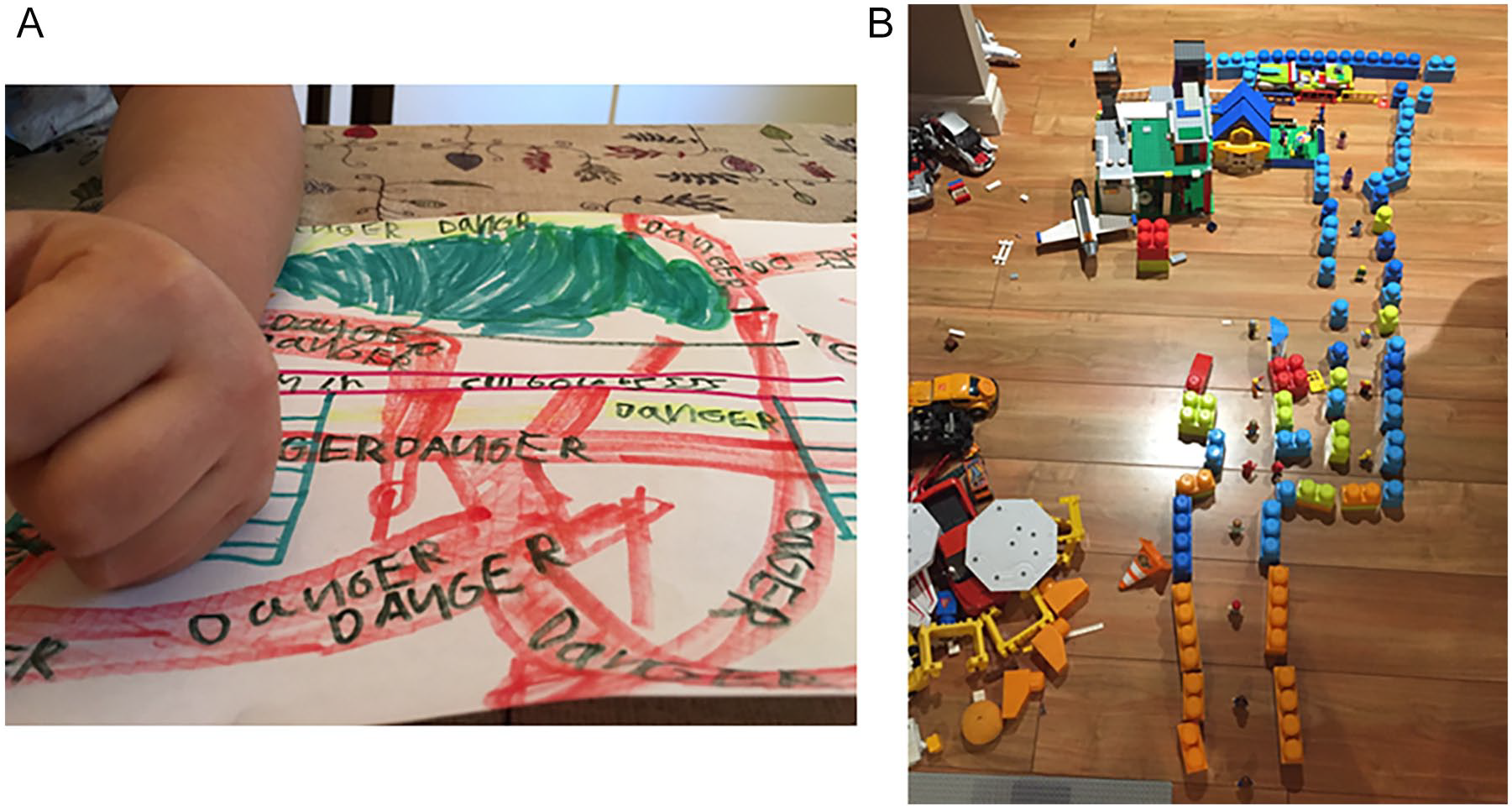
Sensemaking “narratives” of a six-year-old during the COVID-19 pandemic.
Sensemaking narratives such as these create a rich record of what it was like for different kinds of people in different identity positions to live through the personal and organizational challenges that COVID-19 raised at the moment of this episode and following it. Yet, Christianson and Barton (2021) point out that the pandemic also reveals the need to study sensemaking in more places beyond the privileged elites typically addressed by organizational scholars: e.g., nursing home employees, store and delivery workers, and small-business owners. It is early days, and such studies may appear, but they are currently few and far between.
While a pandemic is an occasion for sensemaking, it is also an occasion for sensegiving, which brings us to another stream of organizational theorizing around the notion of “framing” (Cornelissen & Werner, 2014). Narratives do not simply represent reality but also contribute to constructing it. Moreover, events like a pandemic can become the subject of “framing contests” (Kaplan, 2008) where the media, politicians, and organizational leaders may deliberately or not influence the sensemaking of others through the language they use and the narratives they tell.
For example, frames that incorporate labels (the China virus), or metaphors (like war) promote particular understandings that may then influence how people assign blame for distressing events, or behave in the face of them. In an experimental study, Dhanani and Franz (2021) showed how framings that spoke about the origins of the coronavirus in China induced more xenophobic attitudes in respondents. Koon et al. (2021) identified four types of frames articulated in the narratives of citizens of a small US town in the summer of 2020 (concern, crisis, constraint, and conspiracy frames), revealing highly conflicting perspectives strongly associated with demographics and divergent political affiliations.
In sum, with its emphasis on lived experience, sensemaking, narrative and discourse, a “process as narrative” perspective on the COVID-19 pandemic viewed as a cosmology episode or as an occasion for sensemaking and sensegiving tends to illuminate somewhat different aspects of the phenomenon from one espousing a “process as evolution” perspective.
What Is “This” a Case of? Process as Activity
The third approach to considering phenomena processually focuses on activity, and draws on a “becoming” ontology (Fachin & Langley, 2018; Langley et al., 2013) in which processes are considered not simply as acting on things, but to be fully constitutive of a world in constant flux. The focus here is on how a phenomenon of interest is shaped and constituted in and through activity. Methodologies for considering phenomena from a “process as activity” perspective are those that can capture naturally occurring activities and interactions in the moment: ethnography, shadowing, interactive data from observations or conversations. Analytic methods would include deep dive vignettes into interaction episodes, and comparisons of multiple microevents. Conceptual tools compatible with this perspective include various forms of practice-based theorizing (Nicolini, 2012; Schatzki, 2005), such as theories of routines (Feldman & Pentland, 2003), theories of social-symbolic work (Lawrence & Phillips, 2019), and other manifestations of practice theory like strategy as practice (Whittington, 2006), entrepreneurship as practice (Thompson et al., 2016), and why not?—pandemic response as practice?
“This” as a “threat to places of social inclusion” or site for “social symbolic work”
Wright et al. (2020) article in Administrative Science Quarterly “Maintaining places of social inclusion: Ebola and the emergency department” was already advanced in the review process before the pandemic hit. However, it is a wonderful example of a conceptual framework of great relevance to the COVID-19 pandemic. Wright et al. (2020) introduce and elaborate on the notion of a “place of social inclusion” which they describe as a kind of physical location that is institutionally endowed with resources, meaning and values associated with inclusion—i.e., a place where it is taken for granted that everyone has access. In their study, the place of social inclusion considered is the emergency room in the Australian health care system, where it is understood that everyone has a right to come for care. Their ethnography describes in depth the “custodial work” (or “institutional maintenance work”) that health care professionals engage in every day to maintain social inclusion despite resource limitations and safety threats, including the threat of Ebola. The case study describes the emotions professionals experience when faced with threats to social inclusion, and the practices they develop to overcome them in their roles as “custodians.” As such, the study enacts a “process as activity” perspective by analyzing how activities in the moment enable the maintenance of an institution.
Their concept of a threat to places of social inclusion appears to have even broader applicability in the COVID-19 context where the virus has clearly overflowed the boundaries of the health care system. Not only are emergency rooms threatened, but so also are multiple other places of social inclusion where people expect to have free access including care homes, schools, parks, streets, churches, shopping malls, public transportation, etc. This draws attention to the institutional work required of many individuals (policy makers, professionals, police, front-line workers, citizens) to navigate and renegotiate the conditions of access to places of social inclusion. Who is doing this work? How are they doing it? What are the activities involved? What are the tensions and emotions felt by these individuals as they make these everyday decisions where institutionalized assumptions may be challenged or violated?
Beyond the notion of “custodial work,” the “social-symbolic work” perspective more generally, as recently articulated in general terms by Lawrence and Phillips (2019) offers many potential applications to the context of the pandemic. Lawrence and Phillips (2019, p. 31) define social symbolic work as “purposeful reflexive efforts of individuals, collective actors and networks of actors to shape social-symbolic objects” where social symbolic objects are concepts that have socially constructed meanings, such as institutions, strategies, identities, risks, boundaries, etc. By adding the word “work” after labels referring to these social-symbolic objects, scholars have emphasized their processual character. None of these “objects” is tangible in the physical sense. Rather, they are all brought into being by the ongoing doings and sayings of individuals and groups. Thus, we may speak of “institutional work,” “strategy work,” “risk work,” “identity work,” “boundary work,” etc. to refer to the idea that institutions, strategies, risks, identities, and boundaries need to be worked on collectively through activities, material practices and discourse to be created, maintained, or disrupted.
Thinking through what this might mean for the COVID-19 pandemic, we can identify new research questions. Some are related to institutional work (How are individuals, organizations and collectives working to sustain or reshape the institutions, organizations and relations that enable us to pursue our lives?). Others might be related to “risk work” (Power, 2016) (e.g., How do health care organizations trade off the needs for safety with limited availabilities of personal protective equipment? How do policy makers maker risk tradeoffs between health and economics?); “identity work” (How do people work to manage identity tensions raised by the COVID Pandemic); and boundary work (How do individuals and collectives within organizations negotiate who is and is not included in new social groupings online and offline?). More generally, Seidl and Whittington (2021) argue that COVID-19 crisis directs practice theorists attention to the way in which some institutionalized practices shift easily to new forms (meetings on zoom) but others do not, and the way in which some may snap back into place when the pandemic eventually recedes, while others set the scene for newly institutionalized ways of acting.
What Is “This” a Case of? Process as “Withness”
The fourth perspective discussed here, called “process as withness” (Fachin & Langley, 2018) takes as given a world made up of processes, but adds to this an understanding that scholars or researchers are inevitably themselves also “in process,” (or becoming) living forward in time along with those they are interacting with. No-one can truly step outside the flow and examine it from afar. Taking this perspective therefore suggests radically different ways of capturing and intervening in the world as scholars. The perspective is inspired by Shotter’s (2006, 2010) philosophy of “withness thinking” that led him to propose “dialogic action research” as an ideal research method, related to a pragmatist ontology and epistemology (Lorino et al., 2011). This perspective is also inspired by Weick’s (1999) insight that while researchers typically tend to make sense of phenomena by looking backwards at what happened in the past, in everyday life, people must live forward in order to intervene in the world. A process as withness perspective would thus incorporate two key elements: first, studying with others embedded in action, and second, doing so from a forward-looking (rather than backward looking) perspective. Because we are all thrown together into the same challenging context (surfing the same waves, facing the same uncertainties), a withness perspective seems to make a good deal of sense for pandemic times.
The methodological implications of the perspective do however tend to challenge mainstream conceptions of organizational scholarship. In addition to action research, methods such as autoethnography seem to be relevant, as well as other forms of “engaged scholarship” (Van de Ven, 2007). There are a few examples of these in the literature that could serve as models. For instance, Lüscher and Lewis’ (2008) action research study of managing paradox at the Lego Corporation reveals how working through paradoxes with managers could give rise to relevant insights both for managers and for organizational scholars. Interestingly, paradox scholars have not missed the insight that the COVID-19 pandemic has made many latent paradoxical tensions more salient than they were before (Keller et al., 2021). It has been argued that the COVID-19 pandemic is a “case of” the intensification of paradoxical tensions, notably concerning sustainability (Sharma et al., 2021), human resources management and work–life balance (Pradies et al., 2021). Will these observations lead to further attempts to work directly with managers, organizations, and macrolevel actors to address them in real time? For the moment, this is unclear.
Autoethnography is another approach that can capture lived experience in real time both for researchers themselves and for research subjects. We referred earlier to some studies that have already attempted this for the COVID-pandemic, mainly from a sensemaking perspective (Guy & Arthur, 2020; Markham & Harris, 2020). The limitations of autoethnography from a withness perspective may however be that it sometimes focuses more on the lived experiences of the researcher, than experiences shared with others and on action in the future.
This is nevertheless a time when scholars are increasingly calling for greater involvement with practitioners in various forms. I remain somewhat agnostic about the particular conceptual tools that might be most relevant here, except to say that they are likely to be conceptual tools that are less concerned with explaining the past than with focusing on action that can change things in the present and future. Thus, a paradox perspective, which involves considering how to deal with salient tensions may be particularly relevant (Lüscher & Lewis, 2008). Moreover, some scholars adopting an “institutional work” perspective (see the previous section) have also suggested the power of this perspective in enabling scholars to contribute positively to addressing societal issues (Hampel et al., 2017) through academic activism and collaborative research. Overall, however, from a “withness” perspective, discovering what “this might be a case of” is surely something that should in part emerge from and in interaction with practitioners.
Conclusion
In this essay, I examined various ways in which organizational theorists might contribute to understanding the implications of the COVID-19 pandemic, by asking “What is this a case of?” believing that this question is central to who organization theorists are as scholars, and how they can contribute. I focused in particular on theoretical perspectives that draw on process thinking, because this is what I know best (it is grounded in my own identity), but also because I believe that the process perspective is particularly relevant in this time of disruption, when our world is suddenly unfamiliar, and we are still unsure how it will evolve in the future.
In focusing on the key question “What is this a case of?” I offer a nuance to arguments put forward in some scholarly circles that we, as organizational scholars have tended to overemphasize theory (Hambrick, 2007; Schwarz & Stensaker, 2014). I do believe in line with others that we should study and document important phenomena (which the COVID-19 pandemic is at this moment in time). Moreover, I share a concern with others that insistence on making a novel and distinctive “theoretical contribution” in every published article may drive out rigorous and valuable scholarship and inhibit cumulative knowledge (Barley, 2016; Hambrick, 2007). Yet, I also believe that we do need to recognize and delight in the power of theory to help us illuminate those phenomena, to consider them in multiple ways, and ultimately, to find pathways for acting on them. In other words, it is not a question of either-or (empirical documentation or theoretical abstraction), but of both-and. Moreover, in relation to complex phenomena it is not just a question of identifying the single best theory, but of examining how different lenses might allow us to see multiple facets of a phenomenon, to design research that can capture them, and to learn from the exploration and confrontation of different perspectives. I suggest that the question: “What is this a case of?” captures the spirit of intellectual curiosity that can bridge phenomena and theory, making phenomena understandable and theories meaningful. This is what OMT, seen as both a discipline within the broader field of management and as a community of scholars is and should be fundamentally about.
Footnotes
Declaration of Conflicting Interests
The author declared no potential conflicts of interest with respect to the research, authorship, and/or publication of this article.
Funding
The author received no financial support for the research, authorship, and/or publication of this article.