



Abstract
Given the increasing importance of migrations around the world, and the challenges that migrants face in entering the labor market, the process of socialization of migrants into organizations deserves more attention from management scholars. Indeed, societal discourses promoting equality and diversity often appear to be in contradiction with the unequal power relations migrants experience on entering the workforce. Drawing on a dialectic perspective and a qualitative meta-synthesis methodology, we show how the practices engaged in by organizations to socialize migrant employees are deeply embedded in and influenced by macro-social contexts that may place migrants at a disadvantage, giving rise to emerging tensions. We examine a range of contingencies that can mitigate the inequalities that migrants experience, and we reveal a variety of dynamic dialectical pathways surrounding migrant socialization practices through which they may be reproduced or transformed depending on the mutual relationships between situated conditions, emerging tensions and human praxes.
Organizational socialization (OS) is usually defined as a process by which newcomers learn “the ropes” of an organizational role by acquiring the social knowledge and skills required for that role (Schein, 1988; Van Maanen & Schein, 1979). There has been extensive research on this phenomenon (e.g., Allen et al., 2017; Saks and Gruman, 2012; Schein, 1988; Van Maanen and Schein, 1979; Wanberg, 2012). However, with a few exceptions, little work has paid attention to the managerial practices put in place to socialize migrant newcomers, (Jian, 2012; Malik & Manroop, 2017; Mohamed & Leponiemi, 2009; Tharenou & Kulik, 2020).
We use the term ‘migrants’ in this paper to cover all foreign-born individuals that leave their homeland for a new host country either temporarily (e.g., for seasonal work) or permanently (e.g., as immigrants or refugees). Although there are differences in perspectives and opportunities for different categories of migrants in the labor market, in general, they may face special challenges such as language barriers, poor understanding of societal norms, and possible discrimination and social exclusion (Andrijasevic et al., 2019; Kalonaityte, 2010). Indeed, based on a review of research on the experiences of skilled migrants, Tharenou and Kulik (2020, p. 1160) find that they have “more extensive socialization needs than other newcomers,” and that their socialization process may be more challenging, creating tensions in the workplace, and extending beyond the period of initial onboarding. Given the increasing importance of migrations around the world, the disadvantages that migrants face in entering the labor market, and the important role of workplace integration in successful accommodation to society, the process of socialization of migrants into organizations deserves more attention (McGahan, 2020).
Two aspects of migrant socialization practices are of particular interest in this paper. First, as Nkomo and Hoobler (2014) point out, human resource management practices are embedded in and influenced by their geographical, political, and organizational context, which may include state ideologies and institutional arrangements that support or inhibit certain practices (Berry, 1997, 2011; Bourhis et al., 1997). In addition, despite certain societal discourses promoting equality and cultural diversity (Berry, 2011; Bourhis et al., 1997), foreign-born newcomers generally remain at a power disadvantage as they attempt to enter the workforce (Andrijasevic et al., 2019; Nkomo & Hoobler, 2014). Depending on particular macro-social and organizational contexts, as well as on the motives that incite organizations to employ migrant workers, these power disadvantages may be more or less salient and affect the social production of organizational socialization practices and their consequences. Yet, the way in which contextual arrangements influence migrant socialization practices and their transformation or maintenance over time have not been explicitly articulated in the literature.
Second, it is clear that the tension between promoting conformity to organizational requirements and encouraging individuality is present in any socialization practice aimed at enabling employees to effectively accomplish their work roles (Van Maanen & Schein, 1979). However, this tension appears to be particularly acute for migrant newcomers who need to adapt not only to their particular workplace but also to a new host country (Ghorashi & Sabelis, 2013; Hurst et al., 2012; Schwabenland, 2012; Shore et al., 2011). Thus, Tharenou and Kulik (2020) refer to the tension between “identity-blind” and “identity-conscious” socialization practices for migrants, and Ghorashi and Sabelis (2013) speak about organizations “juggling difference and sameness.” For example, socialization practices that emphasize “sameness” (identity-blind) may appear to promote equality, but the lack of attention to differences in cultural background and experience can place migrant newcomers at a disadvantage. Conversely, socialization practices that celebrate cultural differences (identity-conscious), could inadvertently reinforce perceptions of inequality and potentially enhance the risk of marginalization (see also Schwabenland, 2012). Shore et al. (2011) refer to the notion of “inclusion” as incorporating both a sense of belonging and a sense of value in uniqueness – two dimensions related to sameness and difference, that seem inherently difficult to reconcile, but that have been argued to be important to the successful socialization of migrant newcomers (Ghorashi & Ponzoni, 2014; Mor Barak, 2019).
Yet as mentioned, there appears to be a fundamental contradiction between societal discourses promoting equality and diversity, and the inherently unequal power relations migrants experience in the labor market. It is not clear how this underlying contradiction will be reflected in organizational socialization practices, and in particular how it might manifest itself in the emergence of tensions in particular settings. Thus, an additional concern of this paper is to identify the tensions surrounding migrant socialization practices and to examine how these practices, underpinned by such tensions, might play out over time.
Based on these observations, we propose to examine the organizational socialization of migrants drawing on Bensons (1977, 1983) articulation of the dialectic perspective. This perspective considers the dynamic interaction among multiple actors’ ideas and their power to channel their interests in different macro-social and organizational contexts. It also reveals the potential for transformation or reproduction of existing practices over time based on the emergence of tensions and contradictions. Given the underlying tensions inherent to socialization practices of migrants, this approach seems particularly relevant. Specifically, drawing on the dialectic perspective, we ask: (R1) How do migrant socialization practices reflect the macro-social and organizational contexts in which they are embedded? (R2) How do these practices give rise to tensions and contradictions? (R3): How and why are socialization practices reproduced or transformed over time in the face of these tensions and contradictions?
Our aim is thus to increase understanding of the context affecting the organizational socialization of migrant newcomers, as well as to appreciate the contradictions and tensions these practices give rise to, and show how and why they may or may not be addressed. This is important to identify feasible paths towards more satisfying outcomes for both newcomers and host organizations. To develop these ideas, we conduct a form of qualitative meta-synthesis (Noblit & Hare, 1988), drawing on an unusual source of secondary data: a collection of nine empirical case studies, some based on published research, and some on teaching cases. Based on this analysis, we develop a dialectical model of migrant socialization practices and the mutual relationships enabling or inhibiting the emergence of more inclusive and emancipatory forms of organizing. We begin by reviewing the literature on organizational socialization, and in particular those strands with relevance to the issue of the organizational socialization of migrants.
Organizational Socialization
Organizational socialization (OS) research explores what happens to newcomers when they enter organizations, and how organizations shape the attitudes, values and norms of new members (Chao, 2007; Dixon et al., 2012; Schein, 1988; Van Maanen & Schein, 1979). Van Maanen and Schein (1979, p. 211) define organizational socialization as a “process by which an individual acquires the social knowledge and skills necessary to assume an organizational role.” Socialization agents are supposed to guide the individual in learning their new role by providing them with a sense of accomplishment and competence (Van Maanen & Schein, 1979) and with advice on how to meet or exceed job expectations, to transit from outsiders to insiders (Allen et al., 2017; Tharenou & Kulik, 2020) and to become “successful” organizational members (Chao, 2007).
Organizational practices supporting the socialization of newcomers, such as training, networking, mentoring (Dixon et al., 2012), orientation programs, information seeking, sand other adaptation processes (Wanberg, 2012) are usually initiated in order to fulfil business-related goals, such as productivity and performance. Accelerating newcomers’ learning by strengthening job skills (Saks & Gruman, 2012; Schein, 1988; Van Maanen & Schein, 1979) is viewed as central. In the case of migrants specifically, this raises the question of whether their particular requirements will be met by traditional socialization processes. Below, we elaborate on two generic perspectives, in the literature on organizational socialization, focusing in particular on who is supposed to adapt in this process, and on what these perspectives might imply for migrant newcomers.
Assimilation: Organizational Socialization as a One-Way Change Process
The dominant view in the socialization literature appears to be that newcomers are those who primarily need to adapt to existing organizational norms, values, and behaviors. For instance, Van Maanen and Schein (1979) assume that the function of organizational socialization is to secure a transfer of a particular work culture from generation to generation, implying that organizational values and norms should remain unchanged. Therefore, newcomers who might bring change (e.g., by questioning work practices) must, instead be taught to see the organizational world as do more experienced colleagues. Schein (1988) promotes a similar view in which socialization involves one-way change. New members need to “learn the ropes” to become effective members (see also Chao et al., 1994). If new members’ values and behaviors do not meet expectations, Schein (1988, pp. 54−55) suggests that the socialization process needs to involve, as he calls it, a “destructive” or “unfreezing” phase in order to detach newcomers from former values. In this type of process, newcomers are supposed to change, and their previous experiences are not seen as resources if they do not conform to existing cultural patterns.
Applied to the situation of migrants who are not only new to the organization, but also new to the host country, the form of adaptation that is required of them from this perspective is what has been called “assimilation.” The notion of assimilation comes from work on migration at the societal level (Berry, 1997; Bourhis et al., 1997; Gordon, 1964). It is based on the assumption that over time, migrants will adapt to the host society, and become similar to the majority by adopting their culture, values and behaviors. Critics suggest that this unidirectional view attributes any eventual problems of adaptation to the migrants themselves (Bourhis et al., 1997; Ehrkamp, 2006). In addition, the concept of assimilation not only normalizes the majority population's ‘common cultural life’ but also tends to see it as superior. Migrants along with their experiences, values, and behaviors tend to be constructed as inferior ‘others’, who need to adapt to majority expectations. At the same time, some migrants may actually desire to “assimilate” to achieve acceptance and adopt strategies to achieve this (Berry, 1997; Tharenou & Kulik, 2020). In those cases, socialization practices that emphasize conformity might be seen as less problematic.
Integration or Inclusion: Organizational Socialization as a Two-Way Change Process
Though less prevalent, another view may also be identified in the literature. According to this perspective, although newcomers need to adapt to organizational norms and values, the organization also needs to adapt its practices, routines and ways of organizing. However, the overall purpose is the same: to accelerate newcomers’ mastery of required tasks.
For example, Van Maanen and Schein (1979), refer to an investiture socialization tactic in which newcomers’ identities and competencies are confirmed, rather than denied, suggesting the possibility of a two-way “integrative” view – in other words, newcomers are accepted as they are, and the experiences they bring are seen as resources with potential value. Similarly, Feldman (1994) critiques the literature's marginalization of the effects that newcomers have on socialization agents, resituating organizational socialization as a two-way mutual influencing process (see also Allen et al., 2017; Ashforth et al., 2007). Although not necessarily focused on socialization per se, studies of “inclusion” – a notion that emphasizes the value of both employee uniqueness and belongingness (Ferdman, 2017; Houtkamp, 2015; Ortlieb & Sieben, 2014; Roberson, 2006; Shore et al., 2011) also suggest the need for mutual adaptation.
Such a perspective on organizational socialization seems more compatible with what scholars of migration at the societal level have called an “integration” perspective, associated with societies with ideologies and institutional arrangements that favor multiculturalism (Bourhis et al., 1997). Unlike the concept of assimilation, where migrants themselves are held responsible for their own adaptation to society, in the concept of integration, multiple actors and institutions (including migrants) are viewed as jointly responsible (Ager & Strang, 2008; Berry, 2011; Spencer, 2011). For example, Berrys (2011) notion of integration implies two way adaptation, i.e., migrants adapt to society, but at the same time, societal policies and practices are adapted to accommodate the needs of migrants as well as other members. Applied to the organizational level, this perspective implies a preference for two-way socialization practices that recognize newcomers’ distinctive skills and values and provides room for them to flourish.
Theoretically, this view reflects an interactionist perspective on socialization (Allen et al., 2017; Ashforth et al., 2007; Reichers, 1987) in which both organization members (managers, insiders) and newcomers exert agency. Based on this, it is the specific socialization tactics adopted and the nature of newcomers’ responses to them that generates outcomes and constructs common meanings associated with socialization (Reichers, 1987). We now consider the limited body of work that has focused more specifically on the organizational socialization of migrants.
Organizational Socialization of Migrants
As Tharenou and Kulik (2020) point out, while there have been many studies of migrant experiences, there has been relatively little work specifically focusing on organizational socialization practices for migrants. One exception is Malik and Manroops (2017) conceptual paper which proposes, based on social identity theory, that the successful socialization of migrants requires ‘customized’ tactics combining both individualized and collective socialization, inspired by Berrys (1997) notion of societal integration as a two-way process. Tharenou and Kulik (2020) also build on the previous literature to develop a three phase model of the socialization experiences of skilled migrants, theorizing about different organizational strategies that might assist that process at each stage as well as some of the challenges newcomers might encounter.
In terms of empirical work, Månsson and Delander (2017) review mentoring practices for integrating refugees into the labor market in Sweden, and Mohamed and Leponiemi (2009) describe induction training for migrants in Finland. These studies report on particular practices in specific settings without further theoretical development. More interestingly in terms of our focus on the management of tensions, Oerlemans and Peeters (2010) found that discord between local and immigrant workers on socialization approaches resulted in poorer inter-group relations. In contrast, Jian (2012) found that immigrants’ adaptation to local culture, and the preservation of their own culture (two-way integration) contributed to better relationships with other groups. Surprisingly, however, none of these studies addresses the role that power relations embedded in the macro-social and organizational context might play in migrant socialization practices.
Beyond these contributions, we identified several qualitative studies of diversity, that while not framed explicitly in terms of organizational socialization, do speak to this indirectly (Janssens & Zanoni, 2014; Leyerzapf et al., 2018; Romani et al., 2019). What these studies reveal above all is, indeed, the omnipresence of tensions and contradictions, often underpinned by power relations. For example, Romani et al. (2019) study of human resources management in a Swedish firm showed that practices which at first sight appeared integrative in the end seemed to demand migrant assimilation (see also Holck, 2018). Similarly, in a hospital study, Leyerzapf et al. (2018, p. 142) revealed how both minority and majority employees “normalized” sameness and difference in a way that required foreign-born employees to assimilate to the majority, reproducing power differentials “rooted in and expressed through norms.”
These and other studies on diversity in organizations reveal the tensions underpinning migrant socialization practices, where at the same time value is placed on similarity and equality, but also on distinctiveness and uniqueness (Ghorashi & Sabelis, 2013; Kalonaityte, 2010; Schwabenland, 2012; Shore et al., 2011), and where both are underpinned by power relations. Given that tensions and contradictions have the potential to motivate organizational and social change (Benson, 1977), it appears relevant to place these processes within their macro-social and organizational contexts, to compare the various ways they play out over time, and to consider their potential for transformation. Yet, current studies on the organizational socialization of migrants fall short of offering such a relational and dynamic view. Organizational socialization practices are often considered without reference to the specific context, and without considering the dynamic power-based interactions between organizations and migrant employees. We propose to employ a dialectical lens along with a qualitative meta-synthesis method to explore these issues.
A Dialectical Perspective
The dialectical approach focuses on the processes through which organizational arrangements are socially produced, maintained and disrupted. It places emphasis on how contradictions emerge within social arrangements and potentially generate opportunities for transformation. While scholars have drawn attention to a variety of approaches to conceptualizing dialectical processes (Hargrave & Van de Ven, 2017; Putnam et al., 2016), in this paper we build principally on Bensons (1977, 1983) approach grounded in a processual and pluralistic view of the world. From this perspective, an organization is a product of past acts of social construction, and as such, always in a state of becoming. Social or organizational arrangements which seem permanent are viewed as just one of many possibilities (Benson, 1977). Four central, and mutually related principles of dialectic analysis (social construction, context, contradiction and praxis) were formalized by Benson (1977) and developed in subsequent work on topics such as institutional change (Seo & Creed, 2002), and diversity in organizations (Omanović, 2009, 2013; Schwabenland, 2012). In several studies inspired by the dialectical perspective, researchers consider the possibilities of creating alternative emancipatory organizational praxes (e.g., Barros, 2010; Seo and Creed, 2002). However, the approach has not been used as a theoretical framework to analyse different conceptualizations of organizational socialization, as proposed here.
The four dialectical principles put forward by Benson (1977) imply, first that people socially produce their social world through different ideas, interests, and activities. The ideas and interests which guide the social production of organizing depend, however upon the power relations among participants, that is their capacity to control the direction of activities, and influence decisions. The analysis of power relations is thus also an important aspect of the dialectical perspective (Hargrave & Van de Ven, 2017).
Second, context refers to the notion that people produce their social world and are produced by it. However, despite efforts by people in power to centrally channel processes of organizing, some elements or participants both inside organizations (e.g., different workgroups) and outside them (e.g., governmental authorities), remain beyond the reach of rationalization. This enables the development of distinct, semi-autonomous spheres or contexts for social production (e.g., organizations may be influenced by, but not entirely determined by their macro-social context).
Third, according to Benson (1977) these mutual relationships can generate contradictions, i.e., confrontations between apparently incompatible ways of arranging social life. Contradictions are important forces for organizational change, but do not lead to it deterministically. Fourth, some contradictions may lead to maintenance of the status quo (no new praxis), or they can lead to reflexivity, where social arrangements (e.g., existing practices of migrant socialization) are questioned, and alternatives sought and promoted (e.g., by mobilizing other actors). Benson (1977, p. 16) suggests that this happens through the emergence of tensions grounded in contradictions that create awareness of alternative possibilities: “Contradictions provide a continuing source of tensions, conflicts, and the like which may, under some circumstances, shape consciousness and action to change the present order.” Thus, unlike practices that reproduce the established order, new praxis is grounded in alternative ways of seeing, which might enable, at least in part, the reconciliation of contradictions.
This framework is relevant here because of the omnipresence of tensions and contradictions underpinning the organizational socialization of migrants. However, it should not be seen as a rigid framework to be “tested”, but rather as a useful language to address our research questions.
Methodology
Research Design: Qualitative Meta-Synthesis
In presenting our methodology, it is important to clarify for the reader how the approach we are pursuing in this article came about. Our initial interest in the organizational socialization of migrants was, in fact, originally more conceptual than empirical in nature. However, as we explored the phenomenon conceptually, we found ourselves dissatisfied with the existing literature on the topic. This led us to seek some published empirical examples to enrich our understanding. Indeed, it is only after reviewing a number of published case studies from various sources that we began to see the relevance of a dialectical perspective (as described and justified above). Based on this insight, we decided to systematize what had been, until then, a largely exploratory exercise by deepening the empirical base we were working with, and formalizing our analytical approach. We therefore developed an adapted form of qualitative meta-synthesis (Noblit & Hare, 1988) to examine the dialectical dynamics surrounding migrant socialization practices.
A qualitative meta-synthesis involves considering data and analyses from qualitative studies originally conducted separately, and is aimed at developing a “line of argument” that “puts the similarities and differences between studies into an interpretive order” (Noblit & Hare, 1988, p. 64). Variants of this approach have been used to study a range of different phenomena in management studies including dynamic capabilities (Hoon, 2013), interprofessional teamwork (dit Dariel & Cristofalo, 2018), organizational failure (Habersang et al., 2019), organizational democracy (Luhman, 2006) and micro-finance (Horton, 2019).
Qualitative meta-synthesis appears to be a suitable approach to fully develop the dialectical perspective described above, as it enables us to examine the multiple ways in which the contradictions underlying organizational socialization practices play out in different situations where contexts, ideas, interests and activities interact. We are therefore able to capture a variety of contingencies that may affect these complex dialectical processes.
Several approaches to qualitative meta-synthesis have been proposed in the literature (Drisko, 2020; Point et al., 2017). For example, Drisko (2020) and Hoon (2013) distinguish “aggregative” from “translational” (or interpretive) studies. Aggregative studies use content analysis to test pre-existing theory or to draw out common themes, adopting a broadly positivist onto-epistemological stance. In contrast, “translational studies” attempt to conserve the meaning and contexts of the original studies but work to “translate” the concepts found within each of them into one another, and to rise above them to develop novel conceptualizations (Noblit & Hare, 1988). This is the philosophy adopted here. Its purpose is well expressed by Thorne (2019): “The goal of meta-synthesis is to push the body of qualitative scholarship beyond that aspect to which each original investigator might have had access for the purpose of revealing a more comprehensive and integrated understanding of that which constitutes a larger theoretical whole.”
Sampling
Thus, we sought qualitative studies that reveal the dynamics of migrant socialization occurring in particular organizational sites and contexts, but which could be explicitly juxtaposed and integrated to build stronger theoretical insight into the emergence of different types of socialization practices, and their dynamic consequences. The cases we draw on are for the most part based on published articles or descriptive teaching cases. While some authors have argued for restricting samples to studies with identical epistemological assumptions and types of data (Doyle, 2003), those advocating a translational perspective have suggested that different qualitative traditions and data sources can enrich the pool of possible insights (Drisko, 2020; Horton, 2019; Thorne, 2019). At the same time, we remain reflexive about the way in which different perspectives might alter interpretations (Thorne, 2019). For example, we may see a more managerial orientation in teaching cases, and an approach more sensitive to power dynamics in critically-oriented studies. Teaching cases can however be an instructive source of secondary data (Ambrosini et al., 2010; Habersang et al., 2019) because of their open-ended nature as stimuli for reflexivity.
Another issue concerns sample size. While some have argued for an exhaustive search for relevant materials (Hoon, 2013), others have suggested that a qualitative meta-synthesis aimed at theory development should adopt a purposeful sampling approach aimed at identifying cases most likely to add significantly to emerging theory (Finfgeld-Connett, 2010; Noblit & Hare, 1988). For the meta-synthesis carried out here, some limitation on the number of studies appeared desirable to allow rich reporting that could do justice to the contextualized aspects of cases.
Based on these considerations, we first searched broadly for articles in the Web of Science and Google Scholar, and for teaching cases in the Harvard Business School repository, in International Journal of Management Case Studies and in casebooks with keyword derivatives of “migrants,” “refugees”, “immigrants” and “socialization,” restricting languages to English and French. As we realized that some valuable studies were missed, we expanded the pool to include studies referring to “diversity” and “inclusion”, since these sometimes focused on migrants without this being indicated in titles, abstracts and keywords. After reviewing abstracts from this search, we reduced the pool to 16 teaching cases and 28 qualitative articles that were read in detail.
Based on this reading, we reduced the sample to four teaching cases and five qualitative articles. The following were excluded at this stage: (1) Qualitative studies that did not focus on specific organizations; (2) Studies of non-Western contexts; (3) Studies providing limited information on managerial practices; (4) Studies of diversity that emphasized demographic dimensions not predominantly associated with migrants; (5) Studies containing minimal original data (quotes or observations). Finally, an important theoretical sampling criterion was our desire to include a range of situations concerning socialization practices (e.g., both one-way and two-way practices), as well as different contexts in terms of power relations. In addition, while this was not a categorical exclusion criterion, we also preferred studies with a social-historical or longitudinal dimension, allowing us to better understand the positions of migrants on the labor market in the host country, and also to capture the potential for transformation over time.
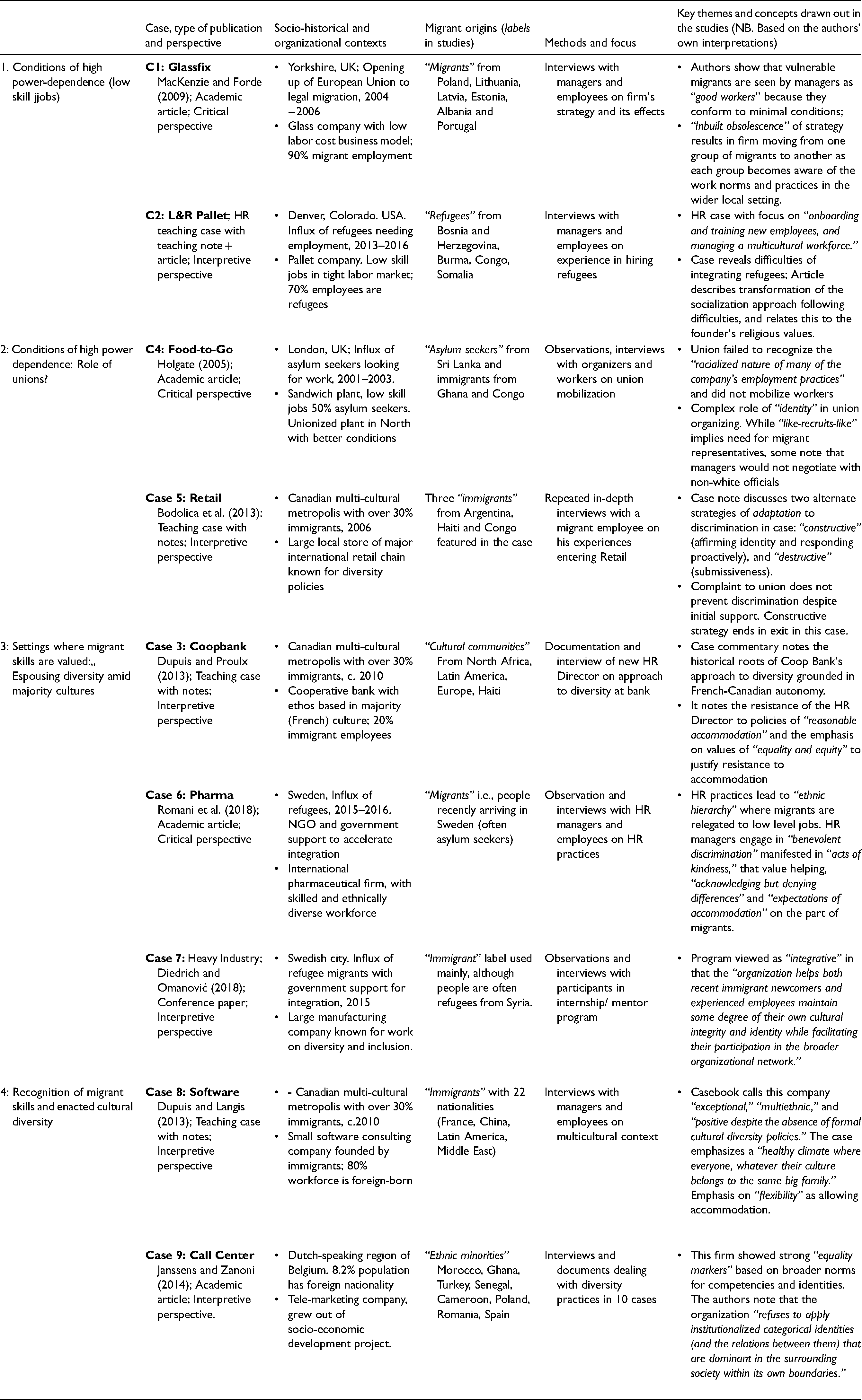
The nine selected cases are presented in Table 1. Three cases (C4: Global Retail; C5: Coop Bank, and C8: Software) are derived from a casebook on multicultural enterprise (Dupuis, 2013) in Montreal, Canada where 30% of the population were born outside Canada, and where the majority language is French. A fourth case (C9: Call Center) is similarly located within a historically undervalued linguistic community in Belgium (Janssens & Zanoni, 2014). Of the other cases, two (C1: Glassfix and C3: Food-to-Go) deal with UK manufacturing firms (Holgate, 2005; MacKenzie & Forde, 2009). Another (C2: L&R Pallet) is based on a teaching case and article on a company based in Denver, Colorado (Schneider, 2017; Schneider & Young, 2018). Case C6: Pharma deals with a Swedish pharmaceutical company (Romani et al., 2019). Finally, case C7: Heavy Industry (Diedrich & Omanović, 2018) is also located in Sweden. As shown in Table 1, the different texts refer to somewhat different categories of migrants and use different labels (migrants, immigrants, refugees, asylum seekers). As indicated earlier, we use the term “migrant” as a collective term that covers all these groups.
Descriptive Summary of Cases Included in the Meta-Synthesis.
Data Analysis
To analyse the situations revealed in the cases, we proceeded in three stages. First, one of the researchers wrote a narrative summary of the case, focusing on key features. At this point, as is typical with translational meta-synthesis (Urrieta Jr & Noblit, 2018), we focused on each study's key concepts, and messages using the language of the original authors. These original concepts and interpretations for each study are summarized in the last column of Table 1.
Second, we then jointly considered and coded each case in the light of themes originally suggested by Benson’s (1977) conceptualization of dialectic processes: the context (including the macro-social context, organizational context, and mutuality between these), the ideas, interests and activities of key protagonists (managers, migrants seeking employment), with a particular focus on organizational socialization practices, contradictions and tensions arising from these mutual relationships within and between the macro-social and organizational context, and finally praxes (if any) in the face of contradictions and tensions.
As we examined the cases, we came to realize that they could be considered as falling on a continuum in terms of the power relations constituted through mutual influences between the macro-social and organizational context and migrant populations seeking work. These relations depend, for example, on the types of jobs available, the possible presence of unions, and other features that may contribute to enhancing or mitigating power dependencies. We noted that organizational socialization practices tended to reflect these differing power relations, although they might shift and evolve over time in the face of emerging tensions. This observation led us to identify more clearly how the fundamental contradiction, noted at the beginning of this paper, between societal discourses promoting equality and diversity, and the inherently unequal power relations migrants experience in the labor market might manifest itself in different situations. It is this that underpins the more specific tensions emerging for each of the different cases.
Based on these observations, and building on the dialectical perspective we then drew on the original accounts to trace (a) the conditions contributing to different socialization practices (e.g., mutual influences between ideas, interests, activities and macro or micro-organizational contexts) and (b) the tensions emerging from these situations, and the praxes, if any, they generated. We used this to build the overarching conceptual schema shown in Figure 1 and to structure our findings section, drawing liberally on extracts from the original materials.
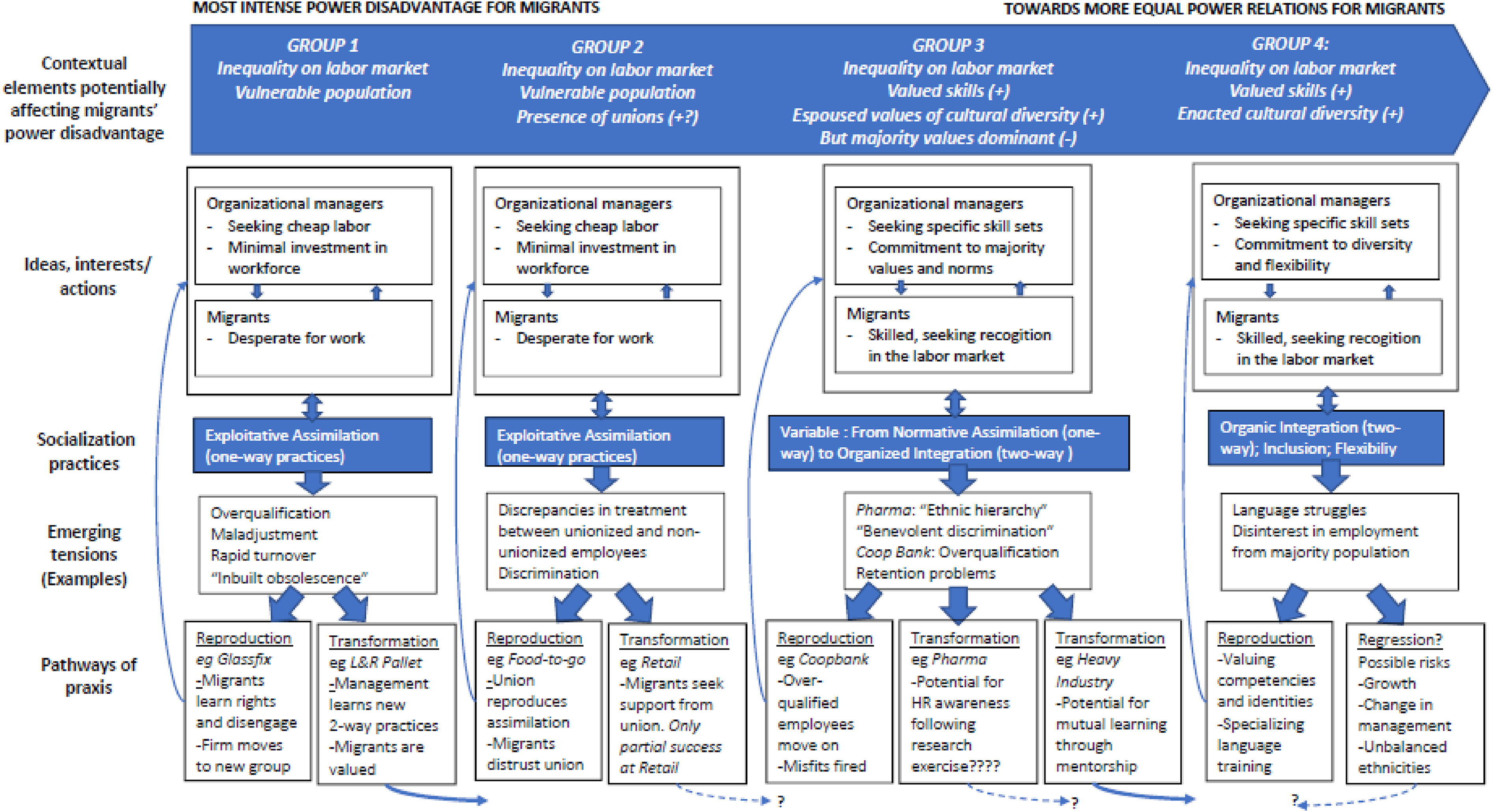
Dialectic pathways in the organizational socialization of migrants.
Findings: Dialectic Analysis of Migrant Socialization Practices
In the analysis below, we consider the nine cases grouped in relation to features that might be considered a priori as potentially affecting these dialectical power relations, starting with situations where migrants are likely to be in the weakest power positions and moving towards situations where there may be greater balance for a variety of reasons.
The first four cases relate to the socialization of migrants into minimum wage low-skilled positions: two in the UK (C1, C4), one in Canada (C3), and one in the US (C2). We begin by presenting the dialectic socialization dynamics for two cases (one in the UK and one in the US) where the power balance seems most strongly in favor of the employer. In these two cases, there appears initially to be no countervailing forces that could give employees more say in how they are socialized. We then move on to two other cases that are similar to the first two in terms of the type of jobs involved, but differ in terms of the presence of unions, which might in theory offer the possibility of more balanced power relations and praxis, although that is not necessarily what we see. The third group of cases (C5, C6 and C7) is of interest because the motives for hiring migrants suggest more balanced power relations a priori – here, migrant labor is valued not simply because it enables firms to minimize their labor costs, but also for other reasons more closely associated with particular competences. We see that despite this, there are various reasons why socialization approaches may tend to be one-way and largely undifferentiated, although this is not always the case. Finally, the last two cases (C8-C9) describe situations in which more integrative and two-way approaches appear to have taken hold. These cases interestingly reveal some particular contexts and conditions that may enable more emancipatory migrant socialization practices.
Dialectics of Socialization Under Conditions of High Power-Dependence
Similarly, L&R Pallet, a firm operating in Denver, Colorado had experienced great difficulty in retaining local labor for its low-skilled business in manufacturing and repairing wooden pallets: “At its low point, L&R Pallet faced a 300% turnover rate.” (Schneider & Young, 2018, p. 2). Desperate for workers who would accept its minimal conditions, the company's owner contacted a local refugee agency. At the end of the study, 70% of employees were refugees.
On the migrant side, there was desperation to find jobs. In the case, of Glassfix, some migrants were in the UK for a temporary period to make money and then go home to their countries of origin. Although the hourly pay was low, many were motivated by the overtime: “That's what keeps us here, otherwise we would go” (p. 153). The L&R Pallet case indicates that the refugee placement agency, “would sometimes place people who weren't ready because “it's better than not working so we’d try it.” (Schneider & Young, 2018, p. 9). Clearly in both cases, we are in the presence of vulnerable workers who had limited choices.
At L&R Pallet, a different set of tensions emerged, and tended to undermine the benefits of hiring refugees. First, because they only received limited training and did not speak English, the refugees were involved in many work accidents: “After completing the three-day training regimen, the workers would drive forklifts at high speeds and hit other people, shoot themselves in the hand or the ankle with high-powered nail guns.” In addition, managers at L&R Pallet were accused by seasoned Mexican workers as favoring the refugees, building inter-ethnic tensions.
Most interestingly, the reaction at L&R Pallet was quite different despite similar power dynamics on the surface. In contrast with Glassfix (C1), the tensions experienced at L&R Pallet (C2) became a source of learning. Perhaps because of continued difficulty in hiring locals, and perhaps for altruistic reasons (associated by the authors with religious commitments – see Table 1), the CEO at L&R Pallet engaged more deeply with the refugees, moving towards an “integration-based” two-way socialization approach. The case explains that on interviewing all 25 refugees, the CEO found that “Men from the same country spoke different languages or dialects and came from different sects” (Schneider, 2017, p. 7), creating unexpected communication difficulties. The case goes on to describe various activities aimed at enabling refugees to integrate to the setting including extended training, building a replica of the plant for training purposes, gathering “those with a common language together” (Schneider, 2017, p. 8), developing programs to recognize anniversaries and hiring staff to help refugees with personal difficulties, all with positive outcomes for work relations and employee turnover (reduced to 5% from 300% two years earlier). The two cases thus reveal two very different dialectical pathways in the socialization of migrants, one that resulted in reinforcement of the assimilation perspective, and one that initiated transformation towards a more integrative approach.
Dialectics of Socialization Under High Power-Dependence: The Role of Unions?
The first two cases are both characterized by a highly unfavorable power dynamic for migrant workers, but reveal two very different dialectical pathways. However, approaches such as that displayed at L&R Pallet may be unusual given the vulnerability of migrants in a context where employees are easily replaced. This raises the question of what dialectics between contextual conditions and ongoing activities could lead to different praxes? Plausibly, elements that could shift the balance of power between management and labor might play a role. In the next pair of cases, we consider the potential role of union representation.
The context for C4 Retail is a large store in a Canadian city that is part of an international chain (head office in a European country). The case focuses on the experience of three workers from different countries (Argentina, Haiti and Congo) who join the company's customer service department for low-paying and physically demanding work in the warehouse. In contrast to the cases discussed so far, the parent company officially espouses, “a policy of integration of cultural differences that values and mobilizes diversity, where everyone uses competences to contribute to the improvement of results and competitiveness” (Bodolica et al., 2013, p. 204). As we shall see, this policy is not strongly in evidence in the particular local store considered.
Similarly, at Retail, the case describes how the three migrant newcomers suffer discrimination from colleagues, and even their supervisor who tends to favor local employees in assignments. The Haitian and Congolese employees appear resigned to their situation: “[Harry, the Haitian colleague] admits that he does not have the courage to complain” p. 214). The Argentinian employee is more prepared to resist, as we see below.
In the case of Retail, the Argentinian employee featured in the case protested his treatment to a union representative. He received initial support from the union and a senior manager who “seemed very touched when he spoke to her about discrimination” (Bodolica et al., 2013, p. 216). Following this, his supervisor altered a work evaluation form in his favor. However, this did not make him popular: “Some of his colleagues began to look at him with a critical eye because of his complaint to the union, and he felt increasingly rejected in the work place.” (p. 216). In the face of frustration with his supervisor's responses and deteriorating relations with his coworkers, he left the organization. Thus, his actions did not have a transformative character in reconstructing existing organizational arrangements. Ironically, it is the two other employees from Haiti and Congo who remained at the firm, but in order to survive, they became socialized into accepting discriminatory treatment – they “assimilated” into the only roles that the company and their work colleagues allowed them. The notion of “assimilation” here takes on a problematic meaning as it implies not just being accepted as equal, but rather as accepting lesser roles and treatment.
Dialectics of Socialization for Skilled Migrants in Majority Cultures Espousing Diversity
The two cases described above illustrate the dialectic potentialities and limitations of union participation in redressing power imbalances in situations of low-skilled jobs, where migrants may be particularly vulnerable. We now consider cases where the power imbalance may be mitigated in a different way. Specifically, we group together three cases that are based in different country contexts (Canada and Sweden), but that share the feature that migrants are valued for their specific skills, in settings espousing diversity, though nevertheless dominated by a majority culture.
Cases C6 Pharma and C7 Heavy Industry are both located in Sweden, a context where the government has made particular efforts since 2015 to integrate a large number of migrants (notably asylum-seekers) into society, including ensuring them employment through a variety of programs. Nevertheless, the authors of the Pharma case comment that, “Despite Sweden's high scores on several indicators of migrant integration, their unemployment rate compared to native-born citizens is much higher than the average Organisation for Economic Co-operation and Development (OECD) country. (…) Structural discrimination is implicit and often naturalised as being a consequence of societal structures.” (Romani et al., 2019, p. 373). Pharma is the Headquarters unit of a pharmaceutical firm that primarily employs people with training in chemistry. It has an anti-discrimination policy and members of the HR department pride themselves on their commitment to diversity. Similarly, Heavy Industry (C7) promotes an inclusive culture on its website, where “everyone can contribute to their full potential and be accepted for who they are, regardless of gender, gender identity, nationality, ethnic origin, religion, age, sexual orientation, any disabilities, etc.”
The two Swedish firms, Pharma (C6) and Heavy Industry (C7) were both involved in partnerships with government and NGOs to promote the integration of migrants to the Swedish labor market. An HR respondent at Pharma comments, “We talked a lot about being more visible, to do something for society […] well, this is a nice initiative” (Romani et al., 2019, p. 384). Financial incentives from the government were also significant for both firms: “You have subsidies for those who have a hard time getting into the job market. [Public Employment Services] covers up to 70 per cent of the salary costs” (HR officer quoted in Romani et al., 2019, p. 379).
At Pharma, Romani et al. (2019) recount how the HR managers sincerely saw themselves as “doing good” in helping migrants who had difficulty finding work elsewhere, and as it turns out, were once more often overqualified for the positions obtained. Indeed, the authors conclude, “Recruiting overqualified applicants (and employees with a foreign background tend to work below their qualifications) is one of Pharma's deliberate strategies” (Romani et al., 2019, p. 382). For the Heavy Industry case (C7), Dietrich and Omanović (2018) suggest that migrants are considered to be: “valuable assets to the companies that are desperately seeking skilled employees,” while on the side of migrant employees, there is a strong motivation to obtain a job equivalent to their education in a context of discrimination in the labor market.
The three cases thus tend to show that although firms value the skills of migrant employees, and explicitly espouse diversity, the power dynamics within broader society means that migrants often remain at a disadvantage. This manifests itself variably in socialization practices.
There was clearly more attention to recognizing diversity both at Pharma and at Heavy Industry than at Coopbank. For example, at Pharma we read that: “Fridays’ afternoon coffee is served with home-made cakes from various parts of the world. We heard that the date of an employee celebration was moved ahead in order not to coincide with the month of Ramadan, and all employees went through a diversity training programme” (Romani et al., 2019, p. 378). Yet at Pharma, goodwill towards qualified migrants was not unconditional or free. More specifically, migrants were assigned positions in lower paid jobs with limited career possibilities, and as Romani et al. (2019, p. 16) describe it, they were expected not to challenge the accepted order but to “respect it and to express thankfulness for acceding to it.” Central also to expectations of all employees at Pharma was what the authors describe as “Swedishness,” which involved not only a mastery of language, but also of certain communication styles. In other words, at Pharma, despite an apparent commitment to diversity, in the end, adaptation was mostly one-way.
In contrast, we do see something closer to a two-way socialization process at Heavy Industry (C7) enacted within a formal internship and mentoring program called Employment Leap. Diedrich and Omanović (2018) describe, for example, how selected interns meet early in the process to learn about the organization's norms, values and behaviors. At the same time the selected mentors are advised to prepare themselves before their first meeting with the interns to learn about the interns’ culture. The company then organizes introductory days for interns in which they not only learn more about the company, its history and values, but also have the opportunity to build a network with others from different countries. The authors describe mentorship at Heavy Industry as a mutual (two-way) learning process, where mentors prevailingly from the majority culture also benefit. One manager quoted notes: “Our mentors said that –“We learned a lot”. … Swedes usually live in silos with other Swedes and do not interact much. But here's the opportunity to do that and get some more understanding. But also get other perspectives.” The case also offers examples of newcomers engaging with mentors from similar immigrant backgrounds in both formal and informal processes of socialization on topics that are not only work-related, but relate to housing, schooling, cultural differences and the like.
The variety of socialization practices occurring within otherwise similar contexts in terms of power relations suggests that managerial choices may make a difference in the way espoused diversity policies are effectively enacted. Nevertheless, as we see next, two-way socialization practices may not entirely eliminate tensions grounded in power inequalities.
For Pharma, the importance given to “Swedishness” as a cultural competence and the way in which newcomers were channelled into positions for which they were overqualified and had no chance of advancement generated an “ethnic hierarchy” (with native Swedes at the top, newcomers the bottom, and Scandinavian or European-born employees in the middle). Romani et al. (2019) label the well-intended but inequality reproducing practices of Pharma's HR department as “benevolent discrimination” because HR department members were strongly motivated to “help vulnerable others” but did so from an assumed position of superiority in the social order which they inadvertently reinforced through their “helping” behaviors.
Finally, at Heavy Industry, tensions emerged as previously socialized employees found it difficult to identify with newcomers who violated norms they considered important, such as timeliness. Moreover, although the internship program was open to individuals who did not initially speak Swedish, speaking the language, and behaving in ways that conformed to the local culture were reported as crucial for obtaining jobs at the end of the internship. One employee commented, “They did not care that I am an economist or have a good personality. They said: “What made us to choose you was definitely the language… the fact that you have learned Swedish in a very short time, means you can learn other stuff the same way.”(Diedrich & Omanović, 2018, p. 18).
Nevertheless, the tensions revealed in the three cases suggest the beginnings of some managerial reflexivity. At Coopbank, the case ends as managers from several bank branches begin reflecting on challenges experienced and the possibility of adjustment of socialization practices: “All these experiences complicate the nature of the support required for the integration of new [foreign-born] employees. That support needs to be not just for the first two or three weeks.” (Dupuis & Proulx, 2013, p. 199). At Pharma, the authors comment on their own role in stimulating reflection about the practices in place at the company: “Our ‘critical friendship’ with Pharma allowed us to pose questions to disrupt, challenge and, hence, potentially trigger bottom-up transformative agency.” (Romani et al., 2019, p. 8). At Heavy Industry, the ambition and openness of the company's mentors, program managers and the interns themselves to learn from and about each other suggests potential for reflexivity concerning power relations. This mutual learning process can be seen as an emerging praxis that relates both to the mentors, managers and interns.
Dialectics of Socialization for Skilled Migrants Where Diversity Is Taken-for-Granted
The three cases described above show how even when migrants are valued for their skills and even when organizations show openness towards diversity, one-way socialization processes (promoting assimilation) may still transpire, but for somewhat different reasons from the previous cases. Our last two cases also involve valuing skills, but in contrast to the previous cases, these organizations have evolved historically in such a way that diversity is not just espoused, but enacted and taken for granted – indeed, hardly problematized at all.
Quite similarly, Call Center (C9) is based in Flanders, Belgium where: “Minorities’ disadvantaged socio-economic position is often presented as resulting from their alleged unwillingness to learn Dutch and ‘their’ culturally specific values and behaviors. The stress on language likely derives from the historical exclusion of Dutch from the public sphere, dominated by French.” (Janssens & Zanoni, 2014, p. 320). Call Center was one of ten cases studied in this social milieu, but differed from the others in part because, though a for-profit company, it grew out of a socio-economic development project aimed at reviving an underprivileged area.
At Call Center, because the company was engaged in multilingual services to clients around the world, it favored ethnic minorities who could function in a variety of European languages. At the same time, the origins of the organization in a socio-economic development project had historically led managers to employ vulnerable individuals such as single parents, political refugees and persons with disabilities who “deserved to get a chance to work and (…) would be more committed and loyal to the company than someone with better employment chances” (Janssens & Zanoni, 2014, p. 324). An employee of Senegalese origin is reported as saying: “They need us because of our native language is French but they also want to give us a chance. (…) It's not easy for me to find work here, surely not as foreigner and as I don't speak Dutch, and surely as a black.”
For Call Center, inclusive socialization practices were characterized by work in multi-ethnic teams and competency-based practices that valued linguistic skills. Activities enabling the expression of multiple identities included allowing religious practices, anti-discrimination policies and multicultural social activities. Based on interviews, these practices were widely appreciated: “Here it's lively, warm, thanks to differences. There is solidarity and togetherness.” (Janssens & Zanoni, 2014, p. 321). As at Software, there was an emphasis on flexibility: “[The] individual-centered flexibility policy treated a broad variety of requests as equally legitimate, allowing all employees to arrange working hours in ways that were compatible not only with religious practices but also, more broadly, with their other social roles outside work.” (p. 327).
Emerging tensions are not so evident in the Call Center case, at least from the information provided. The authors argue that this company had achieved “ethnic equity” in the sense that both competences and identities were fully recognized. Yet, a comment by an ethnic majority employee reveals the possibility of such tensions, potentially affecting the attractiveness of the firm as an employer: “If you don't feel at ease with people with other origins, then you are not going to start here, you wouldn't get through the first interview (Janssens & Zanoni, 2014, p. 326). In other words, members of the majority clearly have more choices than others.
Given the lack of emerging tensions in the Call Center case, there is little to add here, except to indicate that the company in question implemented a dual language policy (French and Dutch) that allowed employees (many of whom were French-speakers) to communicate with each other at the workplace in their preferred language, something that was not possible in the other nine cases that the authors studied, where employees were required to speak Dutch.
In sum, the two cases Software and Call Center illustrate situations in which it seems that the balance of power relations has shifted compared with the other cases. There is still a sense in which the macro-social context disadvantages migrants who have difficulty finding employment. However, the fact that they are seen as less desirable as employees for other organizations renders them available and more desirable for recruitment in these two organizations whose managers appreciate their distinctive skills or, in the case of the Call-Center seem ideologically committed to providing them with opportunities. This and the resulting taken-for-grantedness of cultural diversity as largely unproblematic manifests itself in a relatively informal two-way socialization process that can offer migrants a sense of belonging as well as recognition of their uniqueness.
Discussion: Dialectical Pathways of Migrant Socialization to Organizations
There is a substantial literature on organizational socialization of newcomers in general. Yet, there has been relatively little work on the organizational socialization of migrants specifically (Tharenou & Kulik, 2020), despite the particular difficulties they may encounter in entering the workforce. Moreover, the existing literature focuses more on identifying best practices than on understanding how and why existing practices take the shape that they do. In this paper, we drew on a dialectic perspective to consider three research questions which we revisit and develop here.
How Macro-Social and Organizational Contexts Influence Socialization Practices
First, we asked: How do migrant socialization practices reflect the macro-social and organizational contexts in which they are embedded? As mentioned, there appears to be a fundamental contradiction between certain societal discourses promoting equality and diversity, and the unequal power relations migrants experience. Although the societies studied (Canada, US, UK, Sweden, Belgium) are ostensibly multicultural, openness towards migrants remains contingent and fragile. In all cases, migrants struggle in the face of cultural differences and discrimination. These disadvantages make their socialization into organizations particularly challenging.
However, as revealed in the findings, unequal power relations may be more or less salient, depending on particular macro-social and organizational contexts, and this may give rise to variety in socialization arrangements. In light of this, Figure 1 displays four positions (corresponding to our four groups of cases) that show increasingly balanced power relations as we move from left to right. The progression across these positions reflects three key contextual features shown in the top band of Figure 1: (1) the degree of vulnerability in the labor market (e.g., highest for columns 1 and 2 where firms are focused on minimizing labor costs; lower where specific skills are valued in columns 3 and 4); (2) union presence (specific to column 2), and (3) the degree of adoption of values of cultural diversity (espoused in column 3; enacted in column 4). Based on this progression, we see the appearance of more two-way socialization practices as we move from left to right. However, this trend is not deterministic and we see some intriguing dialectical dynamics occurring within and across the columns as we describe next. Three specific insights are developed here.
In contrast, the types of one-way arrangements we see in column 3 of Figure 1 (more particularly for Coopbank and Pharma) are somewhat different. These firms hire migrants for their particular skills. Migrant employees often work alongside people from the majority group and in principle are socialized in similar ways to conform to firm values. One-way socialization here essentially means treating everyone the same (migrants or others), i.e., in theory, as “equals.” This implies so-called “identity-blind” practices (Tharenou & Kulik, 2020). Yet, because few allowances are made for cultural identities and specificities, or even for language difficulties, and also because norms of acceptable behavior are determined by the majority, what seems to be “equal” ends up placing migrants at a disadvantage. We call this arrangement “normative assimilation” as it implies socializing migrants to conform to majority values. Because of their distinctive backgrounds, this is something that they are quite likely to fail in especially at first, setting up potential for discrimination. In other words, both forms of assimilative practices tend to reproduce the inequalities within the macro-social and organizational context, but in different ways.
In contrast, the cases of Heavy Industry (C7; column 3) and L&R Pallet (C2; column 1) suggest the possibility of a different more “organized” approach to integration where firms have put in place certain more formal mechanisms and practices to deliberately enhance two-way learning between migrants and members of the majority. As we suggest later, the mentoring program at Heavy Industry and the later initiatives put in place at L&R Pallet both seem transformational in character, offering the potential to displace to some degree the disadvantages traditionally experienced by migrants in the workforce. Of course, as the dialectic perspective affirms (Benson, 1977), this never happens in a vacuum. In both cases, the macro-social and organizational contexts of these firms (as well as the tensions raised in prior situations – to be developed further below) led them to see the benefits of involving migrants in their operations, and to find better ways of making that involvement mutually enriching.
At the same time, the particular macro-social context (ideologies, laws, cultures, norms) influences but does not determine the practices in place in different settings. For example, three of the workplaces studied were in the same city, and were influenced by the same multi-cultural (French-dominated) setting. Yet, these appear in three different columns of Figure 1 and are characterized by the emergence of different power dependencies, and practices depending on the origins and histories of the different organizations that we explored in more depth in the findings. There could also be mutual dependencies between different settings within the same context. For example, at Software, the fact that skilled migrants arriving in the city experienced discrimination from large companies, created an opportunity for a small firm that had limited access to such skills otherwise, leading it to create a much more inclusive climate and more two-way socialization arrangements than we see elsewhere (Mor Barak, 2019; Shore et al., 2011). In other words, macro-social context matters, but in more subtle ways than one might have thought a priori.
Tensions, Contradictions and the Potential for Transformation of Socialization Practices
Our second and third research questions asked: (R2) How do socialization practices give rise to tensions and contradictions? and (R3): How and why are they reproduced or transformed over time in the face of these tensions and contradictions? As we noted, issues of similarity and of difference (Ferdman, 2017; Schwabenland, 2012) often arise in situations where organizations are attempting to integrate migrant newcomers, and these are related to power relations (Ghorashi & Sabelis, 2013; Leyerzapf et al., 2018). By taking a dialectic perspective, we examined how these tensions emerged in specific settings, and we focused on the conditions that might lead to reproductive or transformational praxes by both employers and migrants as they experience tensions and react to them. The bottom half of Figure 1 shows examples of the emergence of tensions based on the cases and some alternate pathways for addressing them.
A key insight of our paper, indeed, is that initial socialization arrangements are temporally embedded and potentially unstable. For example, assimilation practices of all types (see columns 1, 2 and 3 in Figure 1) tend lead to difficulties in adjustment and turnover as migrant workers become dissatisfied with jobs that do not use their skills, or are unable to conform to organizational values. In addition, as mentioned above, assimilation practices tend to reproduce inequalities either by socializing migrant employees into roles that would not be acceptable to the majority, or by demanding conformity to norms that migrants struggle to meet. The notion of “benevolent discrimination” identified for Pharma (C6) (Romani et al., 2019) expresses the double bind that migrant employees may find themselves in when they are treated in ways that place them at a disadvantage, but where they are also required to express gratitude for the privilege of working under these conditions. Integration-based socialization practices also encounter tensions in two ways: first, discourses favoring diversity may not always be reflected in local activities, leading to decoupling between espoused and realized arrangements (e.g., Retail; C4). Moreover, practices aimed at integrating migrants may encounter resistance from local employees, if efforts that favor migrant individuality are seen as “unfair” (as at L&R Pallet, C2; Heavy Industry, C7).
We note moreover that tensions emerging in relation to particular arrangements are potential forces of change, but they do not lead to it deterministically (Benson, 1977). Human praxis is an important mechanism that mediates between contradictions and change. Among the cases, we saw how some responses to contradictions result in reproduction of the status quo (e.g., Glassfix; C1), while in a few other cases, the reconstruction of the present order and the overcoming of its limitations led to a new praxis. Praxis has both a reflective moment, involving the critique of existing social arrangements and the search for alternatives, and an active moment, involving mobilization and collective action (Seo & Creed, 2002). The comparison of the cases reveals certain insights into how, when and why tensions and contradictions might lead to emancipatory praxis, or rather to reproduction of existing arrangements.
Indeed, this draws attention to Archer’s (2017) distinction between “private” and “corporate” agency as a pathway for transformation. Individual migrants who react in the moment to the conditions in they find themselves have a limited range of choices – they can only exert “private” agency. In other words, within Hirschman’s (Hirschman, 1970) triptych of possible responses (exit, voice or loyalty), only exit (leave to find better conditions elsewhere) or loyalty (submit to the arrangements offered), may appear viable, neither of which offer opportunities for transformative praxis. We see this kind of pattern as dominant, for example, at Glassfix. The case recounts that migrant employees leave when they realize that the treatment they are receiving is below the standards of what is considered acceptable elsewhere, but this does not transform the firm itself, even though their experience may place these migrants in a stronger position in their subsequent negotiations with other firms.
One would expect, however, that the possibility of corporate agency (e.g., mobilization through unions or other collectives such social movements) might potentially offer migrant employees enhanced power, based on opportunities for collective action that could enable emancipatory praxis. Among our cases, two actually featured union involvement (Food-to-Go; Retail), a situation featured in column 2 of Figure 1. Ironically, however, the potential for corporate agency is not evident in the cases we saw. Food-to-Go is particularly revealing of the way in which corporate agency through union action may be stymied by exactly the same dialectic of assimilation (i.e., reluctance by union officials to recognize the distinctive issues faced by migrants) that we see in the employer-employee relation more generally. The power differentials that migrants experience here extend to the collectives that in theory might support them. In Retail, we see a migrant employee exercising “voice” by calling on the union. However, ironically yet again, it appears that the discriminatory practices of his majority culture co-workers (that the union also represents) was not overcome, through this strategy. This suggests that migrant employees may need to find other forms of “corporate agency,” than those traditionally embedded in capital-labor relations to exert influence, or mobilize to achieve representation through these bodies.
The move towards two-way forms of socialization noted for cases L&R Pallet (C2), Heavy Industry (C7), Software (C8) and Call Center (C9) suggest that there is potential for emancipatory praxis, even though perfect harmony appears elusive. Specifically, an intriguing finding from our analysis is that the emergence of integrative two-way practices may be more likely when managerial actors come to reflect, learn or show commitment to such practices for altruistic or self-interested reasons than when migrant employees themselves attempt to engage in protest or conflict to promote their interests directly (Food-to-Go and Retail).
Contributions, Limitations and Directions for Future Research
The limited literature on the organizational socialization of migrants tends to take a managerial approach that considers how different practices might generate more or less satisfactory outcomes (Hurst et al., 2012; Malik & Manroop, 2017; Tharenou & Kulik, 2020). This perspective is valuable in thinking through approaches that might improve practice, and yet it generally fails to consider the contextual factors (and notably the power relations) that can explain how and why socialization practices take the form they do, and how they are likely to evolve over time (Nkomo & Hoobler, 2014). The present study contributes to the literature on the organizational socialization of migrants by showing how the practices engaged in by organizations to socialize migrant employees are deeply embedded in and influenced by macro-social contexts that place migrants at a disadvantage, and in the particular ideas, interests and activities that emerge in specific settings.
By drawing on a dialectic perspective and a meta-synthesis of a collection of qualitative case studies, we revealed a variety of dialectical pathways (see Figure 1) by which organizational socialization arrangements for migrants are reproduced, or transformed over time in the face of the tensions they create. The patterns of exploitative and normative assimilation that we observed in many cases unfortunately tend to reproduce power relations that disadvantage migrant employees. Because of these underlying power relations, moving towards more emancipatory patterns of two-way socialization may depend on concerted effort by “corporate agents” (Archer, 2017) (e.g., collective actors such as social movements, government, NGOs, unions and even managers) who can enhance reflexivity around migrant socialization practices and contribute towards mobilizing others towards change that takes into account both organizational and migrant needs.
A limitation of this study is that it is not based on primary empirical material. The meta-synthesis method is a powerful approach that enables researchers to synthesize findings from a rich array of studies covering different contexts that it would be difficult to access by other means (Urrieta Jr & Noblit, 2018). However, there would be great value in developing longitudinal and comparative studies deliberately designed to capture practices of organizational socialization of migrant populations over time drawing on a dialectic perspective.
There would also be room for greater focus on migrant voices and experiences in studies of organizational socialization, counterbalancing a literature in which managerial perspectives are often over-represented. For example, empirical material could be based on tracking everyday lived experiences of migrants in the process of organizational socialization, and would focus on challenges, specific moments, and dynamics (e.g., through diaries or repeated interviewing). One of the teaching cases we examined instructively adopts such a perspective (Bodolica et al., 2013), and migrant experiences are partially documented in some of the other cases and studies as well but a more focused study of this topic would be useful.
Conclusion
Our study shows that the organizational socialization of migrants is a multifaceted process, which cannot be isolated from the broader societal context, as well as from ongoing activities of organizing. This process is also relational, and characterized by tensions and contradictions, underpinned by fundamental power inequalities in society. These inequalities often generate socialization processes that sustain disadvantages in the workplace. Yet, certain contingencies revealed in the study can mitigate power dependencies and produce more equitable practices. Our empirical cases also show that the processes through which organizational socialization is socially produced, can in some cases lead to a maintenance of the same form of socialization, while in other cases to its disruption. The dialectical approach emphasizes that changes are possible, but they depend on situated conditions and human praxes.
Footnotes
Declaration of Conflicting Interests
The author(s) declared no potential conflicts of interest with respect to the research, authorship, and/or publication of this article.
Funding
The author(s) disclosed receipt of the following financial support for the research, authorship, and/or publication of this article: This work was supported by the Swedish Research Council for Health, Working Life and Welfare (grant number 2016-07205).
