




Abstract
Despite demographic change leading to increased age diversity among volunteers, extant research offers limited guidance on how organizations can manage age-diverse volunteer teams. In this study, we delve into the dynamics of age diversity in a volunteer context by analyzing the case of German World Shops. We collected extensive ethnographic and interview data from age-diverse volunteer teams over a period of 2.5 years. In our analysis, we identified three overarching barriers to age-diverse teamwork—resistance to change and innovation, communication preferences, and power dynamics—and three enablers—creating space to experiment, ensuring protected spaces, and fostering spaces of encounter. In doing so, we contribute to the existing literature on diversity in volunteering and offer guidance for volunteer coordinators to foster collaboration and the build-up of relational capital among volunteers to create successful age-diverse volunteer teams. Moreover, this research opens avenues for further exploration into this emerging and critical phenomenon.
Introduction
Diverse teams are confronted with specific challenges (Van Dijk et al., 2017), especially when team members are age-diverse (Kunze et al., 2013; Schneid et al., 2016). This is particularly salient in volunteer teams, which often lack formal structures (Kahn, 2001) and encompass age spans from teenagers to senior citizens (Haski-Leventhal et al., 2016). High-quality relationships between members of volunteer teams affect a team member’s tenure, work quality, and well-being and an organization’s ability to drive social change (Alfes et al., 2017; Walter et al., 2021). Consequently, mutually empathetic and empowering interactions in teams are key to successful organizations (Fletcher, 1994, 1998). However, forging and maintaining working relationships in teams characterized by high levels of age diversity is challenging (Kunze et al., 2021). Therefore, teams must build relational capital to leverage potential sources of advantage, such as a greater variety of skills, knowledge, resources, and networks (Nordstrom & Tulibaski, 2020).
Recent data on volunteering highlights important differences among age groups. While youth volunteering rates are decreasing in the United States (Nordstrom et al., 2022), in Germany, for example, volunteer rates have increased in all age groups since 1999, but the greatest increase has been recorded among people aged 65 and older. In this age group, the volunteering rate rose from 18% in 1999 to 31.2% in 2019 (Simonson et al., 2021). Furthermore, as the baby boomers continue to retire, an immense number of individuals who have the potential to volunteer are entering the volunteer market (Einolf, 2009; Haski-Leventhal et al., 2016). In many countries, an increasingly healthy population volunteers at higher rates than ever, representing an important resource for nonprofit organizations (NPOs) (Morrow-Howell, 2010; Wilson, 2000). As a result, age diversity becomes more pronounced in numerous volunteer teams, encompassing members from young children to senior citizens.
However, this opportunity also brings challenges. Existing research points to the complex nature of age-diverse teams (Kunze et al., 2011). During the different stages of an individual’s life cycle, the patterns, reasons, motivation, and reported outcomes of volunteering change (Almog-Bar et al., 2022; Musick & Wilson, 2007; Yamashita et al., 2019), leading to a heterogeneous volunteer workforce. A study by Dávila and Díaz-Morales (2009) investigated the impact of age on motives for volunteering, revealing a shift in volunteer motivations as individuals progress through different life stages. Their results indicate that, as individuals age, their desire to make new friends decreases. Conversely, their motivation to strengthen existing social relationships and express and act on important values increases (Dávila & Díaz-Morales, 2009). Almog-Bar et al. (2022) recently explored age differences in the motivation to volunteer episodically. They found that fulfilling civic duty and emotional satisfaction were more prevalent motivations for older volunteers, whereas spiritual satisfaction and school requirements were more often motivational drivers for younger volunteers. These different motivations lead to different agendas that volunteers pursue (Omoto et al., 2000), which can complement one another but can also prevent the building of relational capital and, in turn, lead to conflict in age-diverse teams.
To date, we lack a coherent understanding of how different age groups can be successfully integrated into volunteer teams (Almog-Bar et al., 2022; Kreutzer & Jäger, 2011). From a societal perspective, exploring and consequently fostering the involvement of all age groups in volunteering has various benefits, including increased cohesion, intergenerational learning, and a more vibrant and resilient civil society (Putnam, 2000). Especially for the well-being of older people, volunteering can be crucial (Morawski et al., 2022; Morrow-Howell, 2010), as it increases physical function (Lum & Lightfoot, 2005) and life satisfaction (Van Willigen, 2000) while reducing mortality (Musick et al., 1999) and depressive symptoms (Musick & Wilson, 2003). Moreover, scholars have found that volunteering has positive effects on subjective well-being, mental and physical health, life satisfaction, and self-esteem (Morawski et al., 2022). While older people play an increasingly important role in volunteer-involving NPOs, many also report difficulties in attracting and engaging younger volunteers to secure the next generation of staff (Shields, 2009). This effort is further complicated by older people being stigmatized as lacking openness and flexibility (Rosa & Trejo-Mathys, 2013), making their omnipresence potentially challenging for experimental younger volunteers. To address these issues, we analyze the dynamics of age-diverse volunteer teams and ask the following research question:
Our empirical analysis draws on data we collected in World Shops (Weltläden) in Germany. Besides selling fair-trade products in more than 900 stores, they engage in political campaigns and educational work to promote fair trade. About 30,000 people are involved in the World Shops in Germany, most of them voluntarily. We purposefully selected the case of World Shops since they represent a revealing setting for investigating age-diverse volunteer teams: Volunteers’ ages range from 17 to 90 years, with a majority of volunteers being over the age of 60 while actively recruiting more younger team members (Weltladen-Dachverband, 2018).
This study makes three key contributions. First, we extend the literature on the role of age and team collaboration in volunteering by highlighting the perspective of team age diversity. Specifically, our model elucidates barriers to and enablers of teamwork in age-diverse volunteer teams. We draw upon the notion of “spaces” to highlight how both younger and older volunteers need spaces for themselves. At the same time, creating spaces of encounter allows for interaction between these groups and the subsequent creation of relational capital. Second, our empirical analysis underscores the pivotal role of relational capital in a volunteer context in which volunteers are not bound to the organization by contract or salary. Finally, we offer implications for coordinators and leaders of volunteer teams on how to create spaces that allow different age groups to thrive.
Theoretical Background
Age Differences in Volunteering
Volunteers are often seen as “the backbone” of NPOs (Alfes et al., 2017), as many rely heavily on a partially or entirely unpaid workforce. This is why volunteering presents a major asset not only for NPOs but for the entire existence of the “third sector” (Jäger et al., 2009). According to Penner (2002), volunteering is defined as “long-term, planned, prosocial behaviors that benefit strangers and occur within an organizational setting” (p. 447). Following this definition, we focus on formal volunteering that is “typically carried out in the context of organizations; informal volunteering . . . is more private and is not organized” (Wilson & Musick, 1997, p. 700).
A number of the characteristics of volunteers make it challenging to lead and manage this group. The first and most apparent difference from conventional employees in for-profit corporations is the absence of pay (Jäger et al., 2009). Consequently, volunteers lack monetary or legal incentives to join or remain with an organization; instead, they are primarily motivated by intrinsic factors and their alignment with the organization’s mission (Clary et al., 1994). To address reliability concerns, organizations more often offer flexible scheduling and remote volunteering options (Wu et al., 2019). The absence of formal contracts and standardized roles can create ambiguity. Modern volunteer management advocates clear roles and responsibilities for volunteers (Studer, 2016), selection criteria, and performance measurement methods (Moura et al., 2019; O’Boyle & Hassan, 2014). However, in reality, volunteers are often a scarce resource (Koolen-Maas et al., 2023), and volunteer-using organizations report an increasingly challenging search for volunteers, fueled partly by rising turnover rates (Brudney & Meijs, 2009; Hustinx, 2010; Lockstone-Binney et al., 2022).
Nonprofit organizations must furthermore cater to diverse motivations across age groups, as the reasons why people engage in volunteer work differ and change over time. Socioemotional selectivity theory (Carstensen, 2006) explains how younger individuals prioritize future-oriented goals like the acquisition of information and knowledge, career planning, personal development, or establishing networks as they perceive the future as open-ended (Löckenhoff & Carstensen, 2004). In contrast, individuals at a later stage in life are more likely to focus on emotion- and pleasure-related goals, which are more often found in smaller social networks and familiar social partners. Many older adults recognize that their time is limited, and their volunteering focus shifts from knowledge acquisition and career development toward emotion-related goals. As a result, volunteers of different ages are motivated by different incentives (Omoto et al., 2000) and may participate in the same volunteer work for varying reasons (Dávila & Díaz-Morales, 2009). Young people are more often motivated to volunteer to develop new skills and advance career outcomes (Clary et al., 1996; Dávila & Díaz-Morales, 2009). Handy et al. (2010) found that students volunteering for résumé building do not volunteer more time than those with other motives, and résumé-driven students show lower volunteering intensity. In contrast, older volunteers are more motivated by service, community, and socialization (Carstensen, 2006; Okun & Schultz, 2003; Omoto et al., 2000). In addition, altruism may increase as one age (Kragt & Holtrop, 2019), which aligns with retirees’ desires to give back to society (Findsen, 2016). Musick and Wilson (2007) suggest that motivations for volunteering are also influenced by life stages rather than just age. As individuals move through different stages, such as from youth to middle age to seniority, their interests, social connections, and available resources change, leading to shifts in their volunteer activities. For instance, younger volunteers may focus on sports and recreation, middle-aged volunteers often engage in political and school-related volunteering, and older volunteers may participate in religious or hobby-based volunteering (Musick & Wilson, 2007). While age is not always a precise indicator of life stage, it is often a useful reference point (Almog-Bar et al., 2022).
From a societal perspective, people in retirement with plenty of spare time and experience accumulated over their lifetime “can fulfill roles that welfare state institutions cannot” (Lengfeld & Ordemann, 2016, p. 4). The increasing number of older volunteers highlights the need to understand age-diverse team dynamics. Despite the crucial role of older volunteers, there is limited research on fostering relational capital in diverse volunteer teams. In volunteer settings, organizations often must work with whoever volunteers, spanning various age groups. Therefore, it is vital to learn how to effectively cultivate age-diverse volunteer teams, leveraging the unique strengths of individuals to benefit the organization’s mission.
Diversity and Relational Capital in Volunteering
Recent research on workforce diversity in general and age diversity in particular highlights the importance of understanding how different age groups collaborate within teams (De Meulenaere & Kunze, 2021). Although the direct transferability of diversity observed in for-profit contexts to volunteer settings may be limited, these results can nonetheless contribute to our understanding and theorizing of collaboration and conflict between age groups in volunteer teams. Two perspectives prevail in diversity research today: (a) the social categorization perspective and (b) the information processing perspective (Williams & O’Reilly, 1998). In social categorization theory (e.g., Tajfel, 1981; Turner et al., 1987), individuals categorize themselves and others based on apparent characteristics, such as race, gender, or age. This can lead to subgrouping, including perceiving out-group members as less honest and trustworthy (Williams & O’Reilly, 1998). Based on this perspective, Kunze and Reinwald (2017) found that the likelihood of age-based subgrouping increases in very age-diverse teams. Relatedly, increasing age diversity might lead to higher employee turnover due to subgrouping effects and social exclusion (Schneid et al., 2016). In addition, an increase in age diversity can lead to higher levels of perceived age discrimination, which might lead to lower performance (Kunze et al., 2011). In contrast, information-processing scholars argue that diverse teams possess a wider range of skills, knowledge, and perspectives, which improves information processing and decision-making (Tasheva & Hillman, 2019). Existing research on team diversity in corporate settings has not definitively concluded whether these positive effects outweigh the negative ones (Horwitz & Horwitz, 2007; Joshi & Roh, 2009). Thus, managing volunteer teams requires mitigating potential negative effects (subgrouping and discrimination) and fostering potential positive effects of age diversity. A key issue at play is relational capital, which can positively contribute to employee satisfaction and retention (Kahn, 1998).
Based on the idea of social capital, which refers to the value individuals experience based on their personal connections (e.g., networks, personal acquaintances, and recognition) (Nahapiet & Ghoshal, 1998; Portes, 1998), individual relational capital describes “the level of mutual trust, respect, and friendship that arises out of close interaction” (Kale et al., 2000, p. 218). It comprises assets that are “created and leveraged though relationships” (Blatt, 2009, p. 534) and values the quality of personal relationships based on dimensions such as trust, norms, identification, and obligations (Blatt, 2009). Exploiting relational capital allows teams to make use of potential advantages—that is, a broader range of skills, knowledge, resources, and networks—which is especially potent in the context of diverse teams. Prior studies have highlighted the importance of positive work relationships (Dutton, 2003; Dutton & Heaphy, 2003) and specifically relational capital in obtaining personal and joint goals, such as enhanced revenue generation, joint learning (Kale et al., 2000), or better board performance (Dalziel et al., 2011). In corporate work contexts, fostering such relational advantages can be based on shared routines or informal, self-enforcing agreements on the basis of personal relationships, reputation, and the value of an actor’s position in a relational network (as opposed to a formalized one) (Dyer & Singh, 1998)—characteristics that are even more dominant in the informal context of volunteering (Blatt, 2009).
We link this topic to the idea of relational identification, “the extent to which one defines oneself in terms of a given role-relationship” (Sluss & Ashforth, 2007, p. 11). In formalized, hierarchical organizations, roles are usually given and defined by job titles (e.g., managers and interns), which imply certain interrelational expectations, norms, and behaviors (Sluss & Ashforth, 2008). In a volunteering context, the lack of legal formalization and a predefined hierarchy leaves room to develop expectations, self-assign norms, and freely choose behaviors. Moreover, the commonly purpose-driven choice to volunteer suggests a high level of internalization of that chosen role. As there might be a mismatch between one’s self-defined role and their externally perceived role (e.g., through peers), especially in the direct interactions that characterize teams, this could further foster team conflicts. In addition, the relational identification lacking formalized touchpoints compared with traditional organizations could foster identification based on common characteristics, such as age, thereby further intensifying perceived differences and exacerbating conflict. This is further supported by social identity theory, which “indicates that individuals interact with others of the same or different groups on the basis of a depersonalized understanding of these relational others when the social identity of groups is salient” (Sluss et al., 2012, p. 950).
Despite these important advances in conceptualizing age diversity and age-related differences, we still know very little about team interactions in age-diverse volunteer teams. We therefore conducted this study to explore the barriers to and enablers of age-diverse teamwork in volunteer teams.
Method
Research Context
The context of the World Shop umbrella association (Weltladen-Dachverband e.V.) provided us with a revealing case to study age-diverse volunteer teams. World Shops are independent local stores run by volunteers and paid staff. They aim for fairness in trade with countries of the Global South. To achieve this goal, World Shops sell fair-trade products, participate in political campaigns, and provide information and educational work on fair-trade issues. The World Shop umbrella association was founded in 1975 and represents the interests of the individual World Shops. There are around 900 World Shops in Germany, and each shop has an average of 25 active volunteers (Weltladen-Dachverband, 2018). While a few of the shops employ paid staff members as store managers, the majority operate solely with the contributions of volunteers. Given their commitment to grassroots democratic processes, most of these shops exhibit a minimal formal hierarchy and only partially defined, often fluid role allocations within their teams. Typical tasks were sales and customer service, inventory coordination, ordering new goods, decorating, maintenance and cleaning, marketing, and volunteer coordination. These roles were flexible and frequently overlapped. Volunteers often had multiple roles or switched roles based on need, interest, or availability. Most stores furthermore engaged in educational work and political campaigns, for which some also had dedicated volunteers.
Prior to the start of our research project, the umbrella association had completed the development of a new strategy (Weltladen-Dachverband, 2018). Within the scope of the strategy process, they had already collected qualitative and quantitative data from paid and unpaid employees. We used that existing data to conduct a preliminary study to identify the key issues at hand. Age diversity and the opportunities and challenges that come with it emerged as a central theme in our analysis. Due to the age range of the participants (17 to 81 years old), our study far exceeds the span that is usually found in corporate work teams.
Data Collection
To answer our research question, we followed the Gioia method (Gehman et al., 2017; Gioia et al., 2012) on building grounded theory from a revelatory single case study (Yin, 2018). We collected extensive empirical data comprised of interviews, observations, and documents (see Table 1).
Overview of Data Sources.
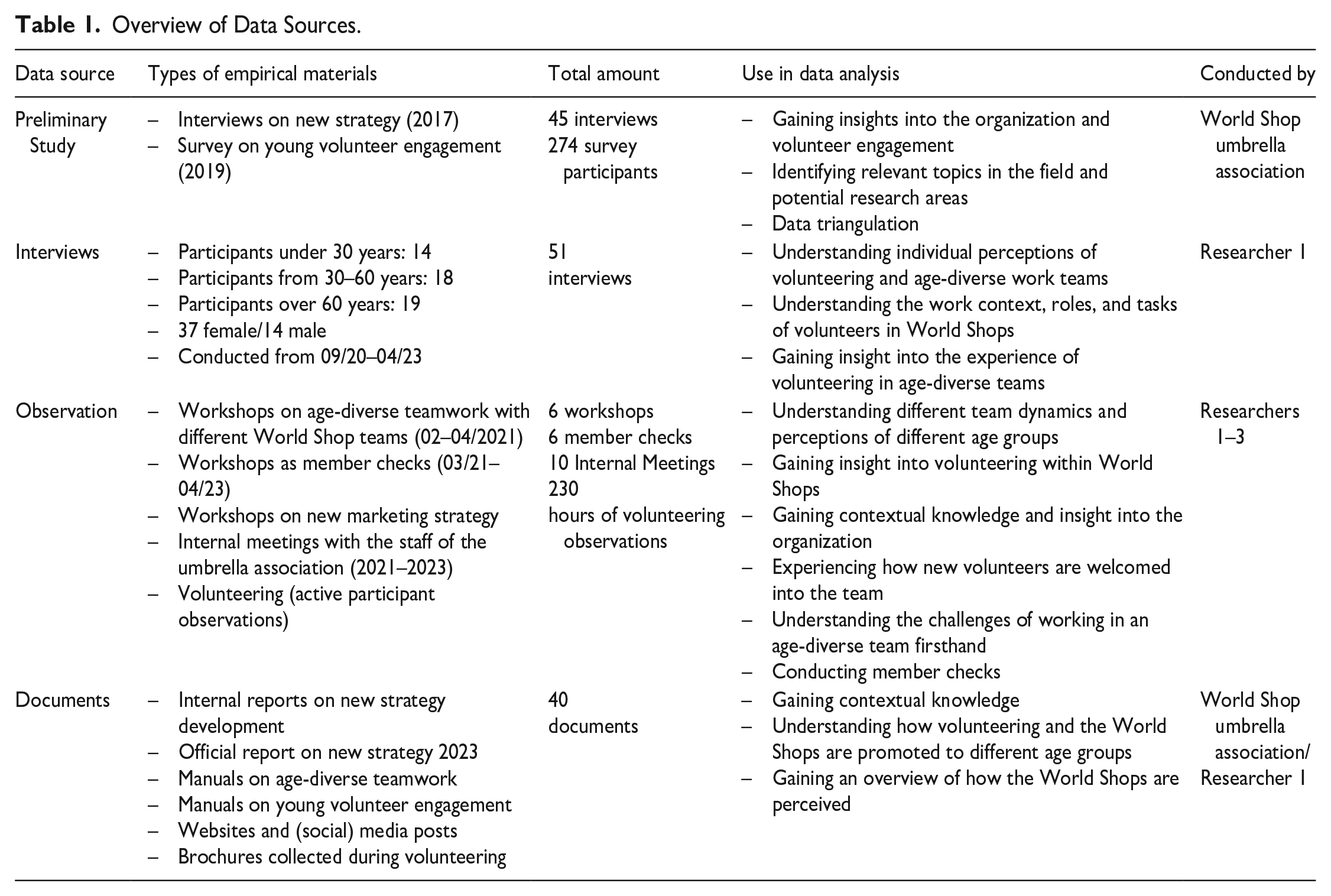
Observations
For a period of 2 years, one of the authors volunteered one afternoon per week for one World Shop to gain on-the-ground insights into the organization as well as contextual knowledge. She was not involved in any World Shop before the start of the study. The team at that World Shop consisted of nine volunteers who were all over 60 years old. The shop is very small, is entirely run by volunteers, and makes very little profit. The researcher was 27 years old when she entered the team, making this a particularly interesting setting. Although the team was not very age-diverse, it provided insights into how a younger person was welcomed into the team and how her ideas were received. Furthermore, we used the observations to gain insight into the work of World Shops. During the observation, one younger team member entered the team but only stayed for 8 months. After he left, we conducted an exit interview about his reasons for quitting (I42). The observations were documented in extensive field notes during and after every interaction. In addition, the participating author joined four workshops on age-diverse teamwork with several World Shop teams as a participant observer in 2020/21. Designed to train volunteers on age-diverse teamwork, each workshop had approximately 15 participants, was 2 to 3 hr long, and was held via Zoom. During these meetings, we took pictures and collected extensive field notes. The participants of the workshops were aware of our research interests. Our goal was to gain insights into the actual behavior of younger and older volunteers and their associated team dynamics.
Interviews
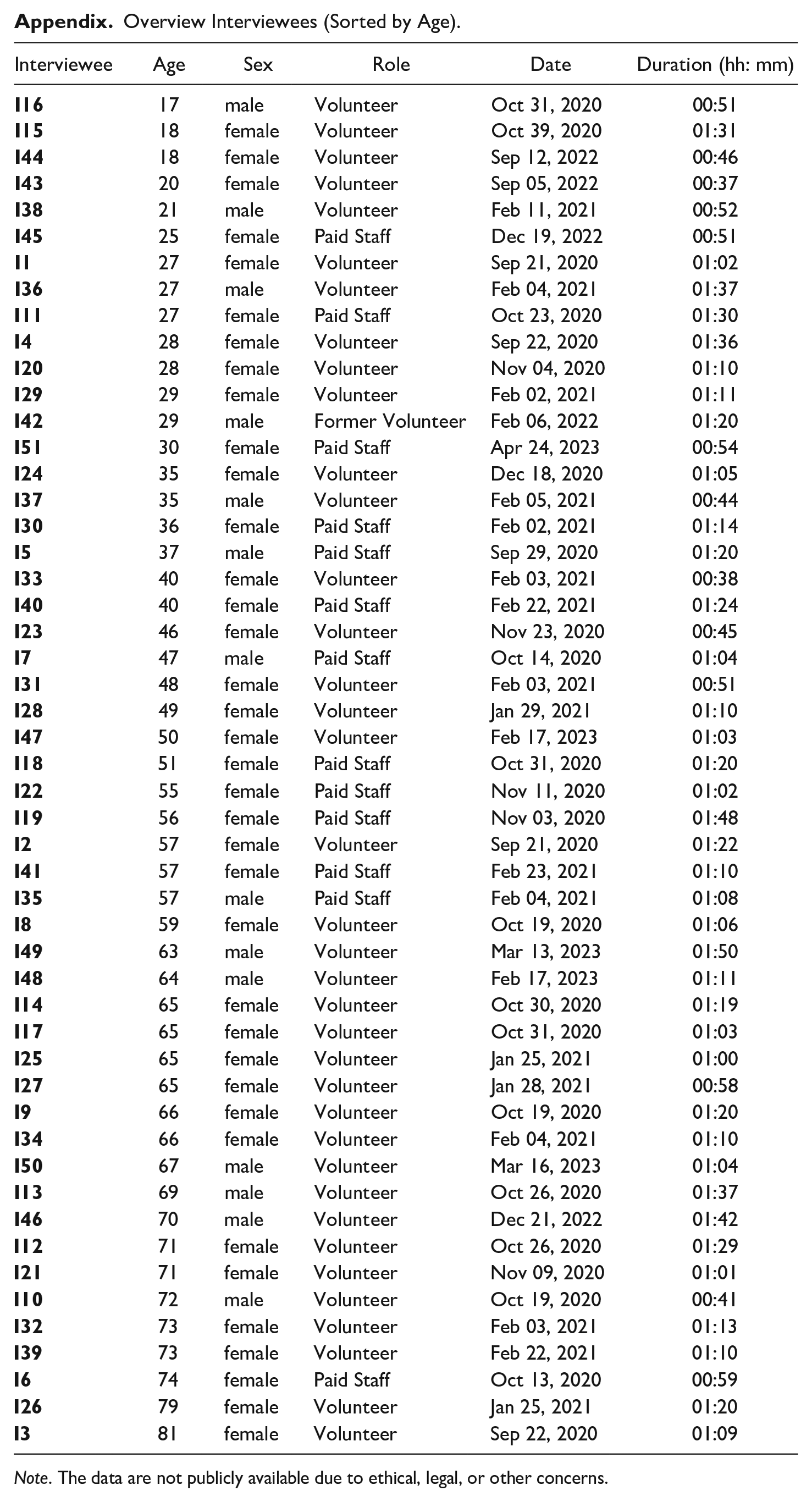
Over a period of 2.5 years (Sept 2020–April 2023), we conducted a total of 51 semi-structured interviews lasting an average of 70 min each. We interviewed 38 volunteers and 13 paid staff who ranged in age from 17 to 81 years (Appendix). We distributed the interviews throughout all age groups: We held 14 interviews with participants under 30 years old, 18 interviews with participants between 30 and 60 years old, and 19 interviews with participants aged older than 60 years. While we were able to conduct many interviews in person, 31 took place via video call. Each interview was audio-recorded and transcribed verbatim. All interviews were held in German to allow the participants to express their feelings, opinions, values, and emotions in their mother language. With the help of the umbrella association, we used theoretical sampling to choose informants who would bring information-rich insights: younger and older volunteers with different backgrounds and organizational tenure (Eisenhardt, 1989; Glaser & Strauss, 1967). Our interview guide included the following topic areas. We started with general demographic questions, followed by questions on the informants’ role, task, experience, and motivation to volunteer, and continued with questions on teamwork in the World Shops in general and on age-diverse teamwork in particular. We finished with questions about their perception of the World Shops. For each topic, we started with open-ended questions to let the participant guide the conversation (Gioia et al., 2012).
Documents
In addition to interviews, we used documents to get a better insight into the organization and triangulate our findings. We had access to confidential internal documents and published papers, such as manuals, annual reports, handbooks, guidelines, and presentations on volunteer work and beyond. The collected documents helped contextualize the information we gathered from interviews and observations. They also increased our understanding of institutional routines and practices as well as an overall better understanding of the context in which our phenomenon of interest occurred (Flick, 2018; Shah & Corley, 2006).
Data Analysis
Following Gioia’s grounded theory approach, we started analyzing the data shortly after the beginning of the data-collection process to create a dynamic and iterative process (Gioia et al., 2012; Lapan et al., 2011). We began analyzing our data with open coding and then continued using axial and selective coding with MaxQDA (Strauss & Corbin, 1998). During the data analysis and the reporting of the findings, we tried to represent the voices of the participants as prominently as possible. For that reason, we retained data in its original language during the coding and cross-coding processes. In addition, we discussed our findings with the umbrella association staff, who were then able to direct us to other interview partners who could give additional insight into emerging themes.
We used different types of triangulation to enhance the credibility of our findings (Patton, 2014). First, we collected multiple data sources. Second, we used multiple investigators to analyze the data. One of the three authors kept an outsider perspective and took on the role of devil’s advocate (Gioia et al., 2012). While all parts of the research have provided context for the findings, the interviews and observation form the main basis of the analysis in this paper.
Supplementarily to the data triangulation, we used two rounds of member checks to ensure the validity of our findings (Patton, 2014). In the first round of member checks, two of the authors presented our analysis in four workshops with (a) the staff and (b) the board of the umbrella association, (c) a group of volunteers, and (d) fair-trade consultants. During those meetings, we discussed the findings and asked for their opinion on our interpretations. We then incorporated the feedback and comments into our analysis and gathered additional data. To further enhance the transferability of our findings, we conducted a second round of member checks (Lincoln & Guba, 1985). Besides two more workshops with the umbrella association and volunteers, we held a 2-hr workshop with another large German NPO to check if our findings would be transferable to other volunteer teams operating in a different context. The other NPO stated that they observed similar barriers in their age-diverse volunteer teams.
We ended the data collection when theoretical saturation was reached (Glaser & Strauss, 1967). In this way, we were able to check the “accuracy, completeness, fairness, and perceived validity” (Patton, 2014, p. 668) of our data.
Data Structure
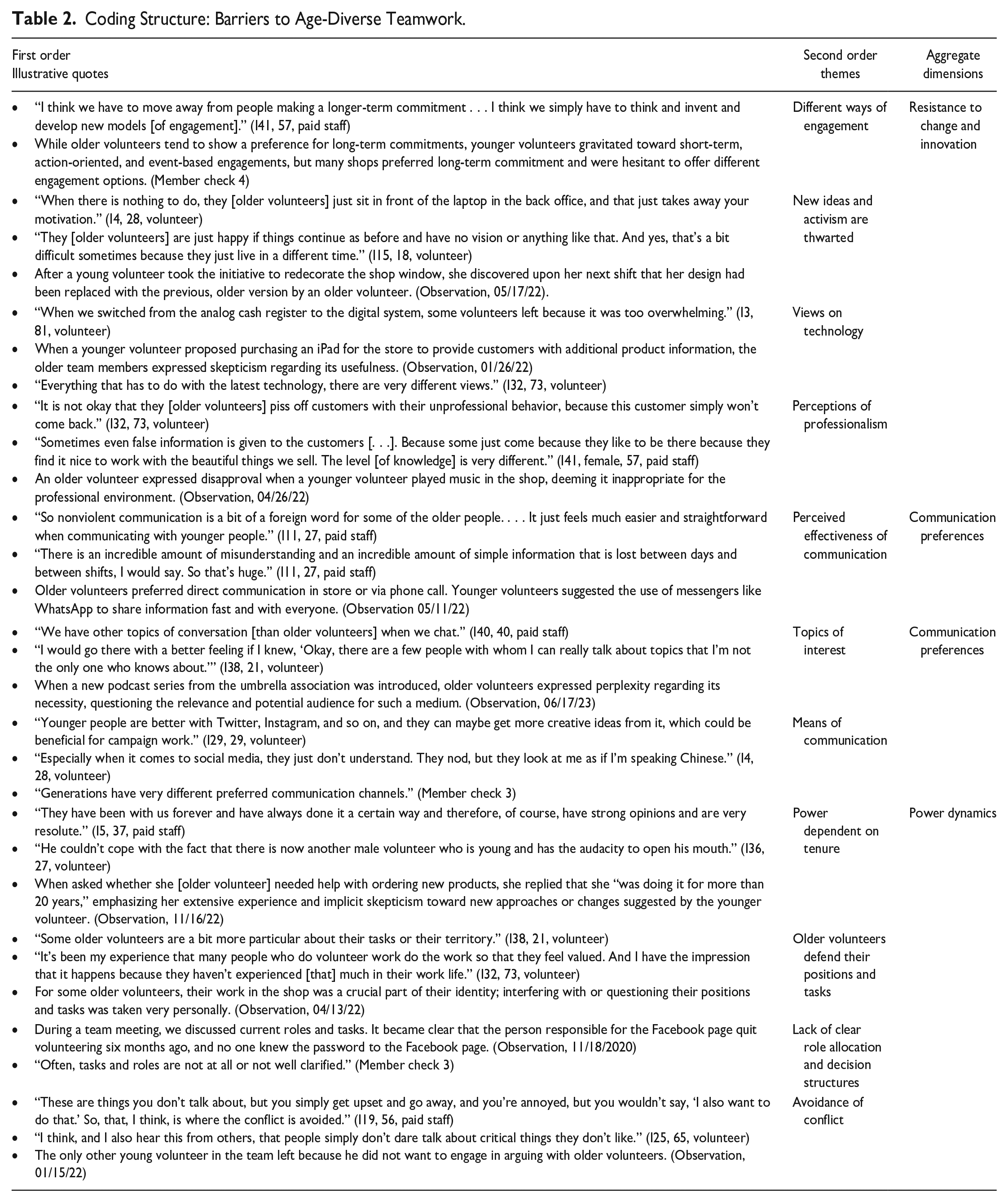
Based on our analysis, we identified three barriers to age-diverse teamwork: resistance to change and innovation, communication preferences, and power dynamics (Table 2).
Coding Structure: Barriers to Age-Diverse Teamwork.
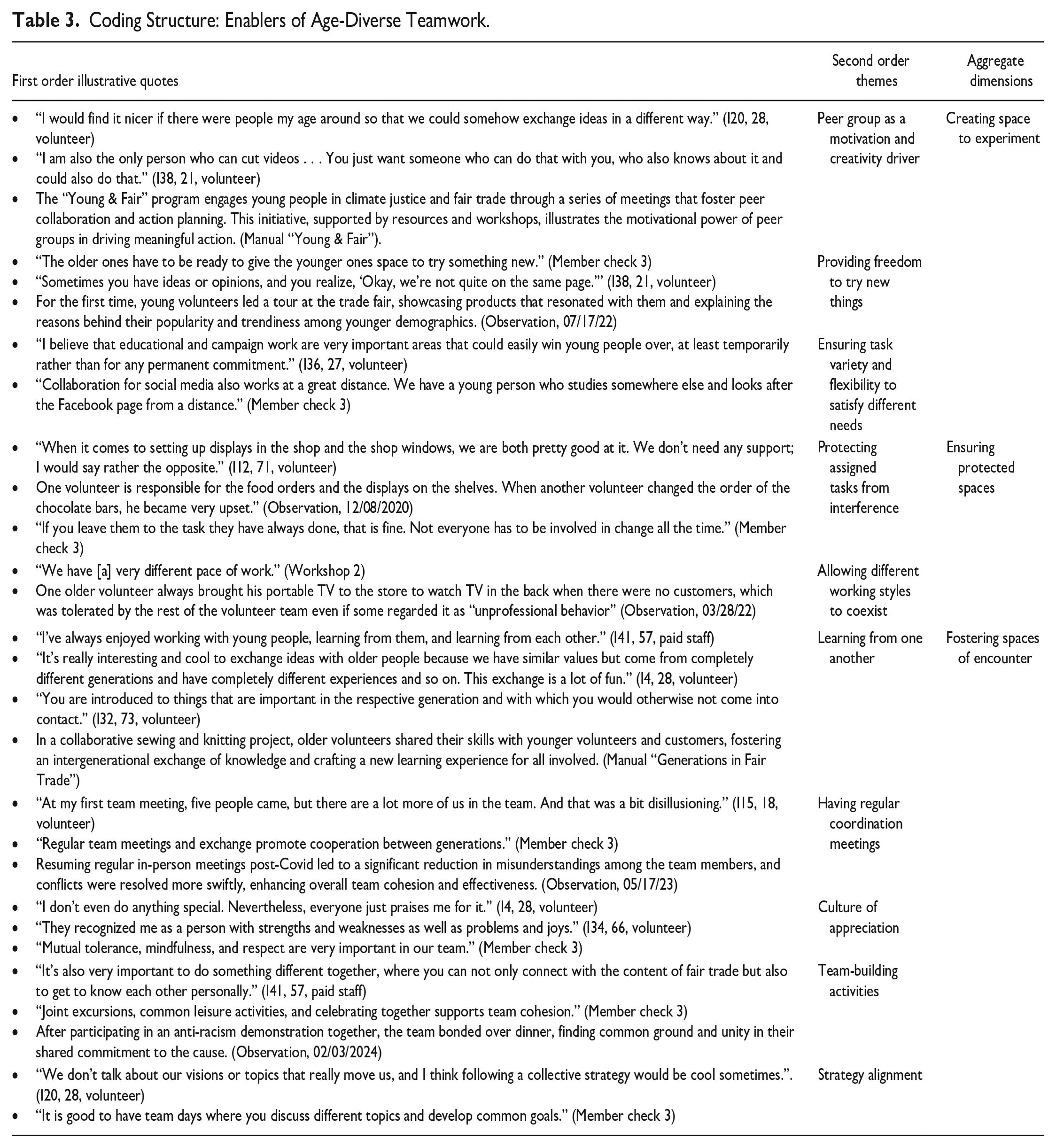
Furthermore, we identified three enablers of age-diverse teamwork: creating space to experiment, ensuring protected spaces, and fostering spaces of encounter (Table 3).
Coding Structure: Enablers of Age-Diverse Teamwork.
Findings
Based on our analysis, we developed a model (Figure 1) that elucidates barriers to age-diverse volunteer teamwork, including resistance to change and innovation, communication barriers, and power dynamics that manifest between the distinct age groups. These barriers can impede the creation of relational capital within volunteer teams, particularly between different age groups.
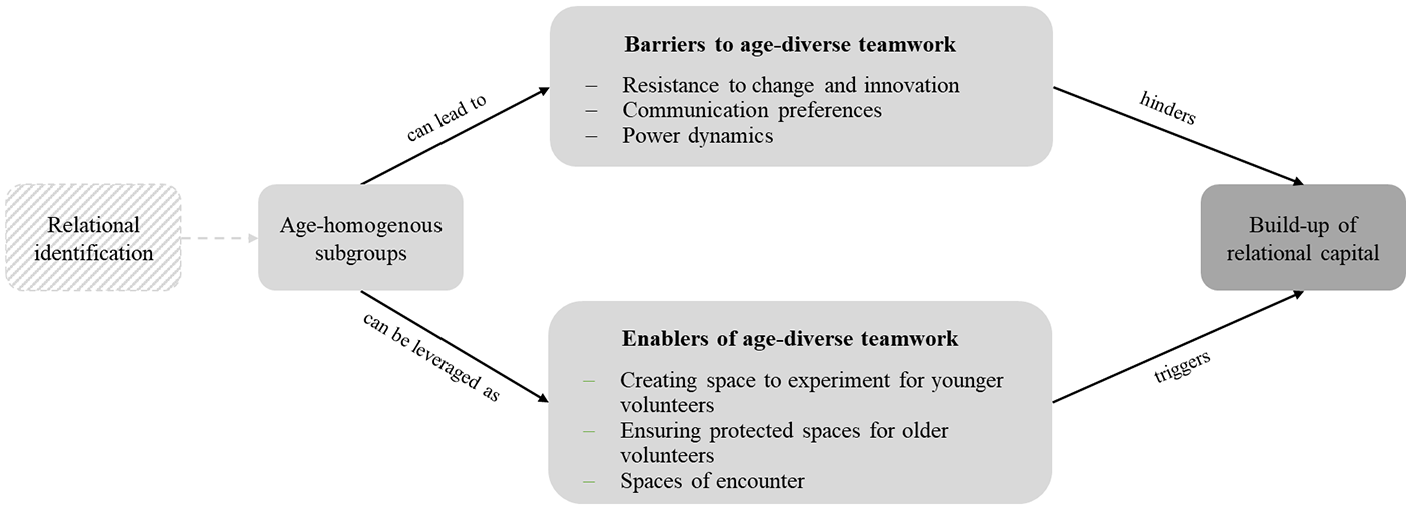
Model: Enablers and Barriers of Age-Diverse Volunteer Teamwork.
In contrast, age-diverse subgroups can also be leveraged strategically by NPOs to facilitate creating spaces to experiment for younger volunteers and ensuring protected spaces for older volunteers. Finally, the spaces of encounter are crucial in building relational capital between different age groups.
In essence, our findings underscore the importance of both facilitating spaces for age-specific interactions and encouraging interactions between different age groups as crucial factors in building relational capital. In the subsequent sections, we will delve into a more detailed exploration of the barriers and enablers of age-diverse teamwork, aiming to provide a comprehensive understanding of how various age groups can be effectively integrated into volunteer teams.
Perceived Resistance to Change and Innovation as a Barrier to Age-Diverse Teamwork
Resistance to change and innovation was one source of conflict that was heavily stressed by our younger interviewees. They perceived their older team members as clinging to old habits and not adapting to a changing environment, which, in their view, limited the potential for creating an impact in fair trade. This aggregate dimension consists of four second-order themes: different ways of engagement, new ideas and activism are thwarted, views on technology, and perceptions of professionalism.
First, different ways of engagement describes the distinction of engagement styles and underlying motivations we found. Our analysis shows how younger volunteers were more often engaged short term and based on distinct causes, whereas older volunteers engaged to pass time and socialize. For example, I31 (48, volunteer) elaborated:
Fair trade is not necessarily the biggest motivation for them [older volunteers]. They do it because they want to do something and be in contact with others and generally want to get involved with their time. But the main reason for their engagement is not fair trade. And I think that is the case with the younger ones who don’t just say, “Well, I have to kill time,” but really do it because they want to make a difference in this direction and invest their time in it.
These (perceived) motivational differences and diverging preferences in volunteer work caused tensions within the teams. Younger volunteers, in particular, expressed that they volunteer to actively promote fair trade, and they expressed dissatisfaction with working in shops with few or no customers. In contrast, older volunteers seemed to mind monotony less and enjoyed engaging in social interactions when they occurred. However, they observed that younger volunteers were committed on a short-term basis, leading to much higher fluctuation rates, an observation encapsulated by I6 (74, paid staff): “A permanent commitment is difficult with students and young people—getting a regular, lasting engagement—because they’re just so busy with other things.” Similarly, the following quote expresses that the World Shops have difficulty retaining younger volunteers: “With the younger ones, it is actually often the case that they somehow drop out anyway at a certain stage” (I18, 51, paid staff). We observed that young people often did not remain with the teams for multiple years as they changed their occupation and place of residence often (Observation 05/11/22). The turnover among younger volunteers led to frustration within the team and reduced the motivation to invest time in onboarding and training.
Second, new ideas and activism are thwarted refers to older volunteers being perceived as impeding innovative ideas and efforts by younger and middle-aged volunteers. I37 (35, volunteer) said, “You have no chance at all as a younger person to change or initiate something,” and pointed out:
I think that’s a shame. And if I were to end up in an environment where people are completely resistant to change and do everything the way they’ve always done it because that’s the way they’ve always done it, I would find that difficult at the very least.
Furthermore, I31 (48, volunteer) added, “The older generation . . . some slow you down, and the others don’t participate.” Another volunteer (I42, 29, former volunteer) agreed: “Besides getting actively slowed down when people say, ‘No, I don’t see why we should do that,’ you also get passively slowed down if you don’t get any appreciation for what you do.” Especially considering the acknowledged need for change in the organization, this reluctance led to frustration among younger volunteers, along with a feeling of powerlessness, thereby reducing their drive to proactively initiate new projects.
Thanks to their extensive experience and commitment, older volunteers often argued that trying specific ideas before unfortunately did not work out. Moreover, it was commonly expressed that older volunteers possess a deeper understanding of the customers, being more attuned to their preferences and needs. Interviewee 45 (25, volunteer) responded to this criticism: “A shop that is mainly run by older volunteers also attracts older customers, and that is totally sad and wasted potential.”
Third,
Instead of using social media as a marketing tool, older volunteers would rather write an article for the local newspaper. A younger generation of “digital natives” often found it hard to understand older volunteers’ views on technology and prejudices against digitization. (Workshop 3)
Another young volunteer (I44, 18, volunteer) observed that “there are only a few people in my age group, because some shops are so old fashioned they have no cash register system, or you cannot pay by card. That [is] just not very attractive to young people.”
In our observations, we noticed that older volunteers were willing to acquire new skills, like using a digital register (Observation 11/05/22). However, they also mentioned experiencing pressure and feeling outpaced by younger volunteers, who were quicker to adapt to new technologies (Workshop 3). One incident involved a younger volunteer (I45, 25, volunteer) engaging in an argument. The older volunteer, in frustration, told the younger, “Let me also do the checkout, and don’t always do it so quickly.” The younger volunteer did not understand the older volunteer’s frustration, arguing that it is also more customer-friendly when it is faster. This highlights a lack of empathy in explaining tasks patiently or accommodating the needs of the older generation. The middle-aged group (in our case, between 30 and 60 years old) often found themselves stuck in the middle, able to understand both positions due to their experiences with their own children and parents and acted as a buffer between the older and younger volunteers. As they were often paid staff members, their role was crucial in bridging both age groups: “I can understand both [older and younger volunteers], and I think it is important to understand their differences. However, I think both are very valuable to our team” (I18, 51, paid staff).
Fourth,
What we can’t accept at all is when a student sits behind the counter and knits, and then a customer comes in. Or just reading on the side, yes, we’ve also had things like that. And you really have to discuss it first because it’s unprofessional, absolutely unprofessional, and we want to be professional.
In contrast, other, often younger, volunteers perceived a lack of knowledge of fair trade as unprofessional, while time-passing behaviors—as long as they were proactively suspended when customers entered the store—were perceived as unproblematic.
In addition, interviewees pointed out differences in handling stressful situations professionally. I19 (56, paid staff) described this phenomenon:
The younger colleagues can deal with hectic situations or with stress better . . . or if something doesn’t work out so well, then it is sometimes very difficult for the older colleagues to cope with it, and they get nervous faster, and then mistakes happen.
Different Communication Preferences as a Barrier to Age-Diverse Teamwork
In our analysis, we identified three barriers related to communication preferences: perceived effectiveness of communication, means of communication, and topics of interest.
First, the Yes, communication is briefer with the elderly. So you reach a common result more quickly. When I talk to my colleague, who has also been there for such a long time, and we exchange ideas, we reach an agreement way faster. That is not the case with the younger ones. It works, but it all takes a little longer. And you also have to be very careful with some [younger volunteers]. (I39, 73, volunteer).
Accordingly, each generation perceived the communication behavior of their respective peers as the most effective. I38 (21, volunteer) described the situation in their store:
What doesn’t work so well now . . . if not all the people are at the store meetings, they still get the information via email, but some don’t have an email address, and others don’t read them. Or that everyone who is on store duty is also informed about X, Y, Z, and the changes and so on. It always takes a bit of time for new information to reach everyone.
Younger volunteers perceived information sharing overall as ineffective as they were used to quick and direct communication and universally available information.
Our data show that older volunteers invested considerably more time in the stores, actively engaging in personal information sharing. This intangible knowledge, however, remained largely inaccessible to team members who spent less time on site and implied building higher relational capital with one’s co-present peers. Consequently, this situation led to a sense of frustration among the team members who spent less time on site, as they felt disconnected.
Second, topics of interest varied between generations. We observed that it can be challenging to find common ground regarding topics that everyone is passionate about in very age-diverse teams (Observation 05/18/20). “Sometimes, I think it would be cool to address other topics as well,” a volunteer stated (I20, 29), adding:
I sometimes wonder how it would be if more young people were there, whether one could talk about something like that [women’s rights] more. I think it would be cool to bring in another point of view.
On a related note, during a member-check workshop, one volunteer pointed out that “the older volunteers have little interest in dealing with the background of fair trade” (Member Check 3).
Consequently, the different interest areas of the different age groups presented a challenge in creating team cohesion. During observations, we noted a difference in priorities and engagement between older and younger volunteers. Older volunteers cared more about what was happening in the shop and were very engaged in keeping the shops clean. In contrast, younger volunteers displayed a stronger interest in the mission of the World Shops and the impact of their work.
Third, means of communication refers to the preferred tools that different age groups use. Younger volunteers preferred quick and direct communication methods, using text messages and chats rather than phone or email. During the observations, one of the authors experienced endless email conversations, using the whole distribution list to discuss issues that concerned only a few. Similarly, a young volunteer (I38, 21) noted:
The communication would be somewhat faster or less complicated and that the people were easier to reach. You can call them or write an email, but sometimes I would like to write them a brief message, “Where is that and that?” but that does not work with all team members.
Communication between volunteers is especially crucial to the teams’ performance in volunteer teams with no team leader. We found that the lack of shared means of communication created annoyance and significantly hindered the build-up of relational capital.
Power Dynamics as a Barrier to Age-Diverse Teamwork
We identified four power dynamics as key barriers to age-diverse teamwork: power dependent on tenure, older volunteers defending their positions and tasks, lack of clear role allocation and decision structures, and avoidance of conflict.
First, power dependent on tenure describes the attribution of power depending on the time a person has spent volunteering in a World Shop. During observations, we noticed that, as information was not formalized, longer organizational tenure as a volunteer equaled an advantage based on knowledge and relational capital. This included essential information, such as passwords, delivering processes, or personal contacts, which were not easily shared with new, younger volunteers. One volunteer (I32, 73) said that volunteers “of the same age or only slightly younger than me sometimes have a kind of ‘I’ve been doing my job for ten years, you can’t really tell me anything new’ attitude.” Most volunteer teams lacked a hierarchical structure or processes that would have kept older volunteers from centralizing power. Younger volunteers thus expressed difficulty getting information and assuming responsibility independently—aspects that most of them cited as their main motivation for volunteering.
Second, older volunteers defend their positions and tasks refers to the psychological ownership older volunteers demonstrated regarding their assigned tasks. One popular example was decorating the shops and the shop windows. When our observant (researcher 1) suggested improving how products were displayed in the shop windows, she was advised to carefully ask the older woman who usually set them up whether she could help her with that task. The older volunteer indicated that her displays were carefully thought out and that changing the display was not appreciated (Observation, 10/21/2020). A younger volunteer (I42, 29) critically reflected on this issue:
The youngsters may have to shake off their arrogance a bit about being able to do everything better now because new things are always better than old stuff anyway. And at the same time, the old people have to get rid of their arrogance, thinking they know everything better because of their life experience, and the young people are just too inexperienced and simply don’t know how things work.
During a member check workshop, one volunteer confirmed our findings as follows: “Older volunteers often don’t accept help from younger ones even if the latter know better” (Member Check 2). This defensive behavior by older volunteers who clung to certain tasks made it almost impossible for younger ones to participate in those activities. In addition, this phenomenon seemed to intensify when the younger volunteer brought special knowledge or new ideas to the task in question and thus potentially threatened the power position of the older volunteer. However, we have also observed that younger volunteers took over roles (e.g., social media) and that, after they left the team, no one was able to do their job (Observation 15/11/20). Consequently, some of the behavior of not wanting to lose control over specific tasks might be learned over time due to previous negative experiences with younger volunteers leaving, taking the knowledge required to fulfill their role with them.
Third, the lack of clear role allocation and decision structures represents our observation that, especially in World Shops with no paid staff and a democratic, grassroots vision, the assignment and distribution of tasks remained unclear. One volunteer described this situation in the following way: Our group is absolutely grassroots-democratic, to the point where it is exhausting. . . . There are no real decision structures. The decision-making structure is “Let’s ask [name] because he is there the longest.” (I41, 29, former volunteer)
There was often no team leader or individual with a coordinating role to manage the team and ultimately be responsible for decisions. One volunteer (I23, 46) from a World Shop entirely run by volunteers stated, “In the World Shop, with its various groups and structures, our internal coordination could be better.” This lack of clear hierarchical structures allowed older volunteers to concentrate responsibility, information, and power within their group.
Fourth, avoidance of conflict describes the desire for unity and harmony but also a culture that did not allow volunteers to stand up for their needs. In our analysis, we observed that young volunteers did not speak up to the older volunteers if they did not agree with their behavior (Member Check 2). I19 (56, paid staff) described a situation that exemplifies this dynamic:
One colleague who was older always wanted to work the cash register . . . She stayed behind the cash register, and she didn’t let the younger one[s] do it . . . I happened to be there that Saturday. And she [the younger volunteer] said to me, “Why won’t she let me touch the cash register? It’s like she’s glued there. You’ve got to be kidding!” These are things one does not talk about but simply gets upset about and then goes away and is annoyed but does not say, “I also want to do that.” So, I think that is where the conflict is then also avoided. But you could tell that she [the younger volunteer] was annoyed. And she will then probably choose people who are a bit more flexible or seem a bit younger.
The lack of clear leadership roles prevented this issue from being escalated to a responsible party. Avoiding conflict in such situations can perpetuate undesirable habits and behaviors in all age groups, potentially leading to volunteer turnover in the worst-case scenario. At the same time, older volunteers were reluctant to openly criticize younger ones (even in cases of apparent wrongdoing) as they were all too aware of the importance of attracting and retaining the next generation of volunteers.
Enablers of Age-Diverse Teamwork
Besides potential sources of conflict that prevented productive collaboration in the age-diverse teams in our case, our analysis also pointed to enablers that fostered trustful relationships between younger and older volunteers. Three dimensions of enablers of age-diverse volunteer teamwork emerged from our analysis: creating space to experiment, ensuring protected spaces, and fostering spaces of encounter.
Creating Space to Experiment for Younger Volunteers
We showed above how younger volunteers criticized older volunteers for defending their positions and tasks, not letting them in, and thwarting their ideas and motivation. To avoid and counteract those mechanisms, we found that it was perceived as helpful to create spaces to experiment for younger volunteers—free from the influence of others. Furthermore, we found that the middle-aged group often helped create and protect those spaces.
First,
Second, providing freedom to try new things describes young volunteers’ need to have space for their ideas, the freedom to experiment, and the opportunity to fail. I32 (73, volunteer) addressed the dynamics that make this freedom challenging:
Well, I really believe that many, many older people say that they would like to work with younger colleagues, but when they do . . . they want to instruct the younger ones. [The older person] has been doing this for ten years, and when a younger person has a problem and says, “But I can do it too,” or, “I know better” . . . they say, “No, no, I’ve always done that.” Then [the young person] is allowed to participate a little bit, but not really with full responsibility. You can only do that if you are a bit older. And that can’t work in my eyes.
This statement shows that some older volunteers were aware of the needs of younger volunteers and critically reflected on their peers’ behavior. During the workshops, we observed that young volunteers tended to be more motivated if they were given their own tasks, responsibilities, and room to experiment early on (Workshop 1). Furthermore, they appreciated building joint relational capital with the older volunteers. One young volunteer recounted one such instance that occurred when decorating the shop window with an older volunteer: “She showed me how she does it first, and then she just let me do my thing. It was nice to learn from her, but also that she appreciated my own ideas” (I44, 18, volunteer).
Third, ensuring task variety and flexibility to satisfy different needs refers to the creation of various engagement opportunities. The following statements indicate the variety of preferences. I1 (27, volunteer) expressed the following:
To work regularly and to have fixed shifts gives me structure . . . I am engaged in the sales group because it is clearly defined. With all other projects . . . I sometimes have the feeling that it could get too excessive and less easy to plan than my regular shifts.
In contrast, I36 (27, volunteer) argued, “I believe that educational and campaign work are very important areas that could easily win young people over, at least temporarily rather than for any permanent commitment.” While the first student mentioned that she enjoyed the regularity of volunteering in the store, other interviewees noted that they preferred more flexible, short-term options. This is an example of how a certain variety of options can attract more younger volunteers. On the contrary, older and middle-aged volunteers preferred regular shifts.
Ensuring Protected Spaces for Older Volunteers
In addition to providing spaces for younger volunteers to experiment, our findings also underscore the importance of ensuring protected spaces, especially for older volunteers, to foster age-diverse teamwork.
First, participants noted the importance of protecting assigned tasks from interference. During the interviews, we found that many older volunteers elaborated in great detail on “their” tasks, which they have had for a long time, and expressed resistance to sharing those tasks. I11 (27, staff member) described one such situation:
So there’s a deco-team [volunteers who decorate and arrange displays in the store], and then some of the other volunteers think, “Oh, but it would be nicer if that other product was there.” Then they move it or hang something else. So it is really important that others don’t interfere with their assigned task.
Creating spaces in which older volunteers could freely express themselves met their need to work without interference. In our case, older volunteers who experienced “safe spaces” were proud and committed to their respective tasks.
Second, allowing for the co-existence of different working styles refers to tolerance of diverse working behaviors. During observations, we encountered an older volunteer who always brought his portable TV to the store to watch in the back office when there were no customers. The other team members accepted that, as he covered two-afternoon shifts per week and thus represented an indispensable resource for the respective World Shop. Similarly, when discussing another older volunteer who always issued gift vouchers incorrectly, a team member said, “We simply need to accept such limitations. We need to always continue to explain to her how it works” (Observation, 04/14/2021). Another volunteer reinforced how vital such acceptance is:
It is really important that you recognize and assess the strengths and weaknesses of the team members. In our team, everyone can get involved as they wish and can contribute as much as they want. This openness and how you accept new people and new ideas is very important, in my opinion. (I45, 19, volunteer)
Fostering Spaces of Encounter for All Age Groups
Our empirical data suggest that, besides creating separate spaces for different age groups, it is also vital to foster overlap in spaces of encounter, as doing so enables reciprocal learning processes and thus enhances mutual understanding.
First, learning from each other refers to the unique opportunity of learning from different age groups in volunteer teams because of the extreme age range (from 17 to 81 years in our study). Young, middle-aged, and older volunteers all acknowledged this opportunity. One example comes from I2 (57, volunteer):
I find it really exciting when there are significantly younger people because then I notice how old I am and how younger people approach things. We are constantly learning from each other. I totally appreciate that. For example, in the age of smartphones, you always have someone you can ask how things work.
Through private conversations during their shifts, volunteers were able to get to know their colleagues and the needs of the different age groups firsthand. I11 (27, paid staff) recounted this dynamic:
So what I find positive about working with older people is simply the experience. It’s just totally enriching and totally exciting for me. And I think to have the different perspectives is really good. Also, because as a young person, I really don’t have a feeling for the older target group . . . and it is hard to put yourself in their shoes.
Second, we found that
There has to be a bit of a coffee party before and after. That’s why they come. But it is already a lot that I set the agenda, and then we discuss certain points, yes. So it’s not just we meet and chat, but there is always an agenda, and we go through it, even if it’s sometimes exhausting. (I40, 40, paid staff)
We found that having such a clear agenda and connecting team meetings with social events, such as eating together or having coffee, worked well to incentivize volunteers to show up. I11 (27, paid staff) mentioned a management team as a different option to initiate regular team meetings but also to communicate information to everyone:
We now have a small team that is like the management team who organizes regular meetings . . . And they have now divided themselves up in such a way that there is a responsible person every day who knows everything from this higher-level team and who then passes on all the new information to each individual volunteer who works in the shop.
Third, our analysis indicates that a culture of appreciation is crucial for building strong relations between the members of age-diverse volunteer teams. Many participants stressed that they felt welcomed and appreciated, which triggered a strong feeling of belonging to the team. They highlighted that the feeling of being comfortable with their volunteer team members was key to their intention to remain with the organization: “I have the feeling that they [the team members] are always very appreciative and friendly and, when I say something, that they accept it. That is always a great motivation” (I26, 79, volunteer). In reference to seeing the value of the different age cohorts, volunteer I33 (40) stated, “I wish that we would do this generation seminar, which highlights the differences between the generations, on a regular basis because you simply forget that in your day-to-day work.” In addition to showing a desire to develop more relational ties, this latter quote also highlights the importance of regular training and diversity management programs on the topic.
Fourth, the participants valued
It would be nice if we could see each other more often as a team. We normally have a team event in summer and winter. All of that is canceled this year, and I think we somewhat lost our team spirit. In general, I would like to have more team meetings and educational events.
In addition, volunteers of all age groups enjoyed participating in joint training and workshops, which allowed them to create joint experiences, exchange their views, and get to know each other beyond the in-store exchanges (Workshop 6). After all the workshops on intergenerational teamwork with different volunteer teams, the feedback was always very positive. The composition of the generations in the world shop is often taken for granted and little reflected on. At the same time, the teams in the world shops are concerned with conflicts between generations and attracting young volunteers. Dealing with the topic of generations can contribute to future-oriented and successful teams. But it has to be “discovered” first. Our workshops showed great potential for improving intergenerational collaboration. (Manual “Generations in Fair Trade”)
Finally, strategy alignment describes the importance of a shared strategy for the different “spaces.” With very diverse teams and few formalized structures, there is always a risk that people may head in different directions or pursue different goals. One paid staff (I35, 57) explained, for example, that it is very important that the deco team and the team that orders new products work closely together and decide on a shared theme so that “things are then ordered accordingly and displayed in the shop window.” During a workshop, one volunteer relayed how their teamwork improved by developing shared norms and goals and regularly checking whether they had been met. In addition, they would print out the sales figures each month and compare them to the previous year to track their performance. When asked how teamwork could be improved, that participant answered that she wished that they had a “common strategy” (I20, 28, volunteer).
Discussion
Barriers to and Enablers of Teamwork in Age-Diverse Volunteer Teams
Our analysis advances prior research on volunteer coordination (Studer, 2016; Studer & von Schnurbein, 2012) and teamwork by offering a sorely needed age-diversity perspective that elucidates enablers of and barriers to the build-up of relational capital in age-diverse teams. In doing so, our study adds a novel perspective to the organizational behavior of volunteers and promotes an understanding of generational differences in volunteering beyond the motivations and benefits of volunteering (Haski-Leventhal et al., 2016; Morawski et al., 2022).
We show how age-homogeneous subgroups may suffer from a lack of awareness, mutual trust, and respect toward each other as a consequence of power dynamics, different communication preferences, and different approaches to change and innovation. Furthermore, we highlight the emergence of relational identification among older and younger volunteers based on physical age (Sluss & Ashforth, 2007). Volunteers demonstrated a depersonalized understanding of their own and other age groups with specific expectations, behaviors, and traits (Sluss et al., 2012). Based on this identification, our analysis illustrates how resistance to change and innovation, communication preferences, and power dynamics acted as barriers to the build-up of joint relational capital. In addition, we explain how the creation of spaces (spaces to experiment, protected spaces, and spaces of encounter) allowed for the exchange, interaction, and relationship building needed in volunteer teams while also offering protection and “elbow room” for volunteers to follow their individual interests and inclinations. Our study thereby responds to calls for qualitative research on how age-related dynamics produce conflict within organizations (Lyons & Kuron, 2014; Urick et al., 2017) and elucidates how the creation of spaces to experiment, protected spaces, and spaces of encounter can mitigate such conflict.
Based on this relational identification, our findings revealed an uncommon dynamic revolving around organizational change. Specifically, we were surprised by the paradoxical resistance that younger volunteers experienced from older volunteers. Not only are values such as “changing global trade,” tolerance, and inclusion key parts of the World Shops’ mission, but the existing literature on diversity largely highlights the exclusion and marginalization of older people, not younger ones (Schneid et al., 2016). Research on ageism argues that society may treat older people “as second-class citizens with nothing to offer” (Nelson, 2005, p. 209), which would imply younger volunteers dominating older ones with, e.g., their digital expertise. However, in our case, young, well-educated, and highly motivated volunteers were marginalized and thwarted by a larger and more powerful group of older volunteers. This was further exacerbated by the younger volunteers also exhibiting easy frustration with a lack of understanding for and limited willingness to learn from their older peers. Our study draws a picture of older volunteers who secure and defend their informal roles and power based on their relational capital. We find this dynamic to be fostered by the undefined, informal structures and processes in the individual World Shops, the nature of volunteering itself, the permittance of extensive tenure beyond retirement age, and the limited role transition and development of younger volunteers. We believe this specific power dynamic in volunteer work, which stands counter to much of the organizational research on change, merits further research attention.
Creating Spaces to Foster Relational Capital in Volunteer Work
Our analysis highlights the “dark side” of volunteer work, pointing to tensions and conflicts between age groups and thus contradicting existing research, which portrays a mostly positive picture of how volunteers benefit from their activities (Van Willigen, 2000). In addition, our analysis points to “diffuse power structures” in volunteer work (Pearce, 1993), which are characterized by a lack of clear allocation of tasks and responsibilities and often neglect selection and promotion processes. Resultingly, leadership positions were predominantly occupied by senior volunteers, meaning they were determined by tenure and relational capital rather than the possession of specific skills. These individuals held intangible knowledge and power based on relationships but were often hesitant to readily share information with newer volunteers.
In our study, we reveal a noteworthy phenomenon wherein new and young volunteers encountered resistance to their ideas upon joining the team. Despite the majority of volunteers expressing a desire to recruit young members to share the workload and facilitate generational change, they encountered relational identification based on age and challenges in effectively integrating and retaining them. Further, older volunteers accumulated significant relational capital throughout their tenure (Blatt, 2009). This was largely because, within volunteering teams, personal power and resourcefulness are not confined to formalized structures or roles; instead, they are derived from informal power stemming from relationships with peers and access to informal knowledge (Byun et al., 2018). As a result, older volunteers consolidated and maintained their influence over younger volunteers, irrespective of the latter’s personal resourcefulness. Thus, our analysis underscores the importance of creating spaces of encounter to foster meaningful interactions among volunteers of various age groups, including younger, middle-aged, and older individuals, to enhance the overall quality of relationships. These spaces of encounter prove to be equally vital alongside the establishment of independent spaces for younger and older volunteers as well as the chance to develop a joint identification beyond age groups.
These spaces of encounter foster the development of relational capital, i.e., the mutual trust, respect, and friendship that emerges through close interaction. When volunteers from diverse age groups interact in such spaces on a regular basis, they are provided with opportunities to overcome separating relational identification based on easily observable criteria—such as age—and exchange ideas, share experiences, learn from one another, and build trust, understanding, and a mutual identification (Blatt, 2009). Creating spaces to experiment offered younger volunteers the opportunity to take risks and learn from mistakes. Encouraging them to explore and innovate within this environment allows them to engage in “trial and error” experiences, which may even encourage them to be more open to learning from more experienced volunteers. Concurrently, the simultaneous creation of protected spaces for older volunteers ensures that their expertise is honored and preserved, allowing them to continue their work without disruptions from younger volunteers. This respect for their experience further contributes to the development of relational capital, as it represents an acknowledgment and appreciation for their contributions to the organization.
Overall, the combination of spaces for encounter, experimentation, and protected spaces serves as a powerful framework for building and retaining relational capital within volunteer teams, particularly age-diverse ones.
Implications for Managerial Practice
As previous research on age diversity and intergenerational teams has mostly focused on corporate settings (Joshi et al., 2010; Kunze et al., 2013; Kunze et al., 2011; Lyons & Kuron, 2014), our findings offer specific implications for coordinators of age-diverse volunteer teams (Studer, 2016; Studer & von Schnurbein, 2012).
To make room for your younger volunteers to find their roles in volunteering teams, we propose to create spaces to experiment through three steps: growing, freeing, and developing. First, we suggest growing the younger peer group by recruiting and retaining younger volunteers. For such recruiting, we recommend embracing digital campaign work to tap into online activism, offering social gap years, and establishing internship opportunities. In terms of retaining, we recommend facilitating interregional networking to enable knowledge transfer and ease volunteering continuity when geographically relocating. To further retain them, we suggest freeing them in their task exploration and choice. Increasing flexibility in volunteering scope regarding tasks and time investment would increase the attractivity of such efforts for younger people. Finally, developing their skills and profile by offering training programs and certification opportunities to the specific interests of young participants, enhancing their engagement and experience.
Second, we emphasize the importance of ensuring protected spaces for the elderly through assigning, training, and socializing. Assigning clear roles and offering specific training opportunities within the organization is of paramount importance to support their engagement. Especially world shops with permanent middle-aged (paid) employees and more established hierarchical structures suggested the benefits of such an approach. In addition, opportunities for socializing and interactions outside of their volunteering activities should be facilitated to offer a supportive social environment and prevent potential isolation. Bringing all three aspects together by offering hands-on workshops and individualized assistance can help older volunteers become proficient in using digital tools, social media platforms, and other technology-related resources that support bridging the gap with younger volunteers.
Finally, to build up relational capital, fostering spaces of encounter is crucial for diverse volunteer teams. We suggest two main steps for that: addressing and promoting. Our findings suggest that proactively addressing the issue by raising awareness of age diversity and consequent differences through making it part of the strategy, transparent monitoring, diversity training, volunteer feedback sessions, and exit interviews can create such spaces. In addition, promoting interaction between different age groups through relationship-building, creating a culture of appreciation, and mentoring across generations can help overcome issues related to an age-diverse workforce and promote a positive view of diversity.
Conclusion and Future Research
Our empirical study of age diversity in volunteer teams identified several barriers to and enablers of age-diverse teamwork. Drawing on extensive observational and interview data in German World Shops, our analysis elucidates how organizations use “spaces” to enable collaboration and distance at the same time. Although our findings are based on a revealing case, we argue that, with due caution, they can be used to make sense of age diversity in other volunteer settings as well. Nevertheless, our study also has some limitations that should be considered.
The young age of the interviewer might have influenced the data-collection process, as the interviewer’s age-related perceptions and experiences could have impacted participants’ responses and interpretations. To mitigate this bias, we used one researcher for an outsider perspective, conducted member checks to validate the findings with participants, and juxtaposed them with our other data sources. Future research might consider using behavioral data to enrich our insights further.
In our research setting, it is worth noting that there was a higher representation of women among the participants. While our study did not specifically explore gender differences or their interactions with age diversity, this could provide an intriguing avenue for future research. In addition, in our settings, there were more older volunteers than younger ones, potentially overlooking dynamics present in contexts with a different age balance. We encourage future research to contrast our findings with those of the respective cases.
Footnotes
Appendix
Overview Interviewees (Sorted by Age).
| Interviewee | Age | Sex | Role | Date | Duration (hh: mm) |
|---|---|---|---|---|---|
|
|
17 | male | Volunteer | Oct 31, 2020 | 00:51 |
|
|
18 | female | Volunteer | Oct 39, 2020 | 01:31 |
|
|
18 | female | Volunteer | Sep 12, 2022 | 00:46 |
|
|
20 | female | Volunteer | Sep 05, 2022 | 00:37 |
|
|
21 | male | Volunteer | Feb 11, 2021 | 00:52 |
|
|
25 | female | Paid Staff | Dec 19, 2022 | 00:51 |
|
|
27 | female | Volunteer | Sep 21, 2020 | 01:02 |
|
|
27 | male | Volunteer | Feb 04, 2021 | 01:37 |
|
|
27 | female | Paid Staff | Oct 23, 2020 | 01:30 |
|
|
28 | female | Volunteer | Sep 22, 2020 | 01:36 |
|
|
28 | female | Volunteer | Nov 04, 2020 | 01:10 |
|
|
29 | female | Volunteer | Feb 02, 2021 | 01:11 |
|
|
29 | male | Former Volunteer | Feb 06, 2022 | 01:20 |
|
|
30 | female | Paid Staff | Apr 24, 2023 | 00:54 |
|
|
35 | female | Volunteer | Dec 18, 2020 | 01:05 |
|
|
35 | male | Volunteer | Feb 05, 2021 | 00:44 |
|
|
36 | female | Paid Staff | Feb 02, 2021 | 01:14 |
|
|
37 | male | Paid Staff | Sep 29, 2020 | 01:20 |
|
|
40 | female | Volunteer | Feb 03, 2021 | 00:38 |
|
|
40 | female | Paid Staff | Feb 22, 2021 | 01:24 |
|
|
46 | female | Volunteer | Nov 23, 2020 | 00:45 |
|
|
47 | male | Paid Staff | Oct 14, 2020 | 01:04 |
|
|
48 | female | Volunteer | Feb 03, 2021 | 00:51 |
|
|
49 | female | Volunteer | Jan 29, 2021 | 01:10 |
|
|
50 | female | Volunteer | Feb 17, 2023 | 01:03 |
|
|
51 | female | Paid Staff | Oct 31, 2020 | 01:20 |
|
|
55 | female | Paid Staff | Nov 11, 2020 | 01:02 |
|
|
56 | female | Paid Staff | Nov 03, 2020 | 01:48 |
|
|
57 | female | Volunteer | Sep 21, 2020 | 01:22 |
|
|
57 | female | Paid Staff | Feb 23, 2021 | 01:10 |
|
|
57 | male | Paid Staff | Feb 04, 2021 | 01:08 |
|
|
59 | female | Volunteer | Oct 19, 2020 | 01:06 |
|
|
63 | male | Volunteer | Mar 13, 2023 | 01:50 |
|
|
64 | male | Volunteer | Feb 17, 2023 | 01:11 |
|
|
65 | female | Volunteer | Oct 30, 2020 | 01:19 |
|
|
65 | female | Volunteer | Oct 31, 2020 | 01:03 |
|
|
65 | female | Volunteer | Jan 25, 2021 | 01:00 |
|
|
65 | female | Volunteer | Jan 28, 2021 | 00:58 |
|
|
66 | female | Volunteer | Oct 19, 2020 | 01:20 |
|
|
66 | female | Volunteer | Feb 04, 2021 | 01:10 |
|
|
67 | male | Volunteer | Mar 16, 2023 | 01:04 |
|
|
69 | male | Volunteer | Oct 26, 2020 | 01:37 |
|
|
70 | male | Volunteer | Dec 21, 2022 | 01:42 |
|
|
71 | female | Volunteer | Oct 26, 2020 | 01:29 |
|
|
71 | female | Volunteer | Nov 09, 2020 | 01:01 |
|
|
72 | male | Volunteer | Oct 19, 2020 | 00:41 |
|
|
73 | female | Volunteer | Feb 03, 2021 | 01:13 |
|
|
73 | female | Volunteer | Feb 22, 2021 | 01:10 |
|
|
74 | female | Paid Staff | Oct 13, 2020 | 00:59 |
|
|
79 | female | Volunteer | Jan 25, 2021 | 01:20 |
|
|
81 | female | Volunteer | Sep 22, 2020 | 01:09 |
Declaration of Conflicting Interests
The author(s) declared no potential conflicts of interest with respect to the research, authorship, and/or publication of this article.
Funding
The author(s) received no financial support for the research, authorship, and/or publication of this article.
