




Abstract
Rational number proficiency is predictive of later mathematics achievement, especially for rigorous mathematics courses, such as Algebra I. Students with learning disabilities (LD) in mathematics struggle to make adequate progress on rational number concepts and skills that lay the foundation for successfully completing secondary mathematics courses. However, recent research has demonstrated that utilizing effective instructional design, such as the use of a number line with systematic and explicit instruction, can result in academic progress for students with LD in mathematics. This article presents teachers with a four-step teaching sequence utilizing the number line and effective strategies for teaching students with LD in mathematics to introduce fraction-to-decimal relationships in upper elementary, a prerequisite for middle school mathematics.
A growing body of research suggests that strong rational number understanding is a critical indicator of students’ mathematical achievement (Jordan et al., 2017; Siegler et al., 2012). Rational numbers are a group of numbers that include whole numbers and integers and can be expressed as the quotient of two integers,
The acquisition of rational number understanding begins as early as second grade when students are introduced to fractions, and it builds throughout upper elementary and middle school, increasing in level of difficulty as students are required to engage in more complex applications of rational number knowledge (Rojo et al., 2022). Yet, one of the largest hurdles to rational number learning is that students struggle to adequately transition from whole number reasoning to rational number reasoning (Jordan et al., 2013; Van Hoof et al., 2017). This phenomenon, referred to as the whole number bias, may have significant implications for the acquisition of mathematical skills, particularly among students with learning disabilities (LD) in mathematics (Ni & Zhou, 2005). Students may struggle with the following topics due to the whole number bias (see Table 1): (a) magnitude (e.g., students may only consider the numerator or denominator within a fraction); (b) arithmetic (e.g., students may view each operand in a fraction arithmetic problem as two separate whole numbers, resulting in misapplication of operations to the two numerators and also the two denominators); (c) density (e.g., students may fail to understand that an infinite number of numbers exist between any two decimals or two fractions); and (d) translation (e.g., students may not understand fractions and decimals as alternative notations; Rojo et al., 2022; Tian & Siegler, 2018).
Rational Number Concepts and Skills.
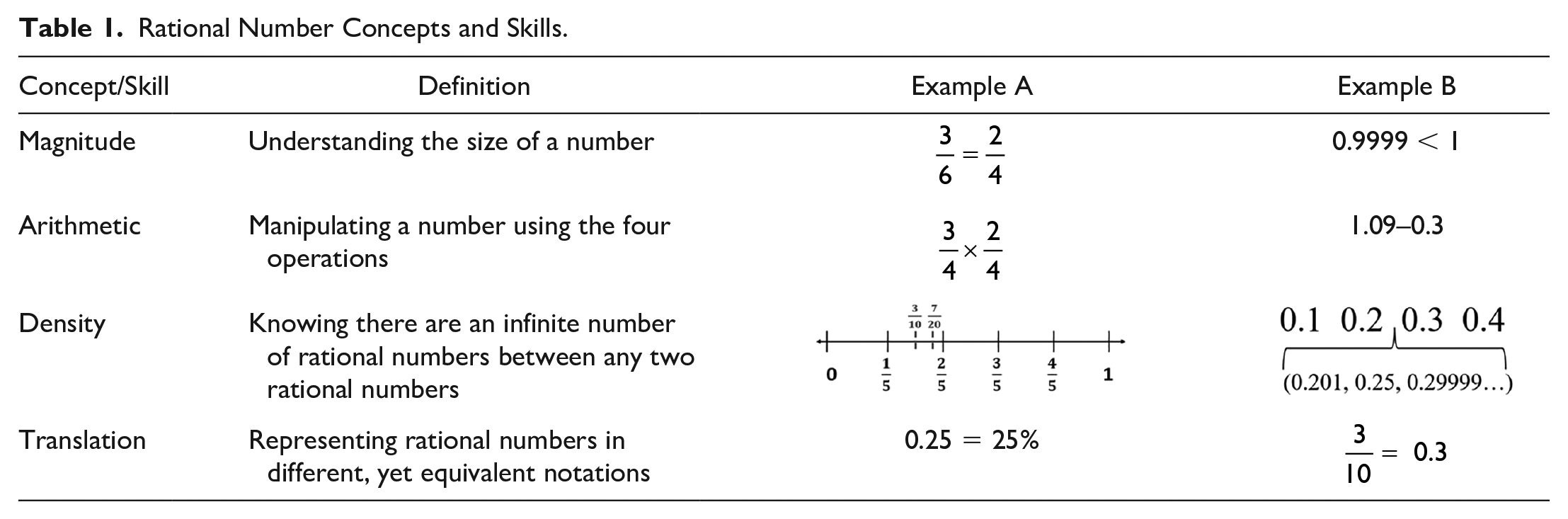
While each of the rational number topics mentioned are vital for achieving mathematics proficiency, this article focuses on how to teach translation to students with LD in mathematics. According to national and state mathematics content standards, translation is first introduced in elementary school. In many states, fourth-grade students will learn about decimal place value to the hundredths place and how to represent these values in fraction notation (Ferrini-Mundy, 2000; National Governors Association Center for Best Practices & Council of Chief State School Officers [NGAC & CCSSO], 2010). Accordingly, by seventh grade, students should be able to “develop a unified understanding of number, recognizing fractions, decimals that have a finite or a repeating decimal representation, and percentages as different representations of rational numbers” (NGAC & CCSSO, 2010). Students who have mastered fractions, decimals, and percentages, and who conceptualize these separate notations as part of the same number system, demonstrate proficiency on assessments measuring algebra competency (Powell et al., 2019). Having a strong foundation in rational number translation will provide students with the ability to reason through real-world situations involving different rational number notations as well as provide a foundation for succeeding in advanced mathematics courses (Namkung & Fuchs, 2019; Siegler et al., 2012).
Developing Rational Number Proficiency
The development of rational number knowledge and subsequent application of one’s understanding is widely documented as a challenge for students (Dyson et al., 2020). This is especially true for students with LD in mathematics who often lack foundational mathematics skills necessary to complete rational number tasks with efficiency and accuracy (Dyson et al., 2020; Jordan et al., 2017). Prior research on rational numbers and students with LD in mathematics points to rational number magnitude understanding as a critical factor impacting students’ ability to perform on rational number tasks (Jordan et al., 2013). Students with LD in mathematics often have underdeveloped rational number magnitude understanding as compared with typically achieving peers (Mazzocco et al., 2013), which places students at a significant disadvantage for developing more challenging skills such as rational number translation (Van Hoof et al., 2017).
One example of a student lacking deep rational number magnitude understanding might think that 0.178 is larger than 0.3. A student may reason, “0.178 has three digits after the decimal point and 0.3 has one digit after the decimal point, so 0.178 must be the large number.” This misconception can later impact the student’s ability to complete complex tasks with these numbers, such as converting decimals to fraction notation (i.e., translation). To better assist students in understanding fraction to decimal relationships, visual representations that highlight the magnitude of those quantities can help students form deep conceptual knowledge of mathematics. One example of a visual representation substantiated by research to improve students’ rational number understanding is the number line (Fuchs et al., 2021; Geary, 2008).
The Number Line as an Effective Tool
In 2021, the Institute of Education Sciences released a practice guide on providing mathematics intervention in the elementary grades (Fuchs et al., 2021). The practice guide made six recommendations based on findings from high-quality research studies involving students with or at risk for LD in mathematics. The level of evidence for all six recommendations was strong, including the use of number lines to support students’ development of mathematics proficiency around various topics such as whole number computation and numerical magnitude.
Given the effectiveness and versatility of number lines when working with students with or at risk for LD in mathematics (Fuchs et al., 2021), it is important to use the number line when teaching complex rational number topics. This is because the use of a physical number line is a cost-effective, practical way to facilitate the formation of a “mental number line” (Gersten & Chard, 1999). Students who are proficient in mathematics store numbers on a mental number line and retrieve this information when it is needed to solve mathematics problems (Jordan et al., 2013; Schneider & Siegler, 2010). A student’s mental number line will expand to include newly learned number types (e.g., whole numbers, fractions, decimals; Siegler et al., 2011) when they receive effective mathematics instruction. Eventually, students will learn that (a) all real numbers can be placed on the same number line and (b) that all numbers are part of a unified number system (Siegler et al., 2011). Without proper instructional tools, students with LD in mathematics typically struggle to build and expand their mental number line (Kucian, 2011; Mazzocco et al., 2013). Thus, a physical number line can serve as a feasible tool that can support students’ conceptual mathematics understanding. In this way, a physical number line affords students an efficient way to retrieve the magnitude of the numbers needed to solve mathematics problems (Fuchs et al., 2021; Geary, 2008).
On the contrary, an overreliance on teaching with area models (e.g., using slices of pizza or pie) may hinder students’ ability to think flexibly about fractions and prevent students’ from developing a deeper understanding of rational number concepts (Moseley et al., 2007). When instruction employs a “pizza pie only” approach, it can stymie students’ capacity to solidify an understanding that fractions are representative of the distance between two whole numbers (e.g., 0 to 1). Consequently, many students with LD in mathematics will struggle to conceptually understand the magnitude of fractions and decimals (Mazzocco et al., 2013). In an effort to support teachers in providing instructional support for that effectively deepens students’ rational number knowledge, a four-step teaching sequence is recommended. This teaching sequence addresses potential misconceptions about fractions as decimals and serves to build the conceptual understanding of rational numbers necessary for students to make progress in mathematics.
A Teaching Sequence for Introducing Fractions as Decimals
The following describes a four-step teaching sequence to introduce rational number translation to students with LD in mathematics. Specifically, this section outlines how a teacher can use the number line to support students’ learning that fractions with a denominator of 10 and 100 can be represented in decimal notation. Although students are not expected to fully grasp the concept of a unified number system until the end of middle school, this fourth-grade skill is vital because there is a learning progression of mathematics, where foundational concepts and skills serve as prerequisites to higher level mathematics knowledge (Clements & Sarama, 2014). This teaching sequence begins by laying the foundation for the knowledge of a unified number system. In that capacity, the number line serves as a visual representation for how decimals and fractions can refer to the same part of a whole.
Each step in this teaching sequence can be most effectively delivered in whole-class and small-group settings through an explicit and systematic instructional approach. Recognized as an evidence-based teaching practice for students with LD in mathematics, explicit and systematic mathematics instruction generally comprises (a) carefully sequenced instructional examples, (b) scaffolded learning opportunities, (c) teacher modeling, (d) guided student practice, (d) independent student practice, and (e) ongoing teacher-provided academic feedback (Doabler & Fien, 2013; Fuchs et al., 2021). A checklist of the teaching sequence, as well as critical instructional components, is provided in Figure 1.
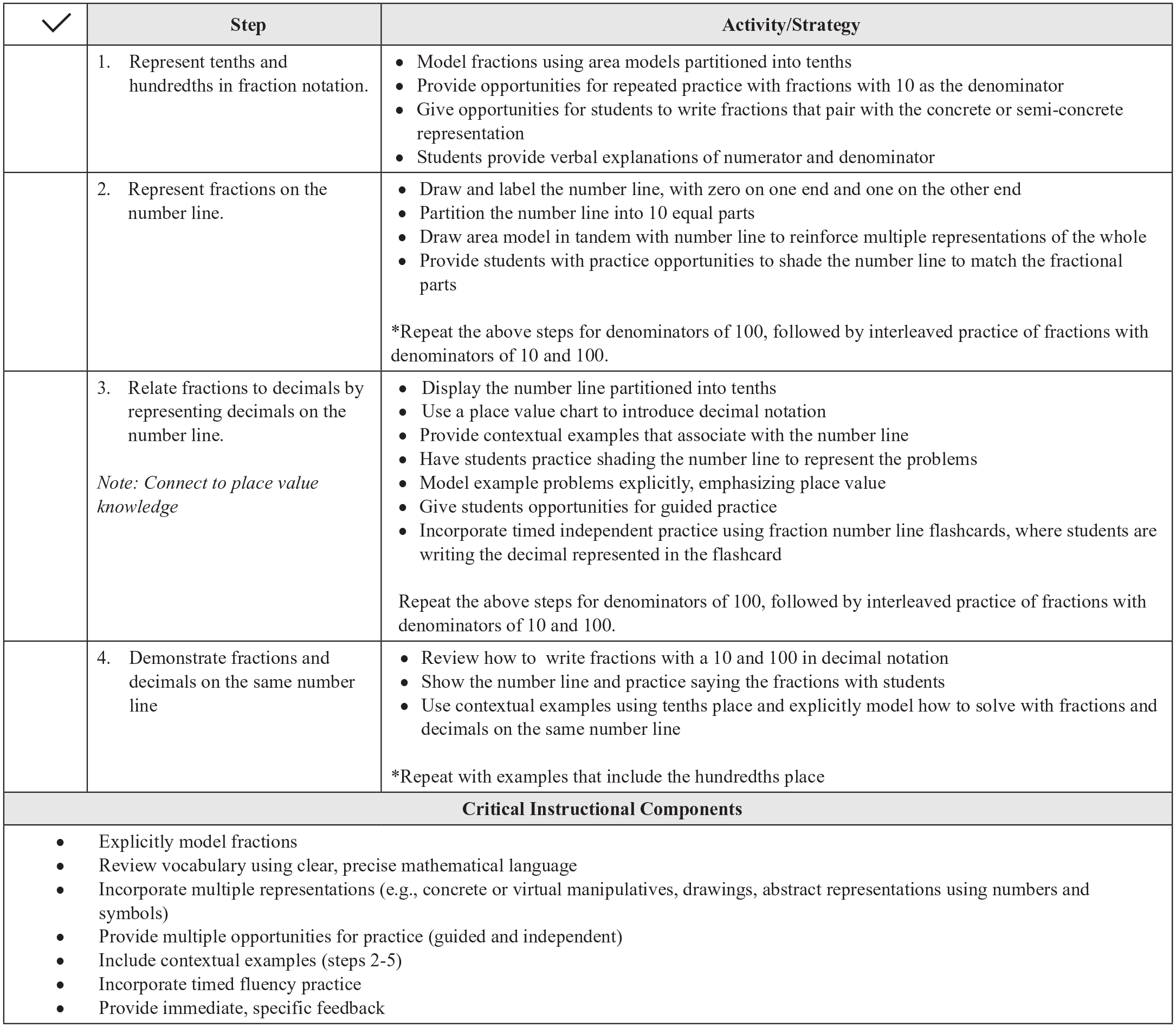
A teaching sequence checklist and components
Step 1: Representing Tenths and Hundredths as Fractions
The first step in this teaching sequence is to introduce students to representing tenths and hundredths in fraction notation. Tenths and hundredths should be taught after students have learned to represent fractions with smaller denominators, such as 2, 4, 6, and 8. When introducing new information, linking previously learned material to new learning objectives can promote learning for students with LD in mathematics (Clarke et al., 2014; Fuchs et al., 2021). Because fourth-grade students are likely familiar with area models (CCSSM 2.G.A.3), teachers can start by displaying an area model partitioned into tenths (see Figure 2, Section A). The teacher can use the model to review important fraction concepts, including the vocabulary terms whole, denominator, and numerator. Pairing vocabulary words with concrete (i.e., physical manipulatives) or semi-concrete (i.e., picture or diagram) representations during instruction can help students with LD make essential connections for learning (Powell & Driver, 2015). The first example in Figure 2, Section A shows the fraction
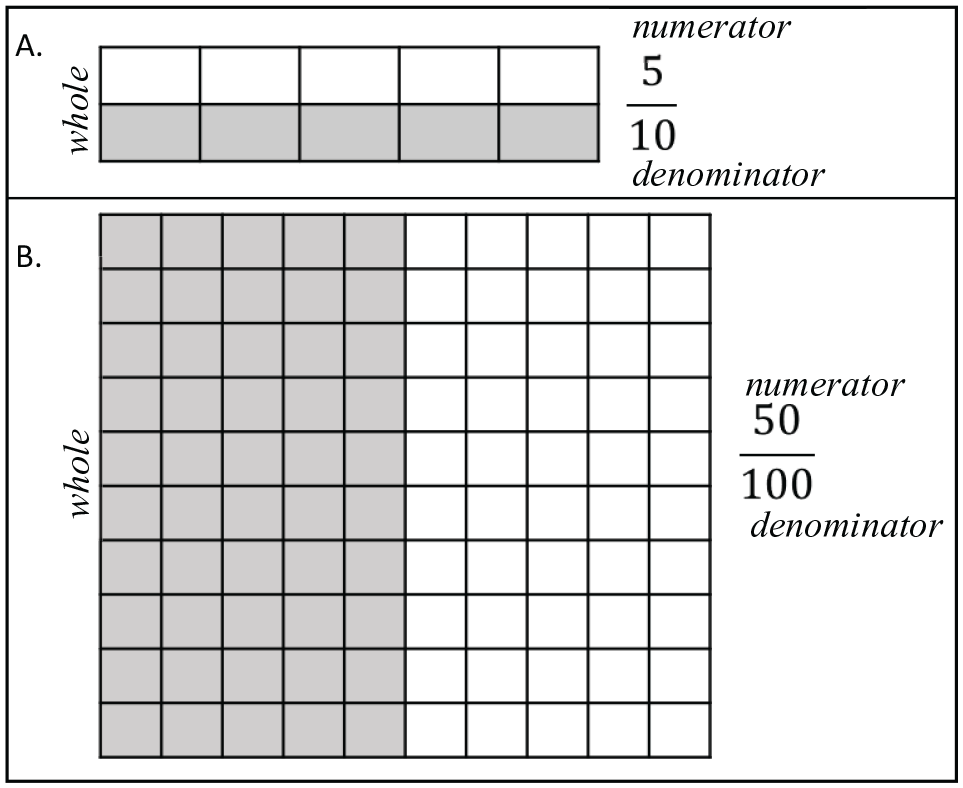
Introducing tenths and hundredths with area models.
Instruction for students with LD in mathematics is most effective when systematically sequenced, moving from less complex examples to those of greater complexity (Fuchs et al., 2021). So, after teaching fractions with a denominator of 10, this teaching sequence can be repeated with fractions that have a denominator of 100, as displayed in Figure 2, Section B. To purposefully link previously learned material to this new skill, the teacher can review fractions with a denominator of 10 prior to introducing hundredths. Then, after successfully completing guided and independent practice for denominators of 10 and 100, students are ready for Step 2.
Step 2: Representing Fractions on the Number Line
The second step in this teaching sequence is to show students how to represent tenths and hundredths using fraction notation on the number line. Although students may have encountered number lines before, many commercially available mathematics programs focus on teaching rational numbers through area models (Fuchs et al., 2013 ). Therefore, the number line should be explicitly taught to students. First, the teacher can draw a number line labeled with two points on either end, zero and one. Next, the number line can be partitioned into 10 equal parts. Teachers should use precise mathematics vocabulary (e.g., points, tick marks, partition) when modeling how to draw a number line. An area model can be shown in tandem with the number line, such as in Figure 3, to demonstrate that a whole can be represented in multiple ways. Since both representations have 10 equal parts, they both represent wholes that are partitioned into tenths. To practice independently, students can practice shading number lines to represent the same fractional parts as various area models partitioned into tenths.
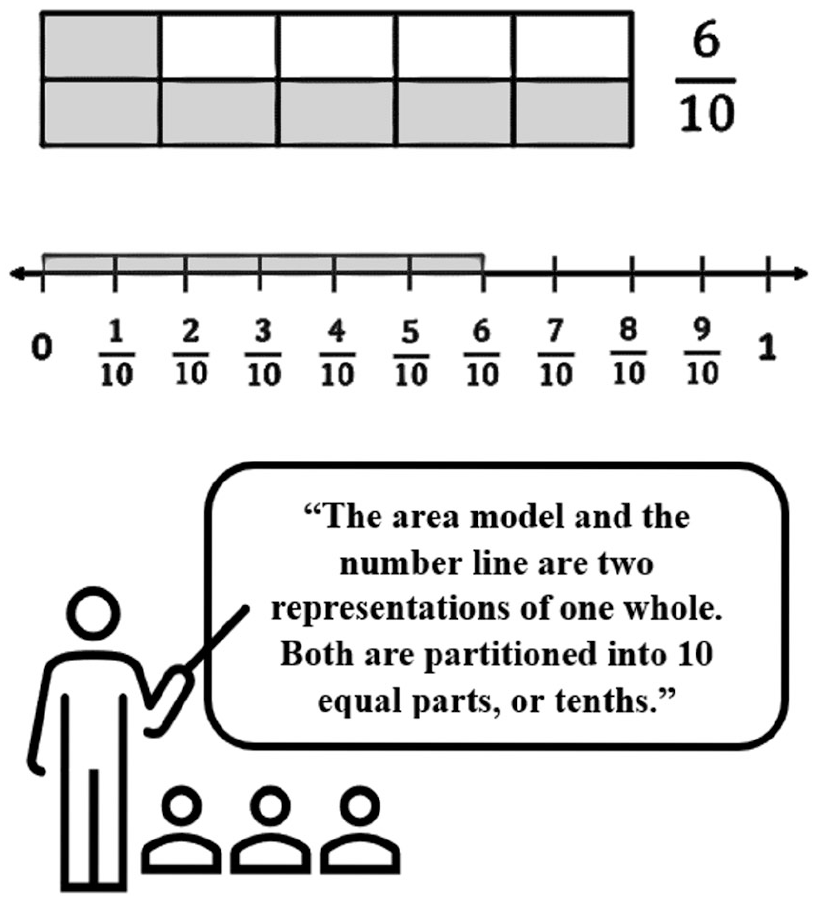
Fractions represented in different ways.
For the next lesson, teachers can model how to represent hundredths on the number line. To accomplish this, they can start by reviewing number lines partitioned into tenths. Next, teachers can use a contextual example to introduce partitioning each tenth into 10 additional equal parts, for instance, representing the amount of a book read that has 10 chapters, with each chapter containing 10 pages. Contextual examples that require measuring from one point to another (e.g., the distance ran by a student during a 1-mile relay race) are powerful when using a number line because they encourage students to think of continuous measurements and can initiate a discussion about the density of rational numbers (Barbieri et al., 2020; Dyson et al., 2020).
Step 3: Relating Fractions to Decimals
Assuming students can now represent tenths and hundredths as fractions on the number line, it is time to introduce decimals as another way to represent the same fraction magnitudes. A handy tool for introducing decimals is a place value chart, which has the place values labeled above blank boxes. As before, instruction should be chunked into smaller steps by teaching tenths prior to teaching hundredths. The teacher can begin the lesson by displaying a number line with tenths and providing a contextual example such as the one displayed in Figure 4. After monitoring how students shade in the number line, the teacher can display the place value chart and say, Now, we are going to represent the amount of candy that Molly ate using a different notation—decimals. Decimals are another way to represent amounts between any two whole numbers, just like fractions. Fractions and decimals can be used to represent the same amount.
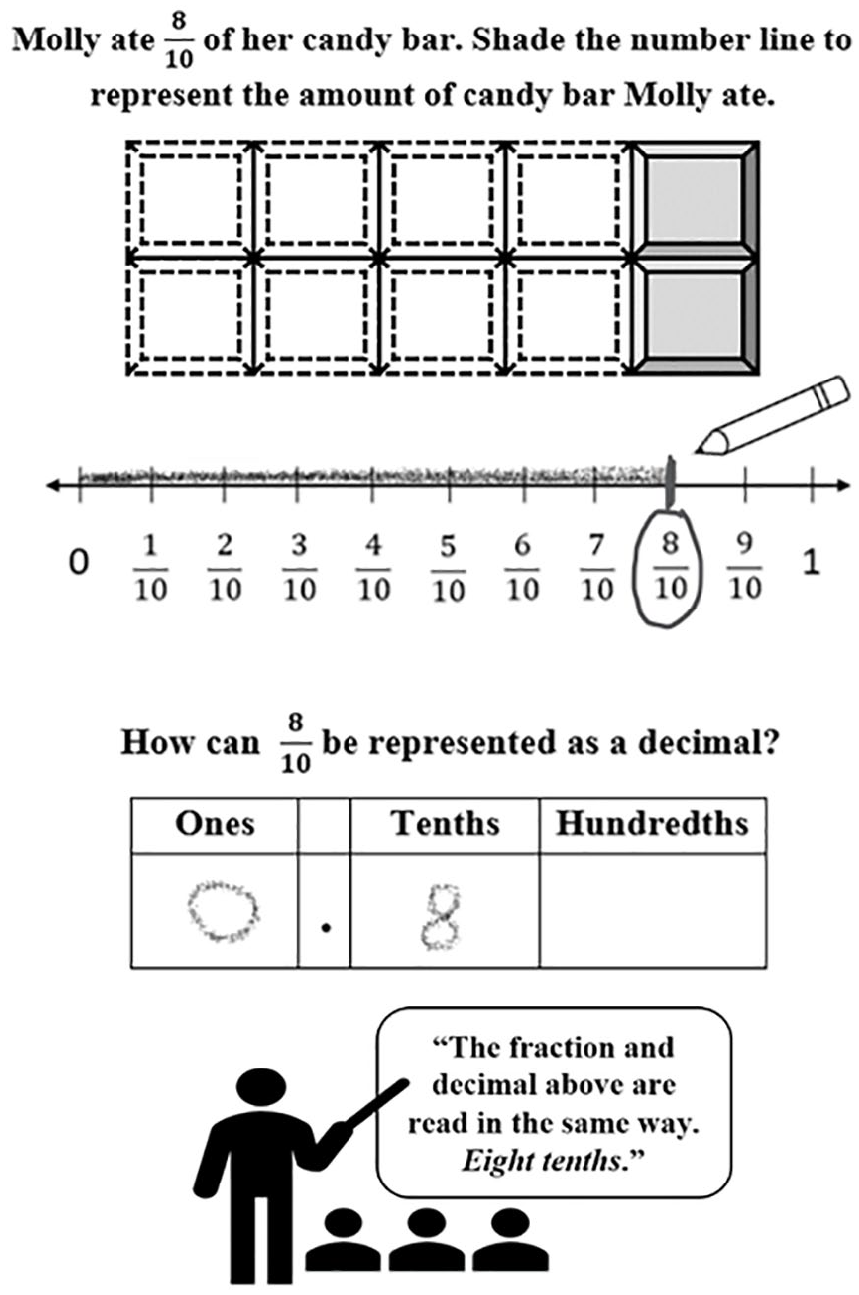
Using a place value chart to introduce decimal notation.
The teacher should explicitly teach the place values and the decimal point by referencing the chart. Then, the teacher can model a few examples of writing decimals from fractions on the number line, starting with the example above. The teacher can say, “Molly did not eat a whole candy bar, so I will write a zero in the ones place. She ate eight tenths, so I will write an eight in the tenths place.” The teacher should offer guided practice by showing different fractions on the number line, naming the fraction, and having students write the numerator in the correct place value on the place value chart. As students are practicing, the teacher should provide immediate and corrective feedback for students who write digits in the wrong place values. For example, if a student places 8 in the ones place for
After students begin to master the skill, the teacher can promote students’ fluency by providing timed independent practice. Timed practice can increase automatic retrieval for students with LD in mathematics and build fluency with other, related mathematics tasks (Fuchs et al., 2021). For this lesson, the teacher can prepare flashcards ahead of time with fractions on a number line. The teacher can have students write the decimal for each fraction represented on the flashcard as quickly as they can. During this timed practice, the teacher should provide immediate feedback to help students improve their accuracy.
Step 3 should be repeated for introducing fractions with a denominator of 100 as a decimal. Students will be familiar with the ones and tenths place from the previous lesson; however, the objective of this next lesson will be to practice writing fractions to the hundredths place as decimals. The teacher should repeat the teaching sequence outlined in Step 3 for teaching decimals to the tenths place. After guided practice and a few independent practice items for fractions with a denominator of 100, the teacher should purposefully mix in practice items that require students to write decimals for fractions with either a denominator of 10 or a denominator of 100. Mixing different example types (i.e., interleaved practice) into independent practice will have a stronger benefit to learners as opposed to only providing examples of the same problem type (i.e., blocked practice; Rohrer et al., 2015). The benefit of interleaving problem types is that students are required to discriminate between problems with different denominators and to think critically about which strategy is necessitated to solve the problem.
Step 4: Fractions and Decimals on the Same Number Line
The last step in this teaching sequence is to demonstrate that fractions and decimals can be placed on the same number line as shown in Figure 5. Placing multiple rational number notations on the same number line will mimic what typically achieving students do mentally as they learn new number types, expanding their mental number line. The process of placing fractions and decimals on the same number line will demonstrate that the two notations can represent the same magnitudes and be sequenced along a continuum (Siegler et al., 2011).
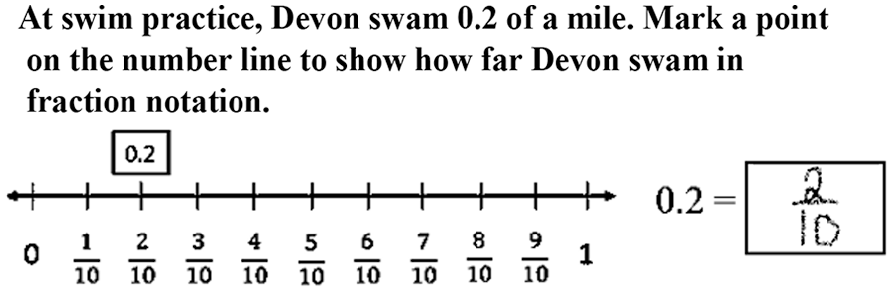
Placing fractions and decimals on the same number line
To start, the teacher should review how to write fractions with a 10 and 100 in decimal notation. Next, the teacher can show the students a number line with fractions and have students say the fractions out loud together. Then, the teacher can point to the contextual example presented in Figure 5. The teacher can say, “I want to represent the amount of laps Devon swam on this number line. I will shade the number line to 0.2 because two tenths in fraction notation is equivalent to two tenths in decimal notation.” Using explicit instruction, the teacher should offer guided and independent practice opportunities to place fractions and decimals on the same number line. Finally, Step 4 should be repeated with the hundredths place.
Conclusion
The teaching sequence presented, when taught using explicit and systematic instructional techniques, can help students with LD in mathematics acquire complex rational number concepts and skills that will prepare them for middle school (Fuchs et al., 2021). In addition, the number line, which provides a physical model for how to organize quantities, can continue to be an effective teaching tool as students learn all about all real numbers (i.e., whole numbers, integers, rational numbers, irrational numbers). Teachers should place an instructional focus on the magnitude of real numbers so that students can develop an understanding of a unified number system. Finally, instruction for students with LD in mathematics should be rooted in evidence-based instructional design (e.g., number line, systematic instruction) to promote overall mathematics competency and preparedness for rigorous mathematics courses.
Footnotes
Declaration of Conflicting Interests
The author(s) declared no potential conflicts of interest with respect to the research, authorship, and/or publication of this article.
Funding
The author(s) received no financial support for the research, authorship, and/or publication of this article.
