




Abstract
This article illustrates how teachers can use number lines to support students with or at risk for learning disabilities (LD) in mathematics. Number lines can be strategically used to help students understand relations among numbers, approach number combinations (i.e., basic facts), as well as represent and solve addition and subtraction problems. The authors draw from the existing research base to describe practices for incorporating number line representations to (a) support students’ conceptual understanding of number and (b) teach addition and subtraction computational strategies. Specific examples are provided for teachers to integrate number line representations with other mathematical models to support the development of whole number understanding for students with LD in mathematics.
The number line is an early number representation that can be strategically used by teachers to build students’ understanding of number magnitude and the operations (Fuchs et al., 2021; Siegler et al., 2011). Student performance on number line tasks is predictive of mathematical achievement across the elementary grades (Schneider et al., 2018). It is hypothesized that students rely upon mental number lines, such as visualizing a 0 to 20 or 0 to 100 number line, to compare number magnitudes and solve mathematical problems (Case & Okamoto, 1996; Laski & Siegler, 2007). For example, students may visualize a mental number line to compare numbers and determine which is greater (i.e., has greater magnitude), and which is lesser (i.e., has smaller magnitude). As a semi-concrete representation of number, number lines can help connect concrete representations of number (e.g., six base-10 blocks, or a set of six objects) to their abstract representation (e.g., the numeral “6”; Agrawal & Morin, 2016).
For students with or at risk for learning disabilities (LD) in mathematics, number lines are particularly advantageous for use within intervention or as an additional support within core mathematics instruction (Fuchs et al., 2021; Geary et al., 2008). Number lines can help facilitate accurate counting, number magnitude comparisons, and computation. One significant advantage of the number line is that it connects mathematical content across the grade levels (Fuchs et al., 2021). While teachers may use whole number number lines primarily in the early grades, a 0 to 1, 0 to 2, or 0 to 5 number line may be used in the later grades to represent a mix of whole numbers, fractions, decimals, and percentages. This article details strategies for teachers to incorporate number lines within whole number intervention in the early grades, focusing on kindergarten through second grade. The following sections describe how the number line can be strategically used by teachers to (a) build conceptual understanding of number for students with or at risk for LD in mathematics, and (b) teach strategies for addition and subtraction computation. In each section, tips and resources are provided for teachers to translate research-based strategies into practice.
Building Understanding of Numerals on the Number Line
When students are initially exposed to early numeracy concepts, teachers can use number lines to help build understanding of the number list from 1 to 10. Initially, number names (e.g., “three” and “six”) and the numerals on the number line (e.g., “3” and “6”) have little meaning to students. Through repeated exposure to multiple number representations, students may come to understand that a numeral represents a quantity (e.g., the numeral “4” represents “••••”). Developing understanding of numerals and the number names is essential for students to be able to decode the language of mathematics as increasingly complex content is introduced. For example, a student without understanding of numeral meaning would not be able to interpret mathematical statements such as “10 + 5 = 15” or “3 > 2.”
To build understanding of the numerals on a number line, it is critical to incorporate mathematical representations beyond the number line itself. Use multiple representations together to facilitate a deeper understanding of connections between concrete, semi-concrete or representational, and abstract models (Bouck et al., 2017). Manipulative materials such as objects or counters, or pictures of objects (e.g., semi-concrete representations), should be explicitly linked to the numerals on the number line. For example, a teacher could introduce the numeral “9” by presenting a group of nine teddy bear counters and guiding students to count them. The teacher could then point to the numeral “9” and have students count from “1” to “9” on a number line, to reinforce the magnitude of nine in relation to other numbers such as 8 or 10. Cardinality charts are particularly useful to help bridge students’ understanding of semi-concrete representations of numerals (e.g., a drawing of nine teddy bears) and the numerical representation on a number line (e.g., the numeral “9”; see Figure 1), as they contain a number line and visual representation of the numbers. For students with or at risk for LD in mathematics, cardinality charts should be available for students to use when working with numbers and solving problems in the general education setting. Collaborate with students’ general education teachers to have charts nearby and to prompt students to use the charts when needed. For example, if a general education teacher asks the class to compare two numerals, students with or at risk for LD in mathematics could be prompted to use their own cardinality chart to make the comparison and to help reinforce the meaning of the numerals being compared.
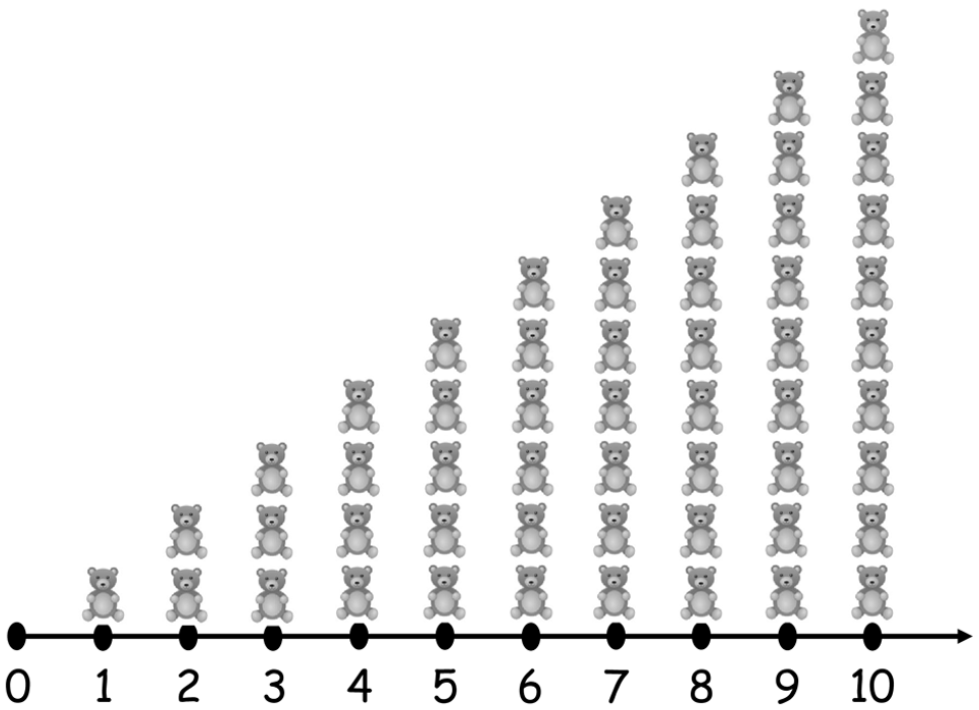
Building understanding of numerals on the number line using a cardinality chart.
As students build a conceptual understanding of numerals, incorporate practice counting on the number line. Teachers can concurrently show a number line and guide students in counting from 1 to 10 while touching each corresponding numeral. Counting using a number line can also help establish the relation between the number word (e.g., “eight”) and the symbolic representation of a number (e.g., the numeral “8”). It is imperative that teachers immediately correct any counting errors, such as skipping over a number (e.g., “6, 8, 9, 10”), so that students are aware of the correct numeral names and do not develop a habit of counting incorrectly (Hudson & Miller, 2006). It is also essential for students to develop 1:1 correspondence, understanding that each spoken number corresponds to a single numeral on the number line. Teachers can correct student errors by providing a clear model and naming the numerals while pointing to each on the number line (e.g., “Listen: 6,
For younger students such as kindergarteners, it may be beneficial to have a large number line from 0 to 20 taped to the classroom floor to be used within whole class or small-group activities. When introducing this tool, teachers should first model how a floor number line can be used, by explicitly showing students how to name the next number (e.g., “two”) as they take a step forward (e.g., from “1” to “2”), and to help students understand that the next number represents a quantity that is one more than the previous number. After the teacher has modeled how to use the number line, they can gradually decrease support and guide individual students to walk along the number line and count. The rest of the class can participate by counting along with the student who is walking along the number line. Practice with a floor number line can also be used to teach counting backwards and the idea that the number that comes before represents a quantity that is one less.
As students learn more advanced strategies such as counting on to solve addition problems, teachers should instruct students to start with the greater amount, and count up the additional amount. Counting on involves starting with one addend (e.g. preferably the greater one) and counting up the remaining amount, instead of starting the count from zero. For example, when adding 2 + 6, instruct students to start at 6 (the greater addend) and move forward two more spaces on the number line. More complex skills such as counting on may take time and practice for students with or at risk for LD in mathematics. Fade back to concrete representations as needed, such as representing each addend (e.g., 2 and 6) with counters to help students practice naming the larger group (6) and counting on from there.
Building Understanding of Number Magnitude
Another foundational skill that students must develop as they increase their understanding of number is the ability to compare number magnitudes (Case & Okamoto, 1996; Clements et al., 2003). In other words, when comparing two or more numbers, students must determine which is greater or lesser in quantity. This skill is essential for understanding the whole number system and representing increasingly greater quantities, as well as eventual application to new number systems such as the rational number system. In addition, students compare number magnitudes when determining with which number to start solving problems (e.g., starting with the greater number) and understanding the inverse relation between addition and subtraction (e.g., 3 + 4 = 7; 7 – 4 = 3).
As students progress in formal schooling and encounter number lines organically throughout core instruction and intervention, they increasingly reference a mental number line to make judgments about magnitudes (Siegler & Booth, 2004). For example, when deciding whether 4 or 7 is greater, a student might picture a number line in their head and the relative position of each number. A key understanding in early mathematics is that, unlike reading’s counterpart in the alphabet, the order of numerals is meaningful (e.g., numbers grow in magnitude when counting from “1” to “2” to “3”). Similarly, students learn that whole numbers follow a discrete scale (National Research Council, 2009). That is, each number represents a quantity that is exactly one more than the number before it and exactly one less than the number it precedes (e.g., 17 is one more than 16 and one less than 18). Fluent retrieval of this mental number line provides a foundation for more advanced operations (Gersten & Chard, 1999). As students progress to learning about the teen numbers and numbers in the later decades, a 0 to 100 number line can be used alongside other representations to orient students to the order in which numbers appear as well as their respective magnitude.
As students first engage in comparing magnitudes (e.g., “Which is more, four or nine?”), utilize counters or other objects to represent numbers and allow children to see and compare quantities. As a first step, ask students to represent “4” and “9” using counters. Prompt students to consider: “Which group has more counters? Which group has fewer?” Then confirm that the group of nine has more and the group of four has fewer. Teachers can guide students toward using multiple strategies to compare number magnitudes, such as counting each group to find the total, or physically lining up the counters in the two groups to visually compare group size. It is important to note that the physical dimensions of objects and their orientation may be misleading for young students (National Research Council, 2009). For example, a group of four cubes that are widely dispersed may be judged as greater than a group of four cubes tightly spaced. Thus, attend to the spacing and size of objects when choosing and arranging manipulatives for comparing. As students with or at risk for LD in mathematics gain proficiency with comparing quantities using concrete objects, explicitly connect concrete objects to number line representations to further anchor students’ understanding.
The number line itself helps to solidify that the number list is fixed (e.g., “4” will always follow “3”) and that whole numbers are evenly spaced from one another (i.e., a quantity is always one more or one less than its neighbors; Geary et al., 2008; Lannin et al., 2020; Siegler et al., 2011). Here, the number line can be invaluable in supporting students’ thinking. Teachers should draw attention to the fixed order of numbers to aid comparisons in multiple ways. Learners may compare each number directly (e.g., “I know that the next number is one more than the number before it along the number line, so four must be greater than three”) or may reference the numbers’ absolute positions (e.g., “I know that numbers further away from zero represent larger quantities, so four is greater than three”). Figure 2 shows a sample lesson where a teacher guides students to engage in greater than/less than comparisons numbers using a number line. Understanding of number names and magnitudes can be deepened further as students’ familiarity with numerals increases. For example, the number line can be helpful in clarifying understanding of similar-sounding numbers, such as comparing “13” and “30” or “16” and “60.”
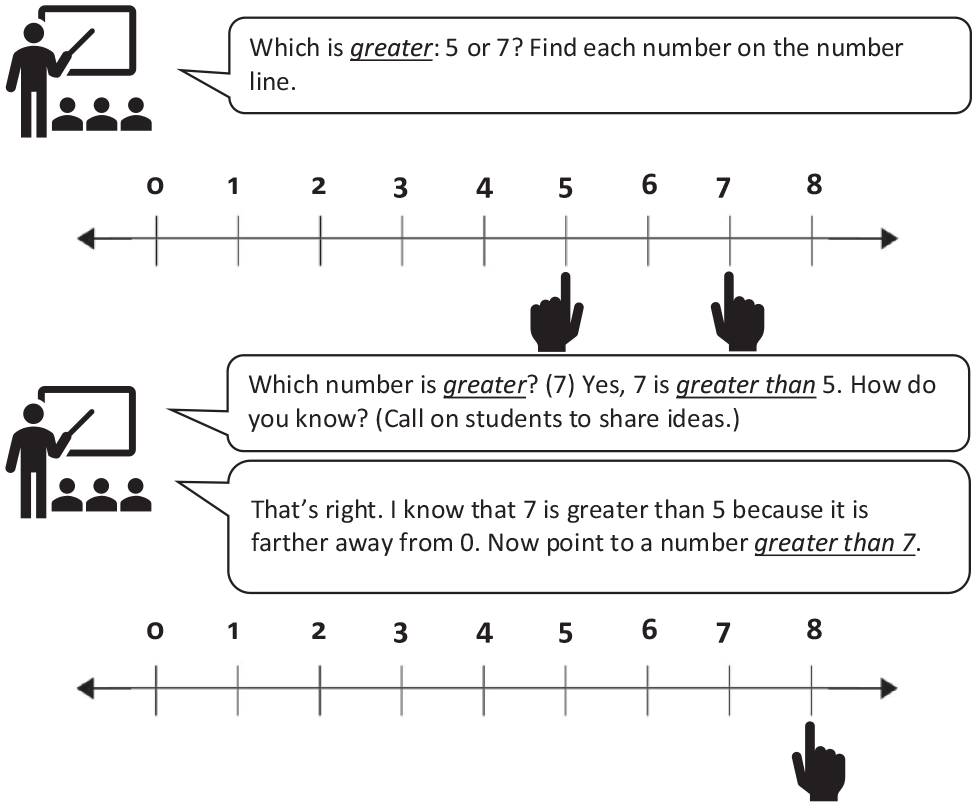
Using number lines to support students in comparing number magnitudes.
Teaching Addition and Subtraction Strategies Within 20
Students with or at risk for LD in mathematics may struggle to understand the meaning of the operations. As students begin learning to add and subtract numbers, it is critical to build conceptual understanding of addition as the merging of two sets or quantities, and subtraction as “taking away” from a larger set to create a smaller set. The number line is a prime mathematical tool for connecting concrete models of addition and subtraction (e.g., modeling “2 + 5” using connecting cubes) with the abstract representation (e.g., “2 + 5 = 7”; Bouck et al., 2017; Fuchs et al., 2021). By using the number line to represent and solve addition and subtraction problems, students with or at risk for LD in mathematics can physically and mentally track the steps of problem-solving while also decreasing the cognitive load for higher-order processing such as engaging in the arithmetic (Koç, 2019; Siegler & Opfer, 2003). This may be especially advantageous for students who struggle to solve simple addition and subtraction facts, as it provides students with a visual representation of the problem as well as a strategy to solve it.
Teaching Students to Add and Subtract 1
Teachers can strategically use number lines to teach rules about adding and subtracting 1 (National Research Council, 2009). For example, teaching students that each subsequent number is one more than the previous number, and each preceding number is one less, can help students more fluently solve +1/–1 problems. Teachers can introduce a rule such as, “When you add one, say the next number (on the number line)” or “When you subtract one, say the number that comes before (on the number line).” Prior to working with the number line, students should have ample practice using manipulatives to model +1/–1 problems by adding or taking away an object from a set of objects. As students model addition and subtraction problems using manipulatives, concurrently model the problem on a number line, by moving up or down the number line to model adding or subtracting one. For example, when solving “5 + 1 = ?,” a teacher might point to the greater number, “5,” on the number line and then show adding one more by moving their finger one space to the right to equal “6.” This could be confirmed by having students double check “5 + 1 = 6” using manipulative materials.
Teaching Students to Add and Subtract More Than One
A similar progression should be followed for adding and subtracting numbers that are greater than 1. After students have practiced representing problems using manipulatives, teachers can introduce the number line and prompt students to count on to solve the problem, starting with the greater number. For example, when solving 6 + 8, the teacher might guide students to count on from the greater number (8), and count up six more. With subtraction, students may count backwards from the greater number or count up from the lesser number. Students with or at risk for LD in mathematics are more likely to make errors while counting backwards (Baroody, 1984); therefore, using the “count up” strategy for subtraction is often a superior choice. In teaching the “count up” strategy for subtraction, help students reframe the problem as an addition statement. For example, when solving “10 – 6 = ?,” reframe the problem as “6 plus how many equals 10?” The teacher could then guide students to start with the lesser number (6) and count up on the number line until they reach 10 (e.g., “Start with
Crossing 10 Addition and Subtraction Problems
A number line can also be used to model addition and subtraction problems that involve crossing, or bridging through 10, where students must regroup from ones to tens, or tens to ones to solve (e.g., 9 + 6, 13 – 7; Van de Walle et al., 2019). These problems can be particularly challenging for students with or at risk for LD in mathematics given that they inherently involve moving from single-digit numbers to teen numbers, or teen numbers to single-digit numbers (i.e., crossing 10). Teachers should highlight the strategy of “making a 10” by either adding to make 10 or subtracting to make 10 using the number line as a guide. For example, consider a subtraction problem that crosses 10, such as “15 – 9.” The teacher would point to 15 and ask students what number to subtract to make a 10. After subtracting five, the teacher would guide students to identify that four more must be subtracted so that nine are subtracted in total. Alternatively, using the “count up” strategy, the teacher could guide students to start with the subtrahend (nine), and ask students, “Nine plus how many make 10?” The teacher can then identify the remaining amount to reach 15. Figure 3 shows part of an example lesson demonstrating how teachers can guide students through solving crossing 10 problems using the “counting up” strategy. In solving crossing 10 problems, highlight “10” on the number line in various ways—either by circling the number or pointing to it, to help students use it as a benchmark for easier problem solving. Building this strategy also benefits students in that they learn to think about putting together and breaking apart numbers flexibly around the base-10 number system.
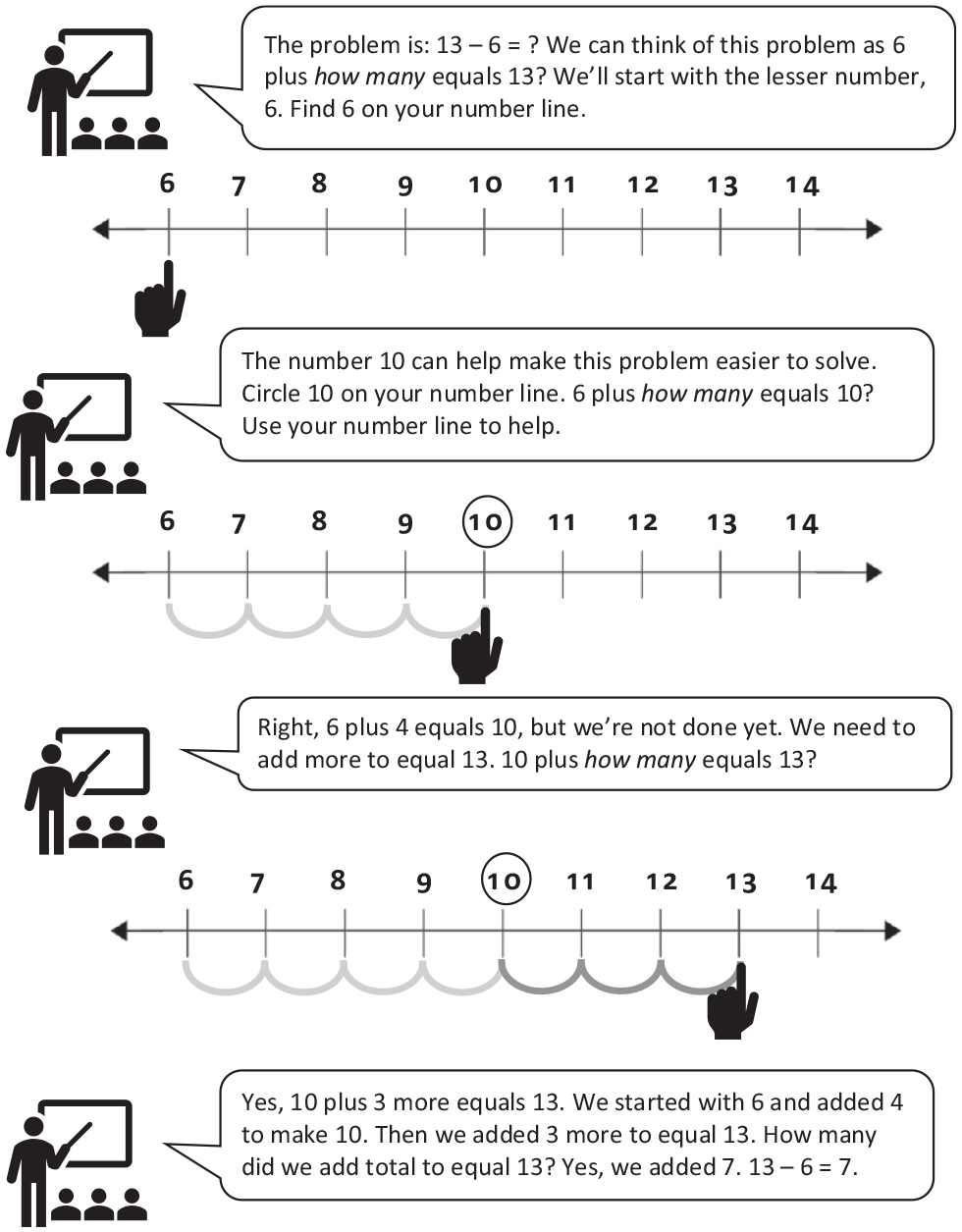
Using the number line to solve crossing 10 problems with the “counting up” strategy
Teaching Addition and Subtraction Strategies Within 1000
Number lines also can be used to represent and solve multi-digit addition and subtraction problems within 1000. While base-10 blocks are an essential tool for building place value understanding within multi-digit computation, number lines should be used alongside base-10 materials to help orient students to how quantities change when they are added to or subtracted from. For example, a student solving a three-digit subtraction problem involving regrouping may learn to represent and solve the problem using base-ten materials. It is advantageous for teachers to also show number line representations of computation with larger numbers to continue building students’ understanding of number magnitude with greater numbers.
Number line representations are especially advantageous after students have developed conceptual understanding of multi-digit operations through practice with manipulatives. Open number lines are less cumbersome than manipulatives, as they can be quickly drawn by students and can be used to show a variety of approaches to solving a given problem. For example, a student solving the problem 42 + 57 using an open number line could start by representing 50, adding 40, and then adding the ones (7 + 2 = 9 ones), or could add the ones and tens separately first (e.g., 7 + 2 = 9; 40 + 50 = 90) and represent both sums on the number line. This helps to reinforce the flexible nature of solving multi-digit problems and the relative place values in each addend. In addition, the number line can be used to highlight base-10 strategies for addition and subtraction computation with larger numbers by employing strategies such as the “jump strategy” that follows.
In Grades 1 and 2, students begin adding and subtracting within 100 (Grade 1) and then within 1,000 (Grade 2; National Governors Association Center for Best Practices & Council of Chief State School Officers, 2010), with and without regrouping. It is critical for students to develop base-10 understanding when solving complex computations, including understanding of regrouping from ones to tens, or tens to hundreds. For example, when adding 47 + 39, students will need to regroup 16 ones into 1 ten and 6 ones, adding the regrouped ten to 4 tens (from 47) and 3 tens (from 39). This type of conceptual thinking around regrouping takes ample time and practice and is a common challenge for students with or at risk for LD in mathematics. Teachers can use number lines to support this type of understanding by representing both addends (e.g., 47 and 39) and the resulting sum.
To help establish base-10 understanding, teachers can model solving the problem by performing “jumps” on an open number line where the tens are added first, then the ones. As an example, a teacher might start with 40 (from 47), add 30 (from 39) to equal 70, and then add the ones (see Figure 4). Students can also be taught to draw open number lines to represent problems and explain their mathematical thinking and reasoning. Representing multi-digit addition and subtraction problems on a number line can help decrease potential errors as students physically track the parts of the problem on the number line, and then go back and check their work.
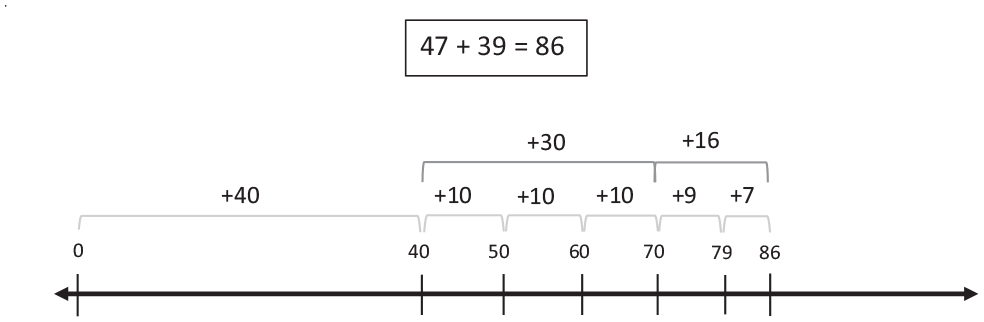
Using an open number line to represent and solve a two-digit addition problem with regrouping.
Conclusion
The number line is an important representational tool for all students, but can be particularly advantageous for students with or at risk for LD in mathematics (Lannin et al., 2020). Students will first need to make meaning of the numerals presented along the number line, understanding the fixed order in which numbers appear and how order links to number magnitude. Students build on this knowledge and apply it to understanding relations among numbers (e.g., moving up or down the number line to add or subtract), as well as representing and solving arithmetic problems. Teachers should integrate number lines alongside other mathematical representations to build a robust understanding of number, eventually leading into more complex mathematical concepts that can be represented by number lines, such as the rational number system.
Footnotes
Declaration of Conflicting Interests
The author(s) declared no potential conflicts of interest with respect to the research, authorship, and/or publication of this article.
Funding
The author(s) received no financial support for the research, authorship, and/or publication of this article.
