




Abstract
Building proficiency with fraction arithmetic poses a consistent challenge for students with learning difficulties or disabilities in mathematics. This article illustrates how teachers can use the number line model to support struggling learners in making sense of fraction arithmetic. Number lines are a powerful tool that can be used to help students represent and solve problems involving addition, subtraction, multiplication, and division with fractions while building conceptual understanding of the underlying operations. Evidence-based strategies for using number line models to teach fraction arithmetic concepts and skills are described and specific examples provided to illustrate how teachers can strategically integrate number line models with other mathematical representations to support the development of flexible understanding of fractions.
Fraction arithmetic is a major focus of mathematics instruction in the later elementary and early middle school grades (Common Core State Standards Initiative [CCSSI], 2010; National Mathematics Advisory Panel, 2008). Developing mastery in this area poses a considerable challenge for students, especially those with learning disabilities (LD) in mathematics (Siegler et al., 2010; Tian & Siegler, 2017). Perhaps the greatest challenge educators face is developing students’ understanding of the concepts and operations underlying fraction calculation procedures. In the area of whole number, students develop conceptual understanding of the meaning of the four arithmetic operations: (a) addition as combining or putting together, (b) subtraction as taking away or comparing, (c) multiplication as repeated addition of equal groups, and (d) division as equal partitioning. When rational numbers are introduced, however, instruction often emphasizes procedural learning at the expense of conceptual understanding (Siegler et al., 2010). As a result, students may view fraction arithmetic procedures as arbitrary rules and struggle to understand why they work, exacerbating the difficulties students with LD in math face in developing proficiency with fraction calculations (Lortie-Forgues et al., 2015).
Fraction arithmetic proficiency is closely linked to fraction sense, or conceptual understanding of the meaning of fractions, their magnitude, and their operations (Dyson et al., 2020; Hecht & Vagi, 2010). Students with fraction sense can apply their knowledge of whole number arithmetic and fractions as numbers to make sense of fraction arithmetic, helping them understand the underlying operations, determine whether an answer is reasonable, and avoid common fraction computation mistakes (Barnett-Clarke et al., 2010; Tian & Siegler, 2017). On the contrary, students who lack this flexible fraction knowledge often overgeneralize whole number properties to calculations involving fractions, leading to errors such as operating on numerators and denominators independently (Tian & Siegler, 2017). It is therefore critical that teachers support development of proficiency with fraction arithmetic through scaffolded instruction designed to bridge whole number knowledge and new fractions content and build students’ fraction sense. The number line can be strategically integrated throughout fraction arithmetic instruction to accomplish these goals (Fuchs et al., 2021; Hecht & Vagi, 2010; Siegler et al., 2011).
Who Benefits From Number Line Representations of Fraction Arithmetic?
Number lines are an important tool to represent and teach fraction concepts and skills, and should be utilized during core mathematics instruction to support all students in mastering critical fractions content, including fraction computation (Fuchs et al., 2021). The literature indicates that using the number line to teach fraction arithmetic in an intervention context is especially beneficial for students with LD in math (Barbieri et al., 2020; Dyson et al., 2020; Jordan et al., 2017), leading to growth in fractions performance both as a standalone practice and in combination with other high leverage practices for teaching mathematics to struggling learners (e.g., explicit and systematic instruction, opportunities to verbalize mathematical reasoning; Jayanthi et al., 2021; Shin & Bryant, 2015). Consistent use of number line models throughout mathematics instruction has been shown to support students with LD in math in developing a mental number line they can use to solve problems and determine whether answers are reasonable (e.g., visualizing a 0–1 number line to estimate the sum of two fractions)—a strategy students with high levels of math proficiency frequently rely on (Siegler et al., 2011). Number lines are also particularly helpful for illustrating key similarities and differences between fractions and whole numbers, supporting development of a coherent understanding of numerical magnitude among students with LD in math (Fuchs et al., 2021; Jordan et al., 2017). This article provides strategies for translating this evidence-based approach into practice in instructional settings to develop struggling learners’ proficiency with fraction arithmetic in Grades 4 to 6. The following sections describe how teachers can use number line models to (a) represent the operations underlying addition, subtraction, multiplication, and division with fractions, and (b) support students with LD in math in accurately representing and solving fraction computation problems across the four arithmetic operations. Figure 1 provides an overview of key terms and concepts for each operation that may serve as a helpful reference to the reader.
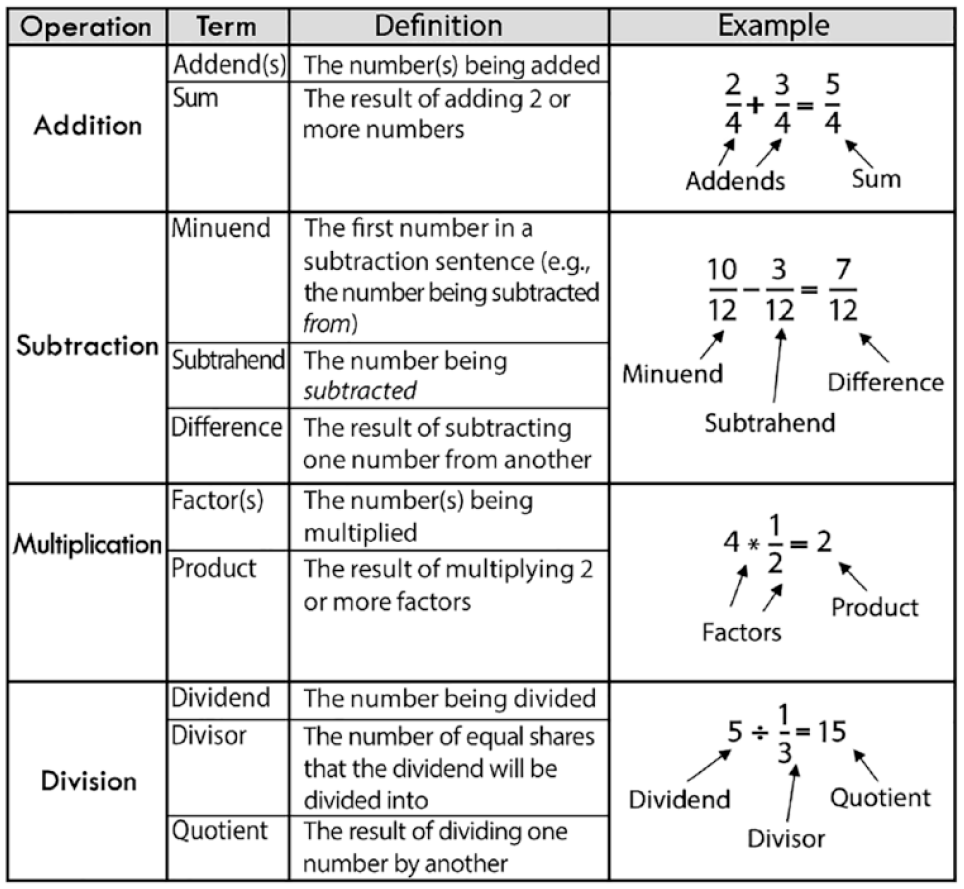
Key Arithmetic terms and concepts across operations
Addition and Subtraction
Number Line Representations of Fraction Addition and Subtraction
Fraction addition and subtraction are critical skills for students to master in the upper elementary grades. In the CCSSI (2010) for Mathematics, students are expected to understand the meaning of fraction addition and subtraction by the end of Grade 4 and apply procedural knowledge to solve fraction addition and subtraction problems by the end of Grade 5. In later grades, a strong understanding of fraction addition and subtraction is necessary to access instruction in more advanced rational number topics and other mathematical domains, such as algebra. In addition, rational number addition and subtraction are utilized in many everyday activities, such as cooking, driving, shopping, and managing finances. Unfortunately, many students struggle to master fraction addition and subtraction, especially those with LD in math (Lortie-Forgues et al., 2015). While the underlying meaning of these operations is consistent with students’ whole number arithmetic knowledge, the procedures are more complex, requiring students to understand how the numerator and denominator work together (Dyson et al., 2020; Van de Walle et al., 2019). For problems involving fractions with unlike denominators, the need to find equivalent fractions with a common denominator adds additional complexity (Barnett-Clarke et al., 2010).
To support students with LD in math, it is recommended that teachers utilize varied mathematical representations to build students’ understanding of the operations underlying fraction addition and subtraction (Fuchs et al., 2021; Hudson & Miller, 2006; Roesslein & Codding, 2019). Incorporating the number line as a visual representation of fraction addition and subtraction is consistent with both the research literature and expert recommendations for providing fractions instruction more broadly and intervention supports for struggling learners (Barnett-Clarke et al., 2010; Fuchs et al., 2021; Van de Walle et al., 2019). This approach also aligns with the developmental progression outlined in the CCSSI for Mathematics (2010), in which students are expected to understand and represent fractions as numbers with unique magnitude on the number line beginning in Grade 3. Number lines can be used to reinforce the idea that fractions are composed of unit fraction “building blocks” (e.g., the fraction
Using Number Lines in Fraction Addition and Subtraction Instruction
When fraction addition and subtraction are introduced, teachers should use number line representations to support conceptual understanding of these operations. An important goal is to build upon prior knowledge of the meaning of addition (i.e., combining, putting together) and subtraction (i.e., taking away, comparing) to help students with LD in math understand fraction arithmetic as a natural extension of whole number computation that allows them to solve new types of problems (Barnett-Clarke et al., 2010). Initial examples should consist of familiar, easily understood fractions (e.g.,
Addition and Subtraction With Like Denominators
Problems involving addition and subtraction of fractions with like denominators are introduced first in the CCSSI (2010) for Mathematics. Teachers can represent these problems on a single 0–1 or 0–2 number line partitioned into intervals that represent the unit fraction (e.g., halves or fourths; Fuchs et al., 2021). To represent addition problems, teachers should first identify and mark the starting fraction (i.e., the first addend) on the number line, then count forward along the number line by unit fraction intervals to find the sum. For example, to represent the problem
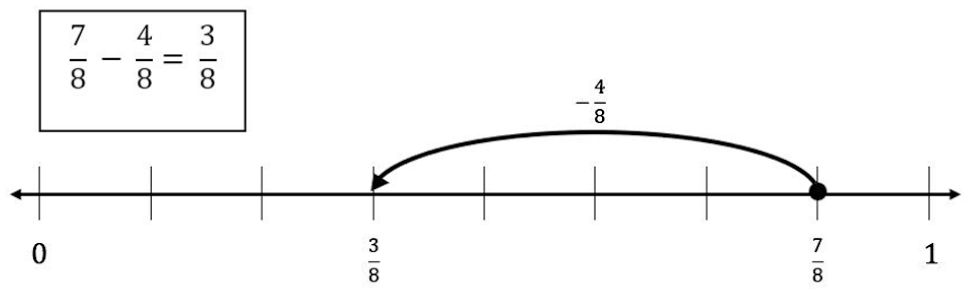
Using a number line to represent subtraction of fractions with like denominators.
Addition and Subtraction With Unlike Denominators
Once students have developed a sound understanding of addition and subtraction involving fractions with like denominators, teachers should introduce problems involving addition and subtraction of fractions with unlike denominators. Teachers can represent these problems on a pair of “stacked” number lines, one directly above the other, as shown in Figure 3 (Fuchs et al., 2021). Teachers should represent each fraction on its own number line partitioned into intervals that represent its unit fraction. For example, to represent the problem
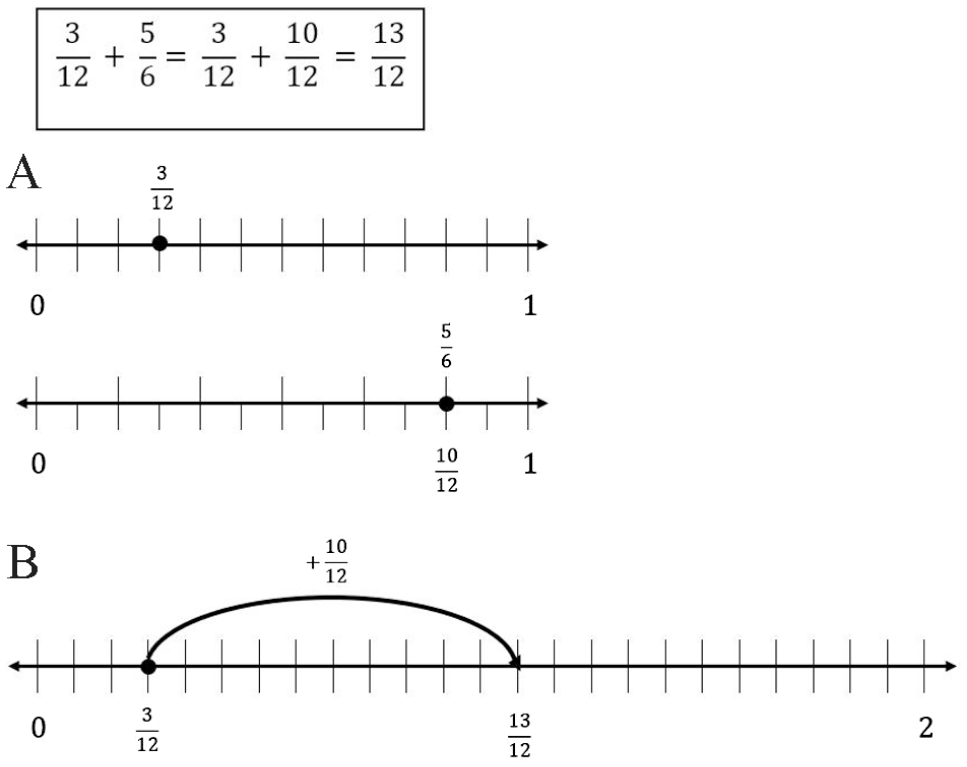
Using number lines to represent addition of fractions with unlike denominators.
Next, teachers should model finding a common denominator and equivalent fractions, partitioning one or both number lines so that the unit fraction intervals align. In the above example, a teacher could guide students to identify the common denominator, 12, by noting that the hash mark representing
Multiplication
Number Line Representations of Fraction Multiplication
Multiplication as Repeated Addition
As with fraction addition and subtraction, multiplication with whole numbers provides the conceptual foundation for fraction multiplication; it is therefore critical that students develop strong conceptual understanding of this prerequisite skill before fraction multiplication is introduced (Jordan et al., 2017; Otto et al., 2011). Central to the idea of multiplication with whole or rational numbers is understanding multiplication as repeated addition of a unit (Bagley et al., 2022). The concept of iteration, in which a unit is laid end-to-end along the length of an object, forms the basis for understanding length measurement (CCSSI, 2010; National Research Council, 2009). For this reason, the repeated addition representation of multiplication is often referred to as a measurement model, and is closely aligned with number line representations of multiplication in which students can see the “jumps” along the number line when the same number is added multiple times. For example, when multiplying
Multiplication as Scaling
However, this interpretation is not as useful for understanding problems involving multiplication of a fraction by another fraction (e.g.,
Challenges in Learning Fraction Multiplication
Fraction multiplication also introduces several unique challenges for students, especially for those with LD in math. Prior to engaging in multiplication with fractions, students will have learned the rule that multiplication leads to a product greater than either factor (Otto et al., 2011). When multiplying a whole number by a fraction, the product will be less than the whole number factor (e.g.,
Using Number Lines in Fraction Multiplication Instruction
Building students’ conceptual understanding of fraction multiplication should be a primary focus of early instruction in this domain. One way to build conceptual understanding of fraction multiplication is to use accessible word problems so that the factors and the resulting product are meaningful. Teachers should start by using familiar unit fractions (e.g.,
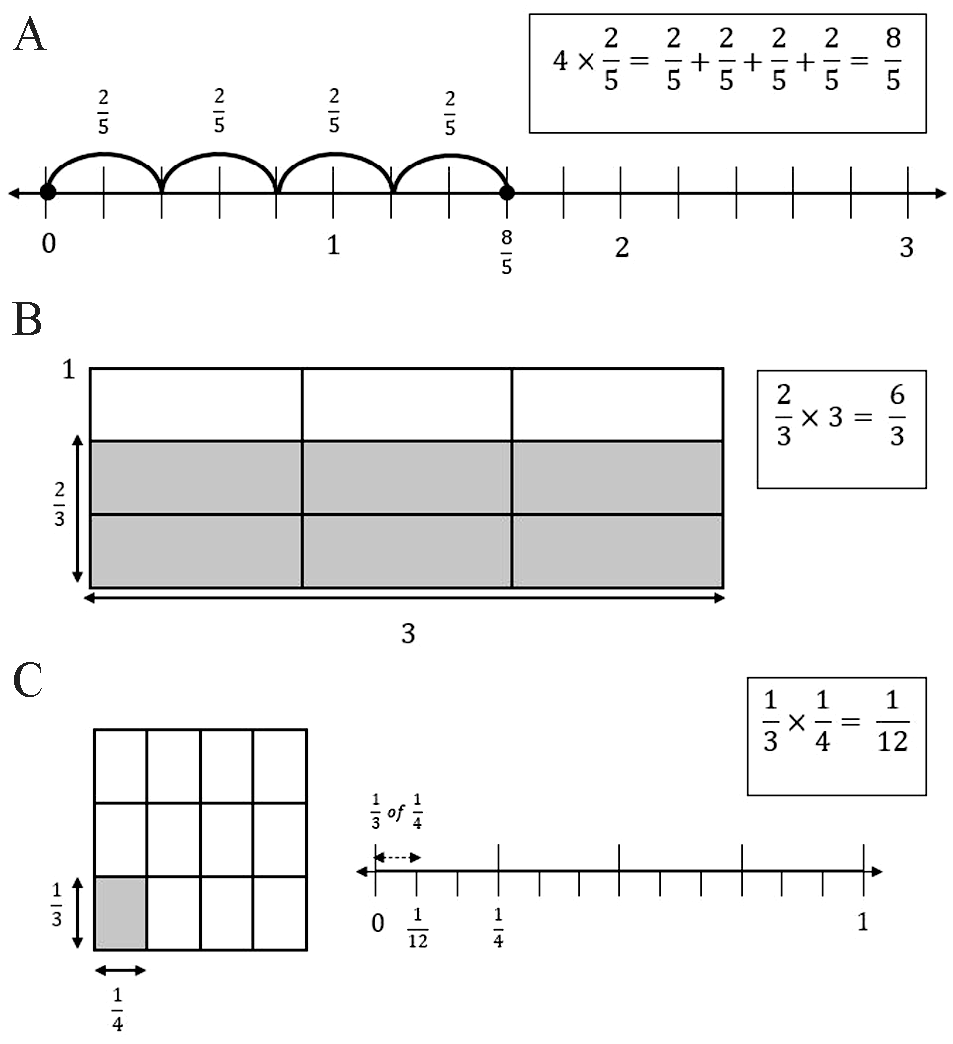
Number line and area model representations of fraction multiplication.
Multiplying a Fraction by a Whole Number
In addition to integrating fraction multiplication in the context of word problems, teachers should be strategic about the type and order of problems they introduce. Fraction multiplication spans several types of problems, including multiplying a whole number by a fraction or a fraction by a whole number, and multiplying a fraction by a fraction. The CCSSI for Mathematics (2010) introduce multiplication of a fraction by a whole number (e.g.,
Multiplying a Whole Number by a Fraction
Next, students should be exposed to problems that multiply a whole number by a fraction (e.g.,
Multiplying Two Fractions
The final type of fraction multiplication problem introduced involves multiplication of a fraction by another fraction (e.g.,
Division
Number Line Representations of Fraction Division
Division as Equal Partitioning
Mirroring the learning sequence and developmental progression of whole number arithmetic, division is the last of the fraction arithmetic operations to be introduced (Barnett-Clarke et al., 2010). Typically, students first learn to solve problems involving a whole number divided by a unit fraction (or vice versa) in Grade 5. Problems involving a fraction divided by another fraction are introduced later in Grade 6 (CCSSI, 2010). Of the four arithmetic operations, developing conceptual understanding of division with fractions is the most challenging (Barnett-Clarke et al., 2010). A common interpretation of division with whole numbers as equal sharing or partitioning provides a foundation for understanding problems involving division of a fraction by a whole number. For example, the problem 12 ÷
Division and the Measurement Model
However, this interpretation does not translate well to problems involving a fraction divisor (e.g.,
Challenges in Learning Fraction Division
The standard algorithm for solving fraction division problems by inverting the divisor and multiplying is complex and poorly understood among teachers and students alike (Barnett-Clarke et al., 2010). As a result, instruction in fraction division often focuses heavily on procedural knowledge, and student errors in this area often reflect a lack of understanding of the steps underlying the algorithm (e.g., inverting the dividend instead of the divisor; Siegler et al., 2010). To promote student proficiency with fraction division, it is essential to build conceptual understanding with visual representations that help students with LD in math visualize the underlying operation to link the procedure to its underlying logic (Jayanthi et al., 2021; Shin & Bryant, 2015). The number line is well suited to modeling fraction division as how many times the divisor “goes into” the dividend. Similar to fraction multiplication, fraction division challenges a previously learned rule that division typically yields a quotient that is less than the dividend. When dividing a whole number by a fraction, the answer is greater than the dividend (e.g.,
Using Number Lines in Fraction Division Instruction
When fraction division is introduced, the primary instructional focus should be supporting struggling learners in developing conceptual understanding that builds on prior knowledge of division with whole numbers. As with multiplication, one way to build students’ understanding is to present fraction division problems in easily understandable contexts (Shin & Bryant, 2015). For example, using word problems that reflect familiar, real-world situations involving fractions, such as measuring with a ruler, cooking, or traveling a distance, gives meaning to the dividend, divisor, and quotient in a problem, as well as the relationships between these quantities (Fuchs et al., 2021; Siegler et al., 2010). It is also recommended that initial examples involve common unit fractions, such as
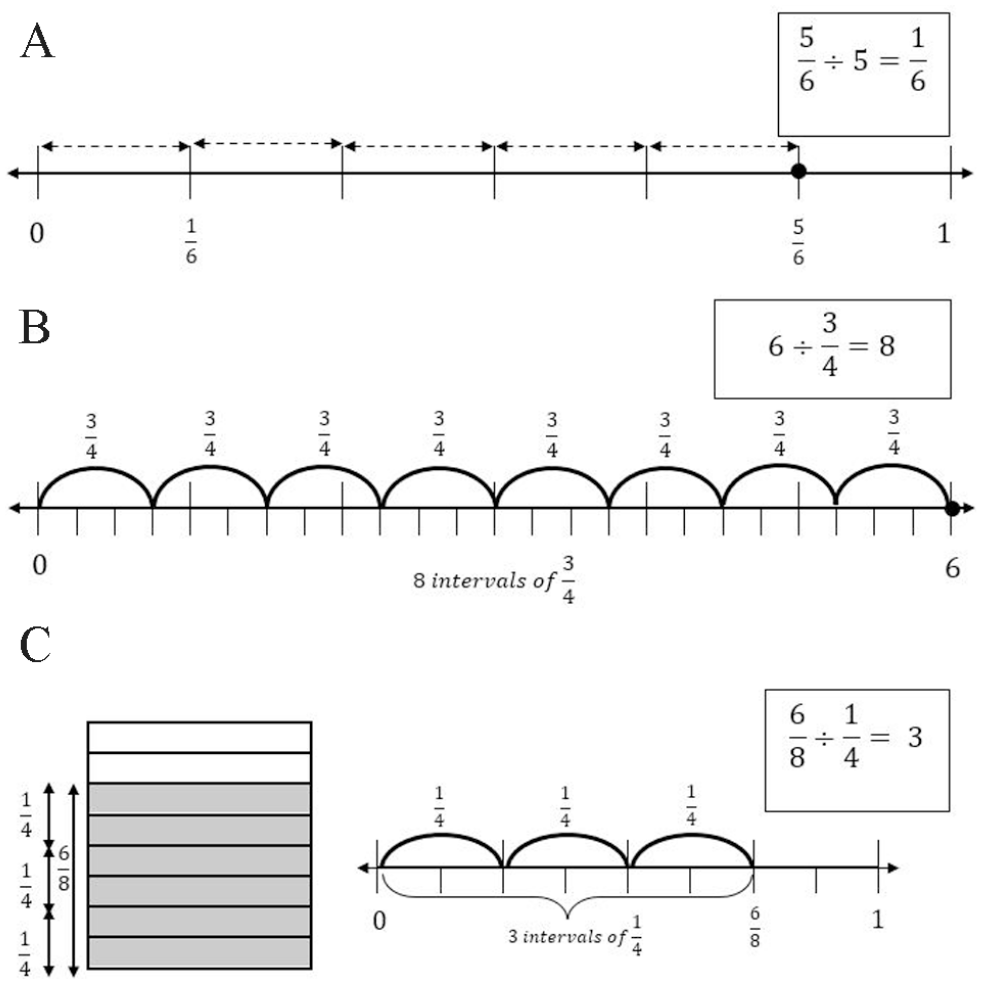
Number line and area model representations of fraction division
Dividing a Fraction by a Whole Number
As with multiplication, fraction division spans several types of problems that vary in difficulty, and teachers should be strategic about how various representations are used to introduce each problem type. Problems dividing a whole number by a fraction or dividing a fraction by a whole number are introduced earlier in the CCSSI for Mathematics (2010), are easier for students to understand conceptually, and are effectively represented on the number line (Fuchs et al., 2021). To build struggling learners’ conceptual understanding of problems that divide a fraction by a whole number (e.g.,
Dividing a Whole Number by a Fraction
Students should also be exposed to problems that divide a whole number by a fraction (e.g.,
Dividing a Fraction by a Fraction
The final type of fraction division problem involves division of a fraction by another fraction (e.g.,
Conclusion
The number line is a powerful visual representation that can be strategically integrated throughout fraction instruction to help struggling learners make sense of key fraction concepts and skills, including fraction arithmetic (Fuchs et al., 2021). Number line models are especially beneficial for students with LD in math, as they can be used across the mathematics curriculum to support development of a mental number line and understanding of how fractions expand the familiar whole number system (Jordan et al., 2017; Siegler et al., 2011). Beginning in Grade 4, teachers can use the number line to model addition and subtraction of fractions, first with like denominators then with unlike denominators, building conceptual understanding of these operations and illustrating the need to find equivalent fractions with a common denominator. Later, teachers can use the number line to represent the operations underlying fraction multiplication and division, building upon prior knowledge of whole number arithmetic to help students with LD in math understand the meaning of these operations with fractions. Representing fraction multiplication and division on the number line may also support student understanding of how the relationships between terms in an equation vary with the magnitude of each term. Teachers can incorporate number line models, along with other mathematical representations, throughout fraction instruction to build fraction sense and proficiency with fraction arithmetic among students with LD in math, setting them up for success in later mathematics instruction and in everyday life.
Footnotes
Declaration of Conflicting Interests
The author(s) declared no potential conflicts of interest with respect to the research, authorship, and/or publication of this article.
Funding
The author(s) received no financial support for the research, authorship, and/or publication of this article.
