



Abstract
Business communication students should be taught how to innovate because the ability to do so is an important skill for business success. Despite knowing that business communication students need to learn how to innovate, instructors are not always equipped with the proper tools to teach students how to innovate based on sound principles. This article provides one such tool by translating the scholarship of teaching and learning (SoTL) principles into specific practices designed to help students innovate. By understanding these practices, instructors will be well-equipped to foster student innovation in their own classrooms based on SoTL principles.
Keywords
The most important aspect of a business is arguably innovation—“an idea, practice, or object that is perceived as new” (Rogers, 2003, p. 12). Innovation is important for the survival (Ortiz-Villajos & Sotoca, 2018) and competitiveness (Löfsten, 2014) of a business, and an innovative business can provide opportunities for all levels of employees to contribute to the business's success through their innovative ideas (Clark, 2022). Further, business innovation is a significant factor in the prosperity and well-being of society. As Ahlstrom (2010, p. 11) argued, “Innovative, growing firms generate economic growth and employment, which, in turn, greatly improves people's lives.” Business innovation is thus a means of creating “shared value” (Porter & Kramer, 2006, p. 5) for business and society because innovation is mutually beneficial for both.
Thus, because innovation is so important for the success of both business and society, business communication students should learn how to innovate. Previous scholars have noted the importance of education for innovation (e.g., Leiponen, 2006; Neely & Hii, 1998; Ortiz-Villajos & Sotoca, 2018; Reave, 2002). The educational environment provides business communication students with a unique opportunity from which they can learn how to be innovative—and this includes learning how to fail and then try again with their innovations. By fostering an educational environment where business communication students learn to innovate, instructors will enable students to graduate with the skills needed to immediately contribute to innovation at their workplace and thus become a vital part of their business's success.
Despite knowing that business communication students need to learn how to innovate, instructors sometimes lack the proper tools to teach them how to innovate based on sound principles. I provide one such tool here by translating the five scholarship of teaching and learning (SoTL) “principles of good practice” (Felten, 2013, p. 121) into specific and concrete practices that business communication classrooms seeking to foster student innovation can apply and assess. The value of the SoTL is clear “in business and management” because such scholarship “enhances both teaching practice and knowledge creation and may help narrow the either–or divide between teaching and research” (Asarta et al., 2018, p. 732); however, the value of practically implementing the SoTL principles in a business communication class focused on student innovation is less clear. Thus, in this article, I provide a conceptual model that moves the SoTL principles from general guidelines for any type of student learning to specific practices for increasing student innovation in business communication classes.
I start by defining “innovation” and justifying why innovation is important for businesses. Then I overview the SoTL principles, including how to implement these principles into specific practices. Finally, I use an assignment from Reave (2002) to exemplify how these specific practices can be applied and assessed in a classroom assignment. Overall, my aim here is to provide instructors with knowledge about how to implement student innovation in their classrooms based on specific practices translated from the SoTL principles so that they can apply that knowledge to help develop new—or improve existing—assignments that teach students how to innovate.
What Is Innovation and Why Should Students Learn to Innovate?
What innovation is and why it is important for business have both been well supported by the literature, so I will give just a brief overview now on the definition of innovation and the justifications for why students should be taught to innovate.
Defining Innovation
In a broad sense, innovation is the “generation of novel combinations from existing knowledge” (Leiponen, 2006, p. 239). It “involves change—change in practice, product, technology or market” (Mole & Worrall, 2001, p. 354)—that is brought about by new ideas. Ideas—the “bedrock of innovation” (Neely & Hii, 1998, p. 4)—are necessary not only for developing or improving new products but also for improving or creating new business models (Geissdoerfer et al., 2018), processes (Ortiz-Villajos & Sotoca, 2018), and services (Leiponen, 2006).
One way to understand innovation is by examining the extent to which an innovation is new. Some innovations are completely new ideas, processes, or technologies: These innovations are called radical innovations. Other innovations are partially new ideas, processes, or technologies: These innovations are called incremental innovations. As Mole and Worrall (2001, p. 354) noted, “Most writers distinguish between radical and incremental innovation, where radical innovations are new technologies or new products that fill needs perhaps yet unrecognized; and incremental innovations improve what already exists.” For example, in a business communication setting, a radical innovation would be the integration of artificial intelligence (AI) to create job advertisements whereas an incremental innovation would be a gradual improvement to this AI so that the job advertisements are more precise or effective than when the AI was first introduced.
Innovations, then, are ultimately about ideas, but these ideas can be either radical or incremental. As Andrews (2004, p. 265) put it, a “major factor in innovation is thinking across borders, or perhaps sans frontières, without borders at all.” Whether radical or incremental, innovations are often created from thinking without limitations, and innovations are important for any business; thus, innovations should be taught.
Justifying the Teaching of Innovation
A case can persuasively be made that innovation is one of the most important aspects of a business. Evan and Black (1967, p. 519) argued that although innovation is present in various types of organizations, “it is probably more commonly observable in a business organization where the environment is a compelling force for adaptation of the organization to new developments.” Businesses need innovation to keep pace with other competing businesses, to attract employees, and to maintain and grow a customer base; therefore, business communication students should learn to innovate.
The reasons why business communication students should be taught innovation are many, and I will highlight a few here. First, innovation is important for a business to survive because it allows a business to adapt to an ever-changing society, one in which competition with other businesses is ever-present. Ortiz-Villajos and Sotoca (2018, p. 1418) argued that how long a business survives is “a clear indicator of business success … [and] [a]mong the variety of factors considered to influence business longevity, innovation is a prominent one.” Second, businesses must innovate to be competitive (e.g., Leiponen, 2006; Löfsten, 2014; Neely & Hii, 1998). For example, Löfsten argued that innovation is especially needed due to continual technological advancements. For businesses to be competitive, then, they must keep up with other businesses that are incorporating technology—such as AI—into their business models. To do so, they need to innovate—but they should innovate in a way that allows for humans and technology to work together for the success and continuation of society.
Third, innovation helps give a voice to everyone in the organization. Although the ideas of those higher in the organizational hierarchy might be viewed as more valuable, Clark (2022) argued that many good ideas can come from those lower in the organizational hierarchy. Further, Moosa and Panurach (2008, p. 4) pointed out that their “assessment is that front-line employees, those closest to the customers and the work of delivering the products and services, have some of the freshest ideas and insights.” And fourth, business innovation is important for a thriving society. Ahlstrom (2010, p. 17, 21) argued that innovation allows for economic growth, and this growth helps provide a variety of societal benefits, including longer life expectancy, better purchasing power, less poverty, “declines in illiteracy,” and “declines in … child labor rates.” Indeed, Ahlstrom maintained, “many studies have shown that a large and rising share of economic growth in recent decades—and with it living standards—is derived from innovation.”
Overall, innovation can help businesses survive, compete, improve employee involvement, and provide economic growth to society. Although those are not the only reasons why innovation is important, they are enough to warrant teaching business communication students not only the importance of innovation but also how to innovate. The educational setting, then, should provide a learning environment for business communication students to try, fail, and succeed at innovation.
Although all business students would benefit from being taught how to innovate, business communication students need to be especially well-versed in innovation because of all the technological changes that are affecting communication in businesses. AI, in particular, is an obvious innovative technology that will have a significant effect on businesses, so business communication students will need to be able not only to understand AI but also to be innovative in using it to help businesses succeed. In addition, business communication students need to be taught how to innovate so that they can be valuable employees in spaces that require innovation to stay competitive, including photography and brand design, social media, and proposal writing, to name but a few. Thus, there is extrinsic value for business communication students to learn how to innovate according to sound principles because it will help them stay competitive and contribute value in their future employment.
Innovation in the Classroom: How to Foster Student Innovation Using the SoTL Principles
I have briefly examined what innovation is and why students should learn to innovate. Now I will turn to the main contribution of this article: how to foster student innovation in a business communication classroom through specific practices based on the five SoTL “principles of good practice” (Felten, 2013, p. 121). Although they may be understood as being more of a guide for researching student learning than a guide for teaching student learning, I use the SoTL principles of good practice here to discuss ways in which instructors can teach students to innovate in a business communication classroom by adhering to those principles. In the next few paragraphs, I briefly define the SoTL principles, including a description of how each principle can be translated into a specific practice following my conceptual model for implementing the SoTL principles in the classroom (see Figure 1). Business communication instructors can then use this model to foster student innovation in their classrooms.
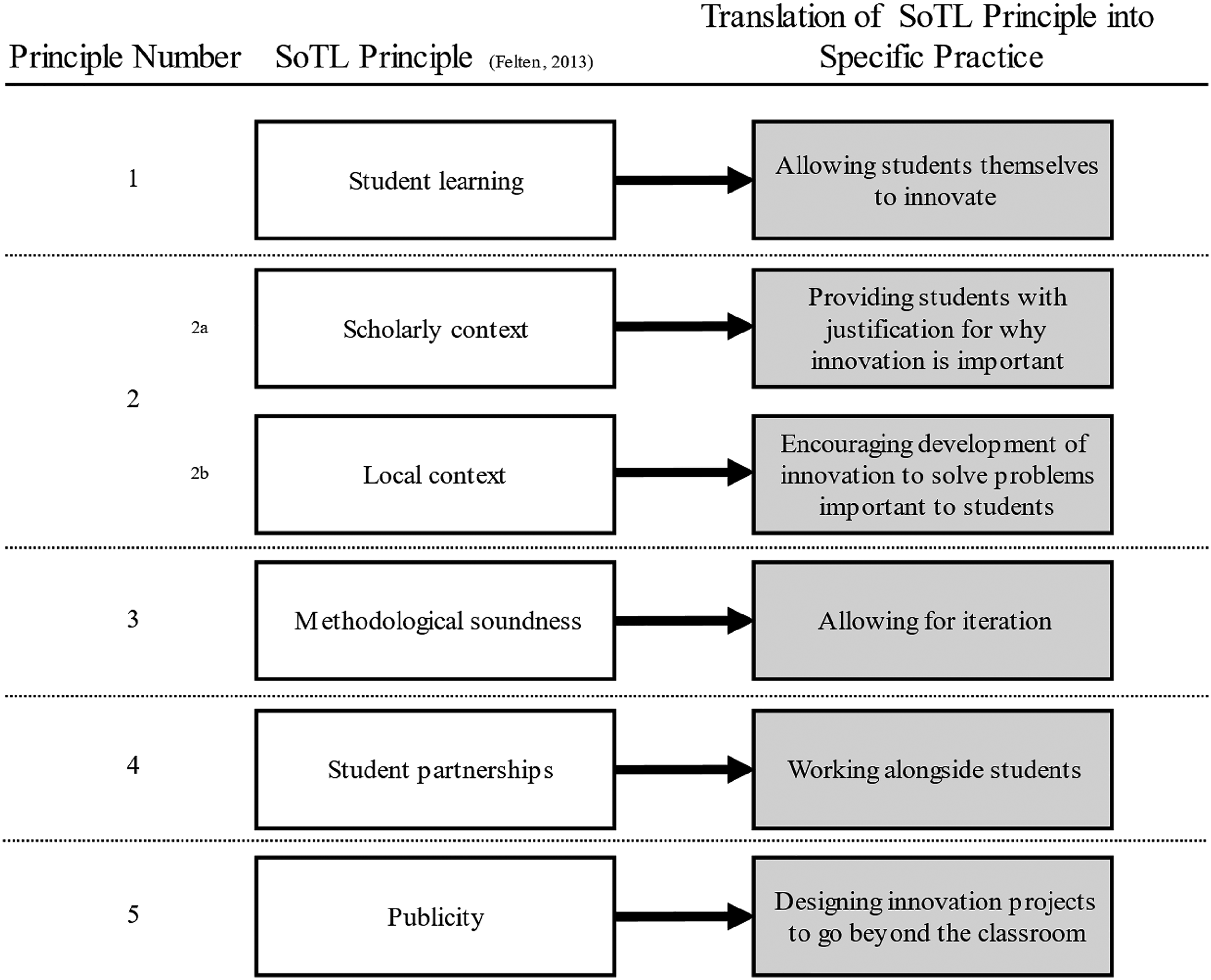
Conceptual model for implementing the SoTL principles in the classroom.
The first SoTL principle “is inquiry focused on student learning” (Felten, 2013). Felten argued that this principle can be applied by examining “how a teaching and teachers influence student learning” (p. 122). One way that teachers can affect student learning is by creating an environment where business communication students learn how to innovate through activities and assignments. That is, business communication students learn about innovation by being innovative themselves. Thus, the first SoTL principle is student learning, and it translates into the specific practice of allowing students themselves to innovate.
The second SoTL principle “is grounded in both scholarly and local context” (Felten, 2013, p. 122). Having business communication students learn how to innovate adheres to both aspects of this SoTL principle. Scholarly articles—as I have overviewed here—support the idea that innovation is important, especially for businesses because of their omnipresent competitiveness. Having students innovate is also contextualized locally because the students themselves develop the innovation and thus bring to their innovations their own backgrounds and experiences. The second SoTL principle is therefore broken into the (a) scholarly context and (b) local context, and these contexts translate into the specific practices of (a) providing students with justification for why innovation is important and (b) encouraging development of innovation to solve problems important to students, respectively.
Felten (2013) described the third SoTL principle as one that is focused on “methodologically sound” practices (p. 123). This principle is obviously intended for researching student learning, but it can still be used for teaching student learning if instructors apply it to innovation assignments that are iterative. For example, in an assignment that applies Yilmaz's (2022) design thinking—a “problem-solving process” that “provides an iterative and cyclical framework with tangible tools for in-depth contextual understanding of a problem” (p. 218)—students create projects that are modified based on the feedback of others. Innovations are not just created and then set aside; instead, innovations should be developed through a feedback loop of create–modify–create–modify. This iterative process itself represents a method toward developing an innovation, and the way students gather feedback on their innovations can also be done in a “methodologically sound” way. The third SoTL principle, then, can be applied to teaching students to innovate by teaching them to use such methodologically sound processes. Thus, the third SoTL principle is methodological soundness, and it translates into the specific practice of allowing for iteration.
The fourth SoTL principle is “partnering with students in inquiry” (Felten, 2013, p. 123). Instructors can partner with business communication students on the thinking, development, and refinement of their innovations. The nature of innovation means that students are creating something new—either radically new or incrementally new—so the instructor will be learning from the students about their innovations. Instructors can add constraints and directionality to the students’ innovations to make them feasible and doable within the time frame that students are given. I suggest that students have specific class times to work on their innovations so that they can receive feedback from their instructor. Although these are the students’ innovations, they are completed in a learning environment, so even if the instructor does not “partner” with the students on their innovations, the instructor will still be involved in the innovation. Accordingly, the fourth SoTL principle is student partnerships, and it translates into the specific practice of working alongside students.
The fifth SoTL principle “involves ‘going public’” (Felten, 2013, p. 123). The innovations that business communication students develop can be presented publicly by having university faculty and staff—or even community business members—come to their innovation presentations. Even if students do not conduct such presentations, their innovations will be designed to go beyond the university walls, and in this way, the innovations are designed to go public even if they never actually do. That is, the student innovations are intended to go public. This fifth SoTL principle, then, is about publicity, and it translates into the specific practice of designing innovation projects to go beyond the classroom.
I suggest that instructors use the SoTL principles as a tool for teaching students how to innovate because they are a holistic yet concise framework from which specific innovation practices can be derived. Several—if not all—of these SoTL principles can also be found in pedagogical literature. For example, the first SoTL principle (student learning) is found throughout the pedagogical literature (e.g., Fry et al., 2009; Laurillard, 1979), and the fifth principle (publicity) is similar to service learning pedagogy (e.g., Bringle & Hatcher, 1996; Salam et al., 2019). The fact that SoTL principles can be found in the pedagogical literature further supports the utility and soundness of these principles.
In summary, my conceptual model (see Figure 1) concisely shows how each SoTL principle can be translated into specific practices designed to help students innovate. To explain each of these specific practices further, I will overview a specific assignment designed to foster student innovation from Reave (2002). Then I will assess how well Reave's assignment follows the specific practices. I use Reave's assignment only to illustrate how the specific practices can be implemented in assignments designed to foster student innovations. Although instructors will likely have other assignments (or know of other assignments) that are designed to encourage student innovation, I use Reave's assignment to show instructors how the specific practices can be implemented in a specific assignment and to provide them with an example of how to assess such an assignment to see how well it implements those practices. I encourage instructors to take the knowledge learned through this specific example and apply it to their own assignments designed to foster student innovation—both to assignments they are already using and to new assignments they are developing. In so doing, instructors will create an environment in which students will innovate according to specific practices derived from the SoTL principles.
An Overview of The Internal Proposal Assignment
In the article, “Promoting Innovation in the Workplace: The Internal Proposal,” Reave (2002) presented an assignment that teaches students how to write an effective internal proposal. Reave argued that employers want employees to come up with new ideas that can help improve the organization. But in order for the new idea to catch on, employees must be able to come up with a good new idea and—perhaps most important—convincingly argue for the new idea. Reave proposed that one way that students can learn how to present and argue for a new idea is by learning how to develop a good internal proposal.
An internal proposal is a written document that outlines a new idea to help improve an organization. Reave (2002, p. 9) gave examples of past internal proposals that students had written, including proposals for “new equipment purchases such as new forklifts, new computers, or new security systems. They have suggested improved inventory and ordering processes, new hiring procedures, and new scheduling systems.” Reave had students think about a problem faced by an organization they are involved in and then write an internal proposal that presents an idea for solving the problem.
The internal proposal contains several sections and subsections, each overviewed by Reave (2002), with the main sections being the introduction, body, and conclusion. In the introduction, students briefly overview what the problem is and how the proposal seeks to solve that problem. The introduction has several important subsections: the background and purpose; main problem, need, or opportunity; and proposal and main support. For example, in the proposal and main support subsection, the student writes “one sentence … describ[ing] the proposal and its main benefit” (p. 14). In the body of the internal proposal, students give details about seven key subsections: problem/need analysis, proposal benefits, plan and schedule, budget/cost analysis, staffing, opposition, and alternatives. For example, in the opposition subsection, the student “addresses existing opposition arguments or anticipates potential objections” (p. 16). In the conclusion, students present the urgency of the proposal and ask for the go-ahead to conduct the action that they are proposing. Reave delineated two important subsections for the conclusion: request for action or approval and end date/deadline. For example, the request for action or approval “should be clear and specific, requesting authorization to begin the project” (p. 17).
Assessment of the Internal Proposal Assignment Based on the Specific Practices Translated From the SoTL Principles
In the following assessment of Reave's (2002) assignment, I examine how well it implements each of the five principles of SoTL, make clear what the implementation of these principles looks like when done well, and suggest how their implementation can be improved. Although Reave's assignment was not originally intended to follow the SoTL principles, it can be assessed by them. In the same way, any assignment—not just Reave's—designed to foster student innovation can be assessed similarly by how well it implements the SoTL principles.
Allowing Students Themselves to Innovate (Translation of SoTL Principle 1)
The internal proposal assignment allows students themselves to innovate because they write their own proposals based on issues relevant to the organizations the students are involved in. Reave (2002) noted that “students appreciate writing within this clear structure, which allows them to focus on developing and supporting their creative ideas” (p. 17). Instead of being a summary of other people's ideas or thoughts, these internal proposals are the creative ideas—the innovations—of the students and thus fulfill the implementation of the first SoTL principle because students are learning to innovate by doing innovating.
Providing Students With Justification for Why Innovation Is Important (Translation of SoTL Principle 2a)
In the article itself, Reave (2002) provided justification for why the internal proposal is important, but it is unclear how much justification Reave provided to students about why the internal proposal is important. Reave does review previous proposals with students, pointing out the “strengths and weaknesses of each proposal” (p. 13), but this review serves to explain how to write the internal proposal more than to justify why the proposal should be written. Thus, to implement the first part of the second principle of SoTL, the instructor needs to provide students with a justification for the assignment by explaining the scholarly context that buttresses the need for the internal proposal and for students to learn how to creatively write such a proposal.
Encouraging the Development of Innovation to Solve Problems Important to Students (Translation of SoTL Principle 2b)
The internal proposal certainly implements the second part of the second SoTL principle, which focuses on having the innovation solve problems significant to the students themselves. As Norton and Hale (2011) argued, “to minimize frustration and maximize innovation potential, students must be trained to constrain searches to domains in which they possess specific knowledge” (p. 811). Reave (2002) has students think about a problem or need that they have noticed at work (or school or volunteer organizations, for those students with little work experience), or some change that they have often wished would be made. They must demonstrate that the idea is not a personal issue, but an issue for the organization. (p. 12)
For Reave's assignment, then, students are specifically instructed to solve a problem that is relevant to them. Reave argued that having the internal proposal be relevant to the students is important because students will be “more motivated,” “better qualified,” and “learn more” (p. 9) through these tailored proposals.
Allowing for Iteration (Translation of SoTL Principle 3)
Allowing for iteration is one aspect of Reave's assignment that could be improved in order to better implement the third SoTL principle. Students are given clear instructions on what to include in the proposal and shown example proposals, but there is limited evidence that students are allowed to modify their proposals after submitting them or given draft proposal workshops where they can get feedback from their peers and instructor on their ideas. Yilmaz's (2022) assignment is a good example of how to allow for iteration when developing an innovation. In addition, incorporating iteration would be easy to do in Reave's assignment; for example, students could submit their proposals to their organizations for feedback and then modify the proposals based on that feedback.
Working Alongside Students (Translation of SoTL Principle 4)
There is some evidence that Reave (2002) does work alongside students on their internal proposals. For example, Reave stated, “I suggest that students check with me first if they have any doubts about their subject so that I can suggest modifications” (p. 12). Here, Reave is helping students with their ideas, making sure that these ideas are suitable and not “too broad” (p. 12); however, because the internal proposals are somewhat lacking in the implementation of the third SoTL principle (i.e., allowing for iteration), this fourth SoTL principle is also somewhat lacking in Reave's assignment. That is, implementing the third SoTL principle can help in implementing the fourth principle because allowing for iteration helps the instructor provide multiple instances of feedback to the students, which in turn makes the instructor a partner with the students on their innovations.
Designing Innovation Projects to Go Beyond the Classroom (Translation of SoTL Principle 5)
The internal proposals are designed to go beyond the classroom, thus excellently implementing the fifth SoTL principle. Reave (2002) specifically pointed out that “I ask students to write the assignment as though they were actually going to submit the proposal within the organization” (p. 13) and that “many students actually submit their proposals within their organizations, allowing the students to see some real-world results” (p. 9). Reave's assignment, then, shows how student innovations can be—and are—used in a capacity outside the classroom. But even if students’ innovations are never implemented by their organizations, they are designed to be used by the organizations and thus implement the fifth SoTL principle.
In summary, Reave's (2002) internal proposal assignment implements three of the SoTL principles well: by allowing students themselves to innovate (Principle 1), encouraging students to develop innovations that solve problems important to the students (Principle 2b), and being designed to go beyond the classroom (Principle 5). Reave's assignment can further align with the implementation of SoTL principles if instructors provide justification for why the proposals are important (Principle 2a), allow the proposals to go through several iterations (Principle 3), and increase how much they work alongside students on their proposals (Principle 4).
Reave's (2002) assignment, then, exemplifies how to implement an assignment that fosters student innovation and how to assess the assignment according to the SoTL principles. Whether or not they use Reave's assignment, instructors who wish to foster student innovation should find it useful to know how to both implement and assess the SoTL principles. Instructors can use the SoTL principles and their implementations when assessing any assignment designed to foster innovation or when designing their own innovation assignments.
Conclusion
Fostering an environment in which students learn to innovate aligns with the SoTL principles. Specifically, student innovation in a business class can be focused on student learning, scholarly and locally based, methodologically sound, done in partnership with the instructor, and intended for public use. When put into practice, these principles should provide a fertile environment from which business communication students can learn and implement innovation.
This article provides a starting place to turn to for instructors of business communication who want to foster student innovation in their classrooms. Because innovation will remain a vital part of business success, teaching students how to innovate will help them be better prepared for their future careers in business. Teaching students how to innovate will also help society because society benefits from business innovation—both from the actual outcomes that innovation produces and from the economic growth caused by innovation. Thus, one crucial outcome of business communication students’ education is their ability to innovate, an outcome that this article should help instructors justify, implement, and assess.
Footnotes
Declaration of Conflicting Interests
The author declared no potential conflicts of interest with respect to the research, authorship, and/or publication of this article.
Funding
The author disclosed receipt of the following financial support for the research, authorship, and/or publication of this article: This article was supported by a Penn State Hazleton Research Development Grant.
