



Abstract
This paper sets out the motivation for structural power composites: structural materials imbued with the capability to store and deliver electrical energy. The conception and development of structural supercapacitors at Imperial College London is described, with current devices now starting to approach the performance of conventional ‘monofunctional’ composite laminates and supercapacitors. Although these materials could offer tremendous lightweighting and energy storage benefits, there are considerable research challenges yet to be addressed. Melding of composite mechanics and electrochemistry disciplines leads to a daunting research landscape, so the effort has been partitioned into four themes: Constituent Development, Device Assembly and Characterisation, Multifunctional Modelling and Design and Scale-Up and Demonstration. This paper culminates by setting out, for each theme, where future research should focus to advance this exciting technology.
Introduction
Structural power composites are an adventurous engineering material development that offer novel solutions for both lightweighting and energy storage. These materials are mechanically load-bearing composites with the additional function of electrical energy storage. Their development presents considerable challenges although the potential rewards are enormous. They will not only deliver significant savings in mass and volume but provide a completely new and exciting approach to innovating with structural composites. For instance, by providing auxiliary power they could halve the conventional battery requirements for a fully electric airliner from 1400 to 700 Wh/kg, making what was originally seen as only achievable at the end of this century to within reach with the current pace of battery developments (Karadotcheva et al., 2021). In considering the conception of this technology, two principal types of energy storage devices were considered: batteries and supercapacitors. The former offers high energy densities but poor power densities with limited cycle life whilst the latter have good longevity and power but are limited in their energy storage capacity. The focus of the research undertaken by the Group at Imperial has been on supercapacitors, since these were considered the better device for addressing scale-up to large demonstrators. Moreover, there are many ‘generic’ issues for structural power composites which are common to both batteries and supercapacitors. These issues include structural electrolyte development, separators, current collection, encapsulation and multicell design and assembly. The aspiration is that addressing and resolving these issues for structural supercapacitors will accelerate their resolution for structural batteries.
Structural supercapacitor development
As illustrated in Figure 1, the focus of the research at Imperial College London has been to advance structural supercapacitors. To provide some context, typical conventional supercapacitors have gravimetric energy (Γ) and power (P) densities of 4.7 Wh/kg and 4.1 kW/kg, respectively, whilst a typical woven CFRP laminate will have a tensile Young’s modulus (E) and shear modulus (G) of 70 and 4 GPa, respectively (Greenhalgh et al., 2023). The first concept was reported in 2009 (Shirshova et al., 2009), which used KOH activated carbon fibre fabrics as the electrodes and glass fibre separators with a PEGDGE structural electrolyte containing lithium salt (LiTFSI). This device demonstrated good mechanical performance (E = 25 GPa), but negligible electrochemical performance. Consequently, efforts focussed on enhancing the electrochemical characteristics, through exploring strategies to increase the surface area of the electrodes without degrading the mechanical properties (Greenhalgh et al., 2015). The approach here was to graft carbon nanotubes onto the fibre surfaces. An alternative strategy for the structural electrolyte was also pursued, which entailed forming a biphasic system consisting of structural epoxy and ionic liquid (EMIM TFSI), with additional lithium salt added to enhance the ion concentration. This concept yielded improvements in energy storage and mechanical performance but decreased the power density. In the subsequent development (Anthony et al., 2019), carbon aerogel (CAG) was introduced to the electrodes, with the carbon fibres acting as a scaffold. A biphasic structural electrolyte has been adopted. The current generation uses spread tow carbon fibre fabric infused with CAG, which greatly enhances the electrochemical performance to Γ = 1.4 Wh/kg and P = 1.1 kW/kg, whilst maintaining reasonable mechanical performance (E = 33 GPa and G = 1.7 GPa) (Greenhalgh et al., 2023).
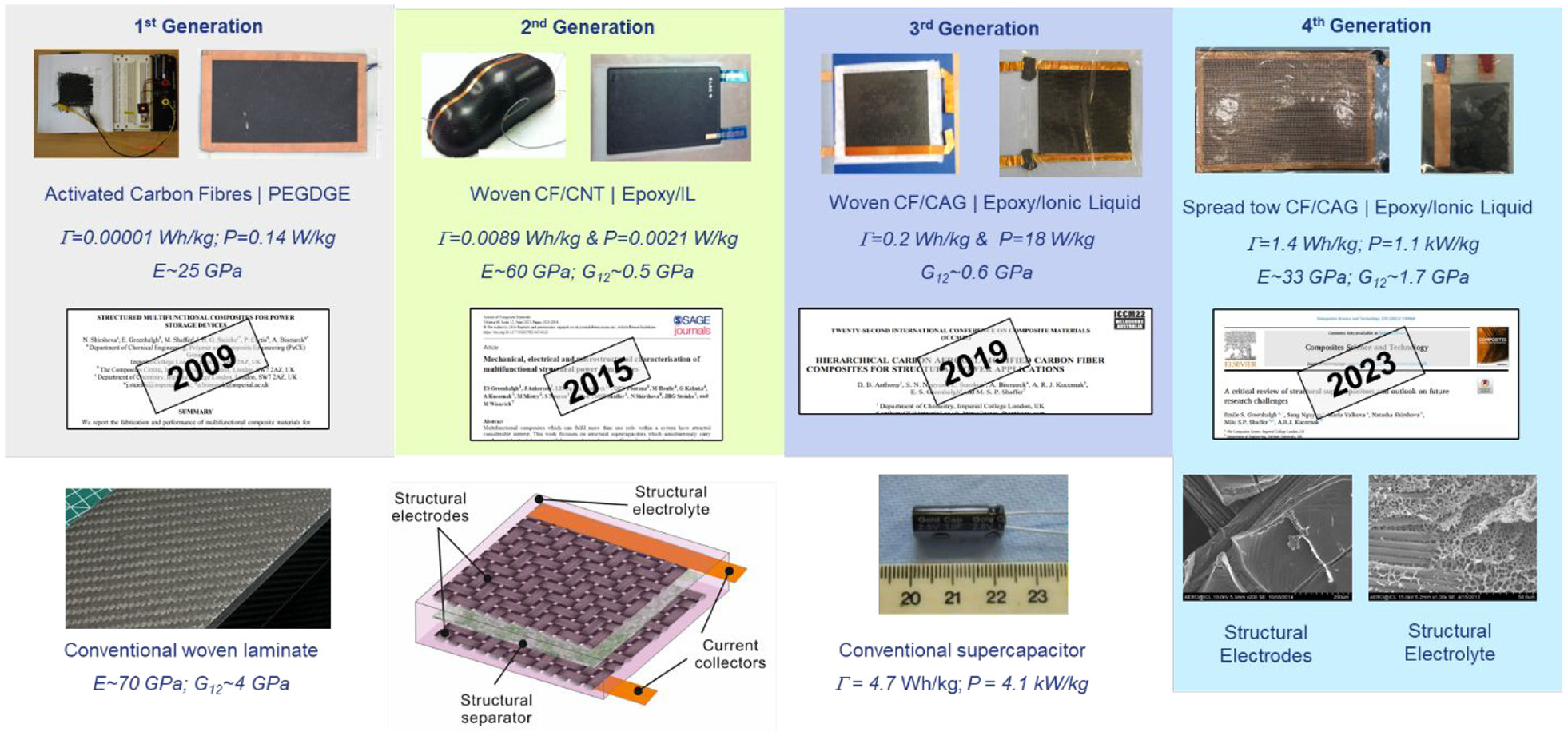
Structural supercapacitor development milestones.
As an emerging field which melds two very different disciplines, the research landscape is enormous, with a considerable number of challenges to be addressed. We have recognised that research should be undertaken at two levels. Firstly, there is a need for scientific discovery to drive the identification of new constituents and address hurdles associated with fabricating and testing the devices. In parallel, there is a need to assemble an engineering framework, addressing the challenges associated with bringing this technology to fruition. The research efforts have been partitioned into four Themes (Figure 2). Constituent Development (Theme 1) and Device Assembly and Characterisation (Theme 2) constitute Scientific Discovery, with an aim to enhancing the intrinsic performance of multifunctional cells. In parallel, Engineering Embodiment delivers methodologies such that when this material development reaches maturity (and the performance permits), there are tools and methods for industry to adopt it. Multifunctional Modelling and Design (Theme 3) predicts the performance of these emerging materials whilst Theme 4 (Scale-Up and Demonstration) addresses the challenges associated with assembling cells, dealing with in-service performance, etc.
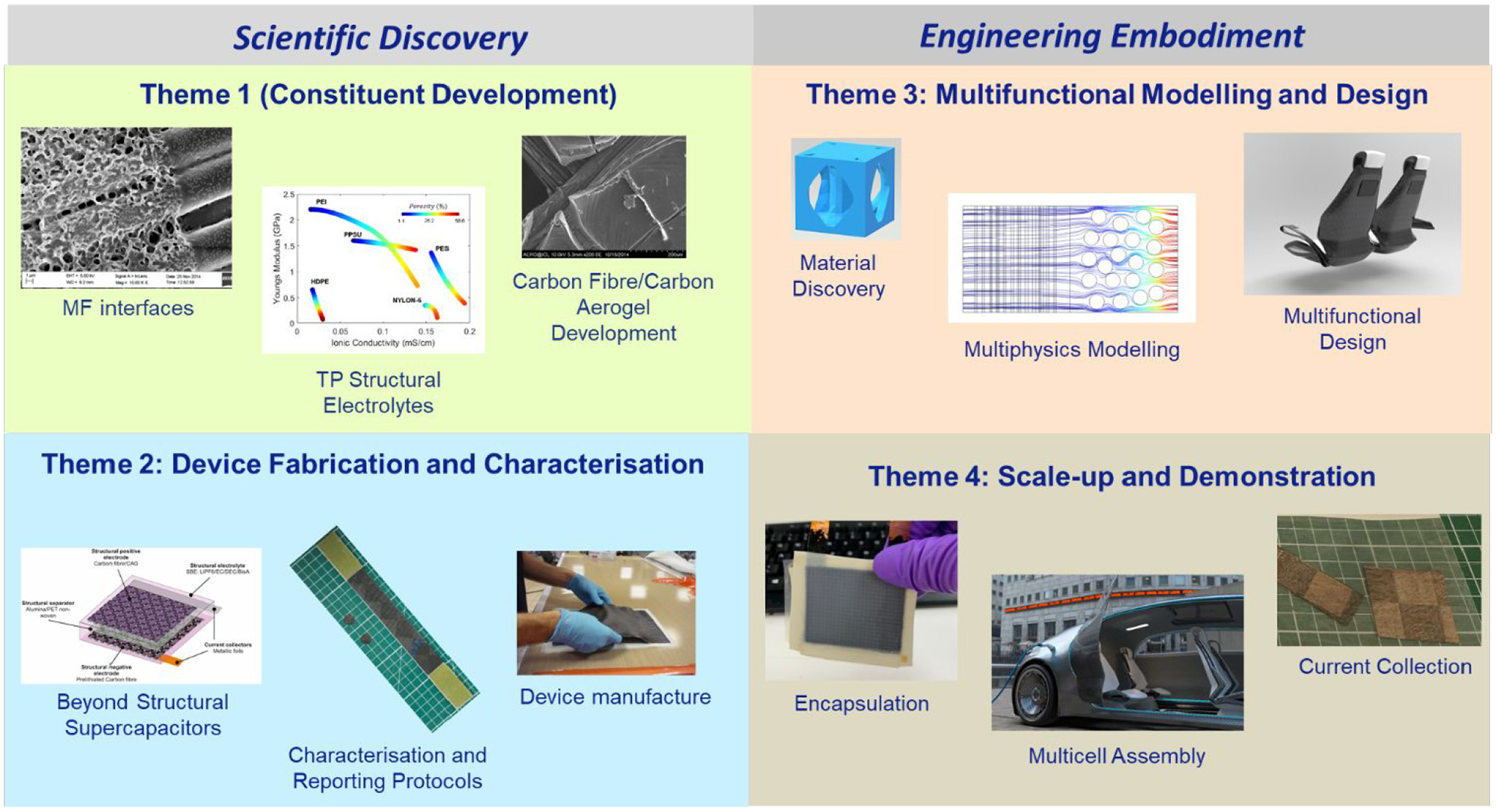
Four research themes and future challenges.
Future research efforts
Considering Theme 1, the development of structural electrodes and structural electrolytes still presents considerable challenges. Regarding the former, CF-CAG offers synergy between increased surface area (and hence capacitance) and elevating matrix-dominated mechanical properties. However, the fabrication route for the CF-CAG lamina is non-optimal leading to the formation of defects and degradation of the parent fibres during processing. Regarding structural electrolytes, these are almost exclusively fabricated using thermoset based systems. However, developing alternatives using thermoplastic-based electrolytes would enhance the toughness, production rate and device sustainability. Finally, a fundamental question is how to optimise the multifunctional interfaces between the structural electrode and structural electrolytes, since the mechanical and electrochemical requirements are in conflict. Too much structural phase in the electrolyte will block the pore in the electrodes, whilst too little will depress the mechanical performance. Regarding Theme 2, fabrication of reproducible and high-quality devices is important to take this technology forward. Moreover, characterisation and reporting protocols are critical to taking this technology forward and providing industry with the means to compare across datasets.
Regarding the Engineering Embodiments, under Theme 3, the development of multiphysics models to predict coupling between electrochemical and mechanical functions is essential, particularly to underpin virtual certification of these emerging materials. For instance, would the development of mechanical damage within a device modify its electrochemical response? There are also opportunities to use numerical methods such as topology optimisation to discover new multifunctional motifs, with the aspiration to use high fidelity additive manufacture to fabricate future devices. Finally, a multifunctional design framework is needed to compare multifunctional products against current off-the-shelf assemblies. Finally, considering Theme 4, current collection is vital to scale-up of structural supercapacitors, and strategies to achieve efficient current collection without excessive weight penalties need to be investigated. An issue which is critical to the application of these multifunctional composites is that of structural encapsulation to ensure the cells are fully isolated from the exterior environment. Such barrier materials would need to be capable of transferring mechanical load between the cell and the surrounding structure. This final point has critical implications for the design of multicell assemblies.
Concluding remarks
The research and industrial community have recognised the huge benefits structural power composites could offer in both lightweighting and efficient energy storage. Imperial College London have pioneered the development of structural supercapacitors and have now achieved unprecedented device performance. Their research efforts have provided valuable insights into resolving the hurdles to maturing this technology. Ultimately, we anticipate structural power composites will become ubiquitous: our phones, cars, computers, aircraft, infrastructure, etc. will all adopt structural power composites, positioning this engineering advance at the heart of society.
Footnotes
Acknowledgements
Finally, the authors would like to acknowledge the efforts and contributions of the Structural Power Composites Group at Imperial College London and our collaborators.
Declaration of conflicting interests
The authors declared no potential conflicts of interest with respect to the research, authorship, and/or publication of this article.
Funding
The authors disclosed receipt of the following financial support for the research, authorship, and/or publication of this article: The authors would like to acknowledge the support and encouragement from Dr Les Lee, AFOSR Program Officer for Mechanics of Multifunctional Materials & Microsystems and funding from EOARD (IOE Grant FA8655-21-1-7040). The authors also acknowledge the funding provided by the UK Engineering and Physical Sciences Research Council (EPSRC) Realising Structural Power (EP/W03526X/1) and the support by the Royal Academy of Engineering under the Chairs in Emerging Technologies scheme.

Data availability statement
Data sharing not applicable to this article as no datasets were generated or analyzed during the current study.