



Abstract
Multifunctional energy storage material systems, such as structural supercapacitors and batteries, simultaneously store electrical energy and carry mechanical loads. They hold great promise for expanding the functionality of structural members and the operational range of ground, air, and space vehicles. While notable contributions have been made to designing and manufacturing these multifunctional material systems, many challenges remain, especially in optimizing synergistic effects while minimizing mass and cost.
Keywords
Conventional batteries lack in mechanical performance and require protective external packaging, which leads to additional mass and cost. Numerous researchers have contributed to improvements in the mechanical properties of energy storage material systems (Greenhalgh et al., 2015; Huang et al., 2020; Johannisson et al., 2018; Moyer et al., 2020; Snyder et al., 2015) through mechanical reinforcements, with most focusing on carbon fibers (CFs; Chen et al., 2019; Moyer et al., 2020). To capture the added mechanical functionality to the energy storage capacity, a mass savings efficiency metric has been developed (O’Brien et al., 2011), combining the structural and electrical energy storage property ratios. This metric was later updated to include electro-chemo-mechanical coupling effects, multiaxial loading conditions, and microstructure influence (Johannisson et al., 2018; Zhou et al., 2020).
The Texas A&M research team has developed both multifunctional structural supercapacitors and batteries. The main approach centered upon nanocomposite electrodes comprised of reduced graphene oxide (rGO) sheets with Kevlar aramid nanofibers (ANFs) reinforcement (Flouda et al., 2021; Kwon et al., 2017; Sun et al., 2019). The mechanical and electrochemical results of the rGO/ANF supercapacitor electrodes are summarized in Figure 1(a), showing an order of magnitude increase in specific Young’s modulus and specific energy by introducing functional groups and structural reinforcement without significantly compromising the specific energy. Figure 1(b) shows the layered microstructure of rGO/ANF and randomly oriented and wavy ANFs used for structural reinforcement. Besides the trade-off, the electro-chemo-mechanical coupling in supercapacitor electrodes was measured and modeled for charging and discharging due to ion-diffusion-induced eigenstrain, as shown in Figure 1(c). Other microstructures and the corresponding analytical and computational models (Aderyani et al., 2020; Zhou et al., 2019) have demonstrated mechanical and energy storage improvements by rearranging the reinforcement material and strengthening the interface.
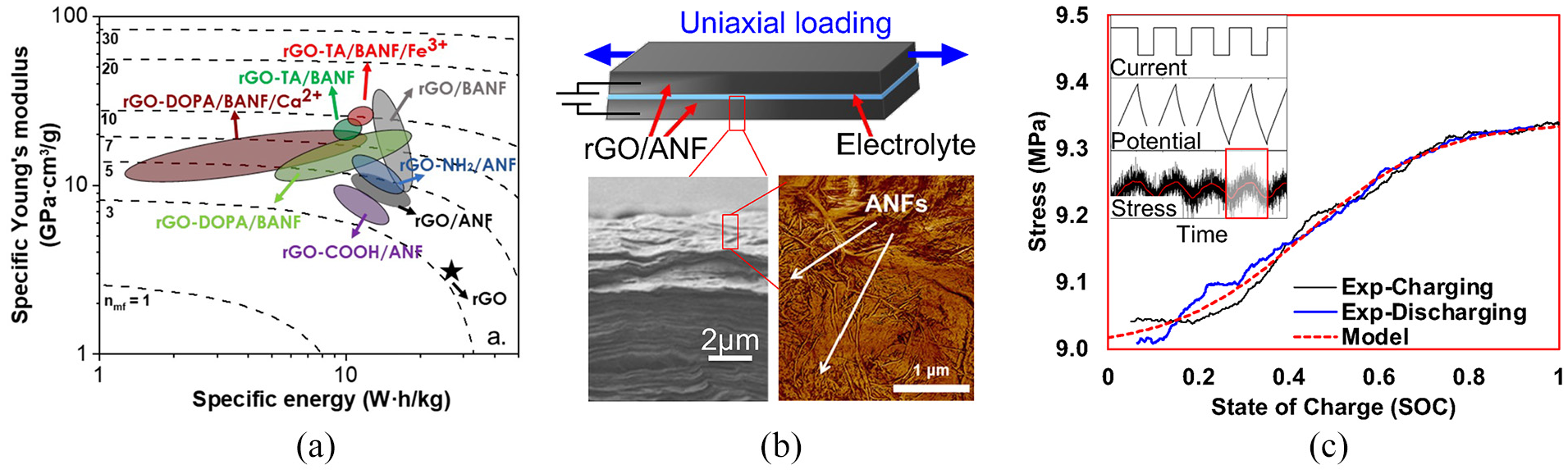
Mechanical and electrochemical performance, microstructure and coupling response of rGO/ANF structural supercapacitor electrodes: (a) Ashby plots of specific Young’s modulus versus specific energy (BANF, TA, and DOPA refer to branched ANF, tannic acid, and dopamine, respectively) with dashed line represents the multifunctional efficiency; (b) schematic of a rGO/ANF supercapacitor with a layered microstructure shown in SEM and AFM images; (c) experimental and modeling results of electro-chemo-mechanical coupling in rGO supercapacitor electrodes. Figures are reproduced with permission from Flouda et al. (2020), Kwon et al. (2017), and Loufakis et al. (2023).
Additional desired functionalities of structural energy storage devices, both batteries and supercapacitors, include shape morphing and a wide range of operating temperatures. Figure 2(a) shows concepts of morphing batteries that can be subjected to various large mechanical deformations using interconnected scale-like structures. Each “scale” is a battery cell with flexible electrical connections, leading to a high mechanical and electrochemical cycle life, while allowing for large overall shape changes (Kim et al., 2021). Morphing of the actual energy storage material (Johannisson et al., 2020), where shape-changing and energy storage are collocated, will be essential in robotics and wearable electronics, and is currently considered by the Texas A&M team using shape memory polymers and additive manufacturing techniques. Space and extreme environment applications will require energy storage devices with operating temperatures as low as −50°C to −80°C, in addition to long cycle life (>30,000 cycles), low mass, and the ability to withstand the impulse and vibratory loads during launch (Ratnakumar et al., 2000). Dual ion structural batteries (Oka et al., 2024) have been proposed to expand the operation temperatures to below −40°C (Figure 2(b)) by shortening the diffusion paths, reacting fast through mixed ion and electron conduction in the redox-active polymers, and eliminating the rate-limiting ion desolvation during discharge at low temperatures. Higher energy storage capacity and power could be achieved by developing hybrid batteries and combining concepts of supercapacitors and batteries at the microscale (Vlad et al., 2014). Challenges specific to multifunctional structural energy storage devices include the need for combined mechanical and electrochemical cycle stability testing in addition to conventional battery reliability tests, shown in Figure 2(c). Investigating the electro-chemo-thermomechanical responses and microstructural influence could lead to thermally stable and mechanically reliable structural batteries for a wide temperature range. Additive manufacturing (Thakur and Dong, 2020; Figure 2(d)) will provide a path for spatial material and microstructure control of multifunctional energy storage material systems to achieve additional functionalities, as well as complex conformal geometries and shape control.
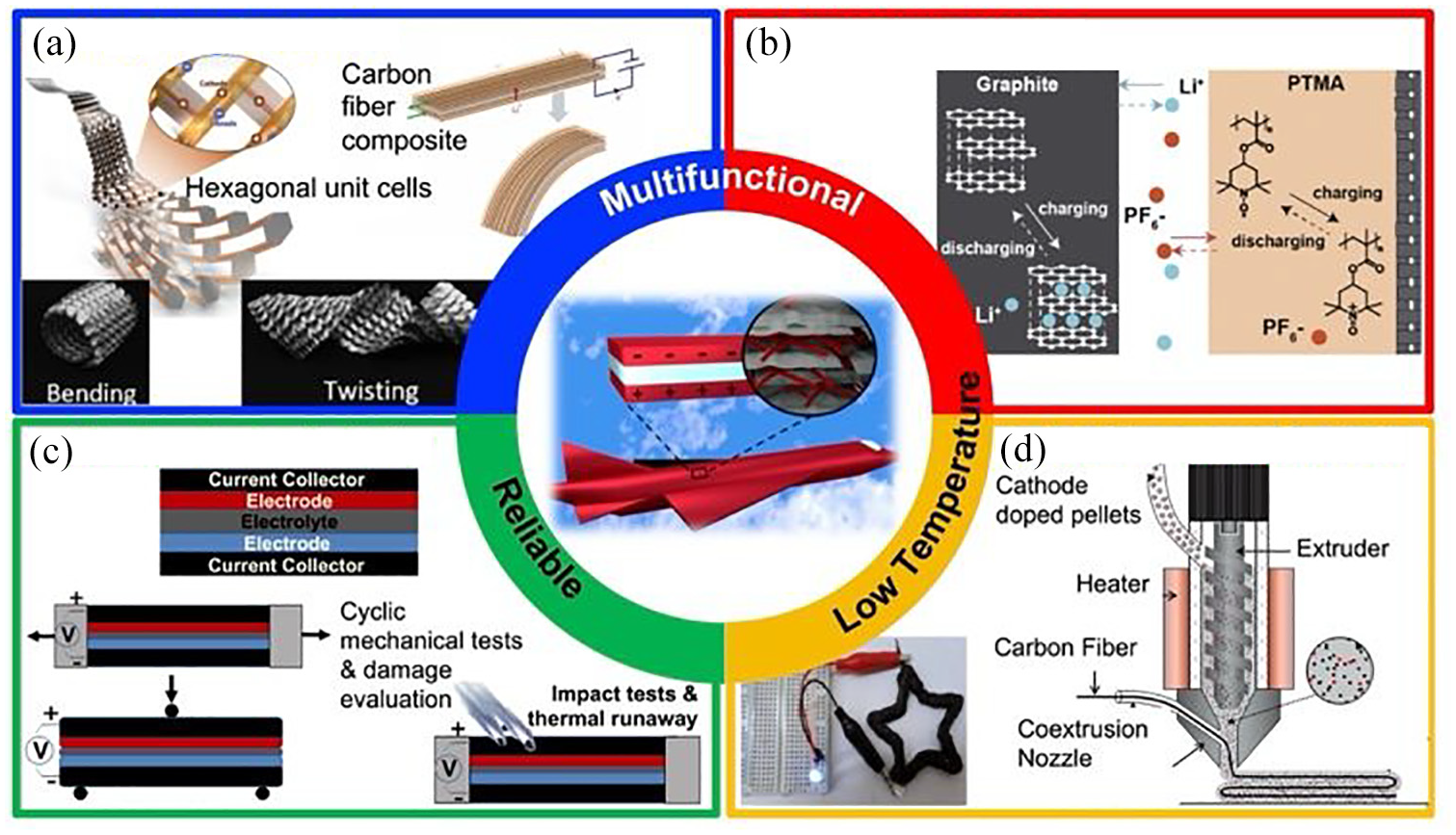
The future of multifunctional batteries: (a) morphing structural batteries; (b) dual-ion batteries for low-temperature performance; (c) mechanical reliability and performance of structural batteries; (d) additive manufacturing of structural batteries for complex geometries. Figures in (a) are licensed under CC BY (Johannisson et al., 2020; Kim et al., 2021); and in (b and d) are reproduced with permission from Oka et al. (2024) and Thakur and Dong (2020).
1. Conclusions
There is a significant need to develop multifunctional structural energy storage material systems for a wide variety of applications. Many innovative material systems have been created that can operate across a wide range of temperatures while maintaining reasonable structural performance. Computational approaches, which can be utilized by the broader community of structural energy and power regardless of the materials chosen, have been developed and will continue to be developed. The primary challenge remains to scale up proposed material systems for large-scale production and the design of complete structural energy storage cells. The broader vision for structural multifunctional energy storage systems focuses on adding new functionalities, improving reliability and operational range, and advancing cost-effective additive manufacturing techniques for complex shapes.
Footnotes
Acknowledgements
This article is dedicated to Dr. “Les” Lee, who has been instrumental in shaping the future of multifunctional materials and structures.
Declaration of conflicting interests
The authors declared no potential conflicts of interest with respect to the research, authorship, and/or publication of this article.
Funding
The authors disclosed receipt of the following financial support for the research, authorship, and/or publication of this article: The authors would like to acknowledge our collaborators, Drs. Jodie Lutkenhaus, Micah Green, James Boyd, and their students, as well as the funding from AFOSR (Grant no. FA9550-16-1-0230, FA9550-19-1-0170, FA9550-22-1-0388).

Data availability statement
Data sharing not applicable to this article as no datasets were generated or analyzed during the current study.