



Abstract
Staphylococcus aureus is one of the most important bacteria responsible for clinical bovine mastitis globally, leading to significant economic losses in the dairy industry. Antimicrobials used to treat and prevent mastitis can lead to antimicrobial resistance (AMR) in S. aureus. We retrospectively evaluated AMR of S. aureus isolates from clinical bovine mastitis cases submitted to the Animal Health Centre in British Columbia from 2013 to May 2024. S. aureus was isolated from 15.0% of submitted bovine milk samples. Antimicrobial susceptibility testing was done on 611 of 1,347 S. aureus isolates. No methicillin-resistant S. aureus isolates were detected based on cefoxitin susceptibility test results, which is encouraging. The highest frequencies of resistance were found for penicillin (46.6%) and ampicillin (42.1%). The lowest frequencies of resistance were to ceftiofur and sulfamethoxazole–trimethoprim (0.2% each) and cephalothin (0.3%). AMR trends over our study period were generally stable, except for penicillin and ampicillin; penicillin resistance increased from 15.2% to 71.1%, and ampicillin resistance increased from 18.2% to 70.1%. The information in our study could help guide clinicians when choosing antimicrobial treatments to treat mastitis caused by S. aureus, particularly in the province of British Columbia. Because S. aureus has a broad host range and is of importance to both human and veterinary medicine, continued monitoring to detect the emergence of resistance is warranted.
Staphylococcus aureus, one of the leading causes of contagious bovine mastitis worldwide, is commonly spread during milking from contaminated equipment and milker’s hands or transmitted by flies between cattle on pasture. Mastitis reduces milk quality and production, causing significant losses to the dairy industry through decreased milk production, milk discard, treatment costs, and potential culling and reproductive losses.6,11 The overall economic impact of a clinical mastitis case in Canadian dairies is estimated at $662 per cow per year. 1
On dairy farms, antimicrobials are used primarily to treat mastitis infections and as dry-cow therapy, resulting in selective pressure for resistant strains. 12 Antimicrobial resistance (AMR) in S. aureus, particularly methicillin-resistant S. aureus (MRSA), is already a major concern in human bloodstream infections, with increasing incidence between 2016–2020 in Canada. 9 One global lineage of S. aureus, clonal complex 8 (CC8), has been reported to have adapted in dairy cattle, indicating an interspecies jump from humans to cattle. 10 As S. aureus is an opportunistic pathogen in both humans and bovids, there is a zoonotic potential for transmission to milkers on the farm and to consumers through food products. 5
The 462 dairy farms in British Columbia have an average of 150 milking cows per farm. 3 The incidence of clinical mastitis in British Columbia has historically ranged from 5.6% in 1996 to 14.2% in 2006. 8 Nationally, the estimated average incidence rate of clinical mastitis was 23.0% from 2003 to 2006. 8 Although studies have been conducted across Canada by the Canadian Bovine Mastitis Research Network, British Columbia was not a participating province in this network. 13 Thus, there are no recent studies that have reported the prevalence of mastitis or the antimicrobial susceptibility of S. aureus isolates in British Columbia. Our objectives were to determine the frequency of isolation of S. aureus among submissions of bovine milk from cases of mastitis, and to describe the proportion of these isolates resistant to antimicrobials from January 2013 to May 2024.
The Animal Health Centre (AHC; Abbotsford, British Columbia, Canada) is the provincial veterinary diagnostic laboratory. This laboratory receives milk samples from clinical mastitis cases for bacterial culture and antimicrobial susceptibility testing (AST). Bovine milk samples that are submitted by veterinarians are routinely tested for the presence of mastitis-causing pathogens, including S. aureus. We retrieved laboratory records from the AHC’s Laboratory Information Management System for descriptive retrospective analysis, and included records associated with bovine milk samples from which S. aureus was identified between January 2013–May 2024.
In brief, samples submitted for mastitis culture were plated on Columbia blood agar plates (Oxoid) and incubated aerobically at 37°C for 24–48 h. Before 2018, any colonies grown on the agar plates were identified by colony morphology, Gram staining, and biochemical testing. Additionally, MALDI-TOF MS (Bruker) was added for bacterial identification from 2018 onwards. AST (Kirby–Bauer disk diffusion) was performed on any isolates deemed to be clinically significant. Inocula were prepared in sterile saline and then adjusted to a density corresponding to a 0.5 McFarland turbidity standard. The final inoculum was then evenly streaked onto the surface of Muller–Hinton agar (MHA) plates (Thermo Scientific). Following inoculation, the plates were inverted and incubated at 35°C aerobically for 16–18 h. The zones of bacterial growth inhibition around each drug were measured and interpreted according to Clinical and Laboratory Standards Institute (CLSI) guidelines. 4 The S. aureus ATCC 25923 strain was used for QC.
Over the course of our study period, changes were made to the drug panels used. From 2013 to 2020, ampicillin, cloxacillin, penicillin, ceftiofur, cephalothin, tetracycline, erythromycin, pirlimycin, and sulfamethoxazole–trimethoprim were included in AST panels. In 2020, cloxacillin was removed and penicillin–novobiocin was added to the panel. Halfway through 2023, penicillin–novobiocin was removed from the panel due to supply issues. Isolates in our study were tested with cefoxitin, which is a surrogate for oxacillin for S. aureus according to CLSI guidelines. 4 S. aureus isolates were tested with cefoxitin to predict any potential MRSA; but unless the isolate was resistant, the laboratory did not include it in the client report. Ampicillin, penicillin, ceftiofur, cephalothin, cefoxitin, tetracycline, erythromycin, pirlimycin, and sulfamethoxazole–trimethoprim were used consistently over the whole period; therefore, only results for these drugs were included. Data were exported into Excel (v.2409; Microsoft) and analyzed descriptively using pivot tables.
S. aureus was isolated from 1,347 of 8,957 (15.0%) bovine milk samples submitted to the AHC between 2013–May 2024 (Table 1), which is similar to the 10.3% prevalence of S. aureus reported between November 2003–July 2005 from clinical mastitis cases across Canada. 8 Between 2013–2017, we found 40–50 isolates per case per year in British Columbia. Only 17 submitted cases contained S. aureus in 2018. Due to regional flooding and temporary closure of our laboratory, case numbers dropped between 2021 and 2022 (Table 1).
Total number of milk submissions and number of Staphylococcus aureus–positive cases from January 2013–May 2024.
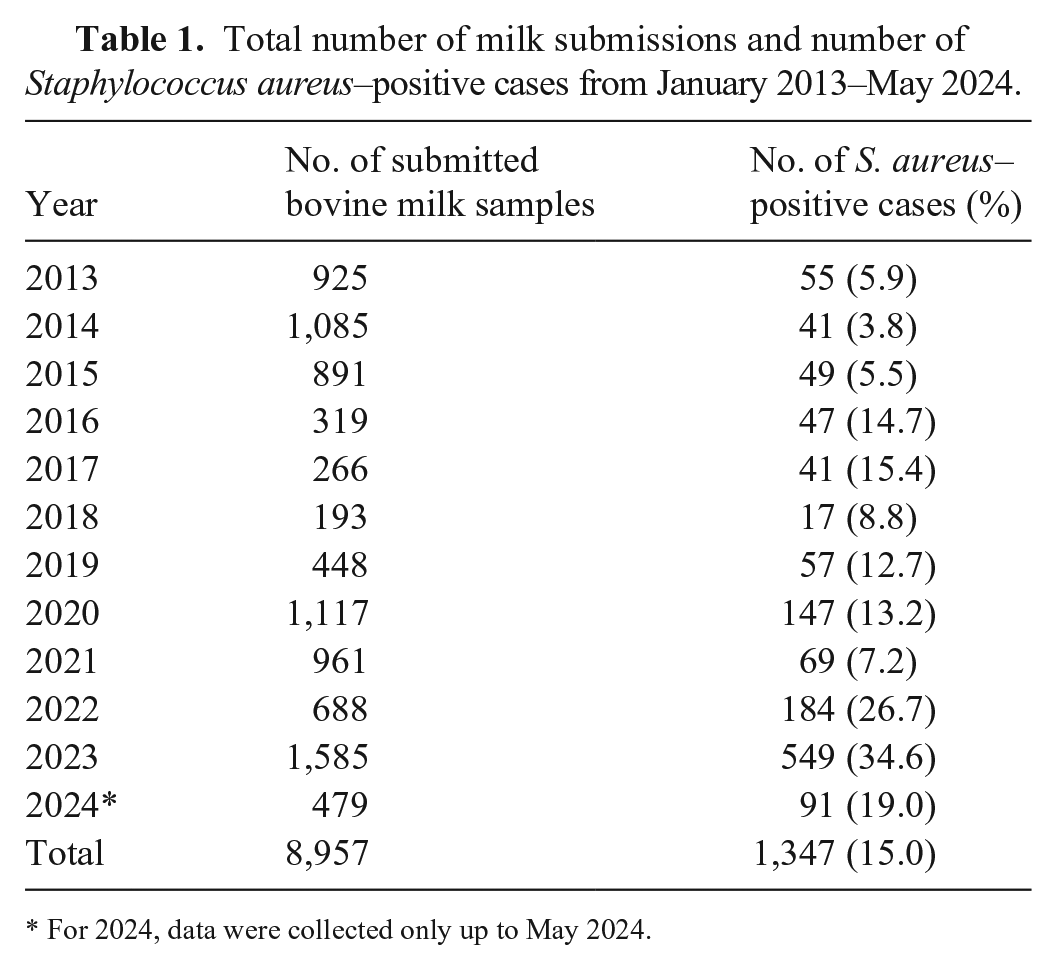
For 2024, data were collected only up to May 2024.
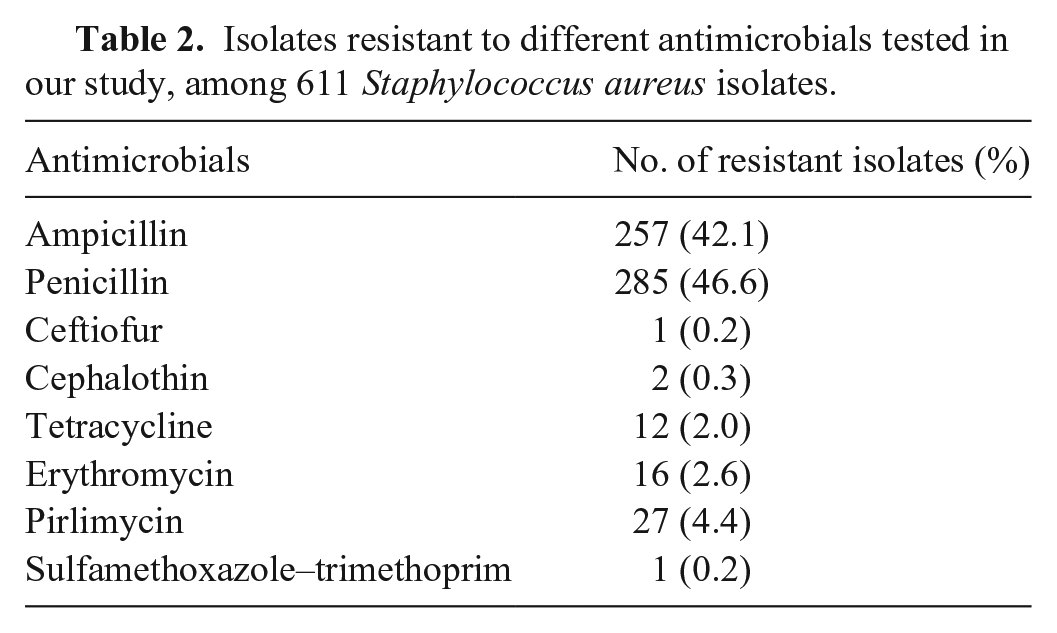
From the submitted cases, 611 S. aureus isolates were selected for AST. All isolates tested were susceptible to cefoxitin, indicating that no MRSA were identified; furthermore, 290 isolates (48%) were susceptible to all of the antimicrobials tested. Overall, resistance was most common to penicillin (46.6%) followed by ampicillin (42.1%), pirlimycin (4.4%), erythromycin (2.6%), tetracycline (2.0%), cephalothin (0.3%), ceftiofur (0.2%), and sulfamethoxazole–trimethoprim (0.2%; Table 2). The frequency of isolates resistant to ampicillin and penicillin increased throughout the years to 66.7% and 70.4%, respectively (Fig. 1). The antimicrobials with the lowest resistance at 0.2% between 2013–2024 were ceftiofur and sulfamethoxazole–trimethoprim, and both only had 1 resistant isolate in 611 isolates.
Isolates resistant to different antimicrobials tested in our study, among 611 Staphylococcus aureus isolates.
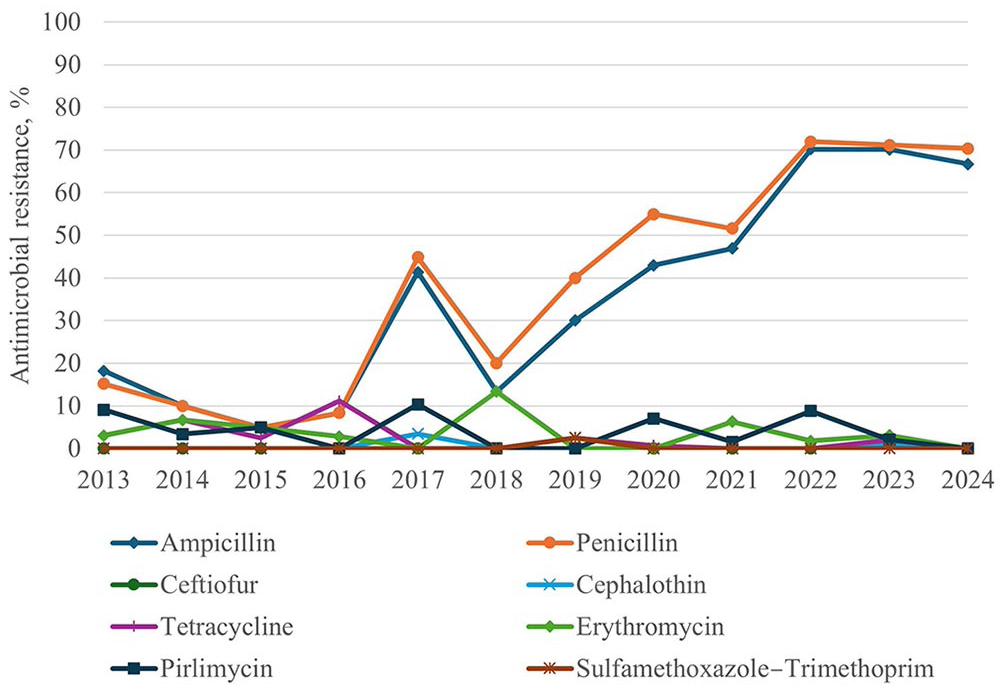
Frequency in percentage of Staphylococcus aureus isolates resistant to different antimicrobials from 2013 to May 2024. Each line represents an individual antimicrobial analyzed in our study.
AMR remained stable throughout the years, except for the β-lactam antimicrobials (ampicillin and penicillin); 42.1% of all tested isolates were resistant to ampicillin and 46.6% to penicillin between 2013–May 2024. Increasing resistance to these 2 antimicrobials was observed, and by 2022, >70% of submitted isolates were resistant to both antimicrobials. S. aureus resistance to β-lactams has been widely documented in other studies and may be attributed to the use of β-lactam antimicrobials in dairy operations.12,13 The increase in ampicillin and penicillin resistance has been associated with the usage of intramammary penicillin–novobiocin for dry-cow therapy as well as with the systemic administration of penicillin. 12 Interestingly, ampicillin resistance has been associated with systemic administration of florfenicol, although the mechanism remains unknown. 12 Ampicillin resistance has also been associated with increasing cow parity. 12 Resistance to cephalothin was found to be 0.3% in British Columbia; no resistance was found in other studies in Canada. 13 One study based in the Atlantic provinces of Canada found 0.4% of isolates to be resistant to cephalexin, which is another first-generation cephalosporin antibiotic. 2 This can be significant, as cephapirin, another first-generation cephalosporin antibiotic, is a commonly used antimicrobial in dry-cow therapy and as an intramammary treatment for clinical mastitis. 13 We identified no MRSA cases between 2013–May 2024. Other studies have reported zero or low frequencies of resistance to oxacillin, indicating that MRSA is still rare in bovine mastitis cases in Canada and North America.13,14 However, given the potential zoonotic transmission of S. aureus to humans, continued monitoring is needed.5,10
Consistent with reports in the literature, pirlimycin resistance was infrequently identified. Other surveys of S. aureus mastitis isolates in North America found this phenotype in 2–3% of isolates.2,13,14 A smaller study of Minnesota dairy herds found 5% resistance to pirlimycin, 7 which was close to the 4.4% resistance that we found in British Columbia. In British Columbia, 2% of isolates were resistant to tetracycline, similar to other studies conducted in Canada that found isolates to have tetracycline resistance rates of 2.6–4.2%.2,13 Resistance to tetracycline has been reported to have increased over time (1994–2013) and with increasing parity, due to tetracycline usage on Canadian dairy farms.2,12 In contrast, the frequency of tetracycline resistance has remained low among isolates tested by the AHC since 2017.
Given that our data were from the provincial diagnostic laboratory, it was a good representation of all dairy herds in British Columbia. However, these data reflected this province only, not the rest of Canada or North America. As only submitted cases were tested, the animal was likely to be diseased, which restricts extrapolation of our results to healthy cattle or cattle with subclinical mastitis. The history of the animal was also limited, and any antimicrobial treatments given to the animal before the milk sample was submitted is unknown. Another source of bias might be repeated submissions from the same farm or individuals post-treatment. 2 Therefore, the isolates submitted might be biased for resistance.
Footnotes
Acknowledgements
We thank all of the submitters of samples to the Animal Health Centre, as well as the laboratory scientists in the bacteriology laboratory department at the Animal Health Centre for performing testing.
Declaration of conflicting interests
The authors declared no potential conflicts of interest with respect to this study, authorship, and/or publication of this article.
Funding
The authors received no financial support for this study, authorship, and/or publication of this article.
