



Abstract
South Korea’s beekeeping industry has been facing a major crisis due to colony collapse disorder (CCD), manifesting since the winter of 2021. CCD in South Korea is presumed to be caused by a combination of factors, including an abnormal climate, pesticide use, declining source plants, and increased honey bee diseases. We examined the prevalence of 12 major honey bee (Apis mellifera) pathogens by sampling 3,707 colonies with abnormal behavior and suspected pathogen infections from 1,378 apiaries nationwide between 2020 and 2023. Black queen cell virus (BQCV), deformed wing virus (DWV), Israeli acute paralysis virus (IAPV), and Vairimorpha (Nosema) ceranae had the highest infection rates among honey bees in South Korea. BQCV had the highest infection rate (83.3% in 2023) and was highly prevalent throughout the year, regardless of the season. DWV (48.7%) and IAPV (41.3%) had the highest infection rates in October–December, corresponding to the winter season. Among the 12 honey bee pathogens, acute bee paralysis virus and Kashmir bee virus were rarely detected; the remaining 10 honey bee pathogens were detected throughout the year. The differences in honey bee pathogen prevalence among regions were not significant. We suggest that South Korean honey bees are highly exposed to viral pathogens, possibly resulting in the loss of unhealthy honey bees during the winter. Our study is expected to help identify trends in the occurrence of honey bee pathogens in South Korea and predict outbreaks to prepare a prevention system and appropriate control measures for honey bee pathogens.
Keywords
Honey bees (Apis mellifera) are extremely valuable creatures that produce beekeeping products, such as honey, bee pollen, propolis, and royal jelly, as well as contribute to the human food supply by pollinating many agricultural crops. 12 Since colony collapse disorder (CCD) was first reported in the United States in 2006, honey bee populations have declined considerably worldwide 34 ; reportedly, honey bee diseases constitute an important factor that is responsible for this decline. Among honey bee pathogens, the bacterial pathogens Paenibacillus larvae and Melissococcus plutonius infect honey bee larvae and pupae, causing American and European foulbrood (AFB and EFB), respectively, and lead to poor bee health and colony weakness. 23
Nosemosis, a fungal disease in honey bees caused by Vairimorpha spp. infection, is associated with diarrhea and a crawling behavior in honey bees. It also shortens the lifespan of honey bees, leading to colony weakness. 6 Two other fungal diseases, chalkbrood and stonebrood, are caused by Ascosphaera apis and Aspergillus spp., respectively, in honey bee larvae and pupae and interfere with normal honey bee development, resulting in weakened colonies. 26 Dozens of viral pathogens that infect honey bees have also been identified, 7 of which (acute bee paralysis virus [ABPV; Aparavirus apisacutum], black queen cell virus [BQCV; Triatovirus nigereginacellulae], chronic bee paralysis virus [CBPV], deformed wing virus [DWV; Iflavirus aladeformis], Israeli acute paralysis virus [IAPV; Aparavirus israelense], Kashmir bee virus [KBV; Aparavirus kashmirense], and sacbrood virus [SBV; Iflavirus sacbroodi]) have caused honey bee disease outbreaks and damage worldwide. 29
In several other countries, such as the USA, Czech Republic, New Zealand, Spain, China, and Sweden, studies on honey bee disease outbreaks are ongoing and the findings of these studies are being used as a basis for disease control.3,8,20,22,27,31 Additionally, the outbreak trends of specific honey bee diseases, such as honey bee viral diseases, are also being investigated in some countries. Unfortunately, such studies are still lacking in South Korea.14,30
South Korea’s beekeeping industry can be divided into 4 seasons, taking into account temperature, honey production, and honey bee breeding style. January–April is the spring season in South Korea, when honey bees return from overwintering and become active, increasing their colony strength. Honey is produced in the May–June period. Unlike other countries, South Korea produces most of its honey in May and June each year, and beekeepers keep honey bees to match the production season. The July–September period is the summer season in South Korea, when beekeepers wrap up honey production, and the honey bees that survive the hot summer are prepared for the upcoming winter season (October–December), during which temperatures drop, and they become less active.
To ensure efficient honey production, beekeepers in South Korea move honey bee colonies from the southern to the northern regions of the country. Additionally, throughout the year, there is active trading not only of colonies among beekeepers but also of artificially raised unmated queens and capped queen cells. Even during the winter season, when honey bees are not active, colonies for pollinating crops such as strawberries and melons produced in facility growth houses are supplied. 4 This phenomenon is typical of South Korea’s beekeeping industry, which according to 2022 data, has the highest number of honey bee colonies per unit area worldwide at 21.8 honey bee colonies/km2, which makes it easy for honey bee diseases to spread. 15
In 2020, South Korea had 27,532 beekeepers and 2,697,842 colonies; in 2021, it had 27,591 beekeepers and 2,690,023 colonies, growing steadily. 16 However, the number of honey bees decreased to 26,805 beekeepers and 2,504,703 colonies in 2022 because of the honey bee population decline that occurred in the winter of 2021, and the honey bee population decline in apiaries continued into 2023. 17 Various causes have been proposed for the CCD outbreaks in South Korea, including extreme weather, pesticide use, and honey bee diseases. 18 However, there is no clear cause responsible for this decline in honey bee populations in South Korea. It has been suggested that diseases caused by pathogenic honey bee infections are a contributing factor to this decline in the honey bee population.
In response to the CCD outbreak in South Korea, which started in the winter of 2021, we determined the prevalence of honey bee pathogens from 2020 to 2023 based on a massive nationwide survey.
Materials and methods
Honey bee sample collection
From 2020 to 2023, we collected 3,707 samples from 1,378 honey bee apiaries throughout South Korea (Table 1). The samples included adults, larvae, and pupae with abnormal behavior, such as paralysis and crawling, and those with suspected diseases, showing signs such as dead adults and rotting or swollen larvae or pupae, and poor wing development, which are not manifested by healthy honey bees. We used 2 or 3 honey bees as well as 2 or 3 larvae or pupae samples for analysis. First, we homogenized samples, followed by nucleic acid extraction for quantitative real-time PCR (qPCR). To account for error in the qPCR test for the identification of honey bee pathogens, ≥5 honey bees and 10 larvae and pupae per sample were collected in sterilized conical tubes, transported to the laboratory in an ice chest, and stored at −70°C.
Summary of samples collected from honey bee apiaries in South Korea, 2020–2023.

Nucleic acid extraction and genetic identification using qPCR or RT-qPCR
Nucleic acids were extracted from the samples (Total nucleic acid purification kit; Postbio) using an automatic processor. The extraction was performed according to a protocol that was designed based on the manufacturer’s extraction protocol with optimal conditions. Briefly, a lysis buffer was added to ~150 μL of homogenate from the honey bee samples. This was followed by the addition of 50 μL of silica-coated magnetic beads and incubation for 5 min. Next, 2-step washing was performed using the washing buffer, and finally, the magnetic beads bound to the nucleic acids in the samples were eluted using 50 μL of nuclease-free distilled water; the eluates thus obtained were used for qPCR as a template.
For qPCR, 5 μL of nucleic acid was mixed with 20 μL of master mix (Qiagen) for individual targets, and qPCR or reverse-transcription qPCR (RT-qPCR) was performed (LineGene 9600 Plus system; Bioer). Further, all molecular assays were performed according to the standard operating procedures (SOPs) of Postbio, a reference laboratory registered with the government of South Korea. Additionally, based on SOPs, a Ct of ≤40 was considered positive because preliminary tests to determine the limit of detection for the pathogens showed that, for all pathogens, a Ct <40 was identified as positive.
Target gene and analytical sensitivity of qPCR or RT-qPCR
The oligonucleotide sequences and thermocycling protocols that we used (Table 2) were in accordance with SOPs proposed by the South Korean Animal and Plant Quarantine Agency, which is in charge of controlling infectious disease of animals and plants, with minute modifications. 33
Target genes and quantitative real-time PCR (qPCR) or reverse-transcription qPCR (RT-qPCR) conditions for detecting 12 honey bee pathogens in honey bee samples.

ABPV = acute bee paralysis virus; AFB = American foulbrood; BQCV = black queen cell virus; CBPV = chronic bee paralysis virus; DWV = deformed wing virus; EFB = European foulbrood; IAPV = Israeli acute paralysis virus; KBV = Kashmir bee virus; SBV = sacbrood virus.
Statistical analysis
Given that the dependent variable in our study was related to the results of the PCR tests involving 12 pathogens, categorized as either positive or negative, we employed mixed-effect logistic regression via a Bayesian statistical approach to identify differences in the risk of infection with the 12 pathogens across the pre-defined time periods. The sampling dates were aggregated into 4 time periods based on seasons and honey production in South Korea: January–April (spring), May–June (honey production), July–September (summer), and October–December (winter).
Additionally, we introduced the sampling region as a random effect into the logistic regression model to account for risk variations between sampling regions and to improve the fitness of the model as follows:


where Yik = the PCR test result for the pathogen from sample i, collected from region k; pik = the probability of a positive PCR test result for the pathogen in sample i, collected from region k; α k = the random effect for sampling region k (i.e., the central, southern, or northern regions, based on temperature to account for the geography of South Korea and adjust the variation of the intercept for each sampling region 1 ).
Based on the Bayesian statistical approach, which allows parameters with a low sample size to be estimated, we estimated the posterior distribution of the regression coefficients α k and β using a Hamiltonian Markov chain Monte Carlo inference method in which weekly informative distribution was assigned to the prior regression coefficient. Further, using the coefficient estimate, β, we calculated the mean odds ratio with 95% credible intervals for positive test results in each time interval using the October–December period as the reference period. The Stan package (v.2.21.8) in R v.4.3.3 (https://www.r-project.org/) was used to perform the Bayesian mixed-effect logistic regression.
Results
Annual prevalence characteristics of honey bee pathogens
Of the 12 honey bee pathogens, the viral pathogens BQCV, CBPV, DWV, and IAPV, had high positivity rates. BQCV had the highest positivity rate in 2023 (83.3%), and its incidence increased annually (Table 3). The prevalence of IAPV was low (1.5%) in 2020, but its positivity rate gradually increased, culminating in the second highest prevalence (36.2%) in 2023. The prevalence of CBPV was low (1.8%) in 2021; however, it appeared to gradually increase over time. The prevalence of DWV decreased slightly in 2021 (15.2%) but occurred consistently. Pathogens such as A. apis, A. flavus, M. plutonius, P. larvae, and SBV had relatively low positive rates without significant changes. However, V. ceranae, which was highly prevalent in 2020 (40.5%) followed by a decline, had a slightly higher positivity rate in 2023 (28.3%), which was higher than that of other fungal pathogens. Further, among the viral pathogens, ABPV and KBV had little or zero prevalence in some years.
Summary of the positivity rates (%) of 12 honey bee pathogens in South Korea, 2020–2023.
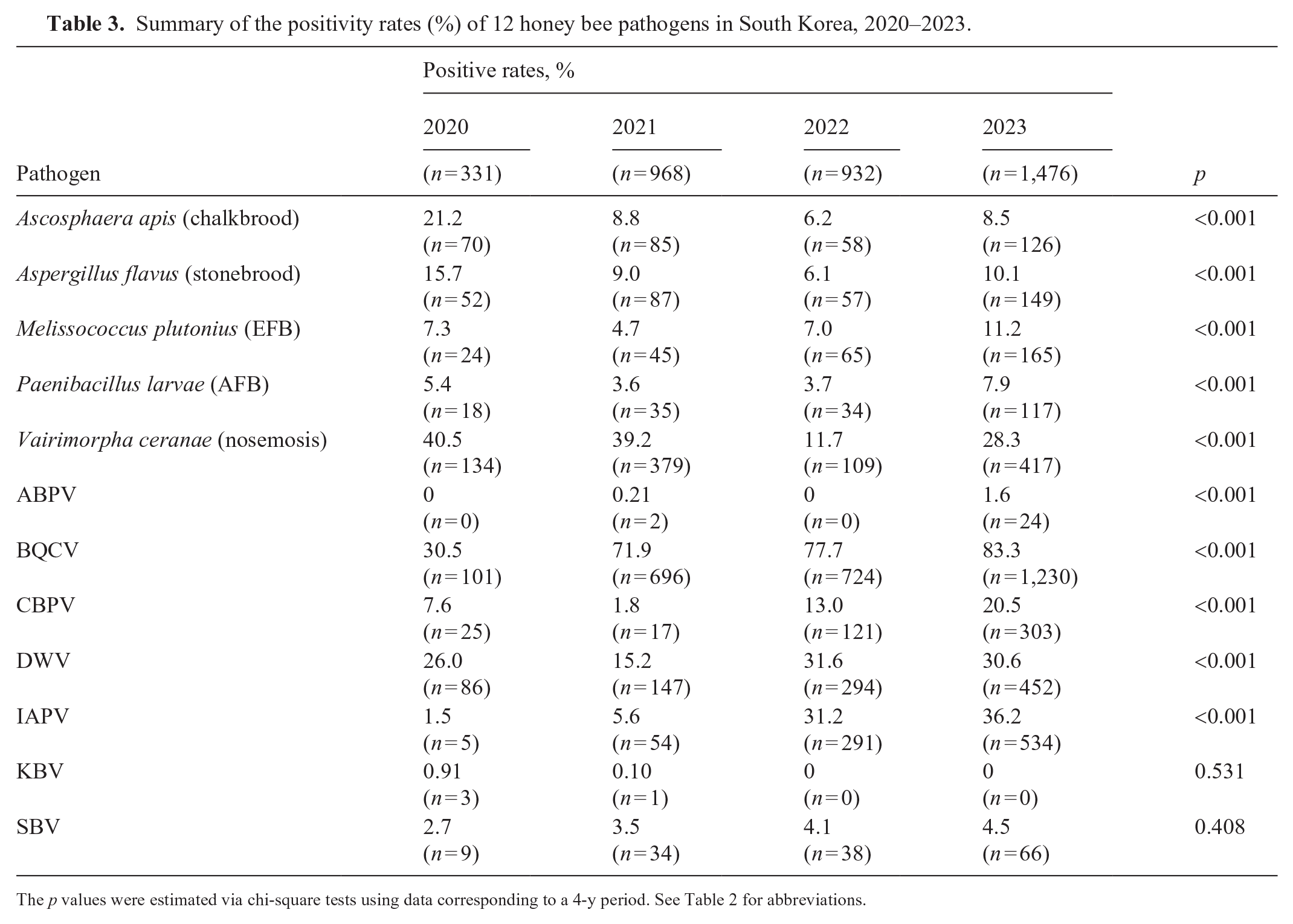
The p values were estimated via chi-square tests using data corresponding to a 4-y period. See Table 2 for abbreviations.
Seasonal prevalence characteristics of honey bee pathogens
We observed seasonal variations in the prevalence of honey bee pathogens over the 4 periods studied in South Korea: January–April, May–June, July–September, and October–December (Fig. 1). Thus, some pathogens were found seasonally, whereas others had relatively stable or sporadic occurrence. For example, SBV had a relatively low percentage of positive cases in January–April (3.5%) and October–December (1.3%) but increased in May–June (12.4%) before decreasing again in July–September (4.0%). Similarly, positive cases of CBPV were increased in May–June (43.2%) compared with other periods; CBPV prevalence remained relatively in July–September (9.9%). Furthermore, DWV increased in July–September (49.1%) and October–December (48.7%) compared to the earlier months. Positive IAPV cases also increased in July–September (46.2%) compared to the preceding months.
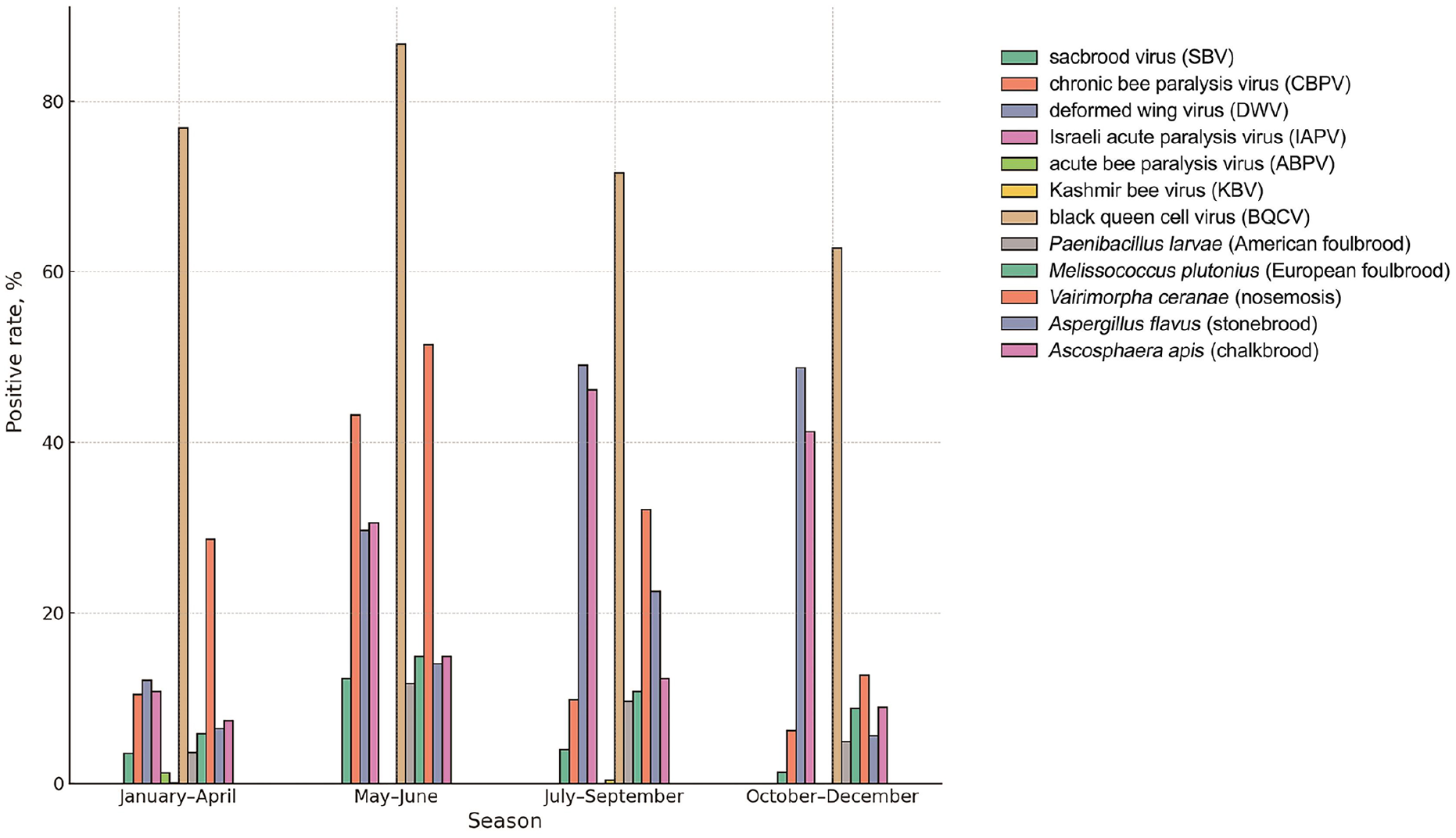
Summary of the seasonal positive rates (%) of 12 honey bee pathogens in South Korea, 2020–2023. BQCV was highly prevalent throughout the year; the number of positive detections of ABPV and KBV were very few or zero during most of the observation periods.
Some pathogens, such as A. apis, A. flavus, M. plutonius, and P. larvae, had a relatively low prevalence but a slight increase in prevalence during certain periods of the year, such as May–June and July–September. In contrast, positive cases of V. ceranae decreased in January–April (28.7%) and October–December (12.8%), with an increase in May–June (51.5%) and an intermediate level in July–September (32.1%). For some pathogens, percentages of positive cases were relatively consistent across different time periods. A high prevalence of BQCV-positive cases was observed throughout the year, with the highest prevalence in May–June (86.8%). Variable but moderate percentages of A. apis–positive cases occurred throughout the year. Additionally, ABPV and KBV had very few or zero positive cases during most observation periods.
Comparison of the odds ratios of honey bee pathogens according to pre-defined time periods and regions
Some pathogens, such as BQCV and V. ceranae, had significantly higher odds of infection, whereas others had seasonality in their infection patterns (Table 4). More specifically, SBV had significantly increased odds of infection in May–June (odds ratio [OR]: 9.0; 95% credible interval [Crl]: 4.8–18.2) compared to October–December. CBPV had a notably increased odds of infection in May–June (OR: 10.5; 95% Crl: 7.5–15.2) compared to October–December. In contrast, DWV had significantly lower odds of infection in January–April (OR: 0.23; 95% Crl: 0.19–0.27) and May–June (OR: 0.32; 95% Crl: 0.24–0.41) compared to October–December. Similarly, IAPV had significantly reduced odds of infection in January–April (OR: 0.31; 95% Crl: 0.26–0.37) and May–June (OR: 0.43; 95% Crl: 0.33–0.56) compared to October–December. Bacterial pathogens, such as P. larvae and M. plutonius, had a higher odds ratio within periods other than in January–April relative to the reference period. The fungal pathogen A. apis was more prevalent in all periods except in January–April (OR: 0.84; 95% Crl: 0.64–1.12), compared to the reference period in October–December, and A. flavus was consistently more prevalent, with the highest increase in July–September (OR: 4.44; 95% Crl: 3.06–6.55). An examination of differences in the prevalence of honey bee pathogens according to the sampling regions in South Korea (central, southern, and northern regions; Fig. 2), revealed no significant differences between the regions (Table 4).
Odds ratios for the occurrence of 12 honey bee pathogens according to pre-defined time intervals and regions.
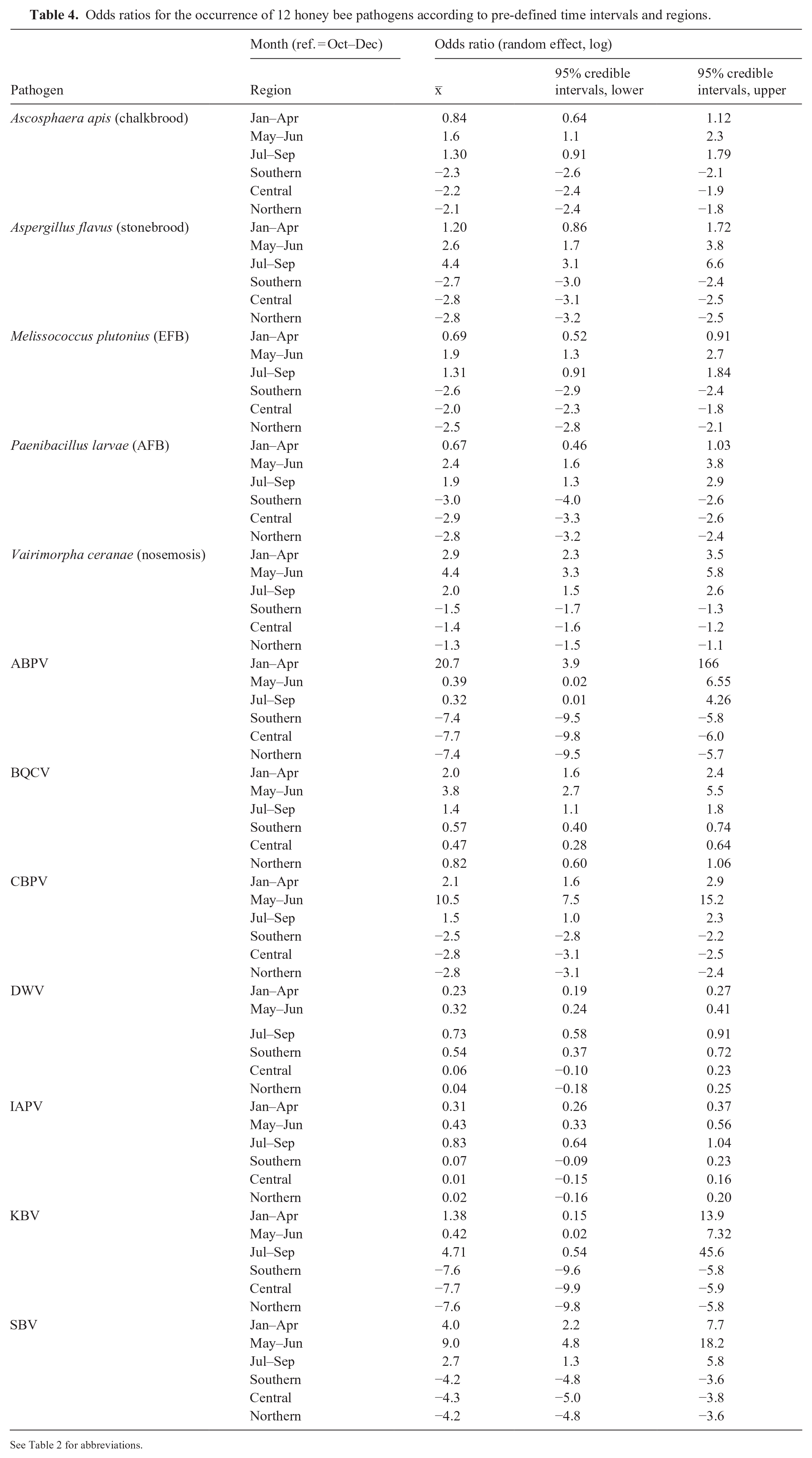
See Table 2 for abbreviations.
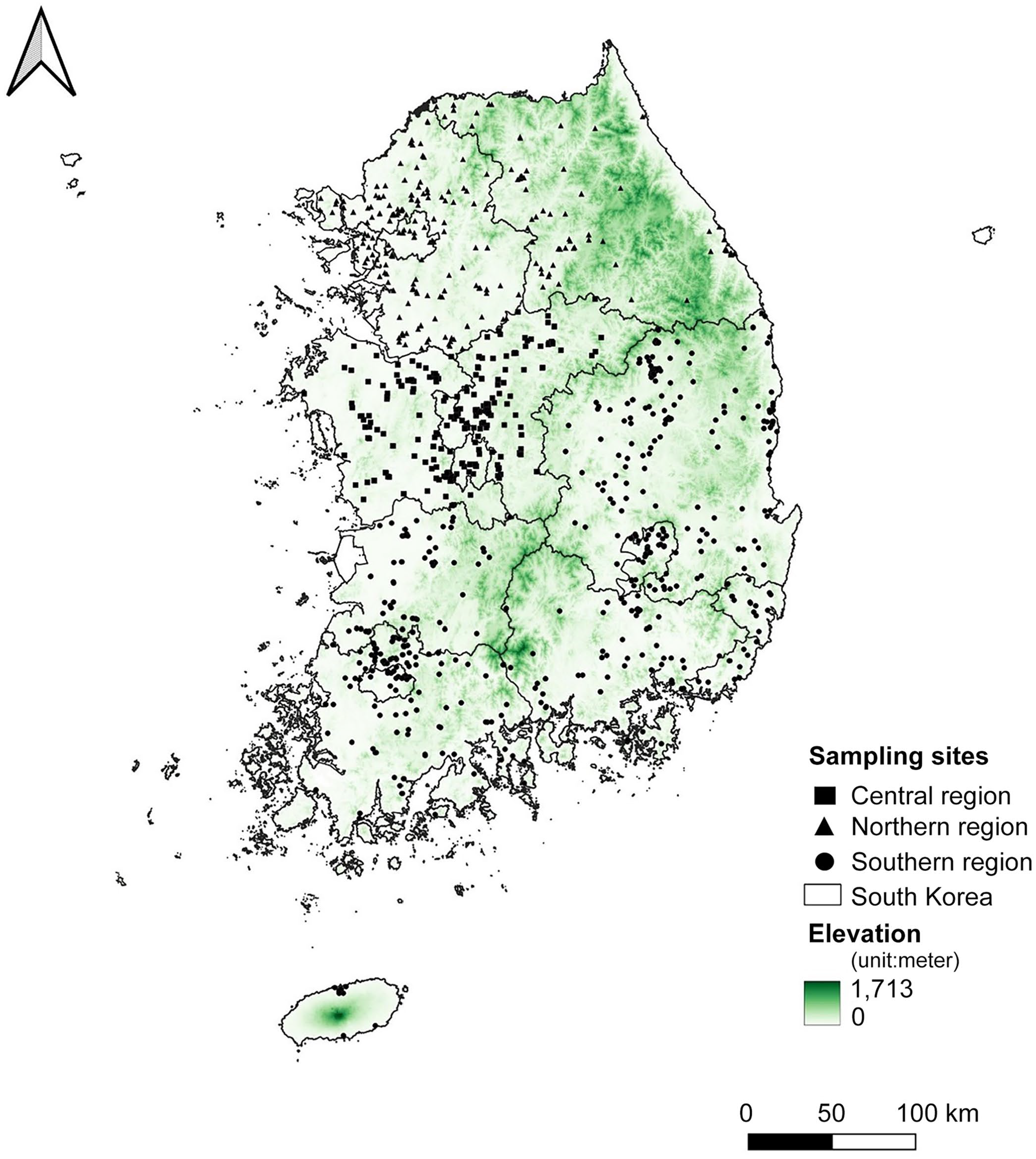
Sampling sites in South Korea divided into central, northern, and southern regions based on temperature differences. The dots with different shapes represent the different regions.
Discussion
The most prevalent pathogens in abnormal domestic honey bees in South Korea from 2020 to 2023 were BQCV, DWV, and IAPV. The fungal pathogen V. ceranae also had a high positive rate. Other fungal pathogens, A. apis and A. flavus, had low but persistently positive results. Further, bacterial pathogens P. larvae and M. plutonius also had low but persistently positive annual rates, and of the 12 honey bee pathogens examined, 10 were highly prevalent in the examined samples, except for ABPV and KBV, which had very low or zero positivity rates.
Several possible explanations exist for the high prevalence of these pathogens in South Korea. First, unlike mammals, honey bees do not have a well-developed acquired immune system, which makes them particularly vulnerable to viral diseases. Given their colonial lifestyle, pathogens spread rapidly once honey bees enter the hive. 5 Cleaning activities, called social immunity, or propolis, a natural antibiotic, can prevent the invasion and spread of these pathogens to some extent; however, these actions are insufficient. 28 Second, because honey bees fly and collect food, pathogens are easily introduced from outside, and unlike other livestock, preventing the spread of pathogens is difficult. Third, South Korea has one of the highest honey bee breeding densities in the world, and honey bee farms are located in close proximity, making it easier for horizontal infections to occur in honey bees between hives.
Among the honey bee pathogens examined, BQCV had the highest positive rate starting in 2021, with a positive rate of 83.3% in 2023, indicating that most honey bees in South Korea were exposed to the BQCV pathogen. Additionally, BQCV had a consistently high positive rate regardless of the season, which is highly related to the characteristics of the South Korean beekeeping industry. BQCV-infected colonies may be supplied for crop pollination in growth houses during the winter season, and this could be the source of BQCV transmission to other colonies within growth facilities. South Korea does not have a system in place to accurately screen and supply BQCV-negative honey bees to queen or pollinator colonies. Further, the tools beekeepers use for grafting, such as plastic cell cups, are not properly sanitized and are often reused with molten beeswax; thus, increasing the possibility of BQCV outbreaks. 2
DWV and IAPV were highly prevalent pathogens in abnormal domestic honey bees. In 2023, DWV and IAPV had positive rates of 30.6% and 36.2%, respectively, and positive rates for IAPV increased steadily and significantly over the past 4 y. DWV and IAPV increased in prevalence in July–September, with peak positive rates in October–December, which is associated with honey bee mites, such as Tropilaelaps mercedesae and Varroa destructor. 21 Mites can act as vectors for the transmission of several pathogens within the hive, and some studies have linked mites particularly to DWV and IAPV outbreaks. 32 Honey bee mites increase in abundance in May–June, and if they are not properly controlled, the mites can severely affect the colony’s health, leading to a failure in overwintering and eventual colony loss during winter. 7 Most beekeepers take measures to control honey bee mites. However, in South Korea and globally, honey bee mites cannot be properly controlled due to resistance of mites to the synthetic pyrethroid-based mite control agents used.9,19 This failure to control honey bee mites is believed to have contributed to the increased positive rates of pathogens, such as DWV and IAPV, worldwide including South Korea. 32
We observed that viral pathogens, such as CBPV and SBV, and other pathogens, such as A. apis, M. plutonius, P. larvae, and V. ceranae, had increased positive rates in May–June. In South Korea, honey production occurs in May–June, with increased temperatures, and honey bees are at their peak foraging activity. 10 Frequent invasions by foraging honey bees to steal honey from other colonies increase contact between honey bees and facilitate the transmission of pathogens between colonies. 24 A. flavus, the cause of stonebrood in honey bees, is a prevalent fungal pathogen in South Korea, and also a zoonotic pathogen that causes liver toxicity in humans. 25 A. flavus had a high positivity rate July–September because of the high humidity in South Korea during the summer season, which creates a favorable environment for the pathogen to thrive. 11
Regional differences in the prevalence of honey bee pathogens in the central, southern, and northern regions of South Korea were not significant. This is because most beekeepers in South Korea migrate across the country according to the flowering time of plants for honey production, and the buying and selling of colonies is an active trade. 13 Regardless, further research is required to accurately determine the prevalence of honey bee pathogens in different regions of South Korea.
We only targeted A. mellifera, which is widely reared in South Korea. Further, we did not investigate the positivity rates of other pathogens, such as Kakugo virus and Spiroplasma melliferum, and parasites, such as Aethina tumida, T. mercedesae, and V. destructor, in our study.
We anticipate that our findings will provide essential data for predicting future trends in honey bee disease outbreaks in South Korea. Furthermore, our findings are expected to aid in reducing the incidence of diseases, such as CCD, by supporting the development of effective quarantine systems, advancing drug treatments, and implementing pathogen prevention strategies.
Footnotes
Acknowledgements
We thank Nyun-Ki Chung of the Honey Bee Clinic in South Korea for help with honey bee sample collection.
Declaration of conflicting interests
The authors declared no potential conflicts of interest with respect to the research, authorship, and/or publication of this article.
Funding
This research was supported by the Honeybee Disease Management Investigation Research Fund (2020-2023-73201) of the Korea Apicultural Agriculture Cooperative.
