



Abstract
To prevent significant economic losses, some countries have successfully eradicated enzootic bovine leukosis (EBL), which is caused by bovine leukemia virus (BLV) infection. In Serbia, efforts to eliminate EBL commenced in the late 1990s. Recognizing the disparities in test selection among laboratories and variations in quality, we evaluated the diagnostic sensitivity and specificity of commercial ELISAs using field samples in Serbia. Using 5 commercial ELISA kits, we tested 138 cattle serum samples, submitted for confirmatory testing between 2020 and 2023, along with 100 serum samples from BLV-negative herds. We found 100% agreement of the ID Screen BLV Competition (IDvet), Svanovir BLV gp51-Ab (Svanova), and INgezim BLV Compac 2.0 (Ingenasa) ELISAs. We observed 93% agreement comparing these 3 kits to the Bovine Leukemia Virus Antibody test kit (VMRD). Agreements of 92% and 88.4% were determined between Idexx and IDvet, Svanova, and Ingenasa kits, and between Idexx and VMRD kits, respectively.
Enzootic bovine leukosis (EBL) is 1 of 2 blood-borne viral diseases caused by bovine leukemia virus (BLV; Retroviridae, Deltaretrovirus bovleu), 11 which significantly impacts animal health and welfare, as well as the economy of the country. BLV infection typically leads to a subclinical condition. However, following an extended incubation period, ~30% of infected cattle develop persistent lymphocytosis (PL), with 1–5% progressing to B-cell leukemia or lymphoma. 1
The discovery of BLV DNA in animal products intended for human consumption raised concerns regarding its potential effects on human health. Although some studies suggest a connection between BLV and the development of female breast cancer and other hematopoietic neoplastic diseases, 8 other research indicates no clear link between BLV and its role as a causative agent in human cancer development. 3
Given the substantial economic impact of EBL, including reduced milk quantity and quality, reproduction failures, and trade restrictions, 11 some countries have implemented disease control programs that successfully led to eradication. 2 In contrast, in other regions, the disease remains uncontrolled, or control programs rely on the voluntary participation of owners. 7 The costs associated with mastitis resulting from BLV immunosuppression were estimated at US$419 per cow in Japan, 9 and the difference in net revenue between infected and noninfected cows has been projected to be US$467 in Canada. 6 Considering indirect costs, such as those due to trade restrictions, it becomes evident that any control strategy is both economically advantageous and desirable.
Various approaches to control EBL are described, including comprehensive management strategies, selective management strategies, test and cull, and test and segregate. 9 Nevertheless, the elimination of infected animals stands out as the sole effective strategy for eradicating the infection. 3 The highest prevalence of BLV is reported in countries such as the United States, Japan, Canada, Brazil, China, and Argentina. 2
EBL is typically detected using serologic tests, including the ELISA and the agar gel immunodiffusion (AGID) test, both of which detect anti-gp51 or p24 antibodies. Although the identification of proviral DNA can also reveal EBL, ELISA, which detects specific antibodies, is generally considered the preferred method. Although AGID is considered the gold standard, advancements in antigen purification and standardization have rendered ELISA more sensitive than AGID. 4 ELISA is recognized for its sensitivity, specificity, commercial availability, high throughput, and potential for automation, which allows the effective testing of pools of up to 10 animals. However, variations in performance exist among ELISA kits from various manufacturers. 8 Like other tests, ELISA can produce inaccurate results in different scenarios, such as during early infection stages when antibodies are not yet detectable or when passively transferred maternal antibodies are detected. 8 As the eradication process nears completion, the accuracy of tests becomes crucial.
Despite the initiation of the eradication process in the late 1990s, EBL continues to be prevalent in Serbia (https://wahis.woah.org/#/dashboards/country-or-disease-dashboard). The eradication initiative in Serbia follows the “test and eliminate” principle, involving testing of all breeding cattle >24-mo-old. The testing utilizes ELISA on group samples, and BLV antibody-positive animals are either sent to slaughter or subjected to stamping out. The process involves 12 veterinary institutes across Serbia, each using their preferred tests due to the absence of a standardized methodology at the national level. Each positive sample undergoes confirmation at the National Reference Laboratory (NRL; Institute of Veterinary Medicine of Serbia, Belgrade, Serbia), which faces challenges due to the variable quality of commercially ELISAs. At the NRL, several ELISAs kits are used for the final detection given the absence of an AGID test.
Given the prolonged duration of the eradication efforts, the lack of harmonization in test selection among veterinary laboratories and observed variations in the quality of available commercial tests, we assessed the diagnostic sensitivity (DSe) and diagnostic specificity (DSp) of commercial ELISA kits using field samples from Serbia.
We examined 238 bovine serum samples to evaluate the performance of 5 commercial ELISA kits. As the designated NRL for bovine enzootic leukosis, the Institute of Veterinary Medicine of Serbia received 138 cattle serum samples for confirmatory testing between 2020 and 2023, forming the basis of our study. Additionally, we included 100 sera from BLV-free herds, according to the data in the State Animal Database (Serbian Veterinary Directorate, “VETUP Program”), in our testing. For the evaluation of performance, we used 5 commercial ELISA kits: Leukosis serum X2 Ab (Idexx; test A), ID screen BLV competition (IDvet; test B), Bovine leukemia virus antibody test kit using ELISA (VMRD; test C), Svanovir BLV gp51-Ab (Svanova; test D), and INgezim BLV Compac 2.0 (Ingenasa; test E). Tests A, C, and D are indirect ELISAs, test B is a competitive ELISA, and test E is a blocking ELISA—all are designed to detect anti-gp51 antibodies.
Sample preparation and testing procedures were conducted following the recommendations of the respective test manufacturer. The interpretation of test results as positive, negative, or doubtful was done individually, adhering to the specified cutoff values provided by the test producers. Cohen kappa values were calculated to assess the agreement among the obtained results. Furthermore, DSe and DSp were determined based solely on the results from the field samples. True-positive samples were designated as those in which at least 2 tests produced positive results (n = 125), reflecting a common practice in laboratory testing and statistical analysis. Similarly, true-negative samples (n = 113) were identified based on consistently negative results obtained from at least 4 tests. This approach is consistent with the principles of sensitivity and specificity, wherein true-positives are samples correctly identified as positive by the respective test(s). 13 In calculating DSe, a doubtful sample result was considered positive. Positive predictive values (PPVs) and negative predictive values (NPVs) were calculated using Epitools (https://epitools.ausvet.com.au/predictivevalues), with a 5% probability of infection chosen to serve as a benchmark for comparing the performance of tests.
Of the 138 samples submitted for confirmation, test A yielded 134 positive reactions, 3 doubtful results, and 1 negative result. Among the 3 samples with doubtful results in test A, the outcomes in other tests were as follows: sample 1 tested positive in tests B–E; sample 2 tested negative in B–E; sample 3 tested positive in tests B, D, and E, but negative in test C. For tests B, D, and E, 126 samples were positive, and 12 were negative. Test C produced 121 positive samples and 17 negative samples. A consistent positive result was obtained for 119 samples across all 5 tests. Eleven samples were positive only in test A. Five samples tested negative exclusively in test C; one was negative solely in test A. All samples from herds confirmed as negative reacted negatively with all 5 kits.
A perfect agreement of 100% and a Cohen kappa value of 1 were achieved for tests B, D, and E (Fig. 1). When comparing test C results with those from tests B, D, and E, a substantial agreement of 93% and a Cohen kappa of 0.67 were estimated (Fig. 1). A slight agreement of 92%, with a Cohen kappa of 0.14, was observed between test A and the results of tests B, D, and E (Fig. 1). Additionally, a slight agreement (88.4%) was determined between test A and C results, with a Cohen kappa of 0.099 (Fig. 1). The DSp for tests B, D, and E was estimated at 99.1% (95% CI: 95.2–100.0%), with a DSe of 100% (95% CI: 97.1–100%; Table 1). Their PPVs and NPVs were 0.86 and 1, respectively, for a 5% probability of infection (Table 1). For test A, the DSp was estimated at 91.1% (95% CI: 84.7–95.5%); the DSe was 100% (95% CI: 97.1–100%; Table 1). The PPV was 0.372, and the NPV was 1 (Table 1).
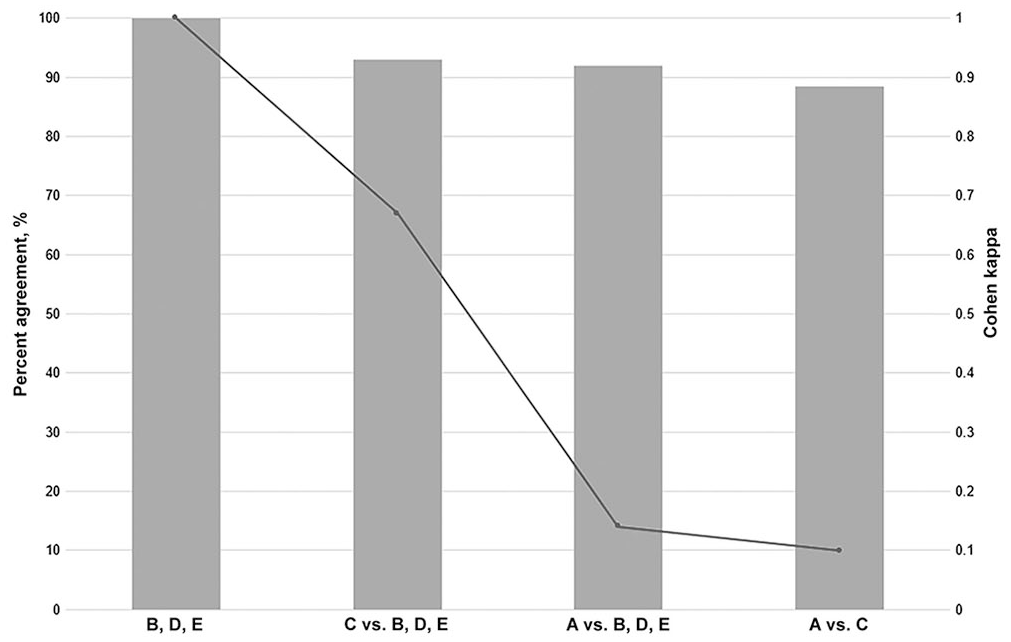
Agreement and Cohen kappa for different test comparisons. A = Leukosis serum X2 Ab Test (Idexx); B = ID screen BLV competition (IDvet); C = Bovine leukemia virus antibody test kit using ELISA (VMRD); D = Svanovir BLV gp51-Ab (Svanova); E = INgezim BLV Compac 2.0 (Ingenasa).
Performance of 5 ELISA kits for the detection of antibody to bovine leukemia virus.

A = Leukosis serum X2 Ab (Idexx); B = ID screen BLV competition (IDvet); C = Bovine leukemia virus antibody test kit using ELISA (VMRD); D = Svanovir BLV gp51-Ab (Svanova); E = INgezim BLV Compac 2.0 (Ingenasa); NPV = negative predictive value; PPV = positive predictive value.
In contrast to the other tests, test C had higher DSp at 100% (95% CI: 92.0–99.1%) but lower DSe at 96.8% (95% CI: 92.0–99.1; Table 1). The PPV for test C was 1; the NPV was 0.998 (Table 1). However, it is crucial to recognize that predictive values are influenced by the prevalence of the disease. When all other factors are held constant, PPV rises as prevalence increases; the number of true-positives tends to increase relative to false-positives, thereby boosting PPV due to a larger proportion of true-positives among all positive test results. 10 Conversely, as prevalence declines, the number of true-negatives increases, elevating NPV because of a larger proportion of true-negatives among all negative test results. Therefore, recalibrating the predictive values based on the true prevalence is essential, particularly during the eradication process, as it can improve decision-making and strategy development. This optimization allows for the design of testing protocols that maximize the identification of true-positive cases in high-prevalence areas and confirm disease-free status in low-prevalence areas.
Although most samples yielded consistent results, potential discrepancies and accuracy issues in test outcomes raise concerns, particularly when a laboratory relies on a single kit. In our study, samples were classified as positive if they produced positive results with at least 2 kits, given the limitation of not considering results from the AGID test due to its lower sensitivity. PCR could serve as an alternative for result confirmation, given its excellent sensitivity and result reproducibility. 12 However, this method was not applicable in our study due to the unavailability of EDTA samples. Similar findings have been reported elsewhere. 5 Although the DSe results remained entirely consistent, discrepancies arise in the DSp results from the Idexx ELISA (test A). Our results indicate a specificity of 90.3%, contrasting with the reported 100%. Based on our findings, we recommend complementing the screening test with a test of different characteristics depending on the purpose, as this approach provides the most accurate results.
The identification of false-positive samples in our study may be attributed to the limited variety of ELISA kits available in regional laboratories, restricting their ability to conduct additional testing on initially positive samples. It is crucial to note that, compared to false-positives, false-negative results contribute to disease spread between annual testing intervals. In cases of single reactors, performing supplementary tests can enhance detection precision. Therefore, results obtained from ELISA kits with low DSp should be approached with caution.
Footnotes
Declaration of conflicting interests
The authors declared no potential conflicts of interest with respect to the research, authorship, and/or publication of this article.
Funding
Our work was supported by the Serbian Ministry of Science, Technological Development and Innovation (grant 451-03-47/2023-01/200030).
