




Abstract
As client interactions with veterinary diagnostic laboratories have evolved, so have client expectations: faster results, enhanced accessibility to cases, and more seamless data transfer from the laboratory database; all of these factors have encouraged the evolution of diagnostic laboratory systems. This evolution started with 24-h access to laboratory results via the web, yet data quality remained at the mercy of the person filling out the form. If bad (incomplete) information was flowing in, then the data coming out was equally bad (incomplete or inconsistent). By designing a web-based system integrated into our existing reporting platform, the Iowa State University Veterinary Diagnostic Laboratory (ISU-VDL) set out to improve the quality of submission data by including the premises identification number (PIN) and obtaining consistent location data, all while presenting to the client an easy-to-use interface. Efforts continued by incentivizing the use of this tool and client submission practices. As clients transitioned, data have become more complete, resulting in easier queries and an improved ability to leverage the diagnostic data. To further enhance the client experience, a streamlined daily reporting summary was designed to communicate laboratory results succinctly. The use of these web-based tools had a positive impact on the quality and consistency of the diagnostic data. As new ideas develop, the ISU-VDL strives to foster continuous improvement and positively impact the clients’ experience.
The beginning
In early 2014, the Iowa State University Veterinary Diagnostic Laboratory (ISU-VDL; Ames, IA) set out to enhance the value of diagnostic records by improving the quality, traceability, and connectivity of the data collected and generated. In the years following, significant investment and ongoing system development efforts have resulted in a suite of tools housed in the ISU-VDL Client Web Portal.
Although online access to results has been a reality for clients of the ISU-VDL since the early 2000s, the integration of online data collection systems lagged. It was comparatively easy to post results to a website but designing an interactive and intuitive submission process took additional investment of time and resources. The ISU-VDL Client Web Portal, in its first version, existed primarily as a reporting tool that clients used to retrieve their results and not much else.
Redefining expectations
The first step in improving data collection was defining the information that the ISU-VDL was interested in collecting. Although paper forms had evolved over time, they were still inadequate when this endeavor began in earnest. The evolution of electronic submission forms has resulted in numerous opportunities for increased data capture, higher quality of data, and the ease with which clients can communicate with the laboratory. Redesign of the original paper forms started with the goal of allowing submitters the opportunity to provide and thus retrieve a more granular and complete dataset. These new, dedicated fields included site (separate from owner information); premises identification number (PIN); source or flow; group or lot; and premises type. ISU-VDL worked closely with State of Iowa and federal veterinary medical officials to ensure that updated submission forms and case reports were consistent with the reporting of information that may be required with current and future program diagnostic work. This was paired with a move to a fillable PDF form so that the data would be more legible and pasted or keyed in by the client. As data fields were developed, the internal laboratory information management system (LIMS) was updated to accommodate the additional information in dedicated data fields.
Moving online
Once the data were defined and a system for collecting and capturing it was established, the ISU-VDL could design a web-based system. The goal was integration into the existing result portal. Clients were accustomed to utilizing the ISU-VDL Client Web Portal to access their case results. By adding submissions, the end product would be a one-stop shop for interaction with the VDL.
By moving the submission form online, enhanced visibility of required fields and the ability of clients to consistently include complete and correct premises-of-origin information was finally achievable (Fig. 1). Additionally, test offerings or other submission-level data-capture fields could be modified as needed without printing and distributing new paper forms, resulting in a perpetually up-to-date form. The client portal interface needed to be easy-to-use and clean in appearance, therefore we modeled it after our most current paper form, making the transition from paper to web-based as seamless as possible for the client. The appearance was almost identical from the start. By minimizing the difference in appearance, clients felt more familiar with the interface and were more willing to make the step over to the web version of the forms. One of many improvements over the PDF form is that the web interface functions mainly by prepopulated dropdown menus. This allows for consistency of submission level that was previously unattainable when the information was written or typed manually. Prepopulated dropdown menu items remove variations in naming, punctuation, level of address completion, as well as the PIN. Initially, the data upload to populate the dropdown was a manual process utilizing Excel spreadsheets, but an additional development piece now allows VDL clients to maintain their own libraries of owners and sites, giving users the ability to easily create, edit, search, and delete owner and site information directly from their portal. This information automatically populates the dropdown in the various submission forms available.
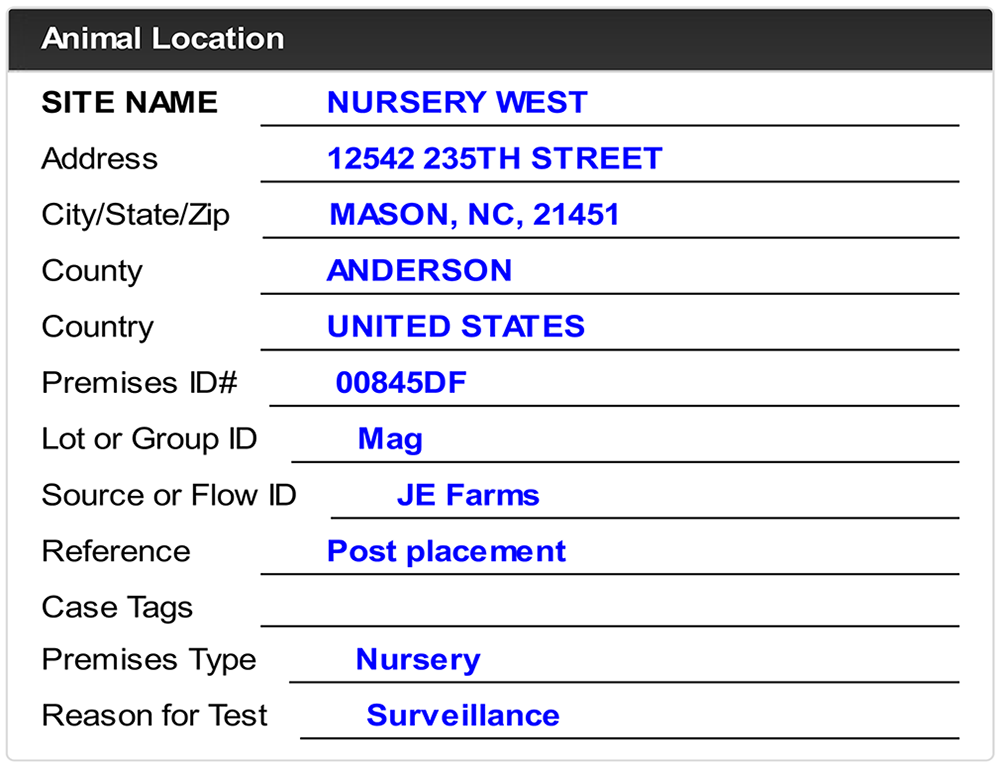
Iowa State University Veterinary Diagnostic Laboratory site-level identifiers on the updated submission form (sample form used for training purposes).
The ISU-VDL Client Web Portal submission interface design features the ability to create new web submissions as well as create and manage reusable templates for those submissions that involve recurring test requests and/or instructions. Clients can also create “pending” worklists of submission forms to come back to when their time or additional information allows. The portal provides the flexibility and freedom of paper by also allowing the generation of “paper” (populated with Client/Owner/Site data but no test requests) submissions that can be printed and carried to any remote (no computer/cellular access) site.
Getting dynamic
Over time, as clients became more accustomed to the web portal, the ISU-VDL Client Web Portal moved to a “dynamic” rendering of the printed submission forms. These dynamic forms change based on the information included or omitted, which altered the look and feel of the printed version of the form. This modification makes the selected tests and included information more straightforward by removing any empty fields from the form, and streamlines the appearance of the form so the client’s request is easily viewed without sifting through information that is not applicable to their specific request(s). It allows faculty and staff at the laboratory to easily see the requested tests, history, special requests, etc., all while making no change to the interface for filling out the form. Additionally, this update removed a point of frustration for VDL clients and staff. For those submissions including significant case history, treatment, differential diagnosis, etc., the previous PDF-rendered versions of the submission form either limited characters to 250 or shrank the text so that it was unreadable. The conversion to the web-based form eliminated the barrier to more complete client information, allowing longer, more elaborate communication from the client by removing the character limit on text fields. Finally, with this update, the ISU-VDL took the opportunity to make species and age a requirement on all submissions. Given that these fields are mandatory, the resulting submission form is more complete. Accurate animal demographic information eases the diagnostic decision process on cases that require a diagnostician’s decision for test selection. This requirement allows for more accurate processing of cases and decreases the number of incomplete submissions sent to the laboratory.
Incentivizing behavior
Recognizing that change is difficult, the ISU-VDL provided motivation for client change. This came in the form of a monetary incentive for utilizing the web interface. In 2016, the ISU-VDL began waiving case submission fees on submissions that used ISU-VDL Client Web Portal generated forms that included a valid PIN on livestock submissions and contained the state of origin. The ISU-VDL offered this incentive to encourage practices that provided quality, consistent, laboratory test requests because this allowed the VDL to produce laboratory reports that were equally consistent, contained high-quality data, and prepared the ISU-VDL’s clientele to reap the benefits of bi-directional electronic information transfer. In 2017, the incentive program was expanded to also include a “Best Practice” component. This helped to further promote good submission practices by offering an additional reward for completed submission forms with relevant history as well as well-labeled and organized samples. As a result of these incentives and efforts to promote the benefits and ease of use, the Client Web Portal utilization by our client base has continually increased over time. Since implementation in late 2015, the client uptake of online web submission has increased from 20% of submissions in January 2016 to routinely > 70% of submissions in 2020 (Fig. 2). At the time of publication, 70% to 75% of all cases received at the laboratory are made via the ISU-VDL Client Web Portal electronic submission application.
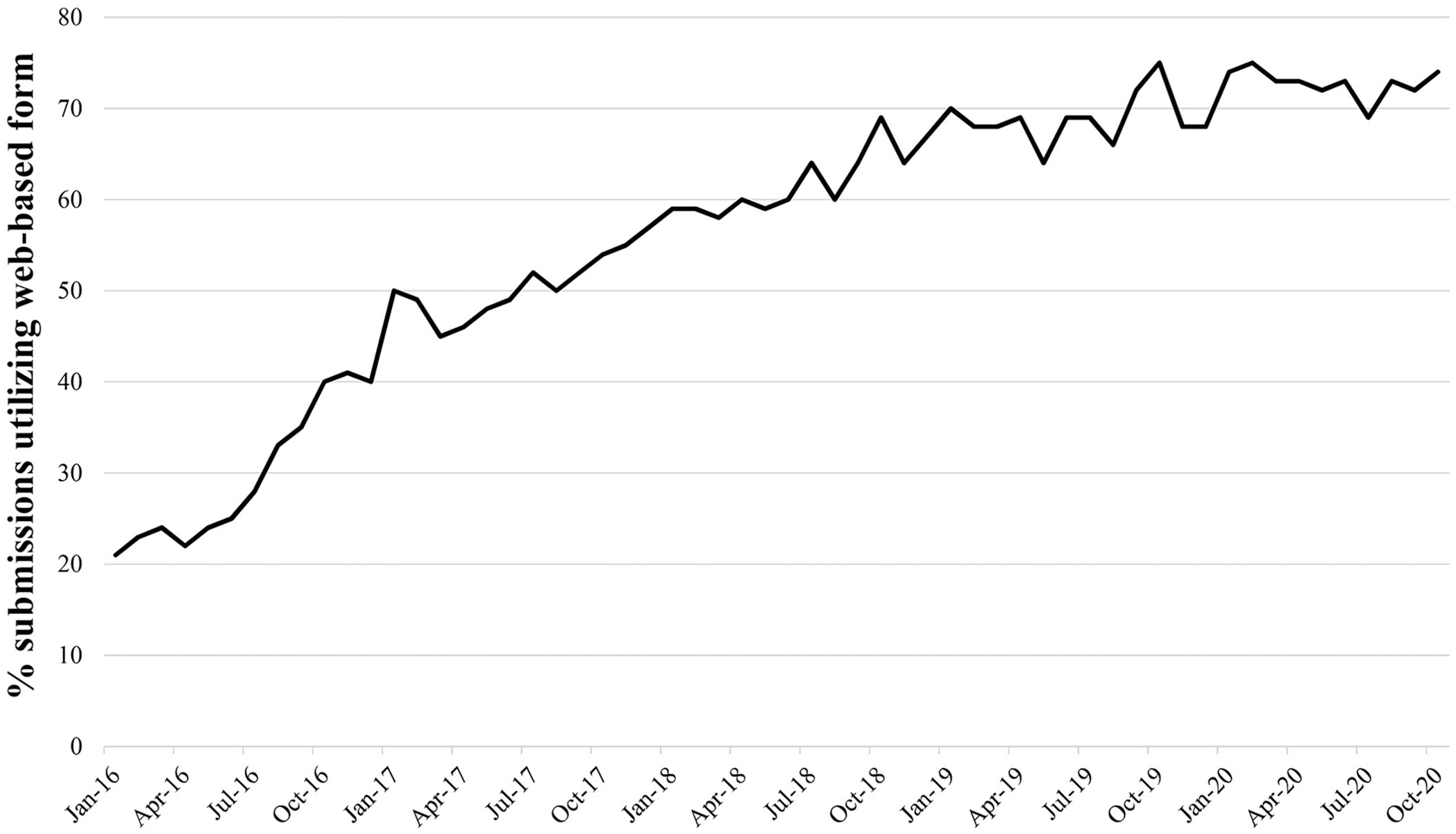
Percentage of submissions utilizing Iowa State University Veterinary Diagnostic Laboratory web form (Jan 2016–Oct 2020).
Streamlined reporting
As the ISU-VDL Client Web Portal submission tool evolved, so did the reporting tool. The ISU-VDL launched a “Daily Summary Report” and associated “Report Preferences”, with the aim of improved predictability and a more streamlined method for ISU-VDL clients to receive updates on their cases (Fig. 3). These 2 updates comprised an improved tool for managing the distribution and receipt of laboratory results. The “Daily Summary Report” enables VDL clients to receive one end-of-day email summary of all of their open cases. The “Report Preferences” enables the active management of client preferences to when, how often, and to whom the “Daily Summary Report” is distributed each day. “Daily Summary Reports” can either be at a clinic level (all reports for that clinic) or a veterinarian level (only reports associated with that individual). This allows the flexibility to meet the preferences of any submitter or clinic. “Daily Summary Reports” contain a mobile-friendly summary of all open cases clearly delimited with associated case identifiers (Veterinarian, Clinic, Owner, and Site), a link to the live case report, and a summary of qualitative test results. The case report links are fully forwardable at an individual case level for ease of sharing. Prior to this development, clients received a minimum of 3 emails per case: 1 at receipt, 1 for preliminary results from a single section, and 1 final report. This number could be as high as 4 per day per case as each testing section released its own report. These “Daily Summary Reports” improve the client experience because they provide an alternative to receiving a barrage of individual e-mails for all of their case submissions and eliminate the need for manual release of case results.
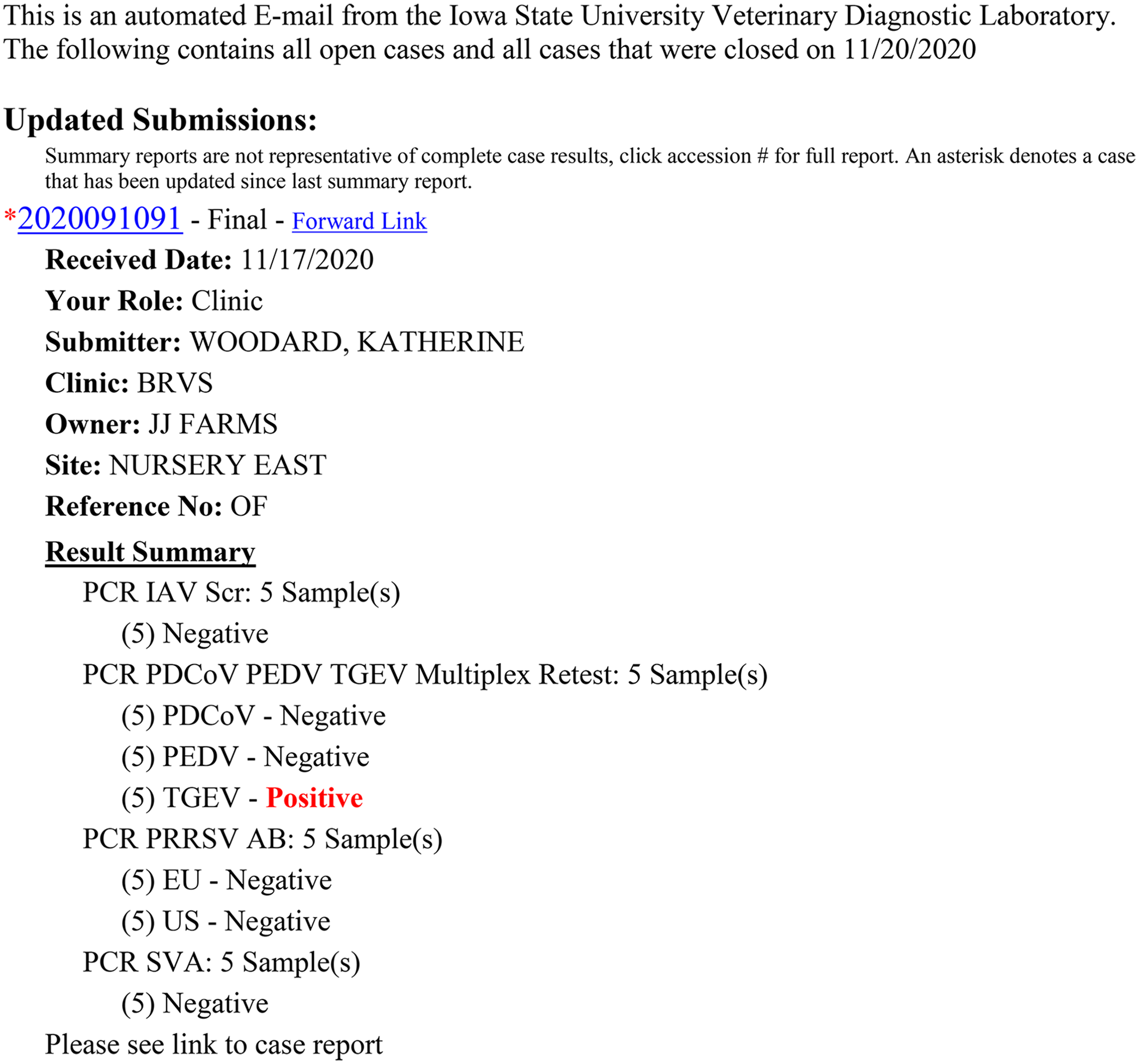
Example of an Iowa State University Veterinary Diagnostic Laboratory daily summary report (sample report used for training purposes).
The backside of data collection
Of course, data are of limited use for trend analysis or disease surveillance if they cannot be accessed easily. With that in mind, as the ISU-VDL developed improved submission forms and tools, corresponding fields in our LIMS were also developed. These fields include site, lot, or group, source or flow, and premises ID, which had not existed previously in the laboratory database as dedicated data fields. With increasing granularity in fields as well as newly required fields, data queries became more reliable, informative, and easier to produce. The ISU-VDL is now better positioned to perform more in-depth queries to fulfill client requests. Instead of sifting through all of the cases from an individual clinic and reviewing hard copies of submission forms, the ISU-VDL and the client can now more proficiently search for owners, sites, lot, or group, source or flow, as well as traditional fields (veterinarian, clinic, reference) and test results, and retrieve complete records from the database. These developments have created a foundation for significant steps forward in the value and utility of laboratory data.
Many ISU-VDL clients now have standing queries that can be generated routinely on a designated schedule or by request. A schedule could be monthly, quarterly, or yearly. These queries are easily accessible to staff through a web interface and do not require the time of laboratory IT staff once the initial query is built.
Client reception
The ISU-VDL client base has been a driving factor in the development of tools. The laboratory is always open to client suggestions and feedback for future developments. As a result, ISU-VDL tools have been received with much anticipation. Client response to these tools has been largely positive. Clients report they “wish it had existed sooner” as it “makes more sense” than paper forms and duplicate data entry. Although some clients are hesitant to make the switch to electronic submissions, “after a bit of learning, it is quite simple.” Although the ISU-VDL has not formally surveyed its clients to objectively gauge feedback on these improvements, anecdotally, submissions are more standardized and, as a result, the laboratory data are as well. Additionally, the ability to export data into Excel and share it directly with others through the portal has proven to be an easy way for clients to move their laboratory data into other applications.
Looking ahead
The next logical step to improve the client experience and leverage the laboratory data is to incorporate customized dashboards for clients. Client requests for access to their results along with an intuitive way to search at a test result level have made it clear that new tools are required. The rapid rise of business intelligence (BI) tools has given the ISU-VDL the ability to build these dashboards in-house, based on client queries. These dashboards can display a mixture of graphs, charts, and tables as a visual representation of laboratory data or data related to client behavior, such as submission numbers, monetary figures, or observance of best practice incentive guidelines (Fig. 4). One could envision these dashboards embedded into the ISU-VDL Client Web Portal, self-driven by the client, utilizing data from the ISU-VDL LIMS database and providing tools for integration into other applications. These dashboards may have a future as a replacement for the more manual query request process that exists currently.
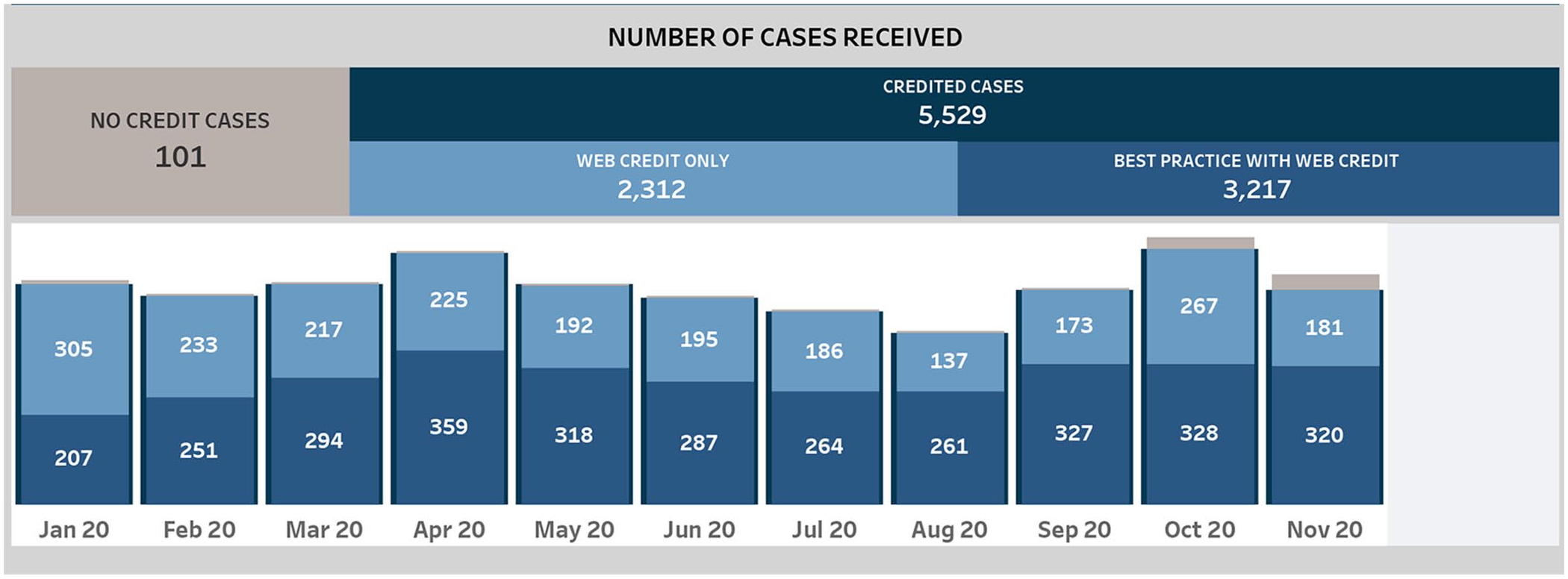
Iowa State University Veterinary Diagnostic Laboratory business intelligence dashboard outlining an individual client’s utilization of the Best Practice Incentive Program. The dashboard displays the overall breakdown for the time period as well as a monthly breakdown. Number of cases received = total cases received in the time period; no credit cases = number of cases that did not qualify for any incentive; credited cases = number of cases that received some incentive; web credit only = a credited case that received only the incentive for submitting via the online portal; best practice with web credit = a credited case that received the web credit incentive and best practice submission credit.
As technology continues to evolve and present new opportunities, the ISU-VDL will continue to develop new ideas, foster continuous improvement, enhance the client experience through thoughtful feedback, leverage the value of laboratory data, and strive to positively impact our clients’ interaction with the laboratory.
Footnotes
Declaration of conflicting interests
The authors declared no potential conflicts of interest with respect to the research, authorship, and/or publication of this article.
Funding
The authors received no financial support for the research, authorship, and/or publication of this article.
