




Abstract
Epithelium or fluid from vesicular lesions are the preferred samples to confirm foot-and-mouth disease virus (FMDV) infection in livestock. A pH-neutral buffered transport medium is recommended for optimal preservation of epithelial samples, but may not be necessary for all circumstances based on the results of our study. Pieces of epithelium were collected from FMDV-infected cattle (isolates O/FRA/1/2001 and A/IRN/22/2015) and stored at room temperature in sealed tubes without any liquid or preservatives. Using RNA extracted from the severely decayed epithelium up to 3 wk after collection, FMDV was successfully detected by RT-rtPCR, and the viral strain was identified by sequencing of capsid protein VP1. Direct isolation of the virus in cell culture was only possible for vesicular material stored for up to 2–5 d, depending on the serotype, but, for both serotypes, infectious virus was recovered by transfection of RNA extracted from epithelium after 3 wk of storage at room temperature. Specialized transport medium will give optimal results, particularly for low-titer samples, but is not required for the reliable detection and characterization of FMDV in highly positive vesicular epithelium by molecular methods.
Foot-and-mouth disease virus (FMDV) is a positive-strand RNA virus (family Picornaviridae, genus Aphthovirus) that infects cloven-hoofed domestic animals and wildlife. 7 In susceptible hosts, the virus causes vesicular lesions in and on the mouth, snout, and feet, a condition known as foot-and-mouth disease (FMD). Because the disease is highly contagious, it spreads rapidly and has a massive economic impact. 7 FMD is endemic in Africa and Asia but does not occur in North America, Europe, Australia, New Zealand, and most of South America, as of 2019. Early recognition of an introduction of FMD into a free area is critical for control and eradication of the disease. Many FMD-free countries, therefore, maintain a targeted surveillance system, in which clinically suspect cases are notified to the authorities and samples are collected for the exclusion of FMDV by laboratory testing.
Vesicular fluid and epithelium from intact or freshly ruptured vesicles are the sample materials of choice for this purpose. For shipment to the laboratory, the World Organisation for Animal Health (OIE) recommends keeping the material in a custom buffered transport medium of neutral pH. 11 The neutral pH prevents virus capsid dissociation 4 and allows re-isolation of the virus in susceptible cell cultures. In Germany, this transport medium is produced and distributed by regional laboratories in the federal states and then held in refrigerated storage at the veterinary offices in each district for rapid deployment in an outbreak situation. Considering that the transport medium must be replaced annually, this procedure is both costly and time-intensive and is increasingly unpopular. At the same time, as in most FMD-free countries, veterinary diagnostic laboratories in Germany no longer rely on virus isolation and antigen ELISAs to detect FMDV in suspect samples.
The first-line laboratory test is the detection of FMDV-specific viral RNA by reverse-transcription, real-time PCR (RT-rtPCR). Compared to the intact virus particle, which is necessary for successful virus isolation in cell culture, it is expected that viral RNA is less dependent on the preservation of the sample, suggesting that a buffered transport medium may not be necessary for RT-rtPCR detection of FMDV.
To test this hypothesis, individual pieces of freshly collected vesicular epithelium (each ~1 mm3 in volume) were randomly distributed into microcentrifuge tubes and stored without any media or preservatives at room temperature (22 ± 2°C) for up to 3 wk. The sample material was gathered from cattle experimentally infected with either FMDV serotype O (isolate O/FRA/1/2001) or serotype A (isolate A/IRN/22/2015). Every day for the next 23 (serotype O) or 19 d (serotype A), 2 tubes per serotype with vesicular material were randomly selected and frozen at −80°C to arrest decay until further processing of the samples. (No tubes were frozen on days 5, 6, 12, 13, 19, and 20 for serotype O, and on days 17 and 18 for serotype A.) After collection and freezing of the last sample, all samples were thawed at the same time and immediately homogenized individually in 1 mL of cell culture medium with antibiotics. For homogenization, a 5-mm stainless-steel ball was added to each tube, and the samples were disrupted (TissueLyser II; Qiagen, Hilden, Germany) for 180 s at 30 Hz. Viral RNA was extracted from 250 µL of clarified homogenate using TRIzol LS (Thermo Fisher Scientific, Waltham, MA) and the NucleoMag VET kit (Macherey-Nagel, Düren, Germany) on a magnetic particle processor (KingFisher Flex; Thermo Fisher Scientific) as described previously. 1 To determine the content of FMDV RNA in the samples, a RT-rtPCR assay targeting the highly conserved 3D region of the viral genome was performed. 2 No loss of viral RNA was evident over the course of the experiment. Even after 3 wk of storage, it was possible to detect RNA of FMDV in all epithelial samples. Indeed, the amount of detectable viral RNA appeared to increase slightly with longer storage (Fig. 1). It is possible that progressive autolysis of the tissue facilitated mechanical disintegration so that larger quantities of virus particles and viral RNA were released from the samples that had been stored longer. The small size of the amplified region (107 nucleotides) compared to the length of the full genome (~8,200 nucleotides) gives the 3D RT-rtPCR assay a high degree of resilience against fragmentation of the viral genome as a result of microbial decay.
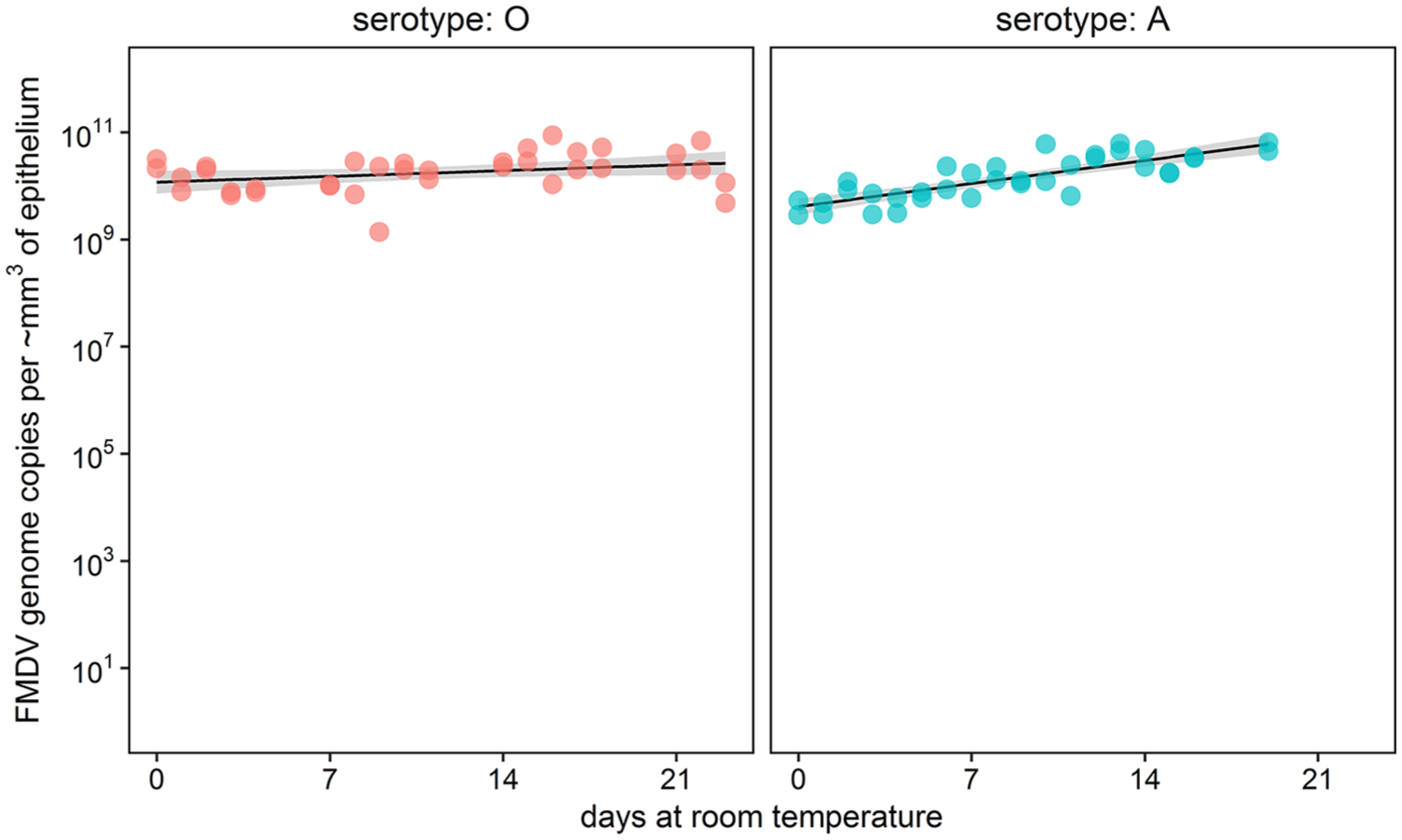
Reverse-transcription, real-time PCR detection of foot-and-mouth disease virus (FMDV)-specific RNA in epithelial samples that were stored at room temperature without any preservatives. A linear equation was fitted to the data with the “lm” function in R (http://www.r-project.org). The line of linear regression for each dataset and its confidence interval are shown in black and gray, respectively. For serotype A, the slope of the regression line was significantly different from 0 (p < 0.001), but for serotype O it was not (p = 0.059).
Although the 3D assay is highly specific and highly sensitive for FMDV, it does not allow differentiation between serotypes or the identification of subtypes. 2 However, accurate identification of the circulating virus isolate is of major importance in an outbreak, particularly when a suitable vaccine is to be procured from a vaccine bank on short notice. Therefore, the extracted viral RNA was also used to sequence the genomic region encoding the structural protein VP1 in order to identify the serotype and subtype of the isolate. The sequencing primers FMD-3161-F and FMD-4303-R have been described previously. 5 The expected PCR product is ~1,200 bp in length. It was successfully amplified from RNA of fresh epithelial material as well as from RNA extracted from the pairs of samples stored at room temperature without preservatives for 19 or 23 d (Fig. 2).
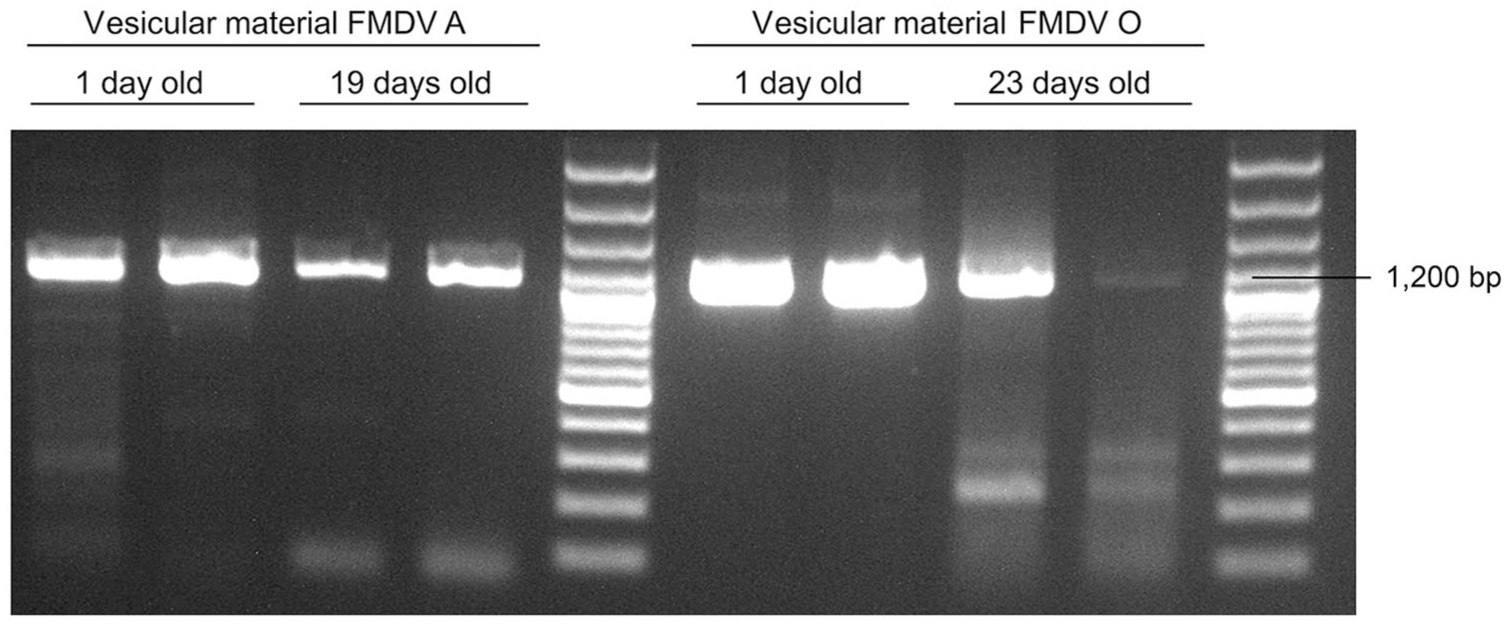
Agarose gel image of the PCR-amplified fragment of the VP3- and VP1-coding regions, obtained with RNA extracted from vesicular material stored at room temperature without preservatives. The GeneRuler 100-bp plus DNA ladder (Thermo Fisher Scientific) was used for size determination.
The sequences obtained from the fresh and stored samples were 100% identical, and the latter were used for a database search with Nucleotide BLAST (https://blast.ncbi.nlm.nih.gov/Blast.cgi). The serotype O and A sequences obtained with the FMD-3161-F primer were 630 and 729 nt long, respectively, and spanned the 3’-end of the VP3-coding region and the 5’-end of the VP1-coding region (overlapping 51% and 66% of VP1, respectively). The serotype O sequence was 100% identical to the deposited sequence of O/FRA/1/2001 (GenBank accession AJ633821.1), and the serotype A sequence was 100% identical to that of A/IRN/22/2015 (GenBank accession KY982289.1).
Traditionally, the serotype of a FMDV-positive sample is determined by immunologic methods, such as antigen ELISAs and cross-neutralization tests.9,10 Apart from complications that arise from cross-reactions between serotypes, these methods are unable to distinguish between viral strains within one serotype and require reagents such as polyclonal sera and inactivated virus preparations that are difficult to standardize and expensive to produce. Molecular methods of strain identification can be easily standardized and are an adequate alternative to traditional methods when combined with comprehensive and well-annotated sequence databases.
If intact viral genomes remain in the sample, infectious virus can be recovered by introducing the positive-strand viral RNA into permissive cells. This was tested by transfecting the extracted RNA into baby hamster kidney cells (BHK-21 clone “Tübingen” obtained from the Collection of Cell Lines in Veterinary Medicine, Friedrich-Loeffler-Institut, Greifswald, Germany; CCLV-RIE 164) using Lipofectamine 3000 (Invitrogen, Carlsbad, CA) according to the manufacturer’s instructions. For both serotypes, the RNA of the day 0 sample was used as a positive control and compared to RNA from an intermediate time (serotype A: day 10; serotype O: day 11) as well as to RNA from the last 3 collected times (serotype A: days 15, 16, 19; serotype O: days 21, 22, 23). Strong cytopathic effect (CPE), indicating the successful recovery of infectious virus, was noted for all times of serotype A as well as for all times except the last one (23 d) of serotype O. The release of infectious viral particles was confirmed by a passage of the supernatants on BHK cells.
Finally, direct recovery of infectious virus from the vesicular material was also attempted. Supernatant from the homogenized epithelium was filtered through 0.45-µm centrifuge tube filters (Spin-X; Corning, Salt Lake City, UT). An aliquot of 100 µL of the flow-through was used to inoculate recombinant porcine kidney cells expressing bovine αVβ6 integrin (LFBKαvβ6) 8 that had been grown to confluency in 48-well plates. The inoculated cells were incubated at 37°C with 5% CO2 for 2 d and were observed daily for CPE. After 2 d, the culture supernatant was passaged to a fresh plate of cells. For serotype O, virus isolation was consistently positive for samples stored at room temperature for up to 2 d, and some CPE was observed in at least one of the tested duplicates from days 3 and 4 (Table 1). In the serotype A samples, infectious virus was consistently detectable in samples stored for up to 5 d, with scattered detection on days 7 and 8 (Table 1). This is in accordance with previous findings of higher capsid stability in serotype A compared to serotype O. 6
Summary of virus isolation results including confirmation by passage and foot-and-mouth disease virus antigen ELISA.
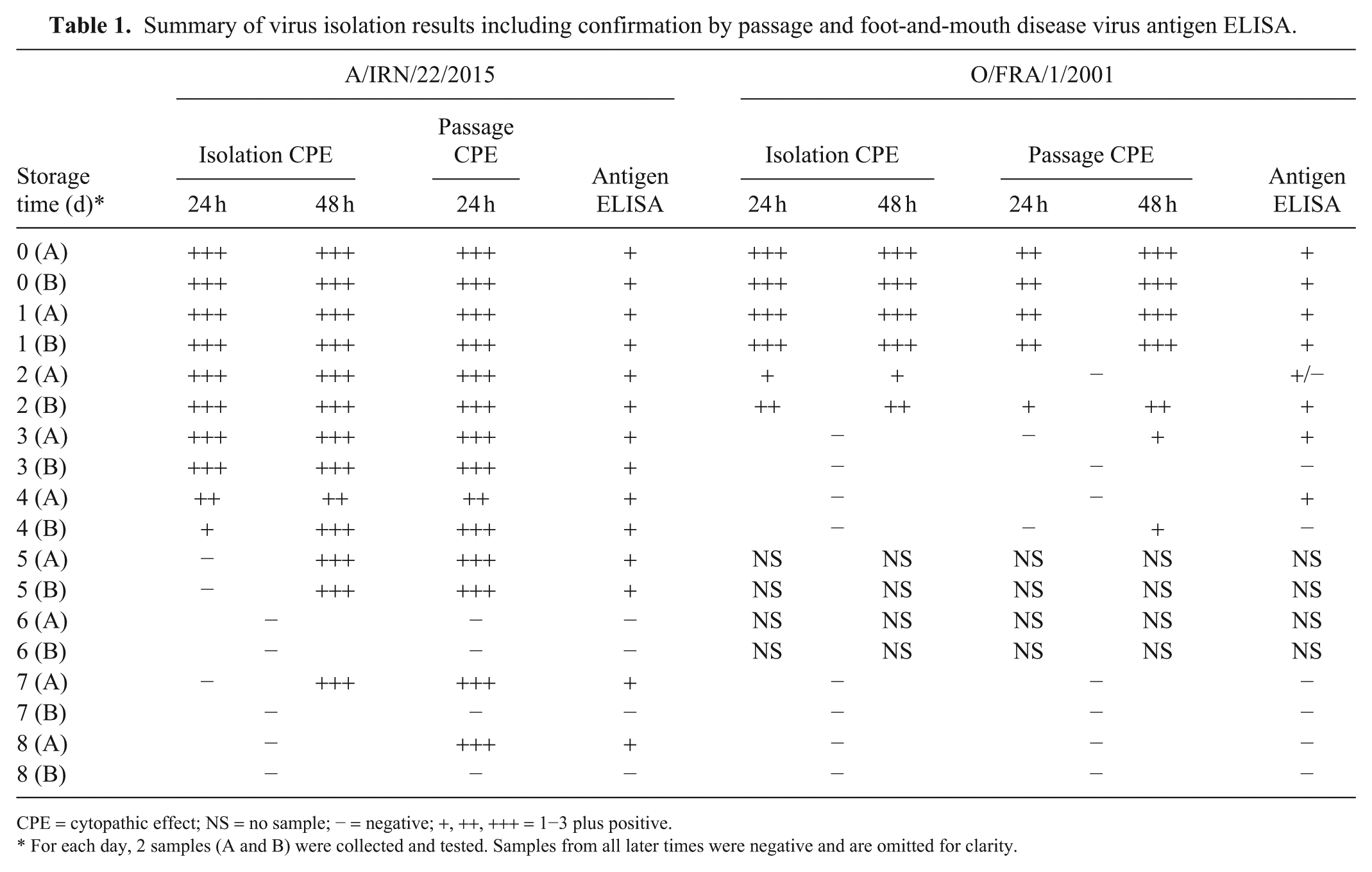
CPE = cytopathic effect; NS = no sample; − = negative; +, ++, +++ = 1−3 plus positive.
For each day, 2 samples (A and B) were collected and tested. Samples from all later times were negative and are omitted for clarity.
To confirm the specificity of the CPE readings in the transfected cells and the virus isolations, cell culture supernatants were tested with an FMDV antigen ELISA 9 according to the instructions given by the OIE. 11 All samples gave at least one positive result for every tested duplicate (Tables 1, 2).
Summary of virus recovery by chemical transfection including confirmation by passage and foot-and-mouth disease virus antigen ELISA.
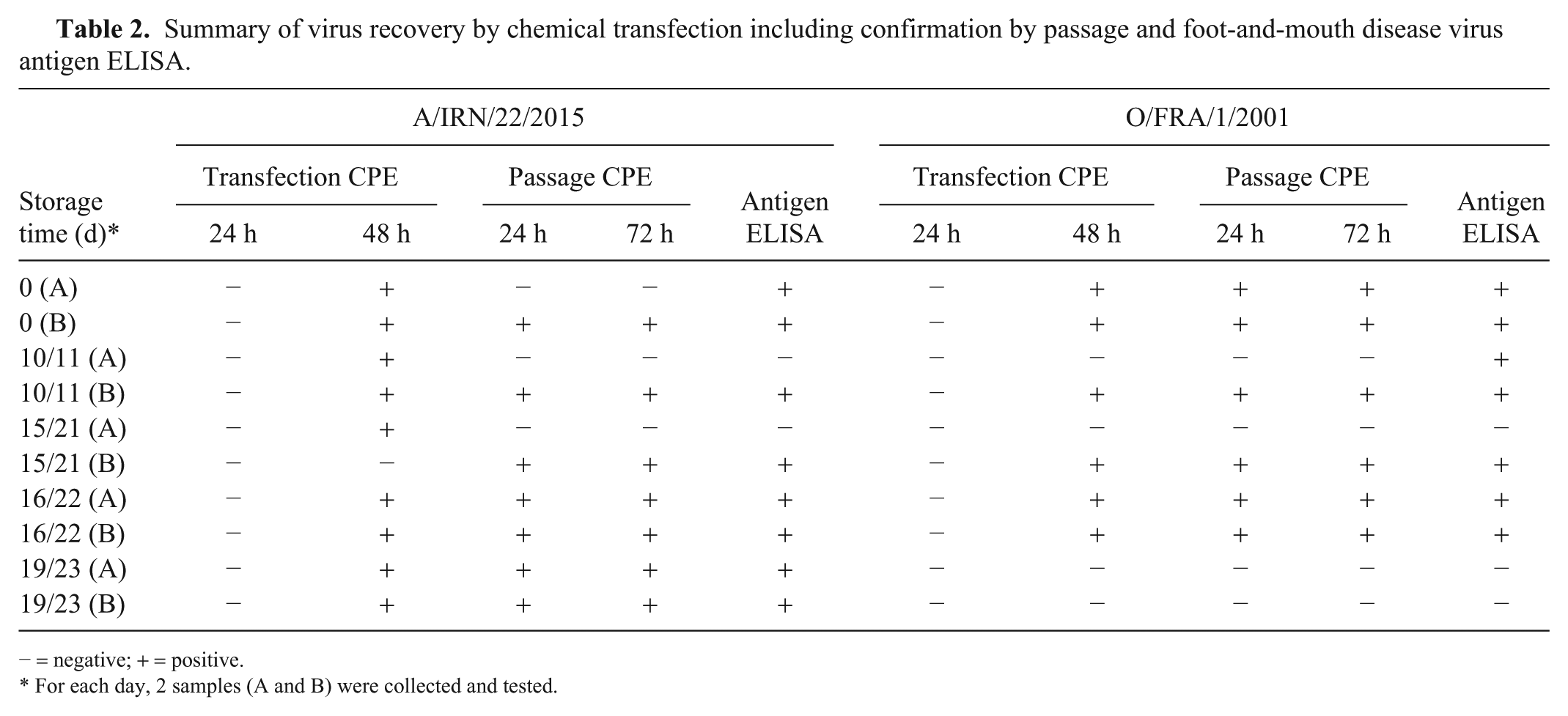
− = negative; + = positive.
For each day, 2 samples (A and B) were collected and tested.
Our results support the hypothesis that custom transport medium may not be essential for comprehensive FMDV detection by molecular methods. Additional studies should include other serotypes and environmental conditions (e.g., more extreme and/or more variable temperatures). Specimens collected from animals in the field may be more severely contaminated than specimens from experimental animals, leading to accelerated decomposition. It is therefore important to validate our findings with field samples.
Nevertheless, it is obvious that submitting a sample without transport medium is preferable to not submitting it at all or delaying the shipment until the transport medium has been procured. If a clinically suspect case is indeed FMD, the collected vesicular material will contain a sufficiently large amount of FMDV RNA to allow positive identification even with a badly preserved sample. In the European Union, the detection of FMDV-specific RNA in a clinically suspect case is sufficient to officially declare an FMD outbreak as per Annex I No. 2 of Council Directive 2003/85/EC. 3 Further characterization of the virus (i.e., the identification of the serotype and lineage that is essential for the selection of an appropriate emergency vaccine) can be swiftly completed by sequencing and a database search. If a viral isolate is required, it can be recovered from the submitted material either directly or by transfection of extracted RNA.
Footnotes
Acknowledgements
We thank Anja Schulz and Holger Freese for their technical assistance.
Declaration of conflicting interests
The authors declared no potential conflicts of interest with respect to the research, authorship, and/or publication of this article.
Funding
V Dill’s position is funded by Merck KGaA, Germany.
