




Abstract
Storage procedures are known to affect the detectability of Clostridium difficile toxins in equine and human feces. We assessed the impact of different storage conditions on the detectability of C. difficile toxins in swine feces. Specimens were inoculated with toxins, 112 ng/g of toxin A (TcdA) and 16 ng/g of toxin B (TcdB) and subjected to the following 3 storage treatments: 4°C, −30°C, repetitive freezing at −30°C and thawing. Toxin determination was assessed at 1, 2, 7, 14, and 21 d with ELISA. A decrease in concentrations of TcdA with time was observed for samples stored at 4°C and repetitive freezing–thawing (p ≤0.05). On day 14, storage at 4°C resulted in decreased TcdA concentration as opposed to storage at −30°C and repetitive freezing–thawing (p ≤0.05). On day 21, storage at 4°C resulted in decreased TcdA detectability compared with storage at −30°C (p ≤0.05). The TcdB concentration was unaffected. These results on toxin detectability in swine feces should be carefully considered in in vitro studies on toxigenic C. difficile. Our results also offer valuable information for microbiologists and veterinarians monitoring the presence of virulent C. difficile in pigs.
Toxigenic Clostridium difficile produces 2 major endotoxins, toxin A (TcdA) and toxin B (TcdB). In infected animals, the toxins cause a rapid pro-inflammatory response leading to pathologic changes in gut tissues, which can result in edema and often diarrhea.6,19 The diagnosis of C. difficile gut infection is often based on clinical signs, postmortem gross anatomic lesions, and detection of C. difficile toxins, TcdA and TcdB. Numerous protocols are available to detect and quantify toxins in biologic specimens. Such protocols include enzyme immunoassays (EIA), cytotoxic tests, and PCR-based gene expression tests. 1 Among these protocols, EIA methods are still the most frequently used assays in clinical laboratories to detect and quantify the toxins. 1 An accurate determination of toxins in specimens from animals or humans with C. difficile infections may help to estimate the spread of the pathogen and the severity of the disease. Toxin quantification may also be useful to assess the toxicity potential of C. difficile isolates. In a typical laboratory, the analysis of biologic materials usually occurs after sample collection. Improper storage conditions, whether refrigeration, freezing, or multiple thawing cycles, may lead to sample deterioration affecting the detectability of toxins in a biologic material. Finally, inappropriate determination of toxins may often lead to the wrong interpretation of results and misleading conclusions. Attention has not been paid to the impact of storage conditions on the detection of C. difficile toxins in biologic specimens originating from pigs, to our knowledge. We hypothesized that different environmental conditions of storage and handling of a porcine fecal sample may significantly affect the stability and therefore the quantitative determination of toxins.
TcdA and TcdB toxins were obtained by growing toxigenic C. difficile ribotype 078 in brain–heart infusion medium with yeast extract (0.5%) and without L-cysteine and then incubated anaerobically at 37°C for 2 wk. Thereafter, the culture was centrifuged at 10,000 × g for 10 min, and the concentration of TcdA and TcdB in the supernatant was measured using a commercial ELISA (tgcBIOMICS, Bingen, Germany), as described previously. 5 To assess the detectability of TcdA and TcdB in porcine feces during storage, sow feces negative for TcdA and TcdB, as verified using the ELISA kit, were inoculated with spent culture supernatant (10% volume) containing both TcdA and TcdB at final concentrations of 112 ng/g for TcdA and 16 ng/g for TcdB. The “feces–toxins complex” samples were then gently homogenized and subjected to the following treatments for toxin determination: 1) storage at 4°C; 2) storage at −30°C; and 3) four repetitive cycles of freezing at −30°C and thawing. For the determination of TcdA and TcdB, samples were brought to room temperature and tested by ELISA. The toxin determination was assessed at 0 (inoculation), 2, 7, 14, and 21 d post-inoculation. Each treatment was analyzed in triplicate and the experiment was repeated 3 times to calculate intra-assay variations. All data management and statistical analyses were performed using SPSS v.24 (SPSS, Chicago, IL). Significant differences between the treatments and within time were calculated by one-way ANOVA with Tukey post-hoc where applicable. Differences were considered significant at p ≤0.05.
A significant decrease in concentrations of TcdA but not TcdB occurred over time for the samples stored at 4°C or with repetitive freezing–thawing (p ≤0.05). Storage at −30°C throughout the experiment had no significant impact on toxin detectability (Fig. 1). Storage of feces at 4°C significantly decreased the TcdA concentration, compared to storage at −30°C and to repetitive freezing at −30°C and thawing (p ≤0.05), which was noted on day 14. One week later, the storage at 4°C significantly decreased the TcdA detectability, compared to storage at −30°C (p ≤0.05). Regarding the concentration of TcdB, there were no significant differences among the 3 storage conditions on the days of measurement (Fig. 1).
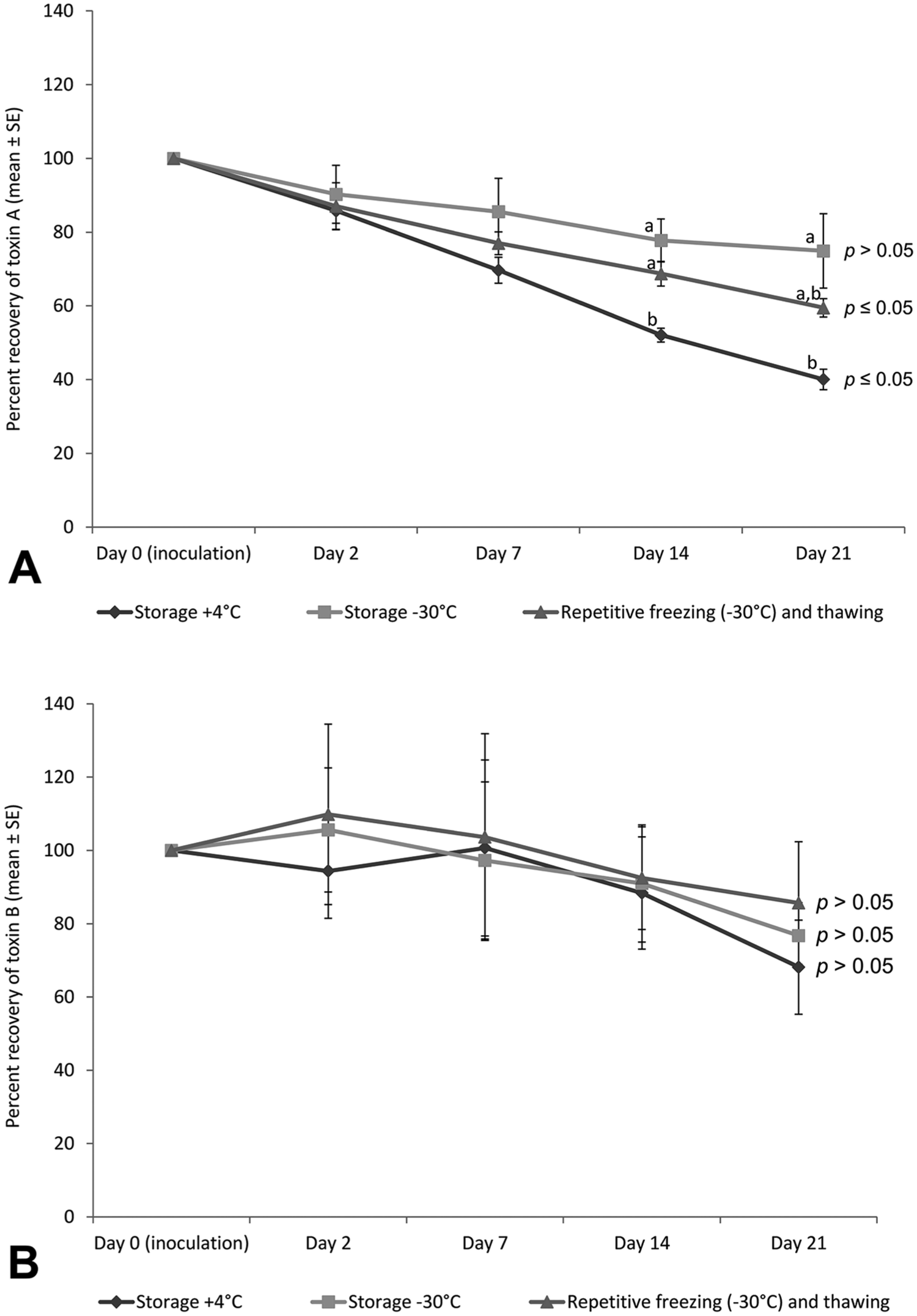
Impact of different storage conditions and time on the percentage recovery (mean ± SE) of Clostridium difficile toxins A (
Although C. difficile is one of the pathogens subjected to a large number of clinical and animal studies, in many cases, no attention has been paid to the impact of storage conditions of the specimens on toxin stability and detection. The lack of such reports is surprising, especially considering the importance of accurate detection and then subsequent decisions on treatment. Only a limited number of studies have investigated toxin detectability in fecal specimens. Previously, the detectability of C. difficile toxins has been assessed in human4,9,17 and equine 20 feces using different storage conditions.
Our study provides data on the quantitative stability of toxins in porcine feces during storage. We showed that the time of storage was detrimental to TcdA but not TcdB in samples kept at refrigeration temperatures and when it was repetitively frozen and thawed. Keeping the samples frozen did not decrease the detectability of the 2 toxins, at least for the 3-wk duration of the experiment. Interestingly, a harmful impact of time depending on the storage conditions was noted only for TcdA but not for TcdB. In addition, at 2 wk of storage, the samples kept at refrigeration temperature had lower TcdA titers compared to samples stored frozen and when repetitively frozen and thawed. C. difficile toxins are proteins 16 and may be susceptible to inactivation by host digestive enzymes that remain in the feces. The toxins may also be prone to degradation by host or microbial products such as proteases already present in the feces or produced by psychrophilic microorganisms during storage at refrigeration temperature.10,11 In addition, repetitive freezing and thawing is known to have a detrimental impact on the stability of certain molecules (e.g., nucleic acids). 14 In our study, freezing–thawing had a negative effect on the detectability of TcdA.
Interestingly, storage of human fecal samples at 4°C for up to 56 d had no effect on C. difficile toxin (toxin type not specified) as verified using a cytotoxic assay with Vero cells, but storage at −20°C and multiple cycles of freezing and thawing adversely affected toxin titers. 4 This is a surprising result, considering the proteinaceous nature of both toxins and the number of agents present in the feces potentially able to degrade them at refrigeration temperature. In a previous study, C. difficile toxins stored in equine feces and in broth at 4°C could be detected by ELISA in both conditions for at least 30 d, although only qualitative data were recorded, and no information on possible toxin concentration loss was provided. 20
Almost all published works on C. difficile toxins in pigs report qualitative (presence or absence) but not quantitative data (concentration per volume of feces). Given that C. difficile belongs to the commensal microbiota of pigs and human, spores of virulent C. difficile and toxins A and B are often found in healthy pigs as well. 5 Thus, more research is required to assess whether a qualitative determination of toxins should be an indication of animal health status or infection. In addition, information on the toxin quantity would be important to determine the minimum concentration that characterizes the infection in animals. Finally, in the diagnosis of C. difficile infection, toxin determination may be even more important than vegetative cell or spore detection, because many commensal C. difficile are non-toxigenic. 18
In a 2018 study, C. difficile toxins could be detected in human feces by EIA up to 4 mo of storage at refrigerated, −30°C, and −80°C temperatures. 17 However, when the feces were diluted, storage at −30°C lowered the stability of toxins. 17 Thus, dilution of the specimens seems to have a negative impact on toxin stability, which is in agreement with the stability of other molecules such as nucleic acids, whether stored diluted or concentrated.12,15 Although the level of toxin titers in a prior study 17 was given as an optical density value, the EIA used did not distinguish between TcdA and TcdB. This raises doubts about the individual susceptibility of either TcdA or TcdB to storage conditions given that both toxins could have contributed to a positive result from the EIA. Nevertheless, refrigeration of feces, especially if diluted, appears to be detrimental to the toxins.
Good detectability of TcdB as compared to TcdA is an interesting finding. Both toxins are large proteins, although TcdB is smaller than TcdA (270 vs. 308 kDa). It is known that, the larger the molecule, the more prone it is to degradation. 2 This might explain why TcdA degraded more rapidly than TcdB when kept frozen. Both toxins share almost half of the same amino acids and are characterized by a similar domain organization, secondary structure, and low pH-induced partial unfolding. 16 However, they still differ in some physicochemical properties, such as distinct thermal behavior. 16 Finally, reports show that more C. difficile outbreaks in pigs are associated with C. difficile producing either both toxins or TcdB only, rather than TcdA only. 3 Similarly, infection in humans can be caused by C. difficile that only produces TcdB, whereas C. difficile isolates that produce only TcdA have not been obtained from diseased patients. Some studies suggest that TcdB is an even more potent toxic agent than TcdA. 13 This could partially explain why TcdB is produced to a lesser extent than TcdA by C. difficile porcine isolates belonging to hypervirulent ribotype 078. 7
Overall, our findings support analysis for TcdB over TcdA, given significant differences in detectability during storage and in situations in which only a concentration of 1 of the 2 toxins can be assessed (e.g., financial or technical capacity of a laboratory). Moreover, data on toxin detectability in feces from one animal cannot be extrapolated to other species, because feces differ in their biologic and physicochemical properties, depending on the animal.7,8
Footnotes
Declaration of conflicting interests
The authors declared no potential conflicts of interest with respect to the research, authorship, and/or publication of this article.
Funding
This study did not receive funding. Ł Grześkowiak was supported by the Deutsche Forschungsgemeinschaft (German Research Foundation; DFG, GR 5107/2-1).
