




Abstract
Farmers in the State of Piauí in northeastern Brazil reported nervous signs in ruminants and donkeys after ingestion of Brunfelsia uniflora at the start of the rainy season when the plant is flowering. Leaves of the plant, collected at the start or at the end of the rainy season, were administered in single doses of 5–20 g/kg body weight to 8 sheep and 3 donkeys. Two sheep and 1 donkey that ingested 10 g/kg of the plant in November at the start of the rainy season, when the plant was flowering, developed severe convulsions and diarrhea. One sheep was euthanized and autopsied, and no significant lesions were found. The other sheep and the donkey recovered. Four sheep and one donkey that ingested 10 or 20 g/kg of leaves collected in April, at the end of the rainy season, did not show clinical signs. One donkey that ingested 5 g/kg of leaves collected in November developed diarrhea and recovered. These results demonstrate the toxicity of B. uniflora for livestock and suggest that the plant is toxic at these doses only during the start of the rainy season.
Brunfelsia spp. (common name = yesterday, today, and tomorrow) are evergreen shrubs from the Solanaceae family (nightshades) that are native to the Americas. 3 Several Brunfelsia species, including B. bonodora, 5 B. australis,2,9,10 B. pauciflora, 1 B. calcyina var. floribunda, 11 B. latifolia, B. americana, and Brunfelsia spp. 9 are reportedly toxic for dogs, and ingestion has led to nervous signs, mainly convulsions, diarrhea, and vomiting. Reversible nervous signs, such as involuntary movements, drooling, restlessness, and convulsions, were seen in cattle after experimental administration of B. pauciflora leaves. 12 Convulsions and other nervous signs have also been reported in rats and mice after administration of an aqueous extract of B. calcyina var. floribunda. 11
Nervous signs in ruminants and donkeys after ingestion of Brunfelsia uniflora (known in the region as manacá; Fig. 1) have been reported in the state of Piauí, Brazil, at the start of the rainy season when the plant is flowering. 6 Donkeys are more frequently affected, but sheep, goats, and cattle may also be affected. Affected animals recover if they are removed from areas invaded by the plant. 6 We aimed to determine the toxicity of B. uniflora in donkeys and sheep at different times of the year.
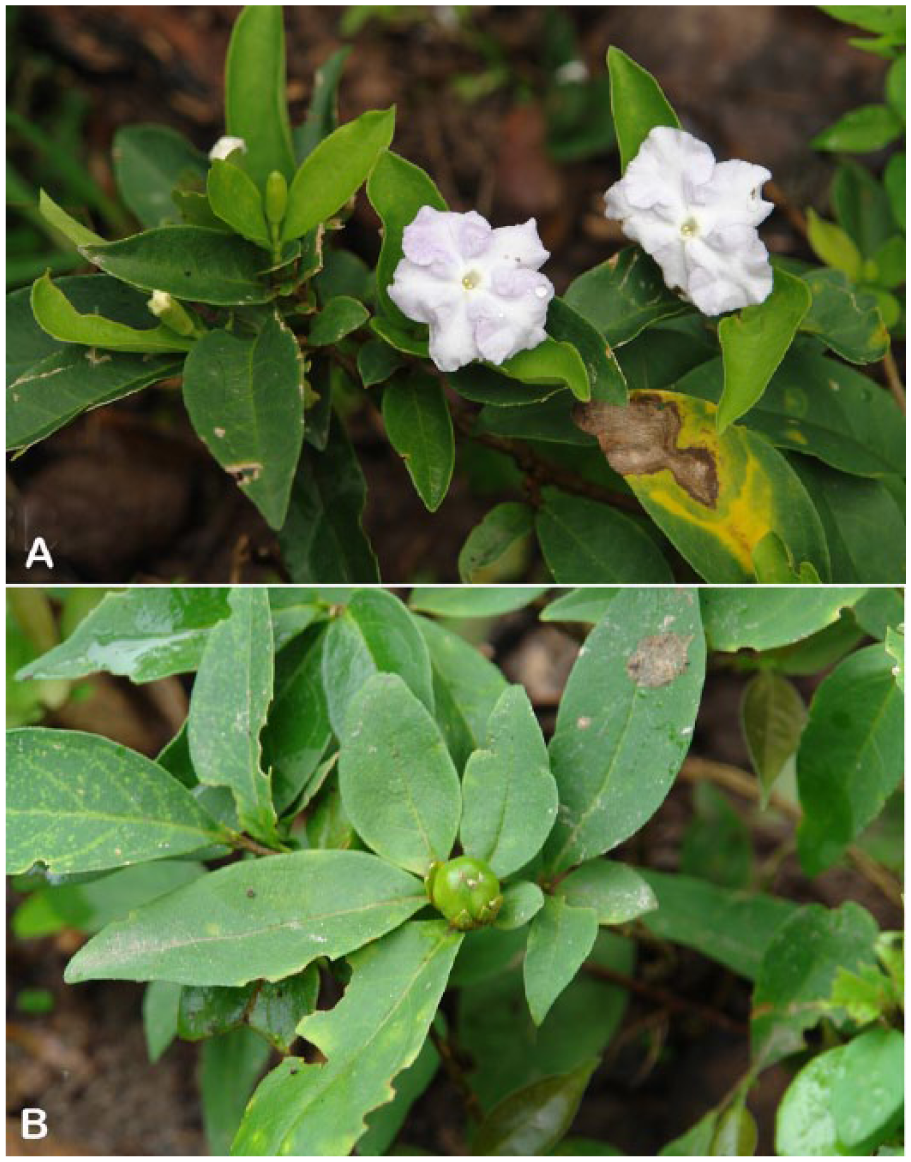
Brunfelsia uniflora from Carnaúba do Piauí municipality, Brazil.
The plant used in our experiments was identified by physical characteristics as Brunfelsia uniflora (Pohl.) D. Don by Odaci F. de Oliveira, from the Federal University of the Semi-arid, in Mossoró, Rio Grande do Norte, Brazil. A voucher specimen of the plant was authenticated and deposited in the Graziela Barroso herbarium of the Federal University of Piauí (TEPB 27.957). The leaves used in the experiments were collected in the Caraúbas do Piauí municipality in the northern region of the state of Piauí. The plants were collected in April 2008, after flowering at the end of the rainy period, and in November 2008, at the start of the rainy period when the plant was flowering. The experiment was approved by the ethics committee on animal experimentation at the Federal University of Piauí (protocol 60/08).
The experimental study included 8 Santa Inês crossbred male hair sheep with an average age of 6 mo and weighing 21–29 kg. Before the experiment, the sheep were maintained for 15 d in individual stalls and fed commercial sheep ration at the rate of 1% of their body weight, as well as fresh elephant grass (Cenchrus purpureus, syn. Pennisetum purpureum) and water ad libitum. The sheep were fasted for 12 h before toxic plant administration. The 8 sheep were randomly divided into 4 groups of 2 sheep (Table 1). Within 6 h after collection, fresh leaves of the plant were administered orally by repeatedly inserting small amounts into the mouths of the animals. Group 1 (sheep 1 and 2) received 10 g/kg body weight of B. uniflora fresh leaves collected in November at the start of the rainy season, when the plant was flowering. Group 2 (sheep 3 and 4) received the same plant as group 1 at a dose of 20 g/kg. Group 3 (sheep 5 and 6) received 20 g/kg of leaves collected after flowering in April at the end of the rainy season. Group 4 (sheep 7 and 8) comprised the control group. The plant and the experimental animals were weighed immediately prior to administration. Exposure doses were determined by the results of a previous experiment at the start of the 2007 rainy season, in which fresh flowering plants given to a sheep at the dose of 9.9 g/kg caused transient nervous signs. In contrast, in the same season, the plant administered to 2 sheep at a dose of 10 g/kg after flowering was nontoxic.
Experimental poisoning in sheep and donkeys with Brunfelsia uniflora.
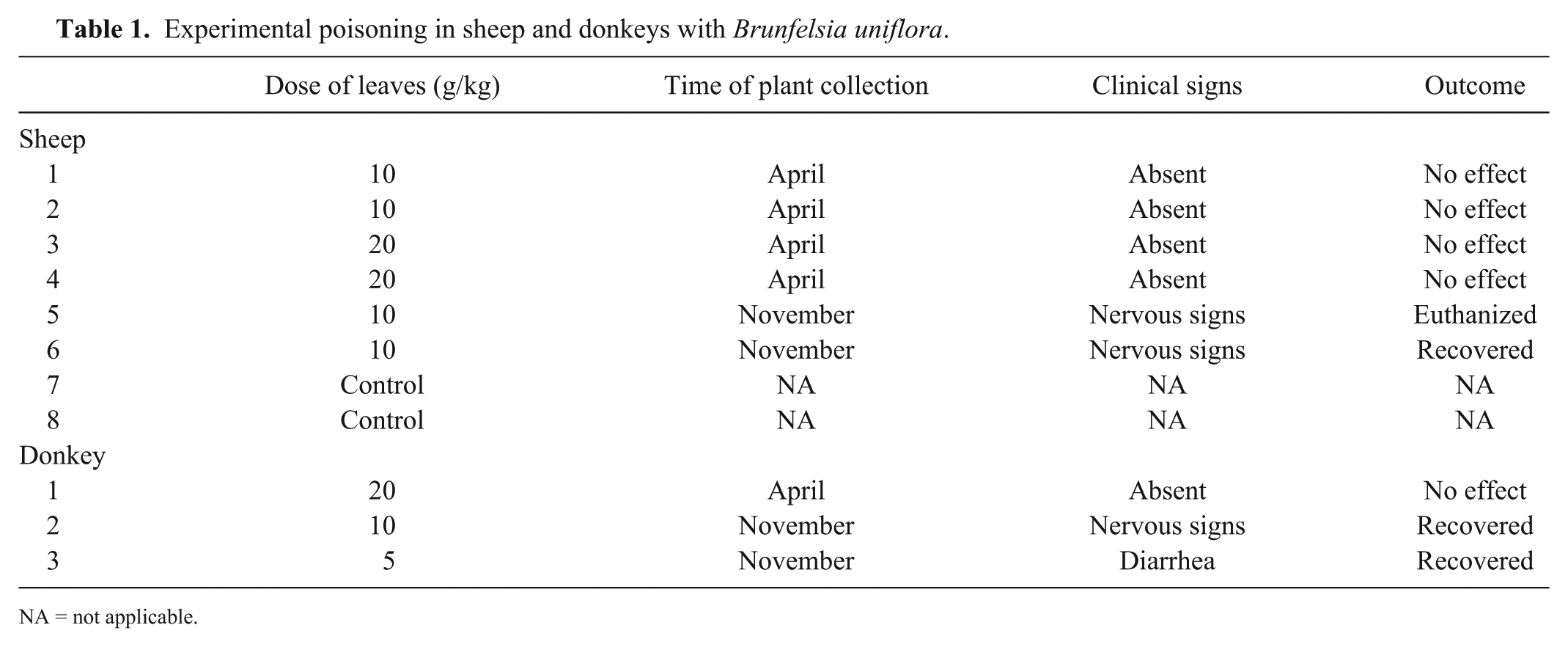
NA = not applicable.
Sheep 5 from group 3 showed drooling and diarrhea 6 h after plant ingestion. After 8 h 45 min, the animal showed apathy and anxiety, and after 45 h had severe ataxia with a broad-based stance and reluctance to move as well as involuntary movements of the neck and continuous chewing. At this time, seizures occurred at ~1-h intervals and lasted for ~5 min. Approximately 80 h after plant ingestion, seizures ceased, and the other clinical signs regressed without treatment, but the animal remained apathetic. Sheep 5 was euthanized, 120 h after plant administration, by intravenous administration of 100 mg/kg pentobarbital sodium. At autopsy, no significant macroscopic lesions were observed. Samples of liver, kidneys, heart, lungs, lymph nodes, stomach, spleen, pancreas, intestine, and the whole central nervous system were collected and fixed in 10% buffered formalin for histologic examination. After fixation, transverse sections of the cerebral cortex, basal ganglia, thalamus, hippocampus, rostral colliculus, caudal colliculus, pons, cerebellum, obex, and medulla oblongata as well as transverse and longitudinal sections of the cervical, thoracic, and lumbar spinal cord were obtained. All samples were embedded in paraffin, cut at 4–6 µm, and stained with hematoxylin and eosin. No significant lesions were observed on histologic examination.
Sheep 6, also from group 3, showed clinical signs similar to those observed in sheep 5, but the signs regressed without treatment in 5–6 d. The sheep from the other groups did not show clinical signs.
In another experiment, fresh leaves of the plant were administered in single doses to three18–24-mo-old donkeys of the Jumento Nordesino breed, weighing 84–112 kg (Table 1). One donkey received 20 g/kg of leaves collected in April, after flowering. The other 2 donkeys received 5 and 10 g/kg of leaves, respectively, collected during flowering in November. The donkey that ingested 10 g/kg harvested at flowering had diarrhea 1 h after ingestion. After 3 h 25 min, the donkey was sweating and ataxic. After 14 h, the animal experienced convulsions with nystagmus, severe drooling, teeth grinding, and lateral recumbency with paddling movements. The animal stayed in lateral recumbency with repeated convulsions that lasted nearly 1 min. Nineteen hours after plant ingestion, the donkey remained standing with ataxia and some involuntary movements. After 2 d, the animal began to eat again, and 3 d after the ingestion, the animal fully recovered without treatment.
The donkey that received 5 g/kg had only diarrhea without nervous signs and recovered within 24 h without treatment. The donkey that received the plant after the flowering period showed no clinical signs.
Results of the experiments demonstrate the toxicity of B. uniflora for donkeys and sheep. Farmers’ reports that the plant is toxic only during the flowering period at the start of the rainy period were supported by the results of our experiments. Sheep and donkeys that ingested up to 20 g/kg of leaves collected in April, after flowering and at the end of the rainy season, did not show clinical signs, whereas those that ingested 5–10 g/kg of leaves collected in November, during flowering at the start of the rainy season, showed clinical signs. In experiments with B. calcyina var. floribunda in rats and mice, all parts of the plant caused similar nervous signs, and the berries were the most toxic part. 11 However, there have been no previous reports regarding the variability of Brunfelsia spp. toxicity during different stages of plant growth.
Several compounds have been isolated from Brunfelsia species, but the substance responsible for the clinical signs of poisoning has not been definitively identified. Some of those substances include scopoletin (6-methoxy-7-hydroxycoumarin), 7 hopeanine (Iyer RP. Brunfelsia hopeana. Pharmacologic screening: isolation and characterization of hopeanine. Diss Abstr Int 1978:Section B 39:761), and brunfelsamidine (pyrrol-3-ylidenemethanediamine). 4 Brunfelsamidine, which is likely the main compound responsible for clinical signs, causes excitement, seizures, and death, 4 whereas hopeanine causes depression and paralysis, and scopoletin is a smooth muscle relaxant that causes hypotension. 3 Definitive identification of the toxic compound and determination of its concentration in different stages of plant growth would help in the study of the epidemiology of the poisoning and in the role that each of these substances plays in causing clinical signs.
In field cases, donkeys are more frequently affected than ruminants. 6 Despite the small number of animals used in our experiments, donkeys were affected with lower doses (5 and 10 g/kg) than sheep (20 g/kg), suggesting that donkeys may be more susceptible to this poisoning. Also, B. uniflora may be more palatable to donkeys than to ruminants as mentioned by some farmers 7 or may reflect management differences in which donkeys are exposed more frequently to the plant.
The clinical signs, characterized by nervous signs (mainly convulsions) and diarrhea, are similar to those reported by farmers from spontaneous poisoning 6 and to those reported in dogs poisoned by other Brunfelsia species. Such signs included convulsions, other nervous signs, and digestive signs, mainly vomiting and diarrhea.1,2,9,10,11 Moreover, the transience of clinical signs1,2,5,8,9 and the absence of significant histologic lesions in the nervous system5,10,11 have been reported in dogs. Gross pathologic or histopathologic findings were also not observed in rats and mice. 11
Footnotes
Declaration of conflicting interests
The authors declared no potential conflicts of interest with respect to the research, authorship, and/or publication of this article.
Funding
This work was financially supported by the National Institute of Science and Technology for the Study of Plant Poisonings (INCT/CNPq, Proc. 573534/2008-0).