



Abstract
HoBi-like pestiviruses (also known as bovine viral diarrhea virus 3) have been sporadically reported from naturally infected cattle in Brazil, Asia, and Europe. Although HoBi-like viruses seem to be endemic in Brazilian cattle and buffalo, they have not been studied in the other countries of South America to our knowledge. Herein we report serologic results of buffalo from 12 large farms in Argentina located near the Brazilian border. These buffalo were not vaccinated against pestiviruses. Our results indicate that HoBi-like virus may be circulating in the northeastern region of Argentina given that half of the analyzed animals showed high levels of neutralizing antibodies against the pestivirus. The HoBi-like seropositive animals were also checked for neutralizing antibodies against BVDV-1a, BVDV-1b, and BVDV-2, and in most cases these animals had low levels or no detectable antibodies against these other pestiviruses. Our study suggests a need for continued pestivirus surveillance in Argentinean cattle and buffalo.
HoBi-like viruses are a group of emerging pestiviruses affecting cattle and buffalo, and are also common contaminants in biological products such as fetal bovine serum (FBS).10,11 Since the first identification in Brazilian FBS in 2004, HoBi-like virus isolates have been described in Brazil, Europe, and Asia.3,5-7,14 Thus, HoBi-like virus has become recognized as a pathogen of concern for cattle and water buffalo farmers because it generates respiratory disease, reproductive failures, and persistently infected animals. 8 The origin of HoBi-like viruses is unknown, but some researchers suggest that the emergence of HoBi-like viruses in cattle could be the result of a host species jump in which these viruses crossed from buffalo to cattle.2,8 Brazil is the largest producer of water buffalo in South America, followed by Venezuela and Argentina. The stock of water buffalo in Argentina is ~100,000 head, distributed mainly in the northeastern region of the country (NEA) with 95% of the national herd living in this area (www.bufalos.com.ar).
Even though the NEA has many natural barriers, such as large rivers and semiarid areas that divide it from other countries, there are remote areas along its international borders with a low level of surveillance, which represents a risk for the introduction of diseases through illegal cattle movement from neighboring countries. NEA borders Brazil, where HoBi-like viruses circulate in both water buffalo and cattle. The other border country is Paraguay, where the existence of HoBi-like virus and the seroprevalence of BVDV are unknown. This situation may suggest that these pathogens could be circulating or be introduced into Argentina.
Argentinean water buffalo are required to be vaccinated against foot-and-mouth disease virus, but not against pestiviruses. The lack of vaccination against pestiviruses allows surveillance studies based on serum antibodies in target herds.
Although there is some antigenic cross-reactivity, significant antigenic differences are observed between HoBi-like virus strains and either BVDV-1 or BVDV-2 strains.1,9,14 Commercial BVDV ELISA kits based on the detection of antibodies that bind BVDV NS3 and Erns may miss antibodies resulting from HoBi-like virus exposure. Further, these tests cannot differentiate between antibodies present as a result of exposure to BVDV-1 or BVDV-2 and antibodies present because of HoBi-like virus exposure. Differential virus neutralization (VN) tests can differentiate between antibodies raised in response to BVDV-1 or BVDV-2 infection and antibodies resulting from HoBi-like virus exposure.1,9
Previously, we reported that BVDV-1b is the predominant BVDV genotype in Argentinean bovine herds and that some of these strains are antigenically different from BVDV-1a reference strains. 12 In the work reported herein, the serologic status of buffalo herds against BVDV-1, BVDV-2, and HoBi-like virus was determined by VN tests.
Mediterranean and Murrah water buffalo (n = 130) were sampled from 12 farms in the Corrientes, Chaco, and Formosa provinces within the NEA region of Argentina during 2014 and 2015 (Fig. 1). Water buffalo were sampled upon arrival at sale barns. All animals appeared healthy at the time of sampling. Blood samples from each animal were collected from the jugular vein in sterile tubes (Vacutainer Serum Plus blood collection tubes, BD, Franklin Lakes, NJ) and stored in a refrigerator at 2–8°C until performance of the VN test.
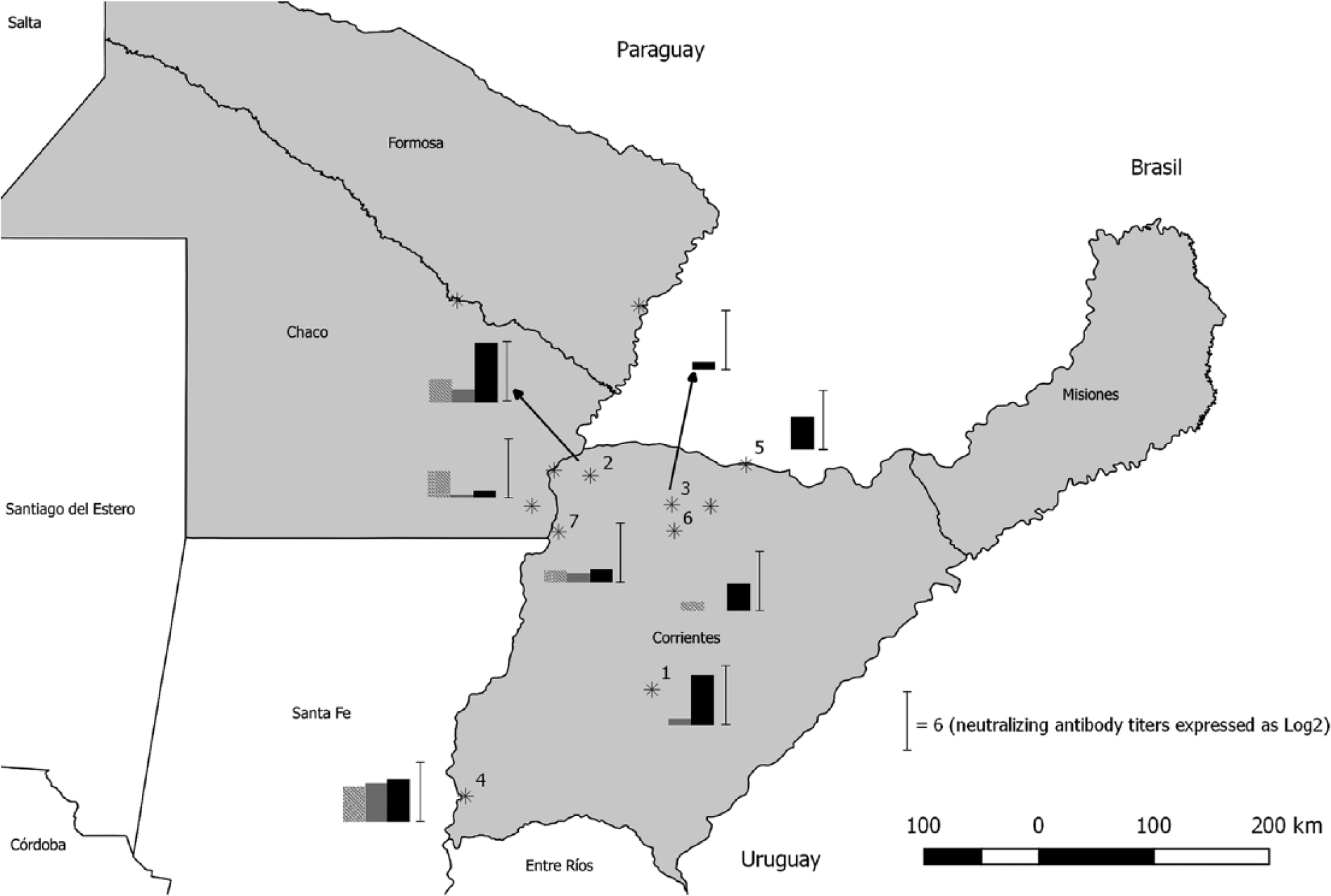
Map of the study area. Asterisks indicate the location of the 12 farms. Histograms represent the results of virus neutralization against bovine viral diarrhea virus (BVDV)-1 (striped), BVDV-2 (gray), and HoBi-like virus (black) of animals from the seropositive farms.
VN tests were performed using the following cytopathic viruses: BVDV-1a Singer strain, isolates 25366 (BVDV-1b) and VS256 (BVDV-2a; kindly provided by Dr. Odeón, INTA Balcarce, Buenos Aires), 12 and HoBi-like virus 83/10 (Decaro N, Department of Veterinary Medicine of Bari, Italy). 7 Madin–Darby bovine kidney (MDBK) cells were used to propagate all of the viruses. Cells were grown in Eagle minimal essential medium (Sigma-Aldrich, Steinheim, Germany) supplemented with 2% FBS (Internegocios, Buenos Aires, Argentina) free from neutralizing antibodies (nAbs) against BVDV, and a penicillin–streptomycin–gentamicin antibiotic cocktail. All of the viruses were titrated on MDBK monolayers in 96-well plates (Greiner Bio-one, Kremsmünster, Austria) using quadruplicate 10-fold dilutions, and titers were estimated using the Reed and Muench method. 13
To study the serologic status of the buffaloes, sera were inactivated at 56°C for 30 min and subjected to VN assay. Briefly, 100 TCID50 of each virus (BVDV-1a, BVDV-2, and HoBi-like virus) was co-incubated for 1 h at 37°C with serial 2-fold dilutions of inactivated sera in triplicate (1/8 to 1/2,048). Then, the mixture was added to 96-well plates with 2 × 10⁴ MDBK cells per well. Plates were incubated for 72 h at 37°C under 5% CO2. Control wells without virus were used for each serum sample as negative controls. Endpoint titers were calculated using the Spearman–Kärber method of endpoint determination, 10 and then the VN results of the seropositive animals were compared using the following formula: RspeciesX = (3 × X)/(X + Y + Z). 4 By this method, it was determined if the serologic response from each animal was specific for BVDV-1, BVDV-2, or HoBi-like virus (X, Y, or Z, and vice versa). The cutoff value to determine the specificity of the serologic response was R = 0.2, and hence different categories were set: samples with R values >0.2 for one pestivirus indicated substantially higher nAb titers for that virus, whereas samples with R values <0.2 for the viruses evaluated were considered equivocal. 4 Also, water buffalo sera were tested by VN against a BVDV-1b strain (Argentinean isolate 25366), which has significant antigenic differences compared to the other pestiviruses evaluated.
Of the 130 serum samples tested, 32% (42 of 130) were positive for BVDV or HoBi-like virus nAbs (Fig. 2). Fifty-two percent of the seropositive samples (22 of 42) showed higher nAb titers against HoBi-like virus than against BVDV. In most of these cases (18 of 22), R values for HoBi-like virus were >0.2 than against BVDV-1 or BVDV-2, so we concluded that the antibody titers were substantially higher against HoBi-like virus. Moreover, 14 of the seropositive animals showed R values substantially higher for BVDV than for HoBi-like virus. Ten serum samples were considered equivocal, because although they were seropositive for pestiviruses, R values were <0.2 for BVDV and HoBi-like virus.
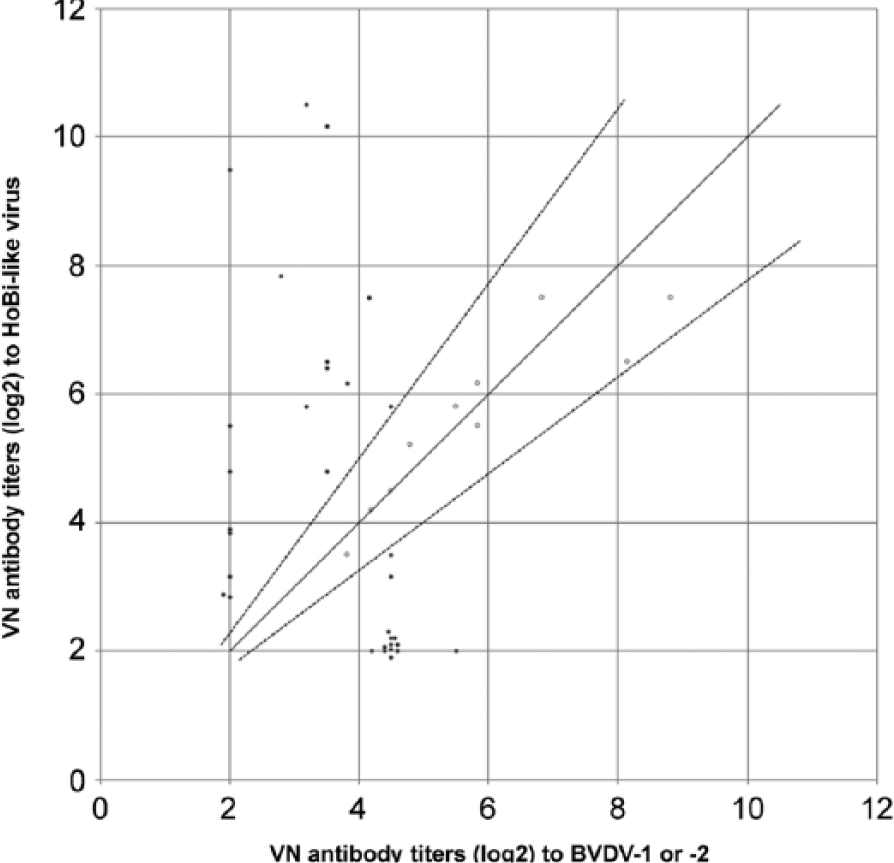
Individual results of seropositive water buffalo for pestiviruses. Neutralizing antibody titers for HoBi-like virus (vertical axis) and bovine viral diarrhea virus (BVDV)-1 or -2 (horizontal axis) are determined by the Spearman–Kärber method. Solid line indicates equal antibody titers for HoBi-like virus and BVDV-1 or -2, while dotted lines indicate the limits at which the antibody titers are specific for BVDV or HoBi-like virus. Black dots indicate specific antibody titers against HoBi-like virus or BVDV. Gray circles indicate equivocal samples, in which R values were <0.2 for HoBi-like virus and BVDV, meaning that the specificity of antibodies against these viruses cannot be inferred.
The geometric mean titers nAb titer, from all of the samples tested, against HoBi-like virus was 5.7 (confidence interval [CI] = 3.7–7.8). This value was lower for BVDV-1a and BVDV-2, yielding 4.6 for both cases (CI = 3.4–5.8 and 3.1–6.1, respectively). From another perspective, the majority of samples from 7 of the 12 farms surveyed had higher nAb titers against HoBi-like virus than BVDV-1 or BVDV-2 (Table 1). No connection was found between seropositivity against any of the pestiviruses evaluated and sex.
Serologic results in buffalo located on 7 farms along Corrientes province, Argentina.
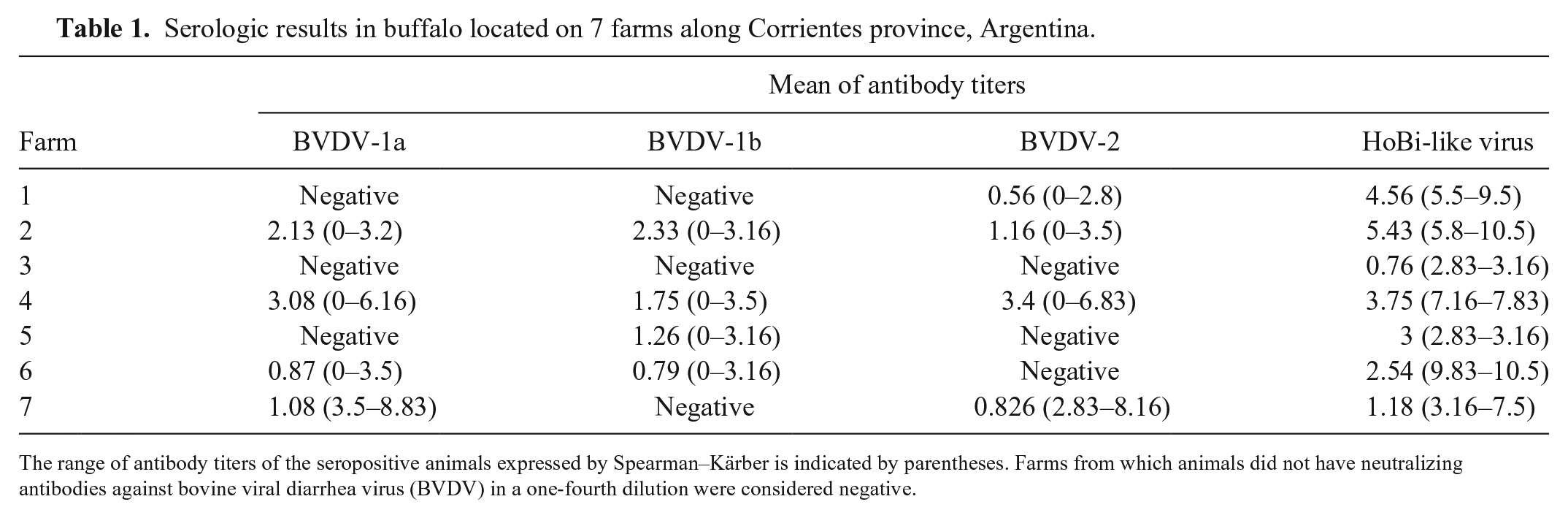
The range of antibody titers of the seropositive animals expressed by Spearman–Kärber is indicated by parentheses. Farms from which animals did not have neutralizing antibodies against bovine viral diarrhea virus (BVDV) in a one-fourth dilution were considered negative.
As a non-probability sampling method was performed in our study, generalization to the whole population of water buffalo from the NEA region cannot be done. However, the observation that 7 of 12 herds surveyed had animals seropositive to HoBi-like virus suggests significant circulation of this agent in the NEA. Because none of these animals had been vaccinated against pestiviruses, the seropositive samples from water buffalo would be evidence of natural infections. It is interesting to note that the NEA of Argentina borders Brazil, where HoBi-like viruses have been circulating for several years in cattle and water buffalo.
Clinical disease was not reported in the herds seropositive for HoBi-like virus. This is not surprising given that the 12 farms surveyed were very large, resulting in limited observation of individual animals, and that the clinical signs caused by HoBi-like viruses may be mild or asymptomatic.
The proportion of BVDV seropositive water buffalo found in our study was 23%. A previously published study reported a 30% BVDV-1a seroprevalence in the NEA (Maidana SS. Caracterización de virus respiratorios en rodeos bovinos y bubalinos de nuestro país. Rol del búfalo como reservorio de virus endémicos de bovinos [Characterization of respiratory viruses in bovine and buffalo herds of our country. Role of buffalo as reservoir of endemic bovine virus]. [PhD dissertation]. Buenos Aires, Argentina: UBA, 2008). However, in that study only BVDV-1a was used in VN testing. Comparison of these 2 studies highlights the importance of including several pestiviral species and/or subgenotypes. In our study, 23% of the animals had nAb titers against BVDV-1a, but the percentage of pestivirus seropositive water buffalo rises to more than double (53%) if we consider the presence of antibodies against all pestiviral species and subgenotypes evaluated (BVDV-1a, BVDV-1b, BVDV-2, and HoBi-like virus). Current commercial ELISA kits cannot be used to differentiate the specific pestiviral species to which the animals were exposed and may underestimate exposure to HoBi-like viruses. In summary, the choice of techniques and interpretation of pestiviral serosurveillance results requires an understanding of the extent and limits of pestivirus cross-reactivity.
Our study shows evidence of large-scale HoBi-like virus circulation among water buffalo populations. Because it has been proposed that HoBi-like virus originated in water buffalo and jumped to cattle, the analysis of bovine and other ruminant samples from the NEA region is important. The circulation of HoBi-like virus in water buffalo populations and the contact between water buffalo and domestic cattle in the NEA of Argentina creates a scenario that could predispose to the introduction of new pestivirus species into the cattle population. Epidemiologic studies need to be conducted to generate information on how widespread HoBi-like viruses are in Argentinean ruminant populations and to evaluate current testing and vaccination strategies against pestiviruses. The information generated in our study will be of value in the design of future studies. From another perspective, the introduction of HoBi-like virus in Argentina forces us to review detection techniques that we are currently using for BVDV, because most of them do not detect this pathogen.
Footnotes
Declaration of conflicting interests
The authors declared no potential conflicts of interest with respect to the research, authorship, and/or publication of this article.
Funding
This work was partially supported by the INTA Specific Project PNSA5054.