




Abstract
A commercial immunoradiometric assay kit designed for the measurement of endogenous adrenocorticotropin (ACTH) concentrations in human plasma does not detect the molecule in plasma samples from cats. It was hypothesized that the inability of the assay to detect the molecule was related to variation(s) in the amino acid sequence of cat ACTH, compared with human ACTH. Cat ACTH complementary DNA was cloned from pituitary tissue and sequenced. The deduced structure showed amino acid differences from the human molecule with cat ACTH having a valine instead of alanine at amino acid 32 and a threonine instead of alanine at amino acid 34. Cat and human ACTH were synthesized along with 2 modified peptides containing alanine substitutions at cat ACTH 32 and 34. Only the human ACTH was detected using the commercial kit, indicating that an epitope recognized by one of the antibodies in the assay requires the presence of 2 alanines near the C-terminus of the molecule.
Two-site immunometric or sandwich assays have become important tools in endocrinology, especially for measurement of proteins or peptides in circulation. These assays employ 2 antibodies, usually directed at epitopes toward the N- and C-terminus of the peptide. Advantages of immunometric assays for peptide assay, as compared with traditional methods such as radioimmunoassay, include improved sensitivity, specificity, and precision.5,6
The Auburn University Endocrine Diagnostic Laboratory (Auburn, Alabama) utilizes an immunoradiometric assay (IRMA) a for the quantitation of endogenous adrenocorticotropin (ACTH) in plasma samples. The kit, marketed for human use, has been validated for measurement of ACTH in dogs and horses.4,8 However, as reported previously, 3 the assay fails to detect ACTH in cat plasma samples. It was hypothesized that this failure was related to differences in the amino acid composition of cat ACTH as compared with human, so that 1 or both antibodies failed to recognize the target epitope in the cat molecule. The amino acid sequence of cat ACTH is not published. Adrenocorticotropin is a 39 amino acid peptide synthesized as part of proopiomelanocortin (POMC). The nucleotide sequence of human POMC (NM_000939) was used to search the National Center for Biotechnology Information (NCBI) cat genomic database, and the gene was identified (XM_003984433). Pituitaries were collected from 2 cats (adult, mixed-breed, and non-littermates) from a colony at the Auburn University College of Veterinary Medicine Scott Ritchey Research Center (Auburn, Alabama) that were euthanized as part of another, ongoing research project. RNA was extracted from the pituitaries, and complementary DNA (cDNA) was synthesized following previously described methods. 7 Oligonucleotides were designed based on the cat genomic POMC sequence to allow amplification of a portion of the POMC gene containing the ACTH coding sequence. Oligonucleotide primer sequences were 5′-GCGATGGCGGGGAGCTGGGCCTGC and 5′-GGCCCTCGGGGCCGAGCGCCGGCC, for the forward and reverse primers, respectively. High fidelity polymerase was used in polymerase chain reaction to obtain amplicons of the predicted size using pituitary cDNA from both cats. These bands were excised from the gel, and the DNA was cloned into a plasmid designed for sequence analysis. Sequences were identical in 3 independent clones using the cDNA from both cats. The sequence for cat ACTH was identical to that in the NCBI database. The deduced amino acid sequence of cat ACTH along with that of the human and dog molecules are shown in Table 1.
Comparative amino acid sequences of human, cat, and dog adrenocorticotropin.
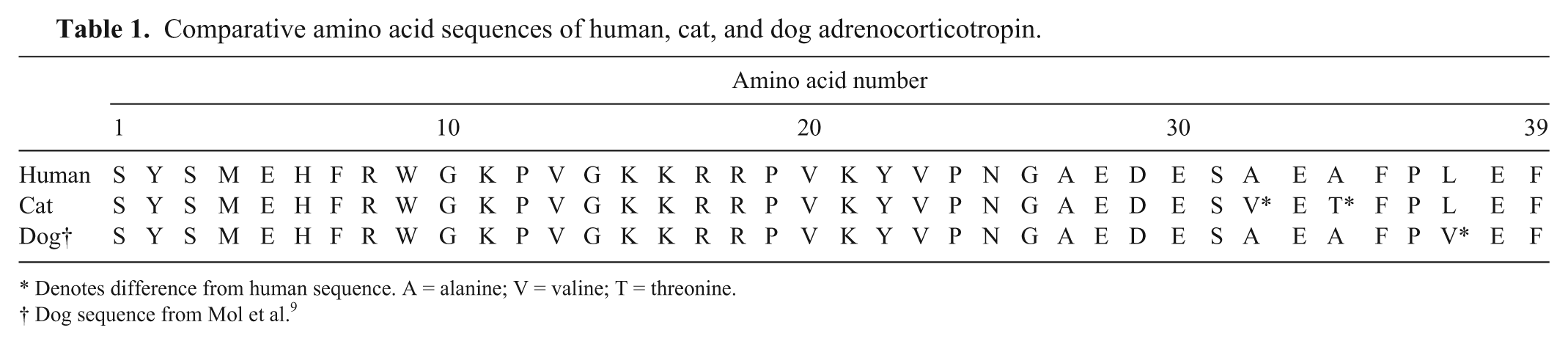
Denotes difference from human sequence. A = alanine; V = valine; T = threonine.
Dog sequence from Mol et al. 9
Cat ACTH differs from the human molecule at amino acids 32 and 34. Human ACTH contains alanines at both positions while the cat molecule has instead a valine at position 32 and threonine at position 34. Dog ACTH differs from human and cat by having a valine at position 37 instead of leucine. 9 As is true with most mammalian ACTH molecules, the first 24 amino acids from all 3 species are identical. 1
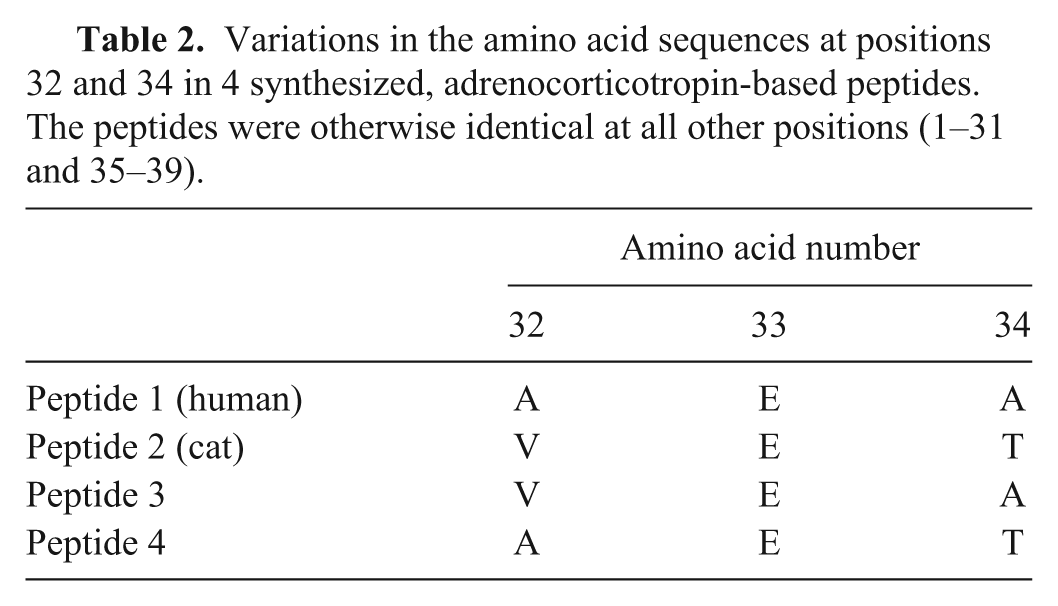
To assess whether the 2 differences in amino acids at positions 32 and 34 would affect the ability of the IRMA to detect the molecule, 4 peptides were synthesized and tested. The sequence of each peptide was identical for amino acids 1–31, 33, and 35–39, but differed at positions 32 and 34 (Table 2). While peptides 1 and 2 were identical to human and cat ACTH sequences, respectively, peptide 3 was a hybrid molecule identical with human ACTH but with valine substituted for alanine at position 32, while peptide 4 was human ACTH containing a threonine instead of alanine at position 34. The logic in synthesizing these peptides was to test whether 1 or both of these amino acid substitutions influenced the recognition of the peptide by the IRMA. The final 5 amino acids (35–39) were identical in all 4 peptides.
Variations in the amino acid sequences at positions 32 and 34 in 4 synthesized, adrenocorticotropin-based peptides. The peptides were otherwise identical at all other positions (1–31 and 35–39).
Peptides were solubilized in 0.01 M HCl, and concentrations were estimated using spectroscopy. 2 Peptides were then diluted in the zero standard provided in the IRMA kit (human plasma devoid of ACTH) to 1,000, 500, 250, and 125 pg/ml (standard curve range in the assay is 1,676–6.5 pg/ml). Peptide 1 (human ACTH) showed full recognition in the IRMA (Fig. 1). In contrast, the IRMA failed to recognize the 3 other ACTH-like peptides, including the cat molecule.
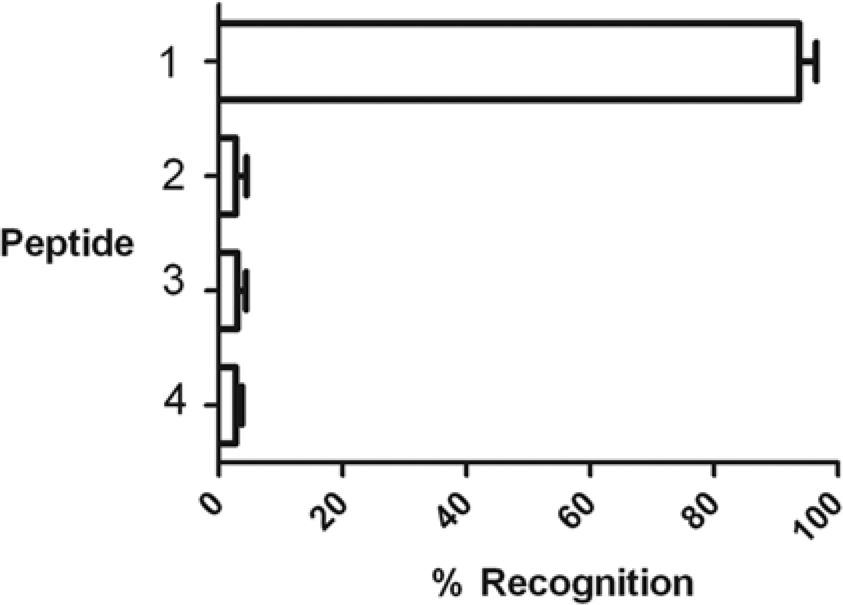
Relative recognition of 4 synthesized, adrenocorticotropin (ACTH)-based peptides in the ACTH immunoradiometric assay (IRMA). Recognition was determined comparing the spectrophotometrically estimated concentration with the result from assay in the IRMA. Each peptide was diluted to 4 concentrations in the zero standard provided in the IRMA kit a and then assayed. The mean ± standard deviation of the relative recognition of each peptide is shown (IRMA concentration/estimated concentration × 100).
Two-site immunometric assays such as the IRMA employed herein have become valuable analytic tools, and are especially useful in determination of protein or peptide concentrations. The fact that these assays utilize 2 antibodies recognizing epitopes at the ends of the peptides results in improved specificity, sensitivity, and precision compared with other methods.5,6 Accurate and precise measurement of ACTH in plasma has historically proved challenging using radioimmunoassay.5,10 Use of IRMA methods to measure ACTH has significantly improved the reliability and clinical usefulness for detection of this molecule, and allowed for sensitive quantitation without the need for prior extraction of ACTH from plasma.5,10
While IRMA has proven to be useful in peptide hormone measurement, the current study illustrates a potential problem inherent in the methodology. Protein or peptide hormones may show variations in amino acid composition when compared across species, as illustrated in the present study and by others.1,9 Consequently, antibodies that recognize a molecule from one species may not cross-react with the same from another species. This concern is magnified 2-fold when using an IRMA (or any assay employing 2 antibodies). Many assay kits are designed to detect peptides in human samples and may prove valid for diagnostic or research use in samples from other species. As the current study illustrates, however, small differences in amino acid composition may render a particular assay unusable with samples from other species. Notably, this IRMA a detected dog ACTH, 8 which, like human ACTH, has alanines at positions 32 and 34. Dog ACTH has a valine instead of leucine at position 37, suggesting that the amino acid at that position may not be crucial to recognition by the C-terminal antibody utilized in the assay. A different IRMA assay kit b for ACTH that can successfully recognize the molecule in cat plasma has been reported. 3 Unless the epitopes recognized by the antibodies in an assay are reported, it appears that trial and error is the best method to screen immunometric assays in order to identify one that will prove useful in a particular species.
Footnotes
Acknowledgements
The author thanks Dr. Nancy Cox of the Scott-Ritchey Research Center at Auburn University College of Veterinary Medicine for help with obtaining cat pituitary tissue.
a.
ACTH immunoradiometric (IRMA) assay, Scantibodies Laboratory Inc., Santee, CA.
b.
ACTH IRMA, DiaSorin Inc., Stillwater, MN.
Declaration of conflicting interests
The author(s) declared no potential conflicts of interest with respect to the research, authorship, and/or publication of this article.
Funding
The author(s) received no financial support for the research, authorship, and/or publication of this article.