




Abstract
Desorption electrospray ionization mass spectrometry (DESI-MS) is an emerging analytical technique that permits the rapid and direct analysis of biological or environmental samples under ambient conditions. Highlighting the versatility of this technique, DESI-MS has been used for the rapid detection of illicit drugs, chemical warfare agents, agricultural chemicals, and pharmaceuticals from a variety of sample matrices. In diagnostic veterinary toxicology, analyzing samples using traditional analytical instrumentation typically includes extensive sample extraction procedures, which can be time consuming and labor intensive. Therefore, efforts to expedite sample analyses are a constant goal for diagnostic toxicology laboratories. In the current report, DESI-MS was used to directly analyze stomach contents from a dog exposed to the organophosphate insecticide terbufos. The total DESI-MS analysis time required to confirm the presence of terbufos and diagnose organophosphate poisoning in this case was approximately 5 min. This highlights the potential of this analytical technique in the field of veterinary toxicology for the rapid diagnosis and detection of toxicants in biological samples.
Desorption electrospray ionization (DESI) is an ionization technique developed for detection of chemicals by mass spectrometry (MS) under ambient conditions. 18 Because ionization with DESI-MS occurs in an ambient environment, samples being tested are directly analyzed with little to no prior sample pretreatment. This technique is applicable for the analysis of a variety of biological matrices, and other liquid or solid media, and is capable of near instantaneous detection of chemicals with a high degree of sensitivity. Rapid and accurate detection of alkaloids, anabolic steroids, agricultural chemicals, explosives, illicit drugs, and pharmaceuticals in a variety of sample matrices are a few examples of the versatility of this technique.3,8,10,12,17–20 In diagnostic veterinary toxicology, extraction of complex biological matrices, when coupled with the analysis times required for traditional analytical instrumentation, can be time consuming and labor intensive. The duration of time between sample submission and reporting toxicology results can have implications on the rapidity of treatment or on remedial efforts to eliminate toxicant exposure in other animals or people. Therefore, efforts to improve extraction efficiency and decrease analysis times in order to expedite diagnoses are a constant goal for diagnostic toxicology laboratories. The current report describes the use of DESI-MS in expediting sample analysis and toxicology results in a case of terbufos poisoning.
Three dogs from the same residence were involved in the current case; 2 of the dogs were found dead and 1 was admitted to the Frankfort Animal Hospital (Frankfort, Indiana). According to the case history, 2 days prior there was a field application of an organophosphate insecticide, suspected to be terbufos, near the residence. After being applied to a field, it was suspected that the dogs had access to a central location in which the insecticide had collected due to runoff after a long rain in that area. The surviving 1-year-old, male pit bull presented at the clinic with hypersalivation, miosis, and muscle fasciculations. Although the dog was treated aggressively with fluid therapy, atropine, phenobarbital, and diazepam, it died within 24 hr after being admitted to the animal hospital. One of the other 2 deceased dogs, an 8-month-old, female mixed breed, was submitted for postmortem examination to the Animal Disease Diagnostic Laboratory at Purdue University (West Lafayette, Indiana). At necropsy, lesions consistent with cause of death were not apparent on gross examination. Significant gross lesions were not observed in the tissues of the integumentary, musculoskeletal, respiratory, genital, urinary, lymphatic, endocrine, and nervous systems. Tissues including liver, lung, spleen, thymus, and small intestine were fixed in 10% neutral buffered formalin and submitted for histology. Histologic examination of multiple organs revealed diffuse congestion. The brain and stomach contents were submitted for toxicology testing.
Duplicate samples of homogenized brain tissue were prepared using a modification of the Ellman colorimetric assay for acetylcholinesterase activity.4,6 The replicates were analyzed using a spectrophotometer, a and the cholinesterase activity was reported as µm/g/min. The mean brain cholinesterase activity in the mixed-breed dog was 1.02 μm/g/min, which is approximately 26% of the normal mean cholinesterase value in canine brain. In diagnostic toxicology cases, depression of enzyme activity greater than 50% is considered indicative of potential exposure to an anticholinesterase agent. 1 Therefore, in the current case, the brain cholinesterase activity was depressed by 74%, suggesting that the dog was potentially exposed to an anticholinesterase agent, such as an organophosphate or carbamate insecticide.
A small subsample (approximately 0.1 g) of the stomach contents from this dog was applied to filter paper and directly analyzed by DESI b -MS. c The DESI parameters utilized for this experiment were similar to those commonly reported in the literature, 18 which included a solvent flow rate (1:1, methanol:water) of 3.0 µl/min, spray angle of 45°, and a nebulizing nitrogen gas pressure of 120 psi. Spectral data was collected using an average of 5 µscans/MS scan and an ionization time of 250 msec. Protonated molecules of terbufos (m/z 289) and terbufos sulfoxide (m/z 305) were readily detected in the stomach content subsample (Fig. 1A). Corresponding tandem mass spectrometry (MS/MS) analysis of the terbufos precursor ion m/z 289 resulted in characteristic fragment ions at m/z 103 and m/z 233 (Fig. 1B), thereby providing positive confirmation of terbufos in the stomach contents. Both precursor and fragment ions observed using this technique were consistent with other methods reported in the literature for terbufos and terbufos sulfoxide.7,16 The total DESI-MS analysis time required to confirm the presence of terbufos and diagnose organophosphate poisoning in the present case was approximately 5 min; whereas, the use of other traditional analytical techniques would have required several hours of sample preparation and analysis time before reaching a diagnosis. For example, gas chromatography–mass spectrometry (GC-MS) was also used to confirm the presence of terbufos in the stomach contents sample from this case. The total sample preparation and analysis time required to confirm terbufos was approximately 6 hr. However, it is important to note that while the DESI-MS technique provides a rapid means for confirming the presence of toxicants, such as terbufos, it is a qualitative diagnostic method. Therefore, detection of toxicants using this technique may warrant subsequent analyses using more quantitative methods of analysis.
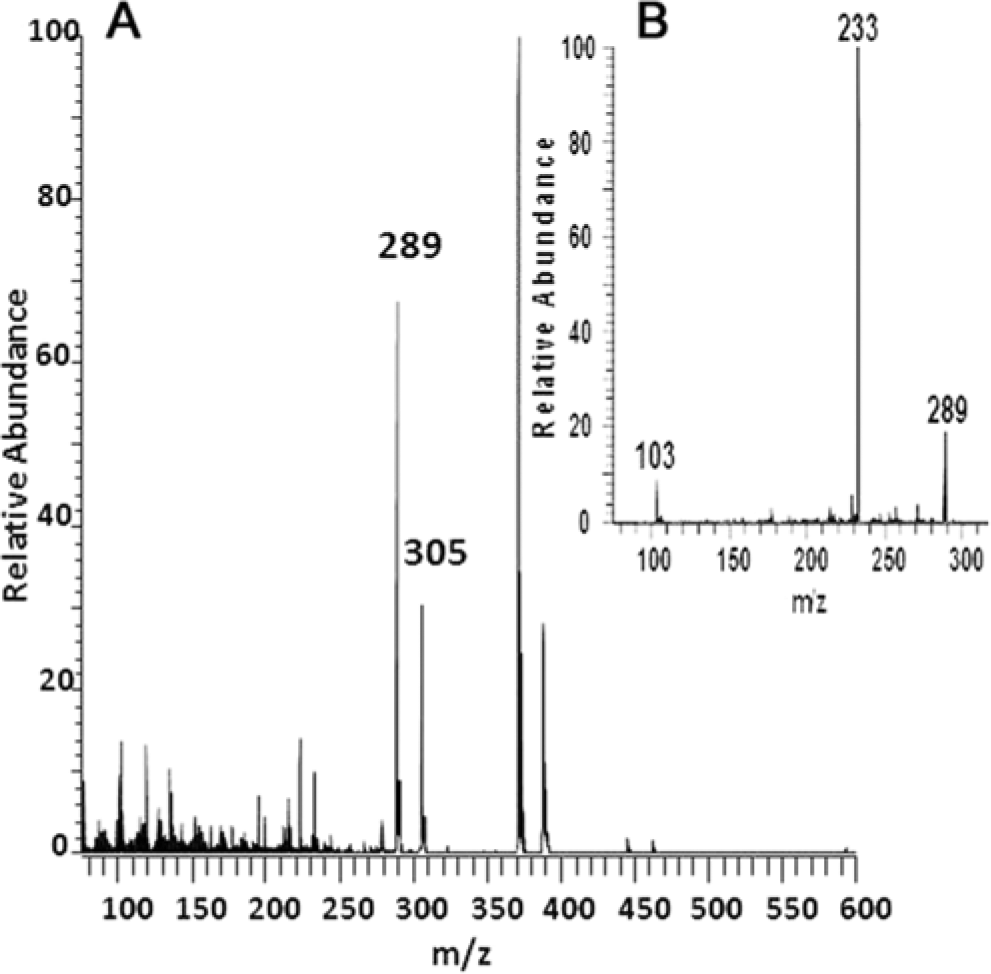
Positive ion desorption electrospray ionization mass spectrum of stomach contents.
Using DESI-MS, the ability to directly analyze the stomach contents from this case enabled rapid detection and diagnosis of terbufos poisoning. Terbufos is an organophosphorus insecticide that is widely used in agriculture and industry to control pests such as corn rootworm, nematodes, seed corn maggots, and white grubs. 21 The toxicity of terbufos and other organophosphate insecticides is through acetylcholinesterase inhibition, which results in accumulation of acetylcholine at nerve synapses causing overstimulation of muscarinic, nicotinic, and central nervous system cholinergic receptors. Because these cholinergic receptors are present in both insects and mammals, accidental or malicious poisonings in nontarget species often occur and are of toxicological concern in both human and veterinary medicine.2,5,11,15,22 Traditional analytical toxicology methodologies typically employed to diagnose insecticide poisoning in these cases include GC–electron capture detection, GC–nitrogen phosphorus detection, GC-MS/MS, and liquid chromatography–MS/MS.9,13,14,23 While these analytical techniques produce accurate results, the sample preparation and analysis times are labor intensive and time consuming, requiring up to several hours before a diagnosis can be achieved. Because of the toxicological implications in cases where nontarget species are exposed to organophosphate insecticides, rapid detection and diagnosis of exposure is of utmost importance. DESI-MS accomplishes this through direct analysis of biological samples for a variety of toxicants and drugs, while providing high sensitivity and instantaneous analysis times. The current diagnostic case highlights the potential application of DESI-MS in the field of veterinary toxicology through rapid diagnosis and detection of toxins and toxicants in biological samples.
Footnotes
a.
8452A diode array spectrophotometer, Hewlett-Packard, Palo Alto, CA.
b.
OmniSpray ion source, Prosolia Inc., Indianapolis, IN.
c.
LTQ ion trap mass spectrometer, Thermo-Finnigan, Waltham, MA.
Declaration of conflicting interests
The author(s) declared no potential conflicts of interest with respect to research, authorship, and/or publication of this article.
Funding
The author(s) received no financial support for this research, authorship, and/or publication of this article.