




Abstract
A study was performed to assess the validity of the BAX automated polymerase chain reaction system (DuPont Nutrition & Health, Wilmington, Delaware) to detect the shedding of Salmonella species in bovine fecal samples. A total of 133 bovine fecal samples that were submitted to the Cornell University Animal Health Diagnostic Laboratory for Salmonella culture were also tested in the BAX system with a modified version of the manufacturer’s enrichment protocol. Using culture as the gold standard test, the BAX system was found to have a sensitivity of 85.7% and a specificity of 90.5%. There was excellent agreement (κ = 0.71, standard error = 0.072) and no significant differences between the 2 methods (McNemar χ2 = 0.180).
Salmonella spp. play a significant role in human and animal disease. There are several host-adapted serovars that can cause illness in various species of production animals, resulting in substantial morbidity and mortality, and leading to great losses by producers. 3 Additionally, there are numerous other Salmonella serovars that can inhabit the gastrointestinal tracts of production animals without causing disease in these species, but can cause serious illness in human beings. 5
According to the Centers for Disease Control and Prevention, foodborne infections from Salmonella in the United States have risen by 3% since 2006, and Salmonella is now the most commonly implicated bacterial pathogen in foodborne illness, hospitalizations, and deaths, causing an estimated 1.2 million illnesses annually (Incidence and trends in foodborne illness, 1996–2010, http://www.cdc.gov/features/dsfoodnet/). The foods most commonly associated with international foodborne Salmonella outbreaks include eggs, produce, beef, and multi-ingredient foods. 4 Animal products usually become contaminated through contact of the carcass with ingesta or feces, 1 while produce is usually contaminated by irrigation water that has been compromised with livestock manure, use of uncomposted manure as fertilizer, or run-off from livestock facilities. 6 It has been shown that Salmonella can survive for long periods of time outside of host species, especially in water and soil.5,7,8 For these reasons, it is important to have accurate methods of monitoring this pathogen in food-producing animals species, and in their waste.
The current gold standard technique for detecting Salmonella in production animals is fecal culture; however, negative cultures are common in early infection and it may take several days for positive results. 1 The BAX automated system h uses probe-based methods to detect foodborne pathogens within a few hours. The manufacturer offers commercially available kits with polymerase chain reaction (PCR) tubes containing tablets that comprise all the reagents necessary for PCR, including appropriate probes, for detecting many foodborne pathogens. The BAX system also includes an internal control that is applied in each PCR reaction. The use of these preassembled PCR tubes decreases preparation time and increases accuracy, consistency, and shelf-life when compared with standard culture techniques and conventional PCR methods. Validation studies have shown that the BAX system performs better than traditional culture methods for detecting Salmonella in food, with sensitivity and specificity of 98% and a limit of detection at 103–104 colony-forming units/ml. 2 However, similar validation studies have not been performed for the detection of Salmonella spp. in fecal samples. The current study assesses the ability of the BAX system to detect Salmonella shedding in cow fecal samples.
The study population consisted of all bovine fecal samples submitted to the Cornell University Animal Health Diagnostic Center (Ithaca, New York) for Salmonella culture from June 17 to October 18, 2010, including all bovine patients in the Cornell University Hospital for Large Animals during that time. The bovine fecal samples were received in foam containers and directly plated onto Levine eosin methylene blue agar a and onto brilliant green agar with novobiocin (BGN). b Fecal samples were also enriched in tetrathionate broth with iodine solution c and incubated at 42°C for 18–24 hr prior to subculture onto xylose–lysine–tergitol-4 (XLT-4) agar d and BGN agar. The XLT-4 and BGN agars were incubated at 37°C in air for 18–24 hr at which time typical Salmonella suspect colonies were picked to a triple sugar iron (TSI) agar slant e for screening. The XLT-4 plates were held an additional 24 hr at 37°C for a total of 48-hr incubation as per the manufacturer’s instructions. At the 48-hr level, new suspect colonies were picked from previously negative samples, if present, and processed in the same manner. Colonies on TSI exhibiting typical Salmonella reactions were identified using a commercial system f to biochemically identify the Salmonella.
The protocol used for amplification of Salmonella prior to molecular detection was a modified version of the manufacturer’s protocol for use with the BAX system. Buffered peptone water containing novobiocin g was inoculated with a fecal sample as a primary enrichment step and incubated at 37°C for 24 hr. At the end of the incubation, 20 µl of this primary enrichment broth was used to inoculate a secondary enrichment consisting of tetrathionate broth with iodide solution and incubated for another 24 hr at 37°C. After the final incubation, a portion of the secondary enrichment was lysed in preparation for BAX PCR detection.
The detection of Salmonella spp. in the samples by PCR was performed using the BAX system. According to the protocol, 5 µl of the secondary enrichment was added to 200 µl of lysis buffer (provided in the commercial kit) in lysis tubes. The samples were heated to 37°C for 20 min followed by heating samples to 95°C for 10 min. The samples were placed in a cooling block for 5 min, and 50 µl of the contents of the lysis tubes was transferred to the PCR tubes, containing tablets with PCR reagents, and sealed with flat optical caps.
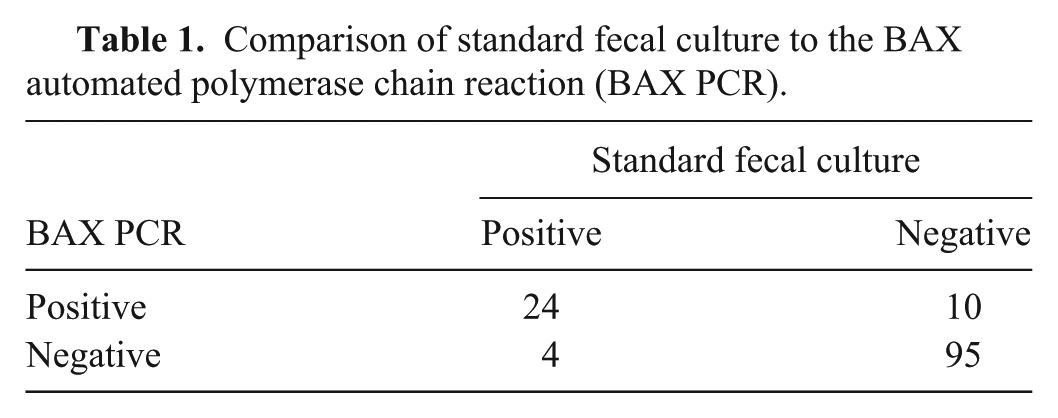
Statistical analyses were performed using a commercial statistical analysis software. i Table 1 is a 2 × 2 table comparing the results of the standard culture and BAX testing for Salmonella. The sensitivity and specificity of the BAX automated PCR were 85.7% and 90.5%, respectively. The positive and negative predictive values were 71% and 96%, respectively. The kappa value was 0.710 ± 0.072 and the McNemar chi-square was 0.180. These analyses indicate that the BAX system produces results that are not significantly different from standard culture techniques for bovine fecal samples in less time. The sensitivity and specificity of the BAX system were likely affected by the ability of PCR to detect nonviable organisms, and to detect them at lower levels. Samples in which Salmonella were detected by the BAX system but not by standard culture techniques (7.5%) were counted as discordant in the analysis, decreasing sensitivity and specificity. The ability of the BAX system to detect nonviable organisms may be perceived as a disadvantage by some while others would see it as an advantage over standard culture techniques, allowing the detection of organisms in samples that may have been mishandled before processing.
Comparison of standard fecal culture to the BAX automated polymerase chain reaction (BAX PCR).
It is important to note that there are many accepted methods for the culture of Salmonella spp. from fecal samples, and that the limit of detection varies slightly with each method. In the present study, the BAX system was compared with only a single method (standard culture). Different results regarding the validity of the BAX method may have been discovered if it had been compared with an alternate culture method. Additionally, the pre-enrichment media used for the culture method was different from that used for the BAX method, which may have affected the ability of the organism to survive, multiply, and eventually be recovered. Even in the face of these challenges, the BAX system provided results that were in good agreement with standard culture practices.
The value of accurate and timely identification of pathogens that are commonly found in the excrement of food animal species is undeniable. In order to decrease the prevalence of Salmonella in these species and to mitigate propagation and spread of the organisms in the food supply chain, the presence of Salmonella needs to be detected rapidly and correctly. The BAX system allows for detection of dead bacteria that may be present in the sample due to poor handling, making it superior to standard culture techniques. Furthermore, the commercially available kits that are made to use with the BAX system provide great ease of use and decrease human error that can be associated with conventional PCR techniques. The sensitivity and specificity that were calculated for the BAX system in the current study were likely an underestimate, yet the calculations still indicate that this technique is an appropriate method to screen for bacterial pathogens in fecal samples. Furthermore, the kappa and McNemar chi-square values indicate a high level of agreement between the standard culture and BAX system, supporting the use of this PCR system as a faster method for detection of Salmonella in fecal samples. After PCR detection, serotype identification can be performed on positive samples just as with standard culture techniques.
Footnotes
Acknowledgements
The authors would like to thank the Delaware County Department of Watershed Affairs and associated dairy farmers for their continued support of research.
a.
Levine Eosin Methylene Blue agar, BD, Franklin Lakes, NJ.
b.
Brilliant green novobiocin agar plates, Northeast Laboratory Services, Winslow, ME.
c.
Tetrathionate broth with iodine solution, BD, Franklin Lakes, NJ.
d.
XLT-4 agar, Northeast Laboratory Services, Winslow, ME.
e.
TSI agar slant, BD, Franklin Lakes, NJ.
f.
TREK Diagnostic Systems Sensititre system, Thermo Scientific, Cleveland, OH.
g.
Buffered peptone water with novobiocin, BD, Franklin Lakes, NJ.
h.
BAX Automated System and associated commercial kits, DuPont Nutrition & Health, Wilmington, DE.
i.
SPSS software, SPSS Inc., Chicago, IL.
Declaration of conflicting interests
The author(s) declared no potential conflicts of interest with respect to the research, authorship, and/or publication of this article.
Funding
The author(s) disclosed receipt of the following financial support for the research, authorship, and/or publication of this article: This research is partially supported by grants from US Department of Agriculture (USDA)/National Research Initiative (2006-35102-17356) and from USDA Federal Formula Funds (NYC-478416).