




Abstract
Crotalaria retusa L. (rattleweed), estimated to contain about 4.96% monocrotaline (MCT) in the seed, was associated with a natural poisoning outbreak in goats. The poisoning was experimentally reproduced by the administration of C. retusa seeds containing approximately 4.49% of MCT. Thus, 1 of 3 goats given a single dose of 5 g/kg bodyweight (bw) of seeds (248 mg MCT/kg bw) and 2 goats given a single dose of 347 mg MCT/kg bw showed acute clinical signs and were euthanized 10–11 days after dosing. Clinical signs and gross and histologic lesions were characteristic of acute centrilobular liver necrosis.
Crotalaria retusa L. (family Fabaceae; rattleweed) is a weed reported in the state of Paraíba, northeastern Brazil, as a cause of chronic poisoning in horses 11 and acute poisoning in sheep.10,13 Cases of hepatic fibrosis associated with consumption of C. retusa have been reported in cattle, 12 but could not be reproduced experimentally in this species by the continuous administration of low doses of monocrotaline (MCT), the principle dehydropyrrolizidine alkaloid (DHPA) produced by C. retusa. 2 Lesions of chronic DHPA-related poisoning have been produced experimentally following administration of Jacobaea vulgaris (syn. Senecio jacobaea) to goats. 6 However, in dosing experiments with Crotalaria saltiana 3 and Heliotropium ovalifolium, 1 the typical lesions of acute or chronic DHPA-related poisoning were not reported. In sheep in northeastern Brazil, the ingestion of seeds of C. retusa cause acute liver necrosis.12,13 In the current report, centrilobular liver necrosis is reported in goats that were ingesting C. retusa seed while occupying a paddock invaded by this plant. To demonstrate the association of the disease with the ingestion of C. retusa, the seeds of the plant were administered to experimental goats.
A natural outbreak of poisoning associated with seeding C. retusa occurred in the municipality of Patos (Paraíba, Brazil) in September 2008. From a total of 30 adult and young crossbred goats, 4 (13.3%) adults were overtly affected and subsequently died. The animals were grazed extensively in an area of native pastures (named caatinga), but some encroached on an agricultural area of the farm and consumed seeds and leaves of C. retusa that infested the area. The main clinical signs, described by the farmer, were frothy salivation and lethargy. Death occurred within 24–48 hr after the onset of clinical signs. One goat, found dead at the time of the visit, was necropsied and its tissues examined histologically.
The liver showed accentuation of the lobular pattern characterized by reddened areas interspersed with pale areas, distributed throughout the capsular surface and parenchyma. There was also a focal area of hemorrhage on the liver surface with adhesions to the peritoneum and diaphragm. Multiple hemorrhages were observed in subcutaneous tissue, abdominal external oblique muscle, and greater omentum. The lung was reddish and blood flooded from the cut surface. Reddish fluid was present in the pericardial sac, and petechiae were observed in the pericardium and endocardium. Histologically, the liver showed centrilobular hemorrhagic necrosis. The hepatocytes of the midzonal region were swollen or had moderate vacuolation of the cytoplasm. No significant lesions were observed in other organs examined, including lung, heart, kidneys, gall bladder, lymph nodes, small and large intestine, prestomachs, and nervous system.
To investigate the potential role of C. retusa in the poisoning outbreak, more seeds were collected in the municipalities of São José do Bonfim and Coremas in the state of Paraíba. High-performance liquid chromatography–electrospray ionization mass spectrometry analysis of methanol extracts of the seeds, as previously described for other DHPA-producing plants,4,5 but using MCT as the calibration standard, revealed a MCT content of 4.49% and 4.96% (w/w dry weight) for the seeds collected at the time at the site of the natural poisoning outbreak and those seeds collected for the experimental investigation, respectively. The MCT constituted >99% of the DHPA content of the seeds, with trace amounts of monocrotaline-N-oxide and 2 related macrocyclic diesters also being observed (Fig. 1).
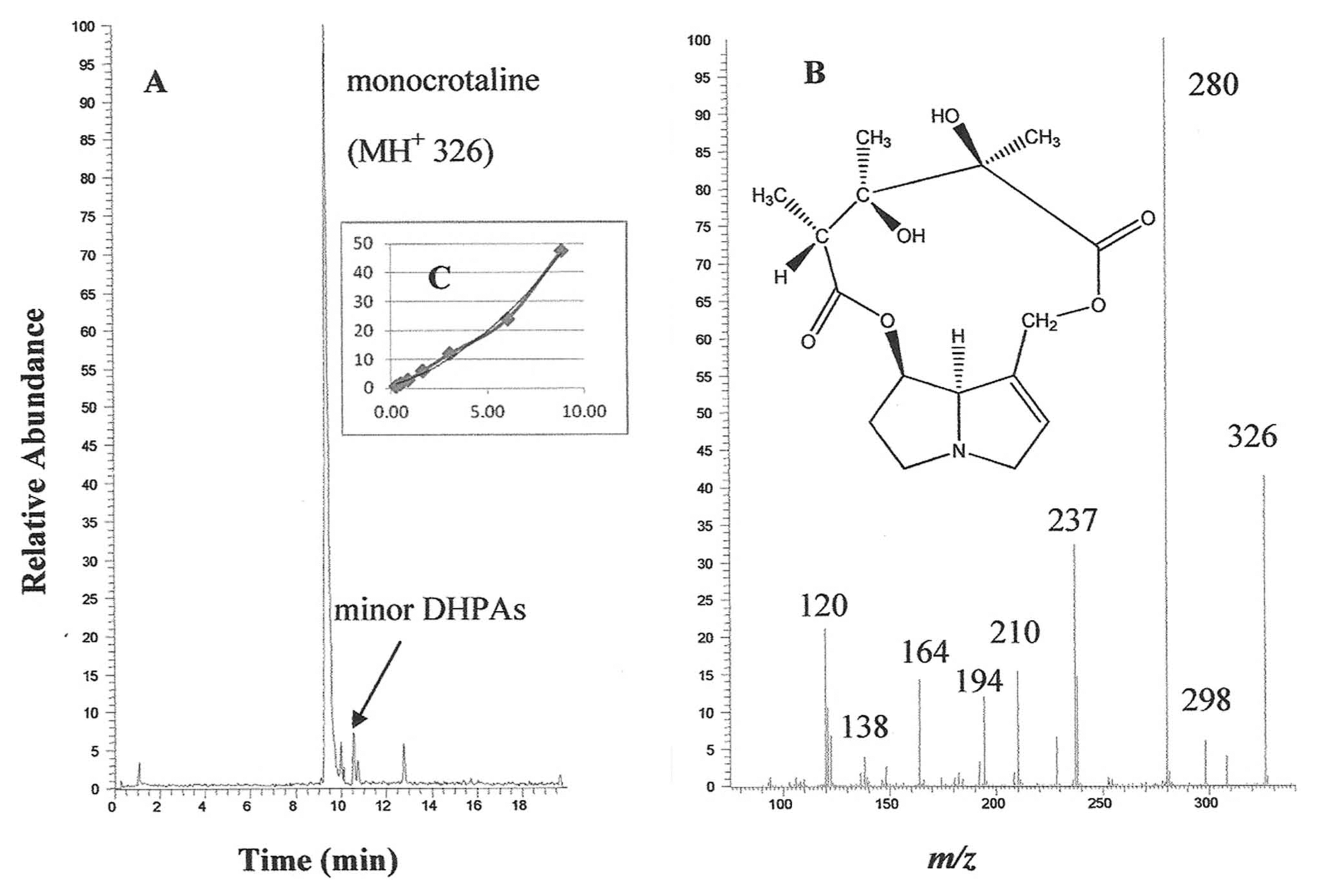
High-performance liquid chromatography–electrospray ionization mass spectrometry base ion (m/z 200–800) chromatogram of a crude methanol extract of Crotalaria retusa seeds showing the predominance of monocrotaline (
Eleven 1–2-year-old Moxotó goats were divided into 3 groups of 3 and 1 group of 2. Groups 1 (goats 1–3), 2 (goats 4–6), and 4 (goats 7 and 8) were given by gavage recently ground C. retusa seeds mixed with water at different doses (Table 1) while the control animals in group 3 (goats 9–11) did not receive seeds. The experiment was approved by the ethical committee on animal experimentation of the Universidade Federal de Campina Grande, process CEP 21-2012. Blood samples were collected from the jugular vein into venous blood collection tubes, on days 0, 4, 10, and 30 from all surviving animals. Immediately after collection, serum γ-glutamyl transferase (GGT) and aspartate aminotransferase (AST) activities were determined by standard spectrophotometric methods. 14
Poisoning by Crotalaria retusa L. seeds in goats: doses ingested, administration period, and outcome of the poisoning.*
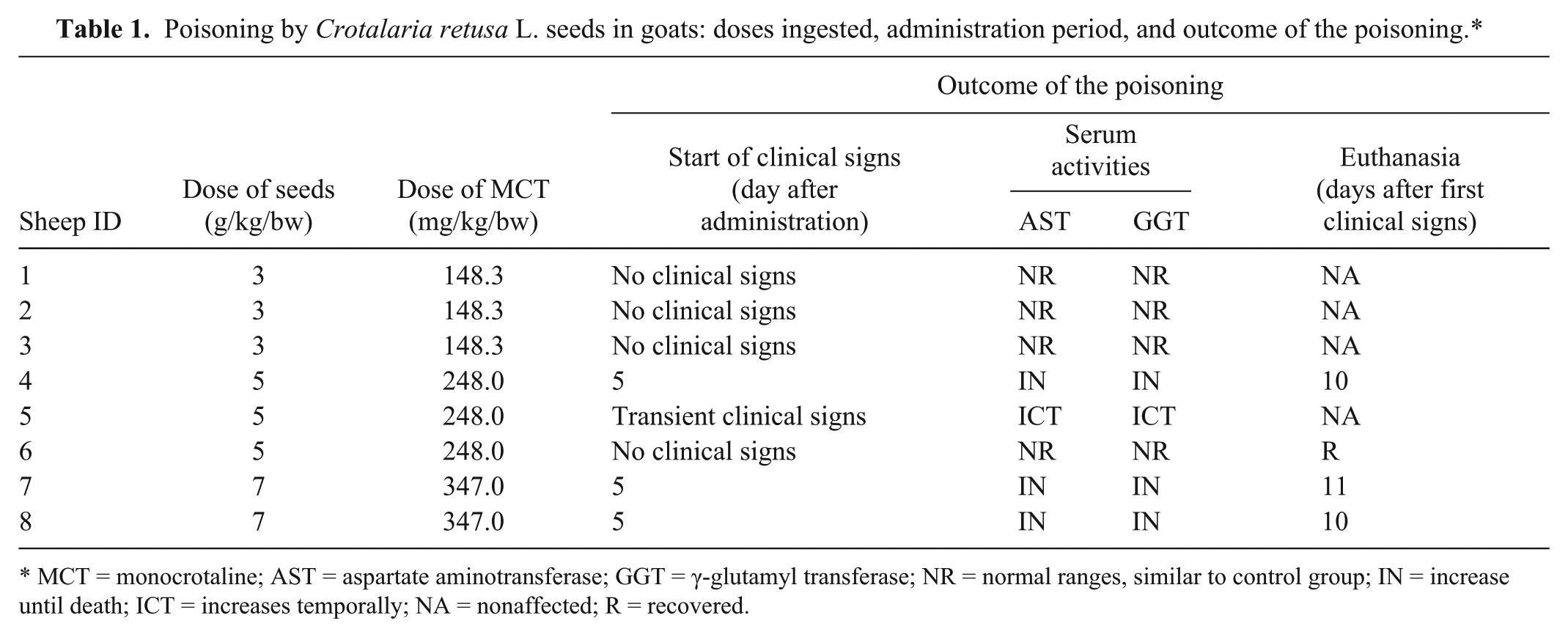
MCT = monocrotaline; AST = aspartate aminotransferase; GGT = γ-glutamyl transferase; NR = normal ranges, similar to control group; IN = increase until death; ICT = increases temporally; NA = nonaffected; R = recovered.
Clinical signs were only observed in 3 goats in 2 groups (Table 1). Goats with severe clinical signs (Table 1) were euthanized in accordance with the resolution #714 of the Brazilian National Council of Veterinary Medicine. Clinical signs included apathy, anorexia, ruminal atony, moans, bruxism, and sternal recumbence followed by lateral recumbence.
In goats 4 (group 2), and 7 and 8 (group 3), which showed clinical signs, serum activities of AST were increased, from day 4 to day 10 varying from 150 to 380 UI/l. During the same period, GGT serum activities varied from 72 to 119 UI/l. In goat 5 (group 2), which showed transient clinical signs, serum concentrations of GGT increased to 75 UI/l on day 4 and returned to 42 UI/l, within the normal range, on day 10. In goats 1–3 (group 1) and 9–11 (control group), serum activities of AST (76–88 UI/l) and GGT (28–31 UI/l) were within normal values (Table 1).
On necropsy of goats 4, 7, and 8, a marked accentuation of the lobular pattern of the liver was observed with red areas interspersed with pale areas distributed throughout the capsular surface and parenchyma (Fig. 2). The gallbladder was enlarged and showed severe edema of the wall (Fig. 2). Petechiae were observed on the surface of the epicardium, endocardium, and abomasal and duodenal mucosa. Ascites and edema of the omentum and mesentery were also observed. The main histologic lesion was hemorrhagic centrilobular liver necrosis (Fig. 3), ranging from moderate to severe, associated with moderate infiltration by neutrophils. Extensive areas of hemorrhages were observed in the epicardium and endocardium and submucosal edema was present in the gall bladder. No significant lesions were observed in the other organs examined.
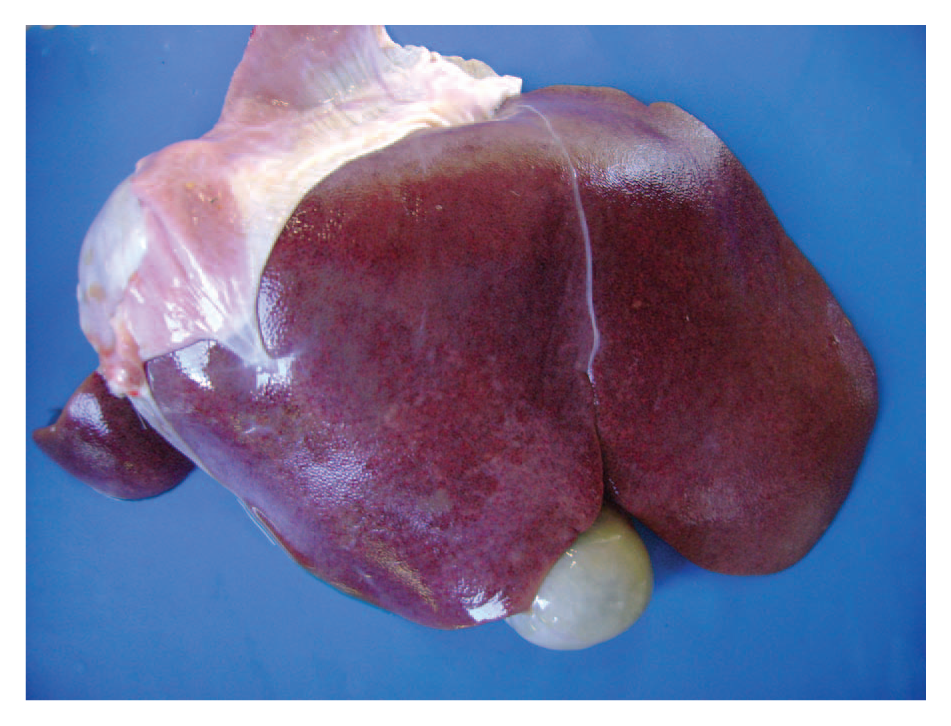
Liver of goat 7, which ingested 7 g/kg of Crotalaria retusa seeds (347 mg/kg/bw of monocrotaline), showing increased size and red areas interspersed with pale areas, distributed throughout the capsular surface. The gallbladder is enlarged with edematous wall.
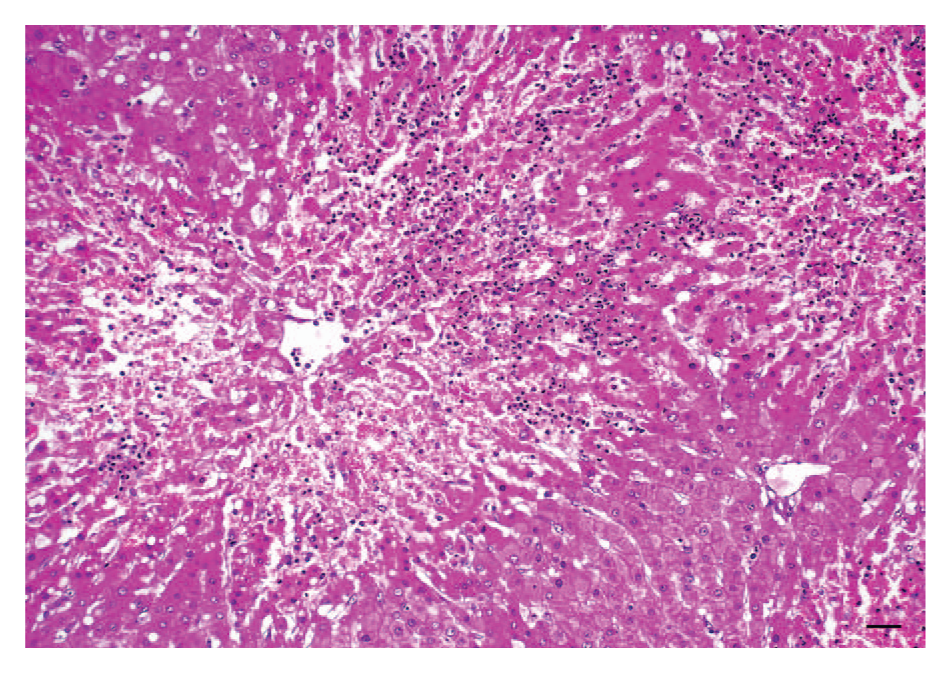
Liver; goat 8. Hemorrhagic necrosis of the centrilobular area is observed. Hematoxylin and eosin. Bar = 50 μm.
The results demonstrated that goats are susceptible to acute effects of MCT and can be poisoned spontaneously by the ingestion of seeds of C. retusa. The diagnosis of natural acute poisoning by C. retusa in goats was based on epidemiological data, and gross and histologic lesions. Clinical signs and gross and microscopic pathology in experimental goats were similar to those observed in the naturally affected goat and to those reported in natural and experimental poisoning by C. retusa seeds in sheep.2,12,13 Acute poisoning by pyrrolizidine alkaloids with centrilobular necrosis are also reported in sheep after the ingestion of high doses of Senecio spp.7,9
While goats, like sheep, are considered relatively resistant to the chronic poisonous effects of DHPAs, 8 it is clear from this present investigation that, given access to enough DHPA-producing plant material in the diet, goats will succumb to an acute DHPA-related intoxication involving hepatic necrosis. The calculated doses of MCT that elicited toxic responses in sheep and goats indicate similar susceptibilities to acute intoxication for these species.
Footnotes
Declaration of conflicting interests
The author(s) declared no potential conflicts of interest with respect to the research, authorship, and/or publication of this article.
Funding
The author(s) disclosed receipt of the following financial support for the research, authorship, and/or publication of this article: This work was supported by National Institute for Science and Technology for the Control of Plant Poisonings, National Council of Scientific and Technological Development (CNPq; grant no. 573534/2008-0).