




Abstract
A cross-sectional study was carried out to determine the flock-level seroprevalence of Caprine herpesvirus 1 (CpHV-1) and Bovine herpesvirus 1 (BoHV-1) and 2 (BoHV-2) and risk factors associated with CpHV-1 in dairy goat flocks from a semiarid region of northeastern Brazil. A total of 1,034 serum samples from 110 flocks were collected from March 2009 through March 2010. A structured questionnaire focusing on variables related to risk factors for CpHV-1 infection was given to each farmer at the time of blood collection. Antibodies against CpHV-1, BoHV-1, and BoHV-2 were detected by neutralization tests. The flock-level prevalences of CpHV-1, BoHV-1, and BoHV-2 were 89.1% (98/110; 95% confidence interval [CI]: 81.7–94.2), 80% (88/110; 95% CI: 71.3–87), and 4.5% (5/110; 95% CI: 1.5–10.3), respectively. Frequencies of seropositive animals were 36.6% (379/1,034), 25.8% (267/1,034), and 0.6% (6/1,034) for CpHV-1, BoHV-1, and BoHV-2, respectively. The use of natural mating was identified as a risk factor associated with CpHV-1 flock-level prevalence (P = 0.001). It is suggested that adoption of veterinary services and active surveillance of the at-risk flocks in the study region should be initiated to reduce the prevalence of herpesvirus infections.
Herpesviruses are widely spread in nature, causing inapparent or latent infections. Caprine herpesvirus 1 (CpHV-1; order Herpesvirales, family Herpesviridae, subfamily Alphaherpesvirinae, genus Varicellovirus) is antigenically and genetically related with Bovine herpesvirus 1 (BoHV-1) and 2 (BoHV-2). 17 Transmission of CpHV-1 in goat flocks is mainly facilitated by natural mating due to selective tropism of CpHV-1 by the genital tract, latency in sacral lymph nodes, and reactivation of latent infection, coincident with estrus. 7 Transmission of BoHV-1 occurs by direct and indirect contact among animals, as the virus is spread through respiratory, ocular, and genital secretions during acute infection, whereas BoHV-2 is most likely transmitted by direct or indirect contact with contaminated vesicular fluids and crusting. 11
Caprine herpesvirus 1 infections in adult goats are usually subclinical 15 and can induce pustular vulvovaginitis, 13 balanoposthitis or ulcerative posthitis, 20 respiratory disease, 2 spontaneous abortions,5,10,20 neonatal enteritis, generalized infections, and perinatal mortality in kids.9,15,21 Nasal discharge, dyspnea, adenitis, and diarrhea have been reported in goats experimentally infected with BoHV-1. 16 However, to the authors’ knowledge, there is no report on clinical signs of BoHV-2 infection in goats.
In Brazil, there are few works on prevalence of CpHV-1 and BoHV-1 in small ruminants. In São Paulo state, frequency of 16% (8/51) was reported in goats and 17% (17/100) in sheep for CpHV-1. 12 In goats in Pernambuco state, BoHV-1 antibodies were identified in 6.8% (14/206) of goats. 4 In Minas Gerais and São Paulo states, BoHV-1 antibodies were reported in 62% (209/337) of the goats tested. 1 However, in these works, few flocks and animals were examined, and there were no sampling calculations.
Goats are economically important in many countries, including Brazil, where this species is an important source of meat and milk for human beings, particularly in the northeastern region, in which 93.7% of the goats are concentrated (Brazilian Institute of Geography and Statistics, IBGE Automatic Recovery System, SIDRA: 2009. Available from http://www.sidra.ibge.gov.br/bda/. Accessed on November 15, 2012). The state of Paraíba, located in the northeastern region of Brazil, is characterized by warm weather throughout the year. The county of Monteiro, located in the Cariri region, excels in goat milk production in Paraíba state and in Brazil and has the largest number of goats in the state, with approximately 30,240 animals (Brazilian Institute of Geography and Statistics: 2009). The aim of the current work was to determine the flock-level prevalence of CpHV-1, BoHV-1, and BoHV-2 infections and to identify risk factors associated with CpHV-1 flock-level prevalence in dairy goat flocks from northeastern Brazil using a planned sampling.
The present study was carried out from March 2009 to March 2010 in the county of Monteiro (7°53’S, 37°5’W), Cariri Ocidental microregion, semiarid region of the state of Paraíba, northeastern Brazil. The climate is semiarid, and the temperature varies from 18°C at night to 31°C during the day, with a mean temperature of 22°C. The altitude is 599 meters above sea level.
The current study was designed as a cross-sectional study of randomly selected dairy goat flocks. Blood samples were collected from female goats that were ≥12 months of age. The number of flocks sampled was determined by considering the number of dairy goat flocks in the region (n = 180, according to the data of the Center for Integrated Development of Goat Production, in Paraíba state), an expected flock prevalence of 50% (considering no a priori knowledge of the flock prevalence), and a 10% desired accuracy for a 99% level of confidence, 19 resulting in 86 flocks to be sampled. Second, the sample size of goats was determined individually for each flock so as to detect the presence of the infection. Calculations were made in accordance with the following formula commonly applied in veterinary epidemiological investigations: 19

where n indicates the sample size, p indicates the probability of detection of at least 1 seropositive goat, N indicates the herd size, and d indicates the number of seropositive goats in the flock.
The probability of detection of at least 1 seropositive goat in a flock was determined at 95% (p = 0.95), and the number of seropositive goats in each flock (d) was calculated assuming within-flock prevalence of 6.8% for BoHV-1. 4 Selection of goats to be sampled from each flock was based on a systematic random sampling, where goats were put in a crush pen and systematically selected. In situations where handling infrastructure was absent, true random sampling was difficult to attain. In such situations, animals were put in a kraal and “randomly” captured.
A total of 1,034 female goats in 110 flocks were randomly selected and examined for CpHV-1, BoHV-1, and BoHV-2 antibodies. All serum samples were heat-inactivated at 56°C for 30 min and then analyzed by neutralization tests. Tests were performed on 96-well microtiter plates. a The neutralization capacities of each serum were tested against the CpHV-1 strain VR 262, b the Los Angeles strain of BoHV-1, b and a BoHV-2 c strain. A volume of 50 μl of serial 2-fold dilution, from 1:2 (1:4 for CpHV-1) of heat-inactivated sera was mixed in the microtiter plates with 50 μl of approximately 200 TCID50/50 μl of respective strains and incubated 2 hr (CpHV-1 and BoHV-2) and 24 hr (BoHV-1) at 37°C in a humidified 5% CO2 incubator. One hundred microliters (50 µl for CpHV-1) of Madin–Darby bovine kidney b cell suspension at a concentration of 3 × 10⁵ cells/ml were added per well for BoHV-1 and BoHV-2. After 96 hr of incubation at 37°C in a humidified 5% CO2 incubator, the plates were viewed using an inverted microscope. All sera were tested in 2–4 wells. A sample was positive when presented titer was ≥2 for BoHV-1 and BoHV-2 and ≥4 for CpHV-1. Infectious titers used were 106 TCID50/50 µl for CpHV-1, 105.14 TCID50/50 µl for BoHV-1, and 105.6 TCID50/50 µl for BoHV-2, calculated according to Reed and Muench. 14
A structured questionnaire focusing on risk factors for CpHV-1, BoHV-1, and BoHV-2 infections was given to each farmer at the time of blood collection. Information was collected on a total of 17 flock-level factors that included: management system, production system, flock size, presence of cattle, availability of veterinary services, history of animal purchasing, history of animal selling, use of pens for sanitary procedures, natural mating, artificial insemination, grazing in communal pasture, use of maternity pens, and history of abortions, vaginal discharge, infertility, birth of weak animals, and death at weaning. The questionnaire was administered immediately after bleeding the animals.
Flocks that presented at least 1 seropositive animal were considered positive. Prevalence of positive flocks was estimated from the ratio of positive flocks to the total number of flocks investigated, with the exact binomial confidence interval (CI) of 95%, 19 using the program EpiInfo. d Risk factor analysis was performed in 2 steps: univariable and multivariable analysis. Univariable analysis was performed using the chi-square test or Fisher exact test, 23 and those variables that presented P < 0.20 were used for multiple logistic regression. The multivariable analysis was then performed, using the stepwise forward method. 8 The significance level in multivariable analysis was 5%. The tests were performed using a statistical software package. e
The flock-level prevalences of CpHV-1, BoHV-1, and BoHV-2 were 89.1% (98/110; 95% CI: 81.7–94.2), 80% (88/110; 95% CI: 71.3–87), and 4.5% (5/110; 95% CI: 1.5–10.3), respectively. Frequencies of seropositive animals were 36.6% (379/1,034), 25.8% (267/1,034), and 0.6% (6/1,034) for CpHV-1, BoHV-1, and BoHV-2, respectively.
All BoHV-2 seropositive animals were also seropositive for BoHV-1 and CpHV-1, and all BoHV-1 seropositive animals were also seropositive for CpHV-1. Most animals tested positive at titers 256, 16, and 4 for anti–CpHV-1, anti–BoHV-1, and anti–BoHV-2 antibodies, respectively (Table 1). One hundred and nine (10.5%) animals showed antibody titers only against CpHV-1.
Number and frequency of seropositive animals for Caprine herpesvirus 1 (CpHV-1) and Bovine herpesvirus 1 (BoHV-1) and 2 (BoHV-2) infections in dairy goat flocks in the county of Monteiro, semiarid region of the state of Paraíba, northeastern Brazil, from March 2009 to March 2010, according to neutralizing antibody titers.*
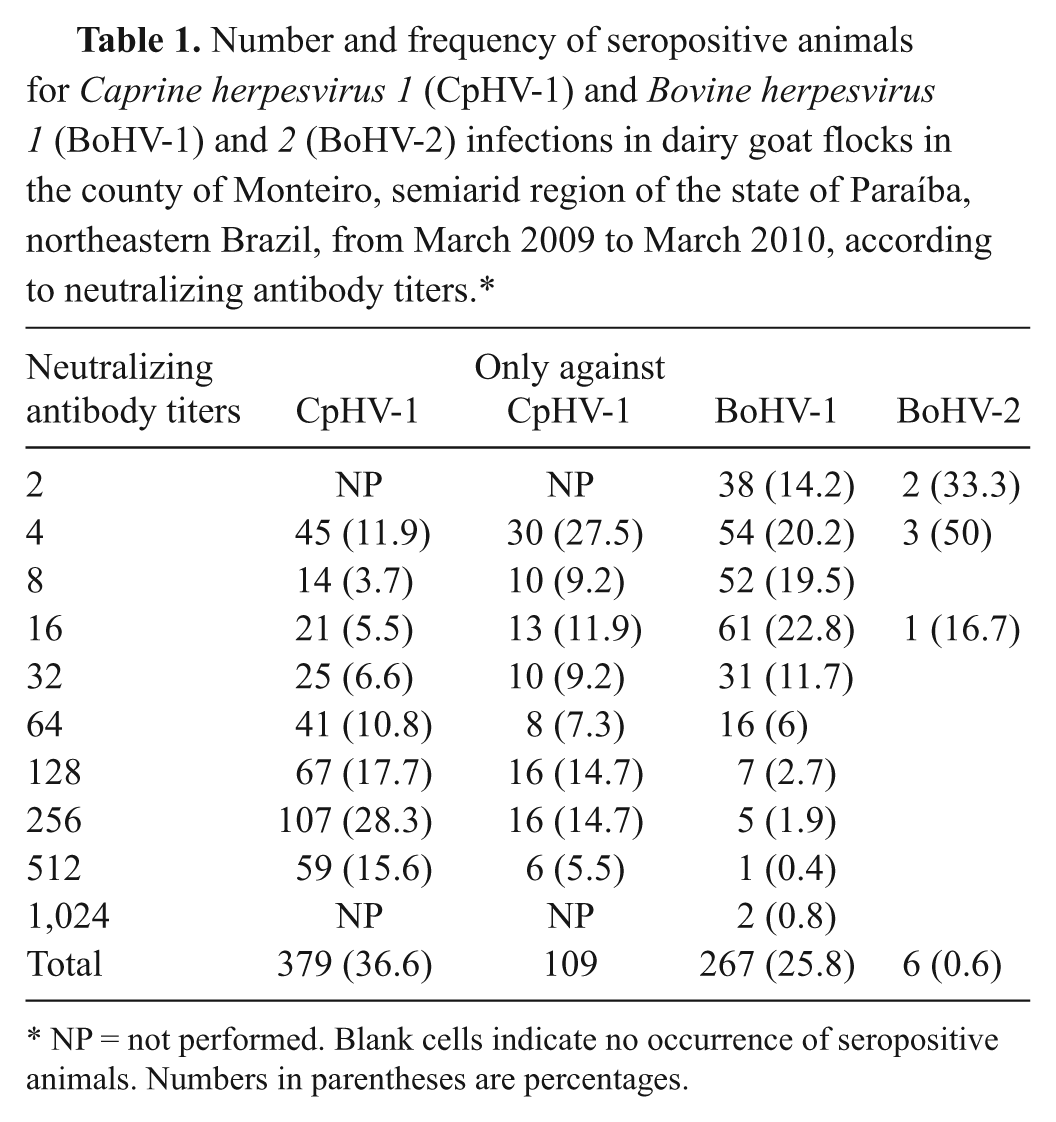
NP = not performed. Blank cells indicate no occurrence of seropositive animals. Numbers in parentheses are percentages.
The use of natural mating was identified as a risk factor (P = 0.001) associated with CpHV-1 flock-level prevalence (Table 2). Because only this variable was associated with CpHV-1, multivariable analysis was not performed.
Flock-level risk factors with Caprine herpesvirus 1 (CpHV-1) infection in dairy goat flocks in the county of Monteiro, semiarid region of the state of Paraíba, northeastern Brazil, from March 2009 to March 2010.
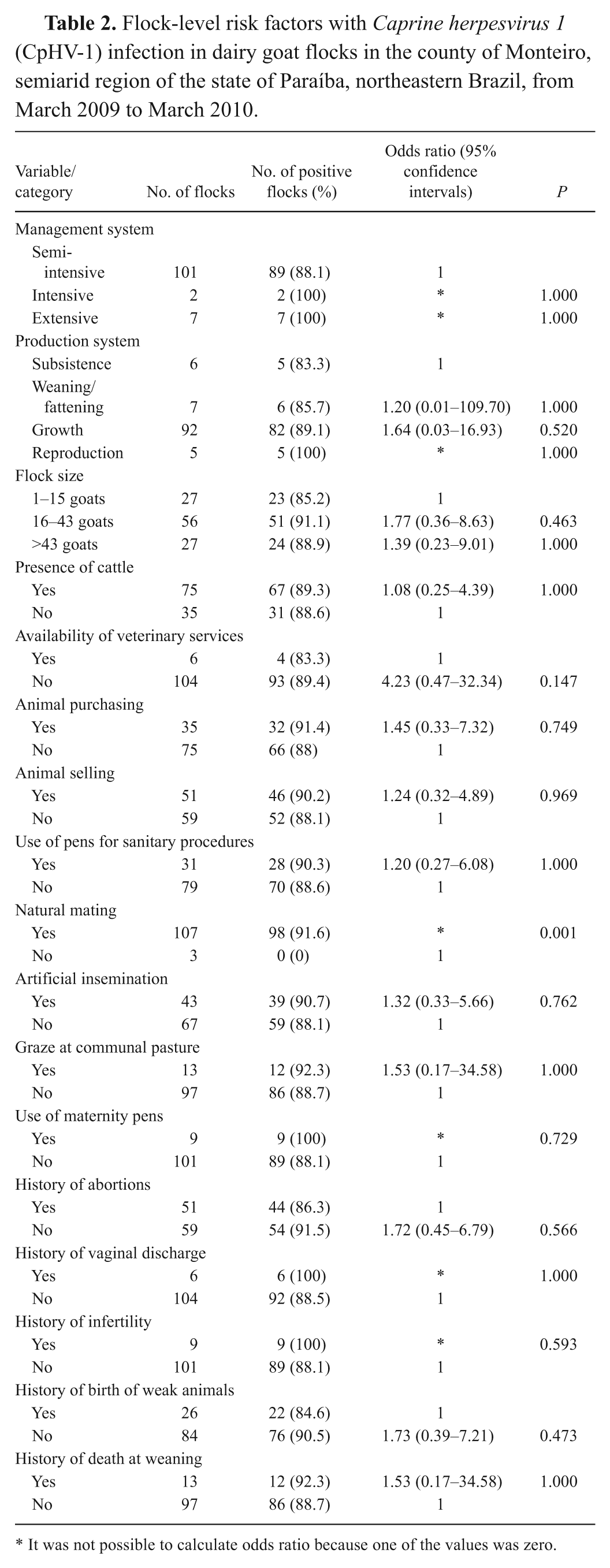
It was not possible to calculate odds ratio because one of the values was zero.
The current study was performed to determine seroprevalence and risk factors associated with CpHV-1, BoHV-1, and BoHV-2 infections in Brazil using a planned sampling. The high flock-level prevalence of CpHV-1 (89.1%) and BoHV-1 (80.0%) infections suggest spread of these agents in the area and is in accordance with results found in other countries such as Mediterranean France. 18
Regarding the BoHV-2 infection, a low prevalence (4.5%) of positive flocks was found associated with low titers in the current study, which may be related to cross-reaction with CpHV-1 and BoHV-1. 17 Indeed, all BoHV-2 seropositive animals were also seropositive for BoHV-1 and CpHV-1, and all BoHV-1 seropositive animals were also seropositive for CpHV-1, and to date, there is no evidence of isolation of BoHV-1 and BoHV-2 in the study region. However, 10.5% (109/1,034) of the goats tested positive only to CpHV-1 antibodies, indicating that in these animals, there was no cross-reaction with BoHV-1 and BoHV-2. Similar results were found in goats in Mediterranean France. 18
It is well known that animals on farms located in colder areas are more prone to herpesvirus infections.3,22 The high prevalences of positive flocks found in the present study for CpHV-1 (89.1%) and BoHV-1 (80.0%) infections was surprising because the climate in the region is hot (temperature is approximately 31°C during the day). However, conditions of high temperature and humidity may cause heat stress in the animals, thus decreasing the immune response and predisposing the animals to infections. 3
In northeastern Brazil, natural BoHV-1 infection of goats may have more serious implications for eradication efforts, as goat flocks are large in many areas, the density of animals in many flocks is very high, thus favoring animal-to-animal contact and virus transmission, and goats are reared in close contact with cattle, sharing pastures, food, water, and facilities.6,16 Such factors obviously favor contact and may facilitate transmission of the virus across species. 6
It was found that natural mating was associated with increased prevalence of positive flocks for CpHV-1. One of the main routes of elimination of CpHV-1 is semen, so use of natural mating involves higher probability of infection.
In conclusion, the results from the present study showed evidence of the presence of CpHV-1, BoHV-1, and BoHV-2 infections in goats from a semiarid region of northeastern Brazil using a planned sampling and that natural mating is associated with increased flock-level prevalence for CpHV-1. It is suggested that adoption of veterinary services and active surveillance of the at-risk flocks in the study region be carried out to reduce the prevalence of these infections.
Footnotes
a.
Flat bottom plates TPP 92096, Sigma-Aldrich Chemie GmbH, Buchs, Switzerland.
b.
American Type Culture Collection, Manassas, VA.
c.
Robert Koch Institute, Berlin, Germany.

e.
SPSS for Windows (version 13.0), SPSS Inc., Chicago, IL.
Declaration of conflicting interests
The author(s) declared no potential conflicts of interest with respect to the research, authorship, and/or publication of this article.
Funding
This study was financed by the Conselho Nacional de Desenvolvimento Científico e Tecnológico (CNPq), under the code 503425/2009-5. S. S. Azevedo is recipient of a productivity fellowship from CNPq. M. L. C. R. Silva is recipient of a scholarship from Coordenação de Aperfeiçoamento de Pessoal de Nível Superior (CAPES).