




Abstract
Nocardioform actinomycetes are significant causes of placentitis and abortions in horses. In the current study, antimicrobial susceptibility patterns of 38 Amycolatopsis spp. and 22 Crossiella equi isolates, the most common nocardioform actinomycetes causing placentitis in horses, were evaluated. Antimicrobial susceptibilities of these isolates were tested by broth microdilution method in a commercial system, which was designed for Nocardia spp., fast-growing Mycobacterium spp., and other aerobic actinomycetes. The minimum inhibitory concentration required to inhibit the growth of 90% of organisms (MIC90) of the following antibiotics tested for Amycolatopsis spp. were: 4 µg/ml for linezolid, trimethophrim–sulfametaxazole (TMP-SMX), and ciprofloxacin; 8 µg/ml for ceftriaxone, doxycycline, and minocycline; 16 µg/ml for amoxicillin–clavulanic acid, clarithromycin, and imipenem; >16 µg/ml for tobramycin; 32 µg/ml for amikacin and cefepime; and 128 µg/ml for cefoxitin. The MIC90 levels for C. equi were 0.25 µg/ml for doxycycline; ≤1 µg/ml for minocycline; 2 µg/ml for linezolid and TMP-SMX; 4 µg/ml for ciprofloxacin; 8 µg/ml for amoxicillin–clavulanic acid, ceftriaxone, and imipenem; 16 µg/ml for clarithromycin; >16 µg/ml for tobramycin; 32 µg/ml for cefepime; >64 µg/ml for amikacin; and 128 µg/ml for cefoxitin.
Nocardioform actinomycetes were reported as a significant emergent cause of placentitis and abortion in horses in Kentucky beginning in the mid-1980s.4,7,9 The agents also cause foal losses from late-term abortions, stillbirths, prematurity, or early neonatal deaths due to placental insufficiency. 4 Lesions most commonly occur in the body of the placenta at the bifurcation of the horns. The affected chorion is covered by a thick, light brown, tenacious exudate.7,9 The actinomycetes associated with nocardioform placentitis do not reach the fetus, and fetal lesions are limited to those of placental insufficiency.4,6,9 Modes of infection and transmission of nocardioform actinomycetes are as yet unknown. Historically, the agents were called nocardioform actinomycetes or Gram-positive branching bacilli, which include several species, based on polymerase chain reaction (PCR) and sequence analysis of 16S ribosomal RNA (rRNA) genes. The 3 major bacteria causing nocardioform placentitis are Crossiella equi, 5 Amycolatopsis spp., 10 and Streptomyces spp. 11 A study published in 2012 showed that Amycolatopsis spp. and C. equi are the most common species, comprising 85.5% of the nocardioform actinomycetes abortion cases in horses in Kentucky. 6
Clinical diagnosis is largely based on ultrasonographic examination of the uteroplacental junction.12,14 Unlike typical cases of ascending placentitis in which transrectal examination is adequate, diagnosis of nocardioform placentitis includes ventral transabdominal ultrasound. 14 Separation of the placenta from the endometrium by exudate at the ventral aspect of the uterine body is considered to be clinically diagnostic for nocardioform placentitis.4,14 Because the nocardioform actinomycetes are limited to the placenta, culture of the agents during gestation is not possible, and infections must therefore be treated empirically based on clinical diagnosis. Presently, there is no information in the literature as to which antimicrobials are effective against nocardioform actinomycetes. Knowledge of the general susceptibility profiles of nocardioform actinomycetes is important to determine the efficacies of antimicrobials in clinical nocardioform placentitis cases. Therefore, the aim of the current study was to investigate the antibiotic susceptibility patterns of nocardioform actinomycetes.
In the current study, 38 Amycolatopsis spp. and 22 C. equi isolates were selected for antimicrobial susceptibility testing. The isolates were identified and characterized earlier 6 by routine bacteriological methods and 2 PCR assays targeting genus-specific region of 16S rRNA gene of Amycolatopsis spp. 18 and species-specific region of 16S rRNA gene of C. equi. 6 Antimicrobial susceptibility testing was performed using a commercial broth microdilution method a according to the manufacturer’s instructions. Briefly, isolates were subcultured onto blood agar plates for purity and incubated for at least 3 days at 37°C. Ten to twenty colonies were picked and put into a commercial bead-beating system b using 1.5 ml of cation-adjusted Mueller–Hinton broth. The colonies were broken down at 7,000 rpm for 30 sec. Then, the suspension was inoculated into 5 ml of cation-adjusted Mueller–Hinton broth until a density equivalent to 0.5 McFarland was achieved, as measured by a nepholometer. a A 50-µl aliquot of this suspension was then added into 11 ml of cation-adjusted Mueller–Hinton broth, and 100 µl of this suspension was distributed into the wells by using an autoinoculator. a Mycobacterium peregrinum American Culture Type Collection (ATCC) 700686, Staphylococcus aureus ATCC 29213, and Pseudomonas aeruginosa ATCC 27853 were used as quality control organisms per the Clinical Laboratory Standards Institute. 3
Initially, the antimicrobial susceptibility of the isolates was performed on a commercial equine antimicrobial panel, c and it was found that nocardioform actinomycetes were resistant to the vast majority of antimicrobials (except tetracycline, trimethophrim–sulfametaxazole [TMP-SMX], and doxycycline). Therefore, another panel, d which was designed for fast-growing Mycobacterium spp. and Nocardia spp., was used in the present study. As no standardized criteria for interpretation of susceptibility currently exist for C. equi and Amycolatopsis spp., no interpretation of the results as sensitive or resistant was attempted. The plates contained the following antimicrobials (with accompanying MIC range as µg/ml): amikacin (1–64), amoxicillin–clavulanic acid (2/1–64/32), cefepime (1–32), cefoxitin (4–128), ceftriaxone (4–64), ciprofloxacin (0.12–4), clarithromycin (0.06–16), doxycycline (0.12–16), imipenem (2–64), linezolid (1–32), minocycline (1–8), tobramycin (1–16), and TMP-SMX (0.25/4.75–8/152).
The results of the antimicrobial susceptibility testing for 38 Amycolatopsis spp. and 22 C. equi isolates recovered from clinical placentitis cases from horses during the 2010–2011 foaling season are summarized in Table 1. The minimum inhibitory concentration required to inhibit the growth of 90% of organisms (MIC90) of the following antibiotics tested for Amycolatopsis spp. were: 4 µg/ml for linezolid, TMP-SMX, and ciprofloxacin; 8 µg/ml for ceftriaxone, doxycycline, and minocycline; 16 µg/ml for amoxicillin/clavulanic acid, clarithromycin, and imipenem; >16 µg/ml for tobramycin: 32 µg/ml for amikacin and cefepime; and 128 µg/ml for cefoxitin. The MIC90 levels for C. equi were 0.25 µg/ml for doxycycline; ≤1 µg/ml for minocycline; 2 µg/ml for linezolid and TMP-SMX; 4 µg/ml for ciprofloxacin; 8 µg/ml for amoxicillin–clavulanic acid, ceftriaxone, and imipenem; 16 µg/ml for clarithromycin; >16 µg/ml for tobramycin; 32 µg/ml for cefepime; >64 µg/ml for amikacin; and 128 µg/ml for cefoxitin.
The minimum inhibitory concentrations required to inhibit the growth of 50% and 90% of organisms (MIC50/MIC90) and MIC distributions in 38 Amycolatopsis spp. and 22 Crossiella equi isolates recovered from clinical placentitis cases of horses.*
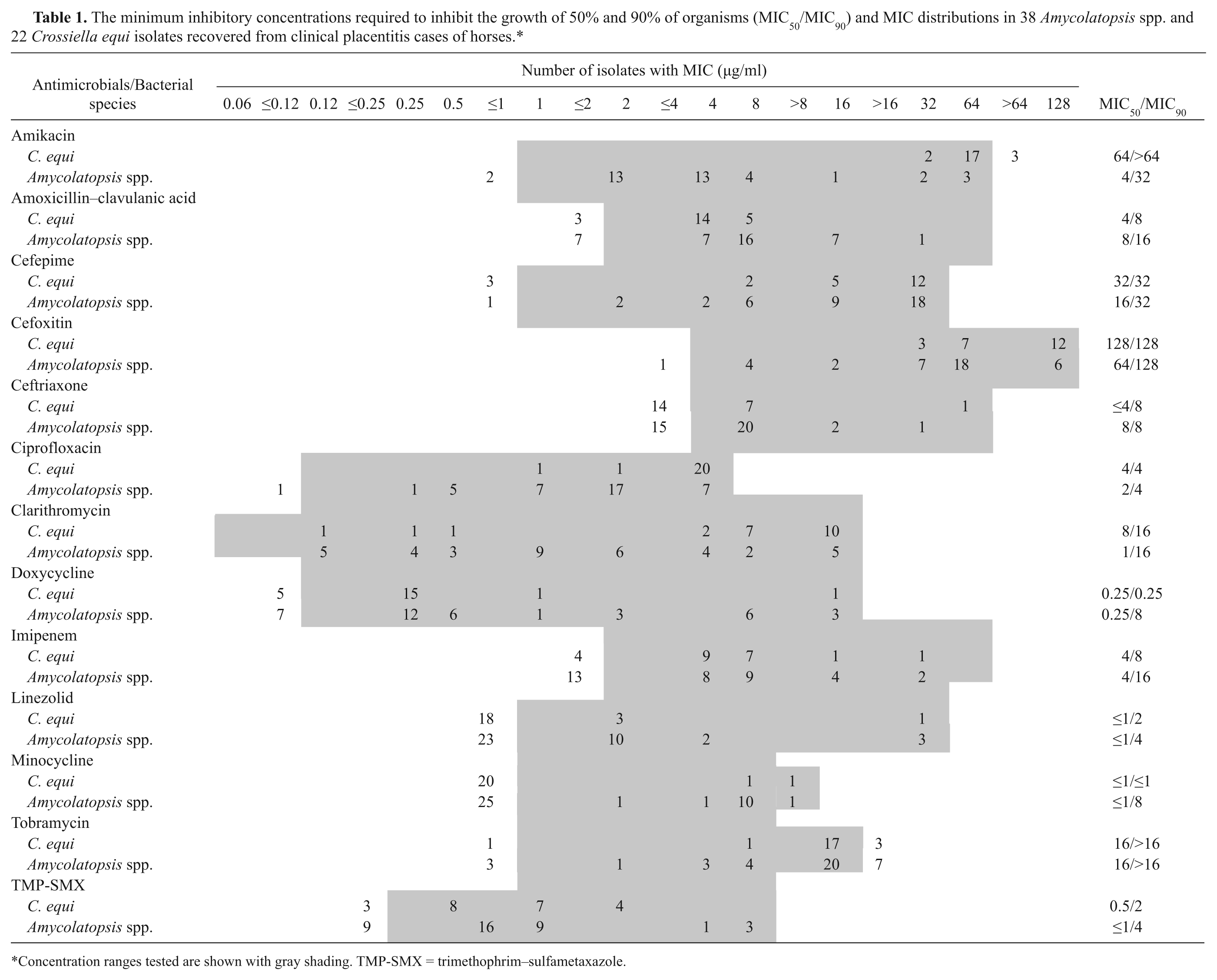
Concentration ranges tested are shown with gray shading. TMP-SMX = trimethophrim–sulfametaxazole.
There are very few reports concerning antimicrobial susceptibilities of other closely related aerobic actinomycetes in animals. In an overview of 28 cases of nocardiosis in cattle and dogs, Nocardia spp. were found to be susceptible (92.8%) to TMP-SMX and amikacin by using the disc diffusion method. 16 In another study, most of the Nocardia nova isolates recovered from cats were susceptible to ampicillin, amikacin, kanamycin, doxycycline, minocycline, erythromycin, clarithromycin, imipenem, sulfisoxazole, and TMP-SMX. 8 Concerning Streptomyces spp., 92 Streptomyces spp. isolates causing brain abscesses in human beings were found to be 100% susceptible to amikacin and linezolid. 17 In another retrospective analysis in human beings, Nocardia spp. were found to be 100% susceptible to linezolid. 19 In the same study, 42% of the isolates were resistant to TMP-SMX, and only 5% of the cases were found to be resistant to amikacin. 19
In human beings, in general, TMP-SMX is the first choice for treatment of Nocardia spp.,1,13 but linezolid has become a useful alternative due to its oral availability and activity against many Nocardia species. 1 Streptomyces spp. and Nocardia spp. are closely related actinomycetes to C. equi and Amycolatopsis spp., and low MIC50/MIC90 levels for C. equi and Amycolatopsis spp. were found to doxycycline, linezolid, minocycline, and TMP-SMX in the current study as well. Other drugs such as ceftriaxone and amoxicillin–clavulanic acid also had low MIC50/MIC90 levels for Amycolatopsis spp. and C. equi in the present study. Although there are currently no clinical breakpoints for nocardioform actinomycetes, the present study may provide guidance for practitioners seeking an appropriate antimicrobial to treat clinical nocardioform placentitis cases. However, regulations regarding use of antimicrobials in horses vary by country. Therefore, any actual use of antimicrobial agent should be done only with a full understanding of the local regulations and requirements imposed on the use of antimicrobials in horses. For example, antimicrobials such as linezolid have not been approved for veterinary use and should not be used in horses until clinical breakpoints are provided by relevant authorities. In addition, the ability of antimicrobials to reach the placenta at a concentration that can treat placentitis is not known to the full extent. However, in experimentally induced placentitis caused by Streptococcus equi subsp. zooepidemicus, TMP-SMX increased the viability of foals,2,12 suggesting that the drug reached the placenta at therapeutic concentrations. In a study of placental transfer of gentamicin and penicillin G, it was shown that the selected drugs attained therapeutic concentrations in allantoic fluid suggesting successful treatment is possible to treat the bacterial placentitis cases. 15 Further studies are needed in pregnant mares with nocardioform placentitis to determine whether the antimicrobials with low MIC50/MIC90 can reach therapeutic concentrations in the placenta and whether they are effective in treating clinical placentitis cases.
Footnotes
Acknowledgements
The authors thank the faculty and staff of the Pathology, Bacteriology, Molecular Biology and Epidemiology sections of University of Kentucky, Veterinary Diagnostic Laboratory and Prof. Stefan Schwarz. Part of this manuscript was given in an oral presentation at the 54th Annual Conference of American Association of Veterinary Laboratory Diagnosticians, Buffalo, NY, 2011.
a.
Trek Diagnostics Systems Inc., Cleveland, OH.
b.
Roche Diagnostics, Indianapolis, IN.
c.
EQUIN1F panel, Trek Diagnostics Systems Inc., Cleveland, OH.
d.
RapMyco Panel, Trek Diagnostics System Inc., Cleveland, OH.
Declaration of conflicting interests
The author(s) declared no potential conflicts of interest with respect to the research, authorship, and/or publication of this article.
Funding
The author(s) received no financial support for the research, authorship, and/or publication of this article.