




Abstract
In September 2010, an outbreak of disease in 2 wild bird species (red-legged partridge, Alectoris rufa; ring-necked pheasant, Phasianus colchicus) occurred in southern Spain. Bagaza virus (BAGV) was identified as the etiological agent of the outbreak. BAGV had only been reported before in Western Africa (Central African Republic, Senegal) and in India. The first occurrence of BAGV in Spain stimulated a demand for rapid, reliable, and efficacious diagnostic methods to facilitate the surveillance of this disease in the field. This report describes a real-time reverse transcription polymerase chain reaction (RT-PCR) method based on a commercial 5’-Taq nuclease-3’ minor groove binder DNA probe and primers targeting the Bagaza NS5 gene. The method allowed the detection of BAGV with a high sensitivity, whereas other closely related flaviviruses (Usutu virus, West Nile virus, and Japanese encephalitis virus) were not detected. The assay was evaluated using field samples of red-legged partridges dead during the outbreak (n = 11), as well as samples collected from partridges during surveillance programs (n = 81). The results were compared to those obtained with a pan-flaviviral hemi-nested RT-PCR followed by nucleotide sequencing, which was employed originally to identify the virus involved in the outbreak. The results obtained with both techniques were 100% matching, indicating that the newly developed real-time RT-PCR is a valid technique for BAGV genome detection, useful in both diagnosis and surveillance studies.
Viruses belonging to the Flavivirus genus, such as Japanese encephalitis virus, West Nile virus (WNV), Usutu virus, and Zika virus, have repeatedly demonstrated the ability to cause infection beyond what has traditionally been considered their geographical range, as previously reviewed. 17 Bagaza virus (BAGV) is a member of the Flavivirus genus (family Flaviviridae), belonging to the Ntaya group. 11 BAGV has become another example of the spread of a flavivirus to a new continent, which in this case is Europe. Before 2010, BAGV had only been identified in mosquitoes in Central and Western Africa6,7,16 and in India. 3 In all cases, it was found in mosquitoes in the context of surveillance activities addressed to other viruses causing diseases of relevance, both for animals and human beings. In India, serological studies suggested that it might be able to infect human beings, 3 although such pathogenicity of the virus is currently unknown. Sequence homology suggested that BAGV is synonymous to Israel turkey meningoencephalomyelitis virus (TMEV), 12 a pathogen affecting turkeys that was first described in Israel in 1958 10 and which has been repeatedly isolated in that country. 4 Outside Israel, TMEV has only been reported in South Africa. 2
In September 2010, BAGV was detected and identified in the southernmost province of Spain (Cádiz), as the etiological agent of an outbreak in wild birds. 1 The outbreak caused mortality in 2 bird species (red-legged partridges, Alectoris rufa; ring-necked pheasants, Phasianus colchicus), which were found dead in different hunting properties. As valued wild game birds, both species are often reared in captivity and released for hunting purposes. The red-legged partridge is native to Spain, where wild populations are still abundant, 15 whereas the ring-necked pheasant (or, common pheasant) is an exotic, introduced game species. 5
BAGV was identified as the causative agent of the outbreak during laboratory investigations using a pan-flaviviral hemi-nested reverse transcription polymerase chain reaction (RT-PCR) assay, amplifying a fragment of the nonstructural NS5 protein coding region of the viral RNA, 14 which was subsequently sequenced to confirm the identity of the viral genome detected. 1 However, this method is cumbersome, time consuming, and, as often happens with nested PCR methods, 9 prone to cross-contamination, and therefore is not suitable for efficient diagnosis and disease surveillance. With the aim to improve the efficacy and speed of the diagnosis of this disease, and to enable surveillance based on the detection of the BAGV genome, a real-time RT-PCR method specific for this virus was developed, and its diagnostic performance was evaluated using field samples and virus isolates from the first outbreak of this disease in Spain. The present article describes the development and evaluation of this new technique.
As a first step, nucleotide primers and a commercial probe aimed at the specific detection of BAGV were designed based on multiple alignments comprising a highly conserved sequence within the NS5 region of different flaviviruses. The alignment included sequences from 3 different BAGV strains (African strain Dak Ar B209, Indian strain 96363, and Spanish strain H/2010), 4 different WNV strains (Kunjin strain MRM61C, NY99, PT6.39, and Eg101), 1 Usutu virus strain (SAAR-1776), and 1 Zika virus strain (MR 766; GenBank accession nos. AY632545, EU684972, HQ644144, D00246, DQ211652, AJ965630, EU081844, AY453412, and AY632535, respectively). Sequences were aligned using commercial software. a Based on this alignment (Fig. 1), a primer pair and a probe specific for BAGV were designed using commercial software. b The forward primer (nucleotide positions 8980–8999, numbered according to GenBank EU684972) was 5’-GGAAGCAGGGCCATATGGTA-3’, the reverse primer (nucleotide positions 9041–9020, numbered as above) was 5’-CGAGGGCCTCAAAYTCTARRAA-3’, and the probe (nucleotide positions 9005–9017, numbered as above) consisted of 5’-FAM-TGGCTYGGATCCC-MGB-3’. The probe was labeled with 6-carboxyfluorescein (FAM) and at the 3’-end with a nonfluorescent quencher bound to an minor groove binder (MGB) group. c
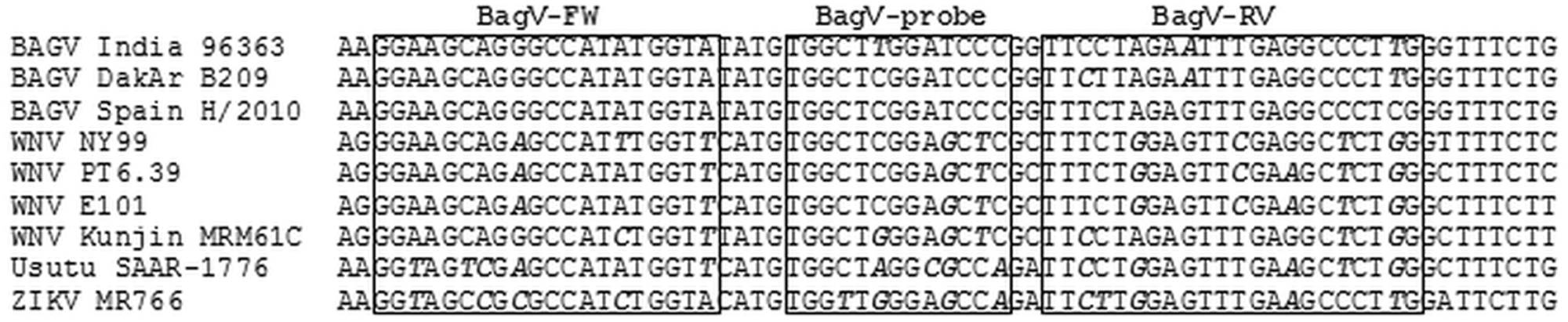
Sequence alignment showing the position of the primers and probe designed in the current study with regard to the nucleotide sequence of Bagaza virus (BAGV) and of other related flaviviruses (names of strains on the left: see text for more details). The genome stretch represented in the figure corresponds to a part of the NS5 gene of the related flaviviruses (nucleotide positions 8977–9048 according to GenBank accession no. EU684972).
The probe and 1 of the selected primers contained, respectively, 1 and 3 degenerate positions to improve the specificity of the real-time RT-PCR for BAGV (Fig. 1). To achieve the best conditions for RT-PCR amplification, the protocol was optimized by testing different concentrations of primers and probe. The final protocol consisted of a 1-step RT-PCR with the following mixture: RT-PCR buffer, d RT-PCR enzyme mix, d forward primer (0.7 µM final concentration), reverse primer (0.7 µM final concentration), probe (0.15 µM final concentration), and 3 µl of template in a total of 20 µl of reaction volume. Amplification and fluorescence detection were conducted in real-time PCR equipment e using a program consisting of a reverse transcription step at 48ºC for 25 min followed by inactivation and denaturation at 95ºC for 10 min, and a PCR amplification cycle of 40 cycles of 95ºC for 15 sec, 52ºC for 30 sec, and 60ºC for 30 sec. Fluorescence data were acquired at the end of the 60ºC step. A hemi-nested RT-PCR specific for a broad range of flaviviruses 14 (the same used in the diagnosis of the outbreak) was performed in parallel in all the samples analyzed in this work, to allow a comparison.
The sensitivity of the new method was analyzed by testing either serial dilutions of viral RNA or viral suspensions (extracted using an automated procedure, f according to the manufacturer’s protocol) from 200-µl aliquots of cell-culture propagated virus seeds (titrated in median tissue culture infectious doses [TCID50]/ml by a standard limiting dilution titration assay 13 using BSR cells, virus titer: 104 TCID50/ml) of a cell culture-grown BAGV isolate Spain H/2010 from the heart of an affected partridge in the 2010 outbreak in Spain. 1 As a result, the real-time RT-PCR method for BAGV genome detection showed a detection limit of 10-1 TCID50/ml, which was comparable to the sensitivity achieved by the pan-flaviviral hemi-nested RT-PCR method performed in parallel (Fig. 2).
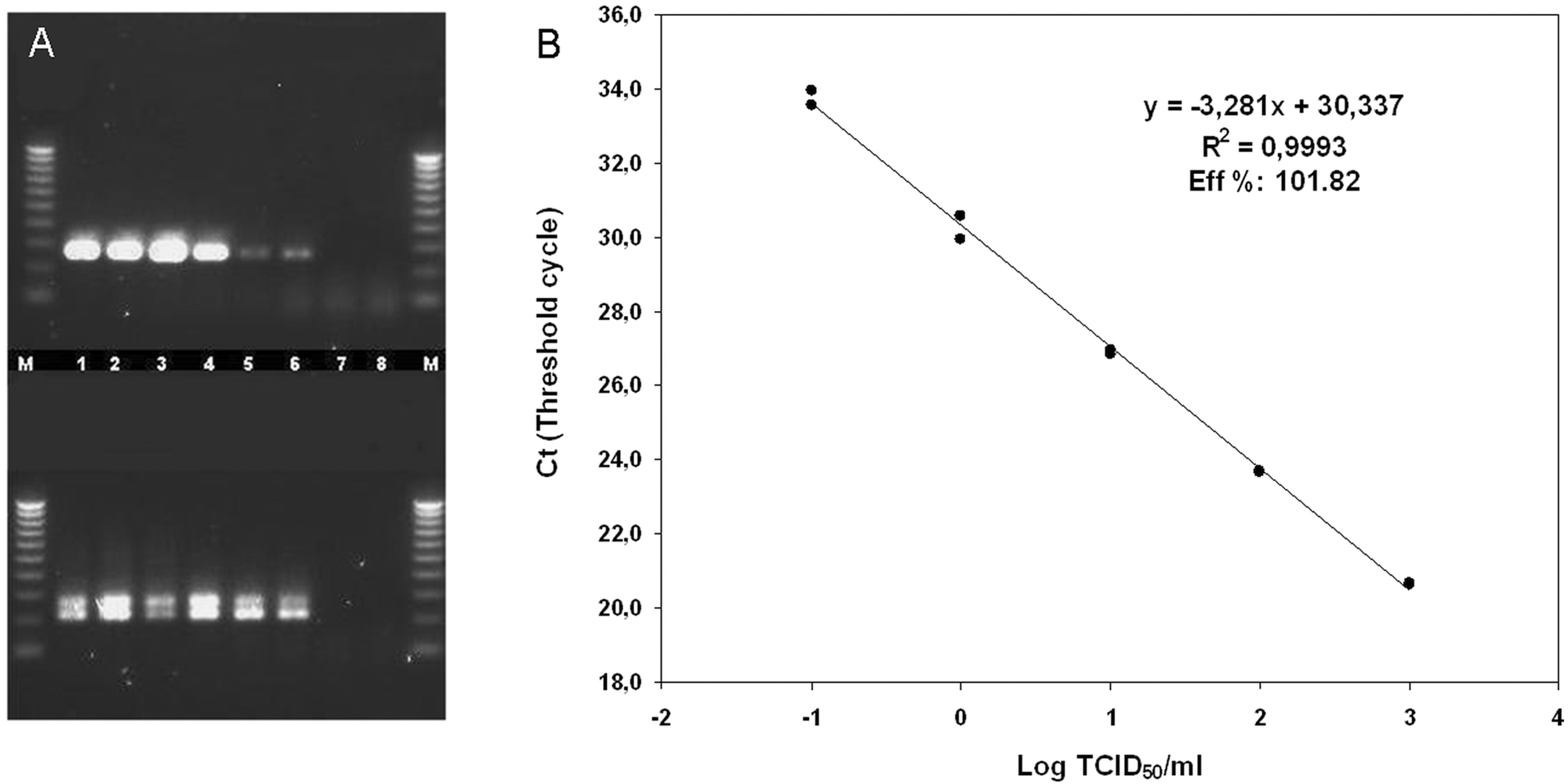
Comparison of sensitivity for Bagaza virus (BAGV) using 2 methods performed in parallel:
To study the specificity of the BAGV real-time RT-PCR, purified RNA samples from different flaviviruses, including BAGV isolate Spain H/2010, as well as non-BAGV flaviviruses (Usutu virus strain SAAR-1776; Japanese encephalitis virus strain Nakayama; West Nile virus strains NY99, PT6.39, Eg101, and Kunjin MRM 16), and other nonflaviviral avian viruses, including avian Influenza A virus (H5N2, H5N3, H7N2, H7N9), Newcastle disease virus (mesogenic and lentogenic strains), Beak and feather disease virus, and Gallid herpesvirus 2, were analyzed. The new real-time RT-PCR gave positive results only with BAGV-derived RNA, but not with RNA from other flaviviruses (whose integrity was confirmed using the broad range of pan-flaviviral hemi-nested RT-PCR; data not shown) or from other avian viruses (whose integrity was confirmed with PCR or RT-PCR methods specific for each virus; data not shown). This result confirms the specificity of the real-time RT-PCR method for BAGV.
To evaluate the performance of the newly developed real-time RT-PCR method in clinical samples, specimens were obtained from red-legged partridges (n = 11) from the disease outbreak that occurred in Cádiz in 2010. The samples were originally submitted for diagnosis to the authors’ laboratory at the National Reference Laboratory for Arboviral Diseases of Animals (Spain). Samples consisted of different tissues and/or organs, including heart, intestine, lung, liver, kidney, brain, and feathers from affected as well as non-affected partridges, which were conserved frozen at −70ºC until used in this work. The samples were previously analyzed by real-time RT-PCR specific for lineage 1 and lineage 2 WNV, 8 all giving negative results in this test, and by the pan-flaviviral hemi-nested RT-PCR. Tissues and/or organs were homogenized in a volume of 200 µl in phosphate buffered saline using commercial equipment, g following the manufacturer’s instructions, and the homogenates obtained were subjected to nucleic acid extraction as above. As a result, all samples identified as positive by hemi-nested RT-PCR were also positive with the new real-time RT-PCR developed in the present study, confirming that the diagnostic sensitivity of real-time RT-PCR is equivalent to the hemi-nested RT-PCR (Table 1). Also, samples from partridges collected during surveillance studies in 2010 and 2011 (n = 81) that yielded negative results in the pan-flaviviral hemi-nested RT-PCR were also negative in the new real-time RT-PCR for BAGV (data not shown).
Comparative analysis of clinical samples from affected red-legged partridges (Alectoris rufa) in the Bagaza virus (BAGV) outbreak in 2010 using a newly developed real-time reverse transcription polymerase chain reaction (RT-PCR) specific for BAGV and a pan-flaviviral hemi-nested RT-PCR method.*
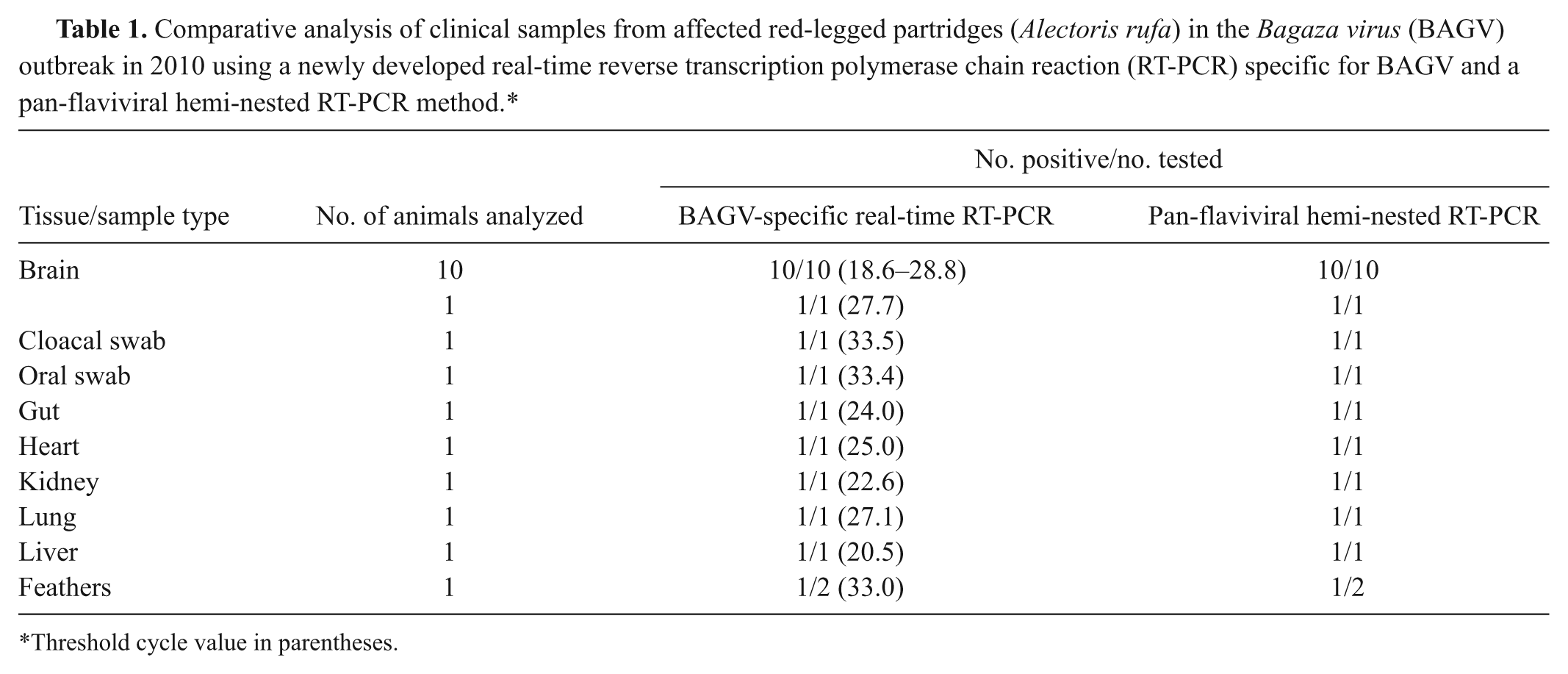
Threshold cycle value in parentheses.
In summary, a real-time RT-PCR method was developed that was specifically designed to detect the presence of BAGV genome in clinical samples with a high sensitivity. This new method proved to be valid for the detection of BAGV genome either in virus isolates or in clinical samples from affected animals, providing a sensitivity equivalent to the gel-based pan-flaviviral RT-PCR method previously employed. As compared to the gel-based RT-PCR, the new method offers several advantages, besides its specificity to BAGV. The new method reduces the time required for analysis (less than 4 hr following receipt of the samples) without any loss of sensitivity or specificity. The assay also significantly reduces the risk of false-positive results due to cross-contamination, which is a well-known drawback of nested PCR protocols. 9 In addition, in combination with an automated extraction system, this new method would enable large-scale analysis of the virus in animal populations potentially affected with the disease, a feature that may be useful in case of recurrence in the area and/or spread to other areas. This method provides the diagnostic laboratory with an effective and rapid analytical tool, useful in differential diagnosis and surveillance of this flaviviral disease of birds, which could represent an emerging animal health risk in Europe.
Footnotes

b.
Primer Express (version 2.0.0) software, Applied Biosystems, Branchburg, NJ.
c.
TaqMan–MGB Probe, Applied Biosystems, Branchburg, NJ.
d.
AGPATH-ID ONE RT-PCR kit, Applied Biosystems, Branchburg, NJ.
e.
7500 Fast Real Time PCR System, Applied Biosystems, Branchburg, NJ.
f.
BioSprint DNA Blood Kit, BioSprint 96 Workstation; Qiagen Inc., Valencia, CA.
g.
MagNA Lyser, Roche Diagnostics, Indianapolis, IN.
Declaration of conflicting interests
The author(s) declared no potential conflicts of interest with respect to the research, authorship, and/or publication of this article.
Funding
The author(s) disclosed receipt of the following financial support for the research, authorship, and/or publication of this article: This study has been funded by the Ministries of Agriculture, Food and Environment, and Economy and Competitiveness of Spain (grant AGL2011-13634-E).