




Abstract
The aim of the current study was to verify if cattle vaccinated against leptospirosis may react in diagnostic tests for brucellosis. Sixty cows were divided into 5 groups, each comprising 12 animals. Four groups were given different vaccines against leptospirosis, while the control group received only saline. Two doses of vaccine were given, as recommended by the manufacturers. Serum samples were collected on the first day of immunization (day 0) and on postvaccination days 7, 14, 21, 28, 35, 42, 49, 56, 96, and 126. All the serum samples were tested for brucellosis and leptospirosis. Twenty animals were reactive at least once to the Rose Bengal test, but by day 96, no further reactions were elicited by this test. Twenty-six samples were reactive to the Rose Bengal test, but only 7 remained positive in confirmatory tests: 1 to the 2-mercaptoethanol test, 2 to the fluorescence polarization assay, and 6 to indirect enzyme-linked immunosorbent assays. None of the samples was reactive in the complement fixation test. None of the animals in the control group was reactive. A significant difference was found between the control group and the groups vaccinated against leptospirosis, according to Fisher exact test. However, the groups were found to respond independently of the vaccine brand. The results indicate that cattle vaccinated against leptospirosis may show reactivity on screening tests for brucellosis.
Keywords
Introduction
Bovine brucellosis and leptospirosis are caused, respectively, by infection with the Gram-negative bacteria Brucella abortus and Leptospira spp. These diseases cause reproductive problems, especially abortion, leading to economic losses and health risks for animals and human beings. 16
To control and eradicate bovine brucellosis and tuberculosis in Brazil, the Ministry of Agriculture, Livestock and Supply established a National Program for the Control and Eradication of Brucellosis and Tuberculosis. The principal measures implemented by the program are obligatory vaccination of 3–8-month-old heifers against brucellosis and the adoption of official diagnostic tests. 8 The tests adopted by the program are the Rose Bengal test (RBT), the Brucella milk ring test, the 2-mercaptoethanol (2ME) Brucella agglutination test, the complement fixation test (CFT), and the fluorescence polarization assay (FPA). The RBT and Brucella milk ring test serve as screening tests, and the 2ME, CFT, and FPA serve as confirmatory tests. Animals testing positive in official tests must be eliminated to prevent the disease from spreading to other animals and human beings. 8 The indirect enzyme-linked immunosorbent assay (iELISA) method is one of the tests recommended for international trade by the World Health Organization. 23
Bovine leptospirosis in Brazil is not considered a disease requiring mandatory notification to the Brazilian Ministry of Agriculture, Livestock and Supply and is therefore not controlled by state or federal animal health agencies that enable animals to be treated successfully. 21 Vaccines and treatments exist that are suitable for bovine leptospirosis, provided they are accompanied by dark-field microscopic agglutination test (MAT). 20
The diagnosis of bovine brucellosis may be adversely affected by the presence of cross-reactions that produce false-positive serological test results because other Gram-negative bacteria share similar epitopes, such as B. abortus O-chain polysaccharide.1,14,22 Several authors have reported evidence of immune cross-reactivity between the smooth strains of Brucella sp. with other microorganisms. According to reports, the bacteria Yersinia enterocolitica O:9, Escherichia coli O157:H7, Salmonella sp., Francisella tularensis, and Vibrio cholerae can react in serology tests for bovine brucellosis.1,5,7,10,13
On herd health planning calendars, leptospirosis is a disease for which vaccination is recommended at least twice a year. Because the vaccines are produced with a Gram-negative bacterium (Leptospira spp.), leptospirosis vaccines can induce the formation of antibodies that may react in serological screening tests for brucellosis, leading to the unnecessary elimination of animals. The objective of this study was to ascertain if cattle recently vaccinated against leptospirosis may react in official and alternative brucellosis tests and, if so, to determine the duration of this interference.
Material and methods
The current study was conducted on the Glória Experimental Farm of the Federal University of Uberlândia Faculty of Veterinary Medicine (FAMEV-UFU; Uberlândia, Minas Gerais, Brazil). Sixty 25–30-month-old mixed-breed and purebred dairy cows were selected and tested negative for leptospirosis and brucellosis in MAT and RBT, respectively. The cattle were distributed using a completely randomized design into 5 groups (A–E), each comprising 12 animals. Group A, the control group, was immunized with 2 ml of saline.
Groups B and C were immunized with 2 different commercial Leptospira spp. polyvaccines composed of the following inactivated cultures of Leptospira interrogans serotypes: Canicola, Grippotyphosa, Hardjo, Icterohaemorrhagiae, Pomona, and Wolffi. Group D was immunized with a vaccine containing the serovars Canicola, Grippotyphosa, Hardjo, Icterohaemorrhagiae, and Pomona; group E was immunized with a vaccine composed of the serovars Bratislava, Canicola, Grippotyphosa, Hardjo, Icterohaemorrhagiae, Pomona, Tarassovi, and Wolffi. The animals were immunized according to the instructions of each vaccine manufacturer.
The vaccination protocol consisted of 2 immunizations: the first on day 0 and the second on day 28. A total of 10 postvaccination blood samples were collected from each animal on days 7, 14, 21, 28, 35, 42, 49, 56, 96, and 126. Thus, a total of 600 blood samples were collected from animals in groups A–E. All the samples were analyzed at the Laboratory of Infectious Diseases (FAMEV-UFU, Uberlândia, Minas Gerais, Brazil) using the RBT, and the reactive blood serum samples were subjected to 2ME, FPA, CFT, 8 and iELISA 23 confirmatory tests. The CFT was carried out at the National Agricultural Laboratory of Minas Gerais (Centro, Pedro Leopoldo, Minas Gerais, Brazil). All the samples were subjected to the dark-field MAT at FAMEV-UFU to verify the production of the vaccine titers (≥100) against Leptospira spp.
At the end of the experiment (day 126), the animals were subjected to the RBT and 2ME tests to check for the presence or absence of reaction. A statistical analysis based on Fisher exact test was applied for comparison of groups A–E using statistical software a and considering a 5% level of significance.
Results
Group A did not present any animals reactive to RBT (Table 1). In groups B–E, 20 animals reacted at least once to the RBT, with 2 animals reacting 3 times and 2 animals reacting twice during the weeks under analysis. Table 1 lists the number of cows found reactive to all the serology tests performed on animals vaccinated against leptospirosis. Table 2 lists the number of cows found reactive to the RBT during the 18 weeks of evaluation.
Number of cows found reactive to serology tests for brucellosis among cattle vaccinated against leptospirosis in 2010 on an experimental farm in Uberlândia, Minas Gerais, Brazil.*
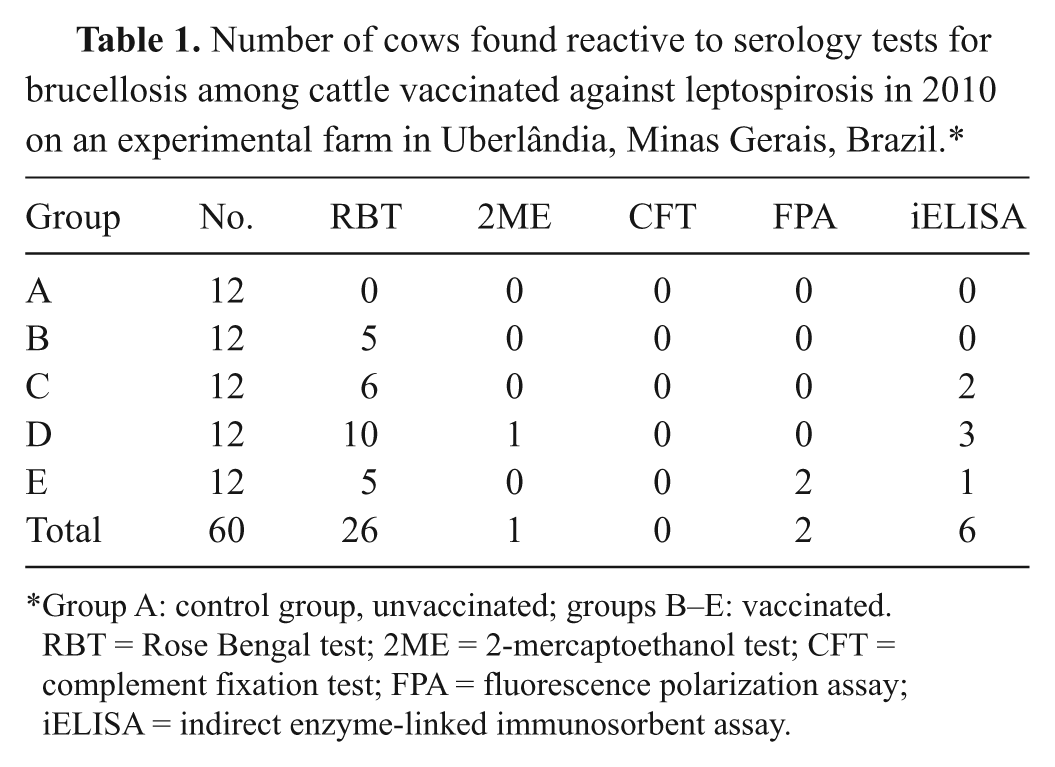
*Group A: control group, unvaccinated; groups B–E: vaccinated. RBT = Rose Bengal test; 2ME = 2-mercaptoethanol test; CFT = complement fixation test; FPA = fluorescence polarization assay; iELISA = indirect enzyme-linked immunosorbent assay.
Rose Bengal test results for cows vaccinated against leptospirosis in 2010 on an experimental farm in Uberlândia, Minas Gerais, Brazil.*
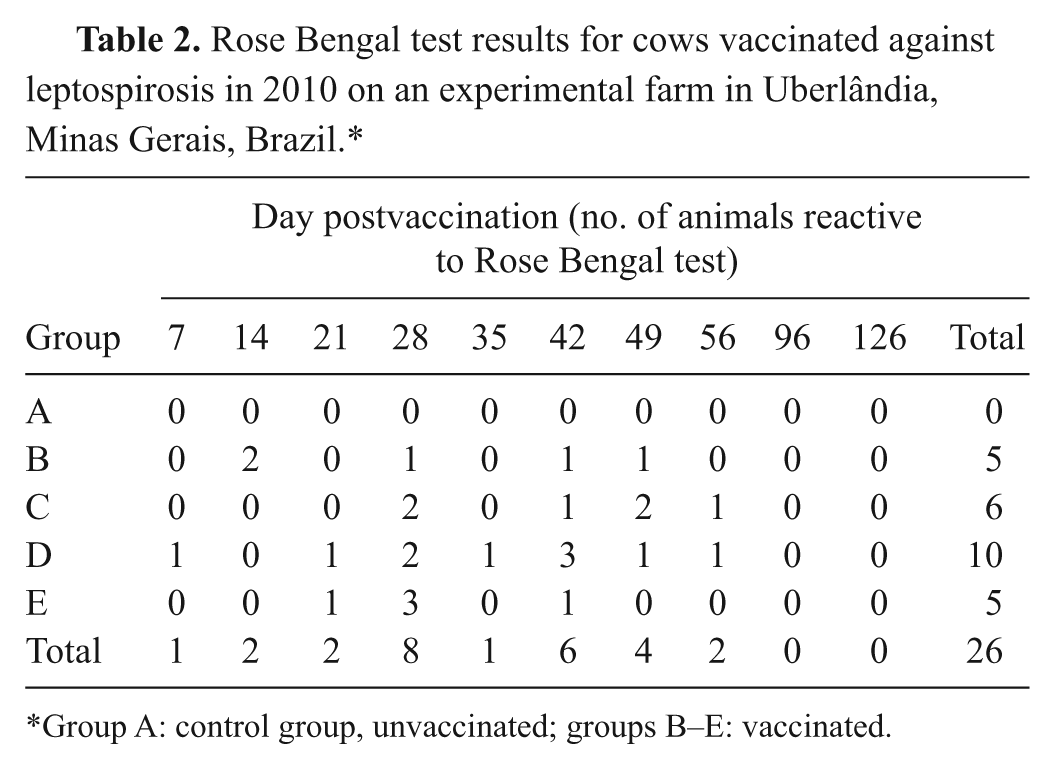
Group A: control group, unvaccinated; groups B–E: vaccinated.
Among the RBT-positive samples, 7 were confirmed: 1 by the 2ME test, 2 by the FPA, and 6 by the iELISA, with 2 samples reacting simultaneously to 2 confirmatory tests (Table 1). The only test that elicited no reaction was the CFT (Table 1).
In a comparison of the results of group A and groups B–E (Table 1), Fisher exact test indicated a significant difference (P < 0.05) because the animals that received commercial vaccines reacted positively to the RBT, while no response was elicited from the animals immunized with saline. No significant difference (P > 0.05) was found in a comparison of groups B–E because the reactions to the RBT were independent of the different commercial brands of vaccines against leptospirosis (Table 2).
All the samples testing positive in the RBT presented anti–Leptospira spp. vaccine titers (≥100). Table 3 lists the MAT results recorded during the 18 weeks of study to check for the presence of agglutination antibodies induced by the vaccines. In a comparison of the MAT results of group A and groups B–E, Fisher exact test indicated a significant difference (P < 0.05). All the groups were statistically different, although there was no difference between groups C and E. In the last evaluation performed on day 126, all the animals tested negative to the brucellosis tests, and only 7 animals presented vaccine titers in the MAT (Table 3).
Dark-field microscopic agglutination test results (1:100) for cows vaccinated against leptospirosis in 2010 on an experimental farm in Uberlândia, Minas Gerais, Brazil.*
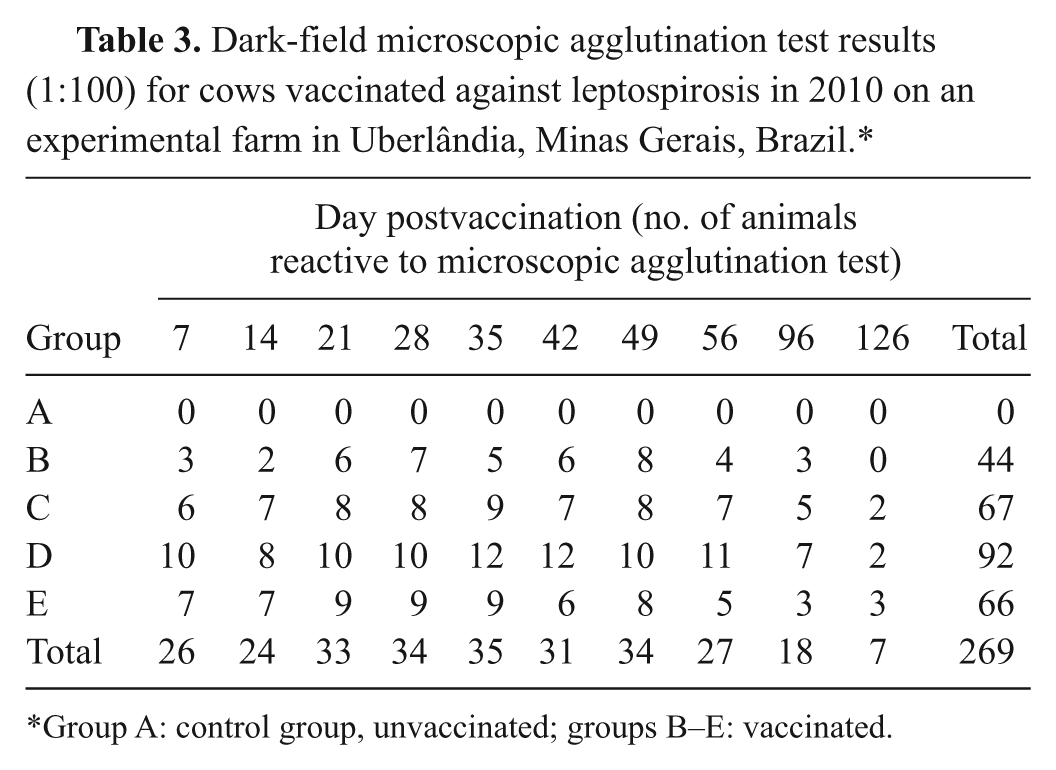
Group A: control group, unvaccinated; groups B–E: vaccinated.
Discussion
The results of the present study demonstrate a cross-reaction in the brucellosis screening tests, as animals testing negative for the disease at the beginning of the experiment reacted after being vaccinated against leptospirosis. This may have been due to the interference of antibodies produced after immunization against leptospirosis.
Based on the statistical analysis comparing the control group against the groups immunized with 4 commercial vaccines, there was a significant difference in the results. This corroborates the hypothesis of cross-reactivity, as the animals that received commercial vaccines against Leptospira spp. reacted positively to the RBT, while no response was elicited from the animals immunized with saline.
The difference presented by the MAT results is due to factors that may influence the effectiveness of vaccines against leptospirosis, including the quality and quantity of immunogenic microorganisms, the similarity between the antigens in the bacterin vaccine composition, the adjuvant, the storage temperature, and transport of vaccine. 15 Studies emphasize that the vaccine antigen concentration has strong influence in the production of agglutinins postvaccination. The fact that the same antibody response against all serovars was not observed may be due to a difference in the final vaccine antigen concentration or the antigenic response suppression caused by the predominance of 1 serotype over another present in the vaccine.3,17
The false-positive results may have been caused by the cross-reaction of immunodominant epitopes in the O-chain polysaccharide of B. abortus lipopolysaccharide (LPS) that are present in several Gram-negative bacteria. 1 When an animal is exposed to a Gram-negative bacterium with an LPS similar to that of B. abortus, antibodies may be formed that are detectable in serology tests. 11 The cross-reaction observed in the RBT of the present study suggests the possibility that B. abortus and Leptospira spp. bacteria may share a similar LPS, causing the Brucella antigen to recognize the leptospiral antibody.
The LPS of Leptospira spp. has a chemical structure and biological effects that are similar to those of the LPS of Gram-negative bacteria, although its toxicity is 12–20-fold lower. 4 Therefore, the scanty number of positive reactions in the RBT might be due to the low immunogenicity of the LPS of Leptospira spp. or a combination of O-side chain, outer membrane proteins, and possibly media proteins leftover during the vaccine preparation.
The antigen used in the brucellosis-screening test, buffered acidified antigen, is composed of dead bacteria stained with Rose Bengal dye and suspended in an acid buffer (pH 3.6). Nonspecific agglutination of class M immunoglobulins (IgM) is inhibited in alkaline media, making the test selective for the identification of class G immunoglobulins (IgG). 19 Vaccines against leptospirosis are based on the protection of the LPS antigen of Leptospira spp., producing high titers of antibodies with IgM, immediately followed by the response of antibodies with IgG, which persist for long periods.9,12 Because the leptospirosis vaccine is targeted to produce antibodies against the LPS of Leptospira spp. and the RBT is based on the detection of B. abortus anti-LPS antibodies, it is reasonable to assume that the interference in the test was due to the latter’s similarity with the Leptospira spp. LPS, which is also from a Gram-negative bacterium.
The occurrence of a larger number of animals testing positive in the RBT than in the confirmatory tests is due to the low specificity of the test, 8 as tests with low specificity produce larger numbers of false-positive results. 18 The 2ME, FPA, and iELISA confirmed that 7 samples recently vaccinated against leptospirosis tested positive when none of the samples were found to be reactive to brucellosis in the CFT.
Earlier studies2,5,7,14 have reported cross-reactions in iELISA serology tests and FPA 13 for brucellosis with Gram-negative bacteria, where bovines were infected experimentally with the bacterium Yersinia enterocolitica O:9. Cross-reactions with the bacterium Escherichia coli O157:H7 have also been observed in the iELISA. 13
In research that analyzed cows that were confirmed positive and inconclusive in brucellosis tests, it was found that 15.1% and 36.9% of the sera, respectively, presented a positive reaction in the MAT, principally those against the serovars Grippotyphosa and Sejroe, indicating a possible diagnostic interference. 6
It is advisable to perform confirmatory tests because they are more specific. According to Brazilian legislation, animals testing positive in the RBT may already be indicated for elimination. In the present study, 20 animals could have officially been destined for elimination because they reacted to the RBT, and 5 animals would have had to be mandatorily eliminated because they reacted to the 2ME test and FPA, which are official tests in Brazil, and the iELISA, which is recommended by the World Health Organization. 23
In the current study, because no cow was reactive to the RBT on days 96 and 126 postvaccination, the cows were confirmed as not suffering from brucellosis, because if they had, they would have presented persistent titers in the serology tests, as the presence of IgG antibodies indicates chronic infection. 8 It is therefore suggested that cattle recently vaccinated against leptospirosis that test positive in brucellosis serology tests be isolated from the herd for an average period of 100 days postvaccination so that retesting can be conducted to eliminate the possibility of interference in the diagnosis of brucellosis. Bovids recently vaccinated against leptospirosis may react positively in official and alternative serology tests for brucellosis for a period of up to 96 days postvaccination.
Footnotes
a.
BioEstat version 5.0, Universidade Federal do Pará, Pará, Brazil.
The author(s) declared no potential conflicts of interest with respect to the research, authorship, and/or publication of this article.
The author(s) disclosed receipt of the following financial support for the research, authorship, and/or publication of this article: The authors acknowledge the financial aid of the Brazilian research funding agencies CNPq (National Council for Scientific and Technological Development).