




Abstract
Two dogs, a 13-year-old spayed female and a 7-year-old neutered male, were diagnosed with pentobarbital poisoning. Follow-up investigation determined that the source of pentobarbital was the carcass of a horse that had been euthanized more than 2 years previously and that was also apparently responsible for the death of a least 1, and possibly 2, other dogs. The fact that the horse carcass remained lethally toxic more than 2 years after it was euthanized reemphasizes the necessity of proper disposal of euthanized animals.
In mid-March, a 13-year-old, spayed, female Labrador-cross was presented dead together with a 7-year-old, neutered, male Australian Shepherd-cross exhibiting ataxia, confusion, and apprehension. Temperature, pulse, and respiration of the surviving male were slightly subnormal, and the dog was hyporesponsive to stimuli. Supportive treatment was given including warming, intravenous fluids, and gavage with activated charcoal, and the dog recovered by the following morning.
Both dogs were reported to be healthy and alert when they were let out of the house at 8:00
The dogs lived in a remote rural area, and both animals were known to wander off the property occasionally. Once the cause of death was determined to be pentobarbital poisoning, the dog's owner backtracked his dogs and discovered an incompletely buried horse carcass in a ravine about 300 m from his house on a neighbor's property. The carcass had been recently scavenged, and the color of the hair matched that found in the stomach of the female. According to the owner of the horse, it had been euthanized more than 2 years previously and had required a “massive dose” of euthanasia solution to die. This was the only possible source of pentobarbital discovered within 2 miles of the dog owner's residence. Interestingly, the same neighbor's dog exhibited similar clinical signs to the female of the present report, died, and was interred in the ravine next to the horse during the previous December. A fourth dog, also belonging to the horse owner, had “laid down and died” shortly after the horse was euthanized. Surprisingly, no wildlife carcasses were discovered near the horse carcass, although it is possible that any additional carcasses had been dragged off by scavengers.
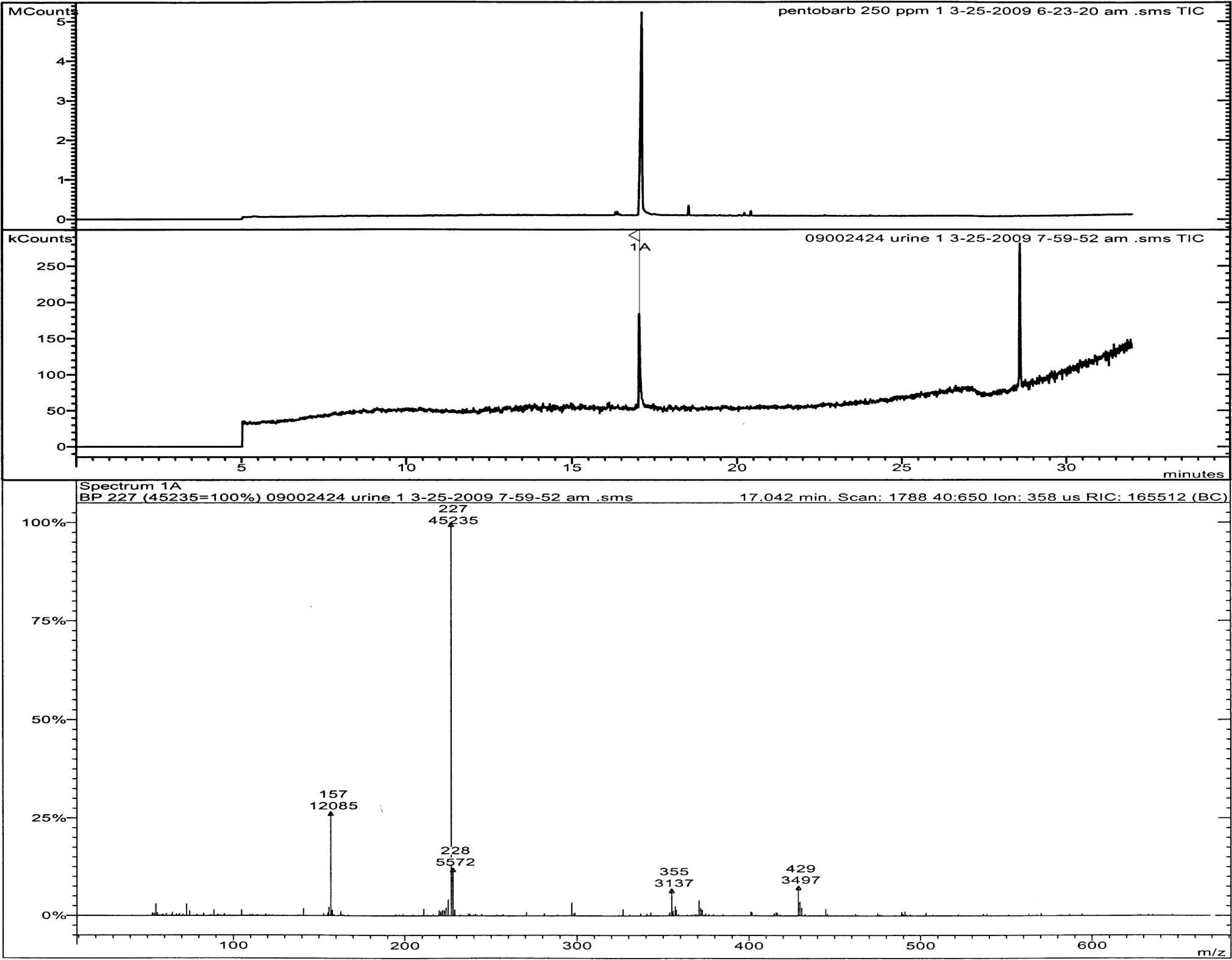
Total ion chromatograms of an authentic pentobarbital standard (
Pentobarbital concentrations in tissues recovered from a 2-year-old, euthanized, equine carcass.*
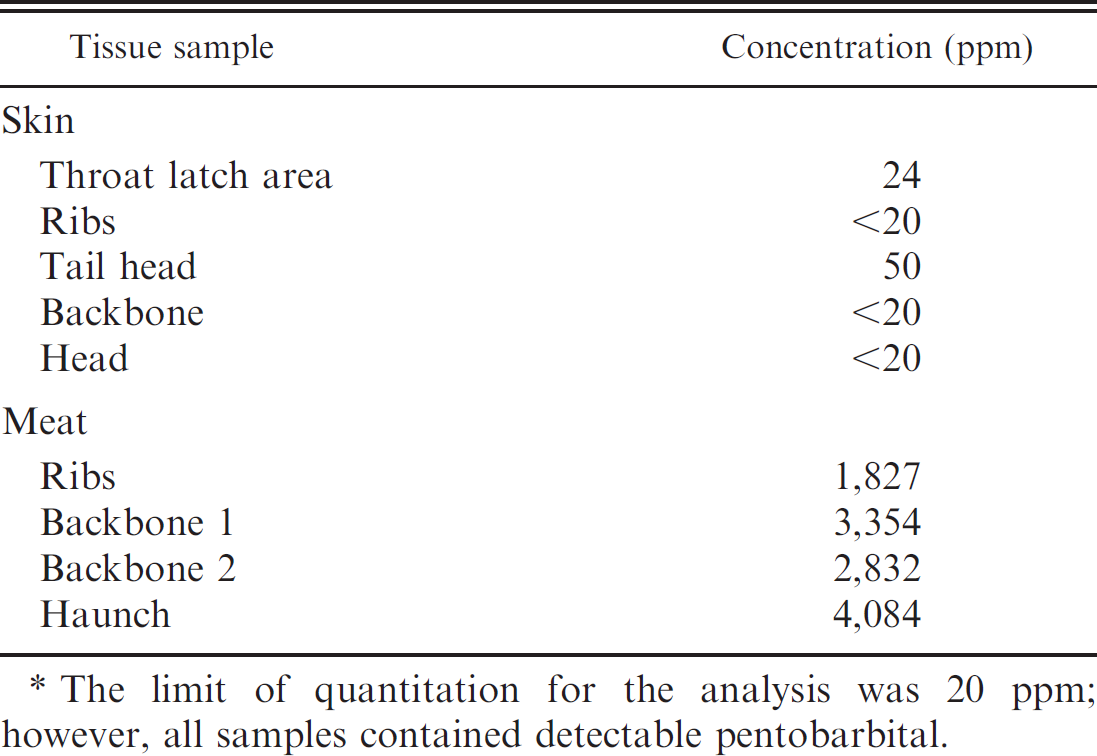
The limit of quantitation for the analysis was 20 ppm; however, all samples contained detectable pentobarbital.
The horse carcass was extremely desiccated and decomposed, but some flesh and skin remained. Multiple samples were obtained from the carcass and, together with a liver sample from the dog buried in the ravine, analyzed as follows. A subsample of each tissue was homogenized in 0.1 M NaHCO3 and washed with hexane, then acidified with 1 g of an 8:2 mixture of Na2PO4 and K2PO4 and extracted twice with 10 volumes of CHCl3. After the CHCl3 was evaporated with nitrogen, the sample was redissolved in methanol and subjected to GC-MS with authentic pentobarbital standard a and pentobarbital-spiked samples. Pentobarbital concentrations in horse tissues ranged from barely detectable (<20 ppm) to more than 4,000 ppm (Table. 1). There was no obvious relationship between the type of tissue analyzed and pentobarbital concentration, with the exception of skin samples that had consistently lower phenobarbital concentrations than meat.
The reported oral median lethal dose of pentobarbital in the dog is 85 mg/kg. Although a published minimum oral lethal dose could not be found, it is presumably somewhat greater than the 28-30 mg/kg recommended orally to produce anesthesia. 2 Assuming that the dogs consumed 2.5% of their body weight, the more concentrated portions of the horse carcass would have provided more than 100 mg/ kg to the dogs after a full meal of horse meat. Interestingly, the liver sample from the dead dog buried in the ravine also contained trace concentrations of pentobarbital, suggesting that it, too, died of pentobarbital poisoning.
Pentobarbital relay toxicity has been reported in numerous species as a result of consuming the flesh of animals euthanized with pentobarbital, 1,3,5,9 and veterinarians have been fined for accidental poisoning of wildlife by euthanized carcasses. 7 Relatively little has been published, however, about the environmental persistence of pentobarbital in the euthanized carcass. Pentobarbital is hydrolyzed to a number of inactive products in aqueous solutions at high pH and reacts destructively with formaldehyde in vitro 4 but is relatively stable at low concentrations in natural waters such as lakes and streams 8 Pentobarbital also resists degradation at rendering temperatures 6 and has been detected at very low concentrations in pet food, presumably as the result of rendering euthanized horses (Food and Drug Administration/Center for Veterinary Medicine: 2002, Report on the risk from pentobarbital in dog food. Available at http://www.fda.gov/AboutFDA/CentersOffices/CVM/CVMFOIAElectronicReadingRoom/ucm129131.htm. Accessed February 11, 2009). Although not a controlled experiment, the present case report demonstrates that pentobarbital may persist at toxic concentrations for at least 2 years in a partially buried carcass.
Footnotes
a.
Quik-Chek™ Pentobarbital Standard, Grace Davison, Deerfield, IL.