




Abstract
Feline autosomal-dominant polycystic kidney disease (ADPKD), with its characteristic growth of fluid-filled cysts of different sizes, is the most prevalent inherited genetic disease of cats. The point mutation (C→A transversion) in exon 29 of the PKD1 gene is known to contribute to ADPKD development and can thus serve as a target for the molecular genetic diagnosis of ADPKD. To this end, a simple amplification refractory mutation system (ARMS) polymerase chain reaction (PCR) was designed with 3 primers: 2 forward primers specifically targeting either the mutant or normal allele, and 1 universal reverse primer for amplification of both alleles. The new method was tested on the DNA from 35 feline blood samples, which included 15 mutant cats and 20 wild type cats. As verified by direct DNA sequencing, both sensitivity and specificity of this tri-primer ARMS PCR were 100%. As the multiplex ARMS PCR test can be performed in a single PCR reaction without other post-PCR procedures, it is a simple and accurate method for molecular studies of feline ADPKD.
Keywords
Feline polycystic kidney disease, also called feline autosomal-dominant polycystic kidney disease (ADPKD), is the most prevalent inherited genetic disease of cats. This disease affects 37–49% of Persians and Persian-related breeds worldwide. 1,3,5 Like human ADPKD, this disease is characterized by the growth of fluid-filled cysts of various sizes in the renal cortex and medulla, and occasionally in the liver and pancreas. 9
Recently, a genetic mutation associated with ADPKD was identified in the PKD1 gene of Persian cats. 15 The PKD1 gene encodes a transmembrane protein called polycystin-1. 12 The genetic mutation consists of a C→A mutation (GenBank accession no. AY612847), which introduces a stop codon at position 3284 in exon 29, and results in the loss of 25% of the C-terminus of the protein. 15 Feline ADPKD is only clinically manifested as a heterozygous mutation, which suggests that a homozygous mutation is embryonic lethal. 15
Traditionally, ultrasound screening has been the most practical tool for noninvasive detection of renal cysts. Yet, problematically, ultrasonographic diagnosis of ADPKD occasionally yields false-positive or false-negative results, and it is usually only reliable in cats over 10 months of age. 4 Based on the identification of genetic marker involved in ADPKD development, 15 several methods have been established for identification of the PKD1 point mutation, including direct sequencing of polymerase chain reaction (PCR) product or restriction fragment length polymorphism (RFLP) PCR. 15 These methods require post-PCR handling steps and require both high-quantity and high-quality DNA. However, it is relatively difficult to collect sufficient amounts of blood from feline patients in a clinical practice for adequate DNA isolation. 2
Recently, several real-time PCR—based assays that combine detection with TaqMan probes, 11 or with fluorescence resonance energy transfer probes followed by melting curve analysis, 7 have achieved high sensitivity in detecting the C→A point mutation; by using TaqMan probe, real-time PCR reliably detected 10–100 pg of genomic DNA, equivalent to 3–30 gene copies, 11 and shortened analysis time. However, the high cost of equipment, consumables, and reagent have been the disadvantage of real-time PCR.
Amplification refractory mutation system (ARMS) PCR, also called allele-specific oligonucleotide PCR, was originally designed for the detection of known point mutations. 16 By using just 2 pairs of primers in a single PCR tube, ARMS PCR can simultaneously amplify both mutant and normal alleles, plus it allows for the amplification of an internal DNA control. This technique has been applied to genotyping, analysis of genetic disorders, 6,17,19,20 and the diagnosis of several different virus infections. 6,10,13,14
The aim of the present study was to develop ARMS PCR as a low cost and fast method that can be easily adapted in most veterinary diagnostic laboratories with only essential equipment for routine screening of PKD mutation. Initially, DNA samples of cats admitted to the Veterinary Medical Teaching Hospital of National Chung Hsing University (Taiwan) were extracted with a commercial kit a and screened for the PKD1 gene mutation by the PCR based on a previous report. 8 The identity of the resultant PCR fragments was determined by automated sequencing. In total, 15 mutant-type and 20 wild-type cats were used for the following study.
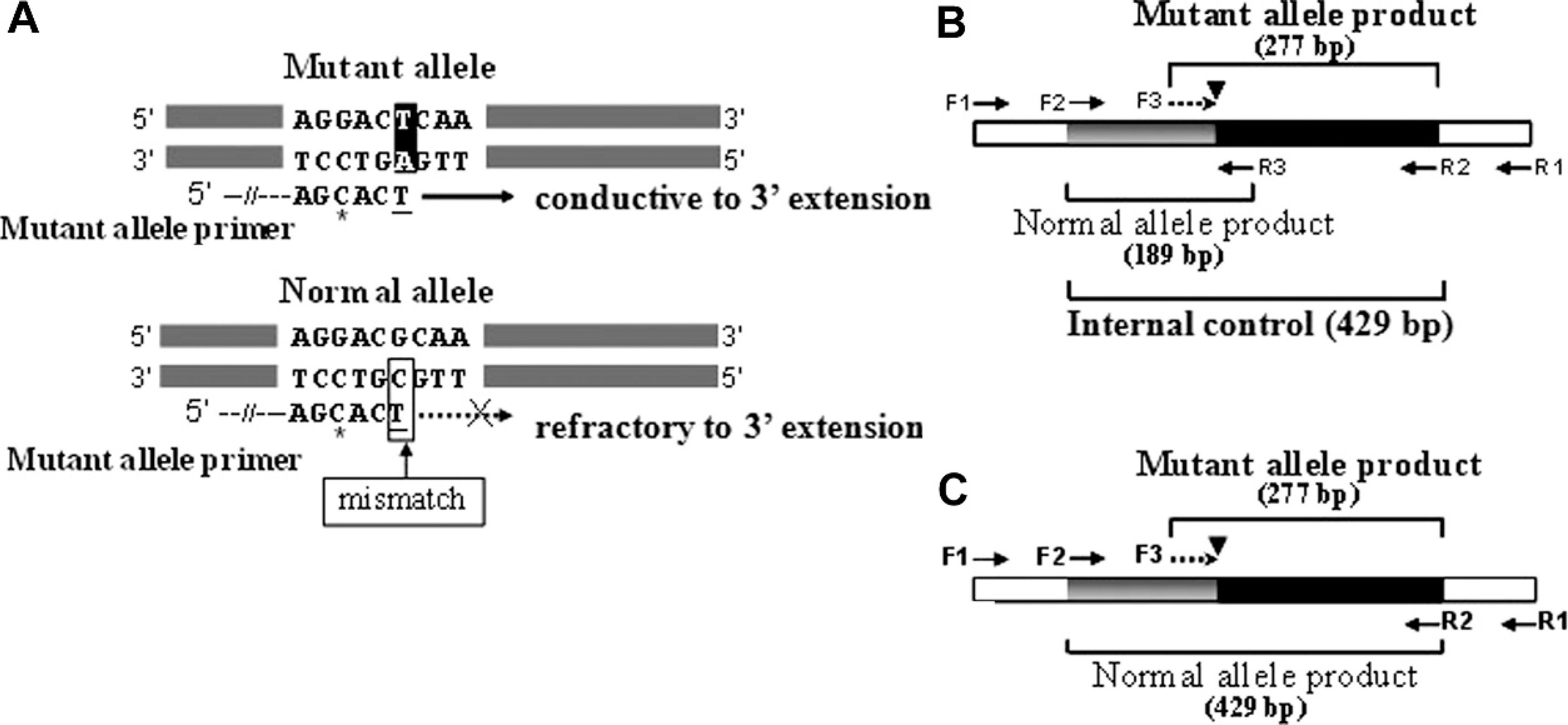
Schematic illustration of the amplification refractory mutation system (ARMS) polymerase chain reaction (PCR) assay.
For genotyping of exon 29 of the PKD1 gene by ARMS PCR, 2 sets of primers are designed to target either the mutant allele or the normal allele based on the C→A point mutation; the 2 allele-specific amplifications take place in opposite directions and yield DNA fragments of different lengths that can be easily resolved by conventional agarose gel electrophoresis (Fig. 1). The discrimination of amplification mainly depends on the mismatch nucleotide at the most 3′-terminus of primer. 16,18 The allele-specific priming of the PCR process will only permit amplification to occur when the most 3′-terminal nucleotide matches with its target sequence (Fig. 1A). Furthermore, an additional mismatch was deliberately introduced at the fourth to last nucleotide position of the 3′ end of the primer to increase the discriminatory power. The design of the ARMS PCR and the location of primer sets are illustrated in Figure 1.
To overcome the problem of low DNA yield from feline blood, the nested ARMS PCR was performed. The product amplified by primer set PKD1F1 and PKD1R1 was used as a template for ARMS PCR. Sequences of primers used in the multiplex ARMS PCR are illustrated in Table 1.
First, the specificity of different primer combinations (as listed in Table 1) was verified by PCR to ensure the best mismatch discrimination between mutant- and wild-type PKD1 alleles. The reaction mixture contained 1 μl of DNA template, 1 μl of forward primers (10 μM), 1 μl of reverse primer (10 μM), and 5 μl of 5 x Taq PCR Master mix b in a total volume of 25 μl. Thermal cycling programs consisted of a denaturation step for 4 min at 94°C followed by 32 cycles of 30 sec at 94°C, 45 sec at 68°C, and 45 sec at 72°C, with a final extension step for 10 min at 72°C. As shown in Figure 2, mutant allele specific primers F3 and R2 amplified a 277-bp fragment only from mutant sample, whereas DNA fragment with an expected size of 189 bp was amplified from wild-type allele by primers F2 and R3 (Fig. 2). As expected, the PCR product corresponding to the normal allele was also obtained from the DNA sample that contained the PKD1 point mutant (Fig. 2, lane 4), because cats with ADPKD are heterozygous at this gene locus. These results confirmed the specificity of these primer sets to distinguish the normal PKD1 allele from the mutant PKD1 allele, which contains just 1 single point mutation.
Combinations and sequences of primers used in different methods of molecular diagnosis of polycystic kidney disease.*
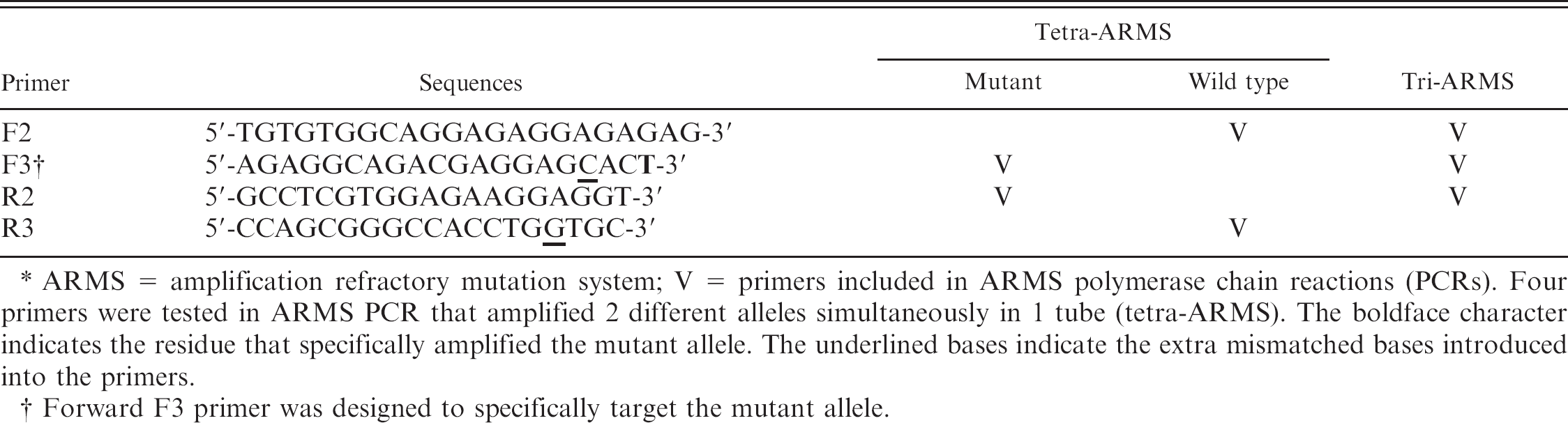
ARMS = amplification refractory mutation system; V = primers included in ARMS polymerase chain reactions (PCRs). Four primers were tested in ARMS PCR that amplified 2 different alleles simultaneously in 1 tube (tetra-ARMS). The boldface character indicates the residue that specifically amplified the mutant allele. The underlined bases indicate the extra mismatched bases introduced into the primers.
Forward F3 primer was designed to specifically target the mutant allele.
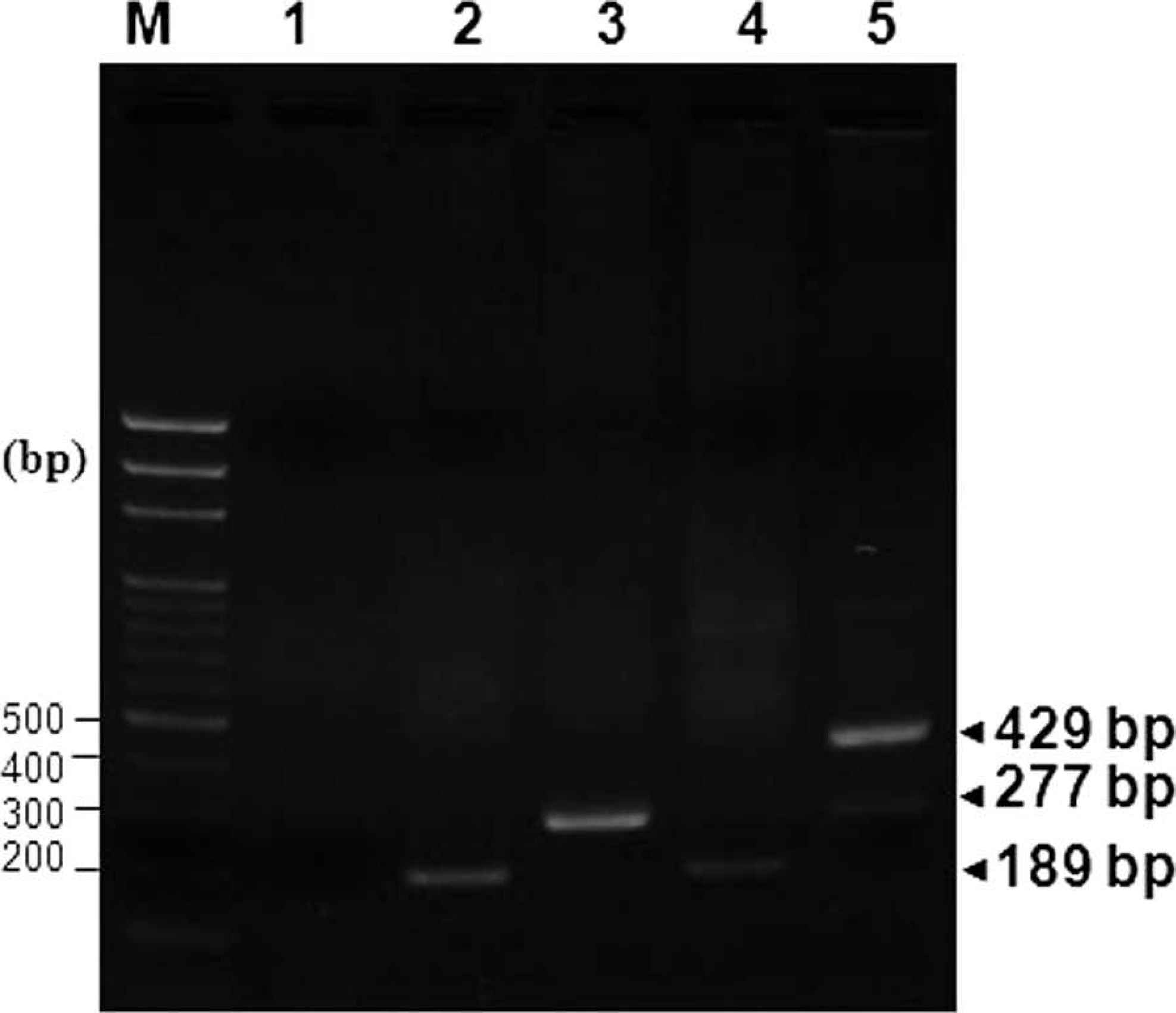
Validation of primers specificity. DNA from normal cats (lane 1, 2) and autosomal-dominant polycystic kidney disease (ADPKD) affected cats (lane 3–5) were amplified with mutant-allele specific primer set F3/R2 (lanes 1, 3), normal-allele primer set F2/R3 (lanes 2, 4), or tetra-primers F2, F3, R2, and R3 (lane 5) by amplification refractory mutation system (ARMS) polymerase chain reaction (PCR). In single-paired ARMS PCR, the mutant-allele primer set yielded a product of the expected size from a polycystic kidney disease—affected sample (lane 3) but not from a normal sample (lane 1). In addition, the normal-allele—specific primer pair amplified a DNA fragment of 189 bp from normal cat and heterozygote ADPKD cat samples. In the tetraprimer ARMS PCR, the product of normal allele (targeted by F3-R3) was unexpectedly absent (lane 5). Lane M: DNA markers.
Next, to simplify handling procedure, the possibility of the simultaneous amplification of mutant and normal allele-specific products in 1 tube was tested. Four primers: 1 μl of F2, F3, R2, and R3 (10 μM) were included in 1 reaction (tetra-primer ARMS PCR) to investigate if portions of the 2 different PKD1 alleles could be differentially amplified. Three products that represent amplification of the mutant allele (227 bp), the normal allele (189 bp), and an internal control (429 bp) were expected to be amplified in the experiment (Fig. 1B). As shown in Figure 2 (lane 5), only 2 PCR products of 429 bp and 277 bp were amplified by the outer primer set F2/R2 and the mutant-allele primer pair F3/R2. The absence of the 189-bp product indicated that the normal-allele primer failed to be amplified. Attempts were made to optimize the tetra-primer ARMS PCR reaction, for instance, by adjusting the annealing temperature (68–72°C) and using various concentrations of individual primers and MgCl2 (1–5 mM); however, satisfactory results were not obtained. Consequently, a tri-primer ARMS PCR was developed to overcome the problem as described below.
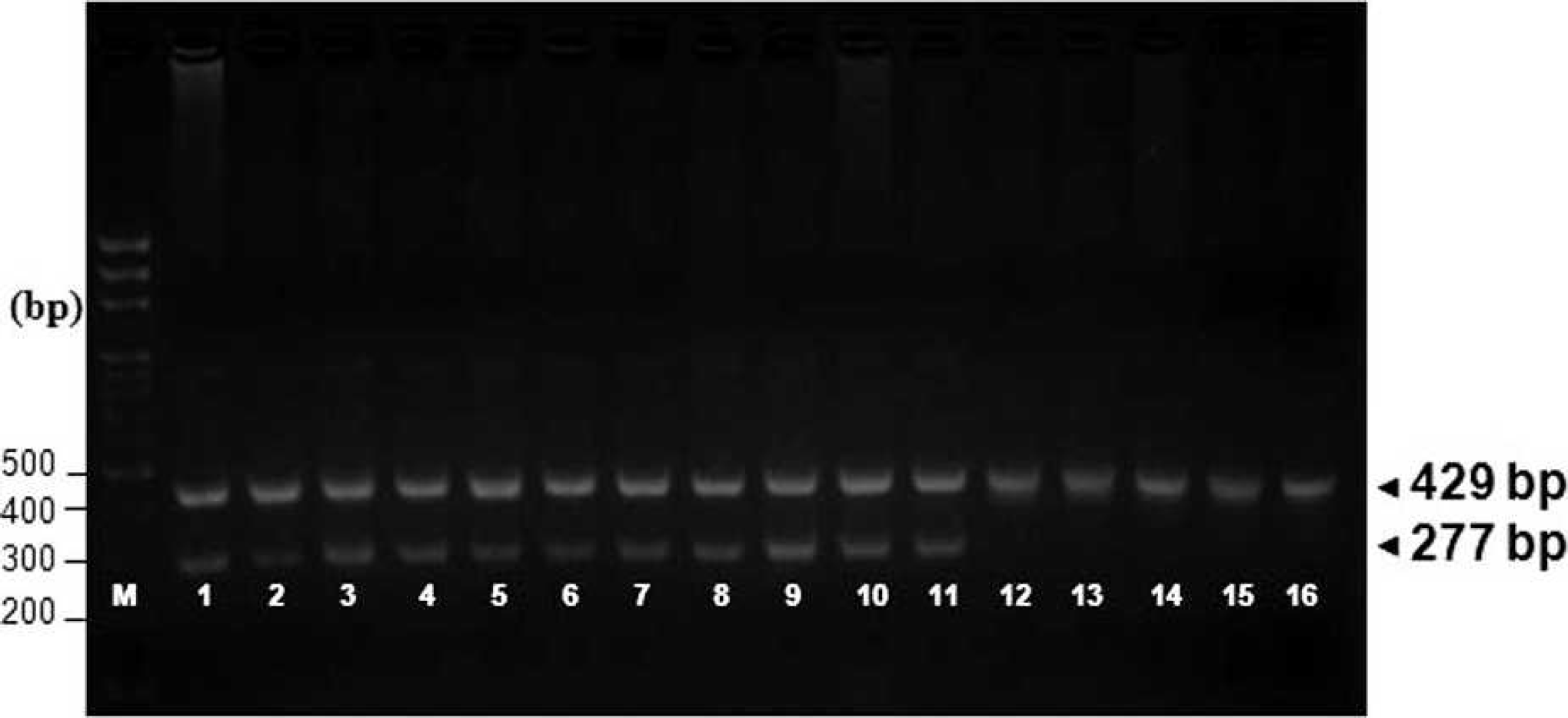
Detection of PKD1 point mutation by tri-primer amplification refractory mutation system polymerase chain reaction. With 3 primers (F3/F2/R2), the product (277 bp), representing the mutant allele, was amplified from all mutant samples (lanes 1–11) but not from homozygous wild-type samples (lanes 12–16); the internal control product (429 bp) was successfully amplified from both mutant- and wild-type samples. Lane M: DNA size markers.
As reported by other research groups, cats that test positive for the mutant allele are heterozygous and, therefore, also have a wild-type allele. Because both normal and ADPKD-affected cats contain normal allele, detection of the presence of 1 normal allele is not critical for diagnosis of ADPKD, as long as the internal control that targets other region of PKD gene is successfully amplified to ensure that the PCR was functional. This led to the development of an ARMS PCR test that uses just 3 primers (tri-primer ARMS PCR) and that omits the R3 normal-allele primer (Fig. 1C).
The tri-primer ARMS PCR was optimized by using 3 primers, F2, F3, and R2, with various concentrations: 0.5μl F2 (10 μM), 0.75 μl F3 (10 μM), 1 μl R2 (10 μM). Two PCR products should be generated if a cat carries the mutant PKD1 allele. The predicted sizes of the PCR products were 277 bp and 429 bp, which would demonstrate simultaneous amplification of the mutant allele and the internal control, respectively. Initially, 16 feline DNA samples were tested by using this tri-primer ARMS PCR method; 2 bands of appropriate sizes were amplified in each of the 11 samples taken from ADPKD-positive cats (Fig. 3, lanes 1–11), which indicated that the ADPKD cats were heterozygous. In addition, the internal control products (429 bp), but not the mutant-allele products, were amplified from all normal feline DNA samples (Fig. 3, lanes 12–16), which demonstrated that the validity of this method. Overall, 35 samples, including 15 ADPKD-affected cats and 20 normal cats, were analyzed. As shown in Table 2, all results derived from the tri-primer ARMS PCR were supported by the genotyping results by direct sequencing analysis (data not shown).
The positive and negative numbers of PKD1 gene mutation examined by different methods.*
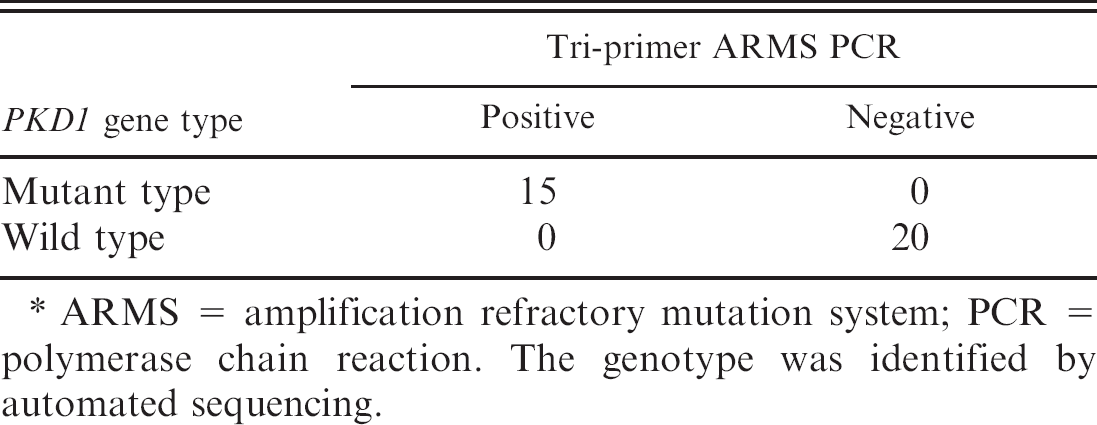
ARMS = amplification refractory mutation system; PCR = polymerase chain reaction. The genotype was identified by automated sequencing.
Because ADPKD is an autosomal-dominant disease, it provides important information for early diagnosis of PKD by veterinarians and to owners or breeders who wish to avoid maintaining this disease in affected breeds. This could best be accomplished through the use of a simple and inexpensive method for detecting the mutant PKD1 allele that causes ADPKD. Real-time PCR is well recognized as a sensitive and time-effective diagnostic method. Because of the high purchase price of specialized equipment and the relatively high material cost, it is not standard equipment in many veterinary medical diagnostic laboratories and for most breeders. In this regard, a diagnostic assay conducted with the conventional PCR machine would be a more approachable option. The advantages of the ARMS PCR method developed in the present study are that 1) it needs neither restriction enzyme digestion nor expensive real-time PCR equipment, 2) it requires only a small sample of feline blood, and (3) it is a time- and cost-effective assay. In respect to sensitivity, real-time PCR 12 is superior to tri-primer ARMS PCR. In the current method, approximately 10–100 ng was used. Nevertheless, DNA is not a limited factor to the ARMS PCR method, because this amount of chromosome DNA could be yielded from as little as 0.2 ml of blood. Although detection of a point mutation by ARMS PCR might take relatively more time than real-time PCR, it is still more efficient than RFLP PCR and PCR followed by automated sequencing.
It is important to emphasize that, unlike DNA sequencing, tri-primer ARMS PCR, in which the mutant-allele primer was designed only for detection of C→A transversion, could yield false-negative results if a variant different from the originally described. This drawback may be common in the differential diagnostic methods, such as RFLP, in which the discrimination depends on the mismatch nucleotide. Nevertheless, in considering that C→A transversion in exon 29 is the prominent base change identified so far for diagnosis of ADPKD and that it is heterozygous in ADPKD cats (homozygous mutation is lethal for embryo), tri-primer ARMS PCR is feasible for ADPKD screening.
In conclusion, complete agreement between the direct sequencing of PKD1 from feline DNA samples and the tri-primer ARMS PCR strategy results from the same samples in the present study indicates that the tri-primer ARMS PCR assay is highly reliable. In general, this assay is an inexpensive, highly accessible, and reliable method for the detection of the PKD1 gene mutation that could be applied in the routine diagnosis of feline ADPKD in laboratories with a standard PCR thermocycler.
Acknowledgements The authors thank Dr. Sarah M. Richart, Department of Biology and Chemistry, Azusa Pacific University, CA, for editorial assistance.
Footnotes
a.
AxyPrept™ Blood Genomic DNA Miniprep Kit, Axygen Scientific Inc., Union City, CA.
b.
Fast-Run Taq Master Mix, Protech Technology Enterprise Co. Ltd., Taipei, Taiwan.