



Abstract
A total of 232 verotoxin 1 (VT1)-positive, VT-producing Escherichia coli (VTEC) strains isolated from goats, sheep, and cattle were analyzed for the presence of the vt1c gene by polymerase chain reaction. One hundred and forty of the 144 (97.2%) caprine strains and 55 of the 63 (87.3%) ovine strains possessed the vt1c gene. In contrast, the gene was not detected in any of the 25 bovine strains. These results show that the vt1c gene is found in caprine VTEC strains and confirm that gene is associated with ovine VTEC strains.
Keywords
Verotoxin-producing Escherichia coli (VTEC), also referred to as Shiga toxin-producing E. coli, may cause severe diseases in humans, such as hemorrhagic colitis (HC) and hemolytic uremic syndrome (HUS). 6 Verotoxin-producing Escherichia coli strains that are capable of inducing HC and HUS are called enterohemorrhagic E. coli (EHEC). 6 Ruminants represent an important reservoir of VTEC and a source of infections for humans. 3,7–9 Verotoxin production alone is not sufficient for VTEC to cause disease. 1 A factor that affects virulence of VTEC is the possession of the eae gene that is necessary for production of attaching and effacing lesions in the intestinal mucosa. 1 Besides the eae gene, some VT types are associated with the virulence of VTEC for humans. 12 Based on toxin neutralization assays and sequence analysis of vt genes, 2 major toxin types, VT1 and VT2, have been described. The VT2 group has been shown to be highly heterogeneous. In contrast, the VT1 group appears to be more homogeneous and related to Shiga toxin synthesized by Shigella dysenteriae type 1. 12 However, a new variant of VT1, designated VT1c, and previously called VT1OX3, has been described. 5 The variant VT1c is distributed widely among isolates of human and ovine origin but is uncommon in bovine strains. 2,4,5,11,12 None of the VT1c-positive strains described so far belong to the classical EHEC serogroups (O26, O103, O111, O113, O145, or O157), and almost all lack the eae gene. 2,4,5,11,12 In addition, VT1c-positive strains usually are recovered from asymptomatic patients and those with uncomplicated diarrhea but not from those with HUS. 2,4,5,12 Thus, the ability to identify VT1c-positive VTEC isolates is of clinical and epidemiologic significance because these isolates are likely to be less pathogenic for humans. 2 The distribution of the vt1c gene among caprine VTEC is almost unknown because, to the authors' knowledge, the presence of the gene was tested in only 1 caprine VTEC strain. 5 In the present study, a representative collection of VT1-positive VTEC strains isolated from goats was investigated for the presence of the vt1c variant. In addition, VT1-positive VTEC strains isolated from sheep and cattle were tested for the presence of the gene.
A total of 232 VT1-producing VTEC strains isolated from healthy goats, sheep, and cattle (n = 143, 60, and 14, respectively) and from goat kids, lambs, and calves with diarrhea (1, 3, and 11, respectively) in Spain between 1993 and 2003 were used in this study. All of these strains previously have been tested positive by cytotoxicity assays on Vero cells for production of VT and by polymerase chain reaction (PCR) for vt1 gene sequences. 3,7–9 One hundred and forty-seven of the 232 (63.4%) VTEC strains produced VT1 only (104 from goats, 19 from sheep, and 24 from cattle), 85 (36.6%) produced VT1 and VT2 (40 from goats, 39 from sheep, and 6 from cattle), and 15 (6.5%) possessed the eae gene (1 from goat, 1 from sheep, and 13 from cattle). The caprine, ovine, and bovine VTEC strains belonged to 33, 18, and 16 serotypes, respectively. However, 68.1% of the caprine strains belonged to one of the 7 serotypes (O5:H-, O76:H19, O81:H21, O146:H21, O166:H28, ONT:H- [NT indicates not typeable], and ONT:H21), and 68.3% of the ovine strains belonged to 1 of the 5 serotypes (O5:H-, O91:H-, O128:H-, O146:H21, and ONT:H-). The VTEC strains were all tested for the presence of the vt1c gene by PCR with primers 5'-GAACGAAATAATTTATATGT-3' and 5'-CTCATTAGGTACAATTCT-3', which amplify a 555-base pair (bp) portion of the vt1c gene. 5
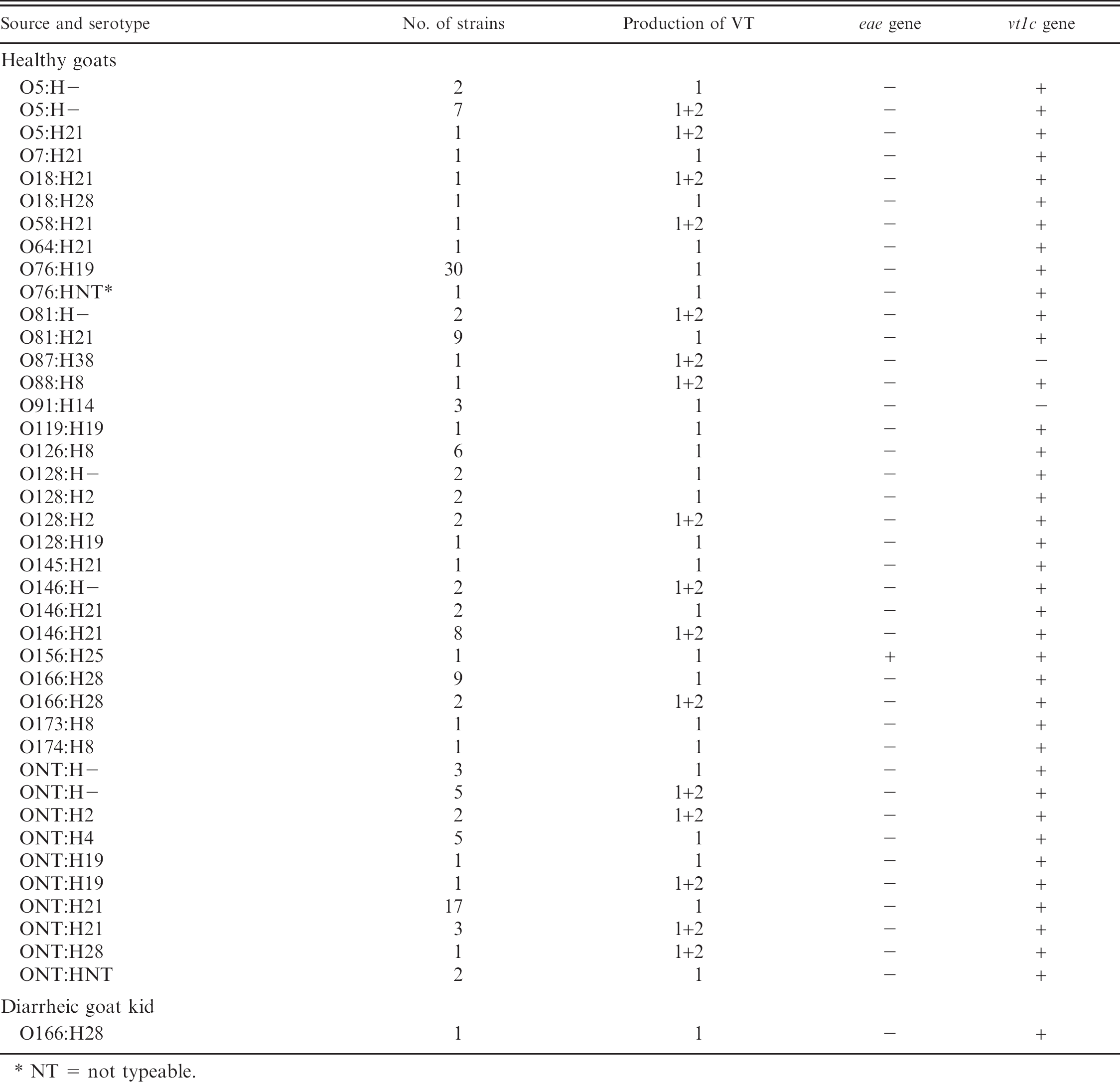
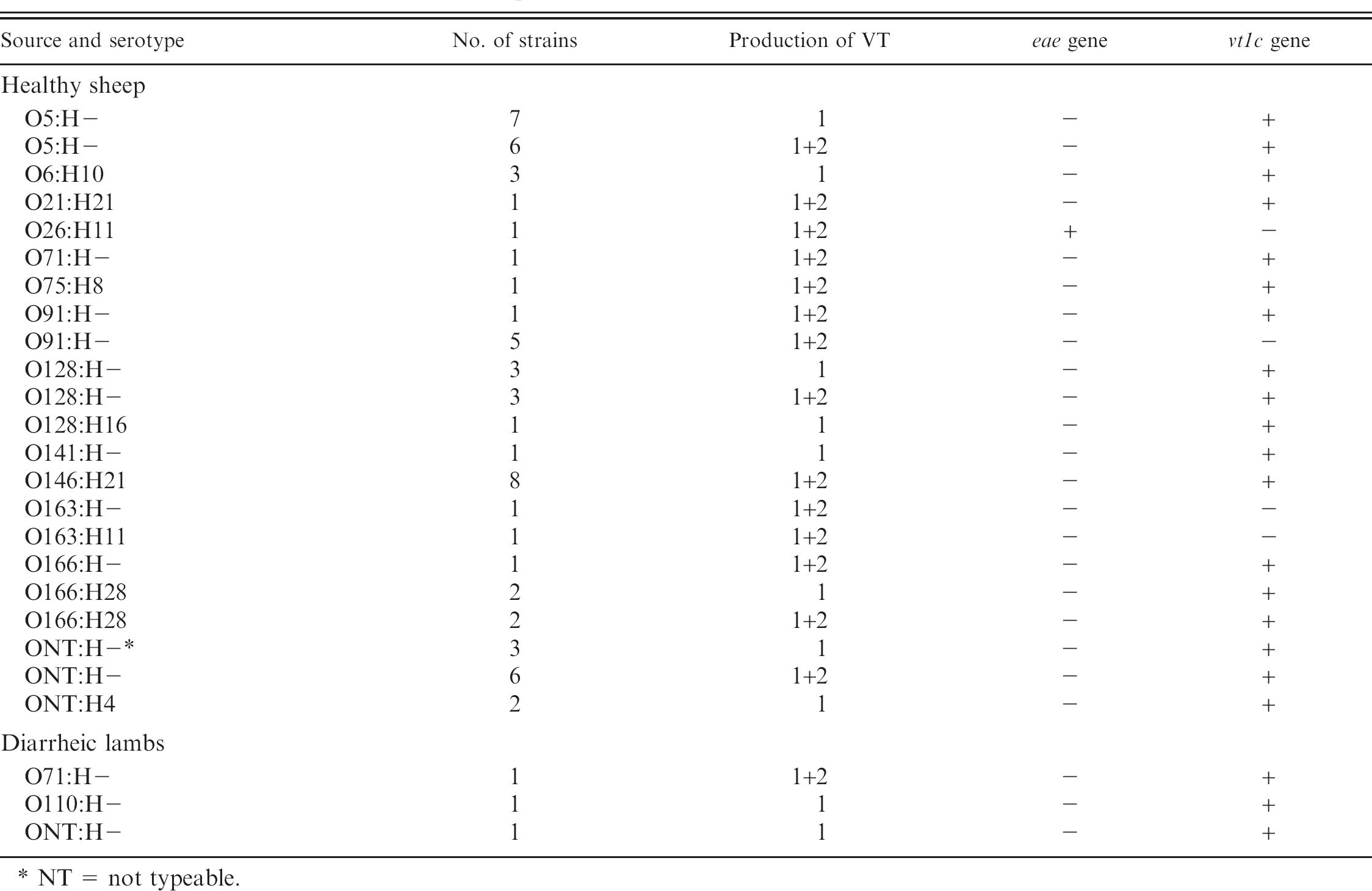
One hundred and forty of the 144 (97.2%) caprine strains and 55 of the 63 (87.3%) ovine strains possessed the vt1c gene (Tables 1, 2). In contrast, vt1c was not detected in any of the 25 bovine strains. The vt1c-negative, VT1-producing VTEC strains from goats belonged to 2 serotypes: O87:H38 (1 strain) and O91:H14 (3 strains), and those from sheep belonged to 4 serotypes: O26:H11 (1 strain), O91:H- (5 strains), O163:H- (1 strain), and O163:H11 (1 strain). Fourteen of the 15 (93.3%) eae-positive ruminant VTEC strains, all caprine strains that belonged to serotype O91:H14, and 5 of the 6 (83.3%) ovine strains with serotype O91:H- were negative for vt1c.
. Serotypes, production of verotoxin (VT), and eae and vt1c genes (presence [+] or absence [-]) in VT1-producing Escherichia coli (VTEC) strains isolated from goats.
NT = not typeable.
Usually, VTEC from goats produce only VT1, do not possess the eae gene, and are considered as a minor health hazard for humans. 1,3,9 As almost all VTEC strains that harbor the vt1c variant lack the eae gene, it is not known whether the possession of the vt1c gene is one reason why such VTEC strains have been associated predominantly in humans with mild disease or asymptomatic carriage. 4,12 Detection of vt1c might offer a marker to identify VTEC strains that cause milder disease in humans. 4
In agreement with the results of this study, it has been reported previously that vt1c is found often in VTEC strains from sheep but not from cattle. 2,5,11 The present work is also consistent with earlier reports that the vt1c gene is not associated with eae-positive VTEC strains or with those that belong to serotype O91:H-. 2,4,5,11,12 However, in contrast with the data of this study, the vt1c gene was not detected in the only caprine VTEC strain analyzed previously, 5 and the vt1c gene was associated with the saa gene in human VTEC strains. 4 The saa gene encodes a VTEC autoagglutinating adhesin and, in contrast with human VTEC strains, almost all the caprine VTEC strains analyzed in this work were negative for that gene. 3,10
In conclusion, it is believed that the results of the current study show for first time that the vt1c gene is found in caprine VTEC strains, and confirm that vt1c is associated with ovine VTEC strains. Further studies are necessary to determine whether the possession of the vt1c gene by most of the VTEC strains from goats may explain, at least partially, the low virulence of those strains for humans.
. Serotypes, production of verotoxin (VT), and eae and vt1c genes (presence [+] or absence [-]) in VT1-producing Escherichia coli (VTEC) strains isolated from sheep.
NT = not typeable.
Acknowledgements. This study was supported by a grant from the Banco Santander Central Hispano-Uni-versidad Complutense (INBAVET 920338).